






Abstract
The current study aimed to determine the predictive relationship of family communication, prosocial behavior, and emotional/behavioral problems in adolescents. A sample of 273 adolescents (girls = 148; boys = 125), aged 11–18 years (M = 14.41, SD = 1.53) were recruited through multistage sampling strategy. Family Communication Scale, Prosocial Scale, and Youth version of Child Behavior Checklist were used to measure family communication, prosocial behavior, and emotional/behavioral problems, respectively. Results indicated a significant positive association of family communication and prosocial behavior (p < .001), and a significant negative association of family communication (p < .001) and prosocial behavior (p < .001) with emotional/behavioral problems. Moreover, mediation analysis revealed that prosocial behavior partially mediated the relationship between family communication and emotional/behavioral problems (p < .002). Results are discussed in terms of the manifestation of adolescents' problems in traditional and collectivistic cultures.
Introduction
The adolescence period is a critical time of transition from childhood to adulthood that demands a continual adjustment with changing physical growth, increased parental expectations, need for independence and autonomy, role identification, and expanding social world (Colins & Grisso, 2019; Lin & Yi, 2017). In this crucial stage, the quality of emotional bond with the family may play a role of either risk or protective factor for the development of emotional and behavioral problems (EBPs) (Cutrín et al., 2019; Dhuria et al., 2009). The common internalizing or emotional problems include anxiety, depressive features, social withdrawal, and somatic complaints (Achenbach & Edelbrock, 1978; Baker et al., 2008). Externalizing or behavioral problems include aggression, acting out tendencies, disruptive, defiant, and hyperactive behaviors (Merrell, 2001). The prevalence rate varies between 2% and 40% with the predominance of emotional problems and girls being more affected (Elhamid et al., 2009; Rahman et al., 2012; Saleem & Mahmood, 2013).
These problems cause considerable distress for adolescents and their families, result in poor school performance and high dropout rates, low self-esteem, social incompetence, feelings of loneliness, interpersonal problems, violent behavior, and lack of well-being (Colins & Grisso, 2019; Rahman et al., 2012). Increased prevalence rate and cumulative negative impact developmental consequences, EBPs constitute a major challenge for health care professionals (Wu & Keysar, 2007). Although these problems can be temporary and adolescents can outgrow, however, some adolescents may not overcome these problems. Therefore, research focused on understanding and identifying risk factors so that early prevention and intervention can be planned.
Physical maturity and increased autonomy, perspective taking, learning of moral reasoning allow adolescents to expand social interaction (Carlo et al., 2012). The success of dynamic and intense social interaction lies in the learning of new social skills and prosocial behaviors that facilitate social growth and development (Jhang, 2017). Prosocial behavior is defined as an action aimed to help or benefit others and making a situation better (Eisenberg et al., 2015). Prosocial behavior is associated with many positive outcomes including high self-esteem, facilitate group harmony, improve interpersonal relationships, increase social facilitation, empathy and buffer against mental health and decrease aggressive tendencies (Aknin et al., 2012; Raposa et al., 2016; Taylor et al., 2013). Several factors that contribute significantly to the learning of social skills, prosocial behavior, and family is said to be the primary source of learning of socialization for adolescents (Emagnaw & Hong, 2018; Padilla-Walker et al., 2018; Wu et al., 2016). According to social learning theory, children tend to learn new behaviors through observation and modeling (Bandura, 1963).
An adolescent's growing need for independence and autonomy in his relationship with his parents is considered to be the main developmental challenge in adolescent years that makes this relationship even more complex (Jaggers et al., 2015). Despite this transitional age, open family interactions and communication, and cohesive family provide a unique opportunity for parents to shape their behavior, express concerns to children, and better adjustment to children (Herrero et al., 2020). The family functioning can be better understood through the circumplex model (Olson & Barnes, 2004), which states that a functional family is a combination of emotional bonding, closeness, and a sense of flexibility that allows members of the family to modify family rules and roles (Olson et al., 2019). This model further postulates that family communication plays a pivotal role as a facilitator to maintain family cohesion which further significantly contributes to the personal, social, and emotional development of the family members (Olson & Barnes, 2004). Moreover, this sense of coherence, interconnectedness, mutual support, and cohesion in the family promotes respect and considerate behaviors for others (Perosa & Perosa, 2001), increase emotion regulation, better adjustment and coping, high self-worth, better social skills, social competence, academic engagement, and academic performance (Cruz-Ramos et al., 2017; Hur et al., 2017; Jhang, 2017; Lang, 2018; Nebbitt, et al., 2014). On the other hand, lack of communication in the family and disruptive family environment is associated with poor problem skills, risky behaviors, and EBPs (Hirsch & Barton, 2011; White et al., 2014).
In summary, adolescence is a crucial period of growth and development where individuals learn social and emotional skills to cope with the pressures and demands of transition. Growing mental health concerns of youth attained attention from researchers to find the risk or protective factors. In the current research, we are interested in identifying the role of family communication and prosocial behaviors concerning EBPs in a sample of Pakistani adolescents. As Pakistan is a traditional collectivistic culture, family norms, cohesion, and conformity are valued (Saleem et al., 2017). In collectivistic cultures like Pakistan, respect toward family harmony, respect for parents, and emotional bonding toward other extended family members being viewed as pivotal for adequate family functioning parents (Lindsey, 2018). Individuals from collectivistic cultures tend to show more conformity to family and social norms than personal interests and choices (Wu & Keysar, 2007). On the other hand, individualistic culture promotes self-growth, self-reliance, and autonomy (Tamis-LeMonda et al., 2007).
In this sociocultural environment, the role of parents becomes even more crucial that demonstrates a long-lasting effect on growth and development. Moreover, prosocial behavior is also determined by the cultural context of an individual. The current research is an attempt to identify the relationship between family communication and EBPs in adolescents, also to identify the mediating role of prosocial behavior in family communication and EBPs in adolescents.
Method
Participants
Before data collection, the Ethical Review Committee approved the current research. A sample of 273 participants (Boys = 125[46%], Girls = 148[54%] with the ages of 11–18 years [M = 14.41, SD = 1.53]) were recruited through multistage sampling strategy from four mainstream schools of Lahore, Pakistan. Strata were made according to academic grade (eighth, ninth, and 10th) and gender (boys and girls). At the last stage, the participants were selected through systematic random sampling where every third child was selected from each grade. Most of the participants have ages between 11 and 14 years (58%) and the rest of the participants (42%) have ages between 15 and 18 years. Participants in this study were predominantly living in a nuclear family system (59%) with their parents and siblings.
Measures
Demographic Form
Basic demographic information was obtained from the participants including age, academic grade, sex, and living condition.
Family Communication Scale
Urdu version of the Family Communication Scale (Olson & Barnes, 2004) from Family Adaptability and Cohesion Evaluation Scale (FACES) IV Package (Olson et al., 2008) was used to measure family communication. The scale has consisted of 10 items measured on a 5-point rating scale of 1(strongly disagree) to 5 (strongly agree). Scores were obtained by calculating the sum of scores on each item of the scale. Scores of the Family Communication Scale ranged from 10 to 50 with a high score indicating a higher level of family communication. The Cronbach's alpha of the Family Communication Scale for current research was 0.75 suggesting satisfactory internal consistency of the scale.
Prosocial Behavior
The Prosocial Scale is taken from Social Intelligence Scale (Yousaf, 2012) comprising seven items. The scale is a 4-point rating scale ranging from 0 (not at all), 1 (sometimes), 2(often), and 3 (very much so). Cronbach's alpha of the Prosocial Behavior Scale for the current study was 0.94 indicating good internal consistency of the scale for the current sample. The scoring range is 0–21 and a high score denotes more prosocial behavior.
Child Behavior Checklist (Youth Selfreport [YSR])
The youth version of the Child Behavior Checklist (Achenbach & Rescorla, 2001) was adapted in Urdu to assess the EBPs of children. YSR consists of 112 items with a three-point rating scale from 0 (not at all), 1 (sometimes), and 2 (often). Items consisted of two broadband scales of internalizing and externalizing problems including subscales of Anxious/Depressed, Withdrawn/Depressed, Somatic Complaints, Social Problems, Thought Problems, Attention problems, Rule-breaking behavior, and Aggressive Behavior. Scores were obtained by calculating the sum of scores on the items of YSR. Possible scores ranged from 0 to 224 with a high score representing higher EBPs. The Cronbach alpha of YSR for current research was 0.92 indicating the sound psychometric properties of YSR for the current study.
Procedure
All study procedures were approved by the Institutional Ethical Committee. A request for permission to gather data was sent to four schools, along with the main aims and objectives of the research. School authorities were informed about the inclusion criteria based on age, gender, and academic class. All four government-run mainstream schools agreed to have students participation. A stratified sampling technique was used, with strata based on sex and educational level. The school authorities provided an enrollment list of all students, and after stratifying, every third participant was selected from the list. Selected participants were then approached with the help of class instructors. Data were collected in groups of ∼15–20 students using pencil-and-paper measures. After reviewing informed consent, participants completed the research protocol of measures listed above. Participants spent ∼20 min, on average, to complete the research protocol. Afterward, participants were offered a debriefing session to provide more information and answer questions about the study.
Data Analysis
Any participant who failed to respond to 75% of the items were removed from the current study (n = 5). To assess basic associations among family communication, prosocial behavior, and EBPs, basic correlations were conducted. Subsequently, regression analysis was carried out to find out the predictors of EBP in this sample. Medication analysis was carried out to determine the mediating role of prosocial behavior between family communication and EBP.
Results
The relationships between family communication, prosocial behavior, and EBPs were investigated using Pearson product–moment correlation. Table 1 suggests a significant positive association between family communication and prosocial behavior (r = .50, p < .001) and a significant negative relationship of family communication (r = −.29, p < .001) and prosocial behavior (r = −.26, p < .001) with EBPs of adolescents. This indicated that adolescents having a high level of positive family communication and prosocial behaviors will experience less EBPs.
Intercorrelations Among FC, PSB, and EBPs of Adolescents (N = 273).
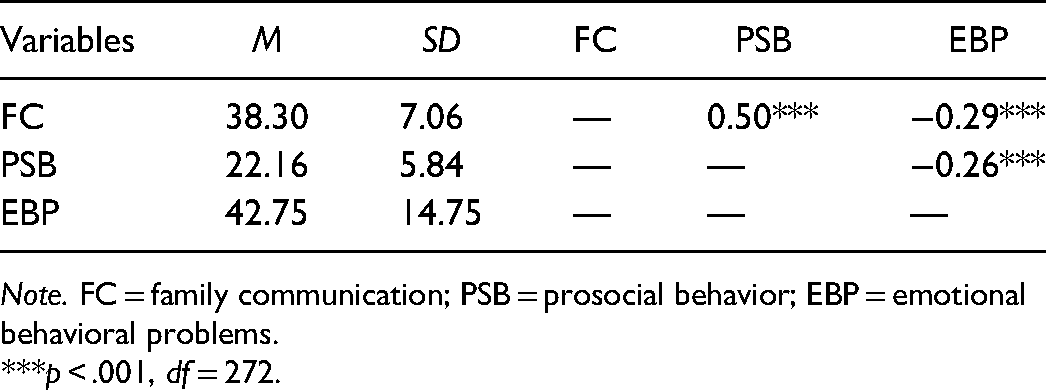
Note. FC = family communication; PSB = prosocial behavior; EBP = emotional behavioral problems.
***p < .001, df = 272.
Mediation Analysis
The Pearson product–moment correlation indicated significant relationships between the variables therefore, the mediating role of prosocial behavior was identified between family communication and EBPs of adolescents. In this regard, the PROCESS (v3) was used to investigate whether or not prosocial behavior mediates the relationship between family communication and the EBPs of adolescents. According to the oldest mediation model proposed by Baron and Kenny (1986), there should a significant correlation between independent and mediating variables. Furthermore, the mediating variable scores should correlate significantly with dependent variable scores. Moreover, after controlling the effects of the mediating variable, the correlation between independent and dependent variables is reduced indicating partial mediation. In the case of the occurrence of complete mediation, this correlation coefficient becomes zero. Hayes (2013), also investigated the conditional process analysis that proposed the need for a mediation model to establish a link between the assumed independent variable (X) to a presumed effect, that is, dependent variable (Y) at least in part through a mediator variable (M).
The current study fulfilled the proposed assumptions of Baron and Kenny (1986) as well as Hayes and Preacher (2013). Therefore, in the current research, Hayes (2018) bootstrapping approach was utilized to observe prosocial behavior as a mediator between family communication as an independent variable and EBPs as a dependent variable (see Figure 1).
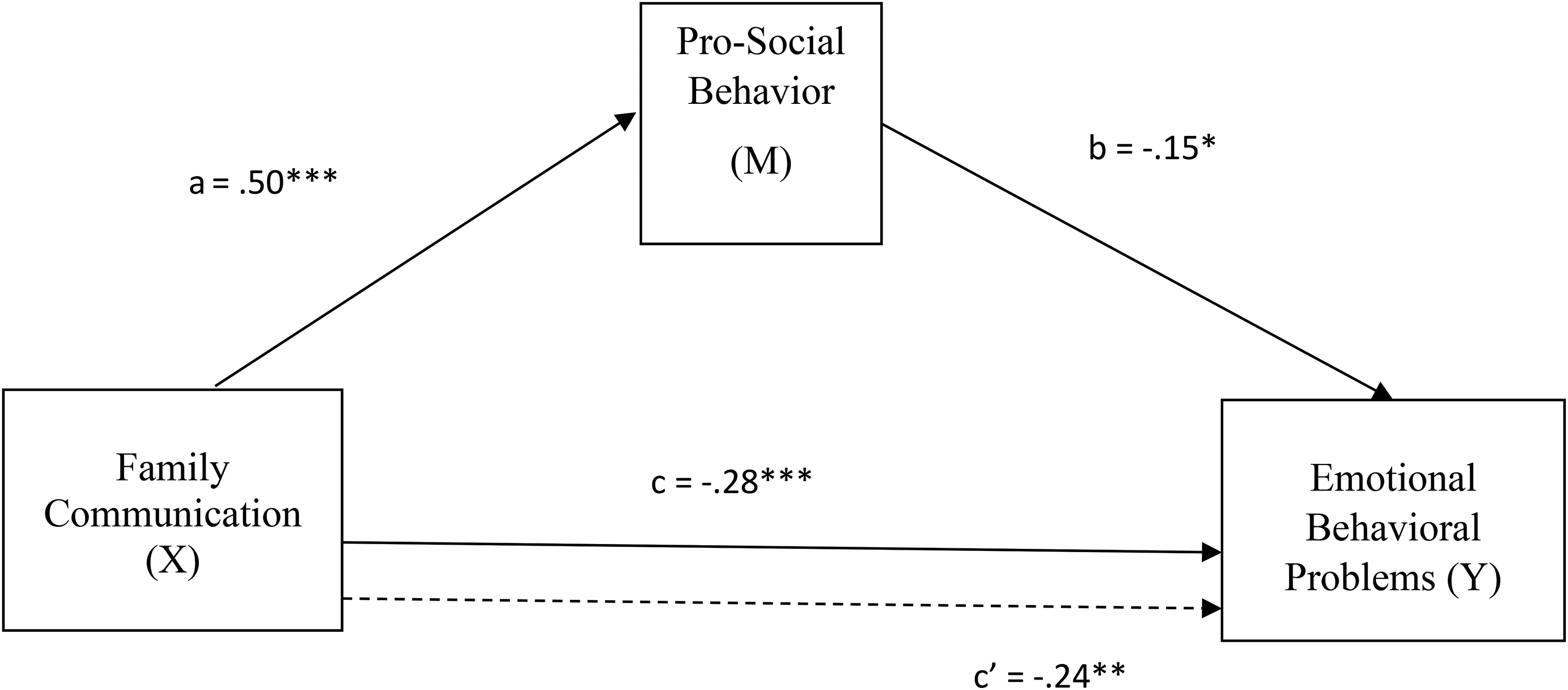
Mediation model of prosocial behavior (M) on the relationship between family communication (X) and emotional behavioral problems (Y).
Table 2 shows the results of the mediation analysis. Path a depicting significant predictive relationship between family communication as an independent variable and prosocial behavior as a mediator, β = 0.50, SE = 0.05, p < .001. Path b in Table 2 reveals a predictive association between prosocial behavior as the predictor and EBPs as the outcome variable. This path also depicts prosocial behavior as a significant predictor of EBPs, β = −0.15, SE = 0.07, p < .05. The relationship between family communication as the independent variable and EBPs as the dependent variable when prosocial behavior as the mediator is shown in path cʹ. If family communication does not affect EBPs and the cʹ path is nonsignificant, then it can be concluded that prosocial behavior completely mediates the relationship between family communication and EBPs. However, only a decrease in the association will specify partial mediation (Baron & Kenny, 1986; Frazier et al., 2004; James & Brett, 1984). Table 2 suggests prosocial behavior partially mediates the relationship between family communication and EBPs as model cʹ is significant, β = −0.21, SE = 0.07, p = .002.
Regression Coefficients, Standard Error, and Model Summary Information for the FC, PSB, and EBPs of Adolescents Mediation Analysis (N = 273).
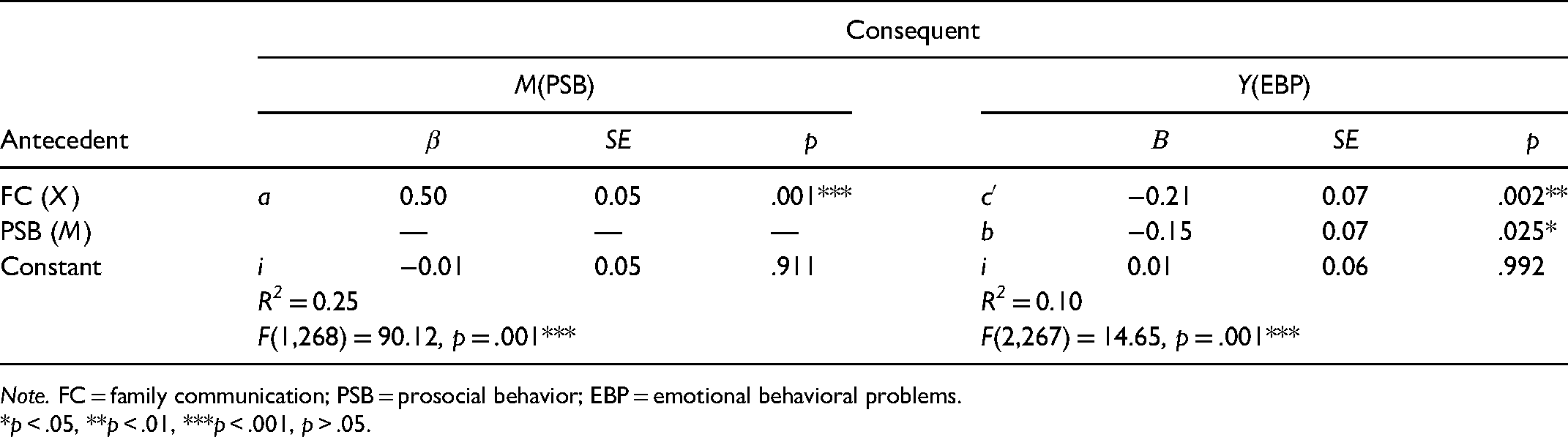
Note. FC = family communication; PSB = prosocial behavior; EBP = emotional behavioral problems.
*p < .05, **p < .01, ***p < .001, p > .05.
Discussion
Family is said to play a most fundamental and influential role in the growth and development of an individual throughout the life span. A rich literature has suggested an association between family and the psychosocial functioning of an individual (Hur et al., 2017; Jhang, 2017; Lang, 2018). This association has been less studied concerning family communication, prosocial behavior, and EBPs of adolescents, especially regarding the Pakistani cultural context. The present study aimed to build on this literature by evaluating the mediating role of family communication, prosocial behavior, and mental health problems in adolescents in a traditional collectivistic culture.
At a bivariate correlation level, a positive association was found between family communication and prosocial behavior, and a negative relationship was found between family communication and EBP, moreover, Prosocial behavior is also found to be negatively associated with EBP. These findings are consistent with literature obtained from Western studies (Park et al., 2018; White et al., 2014). In collectivistic cultures like Pakistan, a family is a central unit for functioning and everything else revolve around family, therefore, other than parental role, the communication within family members, sharing, and mutual discussions tend to influence a child's social and emotional functioning considerably (Saleem et al., 2017). Healthy and encouraging family communication become a social-learning model for the child to communicate outside the home environment and practice socially acceptable communication pattern with ever-expanding social interactions in adolescence years (Padilla-Walker et al., 2018).
The results of the correlation also revealed that family communication is negatively associated with the mental health problems of adolescents. These findings are also consistent with the previous literature (Hirsch & Barton, 2011; White et al., 2014). Family environment and family–child interaction can become a risk or protective factor for EBPs of adolescents. Poor family communication may cultivate poor interpersonal skills, lack of resilience, lack of self-confidence that make an individual vulnerable to deal with the ever-changing demands of adolescent years and make them more prone to develop psychosocial problems that bring lifelong negative consequences (Aknin et al., 2012; Raposa et al., 2016; Taylor et al., 2013).
When we evaluated the mediating role of prosocial behavior with family communication and EBP in adolescents, we found that prosocial behavior partially mediated the relationship between family communication and EBP. This may be a reflection of a pure collectivistic culture where family harmony, family cohesion, and parent–child interaction are more valued than personal and social growth (Saleem et al., 2017). The quality of family communication both verbal and nonverbal patterns facilities social and emotional learning which buffer against mental health problems and problems that arise because of faulty communication which may be only verbal, not experiential than the child will not learn skills to handle life challenges. Consequently, the child will only learn to show behavior in a limited context and may not be able to generalize outside the context. Furthermore, practical implications of this study suggested that not only children but we can also give counseling to family to develop and maintain healthy family relationships by enhancing the communication among family members. In this way, we can reduce certain EBPs of children and adolescents.
The findings of the current research should be interpreted while keeping the methodological strengths and limitations in mind. This study contributed uniquely while considering the role of family communication other than parenting styles or parental rearing practices. A stratified sampling technique provides the opportunity to get a representative sample. However, the sample was recruited only from an urbanized city of Pakistan with a very narrow age range which limited the generalizability. Future research may combine both rural and urban samples of varied ages and may include other family members and peers as participants.
Keeping these limitations into consideration, yet this paper provides an important piece of information that paves the way for investigating the role of family communication in an indigenous context. Furthermore, it can be concluded that the learning process is closely attached to the outcome, clinical education, therapy, and intervention.
Footnotes
Acknowledgments
The authors are highly thankful to study participants as well as school authorities whose cooperation made it possible to complete the study effectively.
Declaration of Conflicting Interests
The authors declared no potential conflicts of interest with respect to the research, authorship, and/or publication of this article.
Funding
The authors received no financial support for the research, authorship and/or publication of this article.
