







Abstract
While associations between child behavior, parenting behaviors, and foster parent stress have been established, a more nuanced understanding of the relationship between parenting behaviors and parental stress in foster parents is needed. This study included a convenience sample of 65 licensed foster caregivers from across the United States to address the following research question: is there an association between foster parenting behaviors and parental stress? Separate models were run for (a) adaptive parenting behaviors (involvement, positive parenting) as it relates to parenting stress and (b) maladaptive parenting behaviors (poor monitoring/supervision, inconsistent discipline, and corporal punishment) and parental stress. Results indicated that higher levels of parental involvement with children were associated with lower levels of parental stress. For maladaptive parenting behaviors, it was identified that more inconsistent discipline and higher endorsement of corporal punishment as a discipline strategy were associated with higher levels of stress, however, poor monitoring was not found to be associated with levels of stress in this model. Results support the importance of training foster parents in positive parenting strategies or intervening with foster parents who may endorse more negative forms of behavior modification.
Foster parenting is immensely challenging for a variety of reasons (Adams et al., 2018; Cooley et al., 2017), yet child behaviors are particularly challenging for foster parents (Cooley et al., 2015; Hebert & Kulkin, 2018; Octomon et al., 2014). Due to the circumstances that led to the removal from their birth parents or primary caregivers (i.e., substantiated abuse and/or neglect deemed too severe to remain in the home), children in foster care often exhibit a high frequency and intensity of behavioral problems (Gabler et al., 2018). Researchers have also identified that the complexity and severity of foster youth behavior problems has been increasing over time (Goemans et al., 2016; Goemans et al., 2015).
Child welfare professionals and foster care parents typically expect children’s behavior problems will improve in their foster care placement as a result of the warm, nurturing, and skilled parenting provided by the trained foster parents (Vanschoonlandt et al., 2013). However, increased behavior problems often exhibited by children in foster care can put foster parents at increased risk for parental stress (Gabler et al., 2014). Other researchers have similarly found that persistent behavioral problems can diminish foster mothers’ effective parenting techniques and increase parental stress (Vanderfaeillie et al., 2012). In turn, increased parental stress in foster care parents is associated with placement disruption (Crum, 2010), which places children in foster care at further risk for increasingly poor behavioral and mental health outcomes. The role of foster parent stress should be better understood, particularly considering that foster caregiver well-being is less frequently examined in foster care research (Ahn et al., 2017). The current study seeks to fill this gap in the literature by examining a model for parental stress in foster caregivers.
Foster Parent Stress
Deater-Deckard (1998) defined parental stress as “the aversive psychological reaction to the demands of being a parent” (p. 315). Parental stress has a reciprocal relationship with child behaviors, which is particularly salient for foster care populations where child behavior problems are more prevalent (Raviv et al., 2010). Vanderfaeillie et al. (2013) found that while foster parent perceptions of poorer child behavior were associated with higher stress, foster parent reported stress was also associated with ineffective and maladaptive parenting responses. Wilson et al. (2000) noted that foster parents can experience stress pileup, given the roles, responsibilities, and needs they must balance in caring a foster child. One study found that over 20% of foster parents reported parental stress in the clinical range, and notably, child emotional and behavioral difficulties were indicated as a significant source of stress (Harding et al., 2018).
Foster parent stress presents a potentially significant concern as it might impact their well-being or even the outcomes of youth in their care. As noted earlier, foster parent stress is associated with placement disruption, as well as reductions in foster parents’ self-efficacy, making them feel less adequate in their role (Whenan et al., 2009). Consequently, foster parents may not be satisfied in their caregiving role, and thus experience reduced desire to continue providing out-of-home care (Whenan et al., 2009). Lohaus et al. (2018) expressed concern that consistent levels of stress may negatively impact the foster parents’ interactions with youth in their care. As such, exploring the connection between parental stress and foster parenting behavior appears critical.
Foster Parent Behaviors
In their study of foster parent-child dyads, Fuentes et al. (2015) identified rigid control, harsh punishment, inconsistent discipline, and parental negativity as ineffective and maladaptive parenting behaviors. Conversely, they defined adaptive and positive parenting behaviors as those demonstrating expressions of warmth, clear communication of expectations of behavior, and appropriate consequences. The researchers identified that children whose foster parents used primarily maladaptive parenting behaviors exhibited more problematic behaviors (including both internalizing and externalizing symptoms), while children whose foster parents reported using higher levels of adaptive parenting exhibited more prosocial behaviors. Using similar definitions of maladaptive and adaptive parenting behaviors, Vanschoonlandt (2013) concluded that foster mothers of children with higher levels of externalizing behavior problems reported more stress and were more likely to use maladaptive parenting behaviors compared to a sample of biological mother-child dyads. The reciprocal interaction of a child’s problem behavior and the foster parent’s more negative parenting response creates and perpetuates a cycle of dysfunctional interactions that have been referred to as a “negative spiral” (Harding et al., 2018). Despite the importance of parenting behavior there have been relatively few articles examining foster parents, particularly in the U.S., and more specifically how parenting behavior is associated with foster parents’ perceived stress.
Theoretical Perspective
The cognitive-behavioral and developmental framework of Mowder’s (2005) Parent Development Theory describes parenting as a series of behaviors that are learned over time, and these behaviors reflect parents’ thoughts and feelings regarding the parental role. Role Strain Theory posits that parental stress occurs when there is a mismatch between parents’ perception of their role expectations and their actual parenting behaviors (Simon, 1992). Thus, these theoretical frameworks when taken together, could explain the parenting phenomena observed in the foster care literature. When foster parents have preconceived notions of what the parenting role entails and their parenting behaviors fail to meet the expectations of this parenting role concept (e.g., when the child’s behavior problems exceed the resources of the foster care parent), this results in parental stress.
Purpose
While associations between child behavior, parenting behaviors, and foster parent stress have been established, the relationship between parenting behavior and parental stress in foster parents needs additional attention. Given the important context of parenting behavior and parental stress in the foster care setting and how it may impact the behaviors of children in foster care, a better understanding of these two parenting constructs seem imperative given potential implications. The current study examined the following research question: is there an association between foster parenting behaviors and parental stress? Separate models were run for (a) adaptive parenting behaviors (involvement, positive parenting) as it relates to parenting stress and (b) maladaptive parenting behaviors (poor monitoring/supervision, inconsistent discipline, and corporal punishment) and parental stress. Based on previous literature discussed above, it is hypothesized that maladaptive parenting behaviors will be positively correlated with parental stress, while adaptive parenting behaviors will be negatively correlated with parental stress.
Methods
Sample
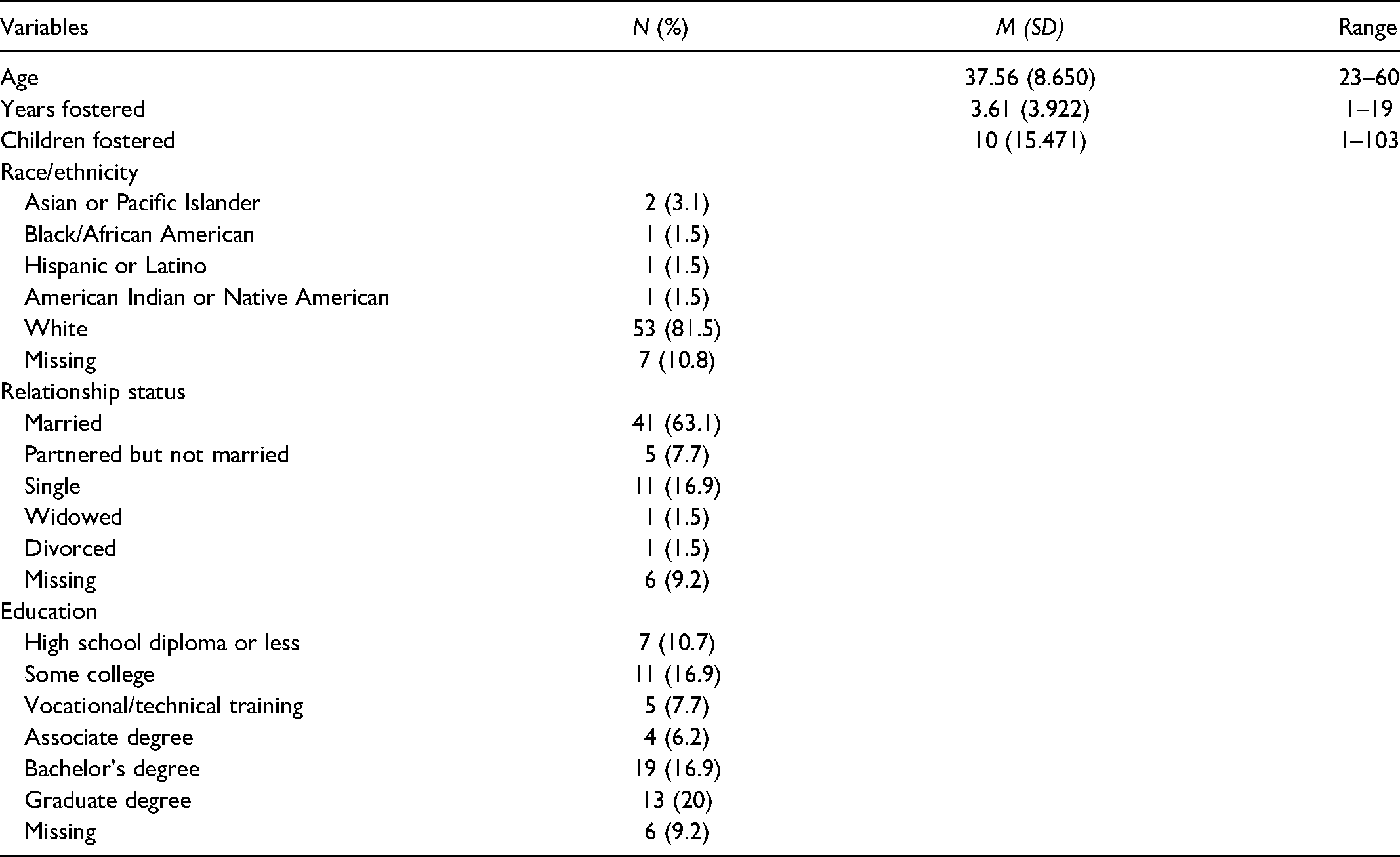
The sample for this study included foster caregivers aged 18 years and over who were fluent in English, were licensed to foster, and had provided licensed foster care services within the past year. Having a child currently in their home at the time they took the survey was not required. Non-licensed or informal foster caregivers were excluded from the study given they may not have the same experiences as formal foster caregivers who have undergone training to become licensed foster parents; and these varying caregiving experiences could influence the results or implications of the study. The sample for this study included a total of 65 participants, who were all female and mostly White. Two participants identified as Native American/American Indian, while the other racial/ethnic categories of Black/African American, Hispanic or Latino, and Asian/Pacific Islander were each represented by one participant. Table 1 contains additional information on other key demographic variables.
Foster Caregiver Demographic Characteristics (N = 65).
Recruitment and Data Collection
A non-random sampling method was used, recruiting foster caregivers by inviting users of two foster parent Facebook groups from a specific state to participate and through word-of-mouth (i.e., participants were asked to share the link if they knew other foster parents). Because it is not possible to know how many potential participants saw the survey invitation, the researchers could not calculate a response rate. Data were collected over a two-month period from January to February 2018 using the Qualtrics online survey platform. One initial invitation and one reminder was posted. At the end of the data collection period, data were exported into SPSS for analysis.
Measures
Parenting Behaviors
The Alabama Parenting Questionnaire (APQ) was used in this study to measure the parenting behaviors of the foster caregivers (Frick, 1991). The APQ consists of 42 items total, including five parenting behavior subscales/dimensions: (1) parental involvement (10 items), (2) positive parenting (6 items), (3) poor monitoring/supervision (10 items), (4) inconsistent discipline (6 items), and (5) corporal punishment (3 items). The remaining items that were not included in a subscale measured specific discipline practices other than corporal punishment and were included in the original survey to avoid casting an implicit negative bias toward the items on corporal punishment. Although foster parents are not allowed to use corporal punishment with foster children, they were asked to respond with their views or endorsement of corporal punishment practices. Respondents answered the items on a five-point Likert scale, with possible responses of (1) Never, (2) Almost Never, (3) Sometimes, (4) Often, and (5) Always. Shelton et al. (1996) concluded that the reliability of the APQ in the global format administered to parents was overall acceptable, finding that the Cronbach’s alpha levels were good for the parental involvement scale (α = .80) and the positive parenting scale (α = .80), moderate for the poor monitoring/supervision scale (α = .67) and the inconsistent discipline scale (α = .67), and poor for the corporal punishment scale (α = .46). Shelton et al. (1996) further found that the APQ had good criterion validity with differentiating clinical groups where the children were diagnosed with disruptive behavior disorders and nonclinical groups.
Parenting Stress
The Parental Stress Scale (PSS) was used in this study to measure the levels of stress experienced by the foster caregivers (Berry & Jones, 1995). The PSS is an 18-item measure that assesses respondents’ perception of parenting that are both positive (i.e., rewards and satisfaction) as well as negative (i.e., stressors and loss of control). There were 10 negatively worded items and eight positively worded items. Item responses fell along a five-point Likert scale, with possible responses of (1) Strongly disagree, (2) Disagree, (3) Undecided, (4) Agree, and (5) Strongly agree. After reverse scoring the positive items, a composite parental stress score was calculated ranging from 18 to 90, with higher scores indicating greater parental stress. Berry and Jones (1995) found that the PSS had good internal reliability (Cronbach’s alpha = .83) and good reliability over time (test-retest correlation = .81 over six weeks). Berry and Jones (1995) further concluded that the PSS had good criterion validity for the PSS, finding positive correlations with the Perceived Stress Scale and the total score on the Parenting Stress Index. The PSS has been used in other studies with foster parents (Miller et al., 2020; Harding et al., 2020; Richardson et al., 2018).
Control Variables
Age of foster parent, years fostered, and number of children fostered were included as control variables in this analysis (e.g., see Lietz et al., 2016).
Data Analysis
Preliminary Analyses
IBM SPSS Statistics Version 27.0 was used to run all analyses. Missing data were assumed to be missing at random (MAR), thus pairwise deletion was used (Kang, 2013). Before running further analyses, data were examined for normality and other indicators of quality and found to conform to acceptable standards (histograms, p-plots, scatterplots, skewness, kurtosis). Multicollinearity diagnostics were also run and found to be in an acceptable range.
Primary Analyses
Regression analyses were utilized to determine if there was a significant linear relationship between the independent (adaptive and maladaptive parenting behaviors) and dependent variables (parenting stress). Multiple regression analysis was appropriate to test the hypotheses because the analysis requires two or more independent variables (APQ subscales) and one continuous dependent variable (PSS score; Cohen et al., 2003). Based on the recommendations of Cohen et al. (2003), the control variables (age of foster parent, years fostered, number of children fostered) were entered into the regression equation model in the first step, followed by the independent variables in the second step. To address the hypotheses that positive parenting behaviors would be associated with lower parental stress and negative parenting behaviors would be associated with higher parental stress, two hierarchical multiple regression analyses were performed: (1) to determine if the parental involvement and positive parenting subscale scores of the APQ predicted lower PSS scores, and (2) to examine whether the inconsistent discipline and corporal punishment subscale scores of the APQ predicted higher PSS scores, as hypothesized.
Results
The first hierarchical multiple regression analysis was calculated to examine a model of adaptive parenting behaviors on parental stress. The three control variables (age, years fostered, number of children fostered) were entered into step 1. Results indicate that the three covariates were not significantly associated with parental stress (F(3, 51) = 2.066, p > .05), with an R2 of .114. The independent variables, parental involvement and positive parenting, were added into step 2 and results indicated that the model was significant (F(5, 51) = 5.236, p < .01), with an R2 of .363. Although the model was significant, two control variables and one independent variable were significantly associated with parental stress: (a) age (β = .308, t = 2.045, p = .047), (b) years fostered (β = −1.122, t = −2.382, p = .021), and (c) parental involvement (β = −1.266, t = −2.170, p = .035). Higher levels of involvement are associated with lower levels of parental stress. See Table 2 for the summary of the hierarchical multiple regression analyses for the adaptive parenting model.
Hierarchical Linear Regression Analyses of Adaptive Parenting and Covariates on Parental Stress.
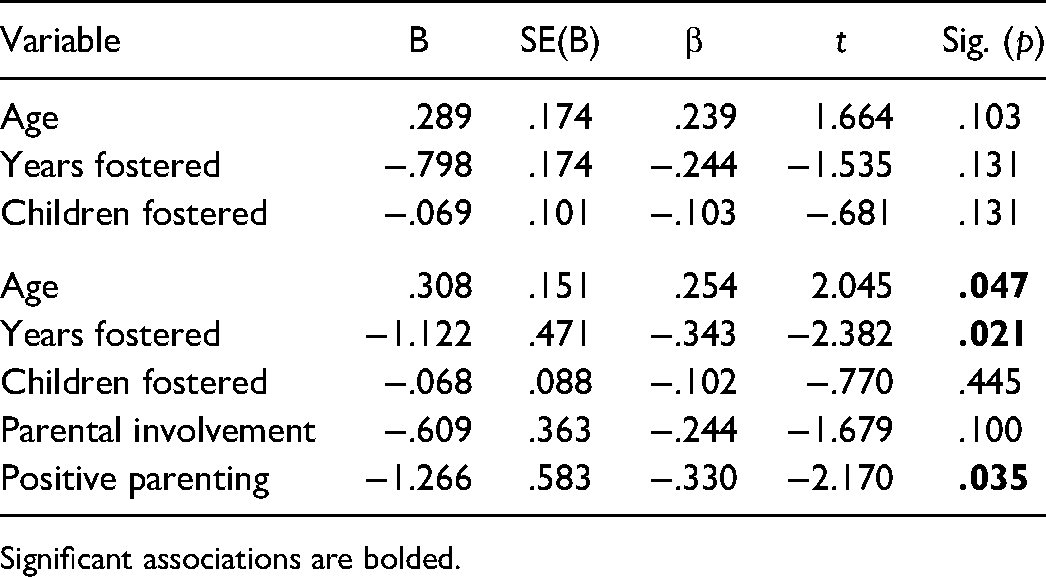
Significant associations are bolded.
The second hierarchical multiple regression analysis was calculated to create a model for maladaptive parenting behaviors to examine parental stress scores based on poor monitoring, inconsistent discipline, and corporal punishment scores. The three control variables (age, years fostered, number of children fostered) were entered into step 1. Results indicated that the three covariates were not significantly associated with parental stress (F(3, 49) = 1.546, p > .05), with an R2 of .092. Poor monitoring, inconsistent discipline, and corporal punishment were added into step two. The addition of poor monitoring, inconsistent discipline and corporal punishment on parental stress resulted in a statistically significant model (F(6, 49) = 5.318, p < .001), with an R2 of .426. Significant associations with parental stress were found for: (a) inconsistent discipline (β = 1.280, t = 2.304, p = .026) and (b) corporal punishment (β = 4.076, t = 2.744, p = .009). Higher levels of inconsistent discipline and higher endorsement of corporal punishment as a discipline strategy were associated with higher levels of stress. See Table 3 for the summary of the hierarchical multiple regression analyses for the maladaptive parenting model.
Hierarchical Linear Regression Analyses of Maladaptive Parenting and Covariates on Parental Stress.
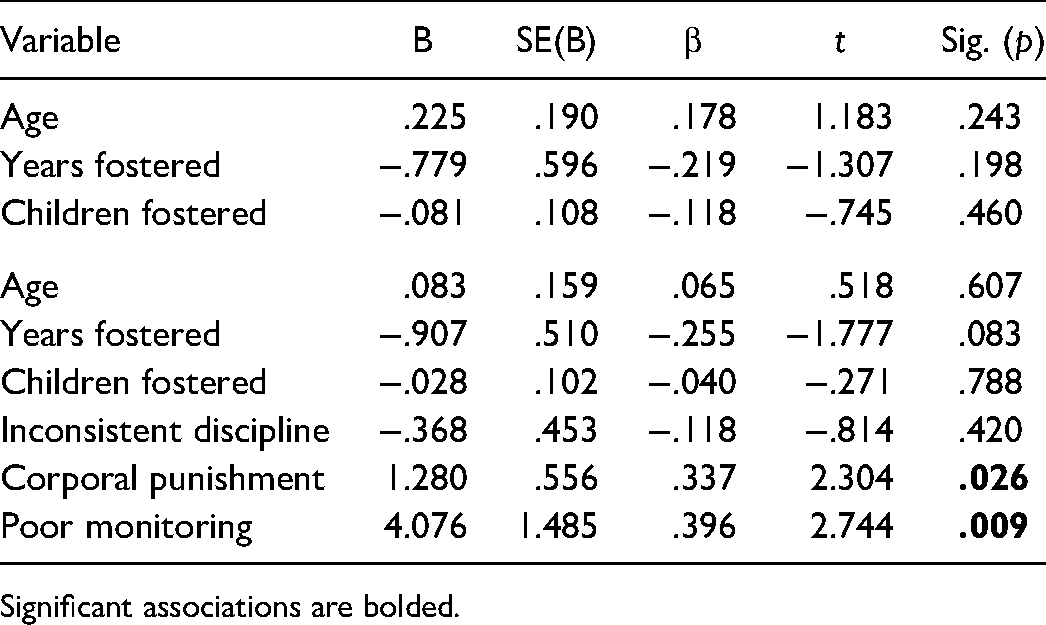
Significant associations are bolded.
Discussion
The results of this study provide partial support for the proposed research hypotheses. Among the adaptive parenting behaviors, foster parents who reported higher levels involvement reported lower levels of parental stress. For maladaptive parenting behaviors, foster parents who reported more inconsistent discipline and higher endorsement of corporal punishment as a discipline strategy reported higher levels of parent stress. Although Parent Development Theory and Role Strain Theory were used to support the research hypotheses, these theories may nonetheless explain why the hypotheses were only partially supported. According to Mowder (2005), parenting behaviors reflect parents’ thoughts, feelings, and learned experiences regarding the parental role. Simon (1992) theorized that if parents’ behaviors did not meet their own expectations for the parenting role, this would result in more parental stress. Among the adaptive parenting behaviors, only parental involvement was associated with reduced stress, while positive parenting was not a significant predictor. Perhaps participants felt confident in their level of involvement and interaction with their child, but they did not feel as confident in their positive parenting abilities. For example, licensed foster parents receive training prior to fostering, but this training does not always cover behavioral parenting strategies or ways to manage child behavior (Cooley, Newquist, et al., 2019). Consequently, the participants may have reported more moderate or inconsistent reports of positive parenting that were not associated with significantly lower parent stress.
It is also possible that the context or behavioral needs of children in foster care are also more significant. Another study found that foster mothers displayed similar levels of positive parenting behaviors as biological mothers in the comparison group, yet still reported experiencing higher levels of parental stress (Vanschoonlandt et al., 2013). Even if a foster parent is applying appropriate discipline, they could still experience parental stress due to other factors. Another explanation relates to how foster parents perceive their parental involvement, specifically their thoughts and feelings of how they are fulfilling their parental role, regardless of their training or parenting skill. For example, Semke et al. (2010) found that parents who reported a greater sense of parental self-efficacy also reported less parental stress and more parental involvement with their children. Therefore, it could also be important to assess self-efficacy (e.g., thoughts and beliefs about parenting) in addition to actual behaviors.
Among maladaptive parenting behaviors, poor monitoring/supervision was not associated with parental stress. It is possible that the foster parents in this study do not endorse or have the option to use lower monitoring or supervision with the children in their care, due to the context of foster caregiving, so there was not a significant association with parental stress. Leeuwen et al. (2012) found that more parental monitoring was associated higher levels of depression and anxiety in children and parents. Parental monitoring and supervision are nuanced parenting behaviors in which parental stress may depend highly on individual and contextual factors (e.g., Cooley et al., 2017). On the other hand, both inconsistent use of discipline and endorsement of corporal punishment were predictors of higher parental stress. Inconsistent discipline and corporal punishment are both known to be ineffective parenting behaviors that are associated with more negative child behavior problems (Saunders, 2013). It is possible that foster parents who reported more inconsistent discipline or endorsement of corporal punishment may report more parental stress because their parenting behaviors and/or their children’s behaviors are associated with lower perceived self-efficacy as a parent or the inability to fulfill the parent role.
Limitations
The current study adds to literature on the association between foster parenting behaviors and parental stress. However, this study also has several limitations. The nonprobability, convenience sampling method limits the external validity of the study. The sample was small and over-represented by White and female foster parents, which may not be representative of all foster parents in the United States. There is also a risk of selection bias because volunteer participants might differ from the general population of foster parents if they chose to participate in this study because of their particular interest in this topic. Participants were also recruited from online support groups, which may mean that they were receiving more support for their parent stress or child behaviors than foster parents not engaged in support groups. Given that foster parents were the only informants in this study, the data may be more reflective of the foster parents’ perceptions of their behaviors rather than their actual behaviors, and a more objective or observational measure may have produced different results. Lastly, because the survey included questions on parenting behavior and parental stress, participants may also have been vulnerable to social desirability bias and underreported on behaviors they may perceive as controversial or negative. However, results indicated that a significant relationship existed between endorsement of corporal punishment and higher levels of parental stress, which seems to reflect some level of honesty as foster parents receive training to understand that corporal punishment is not appropriate for use with foster children. Though the findings may not be generalizable to a wider population of foster parents, the current study retains value as a preliminary study to explore the need for future studies with experimental designs and larger sample sizes.
Research and Practice Implications
This study produces implications for future research and clinical practice. Future research should expand on the findings of this study by collecting larger, more representative samples for studies with quasi-experimental designs to better understand the direction of relationships between parenting behaviors and parental stress. Future research studies should also collect observational data on parenting behaviors to minimize potential biases associated with self-reporting. Furthermore, researchers may consider other validated measures to assess the constructs identified in this study. This study evaluated associations between parenting behaviors and stress, however there may have been other factors, such as child factors or parental self-efficacy, that directly influenced these associations. Lohaus et al. (2017) noted that parental stress and child behaviors may have reciprocal interactions, which could also influence parenting behaviors. Other researchers have noted the role that self-efficacy may play in parental experiences (Semke et al., 2010; Whenan et al., 2009). As such, future research studies should consider various models that could assess multiple factors influencing parental stress for substitute caregivers.
Marriage and family practitioners who serve foster families may consider focusing their interventions on addressing parenting behaviors and/or parental stress to ensure the parent is best equipped for responding to and reducing problem behaviors in their foster children. For example, increasing social support may be one informal intervention that helps to alleviate or diminish parental stress for foster parents. Lohaus et al. (2017) found that social support was particularly helpful for foster fathers. Another study found that social support predicts foster parents’ confidence and satisfaction which has been noted to influence parents’ stress levels (Cooley, Thompson, et al., 2019). It should also be noted that parental stress can lead to placement disruptions for youth in care, and social support may be a means to combat the stress and prevent disruption (Leathers et al., 2019). It should also be noted that qualitative findings from a randomized control trial indicated that the most valuable aspects of a group parenting intervention were the peer support that was developed among group members (Conn et al., 2018).
Ongoing training – both individual and group – could directly address appropriate forms of discipline (e.g., reduced endorsement of corporal punishment techniques and increased awareness of how to use positive parenting techniques) and promote ways to reduce parental stress. Since licensed foster parents already receive training before fostering children, agencies could leverage in-service training or even home visits to proactively address the emerging or targeted needs of foster parents (e.g., behavioral concerns of foster children, parental self-efficacy concerns, ways of increasing involvement with their foster child). Foster parents have reported that training is one of the ways in which they learn skills and knowledge that help them navigate the complexity of the child welfare system, which inherently involves stressful experiences (Cooley et al., 2017). Furthermore, child welfare agencies can support the needs of foster parents by institutionalizing ongoing training and support. While many foster parents report using an authoritative parenting style, many desire additional training in specific positive parenting techniques which can be reinforcing across time (King et al., 2007). Requirements for in-service trainings should be at a frequency that allows for foster parents to receive ongoing and incremental support, not just a one-time training, as a means to potentially reduce foster parental stress. Additionally, specific interventions targeted at increasing foster parent involvement with youth could be beneficial. It has been noted in previous studies that interventions that involve foster parents need to be tailored to their unique needs and roles (Dorsey et al., 2014). An intervention to enhance foster parent engagement with youth may have a mutual benefit for the youth in their care, as well as reduce parental stress (e.g., McKay & Bannon, 2004). For example, foster parents reported higher levels of involvement with their child when they are included in youths’ educational experiences (Mires et al., 2018). Targeted efforts to increase foster parent involvement can potentially reduce the increased risk for parental stress.
Conclusion
Prior research has only produced a limited number of studies that have examined the association between foster parents’ perceived parenting behavior and their parental stress. Although this study included a small sample and self-report data, the findings of this study provide incremental support that specific foster parenting behaviors, both adaptive and maladaptive, are related to foster parent stress. These results produce implications for ongoing support and training for foster parents, which should be addressed and provided by child welfare agencies.
Footnotes
Declaration of Conflicting Interests
The author(s) declared no potential conflicts of interest with respect to the research, authorship, and/or publication of this article.
Funding
The author(s) received no financial support for the research, authorship, and/or publication of this article.
