







Abstract
While couples counseling research provides strategies that support a diversity of relationship configurations, little research has been conducted on the factors which contribute to the vitality of intercultural gay male relationships. The purpose of this study was to understand the experiences which impact the longevity and resilience of Same Gender Loving Male Couples with at least one Black partner. The researchers conducted a qualitative research study, using an interpretive phenomenological methodology, to explore the factors of resilience within couples. Six couples (12 individuals) participated in the study, leading to three main themes: Strategies for Longevity and Growth, Community Support, and Family Relations. Discussion will include an exploration of the complexity of intercultural and interracial relationships while providing implications for counselor practice and training.
Introduction
Interracial relationships have occurred for centuries across the world. The United States Supreme Court upheld a resounding acknowledgement of their validity and importance through the decision of Loving v. Virginia (1967). The Supreme Court of the United States found antimiscegenation laws to violate the Fourteenth Amendment of the Constitution, thereby legalizing interracial marriage across the nation. These laws, however, did not provide marriage protections to same-sex couples (which would not occur until the Obergefell v. Hodges (2015) decision). Furthermore, interracial same-sex couples would still face levels of discrimination and rejection not only for their sexual orientation, but also for engaging in a sexual relationship outside of their racial community. These social and political tensions at the intersection of race and sexuality further established the unsafe nature of finding love across racial identity groups within the LGBT community.
Nearly 1.7 million same-sex couples exist within the United States (United States Census Bureau, 2024). Further, the United States Census Bureau (2018) estimated that interracial same-sex partnerships accounted for 31% of all same-sex partnerships in the United States in comparison to 19% of their straight counterparts. The preceding statistics reflect the expanding diversity of romantic bonds and marriage within queer communities. Although the prevalence of interracial couples is increasing, frameworks and clinical interventions for marriage and family therapists to support these couples have been limited (Robinson, 2017; Seedall et al., 2014). Relationship scholars have made strides toward increasing the knowledge base for helping interracial couples with marginalized identities. For example, Ferguson et al. (2024) suggested the need for counseling and couples literature to focus on same-gender loving (SGL) interracial couples and factors that contribute to their longevity and resilience. This study provides a response to that call to deepen our understanding of interracial SGL relationships and the factors that contribute to their longevity and resilience.
Purpose of the Study
The purpose of this study is to describe the phenomenon of resilience and longevity within interracial SGL male relationships. Same gender loving was coined by Cleo Manago (1996), who identified the nuanced power dynamics of Black persons expressing an attraction to someone of the same gender. Having gathered stories of love, challenge, and persistence, the researchers engaged an interpretive phenomenological analysis (IPA) methodology to understand which factors contributed to the length and endurance of one's relationship within the participants’ particular context. Thematic reflections from their interracial SGL romantic experiences lend to strategies and considerations for professional counselors who seek to provide affirmative counseling to future SGL clients who are in or tend to pursue interracial relationships.
Intersecting Cultural Identities
According to the United States Bureau (2018), cultural diversity is expanding rapidly, with most people holding multiple identities. This aligns with scholars’ predictions that by 2050, there is expected to be an increase in racial diversity in the United States, where there will be an emergence of racial and ethnic minorities becoming the majority in the United States (Wilkerson, 2020). The amalgamation of cultural identities is also evident within romantic relationships, as couples from differing backgrounds are more prevalent than ever (Pew Research, 2017).
Scholars have recognized the need to understand the inner workings of relationships with diverse cultural experiences (Hartwell et al., 2017; McFadden, 2001). Understanding the needs of complex identities may require an intersectional framework that acknowledges how racial, cultural, and social elements relate to building romantic partnerships (Greene, 1994; Veldhuis et al., 2025). We recognize that racial and cultural identity can be challenging to differentiate. Indeed, scholars have often conflated race and cultural identity to describe intercultural relationships (Bustamante et al., 2011; Henderson, 2000; Seshadri & Knudson-Martin, 2013). Race is a social classifier based on phenotypic traits belonging to a person (Killian, 2013). Culture represents shared beliefs, art, language, and experiences (Seshadri & Knudson-Martin, 2013). Sullivan and Cottone (2006) also explained that interculturality has been investigated through familial values, racial identities, spiritual beliefs, and shared experiences. This study will use the term interculturality to emphasize the sociocultural implications of carrying marginalized identities and sustaining romantic relationships.
We recognize how the culmination of intersecting sociocultural factors can be described as interculturality. Thus, we define interculturality as intersecting social factors, such as race, affectional identity, class, and cultural background, that may relate to the cultivation of romantic coupling for gay persons. This definition aligns with relationship experts who have delineated the interrelated nature of familial, racial, and affectional identity development and how this experience contributes to the success of queer relationships (Ferguson & Johnson, 2024; Harper & Singh, 2021; Killian, 2013; Paradis & Maffini, 2021). However, to embrace intercultural knowledge, researchers and clinicians must recognize the prominent identities of SGL couples who navigate a society that has historically devalued their lives and shared love.
Racial Identity
Recognizing how racial identity and sociopolitical factors contribute to forming cross-cultural relationships within the United States is essential. Racial identity is intricately tied to social status, oppression, and community building (Kendi, 2023). Laws that prohibited interracial marriage (Killian, 2013) or created structures for discrimination practices around business, healthcare, and community wealth further severed the possibility for couples from different racial and ethnic backgrounds to thrive. While cases such as Loving v. Virginia (1967) codified the legality of interracial and intercultural marriage, social attitudes remain that negatively impact intercultural relationships. Today, intercultural same-sex couples have reported experiencing stress related to both their affectional identity and race. As Leslie and Young (2015) remarked, intercultural couples may report to therapy with issues related to a lack of familial and communal support. Rostosky et al. (2008) noted that race-related stress impacted the overall stability of interracial relationships, which was linked to the partners of color being subjected to racial microaggressions, isolation, and rejection. Further, one Black male participant specifically reported experiencing anxiety due to the potential rejection from the Black community because he was in an intimate relationship with a White male (Rostosky et al., 2008). Community isolation and familial disapproval have led to seeking additional social support and resources that increase the sustainability of interracial bonds (Inman et al., 2011; Pope et al., 2010; Veldhuis et al., 2025).
Affectional Identity
Queer love and relationship building have also faced societal challenges within Western society. While Loving v. Virginia (1967) was a landmark case that established the foundation for interracial marriage, the precedent only applied to heterosexual couples. It was not until 48 years later that same-sex unions were legally recognized, which highlights how heteronormativity manifests in laws that prioritize heterosexual relationships and family systems.
Today, SGL men continue to face numerous societal challenges, such as stigma, reduced access to healthcare, increased substance use, and higher rates of mental distress that impact their coupling (English et al., 2021; Greenan & Tunnell, 2003). Additionally, due to experiences of marginalization, SGL men may face unique challenges in their identity development while simultaneously navigating the complexity of relational growth within their romantic partnerships (Porche & Purvin, 2008). Developing a romantic bond may also be challenging for SGL men due to issues of internalized homophobia, racism, fetishization, and disconnection (LeBlanc et al., 2015). Researchers have noted that queer couples reported experiencing stigma, which negatively impacted their relationship functioning and increased stress, potentially leading to adverse individual and relationship outcomes (LeBlanc et al., 2015; Veldhuis et al., 2025). Moreover, in a mixed method study, Gamarel et al. (2023) found that queer couples perceived that a lifetime of exposure to stigma had negatively impacted their relationship quality. However, despite intersecting challenges, same-sex couples have demonstrated similar relational satisfaction as their heterosexual counterparts (Pope et al., 2010).
Same-gender-loving romantic partnerships can face additional complexities due to differences in their racial and cultural identities. Scholars have debated how racial and cultural factors are related to the satisfaction of relationships between married and unmarried intercultural couples (Killian, 2004; McFadden, 2001). However, racial identity may not be the primary factor associated with conflict and relationship satisfaction for queer couples (McLean et al., 2003). For example, Black queer couples have reported bolstering their bond and resolving relational challenges by using support-seeking strategies to develop communal networks and accessing mental health professionals (Applewhite & Littlefield, 2015; Ferguson et al., 2024). This further establishes the need to expand awareness, scholarship, and clinical application of a praxis supporting SGL intercultural couples.
Racial, ethnic, and affectional identity differences intersect to create nuanced conversations for intercultural, same-gender loving males seeking longstanding, romantic relationships. The present body of work indicates that scholarship focusing on intercultural same-sex couples is limited and should be further explored. This research study seeks to understand the experiences that contribute to the longevity and resilience of said couples over time. Through an interpretive phenomenological lens, the researchers sought to answer the following question: What contributes to relationship resiliency and longevity in intercultural gay couples with at least one Black partner? The data from this study will help mental health professionals to develop strategies that reinforce resilience within these couples.
Methods and Methodology
The researchers engaged in interpretative phenomenological analysis (IPA) to explore the experiences of relationship longevity for SGL interracial couples. This phenomenological inquiry was grounded in Quare theory, which provided the structure to center Black Queer experiences during the thematic analysis and interpretation of the interview data (Ferguson et al., 2024; Johnson, 2005). IPA provided a framework for our research questions to facilitate the couples’ making sense of what contributed to longevity in their long-term relationships (Smith et al., 2021).
Data Collection
The researchers conducted semi-structured interviews using guiding questions that lasted between 60 and 90 min with each couple. Participants were given the option to participate in person and due to geographic constraints, all interviews were conducted virtually using a secure video platform. The interview protocol included questions that focused on the individuals’ upbringing, the couples’ relationship dynamics, their relationship to their community, and their experiences in counseling. All interviews were transcribed verbatim and the data were uploaded to an online, password-protected database for secure storage. Two of the couples in the study elected to complete the optional second interview.
Recruitment and participants
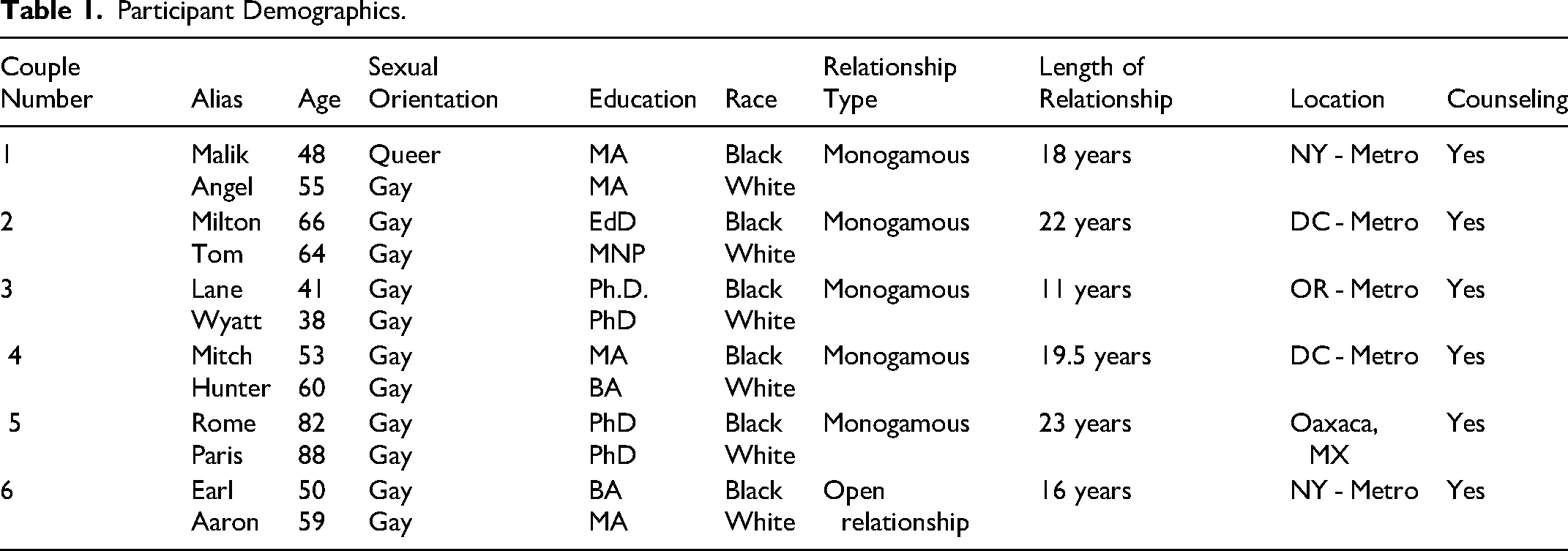
Purposeful sampling strategies were used to recruit participants. The researchers employed snowball sampling and criterion sampling through direct recruitment. Digital flyers and recruitment information were distributed on social media, listservs, and across the researcher's own professional networks to obtain a diverse sample of couples. After establishing initial contact, prospective participants were asked to complete a background questionnaire to ensure they met the inclusion criteria in the sample. To participate in the study, both partners in each couple had to be as least 25; at least one partner self-identified as Black, African American, or of African descent; both partners self-identified as male (including Cis men, Trans men, and Transmasculine nonbinary folks); both partners identified as gay, same gender loving, queer, or a Male who has Sex with Males (MSM); and the partners had been in a relationship for five years or longer. Additionally, both partners had to be available for an interview together and agree to participate in the mandatory first interview, with a second interview being optional. Six interracial SGL couples were interviewed for this study. The demographic and background information for individual participants and couples is represented in Table 1.
Participant Demographics.
Data Analysis
The codes developed in a previous study (Ferguson & Johnson, 2024) served as the basis for coding the interview data. Each interview was then line-by-line coded by two researchers, followed by peer debriefing. During this process new codes emerged and were added to the existing code book. The research team used thematic analysis to interpret the data and through this process, themes emerged (Naeem et al., 2023).
Trustworthiness
Trustworthiness was intentionally built into every step of the research process as suggested by Singh and Shelton (2011). The participant information and data were de-identified using pseudonyms and stored on a secure password-protected platform. All interviews were conducted by the first two authors to facilitate consistency in the interview protocol and structure. Each author used reflexivity as part of the data analysis to bracket out their experiences with the phenomenon and emerging themes. The thematic analysis was completed by the research team, allowing triangulation of the data from all team members who had coded and through continued exploration of the themes.
Findings
The findings of this study highlight the factors that participants identified as contributing to the resilience and longevity of their relationships. Three central themes emerged from the participants’ lived experiences in response to the research question: What contributes to relationship resiliency and longevity in intercultural gay couples with at least one Black partner? The first theme, strategies for longevity and growth, encompasses the factors that sustain relationships, including the processes, strategies, and supports that strengthen them, alongside the vulnerabilities and challenges encountered in maintaining them. The second theme, community support, highlights how participants’ sense of belonging within a community informs their self-concept, self-efficacy, overall health, and well-being, while also shaping their romantic relationships and interactions within these communities. The final theme, family relations, reflects participants’ experiences with family dynamics and the impact of their family of origin on their identity development and the longevity of their romantic relationships.
Strategies for Longevity and Growth
All participants shared strategies related to their communication patterns, their mutual understanding of identity and growth, and their commitment to engage love as action within their relationship. All participants explored the importance of being grounded in their identities, to speak openly about race and how their identities may impact their relationships. For example, Wyatt (White, 38) shared, We learned how to reflect … practice positive regard. Like we learn how to affirm points of view that we disagree with. And so my advice would be to talk about race as soon as possible. Not the first day necessarily, but like acknowledge the reality of race in your relationship and make space for it.
Similarly, Milton (Black, 66) also shared that being grounded in his identity was a pivotal tool for being a part of an intercultural relationship, he shares, “learning to be comfortable in your own skin, you know, just really not internalizing what other people say. That's always a big thing … basically being … comfortable in your own skin. That was something I learned early on.” Identity development went beyond race, with couples noting that the maintenance and cultivation of one's individual identity helped to sustain the romantic connection. Aaron (White, 59) shared, “we also have our own lives. Right … I travel a lot. Extended travel in the summer, like two months. Sometimes I'll be gone for a month and a half. Places he would never go even if he was invited.”
In addition, all participants talked about how important and instrumental communication is to the longevity of their relationship. Rome (Black, 82) described how important communication is for him in this relationship. Rome shared, I never did with my two previous partners. We never talked about anything. So it was very difficult for me to have to talk about things. Okay, there's a problem here. We're gonna sit down and talk about it. In fact, yesterday was an occasion where there had been an issue the previous day. And I said, Paris, I need to talk to you about what happened yesterday.
Rome went on to talk through his process for intentionally addressing difficult conversations with his husband. Paris (White, 88) also echoed Rome's sentiments by highlighting how conversations during morning coffee help them to hold space for ongoing topics and addressing conflicts. In a similar fashion, Wyatt highlighted communication as a salient tool for relationship resilience and how to navigate healthy communication in interracial romantic relationships, Wyatt shared, “Listen with patience and generosity and don't get defensive. Particularly for a white person in that relationship to do more listening than talking in the conversations around race, but they're still talking that you have to do.”
Moreover, couples in this study also highlighted the importance of curating opportunities to show affection towards each other and creating memories together. Earl (Black, 50) stated, “The first thing that came to my mind is love. But more than that, because I am a big believer, you know, love and emotion is great, but you have to put in the work.” Earl went on to explain why that work is meaningful after being together for 16 years and now married. Earl shared, I know for myself and actually for him as well, we are very intentional about treating each other like we're precious … We're boyfriends first. Ah. Like that's who we've been and that's who we stay. That's what we keep in our minds … That magic, that specialness, that's a lot of where that comes from.
These strategies, over time, drew the partners into a deeper, safer connection with one another and strengthened their resilience through increased understanding of one another's needs and identities. Participants also pointed to the importance of external, community support to help maintain and process internal challenges within the relationship.
Community Support
All participants in this study highlighted the critical role community support played in fostering longevity and resilience in their romantic relationships. For instance, Angel (White, 55) highlights how intentional he has been with curating his community. Angel said, “Our community also, it's who we've chosen to be our community. The people in our circles … has been supportive always.” Paris and Rome credited their community members with not only introducing them to each other but also laying the foundation for their relationship. Rome explained how they first connected, sharing that a mutual friend of Paris’ thought that the two would be great together. Their friends then shared each of their contact information with the other. Rome recounted his first interaction with Paris once he received his contact information. Rome stated, I wrote to him immediately and said, who I was, I wanted to be completely honest [that] I had recently lost my partner who died a couple years before … I wanted to be honest because if I was withholding something and we met, and then something else came out, that would be the end.
The couple then went on to discuss the ways in which their communities have been supportive and consistently shown up for them. Moreover, several couples talked about how their geographic location has impacted their relationship. Lane (Black, 41) reflected on how his community continues to show up and support his intercultural romantic relationship. Lane shared, We run with and have built relationships with pretty progressive folk. And so I don't have anybody in my life that I know of who has pushed me away … I almost have zero people in my life who feel that way. Our community. Yeah. I just feel like, and maybe it's this particular part of the country, there's just a lot of support, representation, legislation. And so I feel very, again, while every state has [its trouble] I feel like we have a lot of wind at our back.
Lane went on to share examples of how their intercultural relationship and queer identity in the northwest have received more support than opposition. Similarly, Milton's reflection agreed with Lane, emphasizing that an affirmative sociopolitical community helps create a supportive environment for the relationship to flourish. Milton stated, I know that not all interracial couples, gay couples have the luxury or the privilege to live anywhere they want. Right. My advice is gonna be more general, if you're living in the south, I'm not gonna be dumb enough to think that it's going to be easy peasy to be an interracial gay couple. My first piece of advice would be to know or find folks that would support you. Particularly if you're in areas there would not be support. Not only of the relationship or if there's just general tension between [White] people and black people
To sustain those relational and affectional bonds, the couples emphasized that connecting with other interracial couples was vital in fostering a sense of belonging, affirming their identities, and supporting their overall health and well-being. Hunter (White, 60) reflected on how his community has consistently provided support, emphasizing the importance of being surrounded by other interracial couples. Hunter shared: We're pretty fortunate because most of my friends here in DC have been interracial couples. And so there was never an acceptance issue on my side … Some of my best friends were interracial couples, would vacation together, hang out together a lot when I was single. So that was always a good supportive network
Moreover, all the couples emphasized the importance of intentionally selecting the communities they belong to as a means of safeguarding their gay identities and nurturing their interracial romantic relationships.
Family Relations
All couples in this study reflected on their experiences navigating their romantic relationship within their family dynamics. This included inviting family members into learning about their sexual orientation and introducing their romantic partner of a different intercultural background. These interactions helped to shape both their individual identity development and the growth of their relationships. Family responses ranged from positive and accepting to non-accepting, with some couples experiencing ongoing tensions. These varied experiences prompted the couples to find meaning in these interactions and adapt to the dynamics they encountered. Mitch (Black, 53) highlighted how they positively integrated their families. Soon after we got together … his mother was turning 70, and I ended up being in the family picture … My mother-in-law was kind of like “this is my 70th birthday. Are we really gonna have him in a picture? Is it that serious or what's going on?” So it's kind of funny. So, um, she still has that picture in her, in her home.
Mitch went on to say the family was “pretty much, um accepting,” and has been supportive since he was introduced to the family. Similarly, Milton expressed similar reactions from Tom's (White, 64). Milton states, “whenever Tom was around my family or with my friends, they gave off positive energy and that kind of, Tom immediately gave it back.”
A few couples acknowledged the significance and importance of their familial relations, therefore they were very thoughtful in their approach to introduce and integrate their partner into their family. Wyatt reflected on the proactive work he did with his family before introducing his partner to them. Wyatt shared, Like, what can I do to facilitate your growth so that this person I love doesn't have to be your exclusive learning experience. And I do think that helped a ton. I think the work that Lane did with his family, I think the work that I did with my family set us up for success. I think our families adore us now.
Similarly, Earl reflected on introducing his partner to his family and how intentional the timing of the introduction fostered support. He shared that the introduction took place during a holiday gathering. Earl stated: I knew it wasn't going to be anything monumental. You know, my family, they love me. And I've only brought home three men … So that off the bat lets them know this is someone special … It's going to be different. It's going to be automatic.
Several couples discussed how challenges with their families have impacted their romantic relationships. They emphasized the importance of recognizing differences in cultural and familial dynamics to establish boundaries and protect their relationships. Rome interrogated his relationship with Paris’ family and the use of politeness and atypical distance. Rome articulated, His family have always been very nice to me, very polite. But there's always been a certain distance. It could be for various reasons … It may be the dynamics of that family. You know, they're just not people who can be the way my people can be … It's not about race, it's about family.
Our interviews also revealed that while some couples had proactively examined the racial dynamics within their relationships, others appeared to be exploring these dynamics in real-time during their conversations with the interviewer. Earl shared that he and Aaron had established firm boundaries with Aaron's family due to their racist attitudes. Earl shared, “His family has not been a part of our relationship, because they are garbage. And I, well, they're very racist and homophobic.”
Overall, the participants discussed their lived experiences of inviting others to learn about their sexual and romantic orientations and how this process influenced their development as SGL men in romantic intercultural relationships. Through the voices of participants, the themes of strategies for longevity and growth, community support, family relations illuminate the complexities and strengths of the partnerships highlighted in this study. Together, these findings offer valuable insights into the strategies and dynamics that sustain these relationships, highlighting potential insights for mental health professionals to enhance the resilience and adaptability inherent in other intercultural SGL relationship experiences.
Discussion and Implications
The findings from this study indicate three major themes relate to the longevity and resilience of intercultural SGL male couples: the strategies of relationship resilience require open communication regarding race, class, and cultural heritage; support from one's community bolsters the health and reflection process of relationship resilience and longevity; and a recognition of family relationships connect to a couple's ongoing processing of the relationship they generate between one another. The discussion, then, asserts the importance of exploring the complexities of these relationships as counseling professionals. To do so encourages couples to safely access dialogue and express the tension of being in an SGL intercultural relationship.
Complexity is Interwoven into Intercultural SGL Relationships
As Robinson (2017) and Charlot et al. (2022) note, intercultural couples face multiple challenges in discussing cultural differences. When couples begin to explore a romantic relationship with a partner outside of their racial or cultural group, additional opportunities arise to explore and understand different linguistic nuances and practices for romantic affiliation. Our participants acknowledged that their communication patterns, their reflection of their individual identity development, and the engagement of support systems influenced their readiness to discuss culture, identity, and relationship needs with partners when facing challenges. When sexual identity and race are at the center of their relationship, couples give space to one another to clarify one's history with, and definitions of care, love, family, and community. However, participants noted that their ability to have these conversations were rooted in their knowledge about their racial, cultural, and class background/context. This clarification process encouraged their openness for forgiveness and mutual understanding when conflict arose in their relationship.
The Function of Race as a Participant in the Longevity Phenomenon
Several researchers emphasize the necessity of discussing race and culture to maintain a healthy intercultural relationship (Ferguson et al., 2024; Lassiter et al., 2022; LeBlanc et al., 2015). Participants’ engagement with stories around race, culture, and identity within and before the relationship emphasize that race had been an ever-present force within the structure of the relationship. The development of communication and vulnerability required the participants to involve race and the societal expectations around race as a portion of their identity as a couple. In this way, their navigation of race influenced their communication patterns, community structure, and reckoning of differences throughout the longevity of their relationship. Though McLean et al. (2003) noted that race was not a primary factor of relational challenges, we posit that these couples allude to race being a major aspect of their communication of power and societal expectations within themselves and across the relationship. Overcoming challenges with conflicts of cultural differences supported the resilience of the relationship. Involving others in processing those conflicts fostered their awareness around an affirmative community and family members who could support the navigation of race and sexuality. Thus, a development of strategies to help participants identify, engage, and process the interculturality of their relationship may support the wellness and resilience of the relationship.
Implications for Counseling Practice
The findings of this research support the importance of training, supervision, and continuing education for counseling practitioners working with SGL couples about the complex dynamics within SGL relationships with minoritized identities, as Ferguson and Johnson (2024) suggested. Exploration of comfort in broaching multiple marginalized intersecting identities, including race, class, and gender expectations, would be essential for these counselors in supervision and training. When working with SGL interracial couples, counselors should note that there are a complex array of factors that would contribute to relational longevity. Our findings suggest that exploring longevity with these couples was effective when family, community, identity development, and relationship resilience strategies are explored in session. Counselors should engage in activities that help to assess and explore racial and cultural identity for each individual and its impact upon definitions of relationship values and cultural needs. Specifically, counselors could explore who the couple defines as family and the dynamics between the family and the couple. Participants spoke of a need to be coached by their partner about how to “fit into” each other's family and how to navigate complex dynamics. Identifying support systems, patterns of communication, and connections were also noted as contributing to longevity for SGL interracial couples.
Limitations
All participants in the study reported holding at least a bachelor's degree, with many holding a master's or doctoral degree. The education level of all participants limited our understanding of the role that class or socioeconomic status may play in contributing to longevity. There were opportunities to further explore how participants’ racial and cultural identity development shaped their ability to engage with racial issues within the relationship and across community interactions. In order to participate in the study, at least one partner had to self-identify as Black, African American, or of African descent, and the other partner in all couples self-identified as White. While this provided for rich narratives from the participants that spoke to the influence of systemic racism on longevity, the data did not capture narratives of SGL interracial couples with both partners having marginalized racial identities, which warrants further research.
Footnotes
Declaration of Conflicting Interests
The author(s) declared no potential conflicts of interest with respect to the research, authorship, and/or publication of this article.
Funding
The author(s) received no financial support for the research, authorship, and/or publication of this article.
