







Abstract
A university clinical practicum team consisting of five graduate students, one doctoral supervisor assistant student, and a licensed marriage and family therapist faculty supervisor oversaw a case where the client was shy and hesitant to engage in sessions without the mother present. This clinical case study shows how creativity was utilized with a reflecting team by creating friendship-style bracelets for the client. This allowed the client to feel more comfortable in the therapy room and positively impacted on the therapy process. Student reflections and client responses are shared to show how innovation and adaptability can be used to meet clients where they are and guide student clinicians and clients further in the therapy process. A review of reflecting teams and the importance of creativity in therapy are also included. Therapists can utilize the activity with their own clients and/or bring in their own creativity using the activity as a template.
Therapy is often described as a mixture of science and art. The science behind therapy comes from evidence-based research demonstrating what works and what doesn’t work. The artistic side of therapy often refers to the creativity each individual therapist brings into the room. This paper discusses the importance of creativity in therapy. The authors of this paper were on a practicum team in a university clinic for one semester. One of the authors (AC) was seeing the client while the rest of the team observed the session behind a one-way mirror. The client was a teenager and at first was shy. When the client brought up that she enjoyed making bracelets, the therapist shared that she did too. They started making bracelets in therapy to connect and help the client feel more comfortable opening up in therapy. The supervisor (JP) of the team then decided to do a reflecting team for the client, but with a creative twist, using bracelets. This paper will first provide an overview of reflecting teams and the importance of creativity in therapy and then will detail the clinical intervention as well as the student's and client's responses and reflections on the activity.
Reflecting Teams
Reflecting teams are a transformative therapeutic tool that has played a significant role in the evolution of family therapy. Pioneered by systemic family therapist Tom Andersen, reflecting teams emerged from Andersen's collaboration with influential figures in the field, such as Gregory Bateson, Humberto Maturana, and the Milan team. In 1985, Andersen revolutionized the practice by allowing families to hear the reflections of the therapy team, which had traditionally been conducted behind a one-way mirror (Gehart, 2011). This bold move, initially met with hesitation, fundamentally changed the field of family therapy, as Andersen discovered that clients benefited greatly from listening to the team's reflections. Reflecting teams were thus born—not simply as a therapeutic tool, but as a way of thinking, relating, and communicating within the therapy room (Gehart, 2011).
One of Andersen's key contributions was the shift in therapeutic dynamics. Reflecting teams were designed to generate multiple possibilities for clients rather than providing a single, directive intervention. This flexibility promoted greater client autonomy and a more collaborative, dialogical exchange between therapist and client (Gehart, 2011). Unlike traditional measures of success—where therapy was judged by whether clients completed specific tasks or assignments—Andersen's model focused on the generation of new ideas and perspectives.
Reflecting teams have historically been used to help families who are “stuck” in repetitive patterns by offering new perspectives without imposing direct interventions (Andersen, 1987). This approach involves a team of therapists observing a family therapy session from behind a one-way mirror. As the session progresses, the family and therapist engage in conversation while the team listens and forms their reflections on the dynamics and issues discussed. At an appropriate moment, with the family's consent, the team shares their observations in the therapy room, while the family listens behind the one-way mirror. At the conclusion of the reflecting team, the team returns to the room behind the one-way mirror and the family returns to the therapy room to reflect upon what they just heard with the therapist. This exchange fosters collaboration, introducing new ideas and alternatives without overwhelming the family's existing perspectives (Andersen, 1987).
Central to Andersen's theory was his evolving theoretical foundation, which was initially grounded in Gregory Bateson's epistemology. Over time, it incorporated elements of constructivism and social constructionism, emphasizing that meaning is not only generated within the individual but also through relationships (Gehart, 2011). A key component of this work was listening to both external dialogs (between people) and internal dialogs (within oneself). Andersen stressed the importance of paying attention to who wanted to be heard in each moment and how individuals responded to one another. Reflecting teams can be broken down into several important components, which highlight their flexibility and collaborative nature. One such element is the team's ability to present “appropriately unusual comments” (Gehart, 2011, p. 387). These are statements that are grounded in the client's worldview but novel enough to prompt reconsideration of problems and potential solutions. This blend of familiarity and newness helps families reimagine their circumstances and break free from rigid patterns (Gehart, 2011).
In practice, reflecting team sessions follow a structured format based on several key guidelines. First, the team respects the family's current state, recognizing that stuck family systems often have too many repetitive patterns and too few new perspectives. The goal is to challenge the family's thinking subtly, without overwhelming them or dismissing their existing views (Andersen, 1987). Another vital aspect of the process is navigating three levels of conversation—the “picture level” (what is happening in the family's situation), the “explanation level” (why these things are happening), and the “alternative level” (possible solutions or new ways to think about the issue). The therapist guides the family through these levels while the reflecting team develops their thoughts, which are later shared tentatively to encourage exploration (Andersen, 1987).
The reflections from the team are always presented as speculative ideas rather than definitive conclusions, with phrases like “I wonder if…” or “It occurred to me that…” are used to introduce tentative thoughts. This nonintrusive, collaborative approach empowers the family to explore new perspectives without feeling judged or pressured to accept them (Andersen, 1987). By introducing both/and thinking—offering possibilities beyond black-and-white facts—the team encourages the family to consider more flexible alternatives that may combine elements of seemingly incompatible solutions (Andersen, 1987). The structure of the reflecting team also emphasizes respect for autonomy, both within the family and the team itself. Behind the mirror, team members refrain from discussing or hypothesizing together before sharing their reflections, allowing for diverse ideas to emerge. This helps broaden the “ecology of ideas” presented to the family, promoting more open and creative dialog (Andersen, 1987, p. 4).
Through Andersen's theoretical innovations, reflecting teams have continued to evolve, now being applied not just in family therapy sessions but also in supervision, multifamily groups, and multidisciplinary teams. Reflecting teams allow therapists to foster dialogue, respect, and collaboration, providing clients with multiple pathways to reframe and address their challenges (Gehart, 2011). By emphasizing appropriately unusual comments, balancing inner and outer dialogs, and maintaining a respectful, tentative stance in the therapeutic relationship, reflecting teams help families escape limiting narratives and discover new ways of thinking and relating. The enduring legacy of Andersen's work is the creation of a respectful space for change, where clients and therapists together generate possibilities for growth and understanding. This method remains a cornerstone of systemic family therapy, offering an adaptable and profound approach to helping families find new perspectives on their challenges (Andersen, 1987; Gehart, 2011).
Creativity in Therapy
Operating from a systemic or postmodern lens allows therapists to embrace the fluidity of therapy. Gergen (1991) believes that as people evolve with their systems, therapy must evolve too. The fluidity of this process keeps therapy relevant to the client's world and gives the therapist more flexibility as the system shifts. Creativity can become the bridge to adapt to these shifts. Creativity allows us to respond to the unexpected with openness. Sternberg and Kaufman (2018) remind us that being adaptable and thinking outside the box is crucial in these moments. It also lets us turn client-led surprises into opportunities for exploration. Anderson (1997) highlights how embracing the client's lead can open doors to deeper understanding and collaboration. We can also use symbolic or tangible tools to deepen meaning in therapy; tools that serve as metaphors for further integration, as White and Epston (1990) discussed in their work on narrative therapy. Through a postmodern lens, creativity helps therapists remain curious to the ever-changing nature of our clients’ systems.
Postmodern theories represent an evolution from traditional frameworks, requiring a creative lens to adapt to the complexities of modern human experience. Marriage and family therapists are particularly trained to embrace flexibility, as they attend to the dynamic changes that unfold in the therapy room while remaining aware of the many systemic influences impacting clients’ lives. This adaptability is essential not only for empowering clients toward their goals but also for ensuring therapy remains relevant in an ever-evolving culture and society.
Integrating creativity into therapy does not imply adopting trends or new methods to satisfy personal interests. Instead, it involves pushing beyond rigid, checklist-based approaches by allowing the client's system (individual, relational, or cultural) to guide the practice. Therapy is inherently a vulnerable space, which can feel threatening for clients. Introducing relatability, unexpected insights, and tailored interventions to the process can soften that vulnerability, creating a space where clients feel seen, heard, and valued.
As society develops, the needs and expectations placed on therapy shift as well. The growing recognition of therapy's value brings with it the importance of innovation and creativity in treatment. This openness to exploring new methods and perspectives may not be optional as shown by many theorists over the centuries. The ideas that are the foundation for a therapist today were essentially generated by meeting clients where they are, in both the literal and figurative sense.
The therapeutic alliance is suggested to be a significant predictor of positive outcomes in therapy (Horvath & Symonds, 1991; Wampold, 2015). Lambert and Barley (2001) emphasize that the alliance's strength is influential across models. Core factors of the alliance, including empathy, authenticity, cultural competence, and unconditional positive regard, are consistently correlated with therapeutic success. These components, drawn from foundational thinkers like Carl Rogers and Sue Johnson, bring attention to the necessity of creativity in the therapeutic process (Johnson, 2004; Rogers, 1957). Creativity is vital for incorporating these skills because no two clients are alike. Each brings their own unique history, cultural background, and relational patterns into the room. To demonstrate empathy, therapists may need to creatively engage with clients’ stories, finding new ways to connect and resonate on the spot. Cultural competence, similarly, demands not only knowledge but a willingness to be curious and adapt in response to the specific needs of each client.
Taking a client-centered approach fosters openness and trust, while connecting with a client's cultural and personal interests can motivate them to actively engage in the process of change. For example, using metaphors, rituals, or references that resonate with a client's worldview can bridge differences or disconnects and enhance therapeutic rapport. From this lens, creativity becomes the backbone of a therapy practice that is both effective and deeply human. Therapists are tasked with balancing evidence-based methods with the art of meeting clients where they are and this requires flexibility, innovation, and a willingness to think beyond predetermined norms. Creativity, therefore, is not just a tool but a necessity in cultivating meaningful, transformative therapeutic insights that resonate with the clients’ perceptions of the world.
Clinical Case Information
We were a team of five master level couple and family therapy graduate students, one doctoral level supervisor assistant student, and one licensed marriage and family therapist faculty supervisor. We would meet one day a week for six hours. During these 6 hours, clients would come to the university clinic and one student therapist would see the client while the rest of the team would observe the session behind a one-way mirror. Written consent was obtained for using this case for educational and professional purposes. The client for this case study was a 12-year-old female who attended sessions with her mom. They attended approximately eight sessions with our team. The mom initiated therapy after receiving a call from her daughter's school informing her that her daughter had talked about self-harming. The mom wanted her daughter to have a safe space to discuss her feelings and feel supported. The daughter was fairly open to talking about the self-harm, stating that this occurred several months ago and that her friends pressured her into thinking it was okay. She was now turning to prayer, words of affirmation, and talking to a new, more positive set of friends. The relationship between the mom and daughter also seemed very open, strong, and supportive. After a thorough assessment, the team determined that the client was not at current risk for self-harm and/or suicide. The team continued to assess safety throughout sessions but also provided room for the client to identify her own goals in therapy. The client stated she wanted to build more confidence in school and be more involved in school activities. This would include improving her academics and her beliefs about herself related to her academics, and getting involved in school sports teams. While the client was open to talking to the therapist (AC) about all these topics, she would always want her mom present in the therapy room. The client described herself as “shy” and was not fully comfortable to be in the room by herself. In the fourth session, the therapist scaled the client's comfortability with being in the room without mom in therapy. On a scale of 1 to 10, where 1 is not comfortable at all and 10 is very comfortable, the client rated herself at a 5. By the next session, the client scaled herself at a “7 or 8” on the same scale. In the sixth session, the client mentioned that she liked to make bracelets. The therapist (AC) also liked making bracelets, so she suggested that they could bring in their bracelet making kits to use while in therapy to help the client feel more comfortable. The next session the client and the therapist brought their own bracelet making kit's and they bonded over making bracelets while discussing her goals. By the end of this session, the client scaled herself at an “8 or 9” in terms of comfort and agreed to attend future sessions without mom present.
Activity Summary
Bringing creativity into the room and utilizing the unique tool of making bracelets played an integral role in rapport building and creating a safe space for this client. These bracelets not only served as a tool for the client to become more comfortable in therapy but also as a resource for them to use outside of therapy. This creative resource allowed the client to become more confident and aware of their strength and resiliency. This prompted the team of graduate students to put together a unique reflecting team activity for the client. In this activity, each team member, including the team supervisor, created a custom bracelet to incorporate in their reflection to the client. Each team member chose a word they felt was appropriate based on the client's progress in therapy and colors to resonate with their reflection. The team chose the words kind, brave, strong, radiant, graceful, creative, and unstoppable. Each bracelet and word were made with a unique color scheme or pattern. Bracelets are shown in Figure 1.
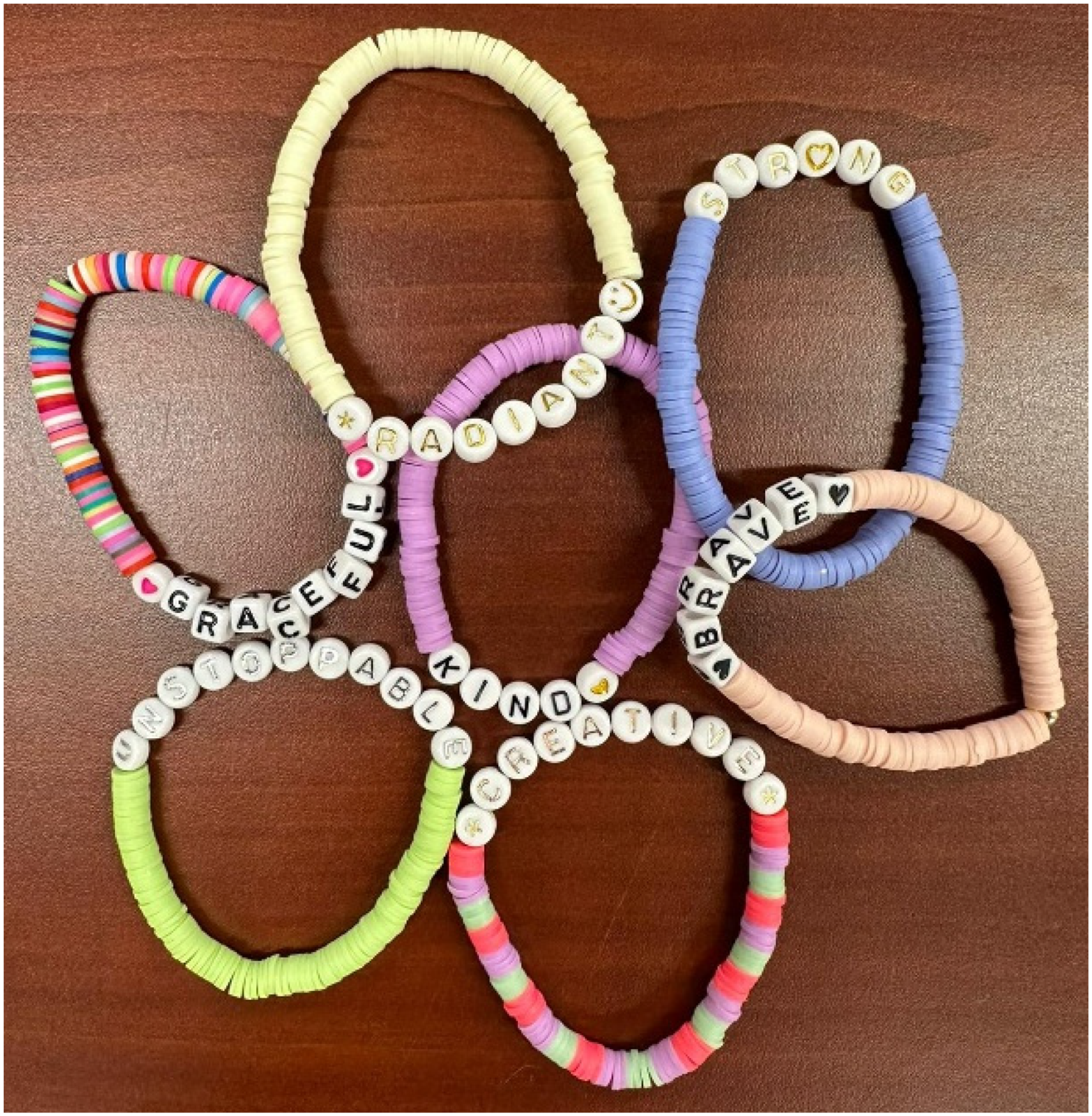
Bracelets.
After the client and mom agreed to the reflecting team activity and switched rooms with the graduate students behind the mirror, the team presented their bracelets and reflections to the client. Each student expressed their reason for the word they chose and how it aligned with the client's progress in therapy. Much of this progress focused on the client's ability to manage and overcome challenges all while remaining true to themselves and their beliefs. Meanwhile, the client was able to see and hear the team reflections on the other side of the one-way mirror. After the team shared their reflections, they were able to give the client each bracelet before switching back to opposite rooms. These bracelets were made for the client to keep as resources or positive self-reminders and affirmations. Once the client and student therapist were back in the room, the therapist shared her word and bracelet with the client. After this, the therapist prompted the client to share their thoughts on the overall experience. Some of the questions asked by the therapist were: What stood out? Did the reflections seem correct? Is there anything you agreed or disagreed with? Are there other things you would have liked to hear? Was this useful? How might these observations make a difference in your life if any?
Client Responses
The client shared their thoughts on the activity and its significance. Overall, the client expressed a positive experience and positive emotions. They provided feedback on the resonance of the words that were chosen. The client also reported how this activity could serve as a tool for them and be helpful in the future. Below is a transcript to show this impact: So, can you share with me a little bit about this activity we just did? This made me really happy, overwhelmed, and made me feel like I am unstoppable. Any words that did not resonate with you? Not really; other people have said radiant, light (spiritual). How might hearing these things today make a difference moving forward in your life? If I feel down, I can look at it. How does it feel to hear being called all these things? Self-confident
At the end of the semester, when the sessions with the client were coming to an end, the client's mom shared how it was “very powerful to hear stuff from other people; it really impacted her (client).” The mom stated that the client was “more open and communicative with me” and how the client has been able to “develop self-confidence in a new way.”
After gathering the client's thoughts on this activity, the student therapist wrapped up the session by sharing their own thoughts and answering any questions the client had. Overall, it was an impactful and creative activity for both the client and the team. The team was able to share their reflections in a manner that was unique to this client and that the client was ultimately receptive to. The client was provided with more tools and resources to utilize in and out of therapy that were unique to them.
Student Reflections
Often in the class setting, students learn theoretical models and specific interventions, but applying these ideas in clinical practice is very different from learning and talking about them. Many times, students in my (JP) internal practicum course state they have learned about reflecting teams but often have many questions about the logistics of the actual intervention. They have questions such as will this be overwhelming for the client? Will it be awkward? What can I say? What should I not say? To ensure this process was a useful learning experience for the students, I (JP) invited them to reflect on the activity. This section includes the student therapists’ and supervisor assistant's reflections on the creative reflecting team. For simplification and clarity, both the supervisor assistant and student therapists will be defined as students. Students were given several questions to reflect on. Students were not required to answer all questions and were allowed to provide reflections outside of these questions. Questions asked included the following: What was it like for you to be part of a reflecting team? What was it like for you to bring creativity into the therapy room? How did having a word to choose for the bracelet impact your experience of the reflecting team? What did you find most useful about this activity? What did you find least useful with this activity? How do you think this activity impacted the client/s? How do you think this activity could be utilized with other clients? How do you think this activity could be adjusted to be even more beneficial? How did this activity impact your learning as a student therapist? What is your biggest take away from this activity and experience?
Based on the students’ responses, the supervisor (JP) identified the following themes: rewarding, powerful impact, tool, and impact on family. Each theme will be discussed further below. Words that are italicized show the connection to the overall theme.
Rewarding
Most of the students found the exercise to be rewarding, not just for the client but also for themselves. Seeing the client and her family react to the activity in such a positive emotional way deeply touched many of the students. They saw the value to the client based on the client's emotions, behaviors, and verbalizations but also saw the impact it had on their own learning experience as therapists in training. The following excerpts highlight how the creative reflecting team with bracelets was a rewarding experience. Watching our team come together to reflect on the client and describe her in positive terms was particularly moving for me. Being part of a reflecting team was very rewarding and inspirational. I had the privilege of being behind the mirror with my client witnessing the team voice their reflections. It was rewarding to watch the physical and emotional reactions from my client as they listened and accepted the team's reflection … It was ultimately rewarding for me to witness my client be recognized for their strengths and unique characteristics that showcased their ability to stay true to their beliefs and show courage and bravery in the face of adversity. Being part of this client's journey as a student therapist was a profound honor. Our team had the privilege of witnessing her remarkable transformation … Though I had read about the significance of creativity and the reflecting team in therapy and had studied it in theory, witnessing its impact firsthand was truly eye-opening … The opportunity to observe this client's growth and then articulate our observations through a creative lens in the reflecting team was a rewarding experience as it enabled us to build on each other's insights … This experience was invaluable to my development as a student therapist. This activity has shaped my learning … by helping me see that I am able to be creative in the room with the team I am working with and watching the growth of the therapist and client happen together.
Powerful Impact
Students also found that the bracelet reflecting team had a powerful impact on the client. Overall, students found that the activity was powerful, helpful, positive, impactful, and rewarding. This helped to connect the theory to application, showing students that this type of intervention is and can be very helpful for the therapeutic process. The excerpts below show the students’ reflections on how much of a powerful impact this reflecting team had on the client. In my opinion, a structured yet genuine, positive, and conversational reflecting team experience like this could become a core memory for the young adult, one that she could draw upon in times of self-doubt or insecurity. It was very fulfilling to hear how purposeful and helpful these bracelets and the overall experience of the reflecting team was for them … My biggest takeaway from this reflecting team is how rewarding and impactful it was for the client. This simple yet powerful act allowed the client to quiet her anxious thoughts and find solace in a task that provided a welcome respite from the pressures typically associated with therapy … This exercise of choosing a word made the reflection more personal and impactful … It also fostered a deeper connection between the client and the team. This activity impacted the client by shifting the mood, tone, and overall process of therapy in shaping what the client had been working on the entire semester with her therapist. I believe this helped reinforce things that may be shared by others and shrugged off, and now feeling more solidified due to others noticing the same. It could have potentially validated all the client's efforts to continue to be the person that she wants to be.
Tool
Many students found that the reflecting team, but especially the bracelets, served as a physical, tangible tool that the client could continue to use outside of therapy. As mentioned before, each student therapist gave the bracelet they made to the client at the end of the reflecting team. The client immediately put all seven bracelets on her wrist. She discussed how she could look at her bracelets whenever she might be feeling down as a reminder of her strengths and abilities. The use of positive affirmations had been discussed earlier in the therapy process. This was now a tangible addition to those verbal affirmations. Before the reflecting team occurred, making bracelets also served as a tool to help the client feel more comfortable in the room and continue to build rapport with the therapist. The following excerpts describe the students’ reflections on how the creative reflecting team was a great tool for the client. Especially at such a formative age, this experience may have created a mental foundation of positive self-regard that she can lean on when needed. This experience felt very intimate and sacred and further strengthened the therapeutic alliance my client and I built over many sessions … It was very special to incorporate these bracelets because it was a hobby my client and I shared and a creative tool we used to help them become more comfortable in the therapy room. We made many bracelets together throughout our sessions and my client found themselves using them (bracelets) as positive affirmations and reminders for self-love … The team's reflection offered my client the unique experience of hearing these traits be validated and acknowledged by other graduate student therapists who observed them too …. This experience allowed the team to share their reflections in a manner that was positive and empowering for the client while incorporating the bracelets that served as a creative tool and resource for the client. The bracelets, in particular, offered her a way to externalize her progress and carry it with her, serving as a physical reminder of her strengths and the work she has done in therapy … creativity has the potential to break down barriers, engage clients in new ways, and provide them with tools to navigate their challenges … The act of creating something tangible can be a powerful tool for engagement, allowing clients to express themselves in a non-verbal way and to see their progress in a concrete form.
Impact on Family
The reflecting team was done in the presence of the client, her mom, and her stepfather. While the stepfather was present for this session, he was not present for any other sessions. While he had an overall positive attitude about the reflecting team, the mother showed and expressed more gratitude as she was present for many of the client's sessions and had witnessed her daughter's growth. The team recognized the impact this activity had not only on the client but the entire family system. While most of the sessions focused on the daughter, and the activity was geared toward the daughter, the mother, and stepfather were invited to participate in the reflecting team, observing with the client the teams’ reflections and processing it with the client and therapist after. The following excerpts show the students’ reflections on how this not only benefited the client but also her family. I also noticed that this experience appeared to be particularly healing for the mother … After the reflecting team session, I observed a noticeable shift in the mother's demeanor – there was an emotional release and an expression of gratitude as if the experience had alleviated some of her anxieties about her daughter's journey of self-discovery during adolescence. I believe that when the reflecting team highlighted the positive qualities shared between the daughter and the mother - acknowledging the generational continuity of these strengths - it may have provided the mother with a sense of calm and renewed confidence in her parenting. “This activity not only had a significant impact on the client but also on her family”
At the end of the semester, the family determined that sufficient progress had been made, and they successfully discharged from therapy. They expressed their gratitude for the safe environment created by the therapist, the thoughtful activity and reflections shared, and the physical reminders that they would take with them into their future.
Conclusion
The opportunity to use creativity in therapy is unlimited. It does not have to be planned in advanced; often the best creative moments are usually unplanned and unexpected. As shown here, the client introduced the topic of making bracelets and the therapist agreed, not knowing it would lead to this specific activity. While it is important to rely on our theoretical foundations and science, it is equally important to bring creativity into the room, especially when it is done for the benefit of the client. As shown throughout the student reflections, there are numerous benefits, not only for the client, but also for the therapist.
Footnotes

Funding
The authors received no financial support for the research, authorship, and/or publication of this article.
Declaration of Conflicting Interests
The authors declared no potential conflicts of interest with respect to the research, authorship, and/or publication of this article.