







Abstract
While family trends indicate that more families are having zero or one child, stigma against one-child families exists. Understanding if there are negative outcomes for only children is important to family planning in the future. Although there are a limited number of U.S. studies with the explicit purpose of examining only child outcomes, this systematic review intends to synthesize current knowledge of only child outcomes in order to better understand the context of this important trend. This review examined peer-reviewed articles and dissertations in two major social science databases (PsycInfo and Social Science Database) for all years since 1984; studies must have been: (a) written in the English language, (b) peer reviewed, and (c) conducted in the United States. 12 articles were found for inclusion. Risk of bias was assessed using the Downs and checklist. Examining only children compared to those with siblings, the results of this review find no negative outcomes for only children and even some more positive outcomes for these children, including quality of parent–child relationship, achievement motivation, more education, and strength of character. Qualitative and longitudinal research is called for to further explore non-significant differences that may exist. Limitations include limited studies found and the younger ages of most participants. The results of this review support the need for more qualitative and longitudinal research to better understand these families of the future.
The pressures of adulthood never seem to cease as humans grow into their 20s and continue into their 30s. Married life holds certain expectations for all couples, including the need to procreate. Once a family becomes three, however, the expectations continue in the pressure to “not have just one” child. In fact, one 2023 U.S. poll demonstrated that only 2% of people believe the ideal number of children is zero and 3% believe it is one; almost half of people believe two is the ideal number of children (Abrams, 2024). The assumptions that harm comes to an only child stem from the belief of the psychologist G. Stanley Hall in the 1800s that only children were “a disease in and of itself” (Abrams, 2024, para. 3). This belief, along with results from an 1896 study by E.W. Bohannon in Pedagogical Seminary, led to the concept of the only child syndrome, in which people believed that only children were selfish and socially maladapted (Sandler, 2014). This original study, which collected experiences from 200 people regarding children the researchers knew, has been criticized for its flawed methodology and biases; however, it was used alongside the observations of the children Hall saw in his clinic to uphold stigmatized beliefs regarding only children (Abrams, 2024).
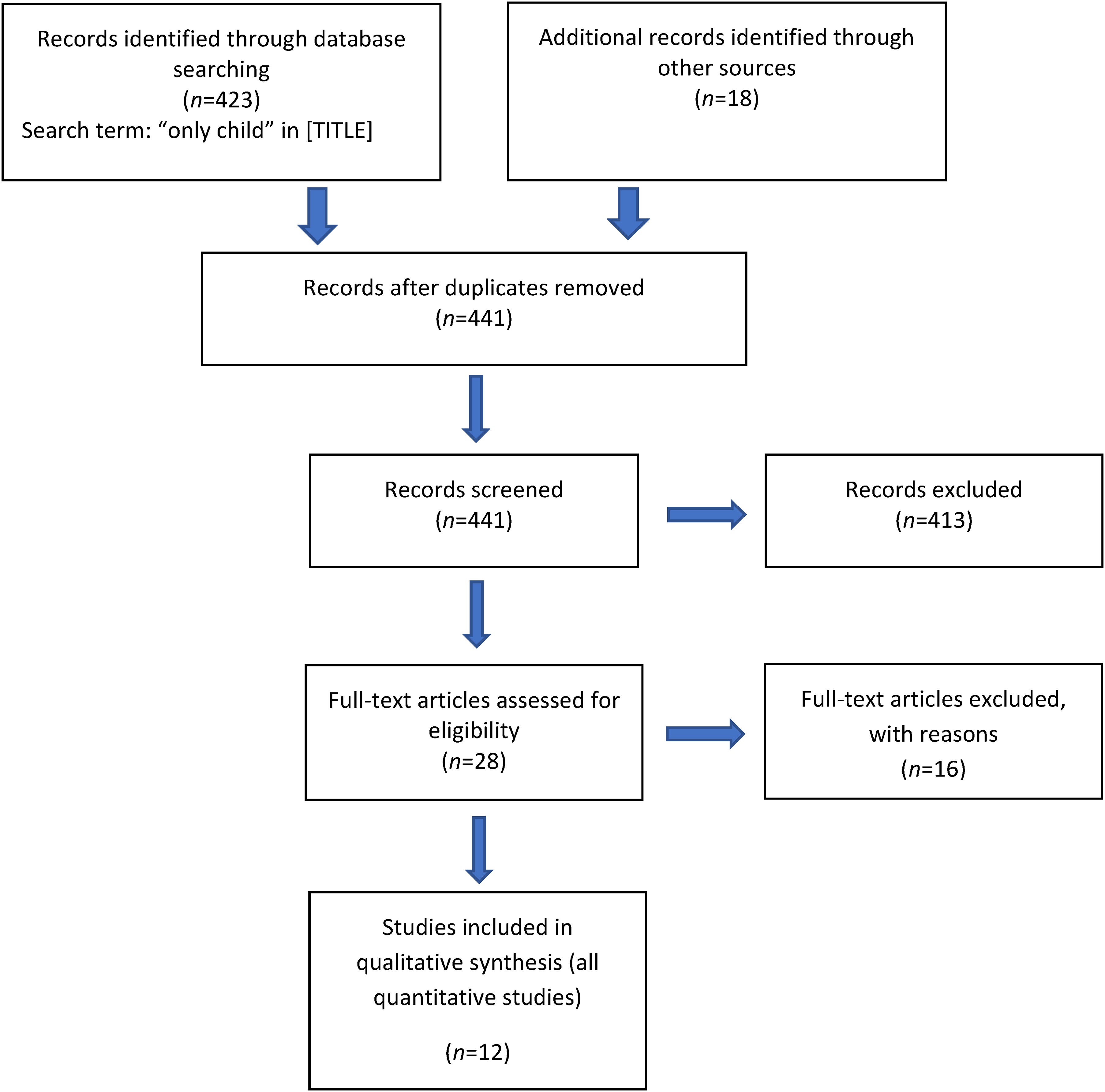
Flow diagram of study screening and selection procedures.
Researchers further report prevalent and strong views that parenthood is a natural, important part of life (Lampman & Dowling-Guyer, 1995; Mollen, 2006; Peterson, 2015). There is frequently an assumption that all people want or should want children (Blackstone & Stewart, 2012). Overall, people push others to have kids, and “just one” is not socially acceptable. Scholarship has demonstrated that this societal expectation of parenthood causes pain and feelings of inadequacy (Bell, 2013; Hansen, 2012; Peterson, 2015) along with guilt and shame (Bell, 2013).
Societal Implications for Single Child Families
Though more people are parents than in 1990 (Himes, 1992), there has been an overall downward trend in rates of procreation, with 40% of women 30–34 childfree in 2025, up from 29% in 2014 (U.S. Census Bureau, 2025). Further, 19% of women faced three or more medical barriers to childbearing in 2021—up from 16% in 2017 (Adler et al., 2023). Further, the choice to parent comes with lifelong implications, leading many singles and couples to choose having zero or one child. Identified drawbacks to having children include reduced financial security, less time, or lesser happiness (Stahnke et al., 2020). A recent Pew Research Center poll also identified that the vast majority (80%–82%) of parents assess parenting as rewarding and enjoyable, but nearly a third of parents also find it to be tiring (41%) and/or stressful (29%; Minkin & Horowitz, 2023).
Changing economic conditions mean rising costs of raising children; in 1980, the average cost of raising a child was $69,232, while the cost was estimated at $284,594 in 2017 (Sawhill et al., 2022). Further, between 2020 and 2022, costs of living increased 8.5%, further expanding childrearing costs (Bureau of Labor Statistics, 2022). To support rising costs, families have taken on more work hours, resulting in limits to the time-related resources available for their children (Sawhill & Guyot, 2021).
Given the increase in the number of families choosing to have one child, this subject is timelier than ever. The literature that does exist has examined the outcomes of only children, demonstrating no significant differences in “personality, cognition, social aptitude, or well-being” (Abrams, 2024, para. 7). What only children do get is all the resources and time of their parents—time and resources that would be split in several ways if there were siblings. Though parents may have more children with the expectation that one day they will have more people to care for them in older age, studies show that only children are more likely to provide care than those from larger families, with gender being a larger factor than the presence of siblings (Chanfreau & Goisis, 2022).
Existing Literature
Since 1979, China has had a “one-child” policy to minimize population growth (Hesketh et al., 2005); in rural areas, only parents of girls were permitted to have another child. Because China does not have a social security system, parents rely on sons for financial support in their older years. Additionally, traditional families value the passing of the family name down through boys to future generations. Given this reality, research from China has demonstrated that only children have advantages academically to multi-child families (Jia et al., 2022). Only children have been found to be equally as altruistic (Zheng et al., 2021) and narcissistic (Foster et al., 2020) as others. However, their empathy may be exceeded by second-born children (Qian et al., 2021), while other children may be more proficient in sports (Jia et al., 2022). Though data has shown an association between more siblings and less divorce rate (Merry et al., 2019), this does not account for the idea that divorces are more likely to happen in one-child families, and children are more likely to divorce if their parents have divorced.
Though slight differences have been found, data has failed to find significant differences in terms of loneliness, selfishness, or well-being. In fact, only children have consistently shown advantages academically and have been found to prefer solitude, according to data from 400,000 teenagers of Project Talent, reportedly having healthier self-relationships and having stronger relationships with their parents (Abrams, 2024). A large study that conducted six meta-analyses of 115 studies on only children, in fact, may be the strongest evidence yet, having shown that only children surpass others in the positivity of the parent–child relationship, adjustment, character, and sociability (Falbo & Polit, 1986). Regarding achievement and intelligence, they have been found indistinguishable from first-borns and those from two-child families.
Importance of and Rationale for Examination of U.S. Only Children
The past 1986 review study (Falbo & Polit, 1986) assessed outcomes and differences of only children between 1925 and 1984. By the mid-1980s, family size had declined from about 2.33 children per family in 1960 to under 2, providing application for this study. Today, this statistic holds true, and further, more families than ever are having only one child. Despite the efforts of some studies to minimize the stigma of one-child families, stigma still exists. However, given the passage of time, societal and familial changes could give way to more differences found in only children when compared to those with siblings than in the past review. Together, these reviews will summarize the scholarship of the last 100 years on the subject of only child outcomes. This research is important as 19% of families voluntarily or involuntarily have only children, and stigma remains, potentially affecting these parents and children in various aspects of emotional and mental health.
Much of the scholarship around only child families have been done out of China, where there is a history of imposed single-child families; further, the research that does exist is mostly incidental to other-purposed scholarship. Despite a possibly sufficient rate of research, that research is not necessarily applicable to the United States or only children of today's economy, society, and culture. Prior to further exploration of U.S. only children, authors first seek to understand what is currently known in the existing American scholarship. The existing review of only child outcomes, by authors Falbo and Polit (1986), reviewed quantitative literature up until mid-1984; the purpose of the current review is to summarize both qualitative and quantitative American literature since this time.
Purpose
There is no evidence to support poorer outcomes for only children when assessing the literature that does exist, which is largely older and foreign. The overarching purpose of this review is to systematically examine research of the past 40 years related to only child outcomes to better understand current outcomes within a society in which only-child families are becoming more commonplace and economically reasonable. The secondary purpose is to determine what level of evidence exists to support families with only one child and whether this may be associated with or causal of poorer (or better) outcomes, such as academically, socially, and emotionally. The specific aims of this systematic review were to examine (a) study characteristics, (b) methodological characteristics, and (c) primary findings of research that incorporated outcomes of only children in the United States. In the Discussion, the authors identify the strengths or areas for enhancement as well as the gaps in understanding outcomes of only children. There was no funding for this project, nor were there known competing interests.
Methods
Search Strategies and Procedure
To produce a sample for this study, the researchers conducted an electronic search of peer-reviewed articles from the following databases for all years, due to limited scholarship: PsycInfo (298 articles) and Social Science Database (125 articles). Databases were selected for their scope in social science literature. The researcher was interested in the relationship between only children and later life outcomes of all kinds, found using only the search term “only child.” Articles had to be peer reviewed within the United States, and participants were required to be only children. Authors further looked for literature that looked at various outcomes for only children, including IQ, academics, social skills, health, etc. Reference lists from prior articles were also examined for additional studies.
Inclusion and Exclusion Criteria
As studies found prior to 1984 were included in the previous systematic review on this topic, authors decided to include articles since that point here (Falbo & Polit, 1986). Studies must have been: (a) written in the English language, (b) peer reviewed, and (c) conducted in the United States. Authors originally chose to include Canadian studies, but none were found. In addition, any article that included the variables of only children and outcomes was included in this study even when the article’s purpose was to examine other relationships or variables. Quantitative and qualitative studies were included in the search. Articles written in foreign languages or examined domains different from only child outcomes were excluded. One dissertation was attained and due to limited literature, was included. The previous 1986 review (Falbo) was included to summarize past literature but not as one of the 12 articles.
Study Selection and Review Procedure
Twelve articles were included in the final review. During the initial search, 423 articles were included for review, plus 18 articles that were identified through other sources. As there were no duplicates, these 441 studies were screened by reviewing the titles/abstracts for content that examined only any child outcomes. Most studies were eliminated due to being outside of the United States and/or not reporting outcomes of only children. Subsequently, 28 studies were included in the full-text review. During the second round of review, the final 28 articles were examined more closely and excluded if they violated any of the inclusion criteria. Inclusion and exclusion criteria were assessed independently by the first two authors, with comparisons and discussions thereafter to ensure accuracy. This removed 16 articles from consideration, for reasons including lack of only child outcomes and country of study. The data was extracted from each article by the second and third authors, and all data was verified by the first author. A systematic review of the literature was conducted in accordance with the Preferred Reporting Items for Systematic Reviews and Meta-Analyses (PRISMA) 2020 guidelines (Page et al., 2021). Quality was assessed using the Critical Appraisal Skills Program, with 10 studies being assessed as high quality and two being moderate. Risk of bias was assessed using the Downs and checklist (PLoS One, 2020) by two authors. See Figure 1 for flow chart.
Coding Procedures
The 12 remaining studies were systematically coded across multiple aspects of the study, including characteristics of the study and study setting, participant/sample characteristics, design, and outcomes (Cooper, 2010). The first author reviewed studies prior to manuscript production and consulted with the second author to produce the codebook. The coding procedure was randomly piloted using three studies selected from the total sample and then edited to eliminate unused and expand coding criteria items. This revised codebook was utilized with remaining studies, and after the second round of coding, researchers met and determined the final codes to ensure all codes were represented. All relevant outcomes were coded for each study. The first author of this study served as an independent coder for each coding stage while the second author consulted on intended codes and verified once they were documented in the tables (before writing up the Results).
Results
Twelve articles were included in the final synthesis: 11 quantitative and one qualitative. One was a meta-analysis. The qualitative article was a dissertation. Included studies are marked with an * in the References list.
Study Characteristics
Purpose
All but one of the studies (n = 11) in this review sought to examine if there were differences between only children and non-only children, though those differences vary across academics, personality, social skills, and various areas of well-being. One study (Mellor, 1990) further had the purpose of testing these dimensions as a validation of the results of a past review of six meta-analyses (Falbo & Polit, 1986). The small, qualitative study looked at experience differences, particularly strengths and challenges, of only children (Roberts, 1997).
Three studies looked at the level of narcissism present in only children comparatively (Eyring & Sobelman, 1996; Foster et al., 2020; Watson & Biderman, 1989), with one looking at predicting narcissism based on status (Watson & Biderman, 1989) and the other two looking at what the relationship is between narcissism and birth order. Three studies looked at the social skills of only children and non-only children (Kitzmann et al., 2002; Polit & Falbo, 1987; Riggio, 1999). Two studies looked at personality differences among other factors (Polit & Falbo, 1987; Riggio, 1999). Development (Mellor, 1990), educational achievement (Travis & Kohli, 1995), psychological well-being (Glenn & Hoppe, 1984), autonomous functioning (Byrd et al., 1993), and likelihood of divorce (Bobbitt-Zeher et al., 2016) were also examined. Polit and Falbo (1987) looked at dimensions of motivation toward achievement, personal control, and adjustment along with the above aspects of only children.
Sample
Among the studies, sample sizes ranged from 20 to 57,000 total participants. Six articles included university students (Byrd et al., 1993; Eyring & Sobelman, 1996; Foster et al., 2020; Mellor, 1990; Riggio, 1999; Watson & Biderman, 1989). Mellor (1990) also looked at K-12 students, as did Kitzmann et al. (2002). Additionally, one article analyzed surveys of the general population (Glenn & Hoppe, 1984), one looked at 40 years of random sampling in the general population within the General Social Surveys (GSS) (Bobbitt-Zeher et al., 2016), and one analyzed the general population of California (Travis & Kohli, 1995). Another article included people aged 20–29 that were associated with the University of Tennessee-Knoxville through a convenience sample (Roberts, 1997). One article was a meta-analysis of 141 studies that included only children of all demographics (Polit & Falbo, 1987). All studies included both men and women; however, none seemed to report on gender identity or sexual orientation. Studies showed some variation in terms of targeted age groups. One study focused exclusively on elementary-aged children (ages 5–11; Kitzmann et al., 2002), while another included participants from early childhood through adulthood (ages 3–adult; Polit & Falbo, 1987). One study looked at junior high, high school, and college students aged 11–19 years of age (Mellor, 1990). The remaining articles included a wide range of adults (ages 18–46).
Studies examined different variables. Two included parental marital status (Bobbitt-Zeher et al., 2016; Eyring & Sobelman, 1996), five included sibling position or birth order (Byrd et al., 1993; Eyring & Sobelman, 1996; Glenn & Hoppe, 1984; Kitzmann et al., 2002; Travis & Kohli, 1995), four included race (Byrd et al., 1993; Eyring & Sobelman, 1996; Roberts, 1997; Travis & Kohli, 1995), and three included socioeconomic status (Bobbitt-Zeher et al., 2016; Polit & Falbo, 1987; Travis & Kohli, 1995) as variables. All studies used U.S. samples.
Methodological Characteristics
Design and Data Sources
In this review, none of the included studies utilized experimental design or random sampling. Of the three studies using secondary datasets, Travis and Kohli (1995) used data from the 1979 Adult Life Cycle Project, a stratified random sample, from California city blocks based on its census. The other two studies used data from national surveys: (a) seven U.S. national surveys, the 1973–1978 and 1980 GSS conducted by the National Opinion Research Center (Glenn & Hoppe, 1984); and (b) the GSS from 1972 to 2012 collected via phone interviews (Bobbitt-Zeher et al., 2016). One study was a review of other meta-analyses, including 141 total studies, all which included a measure of a personality trait as an independent variable and a measure of parent–child relations as a dependent variable (Polit & Falbo, 1987). The remaining eight studies in this review were convenience samples through school affiliations (Byrd et al., 1993; Eyring & Sobelman, 1996; Foster et al., 2020; Kitzmann et al., 2002; Mellor, 1990; Riggio, 1999; Roberts, 1997; Watson & Biderman, 1989).
In Mellor (1990), data was collected in the high school participants’ “homeroom” class in random order. With Kitzmann et al. (2002), a university-affiliated “laboratory school” provided student demographics and setting whereby teachers disseminated in-person, written surveys where sibling information, group social preference and acceptance scores were collected. Group social preferences were attained by students circling their top three favorite and least favorite classmates on a complete class roster, while acceptance scores were collected via a 6-point Likert scale visualization using glasses with increasing amounts of liquid. In another study (Foster et al., 2020), undergraduate students enrolled at a medium-sized university in the Southeastern United States completed demographic information and two measures of narcissism: the Narcissistic Personality Inventory (NPI) and the Grandiose Narcissism Scale (GNS); however, there was no mention of whether data was gathered via paper and pencil or electronically. Also taking a focus on narcissism, Eyring and Sobelman (1996) administered the NPI along with a demographic survey to organize participants into groups by birth order. Riggio (1999) had participants complete the Social Skills Inventory (SSI) and Eysenck Personality Questionnaire, but there is also no mention of whether the surveys were completed on paper or electronically.
For the dissertation, Roberts (1997) conducted open-ended, in-person interviews with participants that included 12 questions, with two possible additional questions if participants lived in a single-parent household. Travis and Kohli (1995) used self-administered surveys, distributed to participants in their homes for completion, though the details of the questionnaire were not shared and likely unstandardized. Another study (Watson & Biderman, 1989) had participants note the number of their siblings while responding to several questionnaires, including the NPI, Narcissistic Superiority Scale, and a third instrument measuring perceptions of parents as permissive. In their study, Byrd et al. (1993) combined biological information, the Independence Scale on the California Psychological Inventory, and the Family Adaptability and Cohesion Evaluation Scales (FACES III) into packets to distribute to participants for completion.
Data Analysis
The included articles were primarily quantitative, utilizing a range of variance analyses, regression models, and independent sample t-tests, whereas the lone qualitative study was a dissertation employing Integrative Thematic Coding (Roberts, 1997). Mellor (1990) used orthogonal planned comparison t-tests to compare gender, birth order, and family size for only children, first-borns, and later-borns. Foster et al. (2020) also used t-tests to look at narcissism rates across groups. Three studies used regressions to test differences (Bobbitt-Zeher et al., 2016; Glenn & Hoppe, 1984; Travis & Kohli, 1995), one being logistic regression to test likelihood of divorce across only children (onlies) and non-only children (non-onlies) (Bobbitt-Zeher et al., 2016) and one linear multiple regression to test varying educational achievements (Travis & Kohli, 1995). Two studies used ANOVA to determine differences between birth order groups (Byrd et al., 1993; Eyring & Sobelman, 1996) on various factors, while Riggio (1999) used MANOVA to look at sex differences across social skills and personality for onlies and non-onlies. One study used two MANCOVAS to look at aspects of acceptance by peer group and friendship quality (Kitzmann et al., 2002), while another used ANCOVA to control for demographic variables (Foster et al., 2020).
Though unclear, one study appeared to have used a correlation to determine a relationship between narcissism and only child status (Watson & Biderman, 1989). Finally, the review study looked at the calculated effect sizes of the 17 meta-analyses included (Polit & Falbo, 1987).
Primary Findings
Testing the same hypotheses of a previous review, Mellor (1990) validated that only first-borns were found to not be significantly different in developmental outcomes, such as achievement and intelligence, from those in small families, also testing for variances of birth order. They also surpassed all non-only borns in character, especially people from families with three or more children, and they surpassed all non-only borns, especially those from large families, in the positivity of the parent–child relationship. A review of 141 studies that looked at 17 different personality dimensions found that only children fared significantly better than other groups in achievement motivation and personal adjustment while finding no significant differences in other dimensions, including contentment, leadership, autonomy, extraversion, and relations with parents (Polit & Falbo, 1987). Each dimension included between six and 32 studies that looked at that factor. Riggio (1999) also looked at aspects of personality, finding various differences by sex but no differences in social skills or competence areas in only children versus non-only children, except in one area: neuroticism, with onlies being slightly more neurotic than those with siblings. However, the study has the limitation of only including 51 individuals without siblings and reporting these results as “not statistically significant,” causing the authors of this review to deem this less reliable than results of the two reviews above, which indicate no higher neuroticism.
Similarly, a study of 139 elementary children showed similar results of friendships for both groups, but onlies were found to be less liked by peer groups as well as more aggressive (Kitzmann et al., 2002). Another study found that first-born children were more independent than only children, but last-borns were not (Byrd et al., 1993). One study that looked at likelihood of divorce for only children found that, among those who ever marry, each additional sibling is associated with a 3% decline in the likelihood of divorce (Bobbitt-Zeher et al., 2016).
Three studies looked at aspects of narcissism in only children, finding in all three that higher narcissism is not related to being an only child in the United States (Eyring & Sobelman, 1996; Foster et al., 2020; Watson & Biderman, 1989). Other findings indicate the advantages of being an only child: Travis and Kohli (1995) found that only children were significantly more likely to have more years of education than non-only children.
In the earliest study here, only children were not found to have different psychological well-being in adulthood than non-onlies (Glenn & Hoppe, 1984). In fact, though authors were not confident in its significance, onlies were found to have better psychological well-being than those with siblings. Finally, the qualitative interview study here found that adult only children were balanced in their views of their status, with acceptance, enjoyment of time alone, and close relationships with parents, while earlier maturity, lacking help when parents are older, and pressure to succeed being challenges (Roberts, 1997).
Discussion
Almost all only child research is conducted in China, where only children make up a large portion of the population. This review took up where another U.S. review left off in 1984 (Falbo & Polit, 1986) to understand the outcomes of only children for the last 40 years. The consensus of the above studies is consistent with the previous review of only child outcomes: there are no significant negative differences between only children and non-only children, despite some more nuanced differences found at times.
Study Characteristics
Each study looked at various types of differences in only children, including narcissism, social skills, personality differences, development, educational achievement, psychological well-being, autonomous functioning, and likelihood of divorce, finding almost no differences across outcomes. Narcissism, in particular, is examined in one fourth of the studies with a lack of evidence found for this idea; therefore, these authors believe the relationship between narcissism and being an only child can be eliminated as a reality. The prevalence of this idea validates the bias that exists that onlies are more egocentric, despite research disputing this as fact.
Though the studies looked at all age groups, which strengthens the finding that onlies are not generally different than those from bigger families across the lifespan, only one study (Travis & Kohli, 1995) utilized a non-student sample, emphasizing a limitation in that older adult participants were not widely used. Further studies should also mainly include adult age groups of non-college ages to more thoroughly examine later-life outcomes of onlies. Many studies did not include relevant demographic variables, which limits generalizability. For example, there was a clear lack of inclusion of minority groups, so conclusions from these studies may not accurately apply to a broader or more marginalized population. We need more studies to examine the socio-economic class of parents of only children, especially when measuring education outcomes, as parental resources and opportunities may skew outcomes. Further, studies examining sociability and peer relationships should account for the geographic and cultural context of participants. For example, rural communities have more emphasis on community, whereas cities, such as New York, are more individualized. These differences can impact how children, especially only children, interact with their peers.
Methodological Characteristics
Due to changes in economic opportunities and social ideals of U.S. families over time, only children are a fluctuating and challenging population to acquire in research. Due to this challenge, three of the 12 studies used secondary datasets, which may or may not provide data that applies directly to the number of children in a household. Though convenience samples were beneficial for acknowledging the common outcomes between onlies and non-onlies, it further limits generalizability.
Due to most of the articles using variance analysis to compare onlies to non-onlies, further research should include a variety of methods to increase the types of questions that can be answered. While three studies were secondary data analyses (Bobbitt-Zeher et al., 2016; Glenn & Hoppe, 1984; Travis & Kohli, 1995), Polit and Falbo (1987) were able to maximize the different outcomes in the only child experience by reviewing 141 studies. Robert's (1997) qualitative dissertation was the only study design able to hold space for the actual only child experience. Since preliminary evidence exists to reject the assumptions of deficit that can be attributed to onlies, future studies should focus on the nuance of their experiences, and how that may contribute to perceived or nonsignificant differences between non-onlies and onlies.
Primary Findings
Part of the purpose of this review was to summarize U.S. findings of only child outcomes in the last four decades, understanding that outcomes may differ from previous and international research. Though realistic to assume differences between only children of the past and those of today exist, these findings are consistent with the past review (Falbo & Polit, 1986). Most of the research has indicated either advantages or neutrality to the position of the only child. Across these articles, strength of character and the parent–child relationship (Mellor, 1990), achievement motivation (Polit & Falbo, 1987), personal adjustment (Polit & Falbo, 1987), number of years of education (Travis & Kohli, 1995), and psychological well-being (Glenn & Hoppe, 1984) were higher in onlies.
Despite one study indicating slightly higher neuroticism (Riggio, 1999), the strength of another study that finds no higher neuroticism in onlies (Polit & Falbo, 1987), which included 17 meta-analyses, causes these authors to exclude the significance of this finding. Further, the two studies that indicated potential negative outcomes for only children were some of the smallest samples in this review (Kitzmann et al., 2002; Riggio, 1999). Kitzmann et al. (2002) found that only children were more likely to be aggressive with peers as well as more likely to be victimized by peers. As those who are victimized are also more likely to be aggressive offensively and defensively, these findings together make sense. This study used elementary school children who are still very young, developing, and unlikely to represent permanent, long-term outcomes of onlies. Further, at this age, these children are still likely to have siblings in the future, detaching these outcomes from those of onlies. Mostly due to the age of participants, this study is the least likely to show true outcomes this review is aiming to capture, though it is possible that it indicates less early social skills in onlies.
Another study found that onlies are less independent when compared to first-born children but equally independent to other children (Byrd et al., 1993). Given the group differences, this is more likely to indicate a higher independence in first-borns above all others rather than a lower independence in onlies or other groups. One study that looked at likelihood of divorce for only children found that, among those who ever marry, each additional sibling is associated with a 3% decline in the likelihood of divorce (Bobbitt-Zeher et al., 2016). Though this correlation seems to be supported in the strength of this study, current authors believe it to be correlational and not causational. A third variable—the lesser likelihood of struggling marriages to divorce when there are more children in the household—is likely to be at play. Further, this study looks at divorce over a 40-year period from 1972 to 2012, whereas earlier in this period, families were likely to be larger and also less likely to divorce at this time in history, and vice versa.
Despite potential for higher neuroticism and lower sociality in young years, supported and emphasized by the balanced conclusions of the qualitative interviews (Roberts, 1997), the positive outcomes for onlies seem to far outweigh these findings. Further, in dozens of aspects of personality, differences have not been found. The main assumption that outside society tends to make, indicated in the rate of studies testing it, is that only children are more narcissistic than others. All three studies in this review that tested this failed to find any significant differences in narcissism of onlies versus other groups (Eyring & Sobelman, 1996; Foster et al., 2020; Watson & Biderman, 1989). Given the fact that these findings align with the past review study (Falbo & Polit, 1986) as well as Chinese research that exists, it seems to indicate that the benefits to and lack of other differences in onlies are not bound by time or culture.
Theory
The rationale for the findings that are had includes that parents as humans only have so many resources to give, and for each child produced, those resources are divided, sometimes leading to less resources than an individual child requires for physical, emotional, and mental health throughout childhood. According to Parent–Offspring Conflict Theory, most parents aim to give each offspring the same amount of each type of resource while children are demanding that they receive more than that share (Trivers, 1974). These authors theorize that with one child, many of these conflicts are eliminated, which will lead to many effects, some of which are positive.
In addition to the number of children in a family, birth order appeared to be important. Studies found that only children were essentially similar in all outcomes to first-borns, supporting the idea that there is less conflict for resources for both of these groups as they are the children who, at birth and until a sibling is born, receive all of their family's resources. Though first-borns do not get this advantage permanently, generally, the positive effects may be had by the time a sibling is born. Less advantages of being older in a family or being the only child may be why younger siblings in families generally are found to have more mental health concerns (Bjørngaard et al., 2013; Easey et al., 2019).
Limitations
A number of limitations exist for this review. All but one (Roberts, 1997) study utilized quantitative analyses, while all but one (Bobbitt-Zeher et al., 2016) were cross-sectional, which limits a more in-depth understanding of the relationship between development outcomes and sibling status. Several studies were not clear in data collection and analysis methods used, making it difficult for authors to assess the quality of the study. Another limitation was that very few articles met the inclusion criteria due to the lack of published research in this area, so authors included any papers within the time frame that looked at any outcomes of only children. Finally, given that many articles looked at younger aged participants, such as children and university students, these papers may be capturing dimensions of self that are still changing and not capturing outcomes that are yet to be final until further into adulthood.
Recommendations for Future Research, Policy, and Practice
Additional longitudinal research is needed to see how outcomes of only children may change across different contexts and conditions. Only one study was qualitative, and given how individual experiences may affect outcomes for only and non-only children, more qualitative work may help to understand further why and how differences do exist. Given that stigma is reported to still exist against single children and their families, dissemination of research into the public eye is vital. Though it may be reasoned that the passage of time between this review and the 1986 review could mean changes in societal perception and attitudes, this was not supported by the findings.
This research may be particularly useful for medical or behavioral health practitioners working with onlies or parents of onlies to minimize the negative and maximize positive outcomes. Qualitative work specifically can more deeply examine the experiences of these individuals and identify what factors (beyond sociodemographic) may explain potential differences, as well as explore what can be done to improve the outcomes of these individuals. Looking at the experiences of parents of onlies may also capture aspects of these families that cannot be gathered from the onlies themselves. Despite literature indicating differently, stigma is reported to exist for parents who have one child and for people who are an only child. The effects of such stigma have not been explored much in scholarship. Questions such as the following may be useful in further understanding this phenomenon: (a) How have your feelings of well-being about your life without siblings changed at different points in your life? (b) How much of your experience is based on your sibling status and how much is based on unique aspects of your family? (c) Have you encountered stigma due to being an only child? (d) What are some negative and positive aspects of being an only child? Consideration for policy may include financial incentives to families who choose to have one child to fully embrace the positive outcomes which are had by these families, further evidenced by academic and financial successes in areas of China, sufficiently displayed in research.
Conclusion
The results of this review fail to find significant negative outcomes for only children when compared to children with siblings. Despite the lack of negative outcomes, some positive outcomes have been found, including quality of parent–child relationship, achievement motivation, more education, and strength of character. These findings align with the past 1986 review study (Falbo & Polit, 1986), and together, these reviews summarize the scholarship of the last 100 years on the subject of only child outcomes. This research is important as more families are voluntarily or involuntarily having only children, and stigma remains, potentially affecting these parents and children on various emotional and mental levels. Qualitative and longitudinal research is called for to further explore non-significant differences that may exist. Despite the limited research that exists in the United States, given its alignment with the findings in other countries as well as across time, these authors believe that enough exists to refute significant differences between onlies and other children, though there may be positive outcomes had by onlies in comparison.
Footnotes

Funding
The authors received no financial support for the research, authorship, and/or publication of this article.
Declaration of Conflicting Interests
The authors declared no potential conflicts of interest with respect to the research, authorship, and/or publication of this article.