






Abstract
Generative artificial intelligence (AI) is increasingly appearing in couples’ help-seeking for relationship advice, communication support, and emotional support before or between therapy sessions. This shift brings new opportunities and ethical challenges for marriage and family therapists, counselors, and counselor educators. This conceptual article frames generative AI as a low-barrier relational bridge that can support structured communication practice, reframe escalatory language, provide psychoeducational resources, and reinforce therapist-guided interventions. However, AI is not a substitute for empathetic presence, systemic understanding, or clinical judgment in situations involving trauma, power imbalances, or safety risks. Guided by the American Association for Marriage and Family Therapy Code of Ethics, the article introduces the Relational Bridge Model, a framework for ethically integrating AI as a supplement, not a substitute, for therapy. The model identifies when AI may be clinically useful, when it may undermine relational work through triangulation or depersonalization, and what safeguards are necessary, including informed consent, transparency agreements, risk screening, and therapist oversight. A composite case illustrates potential benefits and risks, followed by implications for practice, counselor education, and supervision.
Keywords
Some couples now consult generative artificial intelligence (AI) tools for relationship advice or between-session communication support before entering therapy or while deciding whether to seek professional help. In a qualitative study, Vowels et al. (2024) engaged 20 participants in a single-session relationship-support intervention and determined that these tools are often helpful in structured, low-intensity support. Similarly, a mixed-methods study by Luo et al. (2025) of 270 adults who regularly used ChatGPT for emotional and mental health support found that many participants used it for interpersonal and relational concerns and that most found it at least somewhat helpful, while also noting limitations such as superficial emotional engagement and limited professionalism. Taken together, these findings suggest that AI-mediated relationship support is an emerging help-seeking behavior rather than a purely speculative possibility. This variability underscores the importance of counselors assessing clients’ AI exposure and preferences. Because clients vary in their exposure to and comfort with AI, counselors should assess use and preferences rather than assume uniform acceptance. At the same time, professional guidance emphasizes that AI should supplement, not replace, clinical judgment and the therapeutic relationship (American Counseling Association [ACA], 2024a, 2024b).
To concretize these claims, it is useful to consider how some AI-supported functions align with empirically supported predictors of couple stability. For instance, AI tools that facilitate drafting apologies and rehearsing difficult conversations correspond to the principle of repair attempts, a key mechanism for interrupting negative interaction cycles and supporting relational stability (Gottman, 1994; Gottman & Silver, 1999). When used in bounded, therapist-guided ways, such tools may help some couples prepare for difficult interactions and support clearer expression of needs without substituting for direct relational engagement.
This trend presents a practical clinical dilemma for marriage and family therapists (MFTs). AI can expand access to psychoeducation and communication tools for couples who face barriers such as cost, stigma, or geography. However, it may also amplify relational risks. These risks include validating one partner's narrative without adequate context, encouraging avoidance of vulnerable engagement, or mishandling trauma, coercion, and safety issues (Lawrence et al., 2024; Miner et al., 2016). Such concerns are especially important in couples therapy, which involves multiple clients and requires attention to confidentiality and competing perspectives (American Association for Marriage and Family Therapy [AAMFT], 2015). From an attachment-informed perspective, couples with secure attachment patterns may use AI to strengthen their communication and understanding. Couples with insecure attachment patterns might seek AI as a structured support for communication, but may also be prone to use it mainly to regulate distress or to avoid direct interaction with each other. These are clinically informed hypotheses rather than established empirical conclusions (Johnson, 2019; Mikulincer & Shaver, 2016). This article offers an ethically bounded framework for integrating generative AI into couples counseling as a relational adjunct, not a substitute for therapy. Despite increasing discussions about AI in mental health care, there is limited guidance for MFTs on how generative AI acts as a third entity within couple systems—especially regarding triangulation, secrecy, and alliance management.
Defining Generative AI and Clinically Relevant Modalities
Generative AI refers to computational systems that produce new content, usually text, from large datasets. Most consumer-facing tools are large language models (LLMs) accessed through chat interfaces like ChatGPT and Claude. These systems do not possess consciousness, values, or empathy. Instead, they generate plausible language outputs based on probabilistic pattern matching. In counseling, this distinction matters. Couples may experience AI responses as relationally meaningful even though the system cannot provide genuine empathy or accountable clinical judgment (Lawrence et al., 2024).
Natural Language Processing
Natural language processing (NLP) refers to methods that allow computers to analyze, summarize, and generate human language. In mental health, NLP tools may help support language-focused tasks such as organizing text, summarizing written material, and identifying recurring linguistic patterns. However, their outputs require careful clinical interpretation and oversight (Lawrence et al., 2024). When used in therapist-facing tools, NLP can organize client-provided text, such as journal entries or check-ins, and highlight themes or escalation markers (e.g., absolutist language such as “always” or “never”). In couples counseling, NLP outputs are descriptive indicators—not conclusions. Therapists interpret patterns within systemic formulations, including attachment, culture, stress, power, and context.
Large Language Models
LLMs are generative systems trained on large text datasets that can produce coherent dialog, summaries, and structured prompts. Emerging research suggests that, under therapist guidance, LLMs may support mental health practice in bounded ways, including psychoeducation, structured skills rehearsal, and drafting language for clinical or educational purposes, while remaining limited by risks or bias, inaccuracy, and overgeneralization (Lawrence et al., 2024). In couples counseling, LLMs may assist with skills rehearsal by generating examples of reflective listening, soft startup language, repair attempts, and needs-based statements. They may also assist with drafting psychoeducational handouts or between-session exercises for therapist review. However, LLMs should not be relied upon to assess risk, diagnose problems, or arbitrate relational disputes, and their use should remain subordinate to therapist judgment and ethical oversight (ACA, 2024a, 2024b; Lawrence et al., 2024).
Conversational Agents and Chatbots
Conversational agents, or chatbots, are interfaces that combine generative language with rules, boundaries, and sometimes escalation pathways. Research on conversational agents in health and mental health settings suggests that they may provide accessible, low-intensity support for structured interactions, but their usefulness depends on the context, scope, and level of clinical oversight (Lawrence et al., 2024). In couples counseling, chatbots are most appropriate when restricted to low-acuity skills practice, such as guiding turn-taking or prompting validation statements. Couples should understand that the tool is not a crisis resource. Earlier studies found inconsistent responses to disclosures involving mental health crisis and interpersonal violence, accentuating the need for caution in safety-relevant domains (Miner et al., 2016).
How Generative AI Can Help as a Supplement in Couples Counseling
In clinical settings, generative AI may enter couples counseling through two primary pathways: (a) client-initiated use prior to intake or between sessions, and (b) therapist-recommended use as a structured, time-limited adjunct like homework support, when appropriate. The functions described below can apply to either pathway. Clinicians should consider each client's preferences, access, and fit before recommending AI tools. They should avoid assuming that AI use is present or wanted.
To operationalize therapist-in-the-loop use of generative AI in couples counseling, Table 1 presents therapist-curated examples, not validated prompts, along with their intended clinical purpose, appropriate use conditions, contraindications, and required in-session debriefing questions. These prompts are intended as structured practice aids rather than therapeutic interventions, diagnoses, or substitutes for clinical care. Their use assumes informed consent, transparency between partners when clinically appropriate, routine in-session debriefing, and ongoing therapist responsibility for appropriateness, confidentiality, and interpretation consistent with the AAMT Code of Ethics (2015; see Table 1).
Therapist-Curated Generative AI Prompts.
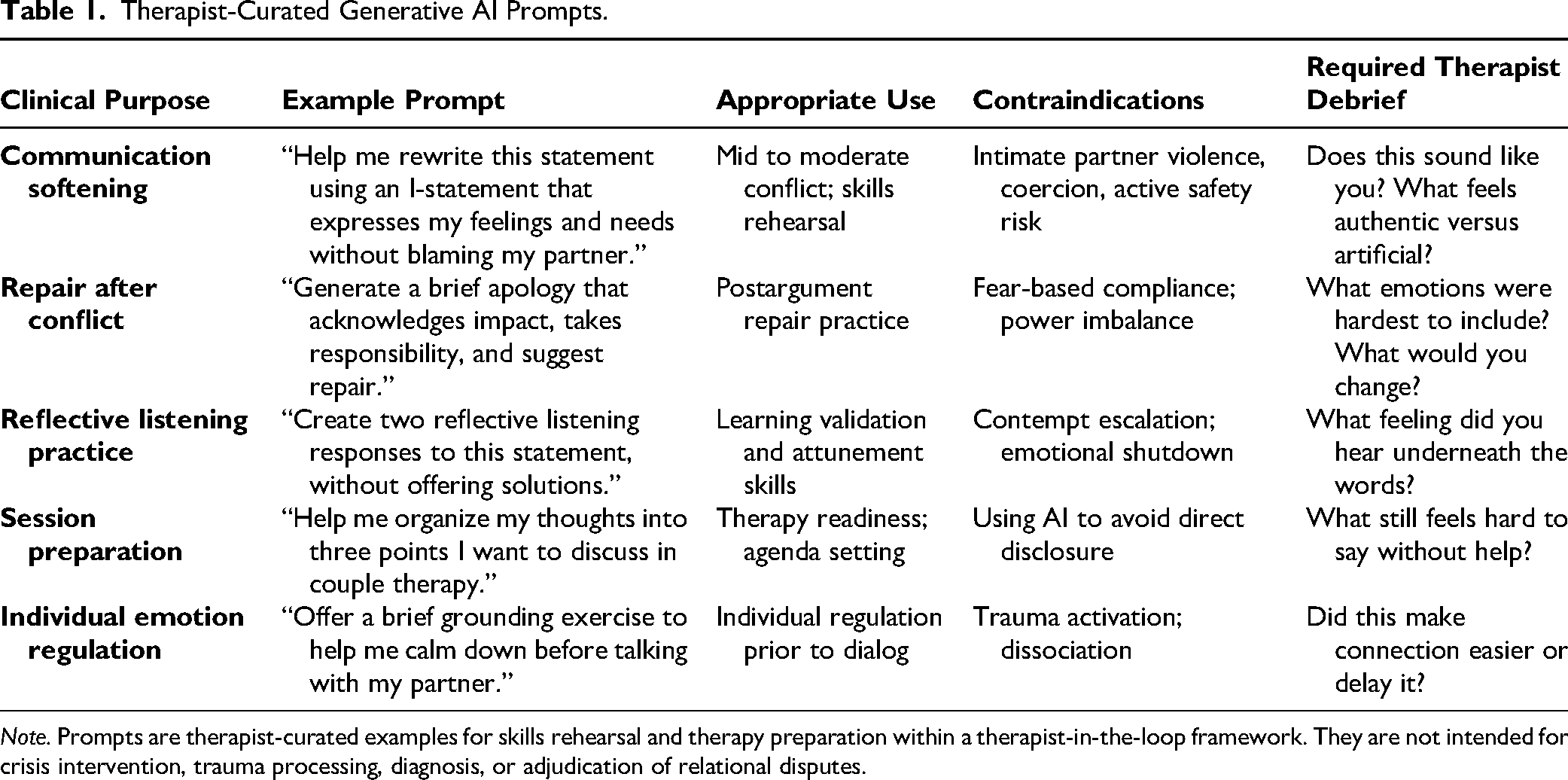
Note. Prompts are therapist-curated examples for skills rehearsal and therapy preparation within a therapist-in-the-loop framework. They are not intended for crisis intervention, trauma processing, diagnosis, or adjudication of relational disputes.
Communication Practice and Skills Rehearsal
Generative AI can support communication practice by offering structured templates and role-based rehearsal. For example, couples may use AI to generate an apology framework (i.e., acknowledgment of impact, responsibility, and repair plan) or to rephrase escalatory statements into needs-based language. When used collaboratively by both partners, these tools may support clearer expression of concerns and, in some cases, reduce perceived defensiveness, consistent with findings that users experience AI-generated relationship guidance as helpful in structured contexts (Vowels et al., 2024). Clinically, AI is best positioned as a workbook-like supplement that supports the practice of therapist-selected skills rather than providing independent interpretations of relationship meaning.
Therapists can track communication patterns over time to assess the effectiveness of AI. For example, a decrease in harsh startups and an increase in partners noticing and responding more positively to each other's bids for connection may suggest that the couple is interacting in less adversarial and more supportive ways. These interactional processes have been repeatedly associated with relationship satisfaction and stability (Gottman, 1994; Gottman & Silver, 1999).
Initial Exploration and Therapy Readiness
AI tools may offer a low-cost entry point for couples who are ambivalent about therapy or who face access barriers. In early exploration, generative AI may help partners clarify emotions, organize concerns, and identify potential next steps for therapy. This aligns with Luo et al. (2025), who found that individuals frequently use ChatGPT to interpret emotional experiences and guide subsequent actions. As part of this exploratory process, AI may also support partners in articulating shared goals for therapy (e.g., reducing escalation, rebuilding trust, strengthening friendship) and in generating questions or topics they wish to bring into intake, without replacing therapist-led assessment or goal setting. This role may be most appropriate when relational distress is mild to moderate and when there are no indicators of coercion, violence, or acute safety concerns. Counselors can frame this use as preparation that increases readiness for professional services rather than as a substitute for therapy.
Resource Generation and Relationship Maintenance
Generative AI may rapidly generate psychoeducational summaries, communication exercises, and ideas for relationship maintenance (e.g., weekly check-in agendas, appreciation prompts, or shared meaning activities). When counselors review and tailor these resources, AI may reduce administrative burden and improve between-session follow-through. Professional guidance remains essential because generic advice may not fit a couple's cultural values, relational history, or clinical context (Lawrence et al., 2024).
Therapist-Aided Reflection on Patterns
When used by therapists with explicit consent and appropriate privacy safeguards, generative AI may assist with organizing themes from structured client materials (e.g., journaling or session preparation exercises) and identifying repeated language patterns that reflect escalation or withdrawal (e.g., blame, contempt, defensiveness, or stonewalling). In practice, this use may resemble analytic tools that support case formulation; the therapist reviews AI-generated summaries as provisional hypotheses and integrates them into systemic assessment and treatment planning rather than treating them as independent clinical interpretations. Consistent with counseling guidance, AI-assisted analytics should be continuously evaluated for accuracy, appropriateness, and potential bias, with professional judgment remaining central to interpretation and intervention (ACA, 2024a; Lawrence et al., 2024). To embed cultural humility in pattern analytics, therapists may consider prompts that question whether language “red flags” signal cultural style rather than pathology. These reflections can safeguard against biased interpretations of AI-flagged patterns and prompt therapists to consider whether language differences reflect cultural communication styles rather than pathology (Hardy & Laszloffy, 1995; Sue et al., 2019).
Collectively, these applications highlight a persistent gap in the marriage and family therapy literature concerning how clinicians translate ethical guidance on AI into concrete, therapist-in-the-loop practices. These applications illustrate the need for practical tools that support communication rehearsal and therapy preparation without substituting for clinical judgment. Addressing this gap requires examples that are intentionally bounded, skill-focused, and embedded within ongoing therapeutic oversight. This concern is also consistent with therapist-perspective research. In a qualitative preprint study of 25 experienced couple and family therapists, interviewees emphasized privacy concerns, depersonalization risks, and the potential impact of AI on the therapeutic relationship (Aviram, 2025).
Limitations and Risks of Generative AI in Couples’ Work
While generative AI can produce language that mimics empathy, it cannot offer embodied presence, coregulation, or real-time attunement to nonverbal cues that are fundamental in couples therapy. Therapists attend to subtle changes in affect, withdrawal, fear responses, and relational safety, which inform intervention timing, pacing, and rupture-repair processes. In contrast to the nuanced and dynamic nature of human interaction—where emotional attunement is facilitated through eye contact, body language, and immediate feedback—AI-generated outputs are static and lack genuine emotional resonance. AI does not possess the clinical judgment or relational accountability required to address trauma activation and attachment injuries, especially when partners are highly vulnerable. This distinction highlights the irreplaceable role of therapists, regardless of the sophistication of AI-generative language.
Depersonalization and Triangulation
AI use can depersonalize relational work when partners outsource difficult conversations to the tool or seek the AI's validation rather than engaging directly. A common relational risk associated with the use of generative AI in couple work is triangulation. Within family systems frameworks, triangulation occurs when a third party is introduced to regulate relational anxiety, often at the expense of direct engagement between partners (McCauley et al., 2021). Generative AI may function in this role when one partner consults AI privately, receives perceived validation, and then invokes AI output as an external authority in conflict, thereby intensifying polarization and avoidance. This concern aligns with ethical MFT scholarship, warning that technology-mediated interventions can inadvertently disrupt relational boundaries and alliances if systemic implications are not carefully considered (Lawrence et al., 2024). Hertlein and Springer (2026) suggest that a common manifestation of this process occurs when one partner privately consults AI, receives one-sided validation, and then uses AI output as evidence against the other partner. This dynamic may increase polarization and undermine therapy goals by shifting the focus from mutual understanding to adjudication. Therapists should proactively assess whether AI use is strengthening or bypassing direct relational engagement.
Ethical Concerns: Privacy and Accountability
Ethical concerns include privacy, data security, and unclear accountability for AI-generated guidance. Many consumer AI platforms are not designed as clinical systems, and couples may not understand how data is stored, processed, or used. These concerns are amplified in couples therapy due to unique confidentiality obligations when more than one person is the client (AAMFT, 2015). When therapists recommend, integrate, or review AI tools as part of treatment, the AAMFT technology-assisted services standard provides relevant guardrails; therapists determine appropriateness, inform clients of risks and benefits, ensure security of the communication medium, and use the technology only after appropriate education, training, or supervised experience (AAMFT, 2015, Standard VI).
Therapists can implement a decision tree for situations in which AI guidance conflicts with professional standards. Such a process may include pausing use of the AI tool, documenting the interaction and concern, consulting peers or supervisors, and determining whether immediate action is needed to safeguard client welfare. These steps help ensure adherence to ethical norms and preserve trust in the therapeutic process.
Inability to Address Deep Issues, Power, and Safety
Generative AI is not designed to reliably assess coercion, intimate partner violence, suicidality, or acute crisis risk. Research on conversational agents has shown that they produce inconsistent or incomplete responses to disclosures involving interpersonal violence (Miner et al., 2016). As a result, AI should not be positioned as a mediator for high-conflict relationships, trauma-related dynamics, or safety-relevant situations. Therapists must treat these contexts as contraindications for AI-guided relationship coaching and prioritize appropriate risk assessment, safety planning, and referrals.
The Relational Bridge Model
From a systems perspective, generative AI may function as a potential third entity within the couple system. Drawing from Buber's (1970) seminal philosophical perspectives on relational presence and objectification, distinctions between instrumental and dialogical modes of relating have been used to conceptualize how technologies can shape relational engagement. When applied to generative AI, an instrumental mode of relating positions the technology mainly as a tool for completing tasks or improving communication. If not carefully bounded, this approach can unintentionally depersonalize interactions and increase triangulation or avoidance. In contrast, a dialogical orientation emphasizes relational presence and mutual recognition, allowing AI to function as a structured scaffold that supports authentic communication while preserving the primacy of the partners’ direct engagement. Viewed through this lens, generative AI has the potential to either support or undermine relational processes, depending on how it is integrated within the therapeutic system and governed by clinical intention and ethical oversight.
The Relational Bridge Model is a conceptual framework for the ethically bounded integration of generative AI into couples counseling. As shown in Figure 1, the model positions AI as a bridge for access and skills practice while preserving the therapist's role as the accountable, empathetic, and systemically attuned professional. Consistent with AAMFT ethical standards, the model assumes that responsibility for appropriateness, informed consent, confidentiality protections, and competence rests with the clinician (AAMFT, 2015).
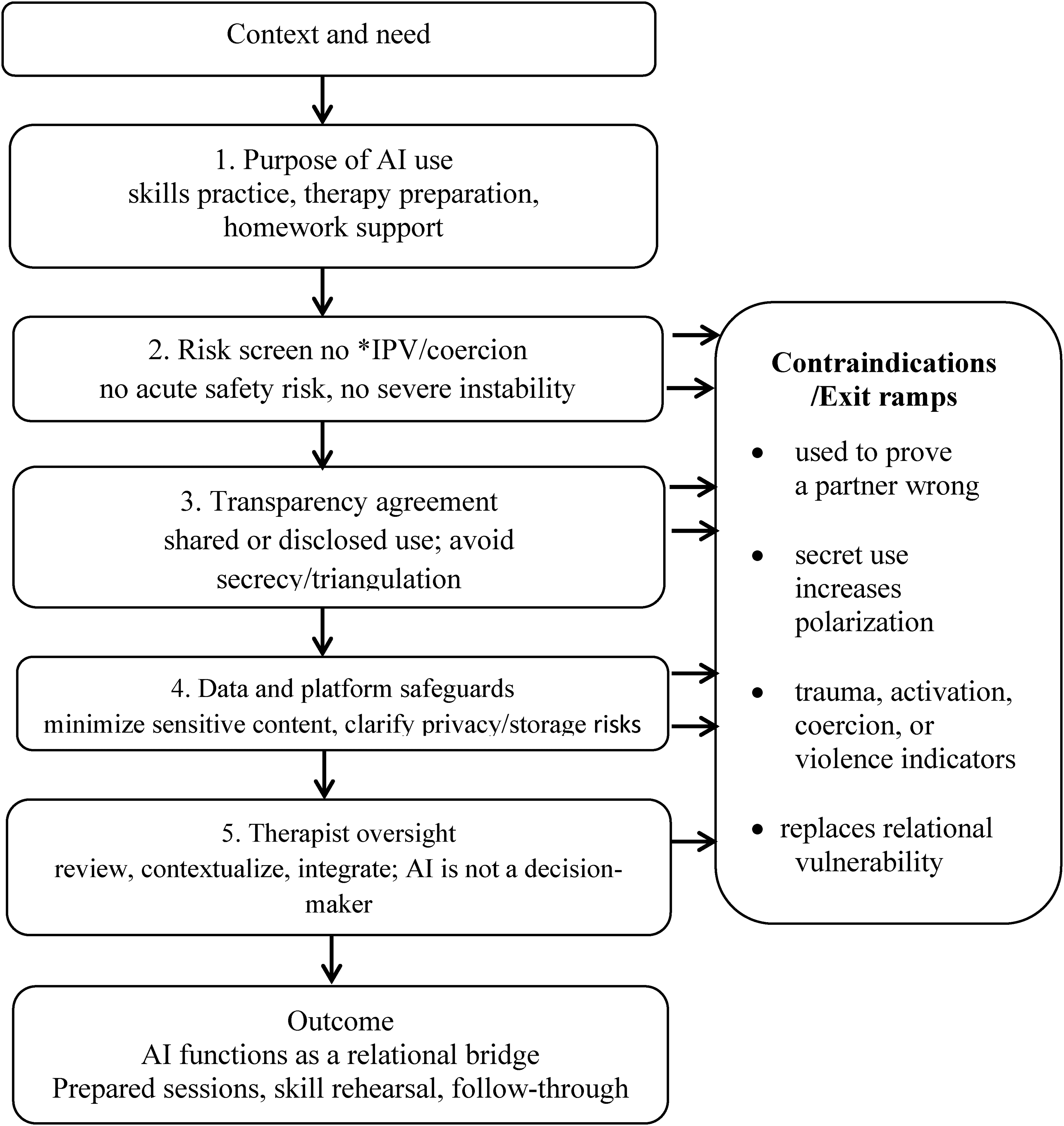
Relational Bridge Model.
Decision Points
The model includes five decision points to guide session planning and supervision. First, the therapist clarifies the purpose of AI use, such as skills rehearsal, therapy preparation, or homework support. Second, the therapist conducts a risk screen, giving particular attention to coercion, violence, acute safety risk, and severe instability. Third, the therapist establishes a transparency agreement to reduce secrecy and triangulation, including shared use when possible and disclosure of individual use. Fourth, the therapist addresses data and platform safeguards, including data minimization and explicit discussion of privacy risks. Fifth, the therapist ensures therapist oversight: AI outputs are reviewed and contextualized, and AI is not used as an independent decision-maker.
Role-play scenarios can allow therapists to practice articulating the purpose of AI use, conducting risk screenings, establishing transparency agreements, addressing privacy concerns, and reviewing AI outputs collaboratively. This experiential practice transforms abstract steps into embodied skills and may enhance readiness to apply the framework in real-world sessions.
Contraindications
The model identifies common exit ramps. AI use is contraindicated when it is used to prove a partner wrong, as this can heighten defensiveness and undermine therapy goals. It is also contraindicated when AI is used to provide diagnostic labels, because AI lacks clinical judgment and can contribute to misinterpretation. Managing crises through AI is not advisable because AI cannot assess real-time risk or provide empathic support. Additionally, AI should not replace vulnerable engagement, as this can prevent direct communication between partners. AI is also contraindicated when there are indicators of coercion, violence, or acute safety risk, as these situations require personalized intervention and professional judgment. Finally, when privacy protections are unclear, AI should not be used, because confidentiality and data security are paramount in therapeutic contexts. In such situations, the therapist's ethical responsibilities require prioritizing safety, appropriate services, and clinically indicated referrals.
Practice Framework: Therapist-in-the-Loop Use of Generative AI
Building on the Relational Bridge Model, the following practice framework offers concrete steps for clinicians who wish to ethically integrate generative AI as a supplemental tool. These steps are designed to preserve the therapeutic alliance and direct relational engagement while remaining consistent with Standard VI's emphasis on appropriateness, risk-benefit discussion, security, and clinician competence (AAMFT, 2015).
Case Illustration
The following composite case illustration reflects common patterns clinicians may encounter.
Case of Maya
Maya (age 38) and Chris (age 40) presented for couples counseling after several years of escalating conflict around parenting, household labor, and emotional connection. Maya described feeling chronically alone and overburdened; Chris described feeling criticized and inadequate. During conflict, Maya sought problem-solving and reassurance, while Chris withdrew and grew quiet, which intensified Maya's distress. Both partners reported decreased intimacy and increased resentment over the past year.
Pre-Therapy AI Use: Early Benefits
Prior to scheduling therapy, Maya began using a generative AI chatbot to draft messages to Chris after arguments. She reported that the chatbot helped her convert accusatory statements into needs-based requests (e.g., shifting from “you never help” to “I need us to agree on a plan so I don’t feel overwhelmed”). Chris initially experienced these messages as less attacking and was more willing to engage. The couple also used AI-generated repair scripts after conflict, including short templates for apologies and reflective listening. Over several weeks, both partners noted fewer explosive arguments and more constructive conversations.
Emerging Problems: Triangulation and Avoidance
As the couple attempted to address deeper emotional issues, Maya used the AI privately to process resentment and to seek labels for Chris's withdrawal. The chatbot provided validating responses to Maya's distress but did not assess relational context, attachment injuries, or safety. Maya began introducing AI output into conflict as evidence (e.g., “the AI says you’re emotionally unavailable”). Chris reacted with defensiveness and withdrawal, stating that Maya was “outsourcing our marriage to a robot.” Over time, the couple's focus shifted from understanding each other to arguing about the legitimacy of AI advice, and Maya increasingly used AI to avoid vulnerable disclosure directly to Chris.
Therapist Intervention Guided by the Relational Bridge Model
In early sessions, the therapist explicitly and nonjudgmentally assessed AI use, inviting both partners to describe what it added and what it disrupted. Consistent with Standard VI, the therapist clarified that technology-assisted tools can be helpful but require appropriate use, careful consideration, risk-benefit analysis, and attention to confidentiality and security (AAMFT, 2015). The therapist then implemented the model's decision points: (a) purpose was narrowed to skills rehearsal and homework support; (b) risk screening identified no indicators of coercion or violence but did identify trauma-relevant triggers for both partners; (c) a transparency agreement was developed such that individual AI use would be disclosed and not weaponized; (d) privacy risks were discussed and the couple agreed to avoid including identifying information in AI prompts; and (e) therapist oversight was emphasized, with AI outputs brought into session for review.
Outcome
Across subsequent sessions, the couple used therapist-approved AI prompts to rehearse reflective listening and to generate shared agendas for weekly check-ins. The therapist focused on the couple's escalation cycle and the attachment-relevant meanings behind pursuit and withdrawal. AI was consistently framed as a tool for practice, not a mediator or authority. Maya reported a softer tone of voice and increased willingness to make direct eye contact with Chris during discussions. Similarly, Chris displayed less defensiveness, leaning in during conversations and maintaining more open body language. By the eighth session, the couple described improved repair processes and greater emotional safety during conflict, evidenced by more frequent expressions of understanding and mutual validation.
Implications for Marriage and Family Counselors
In practice, clinicians can address the increasing presence of generative AI by adopting an ethically grounded, therapist-in-the-loop approach tailored to each couple's context. Some couples may already use AI for relationship support, while others may be unfamiliar, skeptical, or disinterested. Therapists can respond effectively in both situations by assessing AI exposure and preferences, clarifying roles and boundaries, and recommending AI-supported exercises only when clinically appropriate.
Clinicians should assess AI use and technology preferences. AI can be assessed alongside other self-help behaviors without presuming that it is always present. For couples already using AI, therapists can ask what tools they use, what problems they bring to AI, whether use is shared or kept secret, and whether AI use supports or undermines direct engagement. For couples who have not used AI, therapists can assess openness, access, and potential fit before making any recommendation. Some couples may prefer nondigital homework or may have privacy concerns that outweigh potential benefits. When a therapist recommends AI-assisted practice, the recommendation can be framed as optional, time-limited, and skill-specific, with the expectation that the output will be reviewed and contextualized in session to reduce triangulation and role confusion.
AAMFT (2015) ethics language should be utilized to set boundaries. When AI is incorporated into therapy, clinicians can use the logic of Standard VI to guide decision-making: Determine appropriateness, discuss risks and benefits, attend to security and confidentiality, and practice within competence (AAMFT, 2015). In couples work, therapists can also draw from Standard II's emphasis on protecting confidentiality across multiple clients by developing clear agreements about what information is shared, how AI outputs are handled, and how partners’ privacy is respected.
It is important to frame AI as a tool and not as a therapist. Clinicians can reduce unrealistic expectations by framing AI as comparable to a workbook or a communication coach that supports skills practice rather than a clinician. This framing can preserve the couple's reliance on the therapeutic relationship for deeper emotional processing and systemic change.
It is imperative for clinicians to identify contraindications and prioritize safety. Clinicians should avoid recommending AI-guided relationship coaching when there are indicators of coercion, violence, stalking, acute crisis, or severe instability. In these contexts, AI's limitations in risk assessment and crisis response make it an unsafe substitute for professional services. Therapists prioritize safety planning, appropriate referrals, and evidence-based interventions.
Implications for Counselor Education and Supervision
Counselor educators and supervisors can prepare trainees for AI-augmented practice by integrating technology ethics, critical evaluation skills, and applied decision-making. The ACA's recommendations for practicing counselors emphasize competence, transparency, informed consent, and ongoing evaluation of AI outputs (ACA 2024a). Training can include supervised exercises in which students evaluate AI-generated communication scripts for bias, cultural fit, and potential relational harm, followed by debriefing on alliance and ethics.
Competence and supervision for AI-integrated practice can be strengthened by incorporating structured discussion in supervision about how AI tools influence the therapeutic relationship and couple dynamics. Supervision can incorporate discussion of how AI tools affect the therapeutic relationship and couple dynamics. Supervisors can model responsible use (e.g., using AI for drafting psychoeducation that is then edited for cultural responsiveness) while emphasizing the counselor's accountability for clinical decisions. Given that AI platforms and policies evolve rapidly, supervision should include ongoing attention to privacy, documentation, and professional boundaries.
Strengths and Limitations
The Relational Bridge Model's primary strength is its clinical pragmatism. It translates ethical principles into concrete decision points that therapists can apply in intake, treatment planning, and supervision. The model also foregrounds couple-specific risks such as triangulation and confidentiality complexities. However, the framework is conceptual rather than an empirically tested intervention. Research on generative AI in couples counseling is emerging, and current findings largely derive from experiential prompts, simulation studies, and broader mental health AI literature (Lawrence et al., 2024; Vowels et al., 2024). Future research is needed to evaluate outcomes, equity impacts, and best practices for therapist-audited AI integration in couples therapy. Randomized trials, single-case designs, and qualitative studies could together help bridge the current research-practice gap and clarify where AI-supported interventions are most and least clinically useful.
Conclusion
Generative AI is increasingly present in couples’ help-seeking and may offer meaningful support when used as a bounded adjunct for skills rehearsal, therapy preparation, and between-session reinforcement. Yet, AI cannot provide empathic presence, systemic attunement, or clinically accountable judgment—particularly during trauma activation, power imbalances, and safety risks. The Relational Bridge Model positions AI as a bridge to relational care rather than a substitute, emphasizing risk screening, transparency agreements, privacy safeguards, and therapist oversight. Consistent with the AAMFT Code of Ethics, clinicians remain responsible for determining appropriateness, obtaining informed consent, protecting confidentiality, ensuring security, and practicing within competence when technology is integrated into services (AAMFT, 2015). Used thoughtfully, AI can augment, not replace, the deeply human work of couples therapy.
Footnotes

Funding
The author received no financial support for the research, authorship, and/or publication of this article.
Declaration of Conflicting Interests
The author declared no potential conflicts of interest with respect to the research, authorship, and/or publication of this article.