







Abstract
Emotional distance and recurrent conflict threaten marital satisfaction, family stability, and psychosocial well-being. In Ghana, marriage is embedded in kinship, religion, customary expectations, gender norms, economic responsibilities, and extended family participation. This conceptual article applies Family Systems Theory, especially Bowenian concepts of differentiation of self, triangles, emotional cutoff, nuclear family emotional process, family projection, and multigenerational transmission, to emotional distance and conflict in Ghanaian marriages. The article argues that marital distress should not be reduced to individual weakness, poor communication, or moral failure. Rather, it should be understood as a relational pattern sustained by emotional reactivity, unresolved family-of-origin issues, social pressure, unclear boundaries, and culturally shaped expectations. The main contribution is a six-phase Ghanaian Culturally Sensitive Family Systems Counseling Model that includes safety screening, systemic mapping, de-escalation, differentiation-building, reconnection and boundary repair, and maintenance. The article recommends systemic assessment, de-triangulation, boundary negotiation, emotional reconnection, differentiation-building, and ethical integration of cultural and religious resources. It also stresses that family systems counseling must not minimize intimate partner violence, coercive control, or gendered domination.
Keywords
Introduction
Marriage remains a highly valued institution in Ghana because it provides companionship, regulates sexual relations, supports childbearing and childrearing, links kinship groups, confers social recognition, and creates a framework for mutual economic and emotional support. Ghanaian sociology and family studies have long shown that marriage is embedded in kinship, lineage, religion, and community expectations, rather than being only a private contract between two autonomous individuals (Amoateng & Heaton, 1989; Nukunya, 2003; Takyi, 2001). This relational understanding is important for counseling because marital distress is often shaped not only by the couple relationship but also by family-of-origin obligations, gender expectations, religious authority, and the social meaning of respectability.
The communal character of Ghanaian marriage can be protective. Families may provide advice, childcare, financial help, emotional encouragement, and social accountability. Faith communities may offer premarital counseling, prayer, moral guidance, and support during crises. These resources can strengthen marriages when they promote humility, accountability, mutual respect, and care. They can also intensify distress when boundaries are unclear, when spouses feel divided between loyalty to the marital bond and loyalty to their family of origin, or when relatives and religious leaders become permanent actors in conflicts that should first be addressed by the couple (Affram et al., 2020; Osei-Tutu et al., 2019, 2020; Sedziafa et al., 2018).
Emotional distance is one of the most common but least visible forms of marital distress. It refers to a pattern in which spouses become less emotionally available, reduce affectionate communication, avoid vulnerability, withdraw from shared decision-making, or live together physically while functioning as strangers. Couple research has associated relational deterioration with criticism, defensiveness, contempt, stonewalling, withdrawal, and failed repair attempts (Gottman & Levenson, 2000). Emotionally focused couple therapy similarly emphasizes that withdrawal and pursuit are often attempts to manage attachment fear rather than simple signs of stubbornness or lack of love (Johnson, 2004).
Family Systems Theory offers a useful framework for understanding this cycle. It views the family as an emotional unit in which the behavior of each member affects, and is affected by, the behavior of others (Bowen, 1978; Brown, 1999; Kerr & Bowen, 1988). Contemporary family therapy texts similarly stress that symptoms and conflicts should be understood in relation to interactional patterns, family structure, multigenerational learning, and the social ecology around the family (Goldenberg et al., 2017; McGoldrick et al., 2020; Nichols & Davis, 2020). A systems approach, therefore, asks not only what each spouse has done, but also what relational patterns have developed, how the extended family participates in those patterns, and how family-of-origin experiences shape current marital reactions.
The purpose of this article is to show how Family Systems Theory can be used to understand and address emotional distance and conflict in Ghanaian marriages. The central contribution is a culturally sensitive counseling model for professional counselors, clergy, lay marriage counselors, marriage committee members, and family-life educators. The argument is that effective intervention requires more than advice to communicate better. It requires careful attention to emotional process, intergenerational patterns, triangulation, boundaries, gendered power, safety, culture, and religion.
Problem Statement and Article Objectives
Many marital interventions in Ghana begin with advice-giving, moral exhortation, scriptural instruction, or family mediation. These practices may be valuable when they promote responsibility, reconciliation, mutual respect, and wise decision-making. However, they can be limited when they focus only on the visible content of disagreement rather than the emotional process by which spouses become reactive, defensive, avoidant, or unsafe. A couple may repeatedly argue about money, in-laws, sex, childcare, household chores, religious expectations, or family obligations, while the deeper relational pattern remains unchanged.
Empirical work on Ghanaian marriages indicates that marital satisfaction is related to affection, companionship, commitment to the family, and financial support, whereas dissatisfaction is associated with negative behaviors such as disrespect, selfishness, annoying habits, and physical aggression (Malm et al., 2023). Research on Ghanaian in-law relationships further shows that conflict is often handled through third-party engagement, apology, ignoring, confronting, and behavior aimed at preserving social face and harmony (Affram et al., 2020). These findings align with broader research on divorce and marital instability, which links marital breakdown to patterned interaction, conflict management, socioeconomic pressure, and family transitions (Amato, 2010; Amoateng & Heaton, 1989; Takyi, 2001).
The problem addressed in this article is that emotional distance and recurrent conflict are often treated as isolated behavioral failures rather than as systemic patterns. When a husband withdraws, he may be labeled uncaring. When a wife complains, she may be labeled disrespectful. When in-laws intervene, they may be described either as helpful elders or as intruders. A systems approach does not excuse harmful behavior, but it allows counselors to ask deeper questions: What anxiety is being expressed? What triangles are being formed? What unresolved family-of-origin patterns are being repeated? What boundary confusion exists between the couple and the extended family? What cultural or religious meanings are supporting connection, and which are sustaining silence, fear, or domination?
The general objective of this article is to demonstrate how Family Systems Theory can be used to address emotional distance and conflict in Ghanaian marriages. The specific objectives are to: (a) explain key concepts of Family Systems Theory relevant to marital distress; (b) examine how emotional distance and conflict are expressed in Ghanaian marital contexts; (c) identify systemic factors that sustain marital tension, including triangulation, emotional cutoff, unclear boundaries, family-of-origin patterns, gendered expectations, and financial pressure; (d) propose a culturally sensitive counseling model for Ghanaian couples; and (e) discuss implications for professional counselors, clergy, lay marriage counselors, family-life educators, and community leaders.
Methodological Orientation and Literature Selection
This article uses a conceptual review and practice-oriented theoretical analysis. Conceptual articles are useful when the aim is to clarify ideas, integrate existing knowledge, and develop a framework that can guide practice and future empirical research. The article does not present original field data. Its application examples are illustrative rather than drawn from identifiable participants.
The literature base was developed through targeted searches and theoretical sampling of works relevant to family systems theory, marital conflict, emotional distance, counseling, Ghanaian marriage, in-law relationships, religious counseling, gendered power, and intimate partner violence. The analysis gives priority to foundational family systems texts, peer-reviewed couple and family therapy literature, and Ghana-focused empirical studies. The search emphasis included terms such as Family Systems Theory, Bowen theory, differentiation of self, emotional cutoff, triangulation, Ghanaian marriage, marital satisfaction in Ghana, in-law conflict in Ghana, religious lay counseling in Ghana, intimate partner violence in Ghana, and marital power in Ghana. Because the purpose is conceptual integration rather than statistical synthesis, the article does not claim to be a systematic review.
The theoretical analysis draws primarily on Bowen Family Systems Theory, with supporting insights from structural family therapy, genogram-based assessment, couple therapy, and systemic practice literature (Bowen, 1978; Brown, 1999; Goldenberg et al., 2017; Kerr & Bowen, 1988; McGoldrick et al., 2020; Minuchin, 1974; Nichols & Davis, 2020). It also draws on Ghanaian scholarship on marriage, in-law relations, marital satisfaction, religious counseling, intimate partner violence, and gendered power (Affram et al., 2020; Dickson et al., 2024; Kyei et al., 2024; Malm et al., 2023; Osei-Tutu et al., 2019, 2020; Sedziafa et al., 2018).
The scope is limited to emotional distance and conflict in Ghanaian marriages. The discussion is not restricted to one ethnic, religious, or regional group because Ghanaian marriages are diverse. Christian, Muslim, traditional, customary, civil, urban, rural, monogamous, and polygynous contexts may differ in important ways. Nevertheless, many couples face overlapping systemic pressures such as financial stress, extended family expectations, fertility concerns, gender-role negotiation, migration, religious authority, and the need to balance marital privacy with family involvement.
The article also takes an explicit ethical stance. Family systems work is not a substitute for safety planning where there is intimate partner violence, coercive control, severe emotional abuse, sexual violence, or threats. Recent Ghana-focused analyses show that intimate partner violence remains a serious concern and that emotional violence, controlling behaviors, and gendered dominance are especially relevant to marital safety (Dickson et al., 2024; Ghana Statistical Service & ICF, 2024; Shaikh, 2025; Tenkorang, 2018). Therefore, systemic counseling must never pressure a spouse to remain in unsafe contact or interpret abuse merely as a communication problem.
Theoretical Framework: Family Systems Theory
Family Systems Theory is based on the assumption that families function as emotional systems. A change in one part of the system affects other parts, and symptoms expressed by one person often reflect patterns operating in the wider relationship network (Bowen, 1978; Brown, 1999; Kerr & Bowen, 1988). The counselor, therefore, attends to recurring sequences, roles, alliances, cutoffs, rules, boundaries, and meanings rather than treating one spouse as the sole source of the marital problem (Goldenberg et al., 2017; Nichols & Davis, 2020).
Bowenian theory is particularly relevant because it focuses on chronic anxiety, differentiation of self, triangles, emotional cutoff, nuclear family emotional process, family projection, and multigenerational transmission. These concepts help explain why couples can love each other and yet remain trapped in repetitive cycles of distance and conflict. Brown (1999) explains that Bowen's model focuses less on symptom removal and more on helping family members observe their own participation in the emotional system. In marital counseling, this means helping each spouse ask, “What do I do when anxiety rises?” rather than only asking, “What is my partner doing wrong?”
Differentiation of self refers to the ability to remain emotionally connected while maintaining clear thinking, self-regulation, and personal responsibility under pressure. A well-differentiated person can listen without immediately counterattacking, disagree without contempt, and remain connected without losing self. Skowron and Friedlander (1998) operationalized differentiation of self through a measure that assesses emotional reactivity, emotional cutoff, fusion with others, and the capacity to take an “I-position.” A recent scoping review also shows that differentiation remains one of the most researched and clinically influential constructs in Bowen theory (Calatrava et al., 2022). In marriage, low differentiation appears when spouses quickly become defensive, collapse into silence, recruit outsiders, or demand that the other person think, feel, and behave in a particular way.
Triangles are three-person relationship structures that emerge when anxiety between two people becomes difficult to manage. A spouse may involve a mother, father, sibling, pastor, imam, friend, child, or neighbor to reduce tension or gain support. Triangles are not always harmful. Elders and religious leaders can mediate wisely when they are balanced, confidentiality-conscious, and safety-aware. However, triangles become destructive when one spouse repeatedly recruits outsiders to shame, overpower, monitor, or punish the other spouse. The couple then avoids direct communication, and the third party becomes part of the problem-maintaining system.
Emotional cutoff occurs when unresolved emotional issues are managed by reducing contact, avoiding sensitive topics, or physically and emotionally distancing oneself from important relationships (Bowen, 1978; Kerr & Bowen, 1988). In marriage, cutoff may appear as silence, refusal of sexual intimacy, sleeping separately, excessive work, over-involvement in church activities, relocation, emotional investment in children, or dependence on friends and relatives for emotional support that should also be nurtured within the marriage. Cutoff may create temporary calm, but it does not resolve the underlying anxiety.
The nuclear family emotional process explains how anxiety is expressed within the marital and parent–child system. Bowen described patterns such as marital conflict, dysfunction in one spouse, emotional distance between spouses, and impairment of one or more children (Kerr & Bowen, 1988). In Ghanaian families, economic hardship, infertility concerns, unemployment, illness, migration, intergenerational obligations, and pressure to meet social expectations can intensify anxiety. If the couple cannot discuss these anxieties calmly, the anxiety may be converted into blame, distance, or unsafe control.
The family projection process refers to how parents transmit anxiety to children by over-focusing on a child as the problem or solution. A child may become a messenger, emotional comforter, peacekeeper, substitute spouse, or symbol of family success. Multigenerational transmission refers to the movement of emotional patterns across generations. A spouse who grew up in a family where fathers were silent may use silence as authority. A spouse who grew up with harsh criticism may interpret correction as rejection. Another spouse who experienced abandonment may become controlling because closeness feels insecure. Family Systems Theory helps couples ask not only, “What happened between us?” but also, “Where did we learn to respond this way?”
Ghanaian Marriages as Cultural and Relational Systems
A Ghanaian marriage often exists at the intersection of personal choice, family approval, customary obligation, religion, and community recognition. The Ghana Statistical Service (2021) reported that many married persons had not registered their marriages, a finding that underscores the continuing importance of customary and socially recognized forms of marriage. Such marriages often draw legitimacy from family and community systems as much as from civil registration. This has direct counseling implications because marital decisions may be interpreted by spouses and relatives as family matters rather than private couple matters.
Family involvement can be protective. Parents and elders may offer wisdom, mediate disputes, support childbirth rituals, assist with funerals, contribute financially, and help with childcare. Faith communities may provide premarital counseling, marital teaching, prayer, and moral accountability. Research on premarital counseling among Christian and Muslim lay counselors in Ghana found that common topics include medical screening, beliefs and values, expectations, roles and duties, sex, parenthood, financial management, communication, and conflict (Osei-Tutu et al., 2020). This demonstrates that religion and community-based counseling are already central to marriage preparation in Ghana.
At the same time, cultural and religious resources may become problematic when they are applied rigidly or without attention to emotional process and safety. Appeals to respect may silence a spouse who needs to express pain. Appeals to submission may be misused to protect domination. Appeals to family honor may discourage disclosure of abuse. Appeals to forgiveness may pressure premature reconciliation without accountability. A systems approach does not reject cultural or religious resources; rather, it asks how those resources are functioning in the relationship. Are they increasing responsibility, humility, and mutual care, or are they supporting fear, silence, and one-sided power?
In-law relationships are especially important in Ghanaian marriages. Affram et al. (2020) showed that Ghanaian in-law conflict may involve strategies of human or divine third-party engagement, apology, ignoring, confronting, and obsequious behavior. These strategies are often connected to face concerns, respect, and the desire to preserve harmony. A systems counselor should therefore avoid interpreting all indirectness as weakness or all third-party involvement as interference. In some contexts, indirect communication protects dignity and prevents escalation. However, the counselor must also notice when indirectness becomes avoidance, when face-saving becomes dishonesty, and when respect becomes fear.
Gender and power also shape Ghanaian marital systems. Kyei et al. (2024) found that wives in a patriarchal Ghanaian context used communication, affection, intimacy, sex, education, and other relational resources to negotiate agency in marriage. This finding is important for systems work because marital conflict is not merely a communication problem; it may also be a power problem. When one spouse controls money, decision-making, mobility, sexuality, or access to family support, emotional distance may be a survival strategy rather than simple coldness. Therefore, family systems counseling in Ghana must include gender-sensitive and power-aware assessment.
Economic pressure is another systemic factor. Financial support was associated with marital satisfaction in the study by Malm et al. (2023), suggesting that economic cooperation and perceptions of responsibility are central to marital quality. In Ghana, financial stress may include rent, school fees, healthcare, church or mosque obligations, funerals, remittances to parents, support for siblings, business failure, unemployment, and pressure to display social success. Money may symbolize responsibility, respect, masculinity, care, independence, loyalty to parents, or fear of abandonment. Counselors should therefore examine not only income but also the meanings, rules, secrecy, and boundary expectations surrounding financial decisions.
Emotional Distance and Conflict as Systemic Processes
Emotional distance may be misunderstood because many couples continue to perform public marital roles even when the private emotional bond is weak. A couple may attend church together, host family visitors, attend funerals, contribute to social obligations, and present themselves as stable while privately avoiding conversation, affection, sexual intimacy, and shared planning. The social visibility of marriage can therefore hide the emotional absence within it.
From a systems perspective, emotional distance is often an anxiety-management strategy. One spouse withdraws to avoid criticism, shame, or escalation. The other spouse pursues conversation because silence feels like rejection. The pursuing spouse becomes louder or more accusatory; the withdrawing spouse becomes colder or more absent. Over time, the couple's interaction becomes organized around distance. Neither spouse may desire loneliness, but each protects self in ways that intensify the other's insecurity.
Emotional distance may also be connected to unresolved family-of-origin experiences. A husband who saw his father handle marital tension through silence may consider emotional withdrawal normal masculinity. A wife who grew up with unpredictable affection may interpret temporary silence as abandonment. A spouse from a conflict-avoidant family may panic when disagreement occurs. Another from a highly argumentative family may experience shouting as normal engagement. Without awareness of these histories, each spouse misreads the other's behavior as intentional harm rather than as a learned response.
Marital conflict is not necessarily harmful. Healthy couples disagree, negotiate, apologize, and repair. Conflict becomes destructive when it is repetitive, contemptuous, unsafe, unresolved, or connected to emotional cutoff. In Ghanaian marriages, recurring conflict may involve money, in-laws, childbearing, parenting, household labor, religious participation, sex, infidelity, alcohol, migration, career choices, and decisions about where to live. The presenting topic may change, but the underlying process often remains the same.
Three cycles are especially important. The first is the pursue-withdraw cycle, in which one spouse presses for discussion while the other avoids discussion. The more one pursues, the more the other withdraws; the more one withdraws, the more the other pursues. The second is attack-defend, in which one spouse raises a concern through criticism, and the other responds with counter-accusation. The third is triangle escalation, in which one spouse reports the matter to relatives, religious leaders, friends, or children instead of addressing it directly with the partner. Once a marital issue becomes a family or congregational issue, the couple may lose the ability to define and repair its own boundary.
Sexual distance can be a particularly sensitive expression of emotional cutoff. It may arise from resentment, fatigue, childbirth experiences, unresolved conflict, health conditions, pornography, infidelity, religious guilt, sexual pain, or power struggles. Because sexuality is often surrounded by religious, cultural, and privacy concerns, couples may avoid naming sexual distance directly. Systems-oriented counselors should approach the topic respectfully, linking it to safety, consent, affection, health, resentment, and emotional security. Where sexual distance is connected to coercion, trauma, or fear, couple work must be handled cautiously and may require individual support or referral (Dickson et al., 2024; Ghana Statistical Service & ICF, 2024; Johnson, 2004).
Conflict may also reveal unresolved questions of authority. In patriarchal settings, disagreement may be interpreted as disrespect when a wife expresses a different opinion. Conversely, a wife may interpret her husband's decision-making as domination when he does not consult her. Power-sensitive couple therapy literature warns that relational healing requires shared influence, mutual vulnerability, shared responsibility, and mutual attunement, not merely peace without justice (Knudson-Martin, 2013). Therefore, systems counseling must distinguish between legitimate leadership, mutual respect, coercive control, and culturally disguised domination.
Systemic Assessment and Ethical Screening
A systems-informed assessment should begin with the interactional pattern rather than a search for the guilty party. The counselor may ask: When conflict begins, who speaks first? Who withdraws? Who becomes angry? Who apologizes? Who reports the matter to outsiders? What happens afterward? Which topics are never discussed? What role do children, parents, pastors, imams, friends, or siblings play? Such questions shift attention from blame to process.
The genogram is a valuable assessment tool. It maps at least three generations and helps identify patterns of divorce, polygyny, domestic violence, emotional cutoff, infertility concerns, migration, alcoholism, financial stress, religious leadership, remarriage, and strong or weak family alliances. McGoldrick et al. (2020) describe genograms as clinical maps that help counselors see relational patterns, family myths, transitions, and multigenerational themes that may be invisible when the counselor focuses only on the current dispute. In Ghanaian counseling, a genogram can show whether marital silence, harsh authority, over-involvement of mothers, secrecy around money, or avoidance of apology has been learned and repeated across generations.
Assessment should also include differentiation. The counselor observes whether each spouse can speak from an “I-position” without attacking or collapsing. For example, “I feel lonely when decisions are made without discussion” is more differentiated than “You are controlled by your family.” Skowron and Friedlander's (1998) differentiation framework can help counselors observe emotional reactivity, cutoff, fusion, and the ability to state convictions while remaining connected. This is clinically useful because the problem is often not disagreement itself but the couple's inability to stay regulated while disagreeing.
Triangulation should be mapped carefully. The counselor should identify which third parties are helpful, which are harmful, and which are overused. In Ghanaian contexts, elders and religious leaders may be essential support figures. The question is not whether third parties should ever be involved, but whether their involvement strengthens the couple's capacity to relate directly or weakens it.
Finally, assessment must include safety. Counselors should privately screen for violence, coercion, fear, sexual abuse, threats, and severe control. Joint sessions can be unsafe if one spouse will punish the other for disclosure after the session. Ethical practice may require separate sessions, referral to protection services, collaboration with trained professionals, or temporary suspension of couple counseling. Family systems language must never be used to imply that both partners are equally responsible for abuse. The system may explain patterns, but responsibility for violence remains with the person who chooses violence.
The Ghanaian Culturally Sensitive Family Systems Counseling Model
The main practical contribution of this article is a six-phase Ghanaian Culturally Sensitive Family Systems Counseling Model. The model aligns with Ghanaian counseling scholarship that has presented family systems theory as a useful strategy for improving marital satisfaction among Ghanaian couples (Dabone et al., 2018). The model integrates Bowenian systems concepts with Ghanaian realities of kinship, religion, social face, financial obligation, and gendered power. It is intended for professional counselors, clergy, lay marriage counselors, family-life educators, and trained community helpers. It should be adapted to the couple's ethnic, religious, socioeconomic, and safety context rather than applied mechanically. Table 1 summarizes the model concepts, Ghanaian marital expressions, and counseling responses.
Family Systems Concepts, Ghanaian Marital Expressions, and Counseling Responses.
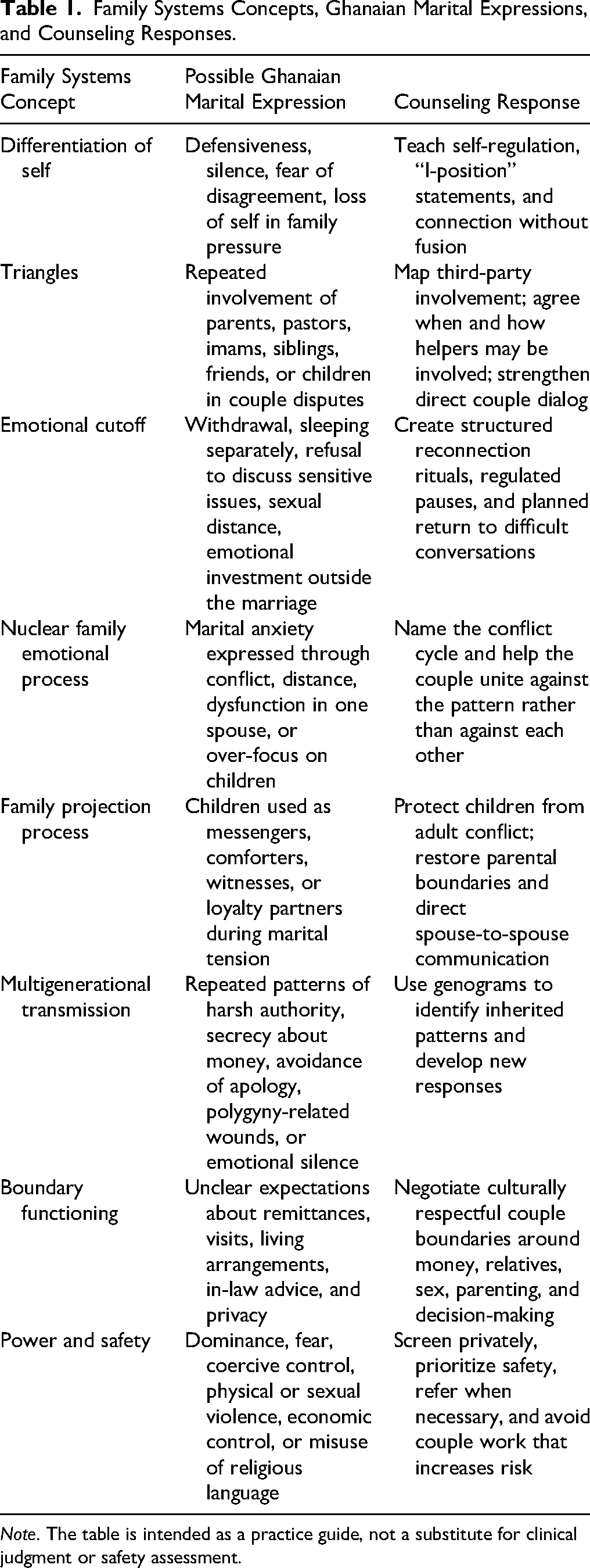
Note. The table is intended as a practice guide, not a substitute for clinical judgment or safety assessment.
Phase 1: Safety and Suitability Screening
The first task is to determine whether joint couple counseling is safe and appropriate. The counselor assesses physical violence, sexual coercion, threats, severe emotional abuse, coercive control, severe addiction, untreated mental illness, suicidal risk, and other conditions that may require referral or individual intervention before couple work. This phase protects the ethical integrity of systems counseling by making clear that reconciliation cannot be pursued at the expense of safety or dignity.
Phase 2: Systemic Mapping
The counselor develops a genogram, identifies triangles, maps in-law involvement, examines religious and cultural authorities, and clarifies the couple's conflict cycle. This phase helps the couple see the relationship as a pattern rather than a courtroom. The counselor asks how anxiety travels through the couple, children, in-laws, faith leaders, finances, sexuality, and family-of-origin expectations.
Phase 3: De-Escalation and Communication Regulation
Couples cannot solve problems when they are flooded with anger, shame, fear, or defensiveness. The counselor helps spouses slow down conversations, take regulated pauses, avoid insults, and return to unfinished issues after calming. A spouse may be encouraged to say, “I need twenty minutes to calm down, and I will return to this discussion,” rather than disappearing for days. The purpose is not silence but thoughtful engagement.
Phase 4: Differentiation Building
Each spouse practices speaking from an “I-position,” taking responsibility for personal reactions, and maintaining a respectful connection during disagreement. Differentiation-building works against fusion disguised as love or respect. A spouse may believe that love means agreement at all times, while another may believe that respect means silence. Bowenian practice challenges both assumptions by teaching that mature intimacy includes connection, clear self-definition, responsibility for emotional reactions, and tolerance of difference without panic (Bowen, 1978; Calatrava et al., 2022; Skowron & Friedlander, 1998).
Phase 5: Reconnection and Boundary Repair
Couples experiencing emotional distance often need structured reconnection. This may include daily check-ins, weekly couple meetings, shared meals, affectionate greetings, apology rituals, shared prayer or devotion where appropriate, and protected time without phones, visitors, or relatives. The couple also negotiates practical boundaries around money, in-laws, sex, parenting, household roles, and privacy. Healthy boundaries do not mean rejecting extended family; they define how the couple will relate to extended family responsibly.
Phase 6: Maintenance and Relapse Prevention
The couple identifies early warning signs of cutoff or conflict escalation, develops repair rituals, schedules follow-up support, and agrees on how to seek help before problems become crises. Relapse prevention is important because systemic change is often tested by predictable stressors such as childbirth, infertility investigations, bereavement, unemployment, relocation, illness, school fees, funerals, and pressure from relatives. The couple should develop a clear family systems plan that identifies likely triggers, agreed rules for involving third parties, and practices for restoring emotional contact (McGoldrick et al., 2020; Walsh, 2012).
Implications for Marriage and Family Counselors
Professional marriage and family counselors should incorporate systemic assessment into marital work. Instead of focusing only on communication skills, they should examine emotional process, family-of-origin patterns, triangles, boundaries, gendered power, cultural meaning, and safety. Counselor education programs in Ghana should therefore include family systems theory, genogram work, domestic violence screening, ethical couple assessment, and culturally responsive intervention (Brown, 1999; McGoldrick et al., 2020; Nichols & Davis, 2020). This is especially important because Ghanaian couples often present marital distress through practical complaints about money, in-laws, sex, children, or respect, while the underlying pattern is emotional reactivity and boundary confusion.
Clergy and lay counselors are important because many Ghanaian couples seek help from religious communities before approaching professional services. Studies show that religious lay counseling in Ghana addresses many interpersonal concerns and that marriage-related issues are common in such settings (Osei-Tutu et al., 2019, 2020). Training for clergy and lay counselors should therefore include confidentiality, balanced mediation, referral skills, safety assessment, and awareness of emotional process. Religious counseling should promote reconciliation with accountability, not reconciliation at the expense of safety or dignity.
Family-life educators should teach couples before and after marriage about emotional distance, conflict cycles, in-law boundaries, money management, sexual communication, parenting cooperation, and family-of-origin influence. Premarital counseling should move beyond wedding preparation to marriage preparation. Evidence from Ghanaian lay counseling indicates that premarital programs already address topics such as beliefs and values, partner knowledge, sex, roles and duties, financial management, communication, and conflict (Osei-Tutu et al., 2020). These programs can be strengthened by adding systemic mapping, differentiation skills, de-triangulation, safety screening, and explicit boundary agreements.
Community leaders and family elders also need systems-informed orientation. Their role should not be to take sides, shame a spouse, or turn private marital injury into public humiliation. When elders or religious leaders are involved, their task should be limited, balanced, confidential, and focused on helping the couple develop responsible direct communication. They should also be trained to identify abuse, coercion, and fear, and to refer cases that exceed their competence.
Limitations and Areas for Future Research
This article is limited by its conceptual nature. It does not provide original empirical data and does not test the effectiveness of the proposed model. Ghanaian marriages are diverse, and systemic patterns may differ across ethnic groups, religious traditions, socioeconomic levels, rural and urban settings, educational backgrounds, and marital forms. The model should therefore be adapted carefully rather than applied mechanically.
Future research should examine how Family Systems Theory-based interventions work with Ghanaian couples in different contexts. Qualitative studies could explore how couples experience emotional distance, triangulation, and boundary negotiation. Quantitative studies could test associations among differentiation of self, marital satisfaction, conflict frequency, in-law involvement, emotional intimacy, religious coping, and gendered power. Existing research has already demonstrated links among marital satisfaction, positive and negative relational behaviors, in-law conflict, autonomy, and intimate partner violence in Ghana (Affram et al., 2020; Dickson et al., 2024; Malm et al., 2023; Tenkorang, 2018). Intervention studies could evaluate culturally adapted systemic counseling in churches, mosques, counseling centers, and community-based family programs.
Research is also needed on men's experiences of emotional distance, women's experiences of power and safety, couples in inter-ethnic marriages, couples in long-distance or migration-related marriages, and the role of digital communication in marital conflict. Additional studies should examine how religious and traditional mediators can be trained to support marital stability while protecting spouses from abuse and coercion. Such work would respond to the reality that Ghanaian couples often seek help from religious and community helpers before they approach formal mental health professionals (Osei-Tutu et al., 2019, 2020).
Conclusion
Emotional distance and conflict in Ghanaian marriages should not be understood only as personal weakness, stubbornness, poor communication, or spiritual failure. They are often expressions of wider relational patterns involving anxiety, family-of-origin learning, unclear boundaries, triangulation, gendered power, financial strain, cultural expectations, and religious meanings. Family Systems Theory provides a strong framework for understanding these patterns because it views the couple as part of an emotional system extending across generations and social networks.
For Ghanaian couples, the goal is not to abandon extended family, culture, or faith. Rather, the goal is to develop a marriage that can remain connected to these resources without being controlled by them. Counseling should help spouses reduce reactivity, increase differentiation, rebuild emotional contact, manage triangles, negotiate respectful boundaries, and transform conflict cycles. When applied ethically and culturally, Family Systems Theory can support healthier marriages, stronger families, and more stable communities.
The central argument is that Ghanaian marital counseling must move from blame to pattern, from advice-only approaches to systemic understanding, and from public marital appearance to private emotional health. The proposed Ghanaian Culturally Sensitive Family Systems Counseling Model offers one pathway for guiding couples toward maturity, connection, safety, and responsible love.
Footnotes
Acknowledgments
No acknowledgments were provided.

Ethical Approval
This conceptual article is based on published literature. No human participants were recruited, and no primary data were collected; therefore, ethical approval and informed consent were not required.
Authorship Statement
All persons eligible for authorship have been included at the time of submission.
Funding
The author received no financial support for the research, authorship, and/or publication of this article.
Declaration of Conflicting Interests
The author declared no potential conflicts of interest with respect to the research, authorship, and/or publication of this article.
Data Availability Statement
Data sharing is not applicable because this article is a conceptual review and does not analyze or generate primary datasets.
Other Identifying Information
The author’s name, institutional affiliation, institutional address, and author email appear on this title page. No funders, approval committees, sponsors, or other identifying institutional bodies were involved beyond those listed above. For anonymized peer review, remove this title page from the blinded manuscript file if required by the journal.