






Abstract
This research examined the mediating effect of marital commitment between ego strength and tendency toward marital infidelity in 300 married individuals (201 women, 108 men; mean age = 38.64 years, SD = 10.71) in Neyshabur, Iran. Data were collected through convenience sampling using the Psychosocial Inventory of Ego Strengths, Attitudes Towards Infidelity Scale, and Marital Commitment Questionnaire. Pearson correlations and path analysis through PROCESS Model 4 were used for analysis. Findings showed that ego strength was positively correlated with marital commitment (r = .41, p < .001) and negatively correlated with infidelity tendency (r = −.38, p < .001), and marital commitment was negatively correlated with infidelity tendency (r = −.29, p < .001). Path analysis demonstrated partial mediation by marital commitment (indirect effect: b = −0.03, SE = 0.02, 95% CI [−0.07, −0.01]), indicating that while marital commitment mediates the association between ego strength and infidelity tendency, a direct pathway also exists (b = −0.28, p < .001). The model accounted for 18% of the variance in marital commitment and 21% of the variance in infidelity tendency. These results highlight the protective associations of ego strength through strengthened marital dedication in relation to lower infidelity risks, particularly in the Iranian cultural setting, where family and religious ethics emphasize relational fidelity. These findings may inform psychodynamic and commitment-based interventions in couple therapy.
Infidelity in marriage is a widely spread and complex problem in modern relationships, and it presents significant risks to individual well-being, relationship stability, and the family system in society. As a multifaceted psychological and social process, it includes behaviors that violate the monogamy of marital relationships, which in many cases causes deep emotional distress and relationship disintegration. This study examines the mediating role of marital commitment in the relationship between ego strength—a key psychodynamic construct—and the tendency toward marital infidelity among married individuals. Drawing on psychodynamic and family systems theories, the research helps clarify the role of inner psychological strengths in relation to fidelity through commitment processes. This study addresses a critical gap in empirical evidence that may inform infidelity prevention efforts, incorporating evidence from Iranian cultural settings.
Infidelity in Marriage
Infidelity in marriage, defined as the violation of marital relationship norms by engaging in physical or emotional closeness with a third party, is a serious relational issue with extensive impact (Aldahadha & Al-Momani, 2023). It occurs in two main types: physical infidelity (involving sexual involvement) and emotional infidelity (involving strong affective bonds that redirect emotional resources away from the spouse) (Rokach & Chan, 2023). Emotional infidelity, in particular, is less obvious yet potentially equally destructive because it involves exchanging intimate thoughts and emotions that undermine the mutual trust within a marriage (Warach & Josephs, 2021).
Infidelity is prevalent across world regions. Recent research indicates that approximately 20–40% of married individuals report extramarital affairs at some point, depending on cultural, socioeconomic, and personal factors (Kaba & Gungor, 2024; Rokach & Chan, 2023). In Western populations, including the United States, lifetime infidelity rates range between 25% for men and 15% for women, though self-reports may be underestimated due to social desirability effects (Ferguson & Johnson, 2024). Cultural values emphasizing family honor and religious restrictions against adultery in the Middle East, including Iran, may suppress overt manifestations, but the propensity toward infidelity remains, often associated with modernization and changing gender roles (Amanelahi et al., 2023; Abdollahi et al., 2022). For example, qualitative studies reveal how women in Iran respond to husbands’ infidelity with deep experiences of betrayal resulting in resentment and relationship conflicts (Amanelahi et al., 2024).
Infidelity has complex and potentially devastating effects. At the personal level, victims may experience attachment trauma reflected in anxiety, depression, and low self-worth (Warach & Josephs, 2021; Azhar et al., 2018). Symptoms among betrayed partners can resemble post-traumatic stress, including intrusive thoughts and hypervigilance, and may be long-lasting (Williams, 2024). Infidelity is among the strongest predictors of divorce, contributing to up to 50% of separations (Previti & Amato, 2004). It also affects family structure, with children experiencing parental conflict and emotional instability (Ferguson & Johnson, 2024). At the societal level, infidelity is associated with family disintegration and the financial burden of divorce (Rokach & Chan, 2023).
Predisposing factors include personality characteristics, attachment styles, and situational stressors. For example, infidelity propensity is associated with dark triad traits (narcissism, Machiavellianism, psychopathy), with moral disengagement and marital dissatisfaction mediating this relationship (Lišman & Holman, 2023). Sociosexual orientation and lower commitment are also associated with increased risk, as individuals with unrestricted orientations may be more favorable toward alternative partners (Mattingly et al., 2011). Power-related factors may further contribute to tendencies; individuals in positions of power, particularly men, may show greater attraction to counternormative infidelity (Lammers & Maner, 2016; Lammers et al., 2011). Fear of intimacy and low self-differentiation are associated with infidelity in the marital context due to reduced sexual satisfaction (Sarhani & Homaei, 2023). Additionally, deficits in cognitive and emotional intimacy mediate attitudes toward infidelity (Zarei et al., 2022).
Understanding the dynamics of infidelity is important, as the tendency toward rather than the actual occurrence of infidelity may affect marital quality (Kaba & Gungor, 2024). These predispositions are measured using instruments such as the Attitudes Towards Infidelity Scale (Whatley, 2006), which indicates how permissive attitudes are associated with behavioral practices (Habibi et al., 2019). This background underscores the need to explore protective psychological factors, such as ego strength, that may be associated with lower infidelity risks.
Cultural and Religious Context of Marriage and Infidelity in Iran
To contextualize the present study, it is essential to understand how marriage, gender, and infidelity are viewed within Iranian society. Iran is an Islamic republic where religious principles derived from Shia Islam substantially influence family law and social norms. Marriage is considered a sacred covenant (piman-e zanashui) with strong religious and moral obligations. Adultery (zina) is legally prohibited and criminally punishable, reflecting the high value placed on marital fidelity in both religious doctrine and cultural practice (Ghoreishi Rad & Poorjabbar Akhouni, 2018).
Traditional Iranian culture emphasizes family honor (aberu), which is closely tied to women's sexual purity and men's ability to protect their households. Consequently, infidelity—particularly women's infidelity—carries severe social stigma and may result in divorce, loss of social standing, or violence. However, recent decades have seen significant social changes, including increased education among women, delayed marriage, urbanization, and greater exposure to Western media. These changes have contributed to evolving attitudes toward marriage and sexuality, particularly among younger and more educated Iranians.
Neyshabur, the city where data were collected, is located in Razavi Khorasan Province in northeastern Iran. It is a historically significant city, known as the birthplace of the renowned poet Omar Khayyam and the medieval philosopher Attar of Neyshabur. With a population of approximately 450,000, Neyshabur is a midsized, culturally traditional city where religious values remain influential. The city has several institutions of higher education, including Islamic Azad University and Payame Noor University, which attract married students and staff. While Neyshabur is more educated than many rural areas in the province, it retains conservative attitudes toward family and marriage compared to larger metropolitan centers such as Tehran or Mashhad. This cultural context makes Neyshabur an appropriate setting for examining marital processes within a relatively traditional yet educated sample.
Theoretical Foundations of Ego Strength
Ego strength, rooted in psychodynamic theory, refers to the ego's capacity to manage conflicting demands from the id, superego, and external reality, fostering adaptive functioning and psychological resilience (Nasirpour, & Abbasian, 2020). Erik Erikson's psychosocial stages extend this concept, positing ego strengths—such as hope, will, purpose, competence, fidelity, love, care, and wisdom—as outcomes of resolved developmental crises (Markstrom et al., 1997). These strengths enable individuals to navigate life tensions, potentially reducing vulnerability to psychopathology (Shojaei & Dehghani, 2023).
In relational contexts, ego strength influences how individuals handle marital stressors. A strong ego may facilitate impulse control, reducing the likelihood of regressive behaviors such as infidelity during conflict (Block & Block, 2014; Baumeister et al., 2008). For example, high ego resilience is associated with stronger emotion regulation and adaptive coping, which may reduce negative affect that could lead to extramarital pursuits (Letzring et al., 2015). In Iranian studies, ego strength is associated with marital empathy and satisfaction, mediated by attachment styles (Khosrobeigi et al., 2021). Weak ego functioning, in turn, may increase vulnerability to id-related urges, including the need for external validation through affairs (Kchoui & Fathi Ashtiani, 2013).
Psychodynamic perspectives highlight the role of ego defense mechanisms in psychological regulation. Immature defenses have been associated with maladaptive interpersonal functioning, whereas mature defenses are considered protective factors (Freud, 1923). Ego strength may thus act as a buffer, enhancing self-awareness and relational investment (Shokri et al., 2019). This foundation sets the stage for exploring how ego strength is associated with commitment in relation to infidelity.
Role of Marital Commitment
Marital commitment, conceptualized as the intention to persist in a relationship despite challenges, encompasses emotional, moral, and structural dimensions (Adams & Jones, 1997). Personal commitment refers to attraction and devotion toward the spouse; moral commitment encompasses ethical obligations to the marriage institution; and structural commitment refers to perceived inability to dissolve the marriage due to social or economic constraints (Ghezelseflo, 2020). This three-part model emphasizes the importance of commitment in long-term relational investment (Li et al., 2023).
Higher levels of commitment are associated with greater forgiveness and positive interactions, which may correspond to lower infidelity likelihood (Clyde et al., 2020; Lioe, 2023). Bidirectional relationships between commitment and marital well-being indicate that committed couples report more forgiveness and satisfaction (Li et al., 2023). Lower commitment, in turn, is associated with more permissive attitudes toward infidelity, mediated by factors such as irrational beliefs or cognitive emotion regulation (Ghobadi et al., n.d.; Mehrtash et al., n.d.). Religious participation is also associated with greater fidelity and lower infidelity among religious adherents (Dollahite & Lambert, 2007).
In Iranian contexts, attachment styles and infidelity tendencies are mediated by commitment, highlighting its protective associations (Abdollahi et al., 2022; Shokri et al., 2019). Collectively, evidence suggests that commitment serves as an important relational factor associated with lower responsiveness to alternative partners.
This Study
Integrating these constructs, ego strength may be associated with greater marital commitment through self-regulation and relational investment, which in turn may correspond to lower infidelity tendencies (Khosrobeigi et al., 2020; Shokri et al., 2019). Psychodynamically, a strong ego may suppress id impulses, with commitment serving as a mediator (Block & Block, 2014). Empirical models support this framework: ego strength is associated with commitment, which in turn is associated with lower infidelity risks (Rajabi et al., 2024; Khorramabadi et al., 2019).
The central hypothesis is that marital commitment mediates the relationship between ego strength and tendency toward marital infidelity. Specifically, higher ego strength is directly and indirectly (via commitment) associated with lower infidelity proneness. This correlational study tests this model using an Iranian sample with validated measures, with findings intended to inform future intervention research.
Method
This study employed a descriptive-correlational design to investigate the mediating role of marital commitment in the relationship between ego strength and tendency toward marital infidelity. Quantitative measures were used to gather data in a field-based setting and analyze associations and path modeling. The study complied with ethical requirements as stipulated by the American Psychological Association and local institutional requirements, ensuring confidentiality and informed consent of participants.
Participants
The target population comprised all married individuals living in the city of Neyshabur, Iran, in 2024. A convenience sampling approach was employed to recruit 300 participants. In total, 311 questionnaires were distributed, and 11 were excluded due to incompleteness or inconsistent responses, yielding a final sample size of 300. Sample size determination was based on power analysis conducted with G*Power software. Using an alpha of .05, target power of .95, a medium effect size of .30, and two predictors, the analysis suggested a minimum sample of 281 participants; the sample was inflated to 300 to allow for possible attrition.
Inclusion criteria required participants to be currently married and participating voluntarily. Exclusion criteria included incomplete or unreliable questionnaires as judged by inconsistent or random response patterns. The sample demographic characteristics were as follows: mean age was 38.64 years (SD = 10.71, range = 20–65 years). Gender breakdown was 201 females (64.4%), 108 males (34.7%), and 2 participants who did not indicate gender (0.6%). Mean length of marriage was 14 years (SD = 9.82, range = 1–40 years), and mean number of children was 1.52 (SD = 1.12, range = 0–5). Educational attainment varied: 52.4% completed a bachelor's degree, 37.3% completed a master's degree or higher, 9.7% completed a diploma or associate degree, and 0.6% completed below diploma level; three respondents (1.0%) did not report education. The sample was predominantly college-educated, representing a moderately educated, urban population in Neyshabur. However, it is important to note that the university-based sampling limits generalizability, as the sample is more highly educated than the general population of Neyshabur.
Measures
Three validated self-report questionnaires were used to measure the major constructs. The instruments were selected based on their psychometric properties and cultural suitability for Iranian samples. Translations and adaptations followed standard back-translation procedures to ensure linguistic equivalence.
Psychosocial Inventory of Ego Strengths (PIES). Ego strength was measured using the PIES (Markstrom et al., 1997), a 64-item self-report scale assessing eight Eriksonian ego strengths: hope, will, purpose, competence, fidelity, love, care, and wisdom. Items are rated on a 5-point Likert scale (1 = not at all like me to 5 = completely like me), with total scores ranging from 64 to 320; higher scores indicate greater ego strength. The scale has good face, content, and construct validity as established by factor analysis and correlations with other psychosocial measures (Markstrom et al., 1997). Initial internal consistency was satisfactory (Cronbach's α = .68), with higher reliability reported in Iranian versions (α = .91; Altafi, 2009). Split-half reliability of the Iranian validation was .77. Cronbach's α in the present study was .89, indicating good internal consistency.
Attitude Towards Infidelity Scale. Tendency toward marital infidelity was evaluated using the Attitudes Towards Infidelity Scale (Whatley, 2006), a unifactorial 12-item instrument assessing permissive views on extramarital relationships. Responses are given on a 7-point Likert scale (1 = strongly disagree to 7 = strongly agree), with six items reverse-scored (2, 5, 6, 7, 8, 12). Total scores range from 12 to 84, with higher scores indicating greater tolerance of infidelity. Construct validity was established through correlations with behavioral indicators, including self-reported infidelity (Whatley, 2006). Original internal consistency was high (α = .80). Iranian validation demonstrated divergent validity through correlations with the Religious Orientation Scale (intrinsic: r = −.29; extrinsic: r = −.16), with reliability values of α = .71 and test–retest r = .87 after two weeks (Habibi et al., 2019). In this study, Cronbach's α was .86.
Marital Commitment Questionnaire. Marital commitment was assessed using the Marital Commitment Questionnaire (Adams & Jones, 1997), a 44-item scale measuring three dimensions: personal commitment (attraction to spouse; 17 items), moral commitment (ethical obligations; 15 items), and structural commitment (constraints; 12 items). Items are rated on a 5-point Likert scale (1 = strongly disagree, 5 = strongly agree), with total scores ranging from 44 to 220; higher scores indicate greater commitment. Item-total correlations and multistudy assessments among married, single, and divorced samples support the questionnaire's validity (Adams & Jones, 1997). Subscale internal consistency exceeded .70. Face and content validity in the Iranian version were established through expert review, with α = .85 observed in a pilot sample of 40 couples (Ghezelseflo, 2017). Reliability in the current study was α = .88.
Procedure
Data were collected during spring 2024 at Islamic Azad University and Payame Noor University in Neyshabur. After receiving institutional ethics committee approval (code: IR.IAU.NEYSHABUR.REC.1403.026), the researchers coordinated with university administrators to access married students and staff. Classes were randomly recruited to increase representativeness within the convenience sampling framework. Potential participants were contacted in groups, and a comprehensive explanation of the study's purpose, voluntary nature, and confidentiality assurances was provided. Anonymity was maintained by not collecting personal identifying information.
All participants provided written informed consent before questionnaire administration. The three measures were presented in Persian as a packet in counterbalanced order to reduce order effects. Average completion time was approximately 20–30 min in quiet classrooms. Researchers were available to answer noncontent-related questions. Upon completion, questionnaires were collected immediately, and participants were thanked personally. Debriefing information, including contacts for psychological support if needed, was provided. All procedures followed ethical principles emphasizing voluntary withdrawal and data confidentiality.
Data Analysis
Analyses were performed using SPSS Version 27 for descriptive statistics and preliminary tests, and PROCESS Macro Version 4.2 for path analysis. Descriptive statistics (means, standard deviations, frequencies, percentages) were used to describe the sample and variables. Inferential analyses comprised Pearson product–moment correlations to examine bivariate relationships among ego strength, marital commitment, and infidelity tendency.
Path analysis tested the mediation hypothesis, modeling direct and indirect effects with marital commitment as the mediator. Bias-adjusted 95% confidence intervals for indirect effects were estimated using bootstrapping with 5,000 resamples to increase robustness against non-normality. Initial data screening addressed assumptions: outliers were checked with boxplots (none detected), missing data (<1%) were handled with mean substitution, normality was assessed with skewness (within ±2) and kurtosis (within ±7)—all values were within acceptable limits except infidelity tendency, which was normalized using rank transformation (Templeton, 2011). Multicollinearity was verified (VIF < 5), and homoscedasticity was confirmed through residual plots. These measures ensured model validity. Significance level was set at p < .05, with effect sizes provided where appropriate.
Results
The sample comprised 300 married individuals in Neyshabur, Iran, during spring 2024. Mean participant age was 38.64 years (SD = 10.71). The sample included 201 women (64.4%), 108 men (34.7%), and 2 respondents (0.6%) who did not report gender. Mean marriage duration was 14 years, and mean number of children was 1.52 (SD = 1.12). Regarding education, 52.4% held a bachelor's degree, 37.3% held a master's degree or higher, 9.7% held a diploma or associate degree, 0.6% had less than a high school education, and three participants did not specify their education level.
Table 1 presents descriptive statistics for the study variables. The mean score for ego strength was 212.45 (SD = 32.18), for marital commitment was 156.82 (SD = 24.67), and for tendency toward marital infidelity was 38.14 (SD = 12.09). Possible score ranges are as follows: ego strength (64–320), marital commitment (44–220), and infidelity tendency (12–84).
Means, Standard Deviations, Possible Ranges, Skewness, and Kurtosis of Study Variables.

Preliminary Analyses
Prior to the main analyses, assumptions for path analysis were examined. No extreme outliers were detected. Skewness and kurtosis values were within acceptable limits (skewness < 2, kurtosis < 7), indicating approximately symmetric and mesokurtic distributions. Scatterplot matrices confirmed linear relationships with no systematic residual patterns, supporting linearity and homoscedasticity. Missing data (<1%) were managed through mean substitution. No multicollinearity was detected (VIF < 2.5 for all predictors).
Pearson correlation results showed that ego strength was positively correlated with marital commitment (r = .41, p < .001) and negatively correlated with tendency toward infidelity (r = −.38, p < .001). Marital commitment was negatively correlated with tendency toward infidelity (r = −.29, p < .001).
Main Analyses
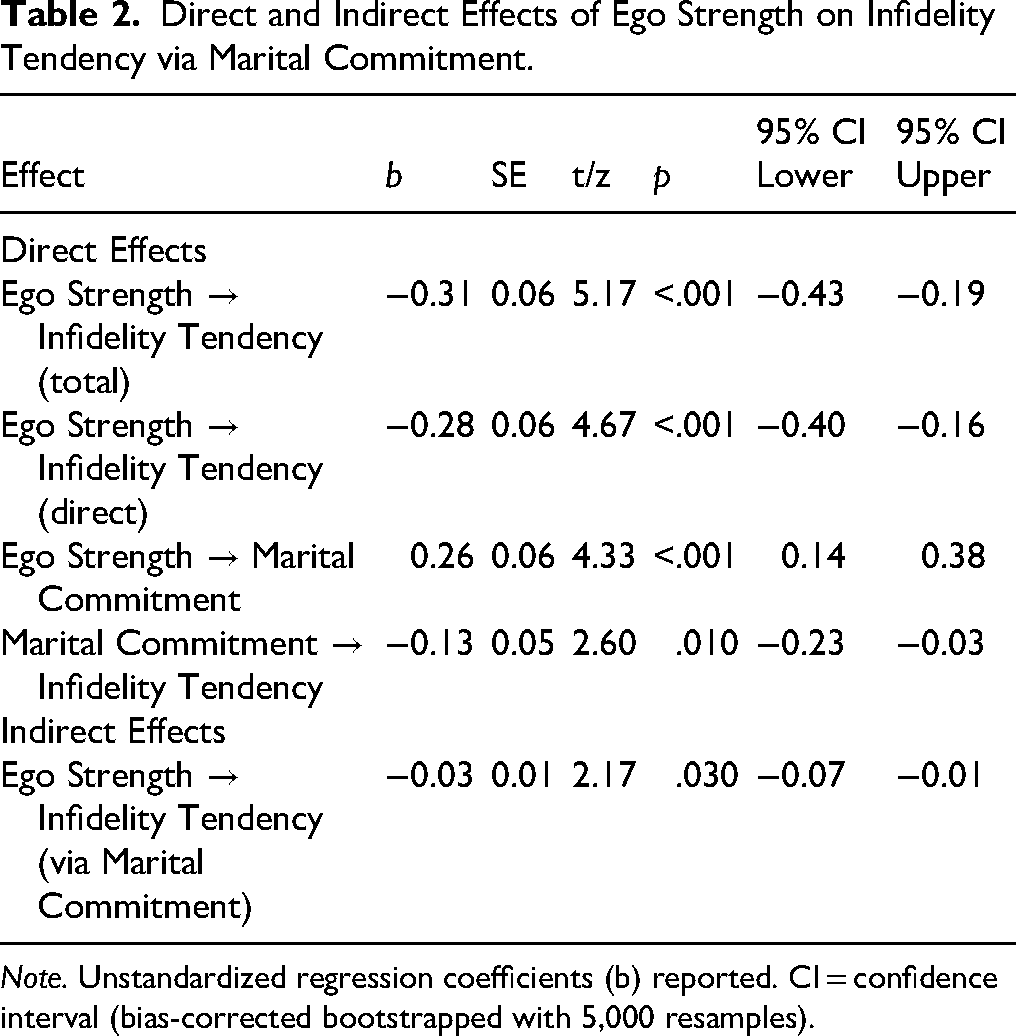
Path analysis was conducted using PROCESS Macro (Model 4) with 5,000 bootstrap samples to test the mediating role of marital commitment. Table 2 presents direct and indirect effects.
Direct and Indirect Effects of Ego Strength on Infidelity Tendency via Marital Commitment.
Note. Unstandardized regression coefficients (b) reported. CI = confidence interval (bias-corrected bootstrapped with 5,000 resamples).
Direct Effects
As shown in Table 2 and Figures 1 and 2, ego strength had a significant direct effect on tendency toward marital infidelity (b = −0.28, SE = 0.06, t = 4.96, p < .001, β = −0.37). Ego strength also had a significant direct effect on marital commitment (b = 0.26, SE = 0.06, t = 4.77, p < .001, β = 0.34). Furthermore, marital commitment had a significant direct effect on tendency toward marital infidelity (b = −0.13, SE = 0.05, t = 2.40, p = .017, β = −0.15).
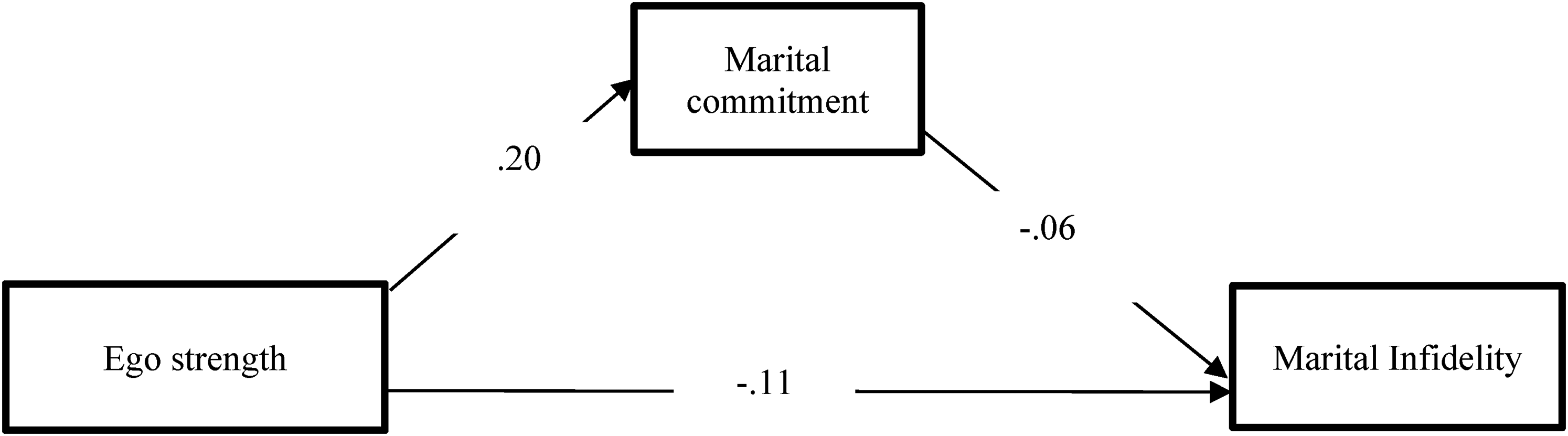
Path model with unstandardized coefficients.
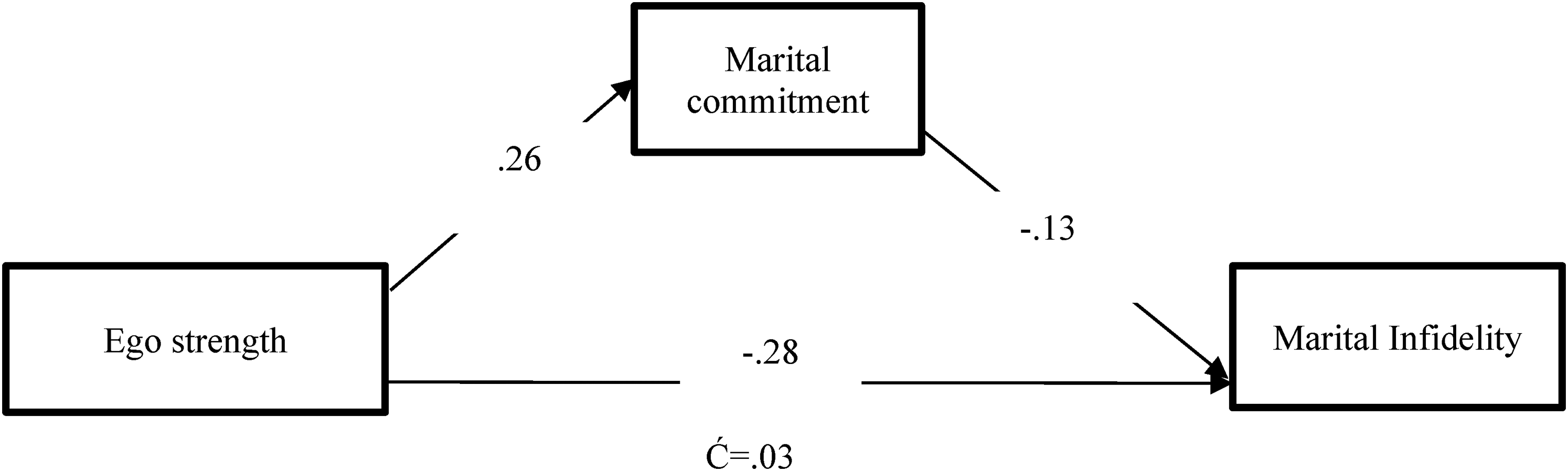
Path model with standardized coefficients.
Indirect Effect
Ego strength had a significant indirect effect on tendency toward marital infidelity via marital commitment (b = −0.03, SE = 0.02, 95% CI [−0.07, −0.01], bootstrapped SE = 0.01, z = 2.17, p < .05). The mediation index was significant (ab = −0.03, 95% CI [−0.07, −0.01]), indicating that marital commitment partially mediates the relationship between ego strength and tendency toward marital infidelity.
Because the direct effect of ego strength on infidelity tendency remained significant when the mediator was included (p < .001), the mediation is considered partial. These results support the main hypothesis, suggesting that marital commitment plays a mediating role in the relationship between ego strength and tendency toward infidelity among married individuals in Neyshabur.
The model accounted for 18% of the variance in marital commitment (R2 = 0.18) and 21% of the variance in infidelity tendency (R2 = 0.21). All paths in the model were significant at p < .05, except where noted.
Discussion
The present study investigated the mediating role of marital commitment in the relationship between ego strength and tendency toward marital infidelity among married individuals in Neyshabur, Iran. Using a correlational design with path analysis, the results revealed significant associations among the key variables. Specifically, ego strength was positively correlated with marital commitment (r = .41, p < .001) and negatively correlated with infidelity tendency (r = −.38, p < .001). Marital commitment, in turn, showed a negative correlation with infidelity tendency (r = −.29, p < .001). The path analysis confirmed a partial mediation effect, where marital commitment mediated the negative relationship between ego strength and infidelity tendency (indirect effect: b = −0.03, 95% CI [−0.07, −0.01], p < .05). The direct effect of ego strength on infidelity remained significant (b = −0.28, p < .001), indicating that while commitment plays a role; ego strength is independently associated with lower infidelity inclinations.
These findings are consistent with the study's hypothesis, suggesting that higher levels of ego strength are associated with greater marital commitment, which in turn corresponds to lower propensity for infidelity. The model explained 18% of the variance in marital commitment and 21% of the variance in infidelity tendency. The sample was predominantly women (64.4%), with a mean age of 38.64 years and average marriage duration of 14 years (a middle-aged, well-educated cohort, with 52.4% holding bachelor's degrees). Overall, the results underscore the interplay between intrapsychic factors (ego strength) and relational dynamics (commitment) in relation to extramarital inclinations. However, given the correlational design, causal inferences cannot be drawn.
Theoretical Implications
The observed associations provide insights into psychodynamic and relational theories of marital fidelity. Ego strength, conceptualized as the capacity to balance intrapsychic demands with external realities (Markstrom et al., 1997), emerged as a factor associated with lower infidelity tendency. Individuals with stronger ego functions reported better self-regulation and impulse control, which may help avoid relationship violations. This finding is consistent with the ego-resiliency and ego-control framework (Block & Block, 2014), in which resilient egos enable adaptive coping with relational stressors, potentially reducing vulnerability to infidelity. For example, stronger ego functioning may facilitate impulse control, reducing id-motivated urges (Baumeister et al., 2008) such as pursuing emotional or sexual satisfaction outside marriage.
The mediating role of marital commitment further enriches attachment and commitment theories. Commitment—encompassing personal, moral, and structural aspects (Adams & Jones, 1997)—may serve as a relational factor associated with greater investment and ethical obligations. Our findings suggest that ego strength is associated with stronger commitment, which in turn is associated with lower infidelity tendencies. This process is consistent with attachment theory, as secure attachment styles (generally associated with well-developed ego functions) are linked to commitment and loyalty (Khosrobeygi et al., 2021; Gungor & Kaba, 2024). For example, individuals with higher ego strength may exhibit greater self-differentiation, allowing them to navigate marital conflicts without resorting to extramarital affairs (Agha Yousefi et al., 2022; Heydarian et al., 2022).
These findings are broadly consistent with prior research. Gungor and Kaba (2024) found comparable results regarding ego states and attachment in relation to infidelity, where dominant ego states (e.g., adaptive adult) were associated with lower infidelity propensity. Shokri et al. (2019) found that ego strength is associated with marital commitment in Iranian samples, mirroring our positive correlation. Khorramabadi et al. (2019) extended this by showing marital commitment's mediating role between executive functions and infidelity, highlighting cognitive-emotional pathways. Warach and Josephs (2021) noted that infidelity may constitute attachment trauma, with a weaker ego structure potentially intensifying relational betrayal, consistent with our psychodynamic perspective.
Mechanistically, the findings suggest how ego strength may be associated with infidelity via impulse control and self-awareness. Stronger ego functioning may help individuals resist temptations arising from situational factors, including societal pressure or marital dissatisfaction (Rokach & Chan, 2023). Baumeister et al. (2008) proposed that ego depletion increases impulsive behaviors; conversely, stronger ego functioning may support impulse control, consistent with our negative direct effect. Self-awareness, a key ego function, may facilitate realistic relationship expectations, reducing dissatisfaction that could contribute to infidelity (Letzring et al., 2015). In cultural contexts like Iran, where familial and religious values emphasize fidelity, ego strength may interact with moral commitment to enhance protective associations (Ghoreishi Rad & Poorjabbar Akhouni, 2018; Ebrahimi Khasmakhi & Salahin, 2018).
The partial mediation suggests additional pathways warranting investigation. For example, personality traits (e.g., the Big Five) may moderate these relationships, as hypothesized by Salehzadeh et al. (2024), who found that attachment styles and sexual satisfaction mediated personality-infidelity associations. Dark triad traits may be associated with higher infidelity even when commitment is present (Lišman & Holman 2023) and should be incorporated into future models. Power dynamics may also play a role; Lammers et al. (2011) found that perceived power is associated with infidelity, which may override ego strength in some individuals. Our study extends this literature by embedding ego strength within a mediation framework, bridging psychodynamic and social–psychological perspectives.
This study contributes to understanding infidelity as a multidimensional phenomenon (Rokach & Chan, 2023). It moves beyond simplistic models by emphasizing intrapsychic mediators in addition to sociocultural factors (e.g., Azhar et al., 2018, on stress and infidelity in Pakistan). In non-Western cultures with high collectivism, ego-related effects may operate through commitment pathways that differ from individualistic cultures (Li et al., 2023). Future theories should incorporate cultural moderators, as our Iranian sample highlights the potential role of religiosity in enhancing commitment (Dollahite & Lambert, 2007).
Practical Implications
The findings have potential implications for marital counseling and intervention programs. Clinicians may consider targeting ego strength through psychodynamically informed approaches, such as ego-strengthening exercises, to enhance self-regulation (Kchoui & Fathi Ashtiani, 2013). Mindfulness-based interventions may develop ego-resiliency, helping couples manage relational impulses (Block & Block, 2014). Such effects may be augmented by commitment-building techniques, including emotionally focused therapy, which promotes secure attachments (Bahramabadi et al., 2019; Choobforoushzadeh et al., 2024).
Specific ego-strengthening techniques include (a) exploring and reinforcing adaptive defense mechanisms (e.g., sublimation, humor, anticipation) while reducing reliance on immature defenses (e.g., acting out, denial); (b) using narrative therapy approaches to help clients develop coherent life narratives that enhance identity formation and ego integration; (c) implementing cognitive reappraisal training to improve emotion regulation under relationship stress; and (d) facilitating problem-solving skills to increase mastery experiences, thereby strengthening self-efficacy and impulse control.
Commitment-based interventions may include: (a) forgiveness models (e.g., Enright's process model) that help couples rebuild trust and moral commitment; (b) emotionally focused therapy exercises that restructure attachment bonds and increase personal commitment; (c) relationship education programs that explicitly address the three commitment dimensions (personal, moral, structural) and their maintenance; and (d) cognitive-behavioral strategies to challenge irrational beliefs about alternatives to the marriage (Li et al., 2023; Clyde et al., 2020).
Culturally adapted interventions for Iranian couples might integrate religious principles that emphasize fidelity as a spiritual duty, while respecting diverse levels of religious observance. For example, clinicians could draw on Islamic concepts of “taqwa” (God-consciousness) and “amanah” (trust) as frameworks for strengthening moral commitment, when appropriate and desired by clients. Additionally, family-based interventions that engage extended family support systems may be particularly relevant in the Iranian cultural context, where family honor and collective values are prominent (Ghoreishi Rad & Poorjabbar Akhouni, 2018).
Ego assessments (e.g., the PIES; Markstrom et al., 1997) in educational or clinical settings could help identify at-risk individuals and teach conflict resolution skills and self-awareness (Clyde et al., 2020). For middle-aged couples similar to our sample, commitment enhancement could be incorporated into programs addressing midlife transitions that may be associated with infidelity (Choobforoushzadeh et al., 2024).
At a broader level, policy initiatives supporting family stability could address the societal costs associated with infidelity. Digital platforms might provide self-help ego and commitment-building tools based on evidence from online intervention research (Khalatbari & Vatankhah, 2022). However, it is important to note that these recommendations are speculative and require empirical testing in intervention studies, as the current correlational findings do not directly test causal mechanisms.
Limitations and Future Directions
Several limitations should be acknowledged. The convenience sample from Neyshabur limits generalizability; findings may not extend to rural populations, different socioeconomic groups, or other regions of Iran. The university-based sampling strategy resulted in a highly educated sample (over 89% with bachelor's or higher degrees), which exceeds the educational attainment of the general Neyshabur population. Future research should employ stratified random sampling to capture more diverse educational and socioeconomic backgrounds.
Self-report measures may introduce bias, particularly social desirability, given the sensitive nature of infidelity (Whatley, 2006; Lišman & Holman 2023). The cultural specificity of Iran may limit applicability to settings with different infidelity norms (Aranda Torres et al., 2020; Djamal, 2023). Future studies should consider using multimethod designs, including behavioral observations or partner reports, to complement self-report data (McNulty & Widman, 2014).
The cross-sectional design precludes causal inferences; longitudinal research is needed to examine temporal pathways from ego strength to commitment to infidelity tendencies (Li et al., 2023). Future research should employ prospective designs with multiple time points to establish directionality and test mediation more rigorously. Additionally, experimental or intervention studies could examine whether ego-strengthening or commitment-enhancing interventions produce changes in infidelity-related outcomes.
Future studies should also aim for more diverse samples, including different ethnicities, religious backgrounds, sexual orientations, and relationship structures (Ferguson & Johnson, 2024). Research could explore moderators such as personality traits (Pertiwi Isma & Turnip, 2019), power dynamics (Lammers & Maner, 2016), or gender differences. Given that our sample was predominantly female (64.4%), future research should oversample men to examine potential gender differences in mediation pathways. Intervention trials examining the effectiveness of ego-strengthening and commitment-enhancing programs for infidelity prevention would help bridge the gap between theory and practice (Navabinejad et al., 2023a).
Conclusion
This study elucidates the mediating pathway from ego strength to lower infidelity tendency via marital commitment, advancing psychodynamic and relational perspectives on marital processes. It highlights the role of ego strength in relation to strong marriages, integrating empirical evidence with theoretical literature. Despite limitations, the findings have potential implications for counseling and future research, advocating for holistic approaches to promote marital fidelity. However, given the correlational design, results should be interpreted as associations rather than causal effects, and intervention recommendations require empirical validation in future studies.
Footnotes
Acknowledgments
The authors would like to express their sincere gratitude to all participants who generously shared their time and experiences in this study. The authors also thank the university authorities and administrative staff in Neyshabur for their cooperation and assistance in facilitating data collection. This research would not have been possible without their support.

Author Contributions
Mustafa Bolghan-Abadi contributed to conceptualization, methodology, supervision, data curation, writing—original draft, and project administration. Fatemeh Barooh contributed to investigation (including interviews), formal analysis, writing—review & editing.
Ethical Considerations
This study was conducted in accordance with the ethical principles outlined in the Declaration of Helsinki. Ethical approval was obtained from the Institutional Ethics Committee (approval code: IR.IAU.NEYSHABUR.REC.1403.026). Following approval, permission was granted by university authorities to facilitate access to married students and staff for the purpose of data collection.
Consent to Participate
All participants were fully informed about the study's aims, procedures, and their right to withdraw at any time. Written informed consent was obtained from all individual participants prior to their interviews.
Consent for Publication
All authors have approved the final version of this manuscript and consent to its publication. Participants provided informed consent for the use of their anonymized questionnaire data in academic publications and conference presentations, with the assurance that all identifying information would be removed to maintain confidentiality.
Funding
The authors received no financial support for the research, authorship, and/or publication of this article.
Declaration of Conflicting Interests
The authors declared no potential conflicts of interest with respect to the research, authorship, and/or publication of this article.
Data Availability
The data supporting the findings of this study are available from the corresponding author upon reasonable request.