






Abstract
Recent studies have associated parental grit with a range of desirable psychological and parenting-related outcomes, such as parental emotional exhaustion and parenting goals. However, within the Chinese context, the assessment and study of parental grit remain in a nascent stage. To contribute to advancing this field, this study evaluated the psychometric properties of a Chinese Grit Scale (CGS)—a general measure of trait-level grit—in a sample of Chinese parents. Cross-sectional data from 423 Chinese parents (mean age = 35.37 years; SD = 4.92; 69% mothers) were analyzed. This study assessed the scale's factor structure, reliability, measurement invariance across gender, and criterion-related validity. The results indicate that the CGS is multidimensional with satisfactory model fit, and demonstrates good internal consistency, gender invariance, and good criterion-related validity with other well-established measures of life satisfaction, resilience, parenting stress, and depressive symptoms. This study provides robust empirical evidence that the CGS is a psychometrically sound instrument for measuring parental grit from a multidimensional perspective in Chinese populations, making it a valuable tool for future family and clinical research.
Background
Research on grit has flourished over the past two decades. Originated by Duckworth, grit refers to “trait-level perseverance and passion for long-term goals” (Duckworth et al., 2007, p. 1087) in the American context with two facets: consistency of interests (maintaining a long-term focus on interests) and perseverance of effort (sustaining effort despite setbacks towards the long-term goal). Recently, the concept of grit and its beneficial effect on individuals’ psychological, social, and physical health has been researched extensively, highlighting its usefulness for experimental and applied purposes (Kelner et al., 2024). For example, a number of empirical studies have shown positive associations of grit with life satisfaction, happiness, hope, mindfulness, optimism, positive affect, resilience, and subjective well-being (e.g., Ekinci & Koç, 2023). Grit exhibits consistent negative correlations with aggression, anxiety, and depressive symptoms (e.g., Shin & Bang, 2022). Additionally, the protective effects of grit have also been confirmed in clinical samples, such as congenital heart disease (Liu et al., 2024) and functional impairment (Delfel et al., 2023). These empirical results underscore grit's role as a protective factor for psychological and physical health, highlighting the importance of reliable measures to assess it.
Regarding the conceptualization of grit, Duckworth and colleagues introduced grit into the literature in 2007 by conceptualizing it as one's noncognitive ability encompassing the sustained application of effort and maintenance of passion toward long-term goals. However, the two-factor model's theoretical generalizability has proven nonrobust and elusive, drawing criticism for its operationalization. For example, the validity of this bi-dimensional grit concept has been called into question, as it may not be psychometrically meaningful, such as unsatisfactory internal consistency and measurement model fit and weak cultural sensitivity in the application of cross-cultural context (e.g., Uribe-Moreno et al., 2024). For example, a series of cross-cultural scale adaptation studies have consistently revealed inconsistent factor structures of two-dimensional grit constructs (e.g., Lee et al., 2019; Li et al., 2018). Grit has been further proposed as a culture-specific construct with unique facets that capture values or beliefs that are embedded in one’s given cultural and social context (Datu et al., 2017; Lam & Zhou, 2021). Within the Chinese context, Lam and Zhou developed a new self-reported Chinese grit scale (CGS), also called the Goal striving scale, in assessing emerging adults’ grit levels through qualitative and quantitative approaches. Compared with the existing grit measures, it provides a more nuanced understanding of how Chinese people strive to achieve long-term goals from a multidimensional perspective (Lam & Zhou, 2021). This scale captures an Affective-Behavioral-Cognitive-Motivational-Social (ABCMS) model of grit. According to this model, the affective dimension is represented by self-confidence, the behavioral dimension by persistent effort, and the cognitive dimension by adaptability—all crucial for striving toward long-term goals. Furthermore, self-talk serves as an indicator of the motivational drive at the intra-individual level, while social support highlights the social components operating at the inter-individual level.
Empirical studies have confirmed that parents’ grit acts as a significant determinant of their children's grit and various educational and psychological outcomes, such as children's school performance and psychological health (Won & Lee, 2023). These inform that the investigation of parents’ grit is not only beneficial for parents themselves (e.g., research evidence for further intervention settings in targeting parents’ grit) but also could bring changes in the grit level of their children and various desired educational and psychological outcomes. However, although the CGS was developed and validated by a Chinese emerging adult population, to the best of our knowledge, its psychometric properties have not been assessed with parent samples. Emerging evidence further indicates that the factor structure and predictive validity of grit measures can vary across different age and cultural groups (e.g., Abu Hasan et al., 2022; Morell et al., 2021). Therefore, in the present study, we investigated the psychometric properties of the CGS—a general measure of trait-level grit—in a sample of Chinese parents. Importantly, we neither propose nor validate a parenting-specific grit construct; rather, we examine whether this general grit scale performs reliably when administered to Chinese parents.
In this study, we validated the CGS among Chinese parents and surveyed parents of early childhood and middle childhood (≤12 years) for two reasons: (1) these children spend the most time with their parents and interact frequently with them (Larson & Richards, 1991), and (2) it is a critical period in a child's emotional, social, and behavioral development, which may present parenting-related challenges to parents and may further impact parents’ mental health (Fang et al., 2024). Furthermore, conceptualizing grit as the capacity to sustain effort toward long-term goals is critical for assessing both positive and negative indicators of parental functioning. This perspective may be particularly relevant for parents who already suffer from mental health issues or deal with ongoing health-related parenting stress. To the extent that future intervention research aims to understand and support grit from a capability perspective, a validated grit measure is a necessary first step. However, determining whether a grit measure is sensitive to change or suitable for evaluating interventions requires longitudinal or experimental designs beyond the scope of this study. Therefore, by validating the CGS, this study aims to provide a foundational psychometric tool for future research, including potential intervention studies, and to help develop a Chinese cultural-specific conceptual and diagnostic research area on parental grit.
Gender Differences in Grit
In addition to gender-based differences, existing research on grit reveals a complex pattern. Some studies indicate that females score significantly higher than males in general populations (e.g., Sigmundsson & Leversen, 2024). Conversely, within parent samples, a recent study found that mothers score lower than fathers in overall grit (Fernández-Martín et al., 2023). These divergent findings highlight a critical psychometric prerequisite: to meaningfully interpret gender differences, it must first be established that the grit scale measures the same underlying construct for men and women. Gender invariance—the condition where a measurement tool functions equivalently across groups—is essential to confirm that observed score differences reflect true variations in the latent trait, not measurement bias (Steyn & De Bruin, 2020). Without establishing invariance, group comparisons risk yielding misleading interpretations (Constant et al., 2016).
A related consideration is whether the grit construct, as captured by scales developed primarily in academic or professional contexts (e.g., Duckworth et al., 2007; Datu et al., 2017), retains an identical meaning for individuals in the role of a parent. The core facet of grit—perseverance toward long-term goals—may be domain-shifted in a parent sample. For parents, the primary “long-term goal” often centers on their children's future development and fostering strong familial bonds, with perseverance manifested through daily child-rearing practices (Suizzo et al., 2019). This potential re-contextualization of grit could influence its assessment and the interpretation of gender differences. Given that the manifestation of grit may differ between genders, testing for measurement equivalence is particularly crucial when examining grit among Chinese parents. Therefore, another objective of this study is to verify whether the CGS is gender invariant among Chinese parents.
Objectives
We aimed to evaluate the psychometric properties of the CGS among a sample of Chinese parents and to examine whether this general grit scale functions reliably and validly when administered to parents. Specifically, we aimed to (a) evaluate its factor structure and internal consistency, (b) examine its criterion-related validity, and (c) test its measurement invariance across gender. Regarding examining criterion-related validity, we followed Hinkin's (1998) assumptions of scale validation, which proposes that a new scale should be associated with the constructs that this new scale is theoretically expected to correlate with. Therefore, the correlations of grit and external criteria measures (i.e., life satisfaction and parenting stress) will be evaluated. In line with previous empirical support, it is expected that grit would be positively associated with life satisfaction and resilience and negatively associated with parenting stress and depressive symptoms (e.g., Ekinci & Koç, 2023; Liu et al., 2022). We also hypothesized that the CGS will demonstrate satisfactory factorial validity, internal consistency, and measurement invariance across gender.
Method
Participants and Procedure
A correlational research design was employed, utilizing a convenience sampling method. This study was reviewed and approved by the authors’ University Research Ethics Committee [SSHRE22-APP011-FSS]. Informed consent was obtained from all participants prior to their involvement. Data were collected anonymously via an online questionnaire administered on Qualtrics, with no identifying information gathered to protect participant confidentiality. This questionnaire was presented in traditional Chinese. After providing informed consent, participants completed the 30-min survey and were compensated with a supermarket coupon for their participation.
Inclusion criteria for the final sample were (i) parents who had reported demographic information for their children aged 0–12 years; (ii) they passed three quality control checks embedded in the survey (e.g., “Please select ‘C’ for this question to show you're paying attention”); and (iii) they completed the questionnaires. Parents of teen and adult children (> 12 years old) were removed from the data analysis because one of the primary goals of this study is to examine parents of children aged 0–12 years. We only included completed responses in this study to ensure data quality and reduce nonresponse bias (Fuchs, Bossert & Stukowski, 2013). The final sample thus included 423 parents (mean age = 35.37 years; SD = 4.92; 69% mothers) with children aged between 0 and 12 years (children's mean age = 4.76 years; SD = 3.00; 49% girls).
Measures
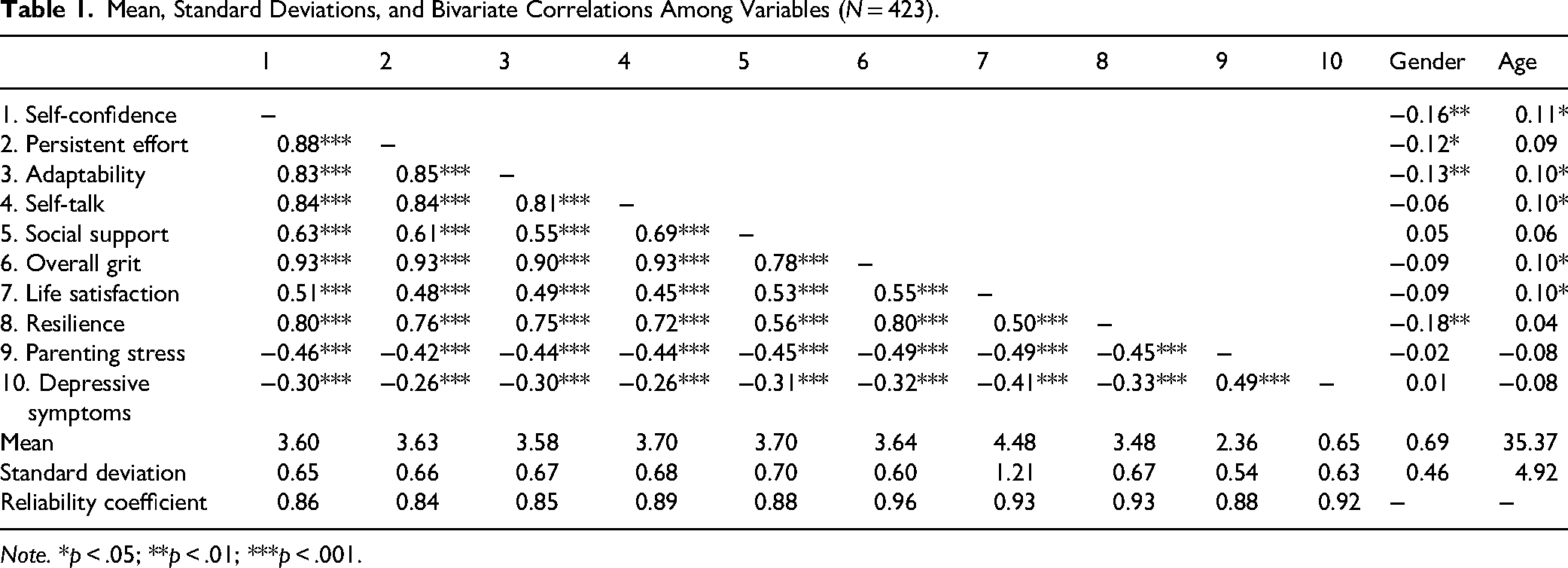
In addition to the grit measure, which we sought to validate in this study, measures of life satisfaction, resilience, parenting stress, and depressive symptoms have been used and validated among Chinese parents and have demonstrated good validity and reliability (e.g., Chen et al., 2024; Cheung, 2000; Wang et al., 2020). In this sample, their internal consistency was good to excellent (α = 0.84 to 0.96; see Table 1 for detailed values).
Mean, Standard Deviations, and Bivariate Correlations Among Variables (N = 423).
Note. *p < .05; **p < .01; ***p < .001.
Grit
Grit was assessed with Lam and Zhou's (2022) Chinese grit measure (CGS), covering 25 items to assess individuals’ overall grit levels in 5 dimensions – covering self-confidence, persistent effort, adaptability, self-talk, and social support. Items were rated on a 5-point Likert scale (1 = not like me at all to 5 = very much like me). A total grit score was calculated by averaging all items, with higher scores representing higher levels of grit in pursuing long-term goals.
Life Satisfaction
Life satisfaction was measured with the 5-item Satisfaction with Life Scale (Diener et al., 1985) about general life satisfaction. Items were rated on a 7-point Likert scale (1 = strongly disagree to 7 = strongly agree). Higher average scores reflected greater life satisfaction.
Resilience
Resilience was assessed with the 10-item Connor–Davidson Resilience Scale (CD-RISC; Connor & Davidson, 2003) about individual ability to cope with adversity. Items were rated on a 5-point Likert scale (1 = not like me at all to 5 = very much like me). Higher average scores reflected greater resilience.
Parenting Stress
Parental stress was assessed with the Parental Stress Scale (PSS; Berry & Jones, 1995). The PSS consisted of 18 items assessing parents’ feelings about their parenting role, divided into two subscales: parental satisfaction and parental stress. The eight items related to parental satisfaction are reverse coded. Items were rated on a 5-point Likert scale (1 = strongly disagree to 5 = strongly agree). Higher average scores reflected greater perceived parental stress.
Depressive Symptoms
Depressive symptoms were assessed with the Patient Health Questionnaire (PHQ-9; Kroenke et al., 2001). The PHQ-9 consisted of nine items assessing the frequency of depressive symptoms experienced over the preceding 2 weeks. Items were rated on a 4-point Likert scale (0 = not at all to 3 = nearly every day). Higher average scores reflected greater perceived depressive symptoms.
Statistical Analyses
IBM SPSS Statistics 24 was used for calculating descriptive statistics and bivariate correlations. Subsequently, Confirmatory Factor Analysis (CFA) was conducted in RStudio (version 2024.04.2 + 764) using package lavaan and robust weight mean square estimator (WLSMV) estimator suitable for ordinal data. This analytical approach utilizes a robust estimation procedure designed to overcome the limitations of conventional methods when applied to data characterized by coarse categorization or non-normal distributions (DiStefano & Morgan, 2014). To estimate good model fit (Falk & Muthukrishna, 2023), we assessed the following indices: the comparative fit index (CFI) and Tucker–Lewis index (TLI), for which values greater than 0.95 indicate good fit; and the root mean square error of approximation (RMSEA) and standardized root mean square residual (SRMR), for which values less than 0.08 indicate acceptable fit.
We assessed measurement invariance across gender using the approach outlined by Putnick and Bornstein (2016), which tests the equivalence of the latent construct across three hierarchical levels: (a) Configural invariance to test whether the factor structure (number of factors and pattern of loadings) is equivalent between fathers and mothers; (b) Metric invariance (weak factorial invariance) to test whether factor loadings are equal across groups; (c) Scalar invariance (strong factorial invariance) to test whether item intercepts are equivalent, ensuring responses are scaled similarly and represent the same underlying construct for both fathers and mothers; and (d) Strict invariance (residual invariance) to test whether, in addition to the factor structure, loadings, and intercepts being equal across fathers and mothers, the amount of unexplained variance (measurement error) for each individual item is equal. In line with established recommendations (Rodríguez-Menchón et al., 2022), metric invariance was supported if changes in fit indices met the criteria of ΔCFI ≤ 0.010, ΔTLI ≤ 0.010, ΔRMSEA ≤ 0.015, and ΔSRMR ≤ 0.030. For scalar and strict invariance, the more stringent criteria of ΔSRMR ≤ 0.010 were applied in addition to ΔCFI ≤ 0.010, ΔTLI ≤ 0.010, and ΔRMSEA ≤ 0.015.
Transparency and Openness
This study was not preregistered. The analysis code is provided in the supplementary material. Due to ethical restrictions, the dataset and materials are not publicly available in any online registries but are available on justified request to the corresponding author.
Results
Preliminary Findings
The descriptive statistics showed that the range of skewness (from −0.43 to 1.26) and kurtosis (from −0.35 to 1.32) were all in the acceptable range between −2 and +2 (Kline, 2010). No significant gender difference emerged in overall grit (t (421) = 1.88, p = .061). However, grit was significantly positively correlated with age (r = .10, p < .05), suggesting that grit increased slightly with age.
Factor Structure
To ensure the sample data was suitable for factor analysis, we assessed sampling adequacy using the Kaiser–Meyer–Olkin (KMO) measure and Bartlett's test of sphericity. A significant Bartlett's value (p < .05) and the KMO value above 0.70 (Pallant, 2020) would meet the requirement. The data were deemed suitable for factor analysis, as indicated by a significant Bartlett's test of sphericity (χ2(300) = 7769.71, p < .001), and an excellent KMO value of 0.96. We tested three measurement models that have been testified previously (see Figure 1; Lam & Zhou, 2022): (1) a unidimensional first-order model, positing grit as a single latent trait; (2) a first-order model featuring five intercorrelated facets, representing grit as a multidimensional construct comprised of distinct yet related components; and (3) a hierarchical model examining whether the covariation among the five facets could be accounted for by a single, overarching general grit factor. This sequential model testing approach, which has been well-established in the validation of grit measures (e.g., Duckworth & Quinn, 2009; Lin et al., 2024), allows for the identification of the most theoretically and empirically justified representation of the grit construct. Among the tested models (see Table 2), the unidimensional first-order model (Model 1) showed poor fit—χ2(275) = 1939.939, CFI = 0.988, TLI = 0.987, RMSEA [90% C.I.] = 0.120[0.115, 0.125], SRMR = 0.073—indicating that a single total grit score is not psychometrically justified. The Model 2—a first-order model of the CGS with five intercorrelated dimensions—demonstrated the best fit to the data: χ2(265) = 819.150, CFI = 0.996, TLI = 0.996, RMSEA [90% C.I.] = 0.070[0.065, 0.076], SRMR = 0.047, supporting the interpretation that the five grit facets are related but distinct dimensions. All items loaded significantly onto their designated factors, with loadings ranging from 0.651 to 0.897 (p < .001), indicating acceptable to good reliability (see Table S1 for detailed loadings). The model collectively accounted for 53% of the total variance. The factor loadings of all 25 items were higher 0.40 (the cut-off value with 0.40) which indicated the proposed items in the model were good (Byrne, 2001). The hierarchical model (Model 3) showed marginal model fit—χ2(165) = 616.100, CFI = 0.994, TLI = 0.993, RMSEA [90% C.I.] = 0.080[0.074, 0.087], SRMR = 0.052—indicating that the five grit facets load onto a single higher-order grit factor. A higher-order general grit score is not strongly supported by the current data and should be used with caution, if at all. Given that Model 2 exhibited superior fit—demonstrating the best CFI, TLI, RMSEA, and SRMR values—compared to both the unidimensional and hierarchical models, we recommend using separate subscale scores for each of the five grit facets rather than a single total score or a higher-order grit factor score.
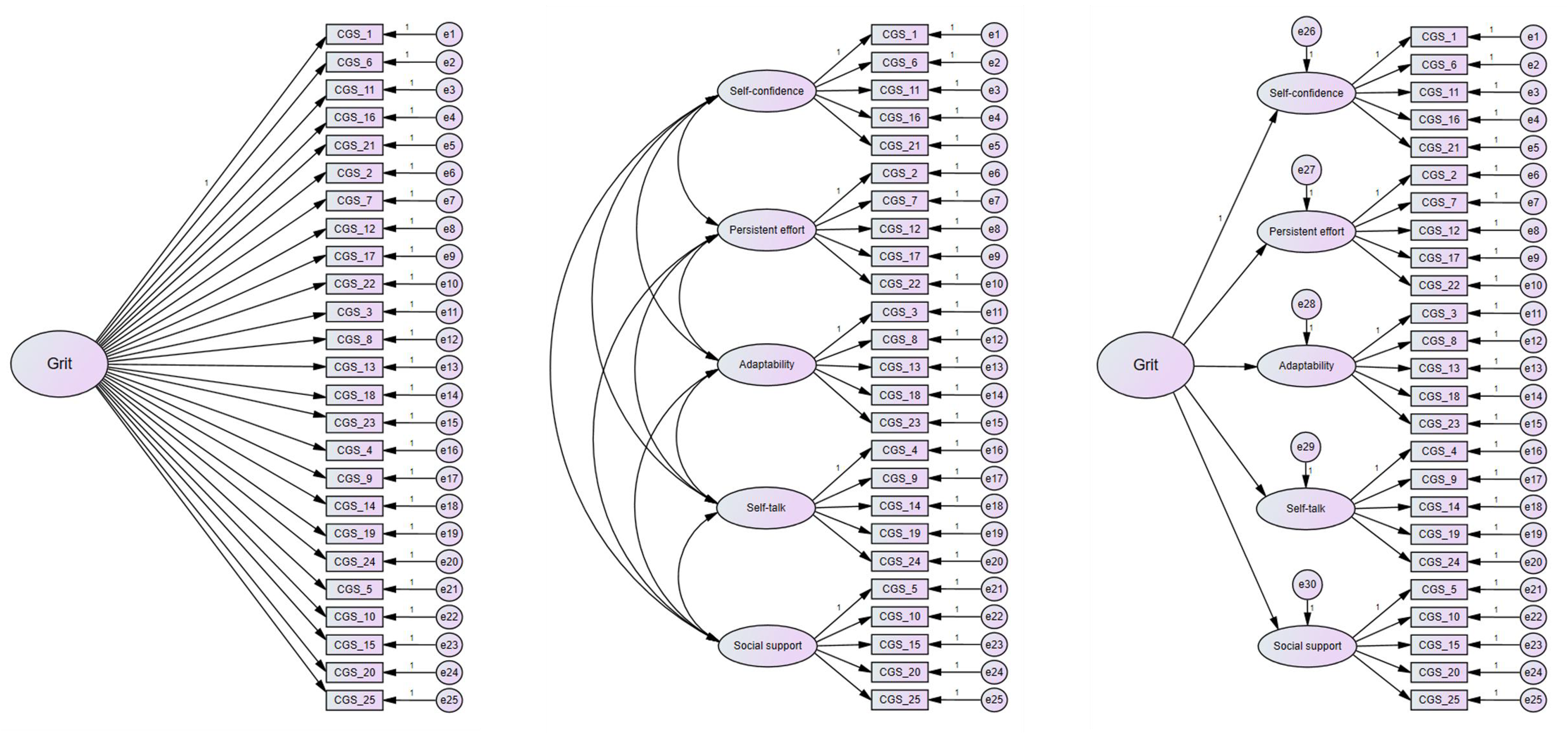
Graphical representation of Models 1–3.
Fit Indices for the Testing Measurement Models.
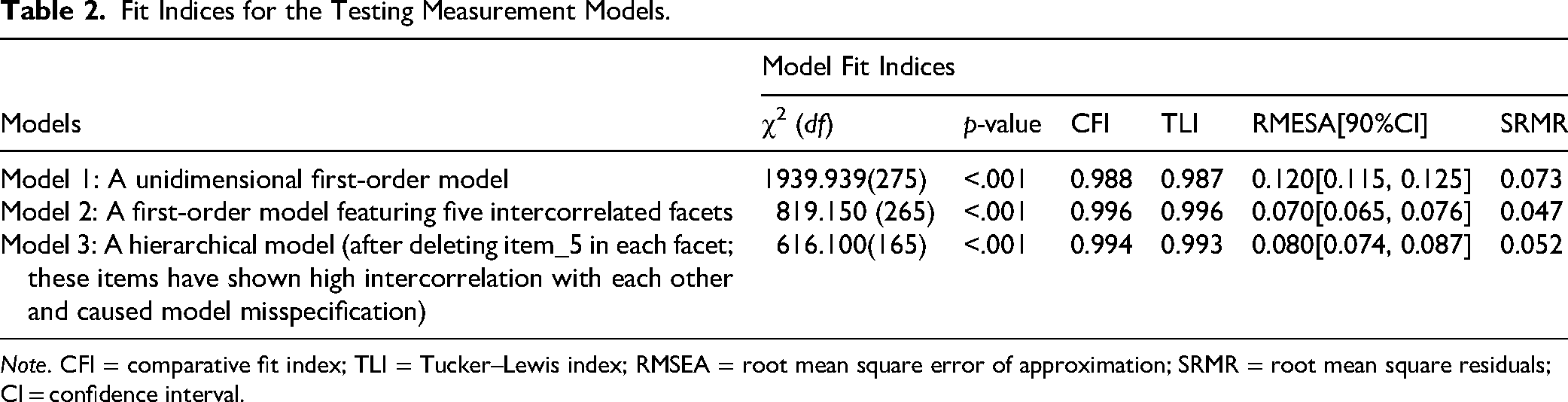
Note. CFI = comparative fit index; TLI = Tucker–Lewis index; RMSEA = root mean square error of approximation; SRMR = root mean square residuals; CI = confidence interval.
Criterion-related Validity
As shown in Table 1, the five grit subscales demonstrated strong positive correlations with the overall grit score, ranging from 0.78 to 0.93 (all ps < .001). To examine criterion-related validity, we analyzed the associations between grit and life satisfaction, resilience, parenting stress, and depressive symptoms, controlling for parents’ gender and age. As shown in Table 3, the results of the regression analysis confirmed that grit was significantly associated with higher life satisfaction (β = 0.54, p < .001; explaining 30.3% of the variance), greater resilience (β = 0.80, p < .001; explaining 65.4% of the variance), as well as lower parenting stress (β = –0.49, p < .001; explaining 24.5% of the variance) and fewer depressive symptoms (β = –0.32, p < .001; explaining 10.4% of the variance). Regarding the results for grit sub-factors, Self-confidence (β = 0.24, p = .012), Adaptability (β = 0.27, p < .001), Self-talk (β = –0.25, p = .005), and Social support (β = 0.41, p < .001) were significantly associated with life satisfaction, explaining 36.0% of the variance. The sub-factors, Self-confidence (β = 0.45, p < .001), Persistent effort (β = 0.14, p = .041), and Adaptability (β = 0.20, p < .001) were significantly associated with resilience, explaining 67.7% of the variance. The sub-factors, Self-confidence (β = –0.23, p = .027), Adaptability (β = –0.22, p = .014), and Social support (β = –0.26, p < .001) were significantly associated with parenting stress, explaining 26.4% of the variance. The sub-factors, Self-confidence (β = –0.24, p = .027), Adaptability (β = –0.26, p = .006), and Social support (β = –0.24, p < .001) were significantly associated with depressive symptoms, explaining 13.8% of the variance.
Multiple Regression Analysis of Overall Grit and its Subfactors Predicting Impact on Life Satisfaction, Resilience, Parenting Stress, and Depressive Symptoms (Gender and Age Were Controlled).
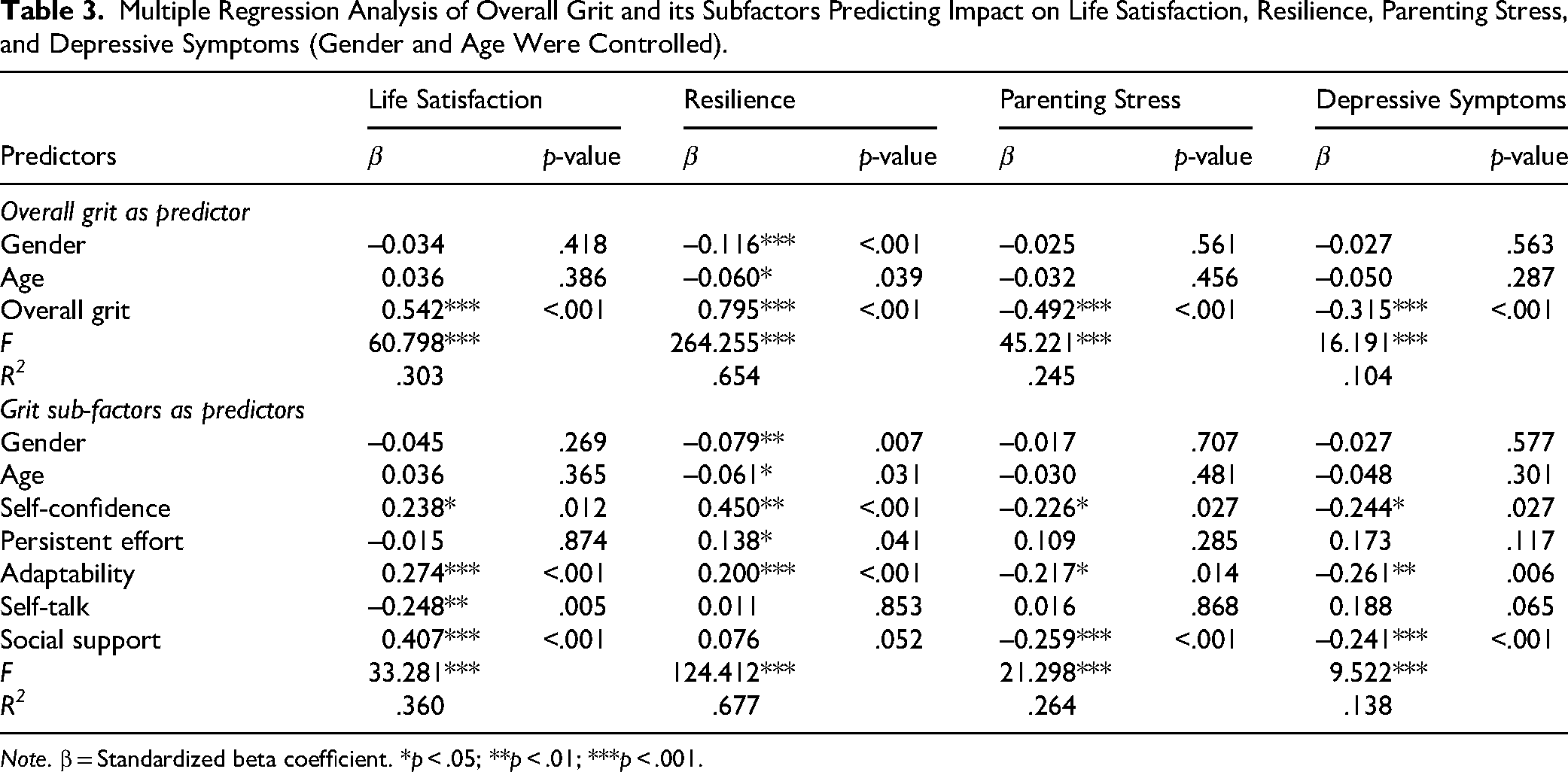
Note. β = Standardized beta coefficient. *p < .05; **p < .01; ***p < .001.
Gender Invariance
To test for gender invariance, we conducted a multiple-group CFA to examine the equivalence of the factor structure of Model 2 across genders. As presented in Table 4, the configural invariance model demonstrated acceptable fit: χ2(530) = 1164.674, CFI = 0.996, TLI = 0.995, RMSEA [90% C.I.] = 0.075[0.070, 0.081], SRMR = 0.055, indicating that the latent factor structure of the CGS was equivalent for fathers and mothers. To test whether metric invariance was achieved, we constrained the factor loadings to be the same across groups and found that the model fit was acceptable: χ2(550) = 1292.220, CFI = 0.995, TLI = 0.995, RMSEA [90% C.I.] = 0.080[0.074, 0.086], SRMR = 0.057. The differences in fit indices between configural and metric invariance were △CFI = 0.001, △TLI = 0.000, △RMESA = 0.005, and △SRMR = 0.003, which supported metric invariance of the CGS. To test whether scalar invariance was achieved, we constrained the factor loadings and the intercepts to be the same across groups and found that the model fit was acceptable: χ2(620) = 1259.606, CFI = 0.996, TLI = 0.996, RMSEA [90% C.I.] = 0.070[0.064, 0.076], SRMR = 0.055. The differences in fit indices between metric and scalar invariance were △CFI = 0.001, △TLI = 0.001, △RMESA = 0.010, and △SRMR = 0.002, which supported scalar invariance of the CGS. To test whether strict invariance was achieved, we constrained the factor loadings, the intercepts, and the residuals to be the same across groups and found that the model fit was the same as shown in the scalar invariance model and no changes in fit indices between scalar and strict invariance (△CFI = 0.000, △TLI = 0.000, △RMESA = 0.000, and △SRMR = 0.000). These results supported the establishment of strict invariance for the CGS, confirming that the measure operates with equivalent factor loadings, intercepts, and residual variances across groups. That is, the observed score differences can be attributed to true differences in the latent construct rather than group-specific measurement error. Collectively, these analyses demonstrate that the factor structure of Model 2 is invariant across gender, confirming that the grit construct is measured in the same way for fathers and mothers.
Measurement Invariance Analyses of Gender for First-Order Measurement Model.
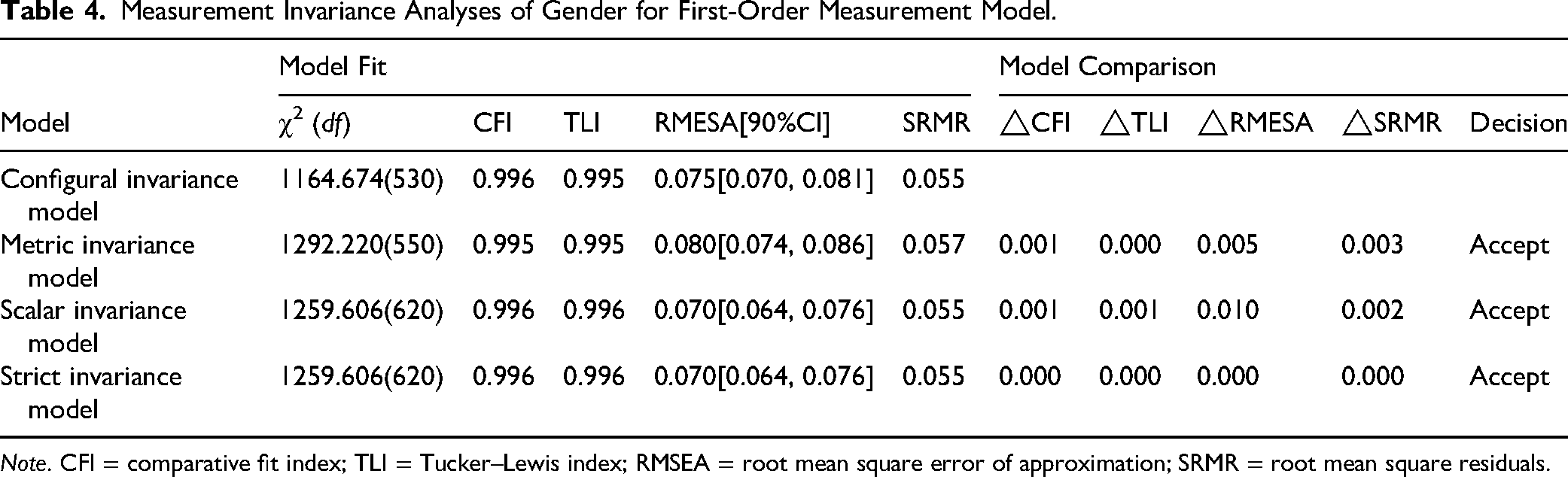
Note. CFI = comparative fit index; TLI = Tucker–Lewis index; RMSEA = root mean square error of approximation; SRMR = root mean square residuals.
Discussion
In this study, we validated the CGS in a parent sample by examining its psychometric properties. In line with Lam and Zhou's (2022) study, evaluation of the CGS yielded support for a first-order measurement model, where the standardized factor loadings were generally good for the total sample as well as for fathers and mothers separately. It implies that the current grit model fits equally well for both Chinese fathers and mothers when assessing grit from a multidimensional perspective. Reliability analysis showed that the CGS had good internal consistency, indicating that the whole scale and all subscales exhibited good reliability. Further, we demonstrated the associations among overall grit, life satisfaction, resilience, parenting stress, and depressive symptoms as evidence of criterion-related validity. As hypothesized, we found that parents’ grit was significantly and positively associated with life satisfaction and resilience, while negatively associated with parenting stress and depressive symptoms, consistent with the previous empirical support for its beneficial role in individuals’ psychological well-being (Rhodes & Giovannetti, 2022) and distress (Sharkey et al., 2018). Our analysis revealed distinct patterns of association for the five grit facets. While self-confidence and adaptability showed robust correlations across all measured outcomes—life satisfaction, resilience, parenting stress, and depressive symptoms—the other facets exhibited more specific relationships. Perceived social support was associated with higher life satisfaction and lower stress and depressive symptoms. Persistent effort was solely associated with resilience, and self-talk showed a negative correlation with life satisfaction. This differential pattern highlights the critical need to examine the multidimensional nature of grit, rather than treating it as a unitary construct, to fully understand its relationship with psychological functioning and outcomes. These findings align with the broader consensus in grit research, which consistently advocates for analyzing the facets of grit separately rather than as a unitary construct (Riskind et al., 2025). The observed poor fit of the unidimensional model of the CGS bolsters this consensus, empirically demonstrating that grit is not a unitary construct in our sample.
Notably, the high empirical association between grit and resilience, as critiqued in the extant literature (e.g., Credé et al., 2017) and also evident in our sample, raises valid questions about their discriminant validity. We acknowledge that this statistical overlap likely stems from a shared conceptual engagement with adversity (Georgoulas-Sherry, 2022), and we do not dismiss the possibility that the two constructs share meaningful common variance. Nevertheless, we argue that grit and resilience are best understood as distinct but related constructs. Our operationalization of grit within the Chinese context underscores its distinctiveness: we conceptualize it as a multidimensional construct encompassing affective (self-confidence), behavioral (persistent effort), cognitive (adaptability), intrapersonal (self-talk), and interpersonal (social support) facets. This holistic framework captures the sustained, proactive striving toward long-term goals, in contrast to resilience's more reactive focus on recovery from discrete setbacks (Duckworth et al., 2007; Herrman et al., 2011). Consequently, the unique variance explained by our grit scale lies in its association with a broader, stamina-oriented motivational architecture over extended periods—a dimension not captured by resilience alone. However, the strong correlation observed in our sample cautions against overinterpreting these differences. Prior longitudinal research (e.g., Eskreis-Winkler et al., 2014) suggests that grit is strongly related to long-term achievement, while resilience appears to be more strongly related to psychological adaptation (Bonanno et al., 2024; Yu et al., 2025). Yet these differential patterns of association, while suggestive, do not definitively establish that grit and resilience are distinct constructs, particularly given the cross-sectional nature of our data. We therefore conclude that grit and resilience are likely distinct but related constructs, though claims of distinctiveness must be made cautiously. The evidence, while suggestive of distinction, does not definitively rule out substantial conceptual overlap. Future research using longitudinal and multimethod designs is needed to more firmly establish discriminant validity. We argue that the present grit scale contributes theoretical value by accounting for the multifaceted nature of sustained goal pursuit—a dimension that resilience alone does not fully capture.
Evaluation of the gender invariance of the CGS demonstrated that the latent structure, factor loadings, item thresholds, and residual variances were equivalent across fathers and mothers. Results supported full configural, metric, scalar, and strict invariance, indicating that the scale's factor structure and the scaling, meaning, and error variance of its items are equivalent between groups. This establishes that fathers and mothers conceptualize the construct of grit in the same manner. These findings align with previous validation studies of grit scales (e.g., Datu et al., 2017; Ramos-Vera et al., 2023), reinforcing the measure's robustness for use across genders. It is worth noting that our sample contained significantly more mothers (69%; N = 293) than fathers (31%; N = 130), which may affect the generalizability of findings to fathers. Therefore, although measurement invariance was supported, these results should be interpreted cautiously given the smaller number of fathers, and future research with more balanced samples is needed.
Limitation and Future Direction
A primary limitation of this study is the validation of the scale solely within a convenience sample of Chinese parents, which may not be fully representative of the broader population of Chinese parents and may introduce selection bias (Golzar et al., 2022). Consequently, the generalizability of the findings to other cultural contexts or nonparent populations may be limited. Further investigations of cross-culture and cross-age samples are recommended. Second, this study relied on self-reported and subjective responses, which may cause social desirability and common method variance (Lindell & Whitney, 2001). Therefore, future research should employ multiple data sources, such as personal diaries or observational methods, to control for this potential bias. Third, the cross-sectional design of this study precludes any causal inferences regarding the relationships between grit and other variables. Although we identified significant associations, the directionality of these effects cannot be determined from the present data. Future research employing experimental designs is needed to test causal pathways more definitively and to evaluate whether the scale demonstrates utility for screening or intervention responsiveness. A fourth limitation concerns the general nature of the CGS. Although global measures are useful for assessing stable trait-like tendencies (e.g., general self-efficacy; Chen et al., 2001), they are limited in their capacity to capture within-individual fluctuations across time and contexts (Yeo & Frederiks, 2011). This may be particularly relevant for parental grit, as parents strive toward long-term goals across distinct domains, such as ensuring a child's love and security, fostering their development, maintaining a positive parent image, and achieving social acceptance for their child (Rodríguez-Bravo & Murga-Menoyo, 2023). Consequently, future research should investigate whether these different types of long-term parenting goals are associated with variations in parents’ exhibited grit levels.
Implications and Conclusion
The results of this study yield significant implications for future research employing the CGS. First, the findings establish the 25-item CGS as a reliable and valid instrument for assessing parental grit across five core domains: self-confidence, persistent effort, adaptability, self-talk, and social support. This study provides a foundational framework for investigating the relative importance of each grit domain, as well as its distinct correlates in Chinese parents. Second, researchers may use this grit scale for research purposes to examine parents’ grit profiles based on their level of grit in each domain. These profiles could inform future person-centered intervention research focusing on the domains that parents feel are most important to them or those areas where they feel less accomplished. Third, the results demonstrated a significant negative association between parental grit and both parenting stress and depressive symptoms. These cross-sectional findings suggest potential directions for future intervention and prevention research, though causal conclusions cannot be drawn from the current data. Future studies could examine whether interventions targeting the five core facets of grit within the family context are beneficial. For instance, subsequent research might design and test structured workshops aimed at enhancing parents’ self-awareness of their grit and bolstering interpersonal (e.g., social support) and intrapersonal (e.g., adaptive self-talk) resources that cultivate it, ultimately investigating whether such interventions reduce stress and mitigate depressive symptoms. Furthermore, based on our factor-analytic results, we found that the five-factor correlated model (Model 2) demonstrated the best fit across all indices. Accordingly, researchers are encouraged to use the five subscale scores separately when assessing parents’ grit level. In summary, the first-order measurement model of grit was verified in a Chinese parent sample, as well as the gender invariance and its criterion-related validity with measures of psychological health, such as the Satisfaction with Life Scale and the PHQ. This grit scale is psychometrically suitable for assessing Chinese parents’ grit from a multidimensional perspective in research contexts. Claims regarding screening or clinical application are not warranted by the current cross-sectional data and await future experimental or clinical validation.
Supplemental Material
sj-docx-1-tfj-10.1177_10664807261457924 - Supplemental material for Psychometric Validation of a Chinese Grit Scale in Chinese Parents
Supplemental material, sj-docx-1-tfj-10.1177_10664807261457924 for Psychometric Validation of a Chinese Grit Scale in Chinese Parents by Kelly KL Lam, Kaixin Liang, Xiuyun Lin and Peilian Chi in The Family Journal
Footnotes

Ethical Approval
The current study was approved by the ethics panel at the corresponding author's institution [SSHRE22-APP011-FSS].
Authors’ Contributions
Funding
The authors disclosed receipt of the following financial support for the research, authorship, and/or publication of this article: Preparation of this manuscript was supported by the joint grant by the Macao Science and Technology Development Fund [FDCT, grant numbers 0095/2022/AFJ and 0023/2021/APD] and the National Natural Science Foundation of China [NSFC, grant number 62261160652], and the grant by the Research Council at the University of Macau [MYRG-GRG2024-00269-FSS].
Declaration of Conflicting Interests
The authors declared no potential conflicts of interest with respect to the research, authorship, and/or publication of this article.
Data Availability Statement
The data that support the results of this study are available from the corresponding author upon reasonable request.
Declaration of Generative AI in Scientific Writing
During the preparation of this work the authors used Grammarly in order to correct grammatical errors and spelling mistakes. After using this tool/service, the authors reviewed and edited the content as needed and take full responsibility for the content of the published article.
Supplemental Material
Supplemental material for this article is available online.
References
Supplementary Material
Please find the following supplemental material available below.
For Open Access articles published under a Creative Commons License, all supplemental material carries the same license as the article it is associated with.
For non-Open Access articles published, all supplemental material carries a non-exclusive license, and permission requests for re-use of supplemental material or any part of supplemental material shall be sent directly to the copyright owner as specified in the copyright notice associated with the article.
