







Abstract

The term serendipity has been used to describe the phenomenon wherein researchers discover unexpected findings merely by chance or even “by accident,” consequently exposing a solution for a problem while they were initially trying to solve another. 1 A more wide and vague description of serendipity includes the definition of “a simple, happy accident.” 1 Analogically, pathologists can encounter unexpected benign and innocent anomalies while they are on the lookout for malignancy.
While screening the tissue samples of a prophylactic mastectomy specimen of a BRCA1 mutation carrier, I noticed abundant apocrine metaplasia in cystically dilated ducts. Although no significant findings were encountered during grossing of the specimen, I was scrutinizing the biopsies for any signs of atypical intraductal cell proliferation, constituting atypical ductal hyperplasia or ductal carcinoma in situ. None were found. Initially, I did not pay attention to the apocrine changes of the mammary epithelium, as the majority of apocrine breast lesions are benign and are often considered as normal features of the female breast after the age of 20 to 25 years.2,3 However, amid the epithelial cells with abundant eosinophilic cytoplasm and round nuclei with prominent nucleoli, I noticed a focus of mammary epithelium with pale mucinous cytoplasm and small, regular, basally oriented nuclei (Figure 1). Unfortunately, further characterization of the mucins in these metaplastic cells was not possible, as the sections used for immunohistochemistry did not contain the small focus of mucinous metaplasia anymore.
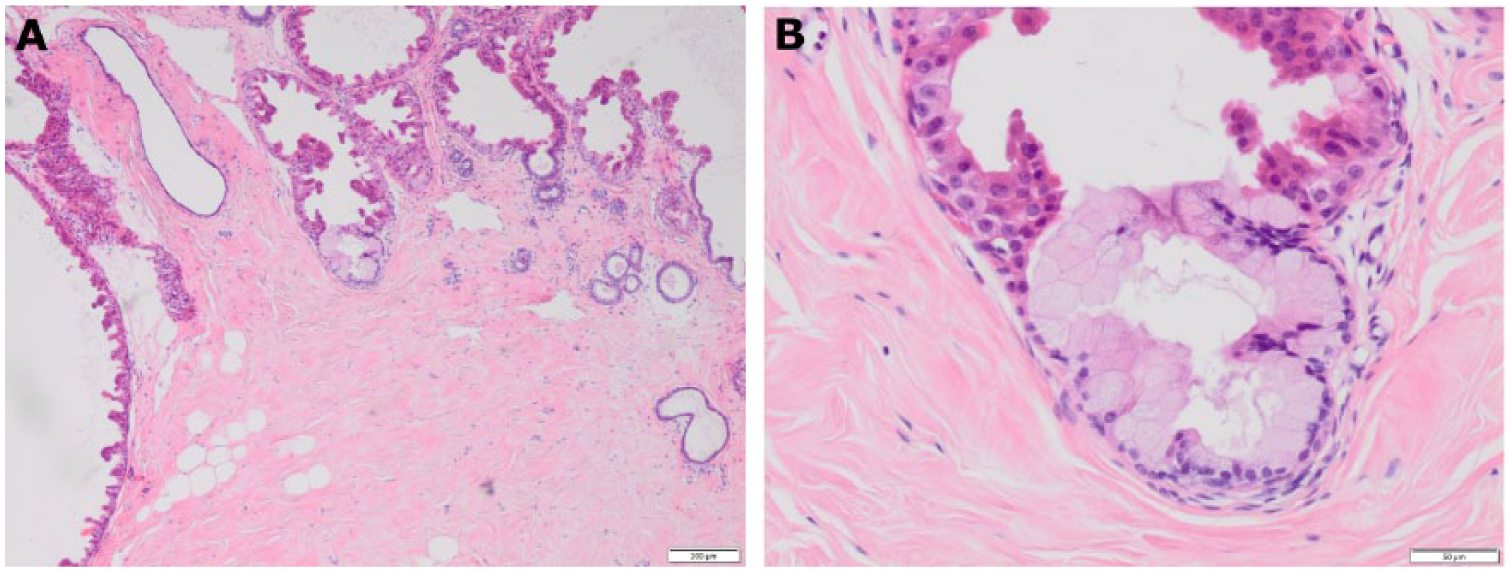
Hematoxylin and eosin staining of breast tissue with abundant apocrine metaplasia and a small focus of mucinous metaplasia. Original magnification 40× (A) and 200× (B).
Innocuous mucinous metaplasia is a very uncommon finding in the breast,4,5 and many textbooks on breast pathology do not even mention it. However, Quddus and Lawrence 6 were probably right when they quoted the old adage: “if you don’t look, you won’t see!”
