






Abstract
Sporadic goiter is a common disease with unknown pathogenesis and poorly understood biology that is morphologically characterized by the presence of nodular hyperplasia of the thyroid. 1 The hyperplastic follicles are vastly heterogeneous in terms of architecture, cellularity, evidence of hemorrhage, fibrosis, inflammation, vascularization, calcifications, osteoid metaplasia, and mucous.1,2 Despite this remarkable degree of histologic variability, no data on the possible association between follicular hyperplasia and chondroid differentiation are available to date.
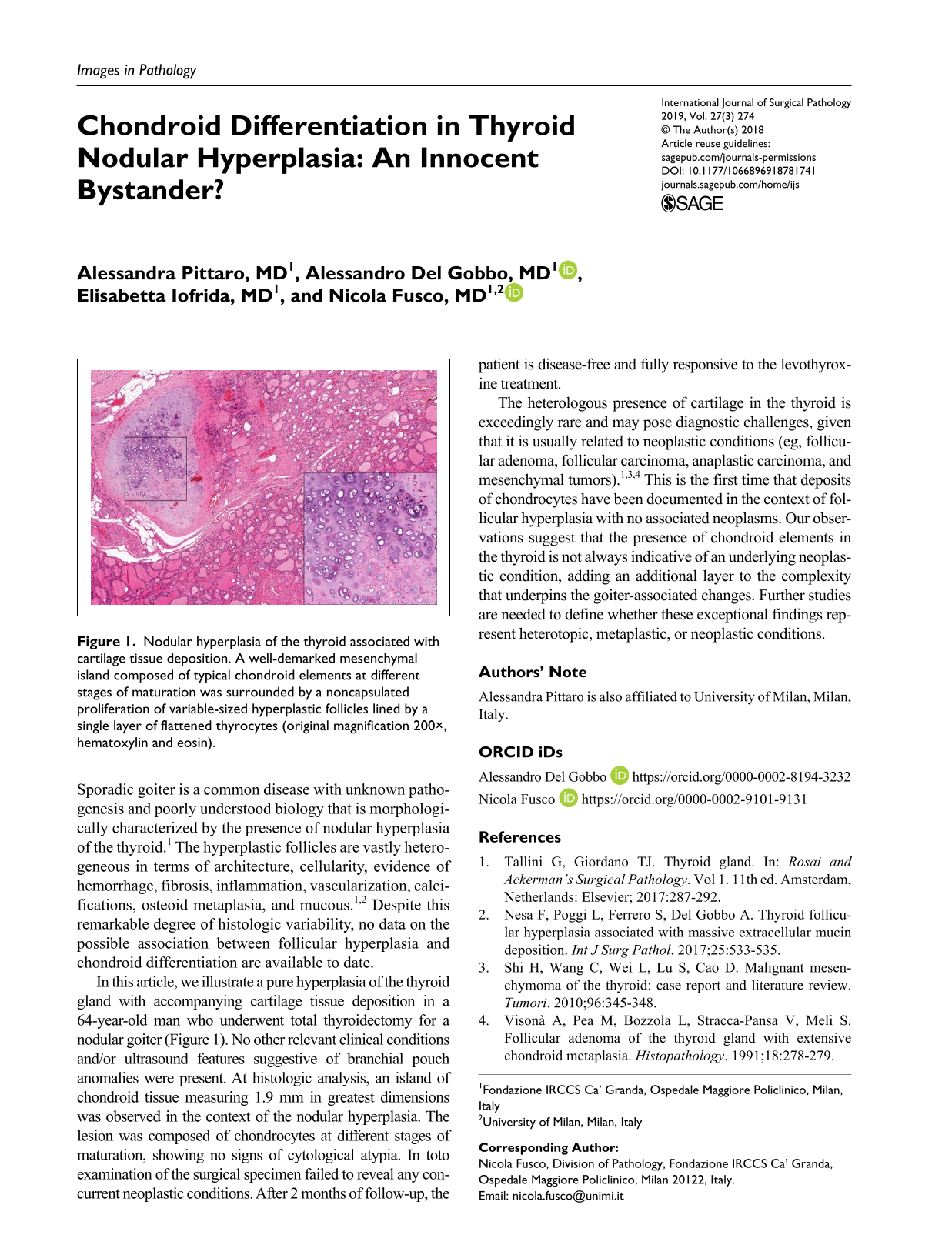
In this article, we illustrate a pure hyperplasia of the thyroid gland with accompanying cartilage tissue deposition in a 64-year-old man who underwent total thyroidectomy for a nodular goiter (Figure 1). No other relevant clinical conditions and/or ultrasound features suggestive of branchial pouch anomalies were present. At histologic analysis, an island of chondroid tissue measuring 1.9 mm in greatest dimensions was observed in the context of the nodular hyperplasia. The lesion was composed of chondrocytes at different stages of maturation, showing no signs of cytological atypia. In toto examination of the surgical specimen failed to reveal any concurrent neoplastic conditions. After 2 months of follow-up, the patient is disease-free and fully responsive to the levothyroxine treatment.

Nodular hyperplasia of the thyroid associated with cartilage tissue deposition. A well-demarked mesenchymal island composed of typical chondroid elements at different stages of maturation was surrounded by a noncapsulated proliferation of variable-sized hyperplastic follicles lined by a single layer of flattened thyrocytes (original magnification 200×, hematoxylin and eosin).
The heterologous presence of cartilage in the thyroid is exceedingly rare and may pose diagnostic challenges, given that it is usually related to neoplastic conditions (eg, follicular adenoma, follicular carcinoma, anaplastic carcinoma, and mesenchymal tumors).1,3,4 This is the first time that deposits of chondrocytes have been documented in the context of follicular hyperplasia with no associated neoplasms. Our observations suggest that the presence of chondroid elements in the thyroid is not always indicative of an underlying neoplastic condition, adding an additional layer to the complexity that underpins the goiter-associated changes. Further studies are needed to define whether these exceptional findings represent heterotopic, metaplastic, or neoplastic conditions.
