






Abstract
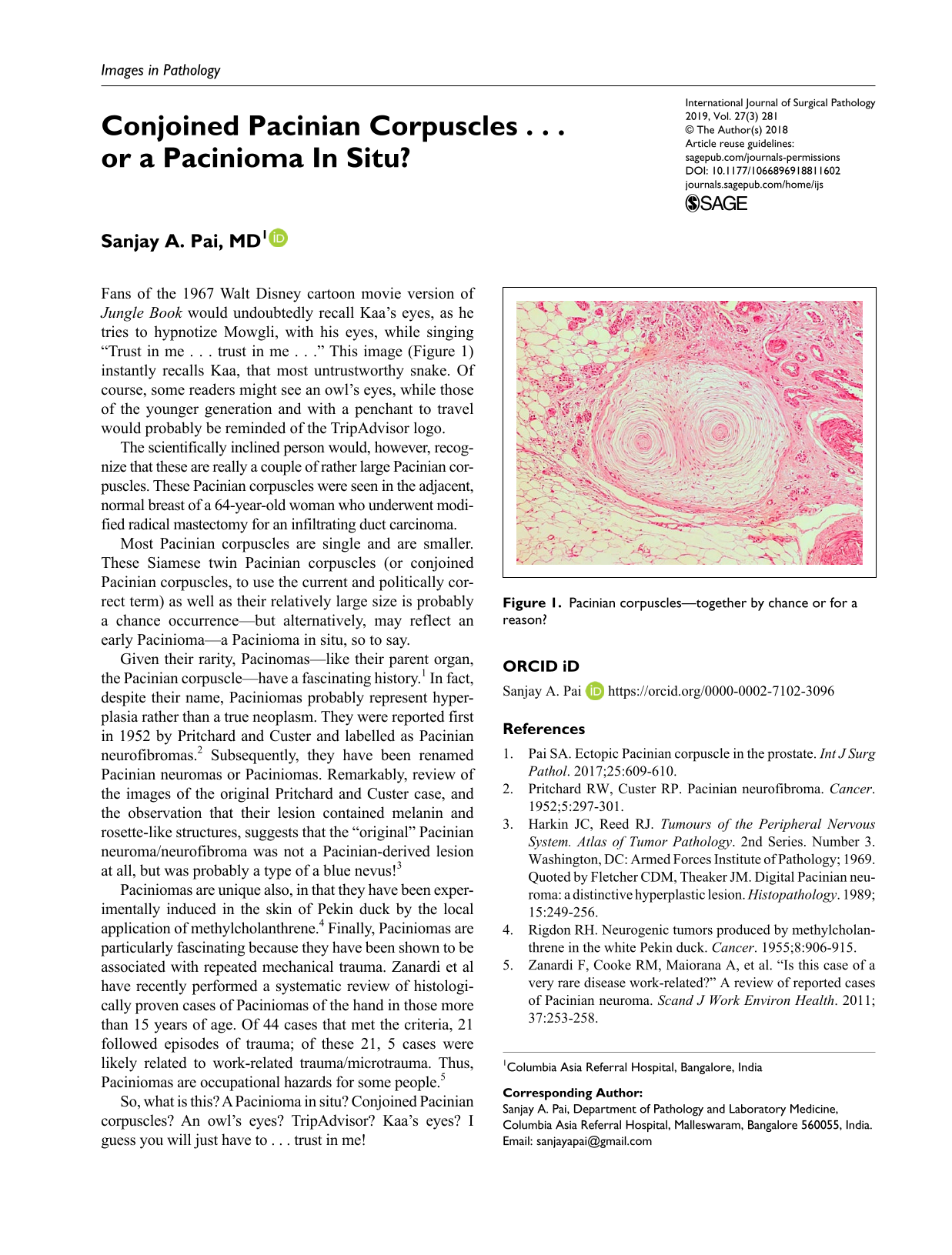
Fans of the 1967 Walt Disney cartoon movie version of Jungle Book would undoubtedly recall Kaa’s eyes, as he tries to hypnotize Mowgli, with his eyes, while singing “Trust in me . . . trust in me . . .” This image (Figure 1) instantly recalls Kaa, that most untrustworthy snake. Of course, some readers might see an owl’s eyes, while those of the younger generation and with a penchant to travel would probably be reminded of the TripAdvisor logo.

Pacinian corpuscles—together by chance or for a reason?
The scientifically inclined person would, however, recognize that these are really a couple of rather large Pacinian corpuscles. These Pacinian corpuscles were seen in the adjacent, normal breast of a 64-year-old woman who underwent modified radical mastectomy for an infiltrating duct carcinoma.
Most Pacinian corpuscles are single and are smaller. These Siamese twin Pacinian corpuscles (or conjoined Pacinian corpuscles, to use the current and politically correct term) as well as their relatively large size is probably a chance occurrence—but alternatively, may reflect an early Pacinioma—a Pacinioma in situ, so to say.
Given their rarity, Pacinomas—like their parent organ, the Pacinian corpuscle—have a fascinating history. 1 In fact, despite their name, Paciniomas probably represent hyperplasia rather than a true neoplasm. They were reported first in 1952 by Pritchard and Custer and labelled as Pacinian neurofibromas. 2 Subsequently, they have been renamed Pacinian neuromas or Paciniomas. Remarkably, review of the images of the original Pritchard and Custer case, and the observation that their lesion contained melanin and rosette-like structures, suggests that the “original” Pacinian neuroma/neurofibroma was not a Pacinian-derived lesion at all, but was probably a type of a blue nevus! 3
Paciniomas are unique also, in that they have been experimentally induced in the skin of Pekin duck by the local application of methylcholanthrene. 4 Finally, Paciniomas are particularly fascinating because they have been shown to be associated with repeated mechanical trauma. Zanardi et al have recently performed a systematic review of histologically proven cases of Paciniomas of the hand in those more than 15 years of age. Of 44 cases that met the criteria, 21 followed episodes of trauma; of these 21, 5 cases were likely related to work-related trauma/microtrauma. Thus, Paciniomas are occupational hazards for some people. 5
So, what is this? A Pacinioma in situ? Conjoined Pacinian corpuscles? An owl’s eyes? TripAdvisor? Kaa’s eyes? I guess you will just have to . . . trust in me!
