






Abstract
Environmental jolts, which are unanticipated and disruptive changes in the external environment, can render firms’ strategies ineffective. Despite their frequency, research examining how firms become resilient to this negative impact of jolts remains scarce. Drawing on the knowledge-based view of international alliances, the authors propose that international alliances are a source of novel knowledge and resources, and in learning the routines and processes to assimilate them, firms acquire dynamic capabilities that enable them to overcome the lack of strategic fit with the environment triggered by jolts. Using a quasi-experimental research design and data from firms exposed to the dot-com bubble burst, the authors find that emphasizing value creation in international alliances attenuates the negative impact of jolts on sales growth. Additionally, for sales and profit growth, international alliance partner diversity positively influences resistance to jolts, while market diversity shows no effect. This study contributes to the literature by demonstrating (1) how international alliances enhance the knowledge, resources, and dynamic capabilities of the firm, (2) the impact of international alliances on firm performance in the face of severe environmental turbulence, and (3) the importance of obtaining competencies from value creation activities and collaborating with diverse partners as resilience-building strategies.
Keywords
The last year has been one [of] the most challenging times in the history of our nations … [b]ut our cooperation with allies and partners provides us with more than a small bit of optimism and faith. It shows us the way forward: together … there are no challenges we cannot and will not overcome.
—U.S. Secretary of State Antony J. Blinken, speech at NATO headquarters, March 24, 2021
In his speech at NATO headquarters in March 2021, Secretary of State Antony J. Blinken highlighted the importance of collaborations with international allies amid the environmental jolt from the COVID-19 pandemic (U.S. Department of State 2021). An environmental jolt is a major unanticipated and disruptive turbulence in the external environment that may render existing strategies ineffective (Meyer, Brooks, and Goes 1990). Companies, too, have long recognized the benefits of international collaborations and have formed alliances with international partners (Zhang et al. 2010); however, research examining the potential benefits of such international partnerships amid environmental jolts is scarce. This is surprising, considering the frequency of environmental jolts such as the dot-com crisis at the turn of the century (Daniel 2022), the financial crisis less than ten years later (Weinberg 2013), and, most recently, economic fallouts from Russia's invasion of Ukraine (Reston 2022). Our study aims to fill this research gap by examining the effect of international alliance activity on the performance of firms exposed to environmental jolts. Firms enter international alliances for many reasons, such as strategic flexibility (Bierly and Coombs 2004; Xia 2011), as they offer access to novel learning opportunities that provide a means to “escape the lock-in knowledge traps” of domestic partnerships (D’Agostino and Moreno 2018, p. 390; Lavie and Miller 2008). We draw on this knowledge-based view of international alliances to posit that firms learn from managing the diverse knowledge and resources that such alliances bring, which in turn enhances their dynamic capabilities and helps withstand the negative impacts of environmental jolts.
International alliances are collaborations between partners from two countries based on equity or nonequity contracts that have been formed to achieve strategic goals (Bello, Katsikeas, and Robson 2010; Silva, Bradley, and Sousa 2012). Theoretical contributions in the literature stem from studies using individual international alliances (Kale and Singh 2009) or the firm (Emden, Yaprak, and Cavusgil 2005; Kale and Singh 2009) as the level of analysis. Within the former stream, studies have focused extensively on alliance formation and partner selection (Yeniyurt et al. 2009) as well as alliance governance and fit (Bello, Katsikeas, and Robson 2010; Robson, Katsikeas, and Bello 2008). Within the latter, studies have investigated the impact of multiple international alliances over time and the characteristics of international alliance portfolios on firm performance (Lavie and Miller 2008; Zhang et al. 2010). Furthermore, most studies focus on a particular type of international alliance, such as international joint ventures (Barkema and Vermeulen 1997; Tower, Hewett, and Fenik 2019). However, as nonequity alliances have become more prevalent and even the most dominant form of agreement in some sectors (Duysters and De Man 2003; Lai, Chang, and Chen 2010), studying all forms of international collaborations is pertinent. Using a firm-level perspective, we aim to understand the role of international alliance activity in firm performance, irrespective of alliance governance type.
Regardless of the level and unit of analysis, most of these studies implicitly assume a steady-state research context in which firms experience relatively static or gradually changing, undisruptive environmental conditions. In reality, long periods of steady economic growth are interrupted by environmental jolts, which are unanticipated, short periods of fundamental change in the firm's external environment (Colombo et al. 2021; Meyer, Brooks, and Goes 1990). When environmental jolts occur, they can lead to significant financial damage. For instance, during the dot-com crisis, nearly one trillion dollars of stock value on the NASDAQ vanished within one week, with some companies losing between 10 million and 30 million dollars a quarter (Geier 2015). With the increasing occurrence of such jolts, we answer calls for more research that focuses on understanding how firms can overcome the setbacks caused by jolts (Fainshmidt, Nair, and Mallon 2017; Park and Mezias 2005). Our study highlights an underresearched benefit of international alliance activity by examining how such activities add to firms’ resilience in overcoming the negative impacts of environmental jolts.
Research on environmental jolts points to the role dynamic capabilities can play in enabling firms to withstand and navigate the severe conditions associated with such jolts (Colombo et al. 2021; Makkonen et al. 2014; Markovich, Raban, and Efrat 2023). Environmental jolts are abrupt changes in the external environment that cause heightened uncertainty (Meyer, Brooks, and Goes 1990). Dynamic capabilities reflect routines and processes that help firms recognize the right things to do—rather than only doing things right—so that they can adapt and reconfigure to fit a radically changing environment (Teece 2007, 2014). Such capabilities become valuable when firms experience a jolt because they can help overcome any lack of fit between the firm's strategy and the external environment that has undergone an abrupt change (Fainshmidt, Nair, and Mallon 2017; Markovich, Raban, and Efrat 2023).
We draw on the knowledge-based view and alliance learning literature to posit that international alliances provide exposure to a range of tangible resources, such as technology, and intangible resources, such as knowledge, that are external to the firm (Das and Teng 2000; Emden, Yaprak, and Cavusgil 2005; Xue and Li 2023). As firms assimilate the diverse knowledge and varied resources from international alliances, dynamic capabilities arise from learning—by doing—the routines and processes entailed in this assimilation (Kale and Singh 2007; Mamédio et al. 2019; Schilke 2014). These dynamic capabilities, in turn, enable firms to sense environmental threats amid a jolt correctly and remain competitive by reconfiguring and adapting the firm's competencies to enhance the strategic fit with the changed environmental conditions (Schilke 2014; Teece 2007). Specifically, our study focuses on the role that three characteristics of international alliances—value creation versus appropriation focus, partner diversity, and market diversity—play in mitigating the negative impact of jolts on performance (Figure 1 shows our study's conceptual model).
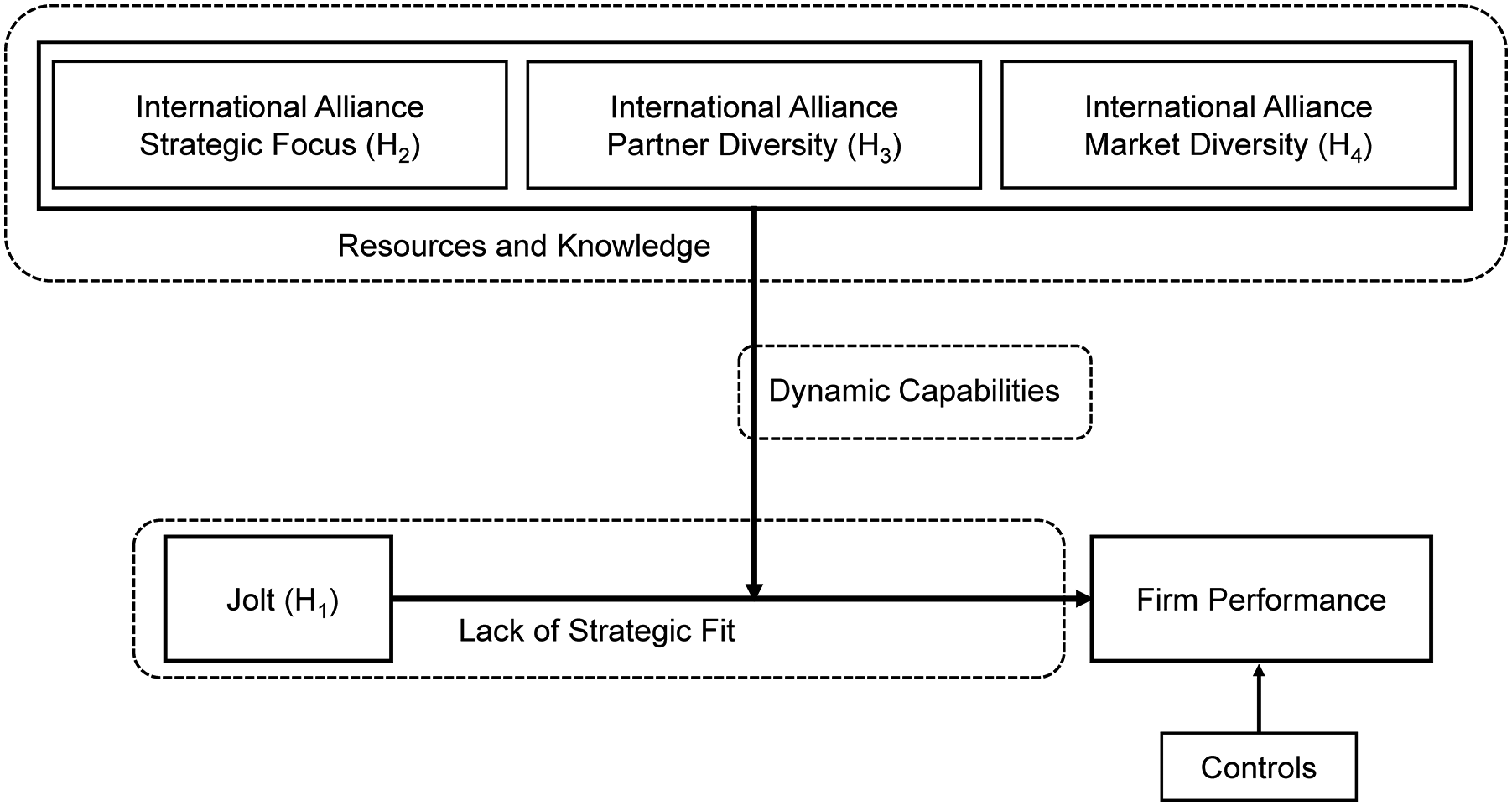
Conceptual Model.
Empirically, we construct a dataset of firms with international alliance activity before and after the environmental jolt caused by the dot-com bubble burst in 2000 (Park and Mezias 2005). We employ a quasi-experimental research design to test several hypotheses related to international alliance activities and firm performance, measured as sales growth and profit growth. Using a difference-in-difference (DID) estimator, we exploit the exogenous variation of the environmental jolt from the burst of the dot-com bubble across various industries. We find that firm performance is negatively affected by a jolt. However, firms that strategically focus on value creation activities with international partners can attenuate the negative impact of the environmental jolt on sales growth. Furthermore, collaborating with varying partners can also positively impact firms’ resistance to jolts, with respect to the performance outcomes of both sales growth and profit growth, while being active in various markets has no effect.
Our study makes three theoretical contributions. We conceptually explore and empirically test how dynamic capabilities via international alliance activity strengthen a firm's preparedness in the wake of an environmental jolt. Thus, we add to the knowledge-based view of international alliances, which posits that international knowledge and resources, and the resulting dynamic capabilities, are important drivers for sustainable competitive advantage (Fletcher, Harris, and Richey 2013; Hoffmann 2007; Kale and Singh 2007; Mamédio et al. 2019). We argue that the routines learned from managing international alliances enhance firms’ dynamic capabilities, such as strategic decision-making (Eisenhardt and Martin 2000; Schilke 2014; Schilke, Hu, and Helfat 2018). Second, we add to international alliance research by empirically testing the impact of international alliance activity on firm performance during unexpected, severe environmental turbulence. To our knowledge, this study is the first to examine the role of international alliance activity in such situations. Third, we add to the literature on environmental jolts and how firms should adapt to them by introducing a novel source of resilience building: international alliance activity. We also offer managerial insights by highlighting the practical relevance of resilience-building opportunities from value creation alliance activities and engaging with diverse international partners.
We proceed by explicating how environmental jolts lead to a lack of fit between a firm's strategy and its external environment, which can harm a firm's performance. Next, we hypothesize how experience with international alliance activity can enable firms to adapt to the changing environment, thus attenuating this negative impact. We then present our methodological setup and empirical testing of our hypotheses. Last, we discuss our findings and their theoretical and practical implications.
Conceptual Framework and Hypothesis
Environmental Jolts and Strategic Fit
An environmental jolt is an unanticipated and severe change in a firm's environment characterized by heightened uncertainty regarding the appropriate actions for sustained performance and survival (Colombo et al. 2021; Meyer 1982). Jolts can manifest within particular geographic regions, such as the unexpected physicians’ strike in California in 1975 (Meyer 1982); within an industry, such as the U.S. auto industry following the 1973 oil crisis (Sine and David 2003); across industries, such as the entire technology sector in 2000 (Park and Mezias 2005); and in the most extreme form, globally, such as the health crisis created by the COVID-19 pandemic in 2020 (Colombo et al. 2021). With increasing occurrences of such disruptive environmental conditions, studying how firms can survive and minimize the damage caused by these jolts is pertinent (Colombo et al. 2021; Fainshmidt, Nair, and Mallon 2017; Park and Mezias 2005).
Firms can perceive environmental jolts as a threat to their very existence (Staw, Sandelands, and Dutton 1981). Depending on the cause of the environmental jolt, industry structures can be drastically changed, with a lack of resources from financial institutions tightening credit and supply chains being disrupted, all of which can lead to investors losing confidence, further perpetuating the uncertainty and risk faced by impacted firms (Colombo et al. 2021; Osiyevskyy et al. 2017). Changes in market demand can lead to immediate impacts on revenues, challenging firms’ financial stability (Colombo et al. 2021). All these abrupt changes in the environment cause uncertainty with respect to optimal strategies that can sustain performance. Jolt-induced environmental changes can render firms’ strategies irrelevant and ineffective because of the misalignment of their internal resources and capabilities with the external environment (Markovich, Raban, and Efrat 2023; Zajac, Kraatz, and Bresser 2000). This lack of strategic fit forces firms to reconsider their strategies as existing business models become ineffective (Fainshmidt et al. 2019; Osiyevskyy et al. 2017).
Until firms reassess and adapt their strategies to the evolving environmental conditions, such strategic misalignment reduces their competitive advantage, ultimately negatively impacting performance (Markovich, Raban, and Efrat 2023; Wan and Yiu 2009; Zajac, Kraatz, and Bresser 2000). Overall, the preceding arguments suggest that all else being equal, firms facing jolts experience a lack of fit between their strategies and the external environment that negatively impacts performance. Therefore:
The Role of Dynamic Capabilities, Resources, and Knowledge in Achieving Strategic Fit
Dynamic capabilities are a “firm's ability to integrate, build, and reconfigure internal and external competences to address rapidly changing environments” (Teece, Pisano, and Shuen 1997, p. 516). These competences are manifest in organizational and managerial processes such as strategic decision making (Eisenhardt and Martin 2000; Schilke, Hu, and Helfat 2018; Teece, Pisano, and Shuen 1997). According to Teece (2007, 2014), dynamic capabilities enhance firms’ ability to quickly sense external environment changes and reconfigure their asset base accordingly to stay relevant in changing markets. In rapidly changing environments, such as the ones experienced during an environmental jolt, dynamic capabilities are characterized by experiential and iterative processes that enable firms to navigate these environmental changes by building new resource configurations and aligning their strategic orientation accordingly (Colombo et al. 2021; Eisenhardt and Martin 2000; Fainshmidt, Nair, and Mallon 2017). Thus, firms can mitigate the negative impact of a lack of strategic fit by rapidly addressing the changing environment and drawing from experiences and efficiencies obtained previously to adjust investments, processes, and business models to the changed environment (Colombo et al. 2021; Teece, Pisano, and Shuen 1997; Teece 2014).
Dynamic capabilities are built over time through learning and experience when individuals and groups within a firm draw from a broad information and resource base (Markovich, Raban, and Efrat 2023; Schilke, Hu, and Helfat 2018; Teece 2014). Learning by doing effectively builds dynamic capabilities (Schilke, Hu, and Helfat 2018), especially when experiential learning occurs across various activities, providing vast information access. International alliances are novel sources of information and resource heterogeneity and provide new forms of learning while contributing to new knowledge development (Grant and Baden-Fuller 2004; Ireland, Hitt, and Vaidyanath 2002; Kim 2013; Mamédio et al. 2019). As firms acquire or access different types of knowledge and resources through international alliances, complex learning accumulation processes build dynamic capabilities (Grant and Baden-Fuller 2004; Kale and Singh 2007). With these dynamic capabilities, firms can quickly adjust their response to the changing external environment (Colombo et al. 2021; Eisenhardt and Martin 2000; Fainshmidt et al. 2019).
Thus, given our arguments for H1, namely that a lack of strategic fit—between a firm's internal competencies and resources and its external environment—associated with jolts reduces firm performance, we expect dynamic capabilities that arise from international alliances to weaken the impact of jolts on performance. Next, we discuss how specific characteristics of international alliance activity increase the diversity of the knowledge and resource bases of firms, which enhances their dynamic capabilities, enabling them to overcome a lack of strategic fit and, by extension, withstand jolts.
International Alliance Activity and Dynamic Capabilities
International alliances provide exposure to knowledge, a tacit resource that “is related to and at the same time different” from what the firm already possesses (Zahra and George 2002, p. 193). International alliances also provide access to novel resources, such as technology, suppliers, markets, and brands (Das and Teng 2000; Ireland, Hitt, and Vaidyanath 2002; Schilke 2014). In managing international alliances, firms learn—by doing—routines and processes required to navigate and succeed in various contexts. By accessing and integrating diverse knowledge and resources from international alliance activity, firms create unique capabilities through experience-based learning (Zahra, Ucbasaran, and Newey 2009). This perspective of experiential learning as a source for building dynamic capabilities is well established in the literature (e.g., Schilke, Hu, and Helfat 2018; Teece 2007, 2014). Thus, international alliance activity and the associated learning routines enable firms to develop dynamic capabilities that are instrumental in dealing with rapidly changing environmental conditions during a jolt (Fainshmidt, Nair, and Mallon 2017; Kale and Singh 2009; Schilke 2014).
In particular, as we argue next, we expect three characteristics of international alliances—value creation versus appropriation focus, partner diversity, and market diversity—to enhance firms’ resilience to environmental jolts. Besides this theoretical linkage that we make for these characteristics, we note that each has also been established as a decision area that is worthy of study, both conceptually and managerially, within the international alliance management literature (e.g., Goerzen and Beamish 2005; Tower, Hewett, and Saboo 2021; Zahra, Ucbasaran, and Newey 2009).
International alliance value creation versus appropriation focus
For many firms, international alliances are a vital strategic tool (Hoffmann 2007; Vapola, Paukku, and Gabrielsson 2010; Yeniyurt et al. 2009) that offers access to novel information and resources not available in the home country (D’Agostino and Moreno 2018; Lai, Chang, and Chen 2010; Lavie and Miller 2008). Understanding the impact of value creation and appropriation activities through interorganizational activities on the focal firm's performance is essential (Hoffmann 2007). Firms enter international alliances with the strategic intent of either value creation, which entails organizational activities to create value for customers by developing new offerings or processes, or value appropriation, which entails capturing value in the form of economic rent from foreign markets (Hoffmann 2007; Mizik and Jacobson 2003; Tower, Hewett, and Saboo 2021). Value creation activities happen via partnerships with foreign firms to develop new technologies, for product or process innovation, or to access new information such as technological blueprints. Thus, value creation alliance activities center around acquiring and determining the criticality of new tangible and intangible resources from the foreign partner, assimilating and transforming these resources into organizational routines and processes, and leveraging these new capabilities to pursue the firm's objectives (Hoffmann 2007; Knight and Cavusgil 2004; Lavie and Miller 2008).
In contrast, value appropriation activities with international alliances focus mainly on activities that enable firms to appropriate rents from the marketplace, such as developing new sales channels or generating new demand in the foreign market (Hoffmann 2007; Lavie and Miller 2008; Vapola, Paukku, and Gabrielsson 2010). While these value appropriation alliances also provide exposure to new information and other resources, and experience in assimilating them into firm internal competencies, they are likely to afford fewer learning opportunities relative to value creation alliances (Das and Teng 2000). Experiences with value creation activities, relative to value appropriation activities, require more focus on resource accumulation and integration, and knowledge gathering, codifying, and processing by linking the knowledge of the focal firm with information from outside the firm (Anand and Khanna 2000; Eisenhardt and Martin 2000). This assimilation and integration of resources and information within the firm and across international alliance activities is key to building dynamic capabilities (Schilke, Hu, and Helfat 2018; Teece 2007). Managers prioritizing value appropriation in international alliances are more concerned with optimally using or improving their existing lower-order capabilities, that is, doing things right, to generate short-term returns (Schilke 2014; Teece 2014). This may not enable the development of dynamic capabilities to the same extent as firms emphasizing value creation alliances. Dynamic capabilities, which enable firms to focus on doing the right things, are needed to overcome the lack of strategic fit resulting from a jolt. Thus, we hypothesize the following moderation effect of H1:
International alliance partner diversity
Firms strategically choose international alliance partners to meet performance objectives, and most are involved in multiple international alliances simultaneously (Ireland, Hitt, and Vaidyanath 2002; Wassmer 2010). Foreign partners’ technological resources, marketing and distribution systems, customer segments, and complementary products or skills are some criteria managers evaluate when identifying potential international alliance partners (Das and He 2006). As each international partner provides access to unique resources and learning opportunities, firms that engage in activities with multiple international alliance partners are tasked with continuous resource and knowledge configuration efforts (Hoffmann 2007; Lavie and Miller 2008; Teece 2007; Wassmer 2010). These firms develop the ability to focus on critical information areas and interpret and integrate this diverse information with their existing knowledge (Kale and Singh 2009). Further, faced with heterogeneity in information and resources, firms adopt diverse problem-solving approaches (Anand and Khanna 2000; Beamish and Kachra 2004; Castro and Roldán 2015; Goerzen and Beamish 2005) to generate out-of-the-box solutions (D’Agostino and Moreno 2018; Lavie and Miller 2008). Thus, such experience with diverse partners enables firms to establish varied learning routines and management processes that enhance dynamic capabilities (Schilke, Hu, and Helfat 2018; Teece 2014). Our prior arguments have proposed that dynamic capabilities should enable firms to weaken the impact of the lack of strategic fit that results from jolts. Thus, by extension:
International alliance market diversity
Firms also make strategic decisions regarding the countries in which to be active via international alliances. By operating in diverse geographic markets, firms are exposed to a variety of institutional legal systems, property rights, regulatory systems, information systems, and informal rules and norms (Kim 2013; Meyer et al. 2009). Furthermore, activities in diverse geographic markets require managers to deal with differences in normative belief systems stemming from cultural influences (Kogut and Singh 1988). These differences in institutions and culture necessitate learning about these foreign market environments, especially customers and competitors (Gaur and Lu 2007; Zahra, Ucbasaran, and Newey 2009). Firms must develop a deep understanding of foreign markets’ cultures, norms, and traditions, known as “social knowledge” (Zahra, Ucbasaran, and Newey 2009). However, information and social knowledge acquired in one institutional setting might not transfer entirely to another (Gaur and Lu 2007; Lai, Chang, and Chen 2010). In parallel, firms operating in multiple international markets also have access to a diverse range of resources that stem from natural differences in these markets’ infrastructure (Kim 2013).
Consequently, firms are motivated to gather knowledge and resources from each diverse geographic market while also interpreting and integrating them to develop actionable strategies with the right mix of global and local elements to enhance performance. Thus, with international alliance activity in relatively more diverse markets, firms gain valuable experience in improving their learning capabilities (Kim 2013). These experiences in operating across different regulatory and social systems prepare firms to adapt to abrupt environmental change (Meyer, Brooks, and Goes 1990). As with the preceding moderation hypotheses, we use the logic that we offered relating dynamic capabilities to overcoming the lack of strategic fit during a jolt to hypothesize:
Methodology
Data
We test our predictions of the impact of an environmental jolt on firm performance and the role international alliances play with a unique dataset that includes data on cross-border alliances from Thomson Reuters Financial SDC Platinum (SDC; now Refinitiv SDC Platinum). Following Sivakumar et al. (2011), to obtain a representative sample with meaningful measures for international alliance strategic focus, partner diversity, and country diversity, we limit our data to U.S. firms that had frequent occurrences of international alliances during 1990–2010, resulting in approximately 3,500 international alliances entered by 64 U.S. firms. While publicly traded firms report expenditures in financial statements, which enables researchers to deduce certain strategic initiatives and foci, there is no reporting requirement for international alliance activities and the associated strategic decisions. Thus, following established procedures (Cui and O’Connor 2012; Sivakumar et al. 2011; Tower, Hewett, and Fenik 2019), we collected textual information about international alliances from SDC. This information was triangulated with text from corresponding Dow Jones Factiva global news database announcements. Only international alliance information revealing the U.S. focal firm's strategic focus on value creation and/or appropriation was retained (see Appendix for sample alliance text). The final sample includes nearly 1,500 international alliance announcements from 45 U.S. firms. After incorporating firm financials from Compustat and accounting for missing values on measures for all variables described subsequently, the final dataset is an unbalanced panel with 435 firm-year observations from 40 firms, comparable to other studies (e.g., Sivakumar et al. 2011).
Our dataset spanning 20 years of international alliance activity and the dot-com bubble burst in 2000 creates an ideal setting for a quasi-experimental analysis. The impact of this environmental jolt on firm performance can be estimated by comparing the average performance before and after the jolt of those firms that experienced the jolt (henceforth, treatment group) with the average performance of those that were not subjected to the jolt (control group). The environmental jolt of the dot-com bubble burst was caused by the unsustainable growth of tech stocks in the late 1990s, driven by the popularity of online retailing with sites like Pets.com. As access to the internet expanded and computers became more pervasive in all aspects of life in the late 1990s, the dot-com bubble started to grow as investors pushed up stock values. New e-retailers that went to market often saw their stocks double on the first day of their IPO (Geier 2015). In March 2000, the bubble burst, and almost a trillion dollars’ worth of stock value vanished in less than one month (Geier 2015), which grew to a loss of five trillion dollars within the next two years (Gaither and Chmielewski 2006). The jolt affected e-commerce businesses in the then-new internet service industry (Colombo et al. 2021), and related industry sectors, such as computer system design, felt the impacts as well. Within these industries, firms faced downturns due to overcapacity, reduced demand, inventory issues, price pressures, resource constraints, and changes in financial market valuations. To identify which firms were exposed to the jolt, thus making up our treatment group, we rely on a publicly available macroeconomic indicator, the unemployment rate.
Environmental jolts are often limited to geographic areas or industries, leading to significant, unpredictable demand reductions and layoffs (Colombo et al. 2021; Deleersnyder et al. 2004). Indeed, in a report published by the Bureau of Labor Statistics (BLS), Mann and Nunes (2009) report that several industries saw significant changes in employment after the peak of the dot-com boom. Most affected were the computer system design; semiconductor manufacturing; internet, telecommunications, and data processing; software publishing; communication equipment manufacturing; and computer equipment manufacturing sectors, all of which saw significant reductions in employment between 2001 and 2008 (see Table 1). In contrast, other sectors, such as pharmaceuticals, aerospace, and scientific research, within the same geographic region, saw significant employment growth during the same time frame. This further supports the notion that environmental jolts are often limited to particular industries (Colombo et al. 2021; Deleersnyder et al. 2004).
Employment Changes 2001–2008.
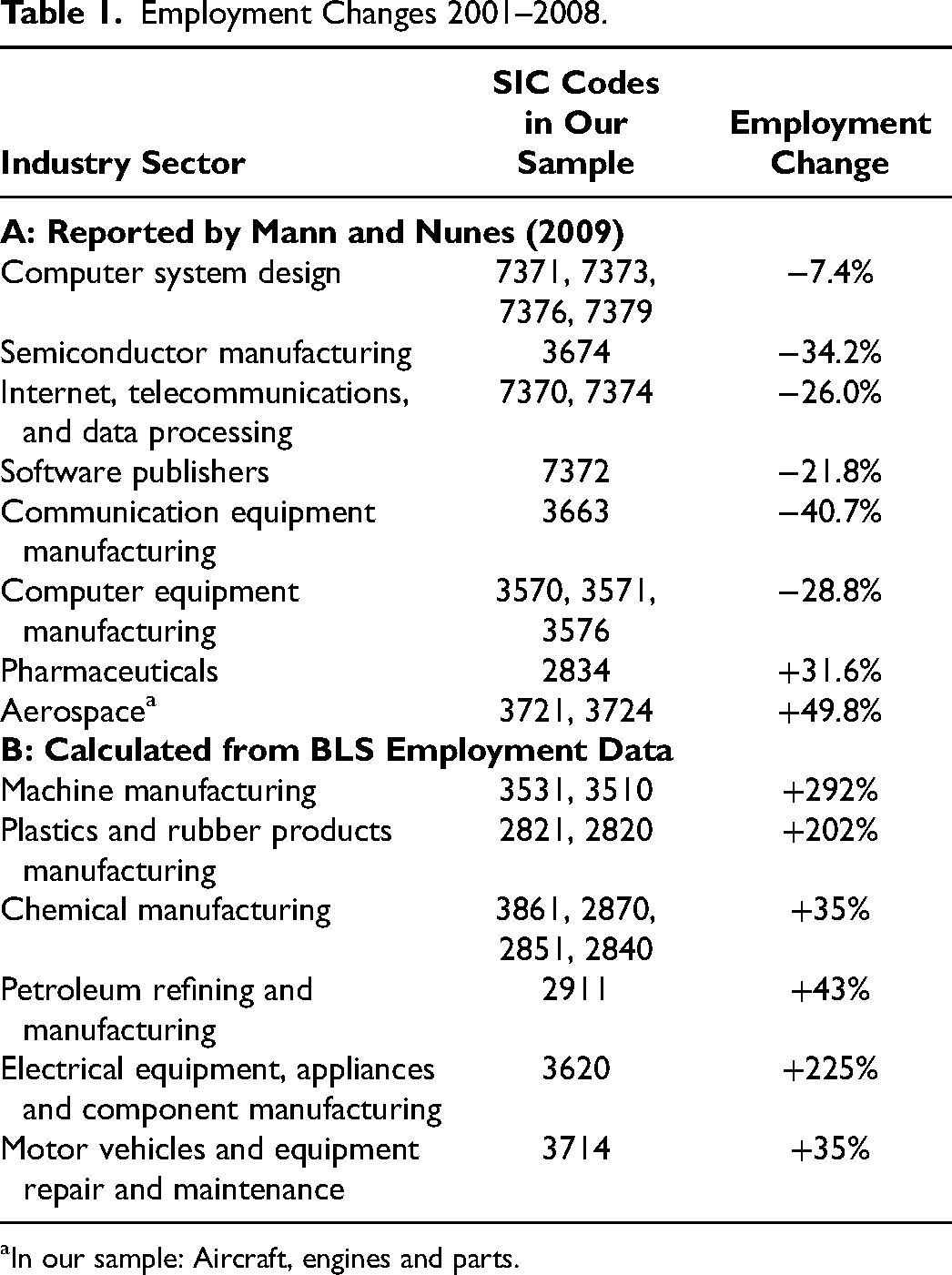
In our sample: Aircraft, engines and parts.
While Mann and Nunes’s (2009) report thus enables us to identify those firms in our sample that were affected versus not affected by the dot-com bubble burst based on their industries, we also needed to do so for firms not covered by the industry sectors in their report (even though our expectation was that these remaining firms are from industries that did not see a reduction in employment, given that the focus of their report was on affected firms). To do so, we consulted additional BLS statistics (see Panel B of Table 1). We obtained publicly available industry-level data that the BLS provided for Standard Industrial Classification (SIC) or North American Industry Classification System (NAICS) codes in 2001 and 2008, respectively (https://www.bls.gov/oes/tables.html). One caveat is that these data are U.S.-wide employment data, whereas Mann and Nunes report regional data. To mimic Mann and Nunes’s reporting, we aggregated similar industries (e.g., Construction, Mining and Materials Handling, and Engines and Turbines in the Machinery Manufacturing sector). 1 This concordance worked for all control firms in our sample except AT&T (SIC classification “Telephone Communications” [4813], NAICS classification “Telecommunications, Wired, Wireless” [517311, 517911]) and Honeywell (SIC classification “Automatic Control for Regulating Environments and Appliances” [3822], NAICS classification “Automatic Environmental Control Manufacturing” [336412]). Five-digit NAICS employment data were not available for these two firms’ industries in 2008, probably because they were subsumed under a higher aggregation level by the BLS. Considering that these two firms are not from industries closely related to the ones in our treatment group, we retained these two firms as part of our control group. As shown in Table 1, and in line with our expectations, none of the sectors of the remaining firms in our sample group saw employment reduction.
Based on these employment statistics (Table 1), the firms in our treatment group are from the following SIC industries: Services–Prepackaged Software; Services–Computer Programming, Integrated Systems Design, Facilities Management, Computer Processing and Data Preparation & Processing, Etc.; Electronic Computers; Computer & Office Equipment; Communications Equipment; and Semiconductors & Related Devices. Those in the control group operate in the following industries: Pharmaceutical Preparations; Biological Products; Telephone Communications; Aircraft; Construction Machinery and Equipment; Engines & Turbines; Plastic Materials; Photographic Equipment & Supplies; Petroleum Refining; Agricultural Chemicals; Auto Controls; Paints, Varnishes, Etc.; Soap, Detergents, Etc.; Electrical Industrial Apparatus; and Motor Vehicle Parts (see Web Appendix A for the list of firms in the treated and control groups).
To further assess whether firms in our treatment group were indeed impacted by the jolt relative to those in the treatment group, we collected letters to shareholders to qualitatively assess the importance of internet-related discussions and emphasis. After creating a dictionary (see Web Appendix B), we calculated the frequencies of internet-related words as a percentage of total words in the annual letters to shareholders (we use a base level of words as well as an augmented list). Using a two-tailed comparison-of-means test (see Web Appendix B), we find statistically significant differences (p < .0001) between the treatment group (.485 and 1.414 for the base- and augmented-level dictionary words, respectively) and the control group (.050 and .165), supporting our classification of firms affected versus not affected by the dot-com bubble burst.
To measure a jolt, we use a dummy variable, Treated = 1 for all firms from industries that experienced the jolt and Treated = 0 for firms in the control group, as defined previously. We also use a dummy variable to indicate the time after the jolt occurred: Post = 0 for the years 1990–1999 and Post = 1 for 2000–2010. Table 2 summarizes the operationalization of all variables.
Operationalization of Variables.
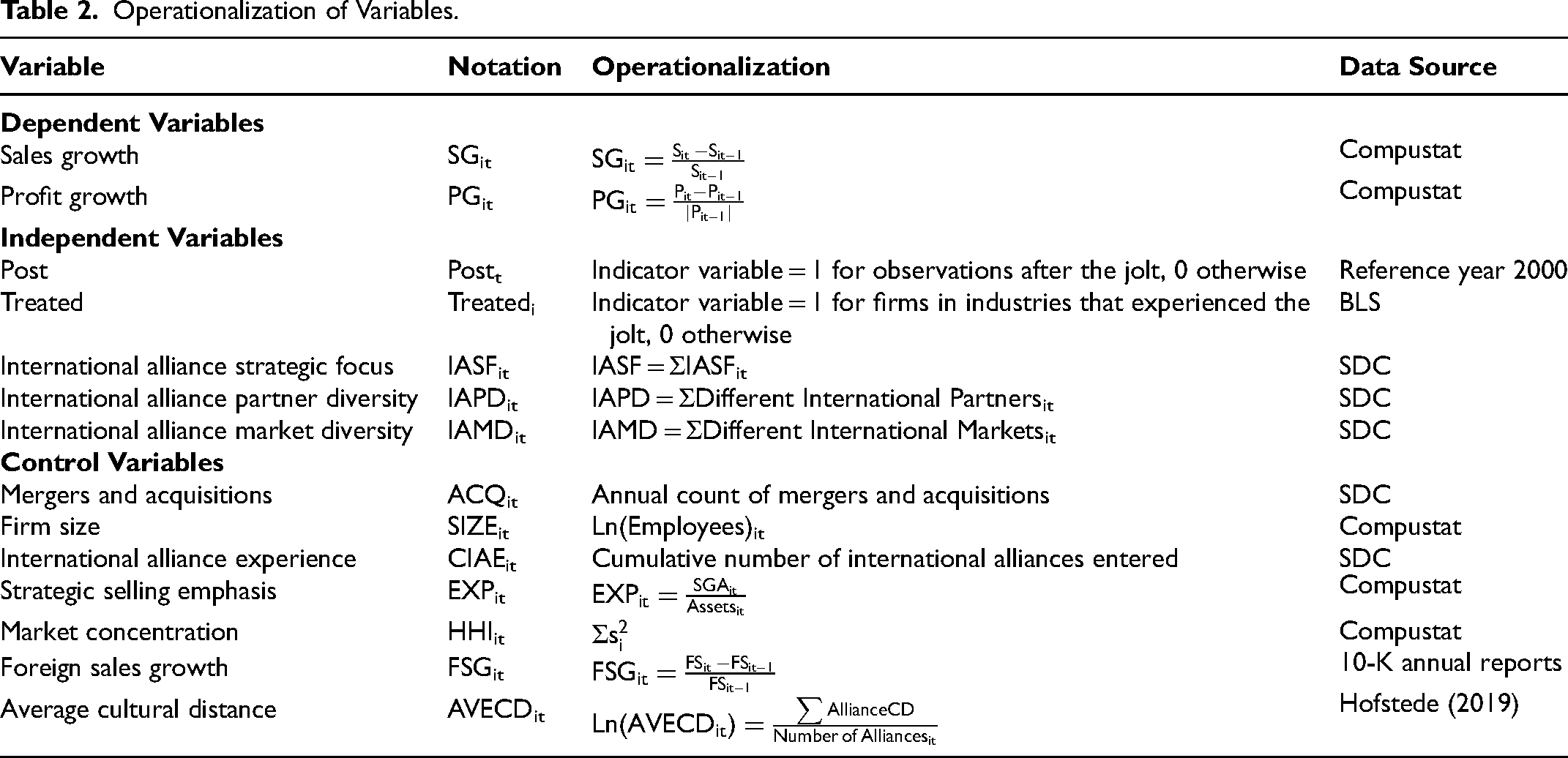
International alliance activity is measured using three dimensions to capture a firm's strategic choices. International alliance strategic focus (IASF) on value creation versus appropriation is captured by coding alliances as having a value creation focus (+1), a value appropriation focus (−1), or both (0) (Lavie and Rosenkopf 2006). To develop the coding scheme, we considered established scale-development approaches (Churchill, Ford, and Walker 1974). First, we consulted the literature (e.g., Mizik and Jacobson 2003) and international alliance announcement texts to capture relevant terminology indicating value creation activities, such as “development of a new product,” “innovation,” or “the alliance was to develop products and services that use wireless communications and computer software,” and value appropriation activities, such as “market existing product,” “marketing activities,” or “formed a strategic alliance to provide marketing services.” Next, the list was augmented based on several semistructured interviews with managers with experience in international alliances. Once the terminology was refined, one researcher coded sample SDC announcements (see Appendix for sample coding). Simultaneously, five academic experts classified the same announcements, and results were compared for internal validity. Discrepancies were discussed, and the process was repeated until we felt confident that our coding scheme captured a firm's focus on value creation and/or appropriation. Ultimately, all alliance texts in the sample were coded by two researchers with initial interrater reliability at 79%. A third researcher resolved discrepancies. After each alliance was coded +1 for value creation focus, −1 for value appropriation focus, or 0 for dual focus, we summed all alliance activity within one year to obtain a firm-level measure of international alliance strategic focus. Thus, a considerable positive value reflects the firm's relative focus on value creation activities with international partners. In contrast, a sizable negative value reflects the focal firm's relative focus on value appropriation internationally. The remaining two dimensions of international alliance activity, international alliance partner diversity (IAPD) and international alliance country diversity (IAMD), are respectively measured by the number of different partners a firm engaged with in any given year and the number of different markets a firm entered in any given year (Sivakumar et al. 2011).
For our dependent variable of firm performance, we use two well-established measures of accounting performance in the literature: sales growth and profit growth (Lee and Griffith 2019; Morgan, Feng, and Whitler 2018). Thus, by choosing “measures most commonly used in previous studies,” we ensure that the “cumulative knowledge built is relevant to managers” (Katsikeas et al. 2016, p. 13). Both measures are also consistent with our theoretical arguments that (a lack of) adaptation to environmental jolts (negatively) impacts performance, which is again consistent with best-practice recommendations to choose measures that are “well aligned with the conceptualization of performance adopted” (Katsikeas et al. 2016, p. 13).
We include several control variables based on our theoretical framework. Merger and acquisition (M&A) activities can also drive firm performance, and firms often engage in international alliances and M&A activities simultaneously (Bahadir, Bharadwaj, and Parzen 2009; Shi, Sun, and Prescott 2012). Thus, we include a count variable for each firm's annual M&A activities during our sample period. Larger firms often have more resources to achieve superior performance, and firm size can also impact the building of dynamic capabilities (Colombo et al. 2021; Reuer and Ragozzino 2014). Therefore, we control for firm size by including the log of the number of employees (Abdi and Aulakh 2012; Nath, Kirca, and Kim 2021). We also control for total international alliance experience by accounting for the cumulative experience with international alliances because research has shown that prior international alliance experience can improve performance (Lai, Chang, and Chen 2010; Shi, Sun, and Prescott 2012). Furthermore, a firm's general strategic selling emphasis can impact sales and profit growth. Thus, we control for a firm's selling emphasis by including selling, general, and administrative expenditures, scaled by assets (Ptok, Jindal, and Reinartz 2018). To control for industry competitive intensity, we include market concentration measured as the Herfindahl–Hirschman index in our model, measured as
Model and Estimation
Our data spanning 20 years of international alliance activity and the dot-com bubble burst in the year 2000 provide the ideal setting for a quasi-experimental analysis. To measure the impact of an environmental jolt on firm performance, we use a DID approach. Specifically, we compare the realized impact of the jolt on performance for those firms that experienced the jolt from the dot-com bubble burst, that is, the treatment group: E[Ytpost] − E[Ytpre], to the performance of firms that were not affected by this jolt, that is, the control group: E[Ycpost] − E[Ycpre] (Krasnikov, Shultz, and Rebiazina 2022). The estimate of interest is the difference across the two groups, δDID = {E[Ytpost] − E[Ytpre]} − {E[Ycpost] − E[Ycpre]}. If this difference is not equal to zero, we will find causal support that a jolt impacts firm performance (Perraillon, Lindrooth, and Hedeker forthcoming). Of course, other factors also affect firm performance and are controlled for in the analysis as outlined previously.
The underlying assumption for estimating the causal impact of a jolt on firm performance is that without the jolt, the trends in sales and profit growth over time between the two groups would have remained constant, conditional on covariates (Perraillon, Lindrooth, and Hedeker forthcoming). Conditional outcome trends are appropriate here since firm performance trends and covariate distributions differ across our two groups of firms. Ignoring these covariate-specific trends and estimating unconditional DID effects can result in biased estimates (Callaway and Sant’Anna 2021). To assess this assumption empirically, we estimate
We also conducted a balance or as-if randomization test (Dunning 2012). Since we are randomizing at the firm level, we assessed the balance of pretreatment covariates by testing differences in means between firms in the control and treatment groups with clustered standard errors. Some differences in means are statistically significant, as could perhaps be expected since the treatment and control groups are based on industries. Overall, since we are empirically testing the parallel trends assumption while controlling for all covariates and find no support that there is a difference in prejolt sales growth and profit growth trends across the two groups, we feel confident proceeding with our analysis. As Dunning (2012, p. 241) points out, “The appearance of a few significant t-statistics in balance tests is therefore not necessarily undue cause for alarm” (see Web Appendix D). A visual representation of our dependent variables can be found in Web Appendix E.
To test our hypothesis, we estimate two models. We begin with a baseline DID model to measure the causal effect of the jolt on sales and profit growth (H1):

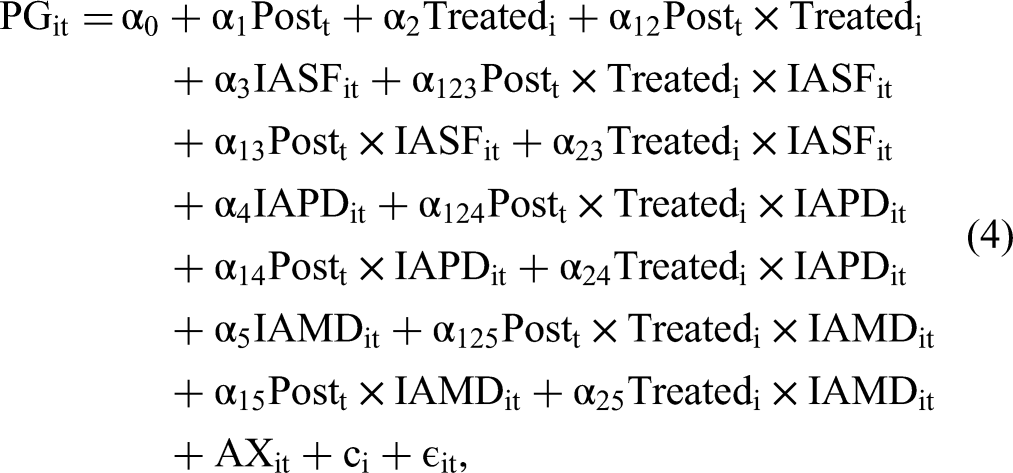
Next, we estimate a difference-in-difference-in-difference model that enables us to assess the impact of a jolt between the treatment and control group as a function of a firm's international alliance activity (Krasnikov, Shultz, and Rebiazina 2022) (H2–H4):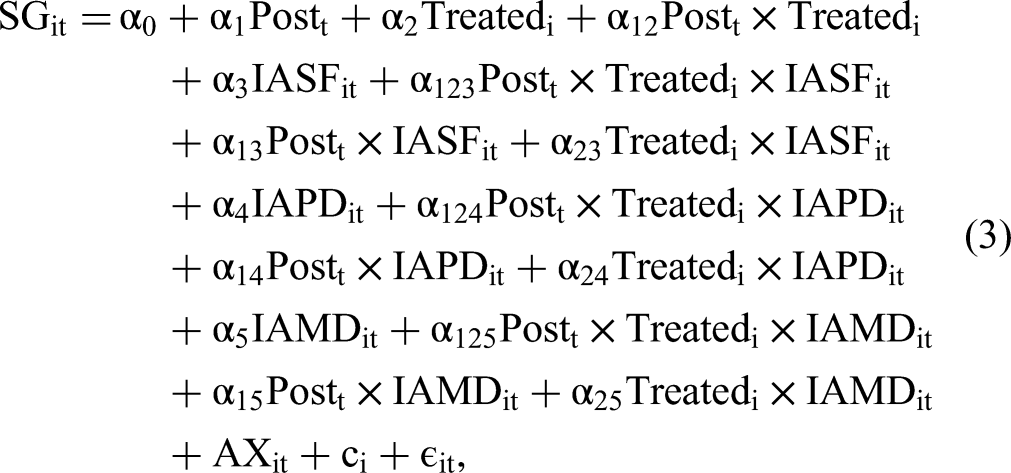
Results
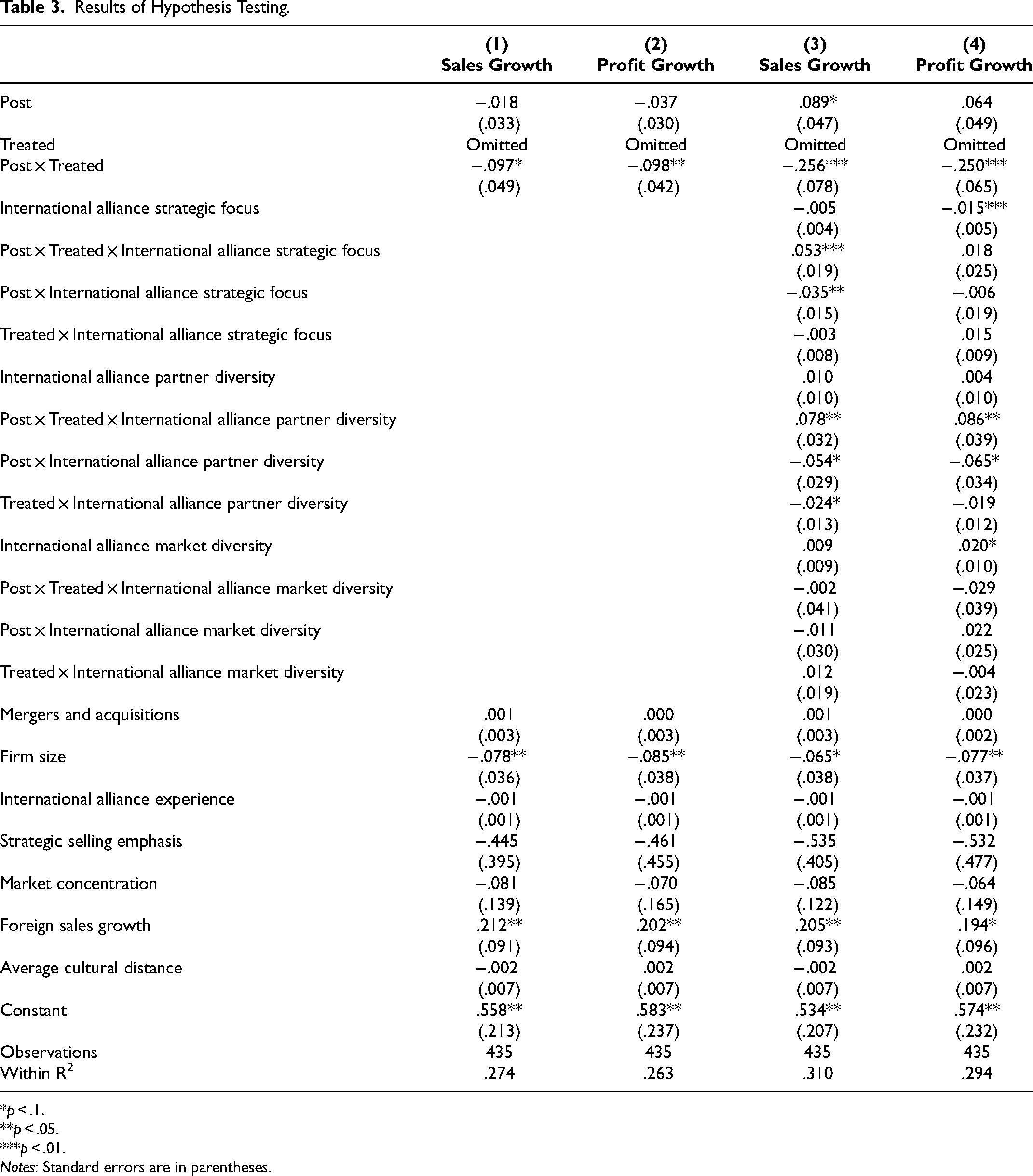
Table 3 contains the results of our hypothesis testing across the four models.
Results of Hypothesis Testing.
*p < .1.
**p < .05.
***p < .01.
Notes: Standard errors are in parentheses.
Results of Models 1 and 2 respectively show that the jolt caused a reduction in sales growth, albeit with marginally weak significance (β12 = −.097, p = .058) and a reduction in profit growth (β12 = −.098, p = .024). Thus, H1 is supported. Models 3 and 4 test the impact of international alliance activity on the negative effect of a jolt on sales growth and profit growth, respectively. We find support for H2 that a focus on value creation activities relative to appropriation attenuates the negative impact of a jolt on sales growth (α123 = .053, p = .010). However, H2 is not supported for profit growth (α123 = .018, p = .477). We graphically illustrate the impact on sales growth of a relatively higher value creation focus by predicting the impact of the jolt on firm performance across low (mean − 1 SD), average (mean), and high (mean + 1 SD) levels of international alliance value creation versus appropriation focus. As shown in Figure 2, focusing on value creation (relative to appropriation) in international alliances enables firms that experienced the jolt to mitigate the negative impact on sales growth.
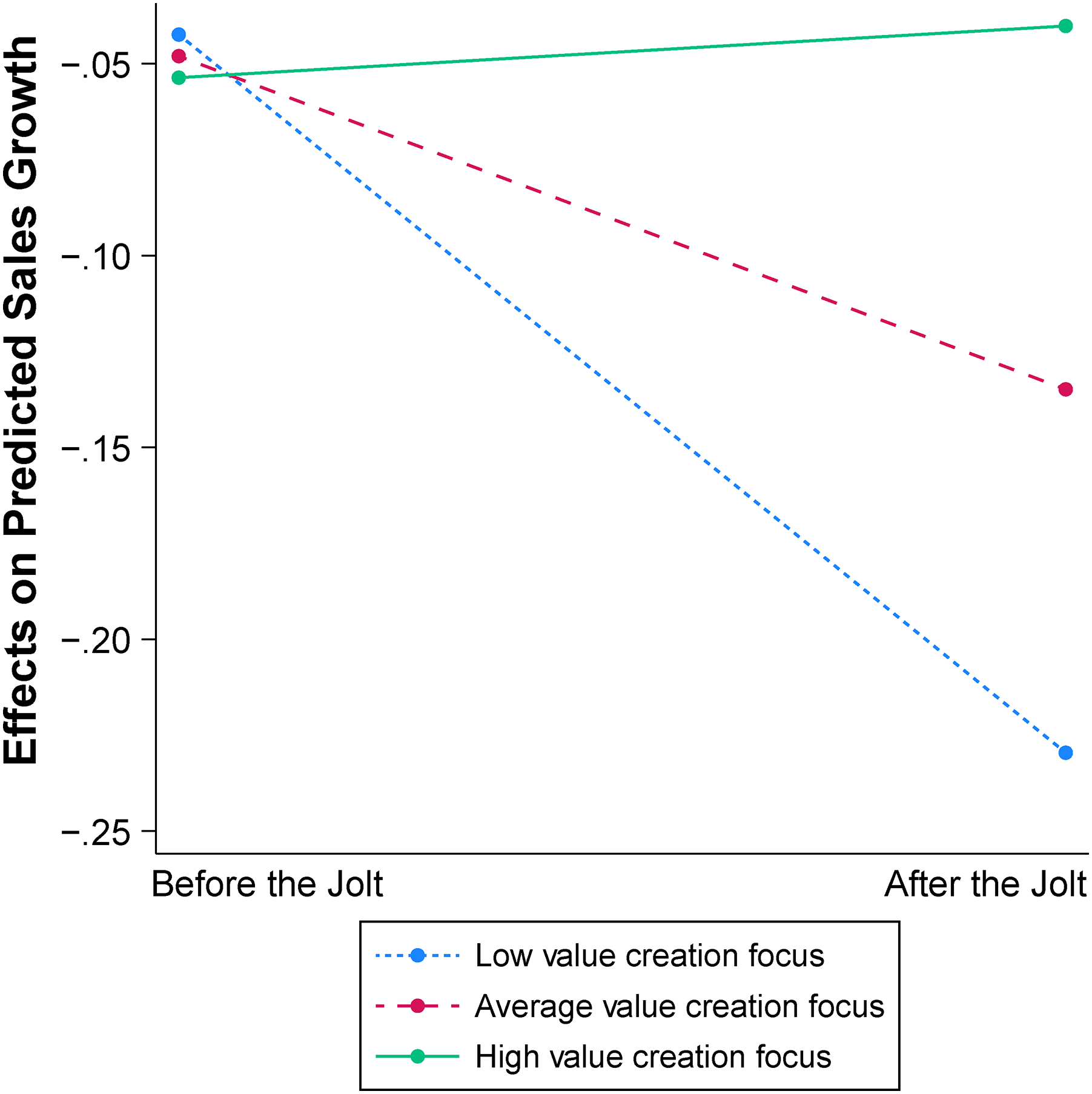
Impact of Value Creation Focus on the Average Marginal Effect of the Jolt on Affected Firms’ Predicted Sales Growth.
H3 is also supported as firms with relatively more new international alliance partners see an attenuation of the negative impact that the jolt has on both sales growth (α124 = .078, p = .020) and profit growth (α124 = .086, p = .031). Figure 3 and Figure 4 graphically show this positive moderation effect of international alliance partner diversity on performance for firms that experienced the jolt.
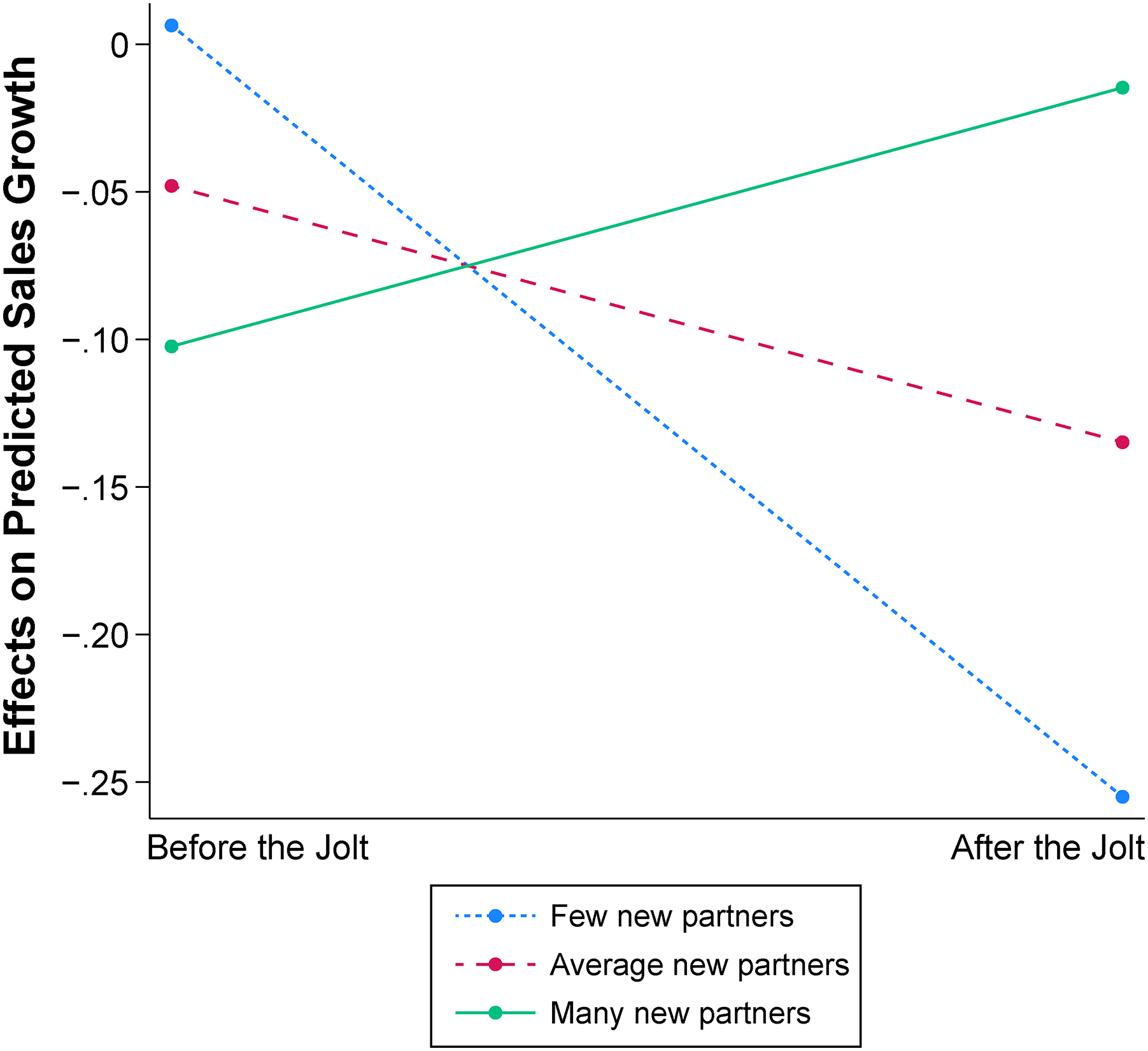
Impact of International Alliance Partner Diversity on the Average Marginal Effect of the Jolt on Affected Firms’ Predicted Sales Growth.
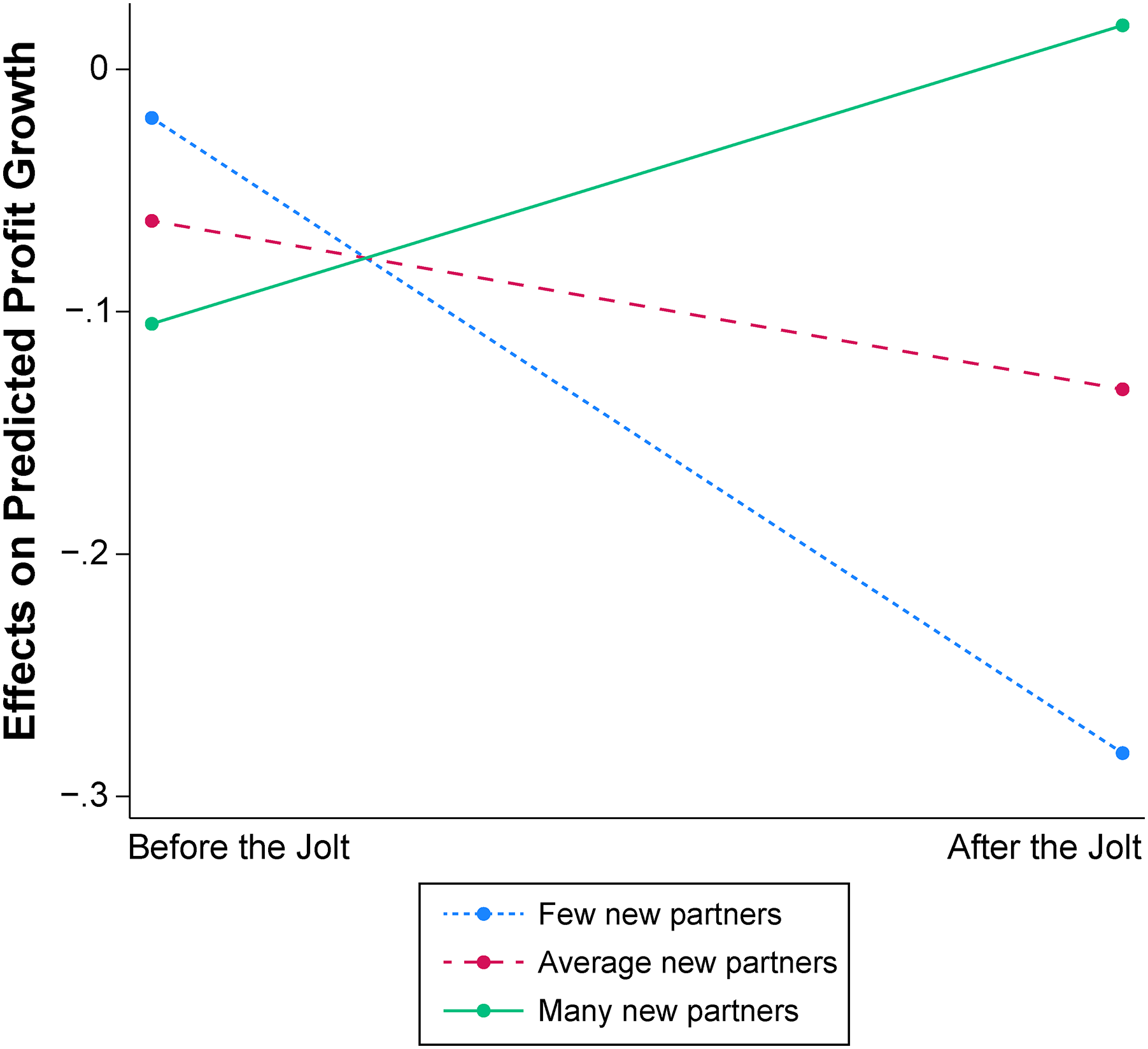
Impact of International Alliance Partner Diversity on the Average Marginal Effect of the Jolt on Affected Firms’ Predicted Profit Growth.
Last, we find no evidence that higher international alliance market diversity attenuates the negative impact of a jolt on either sales or profit growth (p > .10 for α125 in Models 3 and 4); thus, H4 is not supported.
Robustness Checks
As a result of the dot-com bubble jolt, firms in the treatment group experienced negative consequences due to their relationship to internet-related technologies. However, one could also argue that these consequences stemmed from firms’ selling off assets or business units and that not all firms were equally impacted by the jolt. To rule out these competing explanations for our findings, we ran several robustness checks. We first included a measure of internet emphasis in the model based on our analysis of letters to shareholders, as discussed previously. All our focal results are substantively the same and are therefore robust to this inclusion, and the measure of internet emphasis is also not significant (see Web Appendix F). Next, we include a measure of firm assets to control for the potential sell-off of assets by firms affected by the jolt. Our results remain mostly the same (see Web Appendix G). In summary, our findings are robust to alternative explanations of a decrease in sales and profit growth and heterogeneous treatment effects.
Discussion
International alliances are a common tool to implement strategic goals and enhance firm performance (Shi, Sun, and Prescott 2012; Yeniyurt et al. 2009). This study sheds light on a hitherto overlooked benefit of international alliance activity, namely, as a mechanism to build dynamic capabilities, which can prepare firms to adapt to severe, unforeseen environmental changes, such as jolts. Using the knowledge-based view of international alliances, we explain how international alliance activity enhances firms’ dynamic capabilities by providing access to novel information and resources, and experience from assimilating and reconfiguring them. Specifically, we find that although a jolt negatively impacts firm performance, firms that focus on value creation activities with international alliance partners and pursue international alliance partner diversity are better positioned to attenuate the negative effects of a shock. By leveraging the knowledge gained from international alliance experience, firms become more resilient to such unexpected turbulence (Kale and Singh 2009; Xue and Li 2023). Thus, we extend international marketing knowledge by proposing a new role that international alliance activity plays in preparing firms to overcome the negative impact of environmental jolts.
Theoretical Contributions
International alliances and dynamic capabilities
Our study extends research that takes a knowledge-based view of international alliances and adds to the literature on alliance learning (Grant and Baden-Fuller 2004; Kale and Singh 2007). We propose that learning from international alliance management, especially routinizing the acquisition and assimilation of diverse knowledge and resources, builds dynamic capabilities. In turn, these capabilities enable firms to quickly sense and address the strategic misfit between the firm's internal competencies and resources and the external environment that results from environmental jolts, thereby mitigating the impact that such jolts have on performance (Murray and Chao 2005; Shi, Connelly, and Cirik 2018; Yuan et al. 2022).
Scholars have proposed that international alliances can be a source of dynamic capabilities (Lavie and Miller 2008; Zhang et al. 2010; Wassmer 2010). We explicate this proposition in our study and build on it to argue that certain characteristics of international alliances enhance dynamic capabilities. Firms are exposed to knowledge and resources that are external to the firm through international alliances (Das and Teng 2000; Grant and Baden-Fuller 2004; Kim 2013; Zahra and George 2002). Consequently, we argued that in managing these alliances, firms put routines in place to ensure that they identify and acquire knowledge and resources critical to not only future alliance performance but, more broadly, firm performance (Xue and Li 2023). Further, they ensure that there are processes in place that enable effective and efficient interpretation and assimilation of such knowledge and resources.
We test this theorizing by studying three moderators related to international alliance activity that, we argue, enhance dynamic capabilities, thereby mitigating the negative impact of jolts on performance. We find empirical support for two of these moderators, namely, value creation (vs. appropriation) focus and partner diversity. Thus, compared with value appropriation, a value creation focus in international alliances results in greater dynamic capabilities as it necessitates engagement in high-level integrative and reconfiguration activities that are in turn central to adapting to unanticipated environmental changes (Lavie and Miller 2008; Hoffmann 2007; Tower, Hewett, and Saboo 2021). This enhanced ability to realign the firm's internal strategy with its external environment positively impacts sales growth. We do not find support for the idea that a focus on value creation similarly impacts profit growth. One possibility is that value creation activities are more costly and, therefore, do not mitigate the negative impact of an environmental shock on profit growth. Similarly, greater partner diversity exposes firms to diverse information and resources, which in turn builds dynamic capabilities as firms put in place processes and routines to identify and interpret critical areas within each, and integrate and use them (Anand and Khanna 2000; Castro and Roldán 2015; Goerzen and Beamish 2005).
One possibility for the hypothesized moderation with market diversity not being supported may be the strong moderation effect of partner diversity. While diverse markets expose firms to different regulatory, social, and cultural norms, we suspect that diverse partners may be the primary source of this type of social knowledge (Zahra, Ucbasaran, and Newey 2009). Thus, although diverse markets offer exposure to varied information and resources, there might be redundancy relative to the contributions to dynamic capabilities from working with a diverse set of international alliance partners.
International alliances and environmental jolts
Our research marks an important contribution to the international alliance literature that has largely studied steady-state conditions or examined the impact of uncertainty or tensions across international alliance partners (Bello, Katsikeas, and Robson 2010; Robson, Schlegelmilch, and Bojkowszky 2012). Few studies in the international alliance literature that focus on the role international alliances play in adapting to major, and often unanticipated, external turbulence posit international alliances as a strategic tool to achieve specific outcomes. For example, Li, Qian, and Qian (2014) find empirical support that firms that use international alliances to implement different product strategies across countries amid environmental hostility improve their performance. Our study expands the strategic role that international alliances play in enhancing firm performance by explicating how international alliance activities enable firms to become more resilient in withstanding the negative impact of environmental jolts. With jolts often being restricted to particular industries or geographic regions (Colombo et al. 2021; Deleersnyder et al. 2004), we show how experience with and learning from international partnerships specifically make firms more resilient.
Environmental jolts
Literature on threats stemming from environmental jolts and ensuing organizational adaptation is limited (Connelly and Shi 2022). Yet, understanding under what circumstances firms are better prepared to withstand the negative consequences of environmental jolts is increasingly important. These jolts can devastate communities and economies (Geier 2015; Krasnikov, Shultz, and Rebiazina 2022) and often catch firms unprepared (Park and Mezias 2005). We extend the literature on environmental jolts by introducing and studying a new mechanism to withstand these jolts, namely, international alliances. We explicate how dynamic capabilities built through international alliance activity enable firms to adapt to the lack of strategic fit engendered by environmental jolts (Meyer 1982).
Managerial Implications
This study offers novel insights to managers. We encourage managers to view international alliance activity not only as a tool to achieve strategic objectives such as the development of new technology or foreign market access (Vapola, Paukku, and Gabrielsson 2010) but also as a means of building perseverance for challenging times. Our findings suggest that firms build resilience to environmental jolts by managing their international alliance activity. Jolts are unanticipated events, and firms must build dynamic capabilities to withstand them (Shi, Connelly, and Cirik 2018). The literature on dynamic capabilities suggests the need to build routines and processes to manage severe environmental changes. However, the recommendations for doing so are unclear (Schilke, Hu, and Helfat 2018). Our research posits and finds corroborating evidence that particular international alliance activities can build dynamic capabilities by integrating and routinizing a vast variety of knowledge and resources. Specifically, managing value creation activities and maintaining partner diversity in international alliances provide unique opportunities to integrate, build, and reconfigure internal and external competences (Teece, Pisano, and Shuen 1997).
Value creation activities in international alliances come with inherent risks, including uncertain outcomes and substantial resource commitments, especially relative to emphasizing value appropriation alliances. However, these strategic decisions offer firms unique mechanisms to respond effectively to environmental jolts by endowing managers with skills and firm-specific advantages enabling them to quickly assess and adapt to a lack of strategic fit between the firm's internal strategies and its external environment. Engaging in value creation activities enables managers to gain valuable experience in acquiring and evaluating new information and resources from foreign partners, assimilating and transforming them into organizational capabilities, and ultimately leveraging their new knowledge and resource base to enhance firm performance (Hoffmann 2007; Knight and Cavusgil 2004). While international alliance activity is complex and uncertain (Yeniyurt et al. 2009), managers should recognize the added benefit of managing value creation endeavors in building dynamic capabilities.
Similarly, collaborating with a diverse set of international partners may present challenges to efficiency and coordination (Sivakumar et al. 2011). However, it also provides firms a valuable advantage: enhanced information and resource heterogeneity (Lavie and Miller 2008). This enables managers to access varied problem-solving approaches, which are invaluable during environmental jolts. The exposure to different perspectives from diverse partners fosters creativity and adaptability, thus empowering firms to navigate through turbulence with greater adaptiveness and resilience. In summary, we encourage managers to view international alliance activities as a mechanism for preparing for unanticipated external turbulence.
Limitations and Future Research
Our study makes important contributions to the knowledge-based view of international alliances and environmental jolts. Yet, certain limitations can be addressed in future studies. This study focuses on the role of international alliance activity in sustaining performance during a jolt. Yet international partners’ alliances differ in their level of control, commitment, flexibility, and so forth (Bierly and Coombs 2004). These structural differences can impact international alliance activities’ contribution to dynamic capabilities. Additionally, value creation alliances can focus on two related yet distinct domains, namely product innovativeness and institutional innovativeness (Abdi, Aulakh, and Ma 2024). The former involves alliance activities aimed at contributing to the creation of novel ideas and products. At the same time, the latter captures activities aimed at expanding across culturally heterogeneous countries to enhance current and future partnerships (Abdi, Aulakh, and Ma 2024). Future studies can further delineate the impact of these alliance characteristics and different types of value creation activities on the development of these dynamic capabilities.
Furthermore, the firms in our treatment group were from high-tech-related industries that saw significant employment decline. This is not surprising, with the dot-com bubble also being referred to as the “most famous and largest tech bubble” in history (Quinn and Turner 2021). As Grant and Baden-Fuller (2004) note, technology often plays a key role in alliance formation. Although we have other high-tech firms in our sample, such as pharmaceuticals and chemical manufacturing firms, as part of the control group, the observed effects are potentially specific to firms from the industries in our study. Future research could expand our research by examining additional industries during other environmental jolts.
In general, we advocate for more studies examining the impact of a firm's strategic international alliances during environmental disruption. First, it would be interesting to examine these impacts in more recent contexts, such as Russia's invasion of Ukraine or the COVID-19 outbreak. For example, Ciszewska-Mlinarič, Siemieniako, and Wójcik (2024) examine the financial performance of 277 Polish exporters during the COVID-19 pandemic. Furthermore, while we argue that dynamic capabilities are the underlying mechanism that builds resilience to the negative impacts of jolts, we do not directly measure them. Using a multimethod approach, including primary data collection, to succinctly capture a firm's level of dynamic capabilities can further corroborate our findings. In this regard, recent work has suggested that dynamic capabilities can be domain-specific with the introduction and conceptualization of “international dynamic marketing capabilities” (Ciszewska-Mlinarič, Siemieniako, and Wójcik 2024). Last, research on environmental jolts has also highlighted the psychological implications, such as a rigid mindset (i.e., threat rigidity), associated with restricted information processing (Staw, Sandelands, and Dutton 1981). Threat rigidity is associated with psychological conditions of stress, anxiety, and arousal, which in turn manifest cognitively by limiting attention to dominant information signals in the environment (Gladstein and Reilly 1985; Shi, Connelly, and Cirik 2018). This leads to suboptimal decision-making amid an environmental jolt. Additional primary data collection on managers’ psychological conditions during a jolt could prove fruitful in further exploring this aspect of the impact of a jolt on firm performance.
Supplemental Material
sj-pdf-1-jig-10.1177_1069031X241289129 - Supplemental material for Can Experience with International Alliances Help Firms Navigate Jolts? A Study of Resilience Amid the Dot-Com Bubble Burst
Supplemental material, sj-pdf-1-jig-10.1177_1069031X241289129 for Can Experience with International Alliances Help Firms Navigate Jolts? A Study of Resilience Amid the Dot-Com Bubble Burst by Annette Popp Tower and Pravin Nath in Journal of International Marketing
Footnotes
Appendix
Definitions of strategic foci via international alliances are as follows:
Acknowledgments
The authors thank attendees at the 2022 Winter AMA conference, attendees at the 2023 AMA Global Marketing SIG conference, and especially Scott Swain for their insightful comments and feedback.
Editor
Kelly Hewett
Associate Editor
Cem Bahadir
Declaration of Conflicting Interests
The authors declared no potential conflicts of interest with respect to the research, authorship, and/or publication of this article.
Funding
The authors received no financial support for the research, authorship, and/or publication of this article.

Notes
References
Supplementary Material
Please find the following supplemental material available below.
For Open Access articles published under a Creative Commons License, all supplemental material carries the same license as the article it is associated with.
For non-Open Access articles published, all supplemental material carries a non-exclusive license, and permission requests for re-use of supplemental material or any part of supplemental material shall be sent directly to the copyright owner as specified in the copyright notice associated with the article.
