







Abstract
The Problem-Solving Inventory (PSI; Heppner & Petersen, 1982) was developed to assess perceived problem-solving abilities. Using confirmatory factor analysis, results supported a bilevel model of PSI scores with a sample of 164 Mexican American students. Findings support the cultural validity of PSI scores with Mexican Americans and enhance the generalizability with culturally diverse samples.
Problem-solving appraisal is relevant for career counselors and other helping professionals who work with people from a broad range of backgrounds (Heppner & Baker, 1997), including youth. Youth experience a number of stressful events and are at a life stage when they are developing skills to deal with peer pressure and making decisions that could impact the next phase of their life. In particular, Mexican American high school students struggle with issues such as substance abuse (Morgan-Lopez, Castro, & Chassin, 2003), adolescent pregnancy (Mendez-Negrete, Saldana, & Vega, 2006; Trejos-Castillo & Vazonsyi, 2009), and discrimination and prejudice (Edwards & Romero, 2008; Fischer, Wallace, & Fenton, 2000; Romero, Carvajal, Volle, & Orduna, 2007). If not effectively handled, these issues can have negative consequences on these students' academic persistence and career planning (e.g., Alfaro, Umana-Taylor, Gonzales-Backen, Bamaca, & Zeiders, 2009). Therefore, assessing the problem-solving skills of Mexican American high school students can be beneficial for career counselors in deciding how to effectively assist these students with their career planning and decision making. This information can be used to develop or enhance specific problem-solving skills for preventive purposes, or it can be used for diagnostic purposes to understand how to intervene when helping a student to effectively cope with life challenges that may influence their career planning and decision making. Thus, the availability of a problem-solving measure that produces reliable and valid scores with Mexican American high school students can be valuable in career counseling and can help to further career research and practice with this group.
One such instrument is the Problem-Solving Inventory (PSI; Heppner, 1988; Heppner & Petersen, 1982). The PSI scores have been linked to career processes across a number of studies (Heppner, Witty, & Dixon, 2004), suggesting that problem-solving appraisal is an important aspect in making career decisions. Specifically, prior research found that problem-solving appraisal is related to career decidedness (Heppner, Lee, et al., 2004; Larson, Heppner, Ham, & Dugan, 1988; Nota, Heppner, Soresi, & Heppner, 2009), career decision-making self-efficacy (Flores, Ojeda, Huang, Gee, & Lee, 2006), career planning and decision making (e.g., Heppner, Cook, Strozier, & Heppner, 1991; Larson & Heppner, 1985; McCracken & Weizman, 1997), seeking career services (Heppner & Krieshok, 1983), vocational identity (Heppner & Krieshok, 1983), and study habits and academic performance (Elliott, Godshall, Shrout, & Witty, 1990). In addition to its relations to career outcome variables, Heppner, Lee, et al. (2004) found that across the course of career counseling, clients who made improvements in problem-solving appraisal also reported improved working alliance across sessions. Lucas (2004) suggests that future research build upon this study and examine the role of problem-solving appraisal in the career counseling process. Clearly, problem-solving plays an important role in career and academic outcomes and initial findings also suggest that it influences the career counseling process variables.
The PSI has demonstrated acceptable internal consistency across independent samples and cultural groups; however, most PSI research has been conducted with European American college students (Neville, Heppner, & Wang, 1997). Cross-cultural studies of the PSI have included Italian high school students (Nota et al., 2009), African American college students (Harrison, 1994; Neville et al., 1997), French-speaking Canadian adults (Marcotte, Alain, & Gosselin, 1999), Turkish college students (Sahin, Sahin, & Heppner, 1993), South African college students (Heppner, Pretorius, Wei, Lee, & Wang, 2002; Pretorius, 1992, 1993, 1996; Pretorius & Diedricks, 1994), and adolescents in China (Cheng & Lam, 1997). To date, no studies have examined the psychometric properties of this widely used problem-solving instrument with Mexican American samples. However, researchers have noted the importance of using psychological and career-related instruments that have been validated with Latinos to support culturally competent career assessment practices with individuals from this group (Acevedo-Polakovich et al., 2007; Fouad, 1994; Leong & Hartung, 2000). Persons of Mexican descent represent the largest subgroup of Latinos, who are now the nation’s largest racial/ethnic minority group (U.S. Bureau of the Census, 2009). They are the fastest growing groups in the United States, represent a significant proportion of youth in this country (U.S. Census Bureau), and at 21.4%, have higher high school dropout rates than Whites (5.3%) and African Americans (8.4; U.S. Department of Education, 2009). Research that evaluates the validity of measures of problem-solving appraisal with Mexican Americans is warranted and can be used to enhance career decision-making processes with this group.
Among samples of primarily White college students, the estimates of internal consistency of each of the factor scores as well as the total PSI score ranged from .72 to .90 (Heppner, 1988; Moss, 1983). The PSI scores have also been found to have acceptable internal consistency estimates across various cultures (e.g., Heppner et al., 2002; Nota et al., 2009; Pretorius, 1993; Sahin et al., 1993), with α coefficients ranging from .83 to .89 for the PSI total, .76–.87 for Problem-Solving Confidence subscale (PSC), .77–.84 for Approach-Avoidance Style subscale (AAS), and .69–.76 for Personal Control subscale (PC). According to Heppner (1988), the total PSI scores correlated .80 over 2 weeks, .81 over 3 weeks as well as 4 months, and .60 over 2 years with samples of White college students, Black college students, and French Canadian adults, respectively.
A wide range of studies have supported the validity of the PSI. As evidence of construct validity, the three factor scores and the total PSI score were related to students' problem-solving self-reports (e.g., Rath et al., 2004) and ratings of level of program-solving skills and perceived level of satisfaction with skills (Heppner & Petersen, 1982). The PSI also predicted a wide range of psychological adjustment factors, such as anxiety, hopelessness, depression, and self-esteem (Heppner & Baker, 1997). Discriminant validity evidence was provided by correlating PSI factors with measures of both verbal and quantitative intelligence (Heppner & Petersen, 1982). Bivariate correlation coefficients were small: PSC (r = .08–.10), AAS (r = .11–.12), and PC (r = .09–.15), respectively.
Several studies examined the factor structure of the PSI via exploratory factor analysis or confirmatory factor analysis (CFA) with samples of college student from the Midwest United States (e.g., Heppner, Baumgardner, Larson, & Petty, 1988), South Africa (Heppner et al., 2002), and Turkey (Sahin et al., 1993), high school student samples from the Midwest United States (Heppner, Manley, Perez, & Dixon, 1994) and Italy (Nota et al., 2009), and French Canadian adults (LaPorte, Sabourin, & Wright, 1988). The PSI factor structure was replicated satisfactorily across these samples.
Although the prior research findings for these groups indicate strong test–retest reliability, a stable factor structure, and associations with psychological health, it is still too early to conclude the PSI’s cross-cultural applicability with Mexican American samples. More research is needed with diverse samples to extend knowledge about the external validity of the PSI and correlates to problem-solving appraisal. Indeed, numerous scholars have indicated that more attention is needed to examine psychometric issues of the PSI with across cultural groups (Heppner, Witty, et al., 2004; Leong, 1990; Nota et al., 2009). Recently, researchers simultaneously called for further research on the PSI with respect to diversity issues (i.e., race/ethnicity, age, gender, sexual orientation, and social class; Lucas, 2004; O’Neil, 2004; Suzuki & Ahluwalia, 2004). Heppner, Witty, et al. (2004) suggested that the knowledge base and limitations on the PSI would be significantly extended by examining the generalizability or external validity of the existing PSI literature to other sample groups.
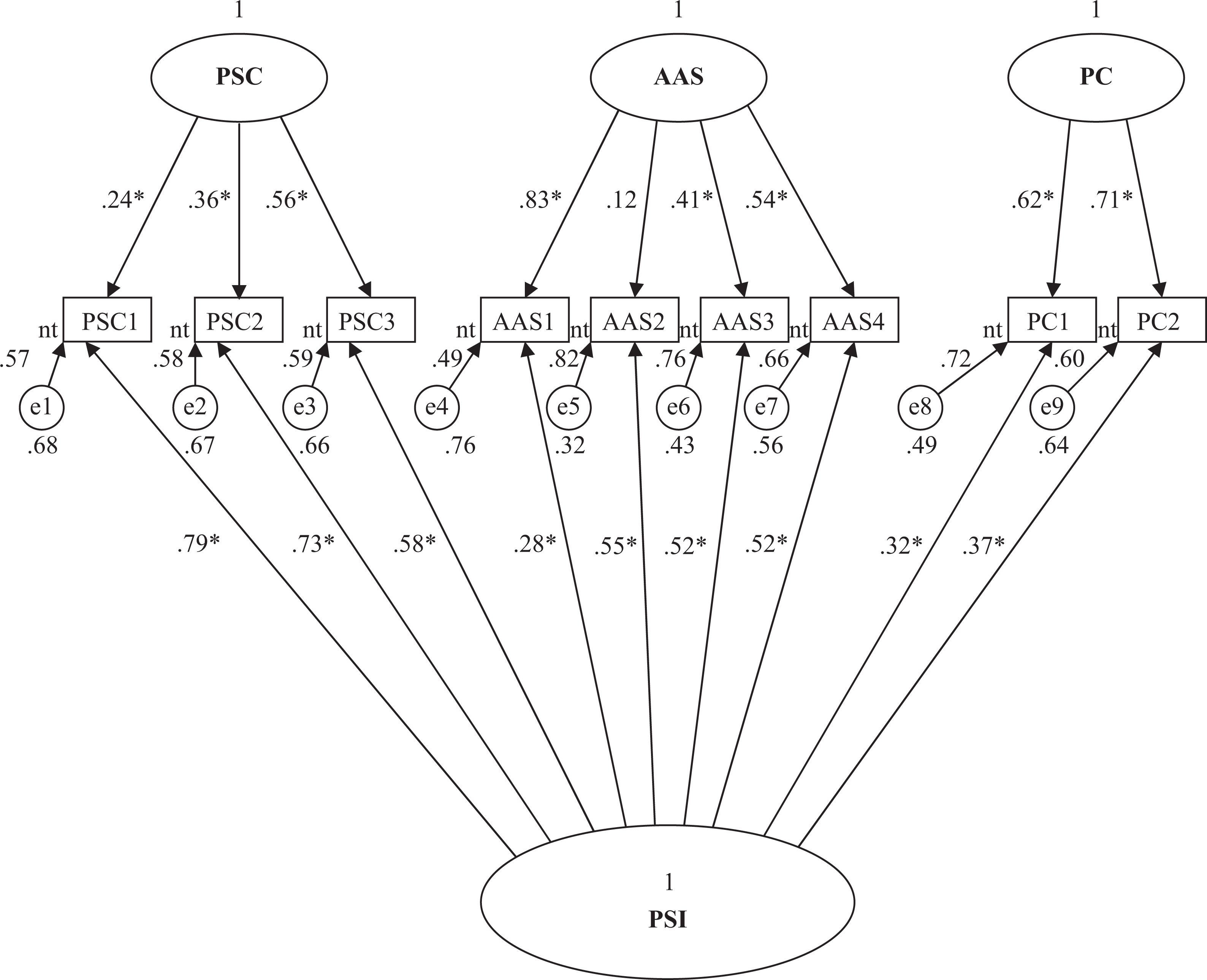
The primary purpose of this study is to extend previous findings by examining the psychometric properties and the factor structure of the PSI with a sample of Mexican American high school students. To date, no studies have examined the validity of the PSI with Mexican Americans. We hypothesized that the PSI would exhibit adequate internal consistency reliability. In addition, the PSI factor structure will be examined to determine whether it is consistent with factor structures previously reported (Heppner, 1988; Heppner et al., 2002; Sahin et al., 1993). Based on findings from a previous study with Black South Africans (Heppner et al., 2002), we expected the bilevel model to demonstrate superior fit with the current sample. Specifically, we hypothesized that the factor structure would support the use of the three factors of the PSI (i.e., Problem-Solving Confidence, Approach-Avoidance Style, and Personal Control) and a general problem-solving factor (see Figure 1 ). Thus, the results are expected to provide support for the assessment of problem-solving appraisal using the PSI for Mexican Americans youth. Another purpose of the present study was to increase our understanding of problem solving by comparing problem-solving appraisal scores across gender groups. Specifically, group comparisons on PSI scores will be conducted to determine whether Mexican American high school men and women scored differently on the PSI and its subscales.
The bilevel model that was tested. The rectangles are measured variables, the large ovals are latent constructs, and the small circles are residual variances. Factor loadings are standardized and are significant (*p < .05), except for the paths designated “nt,” which were fixed at 1. The variance from F1 to F4 was fixed to 1. PSI = problem-solving inventory; PSC = problem-solving confidence; AAS = approach-avoidance style; PC = personal control.
Method
Participants
The sample consisted of 164 (43% female; 57% male) Mexican American students attending two public high schools. The schools enrolled a large percentage of Mexican American students and were located in a rural city near the Texas–Mexico border. The majority of the participants were 10th graders (58%; n = 95), followed by 11th graders (23%; n = 38), 12th graders (14%; n = 23), and 9th graders (3%, n = 5). Three students (2%) did not indicate grade level. Students' age ranged from 14 to 20 years with a mean age of 16.3 years (SD = .99). Among the participants, 29 (18%) identified as first generation, 60 (36%) as second generation, 21(13%) as third generation, 32 (19%) as fourth generation, and 16 (10%) as fifth generation. Six students (4%) did not indicate generation level.
Instruments
Demographic questionnaire
A demographic survey was included to gather information about participants' age, gender, grade level, race, generational status, and career choices.
Problem-solving appraisal
The PSI-Form B (Heppner, 1988; Heppner & Petersen, 1982) is a measure of self-perceived problem-solving ability and consists of 35 items (including three filler items). Participants responded to items using a 6-point Likert scale ranging from strongly agree (1) to strongly disagree (6). The PSI is comprised of three subscales: Problem-Solving Confidence (PSC; 11 items) measures the level of self-assurance while engaging in problem-solving activities; Approach-Avoidance Style (AAS; 16 items) measures the tendency to avoid or approach various problem-solving activities; and Personal Control (PC; 5 items) assesses the belief that one is in control of emotions and behaviors while engaged in problem-solving activities. Item scores are summed and can be used as a single measure of problem-solving appraisal or by subscale. Low scores on the PSI indicate greater perception of effective problem-solving ability, an approach problem-solving style, the presence of personal control, and overall problem-solving appraisal.
The PSI has demonstrated acceptable internal consistency among different samples (e.g., substance abusers, college students) and cultural groups (e.g., Black South Africans) with α coefficients ranging from .72 to .90 (Heppner, 1988; Heppner et al., 2002). Furthermore, the reliability coefficients for the total inventory and for each factor at 2 weeks ranged from .83 to .89. At 3 weeks they ranged from .77 to .81. The last retesting produced coefficients ranging from .44 to .65 (Heppner, 1988). Validity estimates indicate that the PSI is positively related to subjective career distress, active problem solving, and academic self-efficacy (Larson, Toulouse, Ngumba, Fitzpatrick, & Heppner, 1994).
Procedure
Students were invited to participate in the study and were allowed class time to complete the surveys. Parents received an informed consent form prior to the data collection. All students received pencils for participating in the study and were entered into a random drawing for T-shirts, caps, and gift certificates to local movie theaters, restaurants, and stores.
Results
Reliability
Estimates of internal consistency were examined for the PSI total and each of the three factors. For the current study (see Table 1 ), the α coefficients were as follows: .86 for PSI total, .77 for PSC, .76 for AAS, and .66 for PC.
Means, Standard Deviations, Ranges, Reliability Coefficients, Skewness, Kurtosis, and Bivariate Correlations for the Problem-Solving Inventory and its Three Subscales
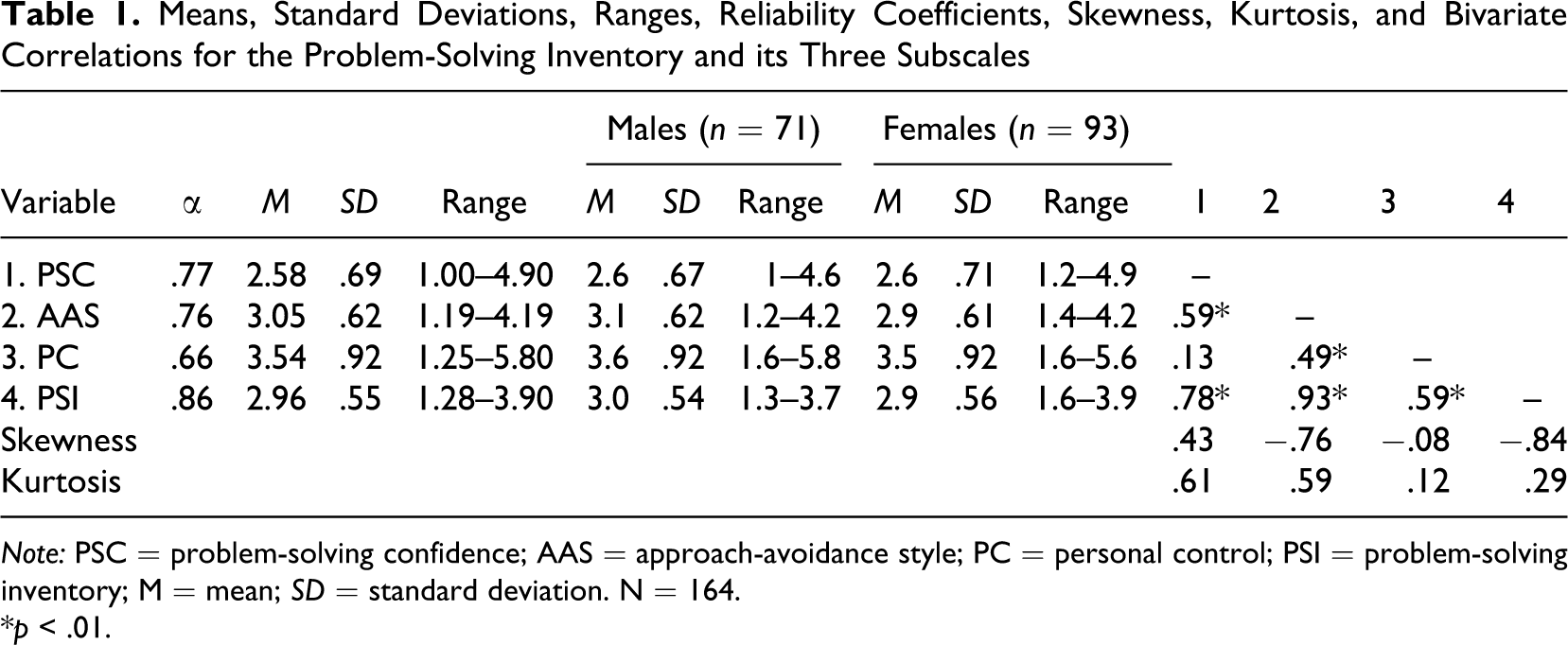
Note: PSC = problem-solving confidence; AAS = approach-avoidance style; PC = personal control; PSI = problem-solving inventory; M = mean; SD = standard deviation. N = 164.
*p < .01.
Preliminary Analyses
The means, standard deviations, range, skewness, and kurtosis for each of the measured variable in this study are present in Table 1. The skewness and kurtosis values were examined to determine whether the variables met the assumptions of normality. The test of multivariate normality demonstrated that the data met these assumptions.
Confirmatory Factor Analysis
To test the hypothesis that the PSI assesses one general factor as well as three specific factors, the bilevel model was examined via CFA. Specifically, the bilevel model consists of three first-order factors (i.e., PSC, AAS, and PC) and the second-order factor is one general factor (i.e., PSI). That is, each indicator (i.e., PSI items) loads on both a general factor and one of the three specific factors of the PSI (see Figure 1). Prior to conducting the CFA, we carried out an item-bundling (or parceling) procedure. In general, the purpose of item bundling is to (a) estimate fewer parameters for both the individual constructs and the hypothesized model, (b) lessen the impact of statistically unreliable individual items (e.g., items with lower reliabilities and communalities), (c) diminish the possibility that items will load on more than one factor, (d) decrease the chances of correlated residuals, and (e) reduce influence of sampling error (MacCallum, Widaman, Zhang, & Hong, 1999). In Heppner et al.’s study (2002), the authors divided the 32 items from the three PSI factors into nine bundles (three bundles for PSC, four bundles for AAS, and two bundles for PC). The same factor structure was used in this current study. Next, on the basis of factor loadings for each factor and assigned items, the items were rank-ordered. The specific procedure, Item-to-Construct Balance, was used to create bundles with equivalent item difficulty and discrimination (Little, Cunningham, Shahar, & Widaman, 2002). For example, for the PSC latent variable, items ranked 1, 6, 7, and 11 for the PSC were assigned to Bundle 1 (PSC1), items ranked 2, 5, 8, and 10 to Bundle 2 (PSC2), and items 3, 4, and 9 to Bundle 3 (PSC3). The correlation matrix among the nine item-bundles of the PSI is presented in Table 2 .
Correlation Matrix Among Nine Item-Bundles of the Problem-Solving Inventory (PSI)
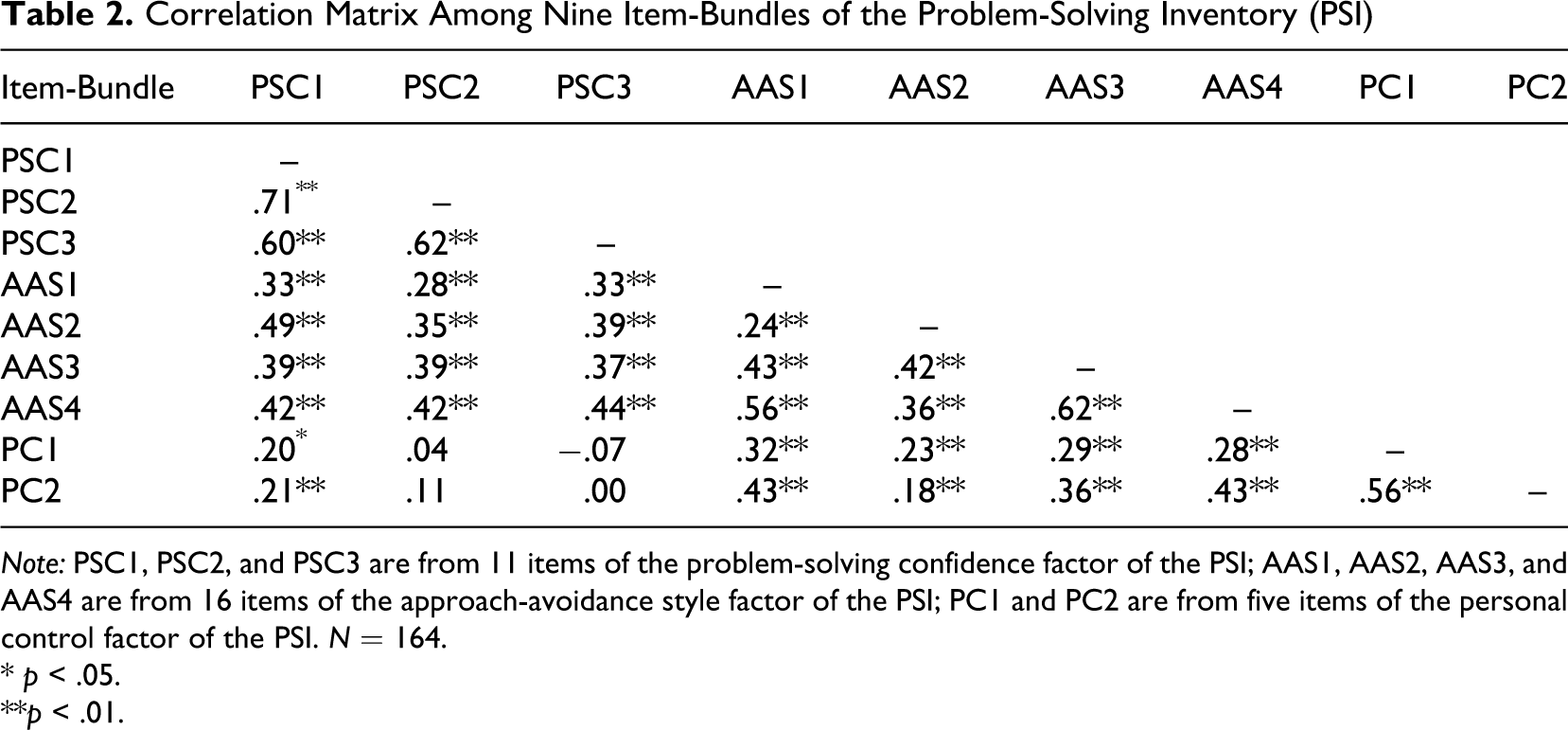
Note: PSC1, PSC2, and PSC3 are from 11 items of the problem-solving confidence factor of the PSI; AAS1, AAS2, AAS3, and AAS4 are from 16 items of the approach-avoidance style factor of the PSI; PC1 and PC2 are from five items of the personal control factor of the PSI. N = 164.
* p < .05.
**p < .01.
Next, the original three-factor orthogonal structure of the PSI was tested using the EQS (Version 6.1) statistical package (Bentler & Wu, 1993). A variety of goodness-of-fit indices (GFIs) were used to assess the adequacy of the model fit, including the chi-square test (χ2; Kline, 2005; best if not significant), the chi-square/degrees of freedom ratio (χ2/df; Kline, 2005; ratios under 3 are considered to represent an adequate model), the comparative fit index (CFI; Loehlin, 1998; best if .95 or greater), the GFI (Loehlin, 1998; best if .95 or greater), the root-mean-square error of approximation (RMSEA; MacCallum, Browne, & Sugawara, 1996; best if .05 or less), and the standardized root-mean-squared residual (SRMR; Loehlin, 1998; best if .05 or less). Examination of the χ2 = 43.87 (df = 16, p < .05), CFI (.95), GFI (.94), RMSEA (.10), SRMR (.04), and χ2/df ratio (3.05) indicated that, in general, the model was an appropriate fit of the data. In conclusion, these results provide empirical support for a bilevel model for the current sample
Factor Intercorrelations
Intercorrelations among the factors are presented in Table 1. The correlation among the factor scores were as follows: PSC/AAS = .59, PSC/PC = .13, AAS/PC = .49.
Gender Group Comparisons
Table 1 shows the PSI means and standard deviations for the total sample and by gender groups. Lower scores indicate that the individual perceives himself/herself as more confident in problem solving, has a tendency to approach problems, and perceives more personal control over his/her problems. To compare the scores of Mexican American male and female the PSI total and its three factors, a between-subjects multivariate analysis of variance (MANOVA) was conducted. The MANOVA revealed no significant gender difference on the PSI total and the three factors, Wilk’s λ F(4, 159) = 1.63, p > .05.
Discussion
The purpose of the present study was to examine the reliability and validity of the PSI with Mexican American high school students. The results of this study support and extend previous research conducted with primarily White (Heppner, 1988), Black (Heppner, 1988), South African (Pretorius, 1993), and Turkish (Sahin et al., 1993) college students. Our findings indicated that the PSI means, standard deviations, and estimates of internal consistency from the current sample are comparable to those reported in these previous research studies. The results of this study also suggest that the psychometric properties of problem-solving appraisal as measured by the PSI seem to generalize to Mexican American high school students. Thus, findings suggest that the PSI may be a useful instrument to examine problem-solving appraisal with Mexican American high school students seeking career guidance.
The initial estimates of reliability suggest that the PSI and the three factors have acceptable levels of internal consistency with the Mexican American high school sample, and these findings are consistent with those reported in previous studies (Heppner, 1988; Heppner et al., 2002; Pretorius, 1993; Sahin et al., 1993). In the current study, PC scores demonstrated lower internal consistency (.66) than PSC and AAS scores; however, this is similar to the α coefficient reported with a sample of high school students (Heppner et al., 1994).
Consistent with findings from a prior study on South African college students (Heppner et al., 2002), the results of the present study provide additional support for the generalizability of the factor structure of the PSI across independent samples. Specifically, our results supported the three factors and a general problem-solving factor of the PSI with the sample of Mexican high school students. These results lend strong support for the consistency of the PSI factor structure across various cultures and to a high school sample, and imply that problem-solving appraisal as measured by the PSI may be a useful construct across different cultures.
In the present study, the correlations between problem-solving confidence and approach-avoidance style (PSC/AAS) and the personal control (AAS/PC) showed similar results to those reported in prior studies (Heppner, 1988; Heppner et al., 2002), but the correlation between the problem-solving confidence and personal control (PSC/PC) was lower than that reported in these previous studies (.13). Results suggest that further examination of the relationship between PSI and PC is needed, especially with a Mexican American sample.
No gender differences were reported on PSI scores between men and women in the previous studies with American college students (Heppner, Hibel, Neal, Weinstein, & Rabinowitz, 1982; Heppner & Krieshok, 1983; Larson & Heppner, 1985). However, researchers found that women were more concerned about the future than men (Constantine, Chen, & Cessay, 1997) and experience environmental and individual obstacles in their careers (Betz, 2006). Even though there we also found no differences among Mexican American high school men and women, it might be helpful for future research to understand the needs of men and women in problem solving independently.
The present findings have implications for assessment and practice. First, our data suggests that the PSI is appropriate for use in research with Mexican American high school students. With regard to counseling practice, it might be beneficial for school counselors to help high school students become more aware of the factors that influence their perceived problem-solving ability. In addition, due to a possible lack of experiences to successfully practice problem-solving skills, Mexican American high school students may perceive more barriers in problem solving than college students. Therefore, counselors can help Mexican American high school students increase confidence by teaching them some problem-solving skills (e.g., exploring options), providing opportunities to practice their skills, and providing support and encouragement when they accomplish these problem-solving tasks. Another way to create and strengthen self-efficacy in solving problems is through vicarious learning experiences (Bandura, 1986, 1989). Thus, counselors and family members can serve as social models in effective problem solving for Mexican American high school students. Because research has linked problem-solving abilities with confidence in making decision (Larson & Heppner, 1985), focusing on the development of problem-solving skills among Mexican American youth may assist in overall psychological adjustment and educational and career development.
Findings from this study are based on a sample of Mexican American high school students from a rural city near the Texas–Mexico border. In terms of students' background, this sample might not represent other Mexican American high school students across the United States. Therefore, the generalizability of the findings to other Mexican American high school students is not known. More studies are needed to determine whether the PSI factor structure exhibits similar findings in other Mexican American high school, adult, and college student samples.
Also, although the PSI has been investigated in previous studies with the international samples, the only diverse U.S. racial/ethnic group previously examined was a Black undergraduate student sample. Thus, more studies with diverse U.S. racial/ethnic groups are needed. Future research might also examine cultural variables, such as acculturation, that influence Mexican American high school students' problem-solving appraisal. Finally, more studies are needed to examine the external validity of PSI scores with Mexican American student samples. These studies might explore the relations between problem-solving appraisal and postsecondary educational intentions, persistence in college, and academic satisfaction.
To summarize, the results of this study provide empirical support for Heppner et al.’s (2002) bilevel model of the PSI with Mexican American high school students. In particular, the three factors of the PSI as well as a general problem-solving factor were presented. These results extend the generalizibility of utilizing the PSI with Mexican American high school students. Given the outcome of this study, the PSI appears to be an appropriate tool for examining problem-solving appraisal with Mexican American high school students.
Footnotes
The authors declared no potential conflicts of interest with respect to the research, authorship, and/or publication of this article.
The authors received no financial support for the research, authorship, and/or publication of this article.