







Abstract
The central aim of the present study was to assess the predictive value of affective disposition and meaningful work on employee engagement. Specifically, it was proposed that meaningful work moderates the relationship between affective disposition and engagement. Questionnaires were completed by 252 white-collar employees, working in a variety of organizations and jobs across Israel, recruited from community-based samples on a voluntary basis. As hypothesized, work engagement, affective disposition, and meaningful work were positively correlated. Additionally, a significant interaction between affective disposition and meaningful work was found. The relationship between affective disposition and work engagement was found to differ by the extent to which individuals perceived their work as meaningful. Specifically, when work was not perceived as meaningful, employees characterized by high scores on affective disposition were more strongly engaged compared to employees who were characterized by low scores on affective disposition. However, when work was perceived as meaningful, there was no difference in level of engagement found between those with high or low scores on affective disposition. The implications of these results are discussed.
Work engagement is considered to have great significance for both employees and organizations. In fact, within the applied world of work, building employee engagement has been touted as the most critical task confronting organizations today (Towers Perrin, 2003). Past research has found work engagement to be related to positive organizational outcomes such as low turnover, high organizational commitment, business financial performance, and organizational performance (Bates, 2004; Salanova, Agut, & Peiro’, 2005; Schaufeli & Bakker, 2004). For instance, in a study examining 7,939 business units from 36 companies, Harter, Schmidt, and Hayes (2002) found that business units that surpassed the typical levels of employee engagement scores also excelled in performance and profitability. As these findings indicate, identifying the predictors to work engagement is an important task for business leaders, both because of enhanced organizational performance and improved employee well-being.
Increased interest in work engagement has resulted in diverse perspectives on the conceptual model and the operational definition of this construct. Kahn (1990) used the term engagement to refer to how individuals incorporate their ‘personal selves during work role performances’ (p. 694). He proposed personal engagement as the extent to which an individual expresses and invests oneself, physically, cognitively, and emotionally, in the work one does. More recently, work engagement has been defined as energy, involvement, and efficacy (Maslach & Leiter, 1997), the direct opposites of the three burnout dimensions on the Maslach Burnout Inventory (MBI; Maslach, Jackson, & Leiter, 1996). In the case of burnout, energy turns into exhaustion, involvement into cynicism, and efficacy into ineffectiveness. By implication, engagement is assessed by the opposite pattern of scores on these three dimensions: low scores on exhaustion, cynicism, and ineffectiveness. An alternative view defines work engagement as a ‘positive, fulfilling, work related state of mind that is characterized by vigor, dedication and absorption’ (Schaufeli, Salanova, Gonzalez-Roma, & Bakker, 2002, p. 74). Taken together, these views depict engagement as the physical, cognitive, and emotional energy employees invest in their work, which helps them persist through difficulties and allows them to become engrossed in their work activities.
Work Engagement and Its Antecedents
Perhaps owing to a diversity of definitions for employee engagement, a great variety of factors appear to hold potential for increasing (or decreasing) engagement. Among theoretical perspectives, the Job Demands-Resources (JD-R) model (Bakker & Demerouti, 2007) provides a straightforward approach to understanding potentially influential workplace factors. Job resources refer to physical, social, or organizational aspects of the job that are instrumental in achieving work-related goals, reducing demands and the associated costs, and stimulating personal growth and development (Bakker & Demerouti, 2007). In this model, if the resources provided to employees are greater than the demands placed on employees, engagement is likely; however, if demands outstrip resources, burnout is likely. Fostering engagement is a matter of providing resources and diminishing demands. The Job Characteristics Model has also been used to identify workplace factors that predict optimal work outcomes (Hackman & Oldham, 1980). This model maintains that there are five core job characteristics that impact employee psychological states. In turn, these psychological states influence work outcomes, which may include engagement. Both job resources (e.g., support from colleagues and supervisors, performance feedback, and learning opportunities) as well as positive job characteristics (e.g., skill variety, autonomy) have been supported as precursors to work engagement (Bakker & Demerouti, 2007; Schaufeli & Salanova, 2007).
The JD-R model (Bakker & Demerouti, 2007) also highlights the fact that job performance can be motivated by intrinsic factors that are relevant to basic psychological needs (Deci & Ryan, 1985) or by extrinsic factors that impel performance through material or social pressures (Gagné & Deci, 2005). Some resources may be more likely to impact intrinsic motivation (e.g., support from colleagues and supervisors; learning opportunities) and some may be more likely to impact extrinsic motivation (e.g., pay raises linked to productivity). In both cases, employees may become more engaged in their jobs, because they derive fulfillment from them (Schaufeli & Bakker, 2004), successively leading to better performance (Bakker, 2009).
Increasingly, interest has been directed at individual-level personality factors that may serve as antecedents to engagement. Most of this research has focused on the connection between work engagement and the Big Five personality dimensions (i.e., Neuroticism, Extroversion, Openness, Agreeableness, and Conscientiousness). For instance, Kim, Shin, and Swanger (2009) examined the Big Five and work engagement and found Conscientiousness to be the most dominant personality trait influencing engagement. They concluded that employees high in Conscientiousness (i.e., characterized by strong responsibility and organizational skills) were more likely to invest energy into work, complete the job, and ultimately feel a stronger sense of professional efficacy. Other research has linked high levels of Neuroticism to greater burnout and lesser engagement; whereas the converse pattern of relations has been found between Extraversion, burnout, and engagement (see Langelaan, Bakker, Doornen, & Schaufeli, 2006). The potential roles of Neuroticism and Extraversion in predicting engagement sheds light on the importance of emotions in work. Neuroticism is defined in part by a propensity to experience negative affect, and Extraversion is defined in part by an inclination to experience positive affect. Thus, some part of the relationship between these two personality traits and engagement could be due to the influence of affective state.
Affect and Engagement
There are a number of reasons to suggest an important relationship between affect and engagement. According to Kahn (1990), people must have psychological availability in order to become engaged. Psychological availability includes the emotional, cognitive, and physical resources needed to fully invest oneself to one’s job. Negative affect may reduce psychological availability, thus impairing engagement. Alternatively, positive affect may help people interpret workplace events favorably by increasing psychological availability, preventing disruptions to one’s work, and facilitating engagement (Schaufeli & Van Rhenen, 2006).
Research has supported the relationship between positive affect and employee engagement (Bosman, Rothmann, & Buitendach, 2005). This research has frequently used the constructs of positive and negative affect (PA and NA, respectively) as measured using the Positive Affect and Negative Affect Schedule (PANAS) developed by Watson and Clark (1984). However, some weaknesses of this instrument have been noted. First, the constructs of PA and NA do not appear to be entirely orthogonal, which reduces the accuracy of estimates of their independent contributions to employee engagement (Barrett & Russell, 1999). Second, significant parts of the affect content domain are left out of PA and NA measurement (Barrett & Russell, 1999; Russell & Barrett, 1999; Schimmack & Crites, 2005). For instance, the PA scale contains items such as alert, inspired, and proud, but does not contain items such as happiness, cheerfulness, or relaxation. Likewise, the NA scale contains items such as tension, guilt, and irritation, but does not include items such as boredom, sadness, or displeasure. Finally, predicting who is most and least likely to become engaged requires consistent and stable measures of affect; yet, there is typically fluctuation in PA and NA scores over time.
In response to these criticisms, Judge and Bretz (1993) have suggested an alternative measure, which they refer to as affective disposition. Affective disposition is defined as one’s predisposition to experience a given affective state (i.e., positive or negative) across situations and over time (Judge & Bretz, 1993). It is a stable characteristic that has been more associated with long-term subjective well-being, as opposed to more brief and transient affective states. For example, affective disposition may have a weak relationship with affective states experienced on any randomly chosen day, but should have a strong relationship with overall subjective well-being experienced over the course of a year. According to Judge (1990), individuals with a positive affective disposition may have a tendency to see the world and their experiences in a more favorable light, a tendency that should carry over into the workplace. In fact, several studies show a linkage between positive affective disposition and positive attitudes toward work, in addition to job satisfaction, job performance, and even current income (e.g., Cropanzano, James, & Konovsky, 1993; Diener, Nickerson, Lucas, & Sandvik, 2002; George, 1989; Hochwarter, Perrewe, Ferris, & Brymer, 1999; Staw & Ross, 1985). However, the relationship between the construct of affective disposition and work engagement has not been investigated to date.
The Neutral Object Satisfaction Questionnaire (NOSQ) was selected as a measure of affective disposition instead of the often-used PANAS for several reasons. First, the NOSQ and the PANAS differ in terms of content and structure; the PANAS asks respondents to indicate how frequently they experience a set of positive and negative emotions, while the NOSQ asks respondents to indicate their reactions to neutral, everyday stimuli (Eschleman & Bowling, 2010). This distinction has led some to argue that the PANAS is more a measure of one’s state of subjective well-being, whereas the NOSQ is a trait measure of affective disposition (Judge & Bretz, 1993). Additionally, the NOSQ is thought to elicit more accurate and direct information recall due to the fact that the items presented are typically ‘external to the individual and neutral,’ whereas the items presented on the PANAS are ‘personally relevant and affective-oriented’ (Eschleman & Bowling, 2010, p. 504).
In an empirical comparison of the NOSQ and the PANAS, the high stability of the NOSQ distinguishes this measure as assessing a disposition. Judge and Bretz (1993) demonstrated the stability of the NOSQ by evaluating the test–retest reliability over a 6-month period. In this study, the NOSQ had a corrected stability coefficient of .88. The NOSQ has also been found to be stable over a 5-week period with a stability coefficient of .79 (Carter, 2004). In addition, when comparing the NOSQ to positive affectivity (PA) and negative affectivity (NA) in longitudinal studies, the NOSQ is more stable (Carter, 2004; Judge & Bretz, 1993). By comparing the corrected stability coefficients of the NOSQ and the PANAS, Judge and Bretz (1993) found that the NOSQ has a stability coefficient significantly stronger than PA (.16 increase) and NA (.17 increase). Carter (2004) provides support for Judge and Bretz in their study over a 5-week period. In this study, the NOSQ has a stability coefficient significantly stronger than PA (.18 increase) and NA (.20 increase). The high test–retest reliability of the NOSQ, in comparison to the test–retest reliability of the PANAS, is evidence that NOSQ provides a better assessment of disposition.
Meaningful Work and Work Engagement
Affective disposition, on its own, may not be sufficient for employee engagement. It may be that having a positive affective disposition allows people with other positive attributes to engage with work. In line with this reasoning, Macey and Schneider (2008) proposed that the interaction of dispositional factors such as positive affectivity and proactive personality could increase the chances of an individual experiencing work in a positive and energetic way. We suggest that the variable of meaningful work is a compelling prospect for interacting with dispositional affect to predict employee engagement. Meaningful work refers to people’s judgments that their work is significant, worthwhile, and has positive meaning (Rosso, Dekas, & Wrzesniewski, 2010). Research on this construct is accelerating and so far supports the idea that meaningful work may provide richer, more satisfying, and more productive employment (Steger & Dik, 2009).
Meaningful work is thought to arise when people have a clear understanding of their abilities, what is expected of them, and how to operate successfully within their work environment (Steger & Dik, 2009; Steger & Dik, 2010). In addition, meaningful work is more likely to be experienced when people know their effort works toward a clear purpose within an organization, and when it contributes to some greater social benefit. Thus, meaningful work occurs when people can really apply themselves to significant work activities that serve a valued, broader purpose.
A number of studies have focused on the consequences of meaningful work. Meaningful work is related to important work-related and general well-being variables, such as job satisfaction, being able to use one’s strengths at work, greater intrinsic work motivation, and organizational commitment (Arnold, Turner, Barling, Kelloway, & McKee, 2007; Littman-Ovadia & Steger, 2010; Steger, Dik, & Duffy, 2012). When employees feel their work is meaningful, it occupies a more central and important place in their lives (Harpaz & Fu, 2002; MOW International Research Team, 1987). Accordingly, they are less often absent from their work and report less intention to leave their organization (Scroggins, 2008; Steger et al., 2012). Research within the job characteristics model has also found that meaningful work is connected to positive work outcomes and general well-being (Hackman & Oldham, 1980).
As implied, the set of attitudes that constitute meaningful work should facilitate employees’ abilities to invest themselves in their work and engage more fully. The conceptual link between meaningful work and work engagement is underscored by a recent report by the consulting firm Towers Perrin (2003), showing that meaningful work experiences formed the foundation for employee engagement in organizations. Nonetheless, only a handful of studies have explored the relationship between meaningful work and work engagement (May, Gilson, & Harter, 2004; Olivier & Rothmann, 2007; Rothmann & Buys, 2011). For example, Olivier and Rothmann (2007) investigated the antecedents of work engagement on a sample consisting of employees from a multinational oil company based at different locations across South Africa. Their results showed that meaningful work was a significant predictor of work engagement. Other research has found a similar relation between meaningful work and employee engagement (Stringer & Broverie, 2007). Thus, meaningful work seems to be a promising avenue for understanding how employees engage in their work (May et al., 2004).
However, meaningful work is conceived as a nearly pure cognitive and motivational variable. Employees make sense of their work, see a purpose to it, and feel driven to help some greater good. Employees engaged in meaningful work should find it easier to be cognitively present and available in their work, stay involved, experience efficacy, and become dedicated and absorbed, which melds with the cognitive and motivational components of engagement (Kahn, 1990; Maslach & Leiter, 1997; Schaufeli et al., 2002). Yet, engagement also is characterized in emotional terms, whether being emotionally available and present (Kahn, 1990), feeling energy (Maslach & Leiter, 1997), or demonstrating vigor for work activities (Schaufeli et al., 2002). We suggest that meaningful work plays a complementary and interactive role with people’s emotional experiences, conceptualized here as affective disposition. When employees experience their work as meaningful, the relationship between affective disposition and employee engagement should be diminished, because of the cognitive and motivational forces associated with meaningful work. However, when meaningful work is low, affective disposition should have a stronger relationship with employee engagement because it can serve as an alternate, emotionally accessible route to engagement.
We hypothesize the following: Hypothesis 1: There is a positive correlation between affective disposition and work engagement. Hypothesis 2: There is a positive correlation between meaningful work and work engagement. Hypothesis 3: The relationship between affective disposition and work engagement will be moderated by meaningful work. In other words, when meaningful work is low, there will be a positive relationship between positive affective disposition and engagement at work, but when meaningful work is high, this relationship will not be significant.
Method
Sample and Data Collection
Data for the current study were collected from a community-based sample of employees in Israel. Potential respondents received a self-report questionnaire with a cover letter explaining that the purpose of the study was to survey working attitudes among people who had been in the workforce for at least 6 months. It was emphasized that the questionnaires were anonymous, and participants were requested to complete them in entirety, with no time limitation.
In the interests of obtaining a sample that represented a range of organizations, industries, managerial positions, tenure periods, and occupations, questionnaires were distributed to randomly selected workers at several organizations. The initial wave of 350 potential respondents were contacted either by an electronic letter contained the electronic survey file, or personally by the researchers who gave them a manual form of the letter and the survey. To increase sample size, a snowball sampling strategy was used, and the initial wave of potential participants were asked to forward the e-mail or to help on distributing the questionnaires to their acquaintances that are employed at least 6 months, for their consideration of participation. Participants who consented to take part in the study completed the survey and returned it to the researchers. Participants did not receive monetary compensation.
Most questionnaires were completed electronically and returned by e-mail, although some (about 10%) were completed manually. After 16 weeks (data for the current study were collected between August and November 2008), 252 usable surveys had been obtained from the respondents.
All participants were white-collar employees, working in a variety of organizations and jobs across Israel. The sample included business firms, attorney’s office, investment banks, high tech companies, research institutes, and more. There were more women than men (63.1% vs. 36.9%), most (86.1%) were full time and many (42.5%) were in managerial positions. Their average age was 33.66 years (SD = 10.03), their work experience ranged from 6 months to 46 years, and their tenure in current position at work ranged from 2 months to 46 years. Average position tenure was 3.25 years (SD = 6.81), and average job tenure was 4.83 years (SD = 4.98). The majority of the sample population were born in Israel and held an undergraduate degree. The sample showed an equal distribution of single and married individuals, and individuals in managerial and nonmanagerial positions. The range of organizations and the variety of occupations in this sample corresponds with the Israeli white-collar workforce.
Instruments
Work engagement
Work engagement was measured with a 9-item version of the Utrecht Work Engagement scale (UWES-9; Schaufeli, Bakker, & Salanova, 2006). The scale consisted of 3-item subscales measuring vigor, dedication, and absorption; the 9 items were combined into a single composite measure. Three sample items are: ‘At my work, I feel bursting with energy’ (vigor), ‘I am enthusiastic about my job’ (dedication), and ‘I get carried away when I am working’ (absorption). Respondents rate their responses on a scale from 0 (never) to 6 (always). Schaufeli et al. (2006) demonstrated good factorial validity of the UWES-9. Satisfactory internal consistency was achieved (α values ranged from .85 to .92 across various countries). In the present study, the reliability of the scale was .93.
Affective disposition
Affective disposition of employees was assessed with a revised 17-item version of the NOSQ (Judge, 1990). Based on an earlier survey instrument developed by Weitz (1952), which surveyed respondent’s reaction to common situations, Judge (1990) eliminated items relating to socioeconomic status (e.g., ‘The area of the city in which you live’), previous employment (e.g., ‘your last job’), and other items that that would not apply to all individuals (e.g., ‘The college you attended’). Wording was also modernized (e.g., ‘automobile’ was changed to ‘car’). This questionnaire presents participants with everyday objects and asks them to choose the reaction that best represents their feeling or level of satisfaction for each of the items on a 3-point rating scale, ranging from 0 (unsatisfied) to 1 (neutral) to 2 (satisfied). Three sample items are: ‘the cars of today,’ ‘your last name,’ and ‘the way you were raised.’ Later factor analytic work by Judge (1992) revealed a primary, 17-item factor that became the current form of the NOSQ that was used in the present study. Judge reported that the NOSQ was distinguishable from other related measures such as subjective well-being, and produced scores with acceptable internal consistency (α = .75). In the present study, the reliability of the 17-item scale was .65.
Meaningful work
Meaningful work was assessed using a 7-item version of The Work and Meaning Inventory (WAMI), which was initially validated in a sample of American employees (Steger et al., 2012). The American WAMI consists of 10 items that assess three dimensions of meaningful work—positive meaning, meaning making through work, and motivations to benefit the greater good through one’s work. The three subscales showed good internal consistency (αs from .82 to .89) with a stable factors structure, positive relations with well-being and positive work attitudes and behaviors, and negative relations with withdrawal intentions and absenteeism. This measure was selected because it has previously been used and found to be reliable and valid in a sample of Israeli volunteers and employees (Littman-Ovadia & Steger, 2010). In developing a reliable, Israeli version of the WAMI, it was found that the positive meaning was the most suitable subscale (Littman-Ovadia & Steger, 2010). However, items were added to increase the internal consistency of scores in working Israeli samples. Therefore, the Israeli version of the WAMI includes 4 items that focus on people’s perception that there is a positive meaning to their work (like the American version; e.g. ‘I have found a meaningful career’), with an additional 3 items that focus on whether there is a point or purpose to their work (only found in the Israeli version; i.e. ‘My chosen career path provides me with a clear sense of purpose;’ ‘My work is purposeless;’ ‘My work is pointless’). Thus, the Israeli WAMI is unidimensional, focusing on meaning and purpose in one’s work, whereas the American WAMI has three dimensions. Items, including three reverse-scored items, were rated on a scale from 1 (completely not true) to 5 (completely true). In the present study, the reliability of the 7-item scale was .84.
Results
To examine the relationships between work engagement, meaningful work, and affective disposition, Pearson correlations were calculated. A decision was made to use the total UWES-9 score, based on Sonnentag’s (2003) inability to find clear evidence for the three-factor structure as a measure for work engagement, and based on recent psychometric findings indicating that both the overall score and the constituent factors may be used in research and practice in Israel (Littman-Ovadia & Balducci, 2012). Correlations between all the study measures, reliabilities, means, and standard deviations (SDs) are presented in Table 1. Hypotheses 1 and 2 predicted a positive relationship between affective disposition and meaningful work with work engagement. As Table 1 shows, all of the correlations were significant and in the expected direction. Specifically, work engagement was positively related to meaningful work (r = .62, p < .01) and to affective disposition (r = .27, p < .01). Thus, Hypotheses 1 and 2 were supported.
Descriptive Statistics, Pearson Correlations, and Reliabilities for Measures.
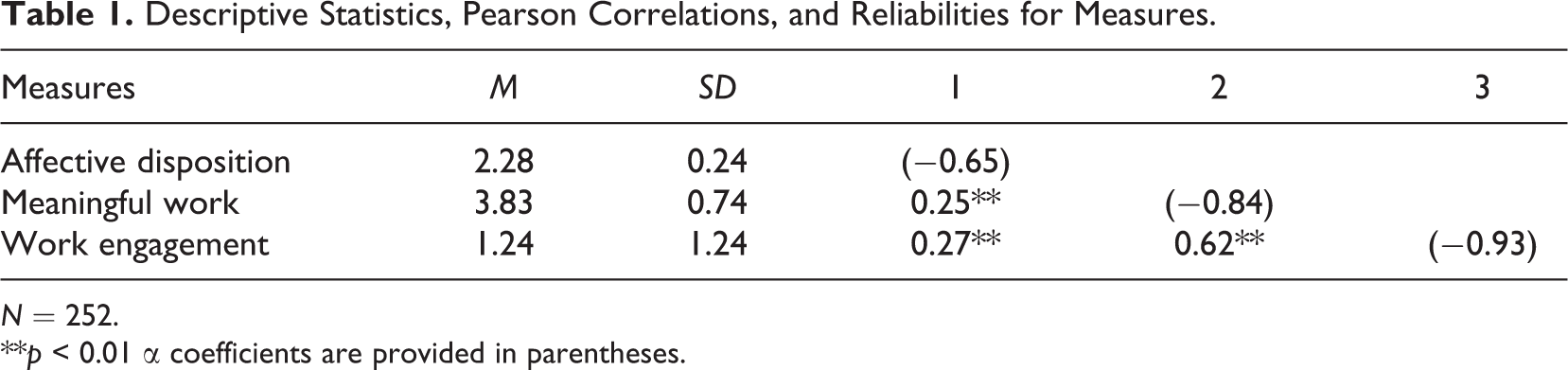
N = 252.
**p < 0.01 α coefficients are provided in parentheses.
Assessing the Moderating Effects of Meaningful Work
Consistent with the guidelines suggested by Baron and Kenny (1986) for examining moderating effects between continuous variables, hierarchical regression analyses were performed to examine the extent to which meaningful at work might moderate the influence of affective disposition on work engagement. With work engagement as the dependent variable, standardized NOSQ scores (predictor) were entered in the first step, followed by standardized WAMI scores (moderator) in the second step. To examine the possibility of a significant moderator effect, standardized NOSQ × WAMI scores were then entered in the third and final step. According to Baron and Kenny (1986), evidence of a moderator effect is present when the interaction term between the predictor and moderator is significant. Regression results for the moderation effect are presented in Table 2. Affective disposition accounted for 6% of the variance in the first step. In the second step, meaningful work accounted for a significant addition of 33% of the variance. In the third and final step, the affective disposition × meaningful work interaction accounted for a significant addition of 2%. The complete regression model accounted for 41% of the variance in work engagement, F(3, 245) = 56.24, p < .001). Step 3 of Table 2 shows that the interaction of affective disposition and meaningful work is significant (β = −.14, p < .01). In support of Hypothesis 3, meaningful work was found to significantly moderate the relationship between affective disposition and work engagement. Overall, these results indicate that meaningful work has a direct influence on work engagement beyond what can be accounted for by affective disposition, and also moderates the relation between affective disposition and work engagement.
Regression Results for the Moderation Effect.
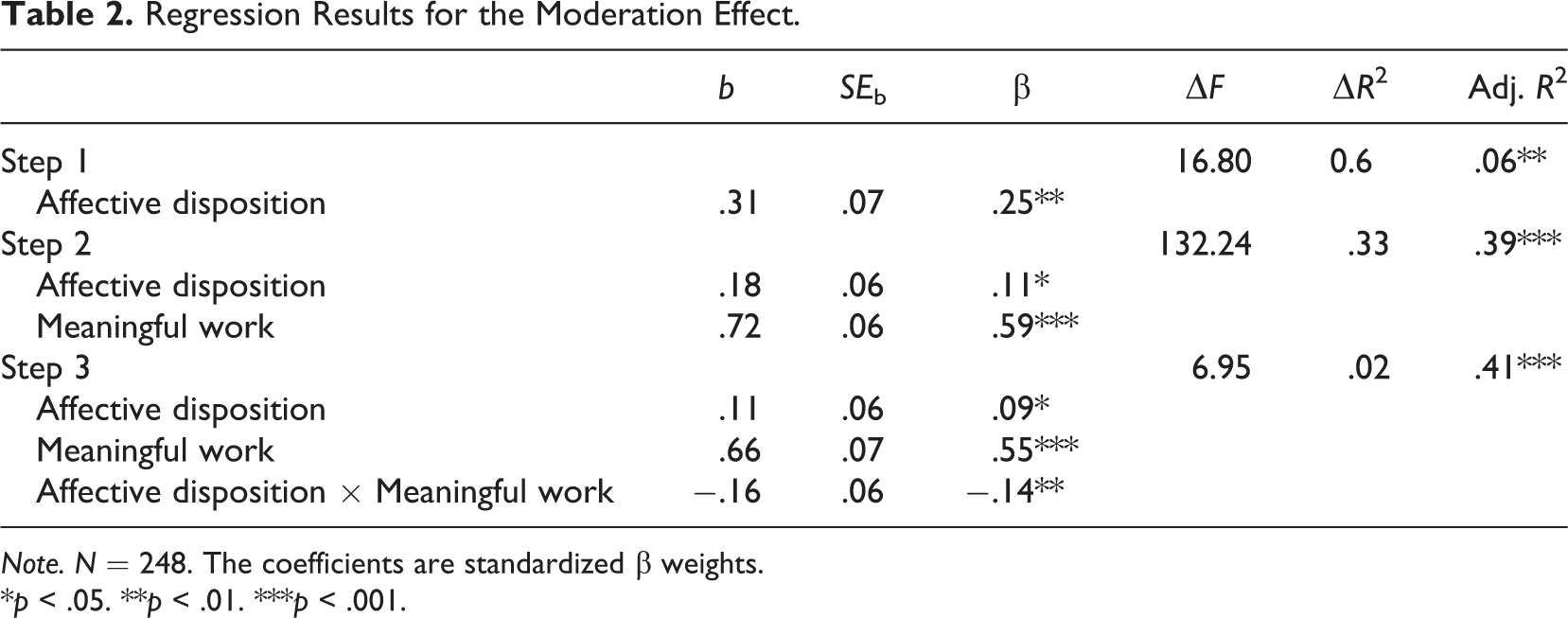
Note. N = 248. The coefficients are standardized β weights.
*p < .05. **p < .01. ***p < .001.
To examine the interaction effects that emerged, we plotted the simple slopes of the affective disposition–work engagement linkage at 1 SD below the mean and 1 SD above the mean of meaningful work (Aiken & West, 1991). We also tested whether each slope was statistically significant. As shown in Figure 1, the results matched the predicted pattern: The affective disposition–work engagement linkage exists in the low meaningful work condition (simple slope = .23, p < .01), but was not found to be significant in the high meaningful work condition (simple slope = −.05, p > .05). Thus, Hypothesis 3 was fully supported. Specifically, when work has low meaning—those employees with high affective disposition engaged much more than those with low affective disposition, but when the work has high meaning—there are no differences between the two groups.
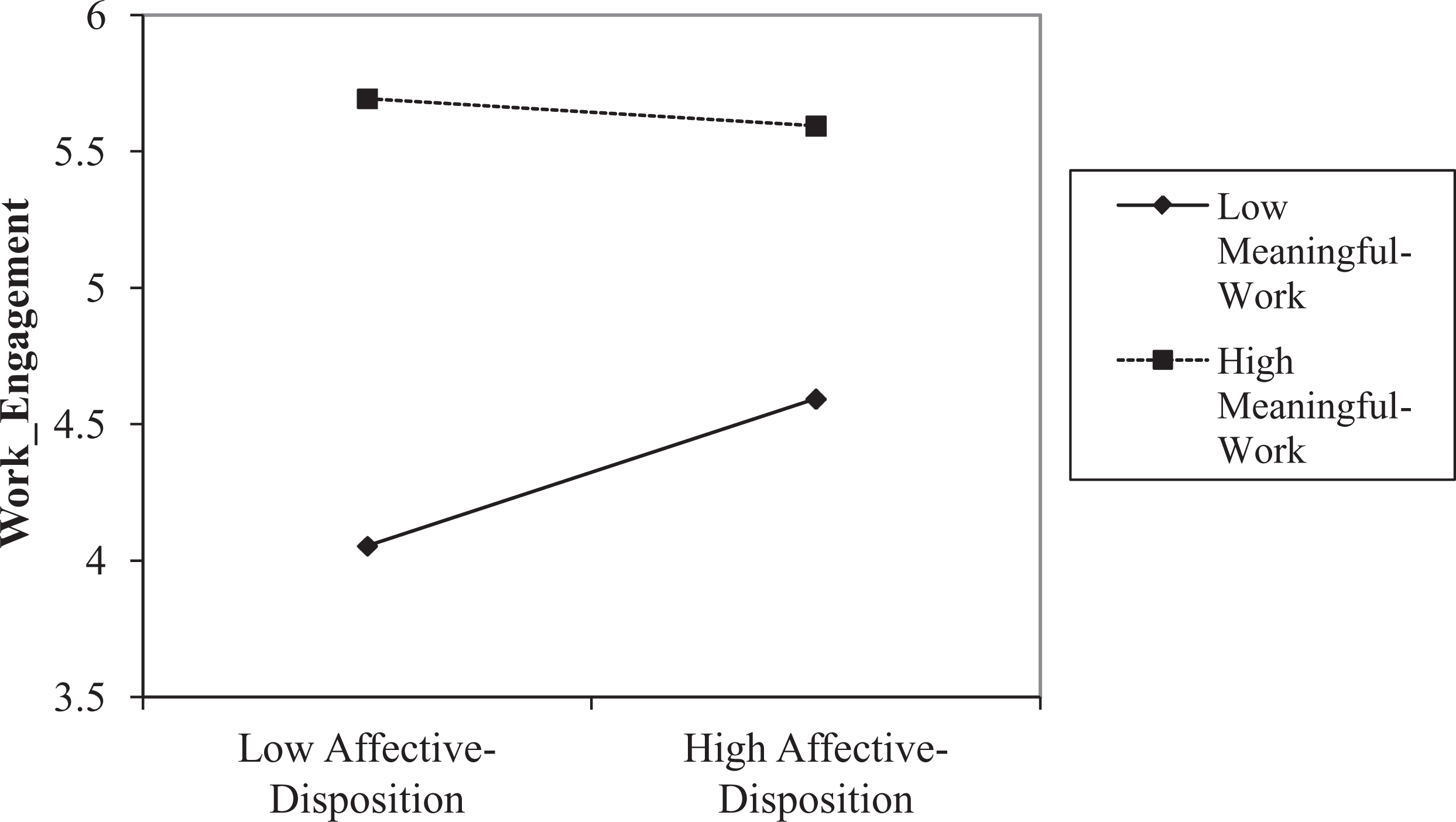
Simple slope for the interaction effect of affective disposition and meaningful work on work engagement.
Discussion
There is a lack in research on the influence of personality factors, and particularly affective disposition, on work engagement. In addition, although work engagement and meaningful work have been linked by previous theory and research, little is known about the nature of that relationship. Descriptions of work engagement include cognitive and motivational, as well as emotional terms, which led to the hypothesis that the presence of meaningful work would moderate the relationship between affective disposition and work engagement. We hypothesized that people who perceive their work as meaningful would engage in their work more, regardless of whether they have the kind of positive affective disposition that could stimulate an emotional source of work engagement. In contrast, we hypothesized that people who perceive less meaning in their work would be more reliant on their affective disposition for work engagement. Specifically, in the absence of meaningful work, people who have a high positive affective disposition would be more engaged compared to people who have low positive affective disposition. As predicted, results from this study showed significant, positive relationships between affective disposition and work engagement, and between meaningful work and work engagement. More importantly, meaningful work was found to moderate the relationship between affective disposition and work engagement in the manner that was hypothesized.
These findings offer some important theoretical implications for vocational and work psychology. The present results support and extend previous studies, which found an association between personality traits with work engagement (Kim et al., 2008; Langelaan et al., ; Shraga & Shirom, 2007). One important result of this research was establishing the linkage between affective disposition and work engagement. These results are consistent with other studies that showed that affective disposition is linked to positive work experiences (George, 1989; Staw, Bell, & Clausen, 1986). One explanation of this result may be based on the Broaden and Build theory of positive emotion (Fredrickson, 2001). According to this theory, certain positive emotions (e.g., joy, interest, contentment) have the capacity to broaden people’s repertoire of thoughts and actions, making it possible for them to recognize additional solutions to problems and opportunities for advancement and growth. Positive emotions therefore might facilitate people’s proactive and adaptive work behaviors, including the kinds of team-building and committed action that are associated with meaningful work. From this perspective, we can speculate that employees who are high in affective disposition may have extended mental, social, and pragmatic resources, and thereby feel more engrossed in their work (Blustein, 2008).
A second implication regards the positive expression of affective disposition in one’s daily work. Employees high in affective disposition may be experienced as more pleasant and kind in interpersonal relationships, and thus avoid work conflicts. As a result, employees can invest more efforts and resources into work and therefore will be more engaged. This result may be related to research findings on organizational commitment, an outcome that is closely related to work engagement (Hallberg & Schaufeli, 2006). In this context, Leiter and Maslach (1988) suggested that supportive contact with coworkers may enhance commitment to an organization. People with positive affective dispositions may enhance their own work engagement—and that of others—through helping create positive working relationships.
This study adds additional support to previous scholarship emphasizing the link between meaningful work and work engagement (e.g., May et al., 2004; Olivier & Rothmann, 2007; Towers Perrin, 2003; Stringer & Boverie, 2007). Because of the consistent link between these two variables, organizations interested in a more energized, fulfilled, and engaged workforce should recognize the meaning and emotional aspects of work (Cartwright & Holmes, 2006). This result also lends some credence to Peters’ (1994) suggestion that people need meaning in their lives and will sacrifice a great deal to institutions that will provide them with this meaning.
The findings in this study also offer some practical implications for organizations. By understanding the antecedents of work engagement, organizations can work toward creating an environment that will nurture increased engagement. In addition, it may be possible to implement the research results in the personnel selection area. For example, organizations should recognize the importance of affective disposition as a predictor of engagement at work, which in turn may be essential to both employee and organizational health (Schaufeli & Salanova, 2007). It may even be possible for organizations to use the concept of affective disposition as an employment selection criterion.
Our results suggest that meaningful work is likely a stronger predictor of work engagement than affective disposition. People who felt their work was meaningful were more engaged, regardless of affective disposition. Yet, among people who found little meaning in their work, those who generally experience more positive affect were more likely to be engaged than those who typically experience negative affect. The confirmation of a moderating role for meaningful work in the relationship between affective disposition and work engagement suggest, however, that there is probably no “one-size-fits-all” answer to increasing work engagement. One implication of the moderating effect we found is that strategies for enhancing engagement might find different targets depending on an employee’s affective disposition. Among positive workers, it may be that both fostering meaningful work and allowing the expression of their innate positive disposition may enhance engagement. Among workers with a negative disposition, meaningful work appears to be closely related to engagement, suggesting that focusing on meaningful work may be a profitable route for engagement. Meaningful work may have a special compensation value for those with low affective disposition, behind the high value that it has for all employees.
The importance of work engagement increases in this current era of economic crisis, instability, and occupational insecurity (Baruch & Hind, 1999). Focusing on the predictors of work engagement may lessen the pain that is experienced by employees and help them overcome this period in a positive and productive way. Given the importance of meaningful work, organizations should increase their awareness of its impact on mental health in general, and on work engagement in particular. Meaningful work should also be considered a potential target for selection procedures, using tools like the WAMI and other measures of meaningful work, particularly within organizations that value engagement. Employers are also encouraged to provide appropriate conditions that enhance employees’ sense of meaningfulness in their work as well as their intrinsic motivation. This might entail clearly defining employees’ roles and responsibilities, demonstrating how employee effort is integral to the organization’s functions, helping employees align their personal values to the organization’s mission, treating workers with respect and providing them autonomy, and fostering opportunities for workers to serve some wider community or social benefit through their work.
Limitations and Suggestions for Future Research
Interpretations drawn from this study should be tempered by its limitations. One limitation derives from the use of single time-point, self-report measures. Because of this study design, we are not able to assess whether employees appear engaged at work to other observers, nor whether their ratings of affective disposition carry through to influence their positivity or negativity at work. We are also not able to provide insight into the direction of effects existing among affective disposition, meaningful work, and work engagement. Future research would benefit from obtaining observer reports of engagement and workplace behaviors, as well as longitudinal designs that allow greater insight into whether engagement leads to meaningful work, to opposite path, or more dynamic, reciprocal influences over time. Although the cultural context of the present research is a strength in many ways, it is true that the measurement of meaningful work differed from how it can be measured in American samples. Meaningful work in Israel seems best understood in terms of the meaning and purpose that are experienced directly from work, without the benefits of work to making meaning in the rest of one’s life and a desire to benefit a greater good that were found to be part of the construct in American samples (Steger et al., 2012). This leaves open the possibility that the meaning of meaningful work might be culture specific, limiting the generalizability of this research. It is encouraging that the most fundamental aspect of meaningful work—my work is meaningful—is shared by American and Israeli cultures, but further research is needed to examine meaningful work in other cultural contexts. Finally, the reliability of the affective disposition measure fell short of typical standards in the present study, perhaps due to cultural differences. Better measurement of affective disposition is recommended for future research.
The current research makes a significant contribution to understanding the theoretical framework of the concept ‘work engagement’ by examining its relationships with its antecedents that express both personality and motivational factors. The present study adds to a contemporary stream of research on this topic by showing that one’s disposition to experience positive affect and a sense that one’s work is meaningful is linked to engagement in the workplace. Characteristically positive people are more likely to be engaged in their work, as are those who find their work to be meaningful. Moreover, an interaction between affective disposition and meaningful work adds to the explanation of work engagement and emphasizes the importance of meaningful work, particularly for people who are not innately disposed to experience positive affect. In essence, meaningful work may provide an important route to engagement, and may compensate for people’s tendencies to feel negative affect.
Footnotes
Authors’ Note
This research is based on a master’s dissertation prepared by the third author, under the supervision of the second author.
Declaration of Conflicting Interests
The author(s) declared no potential conflicts of interest with respect to the research, authorship, and/or publication of this article.
Funding
The author(s) received no financial support for the research, authorship, and/or publication of this article.