







Abstract
This longitudinal study investigated ambivalence during and after the decision in favor of a field of study or apprenticeship in 220 German high school graduates. In addition, participants underwent measurements of career decision-making self-efficacy, neuroticism, conscientiousness, current satisfaction with life as well as satisfaction with the chosen training. On average, we found low to moderate levels of ambivalence during and after career decision making. Analyses showed that ambivalence in career decision making is negatively linked to both current satisfaction with life and satisfaction with the chosen training. Furthermore, the finding of significant predictors of ambivalence during and after career decision making revealed a useful basic approach for further career-choice research as well as suggestions for the development of prevention and intervention programs for ambivalent persons.
Introduction and Theoretical Background
The decision in favor of a career is an important developmental task in adolescence (Havighurst, 1974). In late adolescence, the exploration of career identity begins, and a vocational prospect is specified and implemented (Super, 1992). Thus, late adolescence is the most appropriate time slot for career decision making and, therefore, the time when the decision for a career is actually made. In Germany, after high school graduation, students have two different postsecondary options: studying a certain major in a university setting or registering for an apprenticeship wherein certain vocational skills can be learned. Therefore, the present study focused on young people who had just finished high school and currently faced the decision of choosing between university education and professional training (in the following the term training is used for both career paths).
Making the decision in favor of a career is a challenging developmental task (Havighurst, 1974) because many different aspects have to be considered. For instance, Holland (1996) supposed that the choice of an appropriate vocation, that is a vocation in which a person is successful and satisfied, requires the fitting of interests, abilities, and vocational demands. Evaluating whether this vocational “fit” is appropriate for an individual is a complex and demanding task. Within the career-choice literature, many different models describing this complex and demanding process of career decision making have been discussed. One such model is the Six-phase Model of the Career Decision-making Process by Hirschi and Laege (2007), which distinguishes six phases from becoming concerned about career decision making to being firmly decided and committed to a choice.
Given the complexity and importance of the task of career decision making, uncertainties in the process of career decision making can be expected (Heine & Quast, 2009). One form of uncertainty and indecision is ambivalence. In general, ambivalence is defined as the incidence of contradictory thoughts, feelings, and intentions (e.g., Bleuler, 1979; Swindell, 2010) concerning meaningful, identity creating aspects of life (Luescher & Lettke, 2000). Regarding intentions, ambivalence is regarded as an approach–avoidance conflict (Boekaerts, 1999). Ambivalence indicates that the meaning and consequences of the decisional options are clear to a large extent, but nevertheless, the person is unable to make a decision. Ambivalence can be distinguished from other forms of uncertainty, such as ambiguity that emerges when the meaning of a situation is vague, and decisional options are still unknown (Boss, 1999). For example, the individual may not yet know which career opportunities would be, in principle, available. Similarly, indecision may result when the individual cannot decide between available alternatives because of conflicting consequences or intentions (= ambivalence) or when he or she has not yet searched for available alternatives (= ambiguity).
The present study focused on ambivalence related to career decision making. Ambivalence during and after career decision making is defined as the incidence of contradictory thoughts, feelings, and intentions during (predecisional ambivalence) and after (postdecisional ambivalence) choosing a postsecondary education path. In the first phase of decision making, several options are compared (Ajzen & Fishbein, 1980; Heckhausen & Gollwitzer, 1987). During this phase, ambivalence is likely to occur when available options seem to have similar consequences, or when career options are very difficult to compare (e.g., a secure job vs. an exciting and diversified job). Here, ambivalence indicates that the individual is not (yet) ready to make a clear decision (Sincoff, 1990), and ambivalence may decline when the individual collects additional information or changes his or her perceptions about the pros and cons of available alternatives (Swindell, 2010). Remaining or becoming ambivalent after the decision has been made (postdecisional ambivalence) may inhibit putting the decision into practice and indicates a need to revise the previous decision (Sincoff, 1990).
In fact, many young people do not persist in their chosen postsecondary training. For example, Heublein, Schmelzer, and Sommer (2008) reported that 55,000 of the 260,000 German students who first matriculated in 2001 left university without a degree. As the German state subsidizes the financing of university tuition, the completion of a university degree is an individual as well as a societal concern. In 2007, the average governmental investment in a German university place was €8,400 per student (Buschle & Haensel, 2010). For effective governmental financing of young people’s vocational careers, an important societal task is the investigation of factors that are relevant for a successful career choice.
Until now, career-choice research has mainly focused on career indecision and on career indecisiveness in general (cf. Germeijs, Verschueren, & Soenens, 2006; Savickas & Jarjoura, 1991). Career indecision is defined as an inability to make a career decision (e.g., Leong & Chervinko, 1996) or as difficulties people face when making a vocational decision (e.g., Chartrand, Rose, Elliott, Marmarosh, & Caldwell, 1993). Career indecision may emerge when an individual has tried to make a decision but is torn between available alternatives after exploring them, which is characteristic for the experience of ambivalence. However, career indecision is also observed in persons who are undecided due to a lack of exploration.
Reconsideration has recently been introduced into research on career identity and refers to reexamining current commitments, the comparison of alternative commitments, and the willingness to participate in a broad exploration of career options (Porfeli, Lee, Vondracek, & Weigold, 2011). Reconsideration refers to general doubts about finding a satisfactory career; however, in contrast to ambivalence, it neither includes the intensive swaying back and forth between possible alternatives nor associated contradictory feelings.
Correlates of Decisional Ambivalence
In introducing a new concept into a field of research, an important aspect is the investigation of correlates. Finding relevant correlates is also of practical importance, because knowledge about correlates can serve as a starting point for prevention and intervention. As decisional ambivalence has not yet been investigated in the context of career decision making, we had to refer to research on ambivalence in decision making in other contexts and to draw analogies from research on career indecision in general.
According to cognitive consistency theories, the experience of inconsistency is an uncomfortable state (e.g., Zajonc, 1960). Given that ambivalence is hardly compatible with high levels of subjective well-being, it can be assumed that greater ambivalence goes along with lower satisfaction levels. Concerning this matter, Pinquart, Stotzka, and Silbereisen (2008) found that ambivalence during and after the decision concerning parenthood is associated with lower levels of life satisfaction as well as poorer mental health. Furthermore, Rottinghaus, Jenkins, and Jantzer (2009) reported that undecided college students showed more depressive symptoms than decided students.
Postdecisional ambivalence is likely to show stronger negative associations with life satisfaction than predecisional ambivalence because it is associated with more costs. For example, if students finally decide to drop out from university they would have to wait for the next application period for another field of study or an apprenticeship, and may not know whether their application will be successful.
It also seems plausible that ambivalence in career decision making and satisfaction with the chosen training are meaningfully correlated. A similar relationship has been found between career indecision and satisfaction with a chosen training (Nauta, 2007).
An often investigated construct within the field of career decision making is career decision-making self-efficacy (CDMSE). It is defined as an individual’s belief that he or she can successfully complete the tasks necessary to make career decisions (Betz, Klein, & Taylor, 1996). Lower CDMSE is linked to career indecision (Choi et al., 2012; Wang, Jome, Haase, & Bruch, 2006). A similar relation may be found between CDMSE and ambivalence in career decision making because high self-efficacy indicates that the individual has better decision-making skills that help with making clear decisions (Bandura, 1997). In addition, Nauta (2007) reported a significant positive correlation between academic CDMSE and satisfaction with the chosen academic major.
Based on previous research findings, the personality constructs of neuroticism and conscientiousness may also be associated with ambivalence in career decision making. In this matter, Pinquart, Stotzka, and Silbereisen (2009) found that neuroticism and ambivalence in the decision whether or not to form an intimate relationship are positively linked. Concerning the relationship between personality constructs and career indecision, Page, Bruch, and Haase (2008) showed a positive association between neuroticism and career indecision and a negative relationship between conscientiousness and career indecision. Similar correlation patterns may be expected for ambivalence in career decision making.
Research Questions and Hypotheses
The first aim of our study was to collect information about the prevalence of ambivalence during and after career decision making (Research Questions 1a and 1b). Second, we focused on correlates of ambivalence in career decision making. As CDMSE (e.g., Choi et al., 2012; Wang et al., 2006) as well as low conscientiousness and high neuroticism (Page, Bruch, & Haase, 2008) were reported to be linked to higher levels of career indecision, we expected ambivalence to be negatively linked to CDMSE (Hypothesis 1a) and conscientiousness (Hypothesis 1b), as well as positively linked to neuroticism (Hypothesis 1c).
Based on available cross-sectional associations of career indecision (Nauta, 2007) and ambivalence in parenthood decisions (Pinquart, Stotzka, & Silbereisen, 2008) with life satisfaction, we assumed that higher levels of ambivalence during and after career decision making would be associated with less satisfaction with the chosen training (Hypotheses 2a and 2b) and with lower life satisfaction in general (Hypotheses 3a and 3b).
We also expected that predecisional and postdecisional ambivalence would be correlated (Hypothesis 3c). First, indecisive individuals may show less confidence in their final choice (Rassin, 2007). For example, van Matre and Cooper (1984) described a group of indecisive clients who made a career decision. Due to their indecisiveness, they tended to experience ambivalence regarding their choice which led to a state of career indecision again. Dispositional personality variables, such as neuroticism, may contribute to the correlation of predecisional and postdecisional ambivalence. Second, situational aspects may also promote an association between predecisional and postdecisional ambivalence. For example, when an individual has difficulties with choosing between two similarly attractive alternatives he or she may be more likely to call the later decision into question if decisional consequences are less positive than expected (Nauta, 2007). When no other attractive alternatives were available and the decision was easily made, individuals will be more likely to believe that they made, in principle, the right decision even if not all expected positive consequences came true. Assuming that pre and postdecisional ambivalence are correlated, we also expected that the relationship between ambivalence during career decision making and satisfaction with the chosen training at the second time of measurement is mediated by ambivalence after career decision making (Hypothesis 3d). This hypothesis was based on the suggestion that predecisional ambivalence has long-term consequences on psychological well-being if the individual later questions whether he or she made the right decision. If an individual overcomes predecisional ambivalence, makes a decision, and believes that his or her decision was the right one, then predecisional ambivalence will probably not affect satisfaction with the chosen training. In this case, predecisional ambivalence would indicate a time-limited problem with decision making, for example, based on the fact that the individual had not yet finished the search for relevant information about the pros and cons of available alternatives, and has, therefore, not yet made a convincing decision.
Method
Design and Sample
We used a longitudinal design with two points of measurement to investigate ambivalence during and after career decision making. The first point of measurement was prior to application for training and the second point of measurement occurred 6 months later (after the beginning of postsecondary education). Participants were high school graduates who were recruited from 33 high schools across Germany and via the Internet platform “studiVz.” Those interested in participating could send their e-mail addresses to the investigators. At both points of measurement, a link to the online questionnaire was sent to the participants via e-mail. At the first point of measurement, 164 women (74.5%) and 56 men participated. Their mean age was 19.18 (standard deviation [SD] = 1.20) years. Of these 220 graduates, 175 also took part in the follow-up (74.9% female). The attrition rate at the second point of measurement was 20.5%. There were no significant differences in relevant variables between those who participated only at the first point of measurement and those who participated at both points of measurement (e.g., no significant difference in the experience of predecisional ambivalence, two-sided test, t(218) = −.61, p = .55.
At the second point of measurement, 121 of the 175 participants had begun training. Of the 121 participants, 108 (89.3%) went to university and 13 (10.7%) had started professional training outside university.
Instruments
For reasons of consistency, simplicity, and manageability, a 5-point Likert-type response format (1 = applies not at all and 5 = applies very strongly) was used throughout the measurement.
Ambivalence in Career Decision Making
At the first point of measurement, ambivalence during career decision making was measured with a modification of a scale measuring ambivalence in decisions concerning partnership and parenthood (Pinquart et al., 2008). The scale consisted of 4 items assessing the ambivalence experienced in relation to career-choice acquisition. In the present study, the internal consistency was α = .84. At the second point of measurement, ambivalence after career decision making was measured using the modified scale with 4 items, this time assessing the experienced ambivalence regarding the chosen training. In the present study, the internal consistency of this scale was α = .88. The wording of the items is presented in Appendices A and B.
CDMSE
The short form of the CDMSE scale (Betz et al., 1996) was used at the first point of measurement to assess an individual’s degree of belief that he or she can successfully complete the tasks necessary to make career decisions. The scale consists of 25 Likert-type items (1 = no confidence at all and 5 = complete confidence). In support of the validity of the questionnaire, meaningful correlations have been found with scores for career maturity questionnaires, locus of control, exploratory behavior, career decision-making difficulties, and the individual’s career decision-making status (for overview, see DeBruijn & Bernard-Phera, 2002). In the present study, Cronbach’s α was .89.
Neuroticism and Conscientiousness
The short version of the Big Five Inventory (Rammstedt & John, 2005) with 21 items was used at the first point of measurement to assess neuroticism and conscientiousness. Rammstedt and John (2005) reported findings showing factorial validity as well as convergence of self-reports with partner ratings and with other instruments assessing the Big Five personality factors. In the present study, Cronbach’s α was .75 (neuroticism) and .72 (conscientiousness).
Satisfaction With the Chosen Training
The Academic Major Satisfaction scale by Nauta (2007), which consists of 6 items, was used at the second point of measurement. Because the original scale only measures the satisfaction with the chosen academic major we extended the formulation to the chosen professional training. A sample item was “Overall, I am happy with the major/professional training I’ve chosen.” In support of the predictive validity of the scale, Nauta (2007) found that the measure distinguished between students who remained in their majors versus those who changed majors during 1- and 2-year periods. In the present study, the internal consistency of the scale was Cronbach’s α = .92.
Current Satisfaction With Life
The Current Satisfaction with Life scale of the Fragebogen zur temporalen Lebenszufriedenheit (Trautwein, 2004) was used to assess the participants’ current satisfaction with life at both points of measurement. Trautwein (2004) summarized results on the factorial, convergent, and discriminant validity, such as strong positive correlations with other assessments of current life satisfaction. In the present study, the internal consistency of the 4-item scale was Cronbach’s α = .84 at the first and .85 at the second point of measurement.
Additional Items
Additionally, the sociodemographic variables gender and age were assessed at the first point of measurement and the decisional status of the participants was assessed at both points of measurement.
Results
Prevalence of Ambivalence in Career Decision Making (Research Questions 1a and 1b)
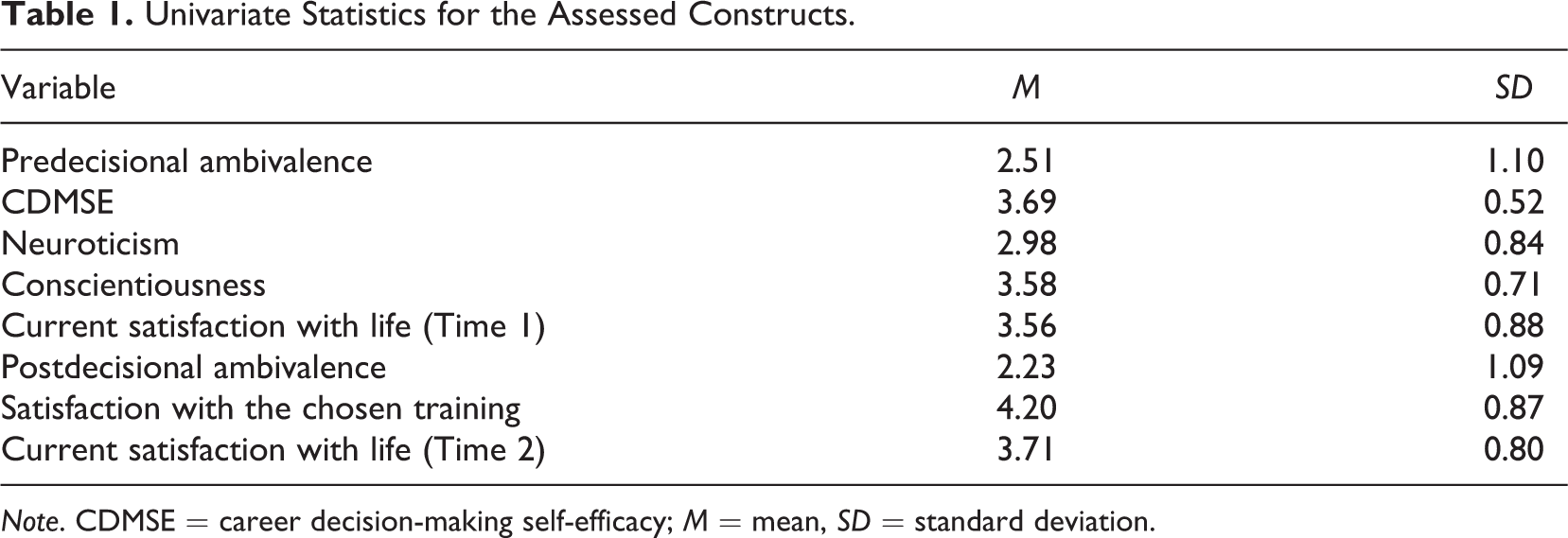
At the first point of measurement (before applying for a postsecondary education path), we observed low to moderate levels of predecisional ambivalence (M = 2.51, SD = 1.10; Table 1 presents the univariate statistics for all constructs). Nevertheless, 30.5% of the participants stated that their levels of predecisional ambivalence were higher than the scale mean of 3.
Univariate Statistics for the Assessed Constructs.
Note. CDMSE = career decision-making self-efficacy; M = mean, SD = standard deviation.
For the 121 participants of the second assessment who had already begun their training, the mean postdecisional ambivalence score was M = 2.23 (SD = 1.09), indicating rather low levels of ambivalence. However, 19% of the respondents had a postdecisional ambivalence score above the scale mean; 12.4% of the participants showed scores of pre- and postdecisional ambivalence above the scale mean. In addition, 35.5% of the respondents showed higher postdecisional than predecisional ambivalence, while the reverse was found in 47.9% of the respondents. The mean predecisional ambivalence was significantly higher than the mean postdecisional ambivalence, one-sided test, t(120) = 1.84, p = .04.
Correlates of Ambivalence (Hypotheses 1a–1h)
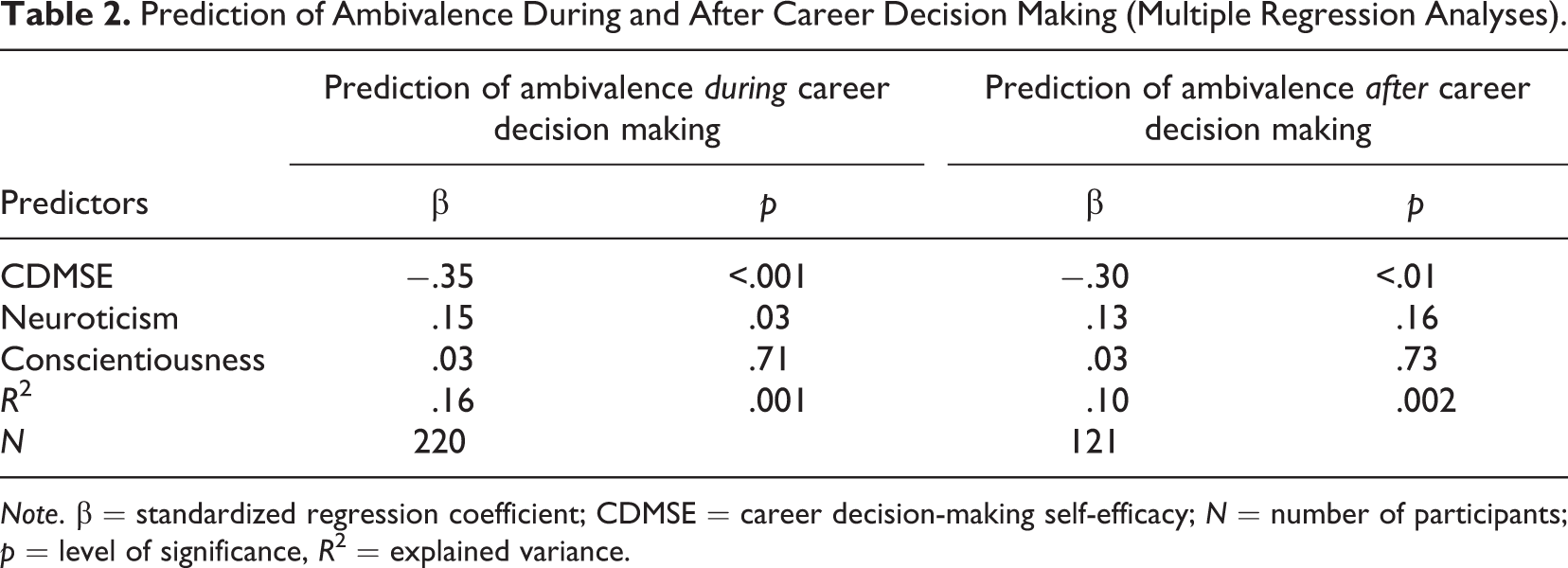
We computed multiple linear regression analyses to examine correlates of pre- and postdecisional ambivalence and to identify variables that provide an incremental contribution in the prediction of ambivalence during and after career decision making (Table 2). The assessed predictors explained 15.6% of the variance of ambivalence during career decision making. Both CDMSE and neuroticism were significant predictors of predecisional ambivalence. In addition, the assessed variables explained 9.9% of the variance of ambivalence after career decision making. Only CDMSE was significantly predictive of postdecisional ambivalence.
Prediction of Ambivalence During and After Career Decision Making (Multiple Regression Analyses).
Note. β = standardized regression coefficient; CDMSE = career decision-making self-efficacy; N = number of participants; p = level of significance, R 2 = explained variance.
Ambivalence in Career Decision Making and Satisfaction (Hypotheses 2a and 2b and Hypotheses 3a–3d)
Spearman’s correlational coefficients showed that both ambivalence during career decision making (rs = −.34, p < .001, N = 121) and postdecisional ambivalence (rs = −.76, p < .001, N = 121) were significantly negatively linked to satisfaction with the chosen training. The hypothesis that the relationship between predecisional ambivalence and satisfaction with the chosen training is mediated by postdecisional ambivalence, presupposes that pre- and postdecisional ambivalence are correlated. Indeed, we found a significant positive correlation between pre- and postdecisional ambivalence (rs = .49, p < .001, N = 121; see Figure 1). Structural equation modeling (LISREL 8.7) showed that the direct path between predecisional ambivalence and satisfaction with the chosen training was no longer significant when controlling for postdecisional ambivalence (β = .03, ns). The significance of the indirect effect was tested using the Sobel (1982) test. This test indicated that postdecisional ambivalence mediated the relationship between predecisional ambivalence and satisfaction with the chosen training (t = 5.34, p < .001).
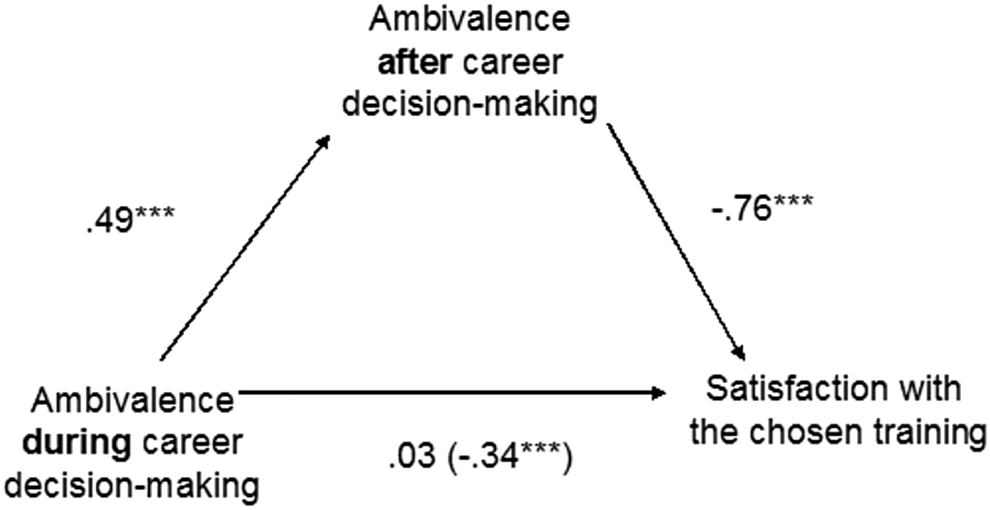
Path diagram of mediation analysis.
Furthermore, statistically significant concurrent correlations were observed between life satisfaction and ambivalence during career decision making (rs = −.15, p = .02, N = 220) as well as ambivalence after career decision making (rs = −.53, p < .001, N = 121). The magnitude of the correlation between ambivalence after career decision making and current life satisfaction was higher than the magnitude of the correlation between ambivalence during career decision making and current life satisfaction (z = −3.85, p < .001).
Discussion
The present study found, on average, low to moderate levels of ambivalence during and after career decision making. Ambivalence was related to CDMSE and neuroticism. In addition, higher ambivalence was related to lower levels of general life satisfaction and satisfaction with the chosen training in particular. Furthermore, the effect of predecisional ambivalence on satisfaction with the chosen training at the second point of measurement was mediated through postdecisional ambivalence.
Prevalence of Ambivalence During and After Career Decision Making
The mean scores of pre- and postdecisional ambivalence as well as the numbers of individuals with scores above the scale mean at both points of measurement (12%) indicate that some individuals experience pre- and/or postdecisional ambivalence although the majority experience neither high levels of predecisional nor high levels of postdecisional ambivalence. The results suggest that, in line with the Rubikon Model of decision making (Heckhausen & Gollwitzer, 1987), predecisional ambivalence is more widespread than postdecisional ambivalence. Similar patterns have been observed regarding pre- and postdecisional ambivalence in decisions concerning partnership and parenthood (Pinquart et al., 2008).
Correlates of Ambivalence During and After Career Decision Making
The considered variables explained a relevant portion of the variance in ambivalence during career decision making. Significant unique predictors of predecisional ambivalence were CDMSE and neuroticism.
The positive relationship between predecisional ambivalence and neuroticism initially observed in decision making about close relationships (Pinquart et al., 2008) was replicated in our study. However, in contrast to previous findings concerning career indecision (Page et al., 2008), we did not find a significant association between conscientiousness and predecisional ambivalence. Even though conscientiousness might be helpful in finding relevant information, it is of no use if a person is torn between equally attractive alternatives.
Similar to previous findings concerning career indecision (Choi et al., 2012), we found that lower CDMSE was associated with higher levels of predecisional and postdecisional ambivalence. If an individual is more convinced that he or she can successfully complete the tasks necessary to make career decisions, he or she actually experiences less ambivalence after career decision making. CDMSE may be a proxy for better decision-making skills that help with avoiding or overcoming ambivalence. In fact, individuals with higher decision-making self-efficacy are more likely to report that they are very systematic when making important career decisions (Mau, 2000). The association of CDMSE with postdecisional ambivalence probably indicates that individuals with high CDMSE are more likely to make informed decisions that they may not regret. In addition, self-efficacy is associated with persistence in the face of obstacles or disconfirming experiences (Bandura, 1997), and previous research found that high CDMSE is associated with a stronger career-choice commitment (Wang et al., 2006).
As only one of the assessed variables at the first point of measurement was related to postdecisional ambivalence, it can be assumed that postdecisional ambivalence is primarily linked to aspects specific to the chosen training (e.g., when the reality does not match one’s initial expectations), which were not investigated in this study. Hence, future research concerning postdecisional ambivalence in career decision making should focus on these aspects.
Ambivalence in Career Decision Making and Satisfaction
Bivariate correlations showed that both predecisional and postdecisional ambivalence are associated with lower levels of satisfaction with the chosen training. These results suggest that the experience of ambivalence during career decision making may impede the making of a satisfying decision. However, the mediator analysis showed that predecisional ambivalence is only related to satisfaction with the chosen training if ambivalence remains after the decision has been made.
The very strong association between postdecisional ambivalence and satisfaction with one’s chosen training is an important finding. This association is probably based on the fact that postdecisional ambivalence reflects a good deal of regret regarding one’s career choice. Nauta (2007) suggested that indecisiveness would lead to greater dissatisfaction with the chosen major because individuals regret having chosen one major over others that were equally appealing. In addition, Ueichi, Kuriyama, Saito, and Kusumi (2012) showed that career-related regrets are negatively associated with career satisfaction.
Our results also showed that ambivalence both during and after career decision making are negatively linked to current satisfaction with life in general. This suggests that in line with cognitive consistency theories (e.g., Zajonc, 1960), the experience of ambivalence is not compatible with a high level of satisfaction with life. In addition, postdecisional ambivalence showed a stronger concurrent relationship with life satisfaction than predecisional ambivalence. This indicates that postdecisional ambivalence is more difficult to cope with. Our findings are in line with the assumption that ambivalence during career decision making is not unusual. Since a person still has the opportunity to make a successful decision, it is understandable that predecisional ambivalence is often not very stressful and that, therefore, the association between ambivalence during career decision making and current satisfaction with life is not very strong. In contrast, after career decision making, an individual has already made a career choice and cannot overcome his or her ambivalence by making a better decision without considerable costs (e.g., loss of stipend, uncertainty about gaining an alternative university place, or apprenticeship). Accordingly, there is a strong concurrent correlation between postdecisional ambivalence and satisfaction with life. Thus, it is important to develop effective measures aimed at preventing or reducing postdecisional ambivalence.
The Relevance of Ambivalence for Decision-Related Interventions
Our study showed that in many cases ambivalence is a transitional state and that the related individuals may not need help overcome it. However, 12.4% of the participants reported moderate to high levels of pre and postdecisional ambivalence, as indicated by scores above the scale mean. It seems reasonable that individuals who feel uncomfortable in the process of decision making, who cannot overcome their ambivalence and may even be unable to make a decision (e.g., who miss the application deadline for a training program), and those who feel ambivalent about their past decision may need support.
In the career-choice literature, several interventions for undecided persons are discussed that mainly focus on the provision of information about relevant career options (cf. Kelly & Shin, 2009). While this approach seems to be appropriate for individuals who have not yet explored available alternatives in depth, it may not always be sufficient for individuals who have already explored alternatives and who are torn between equally attractive alternatives.
The present study provides starting points for prevention and intervention procedures with regard to ambivalence during and after career decisions. For example, effective prevention and intervention procedures should increase a person’s CDMSE by strengthening the belief that he or she can successfully complete the tasks necessary to make career decisions. Measures focused on reducing neuroticism may also be useful but related interventions have not yet been systematically developed and evaluated (Lahey, 2009). Interventions aimed at gathering additional information and promoting systematic comparison between available alternatives (e.g., Kelly & Shin, 2009) may also help reduce pre- and postdecisional ambivalence.
Limitations and Suggestions for Future Research
The fact that we used a longitudinal design to investigate ambivalence during and after career decision making can be regarded as strength of the present study. Nevertheless, several limitations of the present study should be mentioned.
First, we focused only on a 6-month interval. Future studies should extend the period of investigation and analyze, for instance, the relationship between ambivalence in career decision making and the persistence in a chosen training path.
Second, the results of this study apply mainly to high school graduates who pursued a university education. In order to take part in our study, the participants had to become active themselves and send an e-mail to the investigators. Thus, the observed mean level of ambivalence might have been somewhat underestimated because people who were very ambivalent may have felt too uncomfortable to participate. Hence, future research should include, for example, entire classes. Furthermore, two of the measurements used (CDMSE, satisfaction with chosen training) have only been validated outside Germany. Nonetheless, the internal consistencies of these measurements were acceptable and similar to the original scales. Finally, we did not assess career identity reconsideration because the Vocational Identity Status Assessment (Porfeli et al., 2011) had not yet been published at the time of our data collection.
Despite these limitations, we believe the present study provides support for the view that ambivalence in career decision making is an important and unique construct that should be considered in future career decision-making research. In addition, this study provides suggestions about relevant starting points for prevention and intervention procedures aimed at chronically and highly ambivalent persons. Based on our findings on ambivalence in career decision making, further research is recommended on decisional ambivalence and its short- and long-term correlates.
Footnotes
Appendix A
Appendix B
Authors’ Note
This article was based on the diploma thesis of Anne Lena Ernst and Daria Kasperzack, under the direction of Martin Pinquart.
Declaration of Conflicting Interests
The author(s) declared no potential conflicts of interest with respect to the research, authorship, and/or publication of this article.
Funding
The author(s) received no financial support for the research, authorship, and/or publication of this article.