







Abstract
As the importance of social justice advocacy is increasingly emphasized in vocational psychology, it is imperative for researchers to explore the development of individuals’ interest in and commitment to social justice work. With a diverse sample of 298 undergraduate students, this study sought to replicate findings from Miller et al. which supported the use of social cognitive career theory in predicting social justice interest and commitment from social justice self-efficacy and outcome expectations. In addition, person inputs related to a focus on others were examined as predictors of social justice variables. Specifically, we explored whether collectivistic values and a calling orientation toward work predicted social justice outcomes. Results demonstrated replicability of Miller et al.’s model. Additionally, collectivism and sense of calling were each found to directly and indirectly predict social justice variables. Findings indicate that extent to which individuals endorse collectivism and a sense of calling may be useful in predicting how committed they are to social justice work.
Since the early work of Frank Parsons, the field of vocational psychology has been rooted in promoting social justice and ameliorating injustices (Hartung & Blustein, 2002), and it could be argued that the field is presently undergoing a revival of social justice theory and research (Fouad, Gerstein, & Toporek, 2006 ). To continue the upswing of research in this area, it is important to not only study the vocational experiences of populations in need of social justice advocacy but also examine what predicts individuals being committed to promoting social justice in their work and lives. On the one hand, research exploring psychological correlates of injustice has flourished (e.g., Fischer & Holz, 2007; Lin & Israel, 2012; Szymanski & Stewart, 2010; Wei, Wang, Heppner, & Du, 2012), but on the other models of advocacy behavior are fewer and more recent and have yet to attain solid empirical support. Likewise, although there is a substantial amount of literature regarding the need for systemic change, there is a dearth of work investigating individual-level factors that might be important in implementing such change (Zalaquett, Foley, Tillotson, Dinsmore, & Hoff, 2008).
One of the few models explaining the development of social justice commitment (Miller et al., 2009; Miller & Sendrowitz, 2011) applies a well-supported theory of career development, social cognitive career theory (SCCT; Lent, Brown, & Hackett, 1994), to social justice advocacy and has found the model to be useful in predicting commitment in this domain. Akin to numerous other extensions of SCCT in the career domain attempting to identify person inputs (e.g., Byars-Winston, Estrada, Howard, Davis, & Zalapa, 2010; Conklin, Dahling, & Garcia, 2013; Wright, Perrone-McGovern, Boo, & White, 2014), the aim of this study is to build on Miller and colleagues’ findings pertaining to social justice by examining additional, theoretically based person inputs to the core social cognitive constructs. Specifically, we seek to (1) replicate Miller et al.’s findings in a college student population, providing additional empirical support for the model and (2) examine whether endorsing collectivist values and viewing one’s career as a calling predict SCCT constructs.
Social Justice Within SCCT
Over the last three decades, SCCT (Brown & Lent, 1996; Lent et al., 1994) has dominated the career development literature. Rooted in Bandura’s (1986) social cognitive theory, SCCT examines cognitive variables and how they interact with an individual’s environment to facilitate or hinder one’s ability to make career-related decisions as well as achieve success within those domains. Specifically, SCCT focuses on the relations between self-efficacy, interest, outcome expectations, and commitment as well as contextual variables in career decision making (Lent et al., 1994). The foundational concept of SCCT is that individuals will develop interests in domains in which they feel a sense of self-efficacy and can expect positive outcomes. Thus, individuals will gravitate toward, and develop a liking for, activities in which they feel they will do well and will lead to positive outcomes for themselves, their families, or their communities. Developed interests in activities in which individuals feel efficacious and expect positive outcomes in turn lead to goals related to these activities. Beyond these core variables, SCCT includes contextual supports and barriers as well as person inputs as critical predictors of career outcomes (Lent & Brown, 2013; Lent, Brown, & Hackett, 2000).
Although empirical studies applying SCCT principles to social justice advocacy are few, the existing research does point to utility of the model in this area. For example, Feather, Woodyatt, and McKee (2012) found that willingness to support an organization aimed at empowering marginalized Indigenous Australians was predicted by positive outcome expectations of doing so. Likewise, Chung and Probert (2011) found that in a sample of African American young adults, positive outcome expectations for the community were related to greater likelihood of volunteering and positive outcome expectations for the individual were related to greater likelihood of intention to engage in political activism.
Miller et al. (2009) tested a model with SCCT variables specific to the social justice domain with a sample of 274 undergraduate students. Results showed that, consistent with previous findings, (Lent et al., 2001; Lent, Lopez, Lopez, & Sheu, 2008), social justice self-efficacy and outcome expectations each had a direct effect on social justice interest. Social justice self-efficacy also had an indirect effect on social justice interest as mediated by outcome expectations. Additionally, social justice self-efficacy and interest directly predicted commitment to social justice advocacy. The final model accounted for 56% of the variance in social justice interest and 70% of the variance in commitment to social justice advocacy, demonstrating the utility of SCCT in this domain. Miller and Sendrowitz (2011) found further support for the theory as it applies to social justice in a sample of counseling psychology doctoral trainees.
In the current study, we seek to replicate these findings and hypothesize that social justice self-efficacy will have a direct, positive effect on social justice outcome expectations, social justice interest, and social justice commitment (Hypothesis 1); outcome expectations will have a direct, positive effect on social justice interest (Hypothesis 2); and social justice interest will have a direct, positive effect on social justice commitment (Hypothesis 3). Additionally, we predict that outcome expectations will mediate the relation between social justice self-efficacy and social justice interest (Hypothesis 4), and social justice interest will mediate the link from self-efficacy and outcome expectations to social justice commitment (Hypothesis 5).
A Focus on Others and Social Justice
The importance of person inputs within SCCT has been outlined theoretically (Lent & Brown, 2013) and demonstrated empirically across domains (Badri, Mohaidat, Ferrandino, & El Mourad, 2013; Byars-Winston et al., 2010; Conklin et al., 2013; Lent, Paixo, Silva, & Leitao, 2010; Thompson & Dahling, 2012; Wright et al., 2014). In the present study, we propose two variables that may serve as person inputs to social justice self-efficacy, outcomes expectations, interest, and goals. We suspect that the degree to which an individual is oriented toward others in general and at work may be important explanatory variables. Specifically, we propose that the extent to which an individual endorses collectivistic values and views his or her career as a calling may directly and indirectly predict social justice self-efficacy, outcome expectations, interest, and commitment. Because of the global nature of calling orientation and collectivistic values as opposed to the domain-specific nature of SCCT variables, we position these other-oriented variables as predictors.
Collectivism
Collectivism is an orientation in which the self is experienced as a part of a larger group, as opposed to an individual apart from others. This orientation is accompanied by broad values such as group harmony, interpersonal relationships, and duty (Brewer & Chen, 2007; Hsu, 1981; Oyserman, Coon, & Kemmelmeier, 2002; Oyserman & Lee, 2008; Triandis, 2001; Waterman, 1984). Emphasis on the group in a collectivist framework influences people’s goals, motivations, and social behaviors (Singelis, Triandis, Bhawuk, & Gelfand, 1995). Collectivism was traditionally conceptualized as a culture-level variable, but in the last 20 years, scholars have been examining collectivistic values on a person-level scale (e.g., Bierbrauer, Meyer, & Wolfradt, 1994; Sharma, 2010; Singelis et al., 1995). From this perspective, the extent to which one endorses collectivistic values may vary from person to person within the larger society. Therefore, even within a predominately individualistic culture, collectivism levels will vary on the individual level. Thus, in the current study, we conceptualize collectivism as a person input and examine it at the individual-difference level.
Although the relation between collectivism and social justice values has not been directly examined, several past studies have demonstrated a link between collectivism and prosocial values. Specifically, collectivism has been found to positively predict altruism (Finkelstein, 2010; Yablo & Field, 2007 ), helping behavior (Armenta, Knight, Carlo, & Jacobson, 2011; Yablo & Field, 2007), and organizational citizenship behavior (Leon & Finkelstein, 2011). In addition to predicting specific behaviors, researchers have found that collectivism predicts motivation behind behavior. For example, although individualists and collectivists are just as likely to engage in volunteerism, individualists are more likely to be motivated by career-related objectives whereas collectivists are more likely to be motivated by altruism and the desire to strengthen social ties (Finkelstein, 2010). Additionally, in a study of organizational citizenship behavior, collectivism positively predicted prosocial motives and organizational concern, whereas greater individualism predicted greater impression management motives and negatively predicted role identity as one who helps others (Leon & Finkelstein, 2011).
The literature suggests that concern for helping others and contributing to a greater good beyond the self is more pronounced in collectivist context than individualist contexts. Based on these findings, it is likely that people with higher individual-level collectivism have more past experiences with activities related to social justice advocacy and may be more likely to feel efficacious in social justice work and perceive it as having positive outcomes. Thus, we hypothesize that people who endorse higher individual-level collectivism will be more likely to report higher levels of social justice variables. Specifically, we predict direct effects of collectivism on self-efficacy, outcome expectations, interest, and commitment (Hypothesis 6). Additionally, we predict indirect effects of collectivism on interest through self-efficacy and outcome expectations (Hypothesis 7) and indirect effects of collectivism on commitment through self-efficacy and interest (Hypothesis 8).
Career calling
A calling is an orientation to work that is characterized by a transcendent internal or external summons to prosocial work that provides meaning and purpose to the individual (Duffy & Dik, 2013). Core to this definition of calling is the focus on work that is prosocial. Although there is debate among scholars as to the defining attributes of a calling, previous data have demonstrated that people who perceive a career calling overwhelmingly report that helping others as a core aspect of their calling (Duffy & Dik, 2013).
Inherent in social justice advocacy is prosocial behavior. Although an advocate may benefit themselves from their work, the majority of efforts go into systemic changes that will have a broad impact. Furthermore, the kinds of systemic change that many social justice advocates aspire to achieve may take many years, with individual advocates very likely never reaping the fruits of their labor. Because of the necessary prosocial aspect of both viewing work as a calling and social justice advocacy, we propose that these two variables may be linked. From a career development perspective, previous research has shown that prosocial motivations at work predict higher levels of career decision self-efficacy and optimism about one’s future career path (Duffy & Raque-Bogdan, 2010). Based on these data, and research from the prosocial work literature, we suspect that having a calling orientation to work, and in turn, a focus on others in work, may result in a greater likelihood of feeling efficacious in the social justice domain (Hypothesis 9) and more optimistic about the outcomes of their efforts (Hypothesis 10). Additionally, we hypothesize that efficacy and outcome expectations will explain the link of calling to interest in and commitment to social justice advocacy (Hypotheses 11 and 12).
Present Study
In the present study, we seek to replicate findings from Miller et al. (2009) and Miller and Sendrowitz (2011) and examine the additional variables of collectivism and having a calling as predictors of social cognitive constructs. Based on the inherent prosocial factor of having a calling and the empirical evidence showing that those endorsing higher levels of collectivism are more likely to engage in prosocial behavior, we hypothesize that these two variables will positively predict social justice self-efficacy, outcome expectations, interest, and commitment. Additionally, we will examine how each of these variables have indirect effects on interest and commitment via self-efficacy, outcome expectations, and interest. The model with the two additional person inputs (calling and collectivism) will be compared to Miller et al.’s (2009), Miller and Sendrowitz (2011) original, more parsimonious model to determine whether (a) adding in these new constructs adds new information to the model through significant relations and (b) how adding these new constructs, which increases model complexity and decreases parsimony, affects the overall fit of the model.
Method
Participants
The sample was comprised of 337 undergraduate students recruited from general psychology courses at a large southeastern university. Of these, 39 participant data points were discarded due to incomplete data, leaving 298 participants with complete data included in analyses. Of the remaining sample, 101 (34%) identified as male, 194 (63.7%) identified as female, and 3 (1%) did not specify a gender identity. The sample was predominately White (n = 197, 66.3%), followed by Hispanic (n = 47, 15.8%), Asian/Asian American (n = 30, 10.1%), African American (n = 26, 8.8%), Asian Indian (n = 9, 3.0%), Middle Eastern/Arab American (n = 4, 1.3%), Pacific Islander (n = 1, 9.0%), Native American (n = 2, >1.0%), and multiethnic (n = 8, 2.4%). Participants identified with the following social classes: lower class (n = 11, 3.7%), working class (n = 36, 12.1%), middle class (n = 135, 45.5%), upper middle class (n = 99, 33.4%), and upper class (n = 15, 5.1%). The mean age was 20 years. A diversity of majors was represented, ranging from biology to family, youth, and community sciences.
Procedure
After receiving approval from a university institutional review board, a questionnaire constructed on Qualtrics, an online survey generator, was administrated. Participants accessed the survey through SONA, an undergraduate research participant database within the university. Students were granted one course credit for participating in the study; three credits are required for students taking general psychology at the university and credits were granted by the researchers through the SONA website.
Instruments
Social justice variables
Social justice variables were measured with a set of scales developed by Miller et al. (2009). These scales included items that targeted social justice self-efficacy, outcome expectations, interest, and commitment. In previous studies, positive relations between social justice self-efficacy and interests, outcome expectations, and commitment demonstrated criterion validity as these relations are present in established research on SCCT (Miller et al., 2009; Miller & Sendrowitz, 2011). Moreover, the authors performed a confirmatory factor analysis, which confirmed a four-factor model consistent with the existing theory.
The Social Justice Self-Efficacy scale consists of 20 items that ask participants to rate, on a scale of 0 (no confidence at all) to 9 (complete confidence), their confidence in their ability to engage in social justice advocacy at the intrapersonal, interpersonal, community, and institutional/political levels. Higher scores reflect higher levels of confidence in these areas. Example items include “How confident are you in your ability to examine your own worldview, biases, and prejudicial attitudes after witnessing or hearing about social injustice” and “How confident are you in your ability to address structural inequalities and barriers facing racial and ethnic minorities by becoming politically active (e.g., helping to create government policy).” Previous research has estimated an internal consistency reliability of .94–.95 (Miller et al., 2009; Miller & Sendrowitz, 2011) for the total scale and a range of .79–.92 for the subscales (Miller et al., 2009; Miller & Sendrowitz, 2011). The internal consistency reliability estimate for the present study was .96.
Miller et al.’s (2009) Social Justice Outcome Expectations scale measures the extent to which participants perceive likely positive outcomes as a result of engagement in social justice advocacy behavior. The scale consists of 10 items, representing 3 different domains: social, material, and self-evaluative outcome expectations. Participants are asked to rate, on a scale of 0 (strongly disagree) to 9 (strongly agree), the extent to which they agree with statements indicating likelihood of specific outcomes of social justice advocacy. Examples of items include “Engaging in social justice activities would likely allow me to fulfill a sense of personal obligation” and “Engaging in social justice activities would allow me to reduce the oppression of certain groups.” Higher scores reflect higher levels of positive outcomes associated with social justice advocacy. Previous research has estimated an internal consistency reliability ranging from .81 to .88 (Miller et al., 2009; Miller & Sendrowitz, 2011). The internal consistency reliability estimate for the present study was .96.
Miller et al.’s (2009) Social Justice Interests scale evaluates the extent to which an individual exhibits a liking for social justice advocacy activities. The measure consists of nine statements and participants are asked to rate, on a scale of 0 (low interest) to 9 (high interest), how interested they are in activities related to social justice. Higher scores indicate higher levels of interest in the given activities. Examples of items include “How much interest do you have in reading about social issues” and “How much interest do you have in watching television programs that cover social issues.” Previous estimates for internal consistency reliability range from .90 to .93 (Miller et al., 2009; Miller & Sendrowitz, 2011). The internal consistency reliability estimate for the present study was .88.
The Social Justice Commitment scale measures intention to engage in social justice advocacy in the future. The scale consists of 4 items, each of which present statements in which participants are asked to rate on a scale from 0 (strongly disagree) to 9 (strongly agree). Example items include “In the future, I intend to engage in social justice activities” and “I have a plan of action for ways I will remain or become involved in social justice activities over the next year.” Higher scores indicate higher levels of social justice commitment. In previous studies, the estimated internal consistency reliability ranged from .90 to .93 (Miller et al., 2009; Miller & Sendrowitz, 2011). The internal consistency reliability estimate for the present study was .94.
Collectivism
The extent to which individuals endorsed collectivist values was measured using the collectivism subscale of a 32-item instrument developed by Singelis, Triandis, Bhawuk, and Gelfand (1995). The scale is comprised of 16 items measuring individualism and 16 items measuring collectivism. Previous research has found each of these dimensions to be independent of each other, as opposed to opposite ends of a single spectrum. Thus, only collectivism was examined, using the 16 collectivism items. Items include statements which respondents are asked to rate, on a scale from 1 (strongly disagree) to 9 (strongly agree), how much they agree. In the development of the scale, internal consistency reliabilities for subscales ranged from .61 to .76 for each of the subscales, and initial validation demonstrated convergent and divergent validity of the scales with subscales consistently correlating with characteristics predicted by theory (e.g., Singelis et al., 1995 ; Triandis & Gelfand, 1998). The internal consistency reliability estimate for the collectivism subscale in current study was .90.
Calling
The degree to which participants felt called was assessed by the presence subscale of the Brief Calling Scale (Dik, Eldridge, Steger, & Duffy, 2012). Participants were presented with the following prompt: Some people, when describing their careers, talk about having a ‘calling.’ Broadly speaking, a ‘calling’ in the context of work refers to a person’s belief that she or he is called upon (by the needs of society, by a person’s own inner potential, by God, by Higher Power, etc.) to do a particular kind of work. Although at one time most people thought of a calling as relevant only for overtly religious careers, the concept is frequently understood today to apply to virtually any area of work.
Results
Preliminary Analyses
Prior to examining the primary hypotheses, several preliminary analyses were conducted. First, normality was assessed using skew and kurtosis values for each of the observed variables. All values for skew and kurtosis were between −1.0 and 1.0 indicating normality. As such, no transformations to data were made. Second, correlations between all variables in the model were calculated (see Table 1). All variables correlated in the expected directions. Additionally, we examined the data for any demographic characteristics that might impact the amount of power and privilege that individuals might hold in society. Previous scholarly work has indicated that an individual’s place in the hierarchical structure might impact their orientation to social justice values (Levin, Federico, Sidanius, & Rabinowitz, 2002). In order to control for the effect of the amount of power an individual may hold in the societal hierarchy, we assessed for moderating effects of variables that might indicate privilege: ethnicity, social class, and gender. No moderating effects in the relation of social structure values and social justice variables were found. Finally, we assessed sample means for in-person inputs, calling and collectivism (µ = 6.4 and µ = 6.6, respectively). This indicated that participants scored slightly above the scale midpoints for both the calling (µ = 6) and collectivism (µ = 5) instruments.
Descriptive Statistics and Correlations.
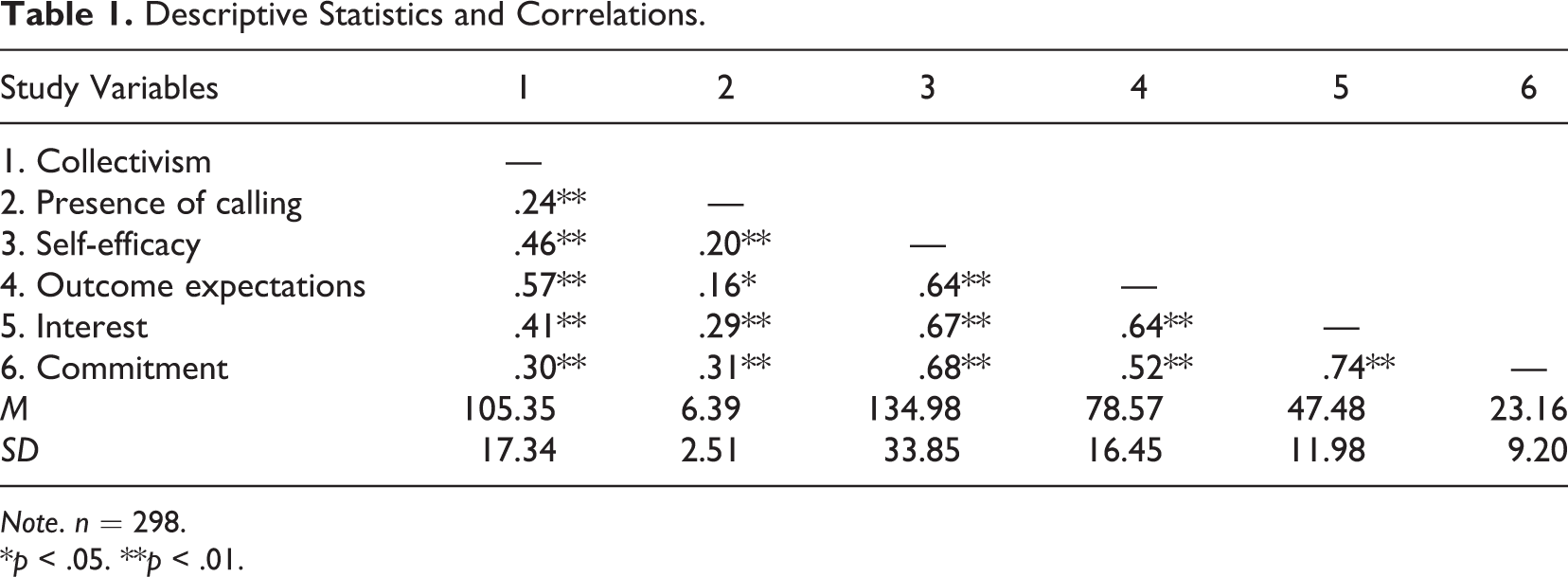
Note. n = 298.
*p < .05. **p < .01.
Structural Equation Modeling (SEM)
SEM was used to assess the fit of the hypothesized models to the data. Following Anderson and Gerbing’s (1988) two-step procedure for SEM, we assessed measurement and structural models. Using observed indicators for each latent variable, models were constructed using AMOS 22.0. Model fit was assessed using χ2, comparative fit index (CFI), and root mean square error of approximation (RMSEA). Although good fit is indicated by an insignificant χ2, this index is unreliable, since it is almost always significant in large samples (Duffy, Allan, Autin, & Douglass, 2014; Tabachnick & Fidell, 2007). As such, CFI and RMSEA were the primary fit indices. CFI compares the proposed model to a null model in which study variables are unrelated. CFI values close to or greater than .95 indicate good fit (Duffy et al., 2014; Hu & Bentler, 1999). The RMSEA assesses how well the proposed model would fit the population covariance matrices if the best parameter estimates were available and is sensitive to model complexity. Values equal to or less than .06 indicate good fit (Hu & Bentler, 1999), values from .06 to .08 are considered fair fit, and values greater than .10 are considered poor fit (Browne & Cudeck, 1993). Bootstrapping techniques with 1,000 bootstrapped samples of the data at a 95% confidence interval were used to determine all indirect effects (Preacher, Rucker, & Hayes, 2007). According to Shrout and Bolger (2002), if the confidence intervals for the mediation models do not include zero, the mediations are statistically significant at p < .05.
Miller et al.’s (2009) model
Before testing the model including collectivism and calling, we tested the replicability of Miller et al.’s (2009) model in the current sample. Following common practice in SEM analysis (see Little, Cunningham, Shahar, & Widaman, 2002), item parcels were created for measures with more than 5 items. Items from social justice self-efficacy and outcome expectations, which contain theory-driven subscales, were parceled by subscale domain. Items representing social justice self-efficacy were divided into 4-item parcels based on domain; social justice outcome expectations items were divided into three parcels based on domain: two containing 2 items and one containing 6 items. Items representing social justice interest were parceled using a procedure suggested by Weston and Gore (2006) in which items were sorted using exploratory factor analysis and assigned to parcels in countervailing order according to magnitude of factor loadings. This allows for approximately equal factor loadings for each parcel. Following this procedure resulted in three parcels, each containing 3 items. Social justice commitment was not parceled, as it only contained 4 items and as such these items were used as indicators. Factors were loaded onto their respective observed indicators to determine the dimensionality of the latent constructs. The measurement model was found to be an adequate fit to the data: χ2(71) = 256.18, p < .001; CFI = .95; and RMSEA = .09, p < .001; 90% RMSEA CI [.08, .10], and all items/parcels loaded on their hypothesized factor at values of .80 or higher. In the structural model, all hypothesized paths were confirmed (see Figure 1). The structural model was found to be an adequate fit to the data: χ2(71) = 256.18, p < .001; CFI = .95; and RMSEA = .09, p < .001; 90% RMSEA CI [.08, .10], and the model accounted for 72.7% of the variance in social justice commitment.
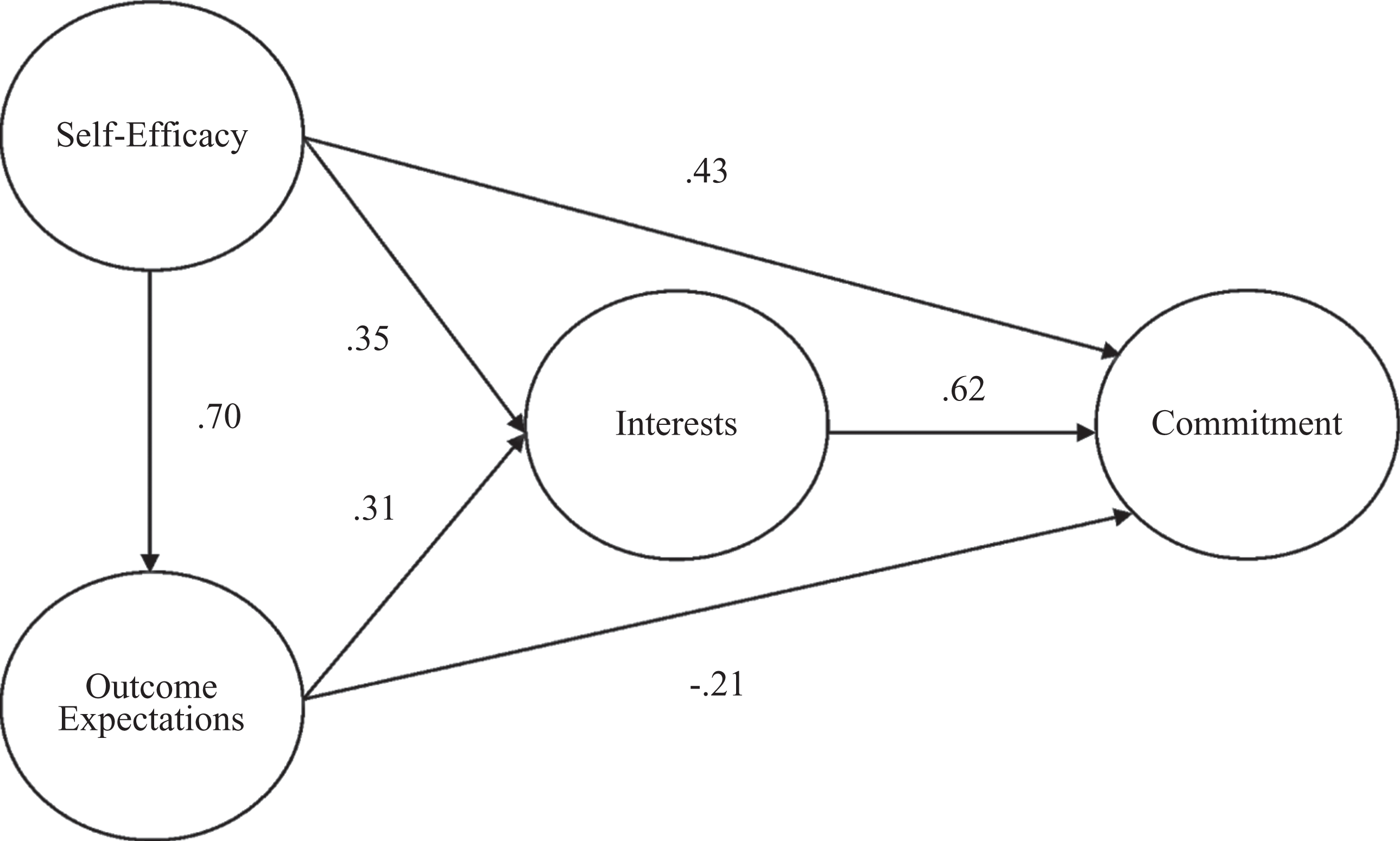
Structural model based on Miller et al. (2009). All paths are significant at p < .05.
Model including focus on others
Next, we added calling and collectivism to the original model predicting social justice interest and commitment. For the measurement model, the same parcels for social justice variables in Miller et al’s (2009) model were used. For collectivism, four parcels with 4 items each were created based on subscales. Presence of calling only consisted of 2 items, so no parcels were created and these items were used as indicators. Initial results indicated that the hypothesized measurement model demonstrated adequate fit to the data: χ2(174) = 402.75, p < .001; CFI = .94; and RMSEA = .08, p < .001; 90% RMSEA CI [.07, .09], and all items/parcels loaded on their hypothesized factor at values of .60 or higher. The structural model consisted of the same hypothesized paths as the Miller et al. (2009) model, with collectivism and calling added as direct predictors of social justice self-efficacy, outcome expectations, and commitment (see Figure 2). This model was an adequate fit to the data: χ2(174) = 402.75, p < .001; CFI = .94; and RMSEA = .08, p < .001; 90% RMSEA CI [.07, .09], and accounted for 72.7% of the variance in social justice commitment.
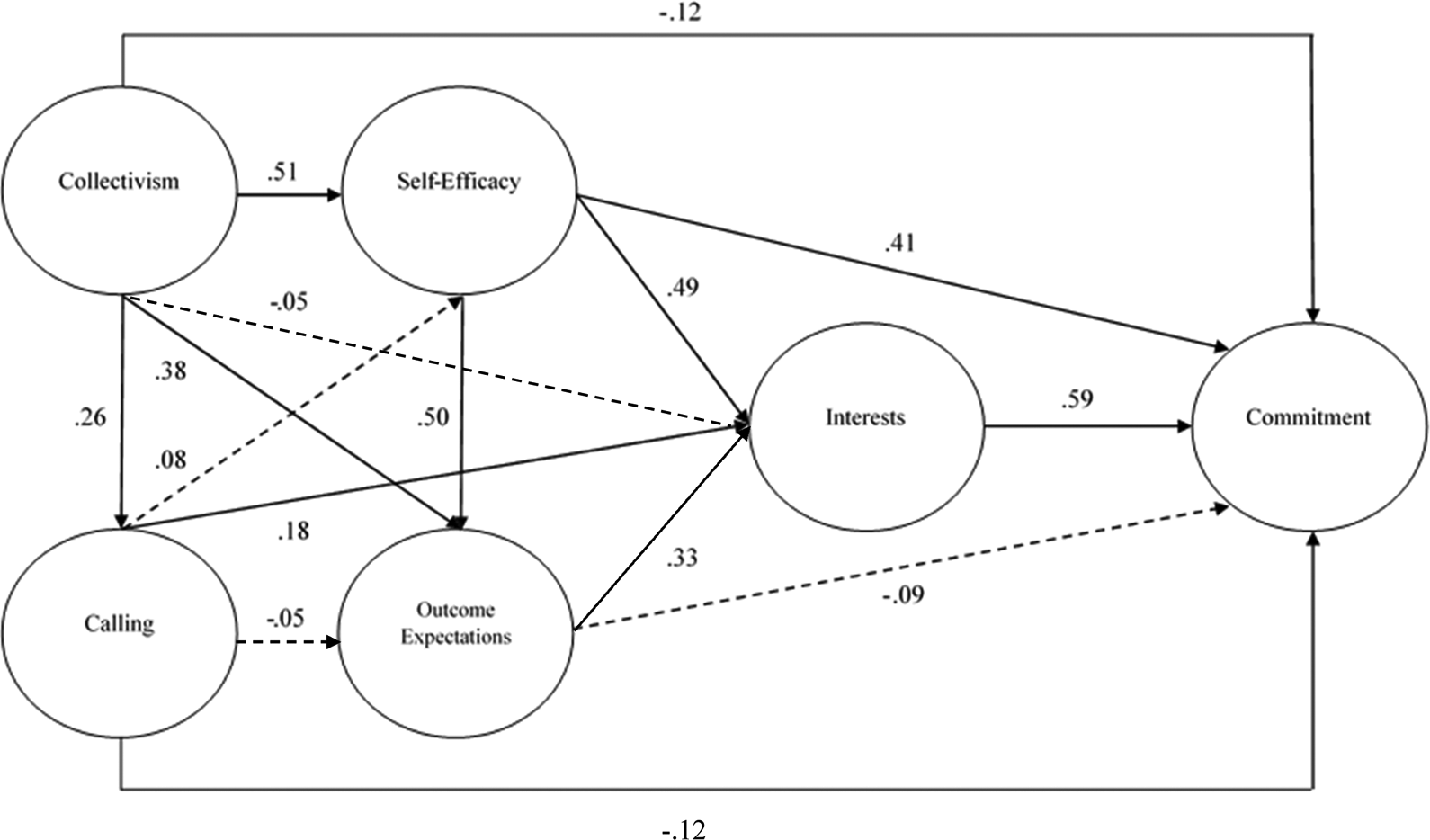
Structural model including calling and collectivism as predictors. Dashed lines indicate nonsignificant findings p > .05.
Indirect effects
We first tested the hypothesized indirect effects of the core Miller et al. (2009) model variables and found the following to be significant: self-efficacy to interest as mediated by outcome expectations (CI [.05, .12], SE = .02), self-efficacy to commitment as mediated by interest (CI [.08, .13], SE = .01), and outcome expectations to commitment as mediated by interest (CI [.23, .33], SE = .03).
In the model including collectivism and calling, we tested all potential indirect paths between the predictor variables and the social justice commitment. Of those, the following were significant: collectivism to outcome expectations as mediated by self-efficacy (CI [.13, .30], SE = .04); collectivism to interest as mediated by calling (CI [<.01, .04], SE = .01), self-efficacy (CI [.08, .20], SE = .03), and outcome expectations (CI [.07, .21], SE = .03); and collectivism to commitment as mediated by calling (CI [<.01, .03], SE = <.01) and self-efficacy (CI [.05, .13], SE = .02). Regarding calling, the only significant indirect path was to commitment, as mediated by interest (CI [.25, .80], SE = .13).
Discussion
The current study had two major aims: (1) to replicate findings of Miller et al. (2009) that validated the use of a social cognitive model to predict social justice interest and commitment in college students and (2) to extend the model by including variables related to a focus on others, specifically collectivism and calling, as person inputs. Results indicated that the Miller et al. (2009) model was, indeed, a good fit to the data from this sample with analogous path estimates. This supports previous studies that have found the social cognitive model to be an appropriate model for predicting interest in and commitment to social justice advocacy.
In addition to replicating previous research, we proposed an extended model with the added variables of calling and collectivism. These variables provided new information on predictors of social justice commitment without sacrificing model fit. As predicted, there were direct, moderate, positive relations from collectivism to social justice self-efficacy, outcome expectations, and interest. Thus, results seem to suggest that the more one views the self as part of a larger group, the more one will feel able to engage in social justice advocacy and the more one will expect positive outcomes of from advocacy work. Above and beyond this effect, the more one tends toward collectivism, the more they enjoy activities related to advocacy. This model is consistent with previous work, suggesting that people who endorse collectivistic values are more likely to engage in altruistic behavior (Armenta et al., 2011; Finkelstein, 2010; Yablo & Field, 2007) and to be motivated by the prospect of helping others as opposed to benefiting themselves (Finkelstein, 2010; Leon & Finkelstein, 2011).
Additionally, calling was found to directly predict social justice interest and commitment above and beyond the variance accounted for by collectivism, self-efficacy, and outcome expectations. Although these relations were small, it suggests that there are aspects of having a calling that may uniquely contribute to an interest in and commitment to advocacy work. Perhaps the transcendent quality and personal meaning inherent in a calling create a desire to engage in advocacy work regardless of one’s confidence in their ability to do the work or expectations of outcomes. This is consistent with previous work showing that people who feel called are often determined to do their work, despite negative consequences that may come from pursuing their calling (Bunderson & Thompson, 2009).
Hypotheses regarding indirect effects were also partially supported. Self-efficacy mediated the link from collectivism to both interest and commitment. Additionally, self-efficacy was mediated by outcome expectations in its relation to interest and interest mediated the link from outcome expectations and self-efficacy to commitment. Consistent with the extant work on SCCT (Lent et al., 1994, 2001, 2008; Miller et al., 2009; Miller & Sendrowitz, 2011), this finding indicates that cultivating self-efficacy and outcome expectations might be an essential part in developing interest in and commitment to social justice. Furthermore, results suggest that a collectivistic orientation might play an important distal role in this process of development. Specifically, as a direct, moderate predictor of self-efficacy and outcome expectations, increased collectivism could potentially be an important pathway to increased efficacy and positive expectations regarding advocacy.
Although future research is needed to fully understand underlying mechanisms driving direct and indirect relations in the model, we can speculate as to why they occur. It may be that because collectivists are more focused on a larger group external to themselves, they are more oriented toward helping others as well as more familiar and comfortable with following altruistic motivations. This may, in turn, result in greater confidence related to the helping aspect of social justice advocacy. Similarly, it may be that because of previous experience with other-oriented, altruistic behavior, collectivistic people have more positive expectations regarding outcomes of engaging in advocacy work. Both self-efficacy and outcome expectations are likely increased because of positive past experiences and familiarity with the other focus that is so salient in advocacy work.
Finally, collectivism accounted for a modest amount of variance in the perception of a calling. This indicates potential overlap between factors present in collectivism and factors present in the experience of a calling. This finding is supported conceptually by the fact that focus on others is imperative to both constructs; a calling is defined by its prosocial aspect (Duffy & Dik, 2013) and collectivism is defined by valuing the well-being of the group over the well-being of the individual (Brewer & Chen, 2007; Hsu, 1981; Oyserman et al., 2002; Oyserman & Lee, 2008; Triandis, 2001; Waterman, 1984). Individuals with a collectivistic worldview may be more likely to develop a calling, in turn predicting increased interest in social justice activities.
Practical Implications
Results from this study may have implications for those working to promote social justice and increase advocacy on college campuses. Results suggest that social justice advocacy, self-efficacy and outcome expectations, and, in turn, interest and commitment are predicted by a focus on others to work and life. Current and previous findings (Miller et al., 2009) suggest that self-efficacy and outcome expectations are strong predictors in interest in and commitment to social justice. It seems, then, that increasing these two predictor variables may be a pathway to increasing overall commitment to advocacy. Results from the current study add to this finding by showing that a focus on others predicts social justice interest and commitment indirectly through self-efficacy and outcome expectations. Furthermore, a focus on others directly predicts all four social justice variables. Thus, it may be beneficial to target a focus on others when considering interventions to increase total commitment to social justice advocacy.
Given that our sample consisted of college students, our participants were highly educated and, thus, relatively privileged. Increasing social justice commitment in this group may be particularly important, as it is essential for any social justice movement to have allies supporting it (Broido & Reason, 2005; Edwards, 2006; Reason & Broido, 2005). Current findings suggest that targeting values that are demonstrated in a collectivistic worldview might be a potential avenue for increasing efficacy, interest, and commitment with regard to social justice advocacy in an undergraduate student population. This may include working with individuals in experiencing themselves as part of a larger group. Previous scholars have pointed to the importance of raising collective consciousness and creating an environment of shared engagement. This may be achieved on college campuses by providing an environment in which dominant group members and minority group members can interact in a way that encourages dialogue and allows students to learn from each other. Examples of strategies universities have used to work toward this include service learning experiences (Baldwin, Buchanon, & Rusdisill, 2007; Enfield & Collins, 2008; Moely, McFarland, Miron, Mercer, & Ilustre, 2002), social justice-oriented course work (Bell & Griffin, 2007; Reason & Broido, 2005), and interactive workshops (Reason & Broido, 2005).
Results also suggest that students who feel called are more likely to be interested in and committed to advocacy. Thus, cultivating calling among college students might be an additional pathway to encouraging social justice activity. University counselors may be in an ideal position to help students develop a sense of calling. It is important for counselors to remember that a calling can theoretically be experienced in any field (Duffy & Dik, 2013). Thus, counselors should consider a calling as applicable to a broad range of majors and future careers (Dik, Duffy, & Steger, 2012). Given the focus on others in social justice work, it may be particularly helpful for university counselors to emphasize the prosocial aspect of calling when working with students.
Finally, counselors might utilize findings in the assessment of clients seeking career counseling. Given the emphasis in career counseling of incorporating values into career decision making, it may be beneficial to incorporate clients’ relative collectivistic values into their career development. Particularly for individuals who endorse high levels of collectivist values, it may be particularly important for their work to involve an advocacy component.
Limitations and Future Directions
Results from the current study need to be considered in light of several limitations. First, the data collected for this study were cross sectional, limiting the extent to which conclusions can be drawn regarding causality and development over time. We suspect that collectivism and calling are best positioned as a predictor variables, but results from this study cannot speak to the direction of the model paths. Thus, we must use caution in interpretation of results. In the future, longitudinal research might be employed to examine how interest in, and commitment to, social justice advocacy change over time as well as to confirm the causal paths in the confirmed model.
Second, this study did not account for potential differences that might arise from variation in the amount of power, privilege, and status an individual may have. Previous research has indicated that people who are more privileged within a society are more likely to endorse attitudes of social dominance (Levin et al., 2002). Although we tested for moderation effects of power on social justice variables, the sample was mostly White, middle to upper middle class, and highly educated. Since this sample was highly privileged, effects of power and privilege may not have been detectable. Future research might further examine how one’s privilege and status in society can moderate the relations found in the current study. This should include diversifying the sample to include a greater number of individuals with minority identities.
Third, this study examined individual-level collectivist values in a predominately individualist nation. Thus, we do not know how the extent to which collectivism is endorsed on a societal level may moderate relations between variables. Future studies in this domain might focus on the role of collectivism at the societal level, ideally through cross-national comparisons. Given the current result that person-level collectivism positively predicts self-efficacy and outcome expectations related to social justice, it may be that collectivism at the societal level enhances these effects. It may also be useful to examine constructs such as collective self-efficacy (Bandura, 1982) and their potential role as moderators in the relations between person-level variables. With the true mean of the collectivism scale being a 5, our sample scored relatively high (µ = 6.6), suggesting that the population of university students may be more likely to endorse collectivistic values. Without future research, however, it is unclear what impact this may have had on model paths.
Finally, although results from the study suggest that collectivism and calling both significantly predict social justice commitment, the question of which specific components of these variables explains this relation remains. Future studies might focus on teasing apart which factors contribute most to social justice outcomes.
Conclusion
In summary, the aim of the current study was to extend previous literature suggesting a predictive link between social justice self-efficacy, outcome expectations, interest, and commitment. In particular, two person input variables, collectivism and calling, were added to the model explaining interest and commitment in social justice advocacy. SEM was used to test direct and indirect effects and compare the original model to the model containing added variables. Results indicated replicability of the original social justice commitment model. In addition, collectivism was found to directly predict outcome expectations and self-efficacy, calling was found to directly predict self-efficacy, and each was indirectly related to commitment via self-efficacy, outcome expectations, and/or interests. Findings may be used to inform educational and counseling professionals seeking to promote social justice commitment in undergraduate students.
Footnotes
Declaration of Conflicting Interests
The author(s) declared no potential conflicts of interest with respect to the research, authorship, and/or publication of this article.
Funding
The author(s) received no financial support for the research, authorship, and/or publication of this article.