







Abstract
Much attention has been paid to explaining the gender disparity in engineering. While significant research examines barriers to professional entry and retention among female engineers, there is a surprising lack of research on the nature of women’s career paths within the profession. In a sample of 274 industry engineers from multiple engineering subfields and firms, we examined the relationship between gender and career path and tested the implications of career path choice for five outcomes consequential to engineers’ experience of their profession and work. We also tested for gender differences in the effects of career path on these outcomes. Our findings show gendered career paths in engineering firms and suggest that some career paths may put women (but not men) at greater risk of professional attrition. Theoretical and practical implications are discussed.
Engineering has been identified as one of the most male-dominated professions in the United States (Fox, 2006), with recent statistics showing that women represent approximately 13% of the engineering workforce (National Science Foundation, 2015). Moreover, women continue to opt out of engineering fields even as they increase their numbers in other traditionally male-dominated professions, for example, law, medicine, and business (Snyder, Dillow, & Hoffman, 2009). Many have argued that this underrepresentation of women in engineering is problematic in terms of both allowing equal opportunities for women and ensuring the future viability of the field given widespread personnel shortages in most engineering subfields (Hewlett et al., 2008; Hill, Corbett, & Rose, 2010).
Given the severe underrepresentation of women in the field, much attention has been paid to explaining the gender disparity in engineering and understanding women’s experiences of engineering work. Explanations for the disparity often center on problems with female engineers’ career “pipeline.” For example, scholars have identified reasons why fewer young women chose to study engineering (Eccles, 1994, 2007), why women majoring in engineering fail to move into engineering careers (Frome, Alfeld, Eccles, & Barber, 2006), and why women leave engineering jobs at a higher rate than their male counterparts (Fouad, Fitzpatrick, & Liu, 2011; Hewlett et al., 2008; Richman, vanDellen, & Wood, 2011). Research on the experience of women in engineering has focused largely on how work contexts affect women’s experience of their work. The literature shows that factors such as gender discrimination; unsupportive workplace environments; limited role models, mentors, or sponsors; and a lack of family friendly policies reduce women’s perceptions of perceived belongingness in masculine organizational contexts and reduce women’s certainty about their choice of career (Ahuja, 2002; Fouad et al., 2011; Hewlett et al., 2008; Lennon, 1987; Robinson & McIlwee, 1991; Singh et al., 2013).
Although the extant literature has provided important insights, it is limited in at least three ways that are relevant to the current research. First, perhaps because the majority of research has been devoted to discovering barriers to entry and retention along the career pipeline, there is a surprising lack of research on the nature of women’s career paths within the profession. While it is known that women leave the engineering profession at higher rates than men—about one in four women who enter the engineering profession have left by age 30 (Fouad et al., 2011; Society of Women Engineers, 2007)—less is known about how female (as compared to male) engineers navigate their career paths within engineering firms. Second, because extant research on the experience of women in engineering has focused largely on how work contexts affect women’s experience of their profession and work, there is a paucity of research examining whether and how female engineers’ own career path choices impact professional and work attitudes that may increase their risk of attrition. Third, though extensive previous research has suggested that female engineers may experience engineering workplaces as unfriendly or unsupportive (Ahuja, 2002; Hewlett et al., 2008; Lennon, 1987; Singh et al., 2013), relatively few studies compare the experiences of women in engineering firms to that of their male counterparts. Thus, little is known about whether or how male and female engineers in engineering firms experience their career paths differently. Such comparisons may further an understanding of workplace issues that affect all engineers as well as those that are particular to female engineers.
The purpose of this research is to examine these underexplored issues. In a sample of 274 industry engineers from multiple subfields and firms, we tested the relationship between gender and career path as well as the implications of career path choice for all engineers and for men and women uniquely. Understanding the implications of career paths in general, and for different segments of the engineering workforce (e.g., men and women), represents a theoretical advancement and has practical application for organizations wishing to improve the work experiences of female engineers and thus their retention in engineering firms.
Career Paths in Engineering
Tremblay, Wils, and Proulx (2002) describe three primary career paths taken by industry engineers: managerial, technical, and hybrid (see also Bailyn, 1987; Johnson & Sargeant, 1998; Rynes, 1987; Sedge, 1985). On the “managerial” path, engineers are assigned to jobs with increasing levels of managerial responsibility. Technical work gradually shifts to organizational and supervisory activities. On the “technical” path, engineers climb a technical career ladder. In this path, engineers can become increasingly technically specialized, or they can take a project-based approach, whereby they participate in a series of technical projects that broaden their, still highly technical, focus. The “hybrid” path combines technical and managerial, typically in the form of project or product management functions. On this path, engineers supervise and coordinate the work of groups of technical experts.
These three distinct career paths—managerial, technical, and hybrid—align with what scholars have referred to as the “technical/social dualism” in engineering (Faulkner, 2000) or “the ideological separation of technical and social engineering competencies” (Cech, 2013, p. 1148). This dualism is infused with gender stereotypic distinctions between masculine instrumentality and feminine expressiveness that are linked to expectations about who is “best suited” for certain professional activities (Cech, 2013; Faulkner, 2000; Fletcher, 1999). This gendered perspective on the technical/social dualism has been used to explain why women may choose to enter more “socially oriented” engineering subdisciplines (e.g., bioengineering vs. mechanical engineering) and why women prefer different types of engineering work activities (e.g., employee relations vs. design; Cech, 2013). Consistent with these gendered patterns, a recent qualitative study of 61 industry engineers (Cardador, 2017) found that female engineers were disproportionately represented in career paths with a managerial focus, and males were disproportionately represented in the technical path. The current study tests whether this gendered career path pattern holds in a larger sample of engineers.
Implications of Career Path
The limited research on engineers’ specific career paths within engineering firms has largely concentrated on why engineers may choose one path over the other. For example, Tremblay and colleagues (2002) found that engineers pursued career paths consistent with their preferences and that engineers’ desire for promotion predicted orientation toward a managerial path. Sedge (1985) found that needs for dominance and affiliation predicted engineers’ movement into engineering management.
Although scholars have long known that career paths are critical to understanding employee work experiences and behaviors (e.g., Briscoe, Hall, & DeMuth, 2006; Hall, 2004; Mirvis & Hall, 1994), specific to engineering, the implications of career path choice within engineering firms are not well understood. While some research has linked career path to the reaction of engineers to career development policies, administrative procedures, and attitudes toward one’s organization (Gerpott & Domsch, 1987; Raelin, 1985), little is known about whether or how engineers’ career paths in engineering firms are related to their experiences of the profession and their work.
We examine the relationship between career path and five outcomes relevant to engineers’ experience of profession and work: intent to leave engineering (profession), identification with engineering colleagues (profession), intragroup respect (profession), work satisfaction (work), and meaningful work (work). Given the need for a better understanding of gender differences in engineers’ experiences of profession and work, and our interest in the relationship between gender and career path among engineers, we also tested gender as a moderator between career path and these outcomes of interest.
The five outcomes selected for this study were chosen because all except meaningful work have been associated with attrition from engineering, especially among women (Fouad et al., 2011; Hewlett et al., 2008). Meaningful work has been linked to employee turnover intentions in other professional contexts (Cardador, Dane, & Pratt, 2011). Intent to leave engineering refers to the degree of commitment to remaining in the engineering profession (Ciftcioglu, 2011). Identification with engineering colleagues is a form of group identification that captures perceptions of similarity, liking, and connectedness to professional coworkers (Hogg & Haines, 1996). Intragroup respect refers to one’s perception of his or her status within a social group (in this case, among other engineers), or the respect a person perceives that they receive from other group members (Branscombe, Spears, Ellemers, & Doosje, 2002; Jetten, Spears, & Manstead, 1997). Work satisfaction reflects the degree to which individuals are satisfied with several critical aspects of work including, their job, employer, present employment, career progress, and prospects (Super, Thompson, Lindeman, Jordaan, & Meyers, 1988). Meaningful work refers to perceptions of work as purposeful and significant to the individual (Steger, Dik, & Duffy, 2012; Wrzesniewski, 2003).
Overview of Present Study
In a field sample of industry engineers from multiple subfields and organizations, we tested whether men and women take different career paths in engineering firms, whether career path relates to engineers’ experiences of the profession and work, and whether these relationships differ by gender.
Method
Participants and Procedure
The sample was comprised of 274 industry engineers from multiple engineering subfields (e.g., civil, mechanical, chemical, aerospace, etc.). Of those 274, a total of 238 participants completed the entire survey. A series of t-tests showed that there were no significant differences in any of the study variables between those who completed the entire survey and those who did not. Participants were recruited from multiple sources, including a database of alumni of an undergraduate engineering program in the Midwestern United States, and postings on engineering professional association social media sites. Alumni were recruited through an e-mail solicitation that briefly described the study and participation requirements. Professional association members were recruited via postings that included the same information as the e-mail. All participants completed an online survey.
The 274 participants represented 108 unique companies and 20 engineering subfields. Participants were 40% female and had an average professional tenure of 9.9 years (SD = 9.2). We were able to obtain participation from female engineers at percentages above their representation in the workforce by posting study information on the social media sites of professional associations for women in engineering (e.g., Society for Women in Engineering).
Measures
Unless otherwise stated, all measures used a Likert-type scale ranging from 1 = strongly disagree to 5 = strongly agree.
Gender
Participants were asked to report their gender. Gender was dummy coded, female = 1 and male = 0.
Career path
Consistent with prior research (Tremblay, Wils, & Proulx, 2002), career path was measured by asking participants to report which of three career paths (managerial, technical, or hybrid) there were on. Thus, career path was operationalized as a categorical variable, with 1 = managerial, 2 = technical, and 3 = hybrid.
Intent to leave engineering
Intent to leave engineering was measured with 2 items from the occupational intent to turnover scale (Ciftcioglu, 2011), adapted for engineering. Items included: “I frequently think of quitting engineering” and “I am seeking other career alternatives besides engineering” (α = .79). Previous studies using this measure report reliabilities of .77 in a sample of accountants (Ciftcioglu, 2011) and .97 in a sample of information technology professionals (Moore, 2000). Previous research has shown that occupational intent to turnover is positively correlated with related constructs such as work exhaustion (r = .38) and role conflict (r = .29) and negatively correlated with constructs such as occupational commitment (r = −.28; Ciftcioglu, 2011; Moore, 2000), thereby supporting the convergent and discriminant validity of the measure.
Identification with engineering colleagues
This construct was measured using the 7-item in-group identification scale (Hogg & Hains, 1996) adapted for engineers. Items included: “I am similar to my engineering colleagues in terms of general attitudes and beliefs,” “I like my engineering colleagues as a whole,” “I identify with my engineering colleagues,” and “I feel strong ties to my engineering colleagues” (α = .89). Previous studies using the in-group identification measure report reliabilities of .85 and .89 in separate samples of students (Ellemers, Spears, & Doosje, 1997; Roccas, Klar, & Liviatan, 2006). Studies have shown that in-group identification is positively correlated with, but empirically distinct from, related constructs such as interpersonal similarity (r = .34) and social attraction (r = .36; Hogg & Hains, 1996) and negatively correlated with constructs such as relationship conflict (r = −.29; Han & Harms, 2010), thereby supporting the convergent and discriminant validity of the in-group identification measure.
Intragroup respect
This variable was measured with the 5-item intragroup respect scale (Deaux, Reid, Mizrahi, & Cotting, 1999) adapted for engineering. Items included: “Overall, others in my workplace consider me to be as good as other engineers,” “In general, others in my workplace respect me as an engineer,” “In general, other engineers in my workplace would say that I am competent,” “I am perceived by most other engineers in my workplace in a positive manner,” and “Most people in my workplace would assume that I am knowledgeable” (α = .89). Intragroup respect scale scores have been found to have an internal consistency reliability of .92 and .89 in separate samples of military personnel and .94 in a student sample (Ellemers, Sleebos, Stam, & Gilder, 2013; Jetten, Schmitt, Branscombe, & McKimmie, 2005). Additionally, intragroup respect has been shown to correlate positively with group attitudes such as perceived inclusion (r = .51) and willingness to invest in the team (.37; Ellemers et al., 2013).
Work satisfaction
Work satisfaction was measured with 5 items adapted from the career satisfaction scale (Super et al., 1988) to include additional questions about one’s job and employing organization. Participants were asked to: “Indicate your current satisfaction levels most of the time in response to each of the following…” Categories included: “Your present employment,” “Your career progress to date,” “Your future career prospects,” “Your job,” and “Your employing organization” (α = .84).
Meaningful work
Meaningful work was measured with the 9-item Work and Meaning Inventory (WAMI; Steger et al., 2012). Items included: “The work I do serves a greater purpose,” “My work provides me with a clear sense of purpose,” “I know my work makes a positive difference in the world,” and “I have found a meaningful career” (α = .91). Steger, Dik, and Duffy (2012) conducted an appraisal of the reliability and construct validity of the instrument’s scores in sample of university employees. They found scale reliability of .93 and that meaningful work positively correlated with similar constructs such as sense of calling (r = .51) and job satisfaction (r = .62) and negatively correlated with extrinsic motivation (r = −.11) and absenteeism (r = −.15). Others have found scale reliabilities of .94 and .95 in samples of working adults (Duffy, Allan, Autin, & Bott, 2013; Duffy, Allan, Autin, & Douglass, 2014).
Control variables
We controlled for variables that have previously been identified as related to engineers’ experiences of engineering, particularly for women: perceived belongingness and career certainty (Cech, Rubineau, Silbey, & Seron, 2011; Fouad et al., 2011; Hewlett et al., 2008). Perceived belongingness captures the degree to which engineers feel socially integrated at work. Perceived belongingness was measured with 4 items from Keyes (1998). Participants responded to the following stem: “In the past month…” Questions included: “I haven’t felt like I belong to anything I would call a community at work” (reverse coded), “I have felt close to other people at work,” and “I have felt like I am an important part of my work community” (α = .79). Career certainty was measured using 5 items from the career indecision scale (Osipow & Gati, 1998), adapted for engineering. Items included: “If I had the chance to choose another career, I would probably still stick with engineering,” “I often wonder if I made the right career decision” (reverse scored), and “I can’t think of another profession that suits me better than engineering” (α = .82).
Results
Correlational Analyses
Table 1 shows means, standard deviations, and bivariate correlations for all variables by gender and highlights correlations that are significantly different by gender. The correlations for many variables were stronger for women than men, such as the correlations between identification with colleagues and intragroup respect, identification with colleagues and meaningful work, intragroup respect and meaningful work, intragroup respect and perceived belongingness, and meaningful work and work satisfaction. Table 2 shows means, standard deviations, and bivariate correlations for all variables by path. The table highlights several correlations that are significantly higher for those on the managerial path as compared to those on the technical and hybrid paths.
Means, Standard Deviations, and Bivariate Correlations Separated by Gender.
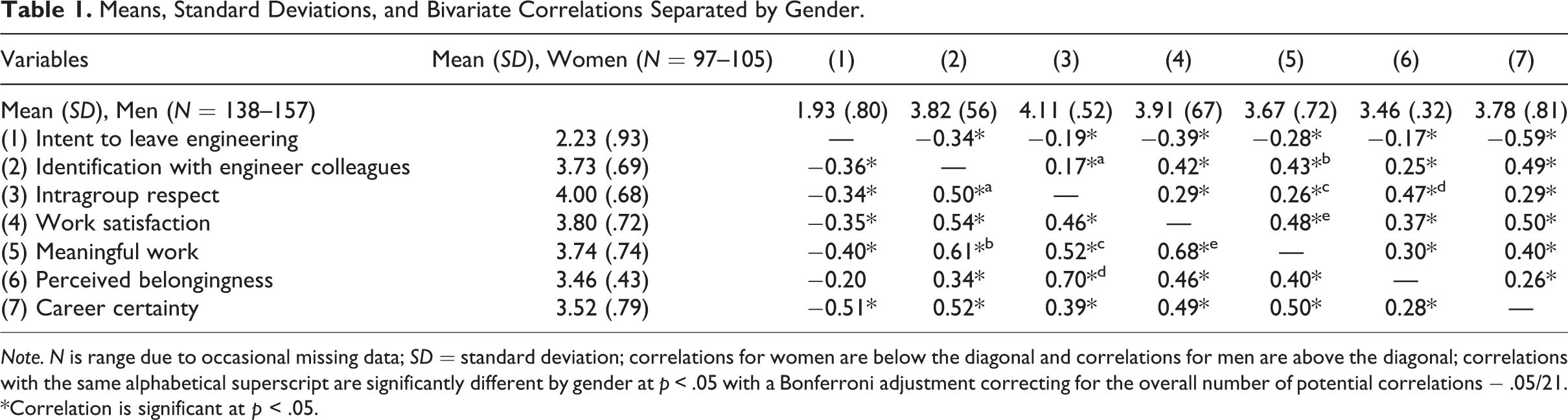
Note. N is range due to occasional missing data; SD = standard deviation; correlations for women are below the diagonal and correlations for men are above the diagonal; correlations with the same alphabetical superscript are significantly different by gender at p < .05 with a Bonferroni adjustment correcting for the overall number of potential correlations − .05/21.
*Correlation is significant at p < .05.
Means, Standard Deviations, and Bivariate Correlations Separated by Path.
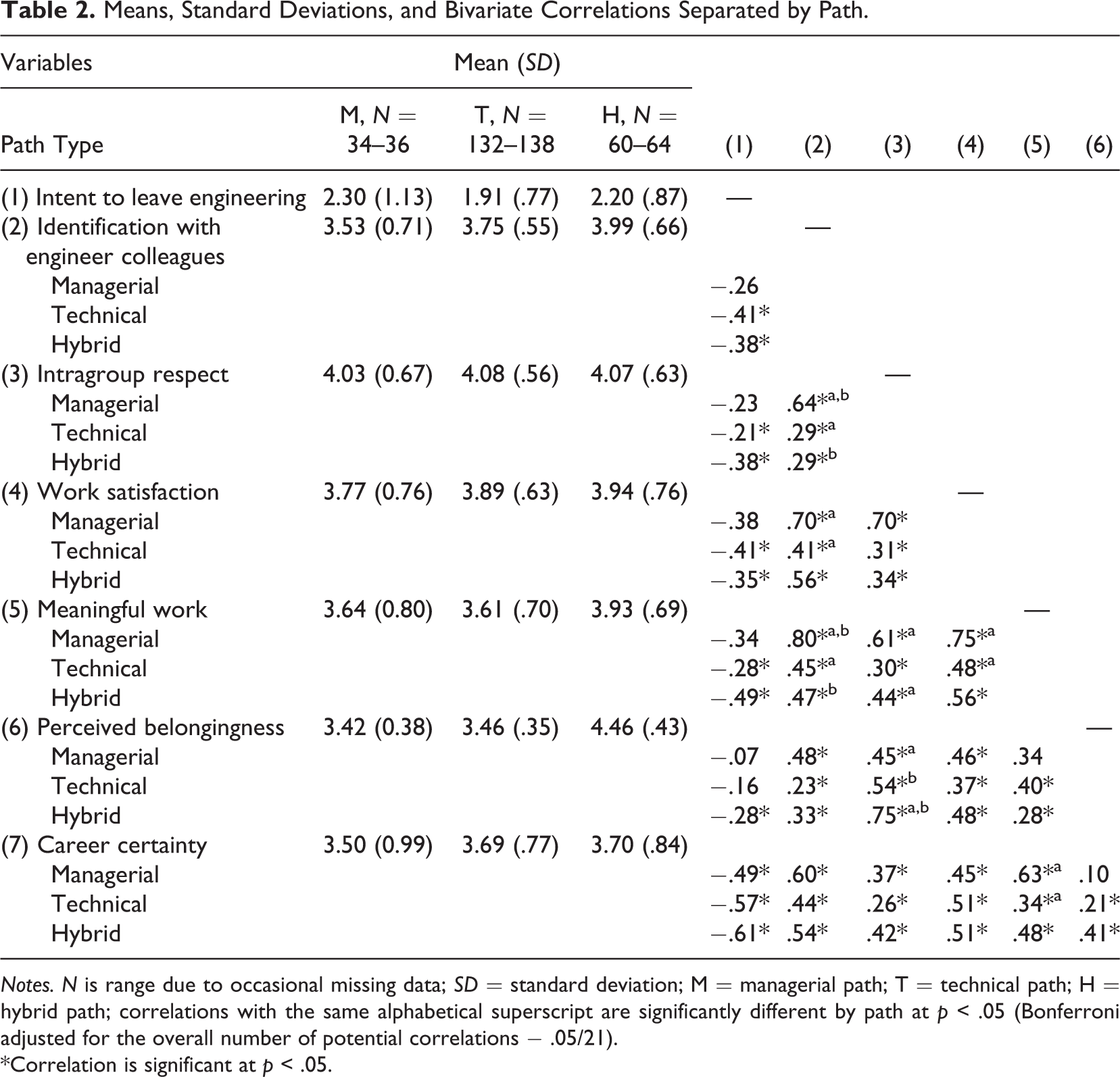
Notes. N is range due to occasional missing data; SD = standard deviation; M = managerial path; T = technical path; H = hybrid path; correlations with the same alphabetical superscript are significantly different by path at p < .05 (Bonferroni adjusted for the overall number of potential correlations − .05/21).
*Correlation is significant at p < .05.
Effect of Gender on Career Path
We first examined the relationship between gender and career path. In order to highlight patterns associated with each of the three paths, we created three dummy variables—one for each path (on path = 1, not on path = 0). Results showed significant relationships between gender and each of the three career path dummy variables: managerial path—F(1, 236) = 7.29, p = .007; technical path—F(1, 236) = 19.09, p = .001; hybrid path—F(1, 236) = 6.55, p =.011. Comparisons of means for each career path showed that women were significantly more likely than men to be in the managerial path (M = 0.23 for women vs. 0.10 for men, p = .007, η2 = .03) and the hybrid path (M = 0.36 for women vs. 0.21 for men, p = .011, η2 = .03). In contrast, men were more significantly likely than women to be in the technical path (M = 0.68 for men vs. 0.41 for women, p = .001, η2 = .08). These results suggest a gendered patterning of career paths in the engineering firms sampled.
To examine the main effect of career path on the five dependent variables—intent to leave engineering, identification with engineering colleagues, intragroup respect, work satisfaction, and meaningful work—as well as the interaction between career path and gender to predict these outcomes, we used analyses of variance with a Bonferroni adjustment for multiple comparisons.
Main Effect of Career Path on Outcome Variables
With respect to the main effects of career path on the outcome variables, we found significant effects for intent to leave engineering—F(2, 235) = 5.12, p = .007, partial η2 = .04; identification with engineering colleagues—F(2, 224) = 6.62, p = .002, partial η2 = .06; and meaningful work—F(2, 228) = 5.44, p = .005, partial η2 = .05. The effects of path on intragroup respect and work satisfaction were not significant.
Pairwise comparisons showed that engineers on hybrid path were significantly more likely to report intent to leave engineering as compared to those on the technical path (p = .047). Engineers on the hybrid path showed significantly higher levels of identification with engineer colleagues than those on the managerial and technical paths (p = .004 and p = .009, respectively). Engineers on the hybrid path reported higher levels of work meaningfulness than those on the technical path (p = .003). There were no path differences for intragroup respect and work satisfaction (see Table 3 for summary of means and mean differences for the effect of path on all dependent variables.)
Means and Standard Errors for the Effect of Career Path Type on All Dependent Variables.
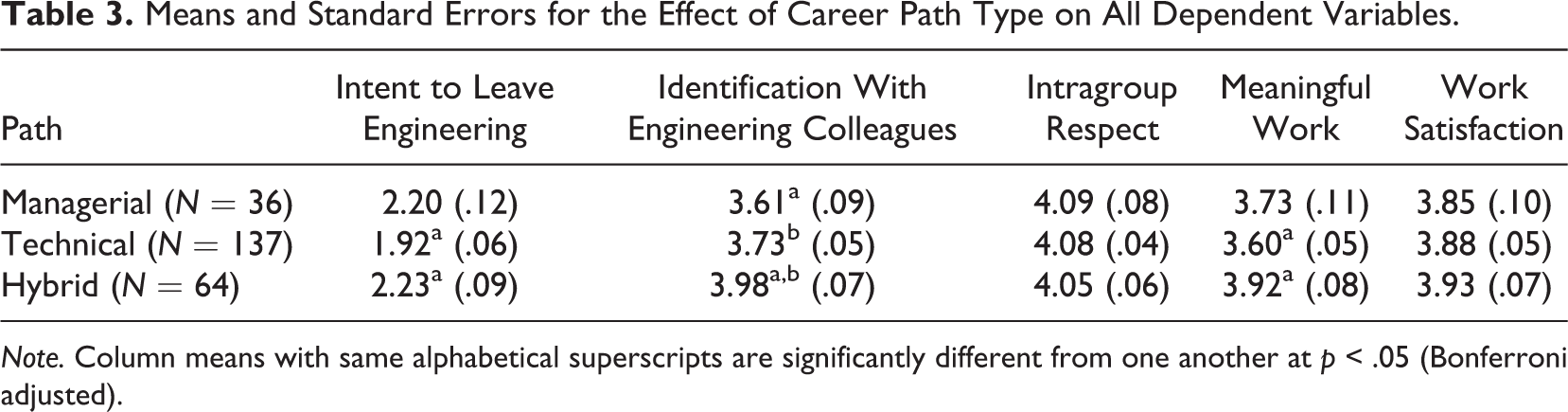
Note. Column means with same alphabetical superscripts are significantly different from one another at p < .05 (Bonferroni adjusted).
Gender × Path Interactions
With respect to the differential effect for men and women of career path on each of the dependent variables, we conducted 2 × 3 analyses of variance with a Bonferroni adjustment to test for Gender × Path interactions. Analyses revealed Gender × Path interactions to predict intragroup respect—F(2, 233) = 3.79, p = .024. Results did not reach acceptable levels of significance for intent to leave engineering, identification with engineering colleagues, meaningful work, or work satisfaction. Table 4 shows the gender by path means and standard errors.
Path by Gender Means and Standard Errors for All Variables.
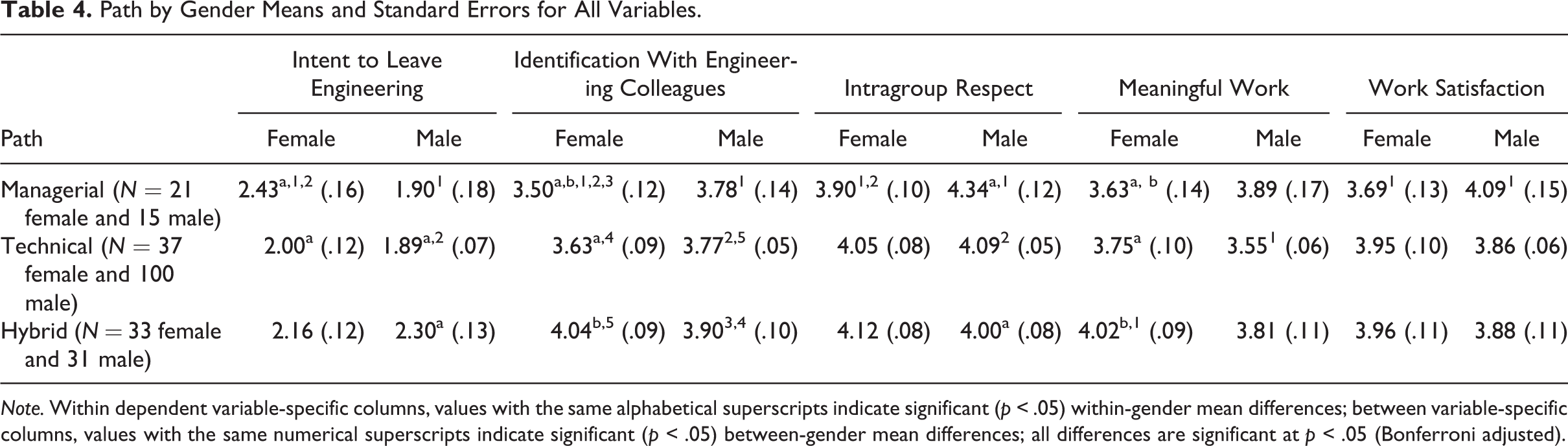
Note. Within dependent variable-specific columns, values with the same alphabetical superscripts indicate significant (p < .05) within-gender mean differences; between variable-specific columns, values with the same numerical superscripts indicate significant (p < .05) between-gender mean differences; all differences are significant at p < .05 (Bonferroni adjusted).
Within-gender and between-gender path effects
We next examined the pairwise comparisons to determine the within-gender and between-gender effects of path on the dependent variables. In terms of within-gender effects, for men, results showed that those on the hybrid path were significantly more likely to report intent to leave engineering than those on the technical path (p = .004). Additionally, men on the managerial path reported significantly higher levels of intragroup respect than men on the hybrid path (p = .031).
With respect to the within-gender effects for women, results showed that women on the managerial path were significantly more likely to report intent to leave engineering than women on the technical path (p = .024). Women on the managerial path reported significantly lower levels of identification with colleagues than woman on the technical or hybrid paths (p = .001 and .001, respectively). Women on the managerial path reported significantly higher levels of work meaningfulness than women on the hybrid path (p = .015) or technical path (p = .046).
In terms of between-gender differences, women on the managerial path reported significantly: (1) higher intent to leave engineering than men on the managerial path or technical paths (p = .026 and .002, respectively), (2) lower identification with engineering colleagues than men on the managerial, technical or hybrid paths (p = .025, .025, and .006, respectively), (3) lower perceived intragroup respect than men on the managerial path or technical paths (p = .008 and .046, respectively), and (4) lower levels of work satisfaction than men on the managerial path (p = .030). Women on the hybrid path reported significantly: (1) higher identification with engineering colleagues than men on the technical path (p = .009) and (2) higher work meaningfulness than men on the technical path (p = .001). Women on the technical path reported lower levels of identification with engineering colleagues than men on the hybrid path (p = .036).
Discussion
Although significant research attention has been devoted to understanding the factors that affect female engineers’ career pipeline and the experiences of women in engineering, a surprising paucity of research has examined women’s career paths within engineering firms, or the professional and work implications of career path choice for all engineers and for men and women uniquely. This study sought to address these gaps. The results show that female (as compared to male) engineers were more represented in managerial and hybrid career paths and that male engineers were more represented in the technical career path. For all engineers, career path was associated with intent to leave engineering, identification with engineering colleagues, and meaningful work. Specifically, engineers on the hybrid path reported significantly higher intent to leave engineering than engineers on the technical path, engineers on the hybrid path showed significantly higher levels of identification with engineering colleagues than engineers on the technical and managerial paths, and engineers on the hybrid path reported significantly higher levels of meaningful work than engineers on the technical path. In short, these results show that engineers on the hybrid path experienced the most favorable outcomes with respect to identification with engineering colleagues and meaningful work. Those on the technical path experienced the most favorable outcomes with respect to intent to leave engineering, and those on the managerial path experience the least favorable outcomes with respect to identification with engineer colleagues.
Moreover, significant within-gender and between-gender effects of career path were observed. For men, the technical path was favorable to the hybrid path in terms of intent to leave engineering; however, the managerial path was more favorable in terms of perceived intragroup respect than the hybrid path. For women, being on the technical path was favorable to the being on the managerial path in terms of intent to leave engineering; the hybrid and technical paths were favorable to the managerial path in terms of identification with other engineers and meaningful work.
With respect to between-gender differences, significant differences were noted in men’s and women’s experience of the managerial path. Women on the managerial path reported higher intent to leave engineering, lower identification with other engineers, lower perceived intragroup respect, and lower work satisfaction than men on the same path. Women on this the managerial path also has less favorable outcomes than men on the technical path in terms of intent to leave engineering, identification with engineering colleagues, and perceived intragroup respect. Women on the managerial path also reported lower levels of identification with colleagues than men on the hybrid path. However, women on the hybrid path reported significantly higher levels of identification with engineering colleagues and meaningful than men on the technical path.
These results offer new insights into the literatures on engineers’ career paths and experiences of work and on women’s experiences in engineering, more specifically. Results showed gendered career paths in engineering and relationships between career path and engineers’ attitudes toward their profession and work—specifically intent to leave engineering, identification with engineering colleagues, and meaningful work. Moreover, the results showed career path-specific attitudes toward profession and work. In particular, engineers on the hybrid path reported greater intent to leave engineering than those on the technical path, engineers on the hybrid path reported higher levels of identification with engineer colleagues than those on the managerial and technical paths, and engineers on the hybrid path reported higher levels of work meaningfulness than those on the technical path.
The Path × Gender interactions and pairwise comparisons suggest that specific career paths may carry with them different associated “benefits” and “risks” for women and men with respect to their attitudes toward profession and work. In particular, while the hybrid path appeared to offer the most benefit to women in terms of meaningful work and identification with engineering colleagues, this path posed risks to men in terms of intent to leave engineering. Similarly, though the technical path appeared favorable in terms of intention to leave engineering, for men this path was associated with the lowest levels of work satisfaction and meaningfulness. The managerial path appeared to pose the greatest risk for women in terms of favorable professional and work outcomes because of its association with the highest levels of intent to leave engineering and the lowest identification with other engineers, perceived intragroup respect, work satisfaction, and meaningful work.
This research also informs the literature on the experience of women in engineering. While it is well established that women leave the engineering profession at higher rates than men (Fouad et al., 2011), the results of this research highlight that one potentially overlooked factor related to women’s risk of attrition may be the career path they take in engineering firms. Our results showed that female engineers were significantly more likely than male engineers to be in the managerial path and, as noted, for women, the managerial path was associated with the lowest levels of identification with other engineers, perceived intragroup respect, meaningful work, and work satisfaction as well as the highest levels of intent to leave engineering. These findings are significant, given that one commonly suggested strategy for addressing the gender disparity in engineering—as well as other male-dominated occupations—has been to increase women’s numeric representation in management roles (Cohen & Huffman, 2007; Gorman, 2005; Skaggs, Stainback, & Duncan, 2012; Stainback & Kwon, 2012). This recommendation, and the research that informs it, is based on the premise that increasing women’s visibility and power in male-dominated occupations will reduce persistent gender stereotyping as well as perceptions of lack of belongingness and fit that pose barriers to women in these professions (Gaucher, Friesen, & Kay, 2011; Heilman & Parks-Stamm, 2007; Skaggs et al., 2012). Our research suggests that this recommendation should be viewed with caution in the engineering context as moving women into managerial roles in engineering firms appeared to have negative implications for professional and work-related outcomes linked to professional attrition.
This research also raises questions about why women may be more likely to move away from technical career paths toward more managerial paths. Research shows that female engineers are as technically proficient as males and that engineers exhibit similar work values (Jagacinski, 1987; Robinson & McIlwee, 1991). Why, then, might women appear disproportionately inclined to go into managerial or hybrid roles, over purely technical roles? Perhaps organizations play a role in encouraging women to gravitate toward managerial paths (Cardador, 2017), or women’s own preferences create the motivation (Cech et al., 2011). Perhaps women move into managerial roles to escape the identity threat of the persistent stereotyping of women as less technically capable and competent (Logel et al., 2009). Future research is needed to uncover the organizational and social–psychological factors that shape female engineers’ career path decisions and outcomes in engineering firms.
Limitations and Future Directions
This study has some limitations that suggest opportunities for future research. First, though we found several significant relationships, our cross-sectional design does not allow us to make definitive causal claims. Thus, other explanations for the relationships observed may be plausible. For example, it may be that women’s lower levels of identification with engineering colleagues lead them to select managerial paths in engineering firms, or that women who perceive low levels of intragroup respect from engineering colleagues are likely to select paths in engineering that minimize their need to demonstrate technical competence. Accordingly, future studies should adopt a longitudinal approach to better test the causality of relationships found here.
Second, our reliance on self-report measures is a potentially limiting feature general to many field studies involving attitudinal or psychologically based constructs (Podsakoff & Organ, 1986). Although researchers have debated the significance of same-source, same-method biases (Lindell & Whitney, 2001), we used several recommended procedural steps to mitigate common method bias (Podsakoff & Organ, 1986). For example, we used previously validated scales and scale items that were clear, simple, specific, and concise. Nevertheless, further research is needed to equate self-report measures of career path with organization-provided data on job titles and equate self-reported profession- and work-related attitudes with supervisor-reported measures.
Third, though we were able to assess engineers from all three career paths, the fact that comparatively fewer engineers pursue the managerial career path in engineering firms (Tremblay et al., 2002) meant that there were fewer numbers of engineers in this path in our sample. Because small sample sizes may affect the reliability of findings, future studies should attempt to replicate our findings in a larger sample of industry engineers, with efforts taken to increase the representation of those in the managerial path.
Fourth, though we were able to improve the external validity of our research by sampling multiple engineering organizations and engineers from multiple engineering subfields, we were not able to examine the effect of organization, engineering subfield, or industry on the pattern of results established here due to the low numbers of participants in any single organization, subfield, or industry. Thus, it may be that gendered career path patterns and their implications are more prevalent in some engineering firms, subfields (e.g., mechanical engineering), and industries. Future studies should build on the theoretical and empirical contributions presented here to develop an understanding of organization-, field-, and industry-level boundary conditions to the pattern of results found. Additionally, future research could extend these results to other occupational contexts. It may be, for example, that gendered career path patterns exist in other male-dominated occupational contexts (e.g., finance, law enforcement), or even among engineers in non-industry settings, such as academia.
Conclusion
Michio Kaku once said “What we usually consider as impossible are simply engineering problems.” Ironically, the problem of retaining more women in engineering has proven to be a difficult one to solve. The results of this research shed new light on this persistent problem by highlighting gendered career patterns in engineering firms and showing that career path is important for engineers’ experiences of profession and work. The findings show that women (but not men) taking managerial paths in engineering firms may be at the greatest risk of professional attrition.
Footnotes
Acknowledgments
We are grateful to our Editor W. Bruce Walsh and two anonymous reviewers for their comments and guidance throughout the review process. We also wish to thank John Popovics and Amy Fruehling for their assistance in data collection.
Declaration of Conflicting Interests
The author(s) declared no potential conflicts of interest with respect to the research, authorship, and/or publication of this article.
Funding
The author(s) received no financial support for the research, authorship, and/or publication of this article.