






Abstract
Among Latina/o Americans, the fastest growing segment of the U.S. population, disparities exist in educational and career attainment. The emergence of research on Latina/o students has resulted in varied findings that make it difficult to draw conclusions as to which predictors are most closely associated with goal outcomes for this population. Using meta-analytic techniques, the current study examined the magnitude, direction, and heterogeneity of effect sizes across multiple educational and vocational goal outcomes for Latina/o students (i.e., educational/vocational aspirations, expectations, goals/plans, and persistence). Across 34 independent samples from 33 studies, career-related self-efficacy, peer support, adult support, barriers, and Anglo acculturation had moderate effects on at least one of the outcomes, with career-related self-efficacy and peer support being moderately related to two or more outcomes. If replicated, this research suggests that interventions focused on career-related self-efficacy and peer support could enhance the development of educational and career goals for Latina/o students.
Latina/o Americans disproportionately experience academic underachievement, low career attainment, poverty, and circumscription in low-paid, low-status occupations (PEW Research Center: Hispanic Trends, 2016). In 2014, 20.6% of the population of U.S. Latina/os aged 25 and older had less than a ninth-grade education, compared to 2.4% White, 4.3% Black, and 8.2% Asian persons (PEW Research Center: Hispanic Trends, 2016). Moreover, in 2014, 15% of U.S. Latina/os aged 25 to 29 had a bachelor’s degree or higher, compared to 41% White, 22% Black, and 63% Asian persons (PEW Research Center, 2016). Furthermore, Latina/os were disproportionately represented in several low-earning job categories including agricultural (43.4%), grounds cleaning and maintenance (36.7%), construction and extraction (32.3%), and food service jobs (24.9%; U.S. Bureau of Labor and Statistics, 2015). These figures suggest that a rapidly increasing proportion of the U.S. population will be comprised of individuals whose opportunities for economic and social mobility are limited considerably. The current study provides a meta-analytic synthesis of predictors of educational and vocational goals for Latina/o students with particular attention to the operationalization of goal outcomes. Establishing goals represents a critical aspect of educational and vocational development, as goals provide a direction toward which one can organize and guide behavior (Lent & Sheu, 2010). Identifying the predictors most closely associated with the educational and vocational goals for Latina/o students is imperative to better understand patterns of underachievement and inform the development of empirically derived interventions.
In accordance with Social Cognitive Career Theory (SCCT; Lent, Brown, & Hackett, 1994), goals and goal-formation processes play a key role in shaping one’s career trajectory. Extending Bandura’s (1986) social cognitive theory to the academic-career realm, SCCT explicates the process by which cognitive–person variables interact with other aspects of the person and her or his environment to drive the course of career development. Of particular relevance to racial/ethnic minority students, SCCT incorporates sociocultural and contextual factors that influence career development and enhance, hinder, or supersede personal agency (Lent, Brown, & Hackett, 2000). Within this framework, educational/vocational goals were distinguished from educational/vocational behaviors (i.e., actions required to bring goals to fruition) and defined as intention to engage in a specific activity or determination to pursue a particular plan of action or outcome (Bandura, 1986). The more demanding the goal set, the more motivation the individual has to apply effort and surpass previous performance (Brown, Jones, & Leigh, 2005). Importantly, goals have been shown to be predictive of academic (Cupani & Pautassi, 2013) and career (Abele & Spurk, 2009) performance.
Within the broader SCCT literature, previous researchers have conducted meta-analytic reviews of the bivariate relations and direct/indirect paths in the SCCT model and found support for the applicability of SCCT in understanding career development processes with predominantly White samples (e.g., Multon, Brown, & Lent, 1991; Rottinghaus, Larson, & Borgen, 2003). Using more advanced meta-analytic tools, Sheu et al. (2008) conducted a meta-analytic path analysis of two versions of the SCCT choice model with a focus on STEM-related choices with racial majority, racial minority, and racially heterogeneous samples. A model that included self-efficacy (confidence in one’s ability to complete a behavior/task; Bandura, 1986), outcome expectations (beliefs about probable response outcomes; Bandura, 1986), interests, and choice goals accounted for much variance in interests and choices for all three groups. Furthermore, studies with racial minority groups evidenced a larger path coefficient on the direct path from self-efficacy to choice goals. An expanded model that included environmental supports and barriers accounted for much variance for both the racial minority and the racially heterogeneous groups (Sheu et al., 2008). For both groups, path coefficients were small to moderate and environmental supports were linked to choices mostly indirectly, while barriers evidenced limited predictive utility. Further work was needed to test the basic and more complex assumptions of SCCT across studies with Latina/o samples (African Americans were the largest minority group in the aggregated samples). Moreover, a meta-analysis of goal outcomes that includes culture-specific variables such as acculturation had not been conducted. Thus, the magnitude of the effects of the specific individual, sociocultural, and contextual predictors across educational/vocational goals among Latina/o students remained unexamined.
The purpose of the current study was to synthesize the emergent literature on the educational and vocational goals of Latina/o students by determining the overall effects of predictors relevant to SCCT as well as culture-specific variables salient to Latina/o students (i.e., career-related self-efficacy, sociocultural person variables, and contextual variables). Although the number of studies on this underrepresented group is not robust, examining the findings to date can inform and focus future research and interventions. In the current literature, various goal constructs have been studied including educational/vocational aspirations (i.e., what one hopes to achieve) and expectations (i.e., what one believes will occur), global and domain-specific goals (i.e., the desired objective), and persistence (or effort expended) toward goal completion (e.g., Ali & Menke, 2014; Flores, Navarro, & DeWitz, 2008; Flores & O’Brien, 2002). There is overlap among these constructs; however, they are conceptually distinct in the extent to which they capture a concrete and well-specified educational/vocational goal or choice (e.g., aspiration to earn a graduate degree) as opposed to a goal or choice aspect (e.g., intention to persist in the face of obstacles). In light of this conceptual distinctness, an examination of the independent associations of specific goal outcomes (i.e., educational/vocational aspirations, expectations, goals/plans, and persistence) with culturally and theoretically relevant predictors became the focus of this study.
One of the most widely studied predictors of goals and goal-related behavior across both the education and the vocational psychology literatures is self-efficacy (Bandura, 1977, 1997). Since applied to the career development realm, support has amassed for the role that self-efficacy plays as a mechanism of personal agency and positive adaptation in educational and vocational functioning (e.g., Brown & Lent, 2016; Lent & Brown, 2013). More specifically, the basic choice model of SCCT puts forward that career choice goals that are consistent with self-efficacy beliefs are more likely to be established and pursued. Building on SCCT, Flores and O’Brien (2002) found that nontraditional career self-efficacy was not a predictor of career aspiration for Mexican American girls. Further, contrary to hypotheses, college self-efficacy was not related to Mexican American high school students’ educational goal expectations and aspirations (Flores, Navarro, & DeWitz, 2008). In a study of Latina/o rural high school students, Ali and Menke (2014) found a moderate association between vocational skills self-efficacy and career aspirations operationalized as goals for leadership, advancement, management, and higher education. Thus, the relevance of self-efficacy may depend on the type of self-efficacy, specific goal outcome, and/or equivalence in specificity of constructs (Brown & Lent, 2016). In light of the significance of self-efficacy as an antecedent of behavior and disparate findings that have emerged in the context of goal outcomes, career-related self-efficacy was included as a predictor variable in the current meta-analysis.
The literature on the educational and vocational attainment of Latina/o students also underscores the significance of sociocultural factors in career decision-making (Flores et al., 2008; McWhirter, Hackett & Bandalos, 1998). Moreover, career development theories that focus centrally on individual differences or personal agency as the primary indicators of educational and career outcomes have been criticized for their lack of attention to the social context of racial and ethnic inequity (Worthington, Flores, & Navarro, 2005). In consideration of this criticism and to include the growing literature examining sociocultural elements in the educational and career goals of Latina/o students (e.g., Cano et al., 2012; Gonzalez, Stein, & Huq, 2013), the second group of predictor variables in this study was referred to as sociocultural person variables and included acculturation and enculturation (i.e., Latino acculturation).
Acculturation (i.e., Anglo acculturation meaning orientation to host culture) and Latina/o acculturation (i.e., orientation to one’s culture of origin) are important psychological processes for Latina/o individuals who are in contact with majority culture as well as their culture of origin (López, Ehly, & García-Vázquez, 2002). For this reason, acculturation has been studied across theoretical perspectives as a key predictor of goal outcomes for Latina/o students. Among Mexican American high school students, orientation to Anglo culture predicted educational and career plans (McWhirter et al., 1998) and accounted for unique variance in educational goals (Flores, Ojeda, Huang, Gee, & Lee, 2006), aspirations, and expectations (Flores et al., 2008). However, the same finding did not hold for orientation to Mexican culture (Flores et al., 2006, 2008) as well as for math/science goals among Mexican American youth (Navarro, Flores, & Worthington, 2007).
Furthermore, more research is needed that examines the role of contextual variables in career development, particularly with individuals from underrepresented populations. Contextual variables refer to characteristics of the environment—thus external to the individual—that either constrain or enhance personal agency (i.e., barriers and social support; Lent et al., 2000). Since the conceptual refinement of SCCT that hypothesized the direct effect of environmental factors on the formulation of career goals (Lent et al., 2001), research examining these relations for Latina/o students has amassed. Perceptions of barriers accounted for 24% of the variance in career aspirations in rural Latina/o high school students (Ali & Menke, 2014). However, this same predictor accounted for a much smaller amount of variance (3.6%) in Mexican American high school students’ educational aspirations (Ojeda & Flores, 2008). With regard to social support, a small association was found between social support and persistence (measured as self-report dropout likelihood; DeGarmo & Martinez, 2006), while another study noted robust associations between perceived encouragement from mother and father (assessed separately) on educational expectations (Reynolds & Burge, 2008). These studies supported the relevance of barriers and supports, and thus contextual variables represented the third group of predictors in the current meta-analysis.
To end, using meta-analytic techniques, the current study examined the magnitude, direction, and heterogeneity of effect sizes of three salient groups of predictors (career-related self-efficacy, sociocultural person variables, and contextual variables) across multiple educational and vocational goal outcomes in the emergent research on Latina/o students.
Method
The meta-analysis proceeded in four major steps (see Quintana & Minami, 2006). First, a comprehensive literature search was conducted to locate relevant studies, and each study was evaluated based on predetermined inclusionary criteria. Second, general study characteristics and statistics were extracted from each paper, and an effect size was computed for each study. Third, a weighted average of the effect sizes was computed (weighted by sample size) to obtain an overall assessment of the direction and magnitude of the association when all studies were combined. Fourth, homogeneity analyses were conducted to determine the homogeneity of the group of effect sizes. A diverse research team was assembled to assist in the current synthesis. The team consisted of three doctoral students and one professor in counseling psychology and eight undergraduate students in psychology.
Literature Search
The literature search was implemented in seven sequential steps (see Multon et al., 1991; Spengler et al., 2009). First, a preliminary examination and evaluation of the literature was conducted to derive the topic definition (i.e., studies examining the relations between career-relevant person variables [i.e., various forms of career-related self-efficacy], sociocultural person variables [i.e., Anglo- and Latino acculturation], and contextual variables [i.e., barriers and support] and educational/vocational goals [i.e., aspirations, expectations, goals/plans, intentions to persist] for Latina/o students). PsycINFO, Educational Resources Information Center (ERIC), and ProQuest Dissertations and Theses Database were used to retrieve studies related to the topic definition. These databases were selected based on disciplinary scope and the inclusion of unpublished work.
Second, search terms were identified to describe the topic at the appropriate level of specificity. In this process, the goal was to maximize efficiency by obtaining a maximum number of relevant sources, a minimum of identified but not relevant sources, and very few relevant but not identified sources. To ensure consistent and inclusive vocabulary, the thesauri of the databases were consulted for the incorporation of the subject terms. For each subject term, a list of narrower and related terms was generated by the particular thesaurus. Creating search profiles to provide logical structure to the search represented the third step in conducting the comprehensive literature search. Initial search parameters were created such as Latino AND students AND career OR vocation.
The main search was conducted in the fourth step. Unpublished doctoral dissertations were included in the search to reduce publication bias. A document evaluation manual and corresponding database were created by the first author for the main search. One member of the synthesis team was responsible for each of the three databases. Each document (e.g., article, technical report, and dissertation) identified as relevant in the main search was evaluated based on predetermined inclusionary criteria (discussed in the following section), first by the team member conducting the main search and second by the first author.
Two complementary search strategies—author and citations searching—were conducted as a fifth step. The second author conducted an author search of those identified as key researchers in this area (Flores, Gloria, Gushue, Luzzo, McWhirter, Navarro, and Solberg) and evaluated whether each identified document fit the inclusion criteria. Next, citation searching was conducted by two members of the synthesis team and the first author. The reference lists of all documents obtained through the computer searches that fit initial inclusionary criteria were mined for additional studies. Again, each document identified as relevant was evaluated for inclusion first by the synthesis team member conducting the citation search and second by the first author.
After identifying all possible studies, forward and backward cross-referencing were conducted until no new studies were obtained. This sixth step involved cross-checking the list of studies generated from the electronic database searches with the list of studies obtained from mining the reference lists of articles and vice versa. Finally, the seventh step entailed a supplemental-focused search to locate studies published in the most recent year since the study began. The same document evaluation procedures discussed above were implemented.
Each study identified from the processes described above was reviewed by one member of the synthesis team and the first author using the selection criteria. Consistent with best practices as outlined by Quintana and Minami (2006), studies were eliminated for failing to meet one or more of the criteria. Selected studies met the following criteria: (a) Latina/o students were either a single sample or a subsample; (b) included a measure of an educational or vocational goal (e.g., education and/or career aspirations, expectations, goals/plans, and/or persistence); (c) had at least one of the following variables correlated with a goal outcome: a measure of career-related self-efficacy, sociocultural person variable (i.e., Anglo acculturation, Latino acculturation), and/or a contextual variable (i.e., perceived barriers, supports); and (d) provided sufficient information to calculate effect size estimates (i.e., correlation coefficients). All effects in the current meta-analysis were zero order.
Coding Procedures
A coding manual was created to provide detailed instruction of how to code each item and included notes about decision rules developed as the research team coded studies. The corresponding coding database was created in Excel to maximize efficiency in recording coded data. The coding procedures took place in two steps (see Spengler et al., 2009). First, each study was coded for specific study characteristics independently (i.e., initial codes were recorded in separate databases) by two members of the research team. Second, statistical information needed to calculate effect sizes (i.e., correlation coefficient and sample size) was retrieved and coded independently for each study by two members of the synthesis team. If zero-order correlations were not reported, sufficient information to compute a bivariate relationship (e.g., exact p value and sample size) between the two variables of interest was searched for within the document. Codes that had 100% agreement from both raters were then recorded in the database. Discrepancies were addressed by the first author who examined the original document.
The literature search, document evaluation, and coding sequences described above resulted in the retention of 33 studies. Studies were omitted at various stages as follows: (a) 286 unique studies were within the scope of the project, (b) 144 were excluded for not having a goal construct consistent with our operationalization, (c) 16 studies were not included because the document could not be located, (d) 99 were excluded for not having a correlate of interest and/or sufficient information to calculate effect size estimates, and (e) to retain studies, 19 authors were contacted and 6 provided the necessary data.
Statistical Analyses
Effect size calculation
The primary effect size metric used to aggregate data across studies was the Pearson Product–Moment Correlation Coefficient (r), as the research questions under investigation concerned associations between two continuous variables (Rosnow, Rosenthal, & Rubin, 2000). The magnitude of the effect size was determined based on guidelines established by Cohen (1988); r < .3 represents a small effect, between .3 and .5 a medium effect, and > .5 a large effect.
Mean effect sizes were calculated following standard methods (e.g., Rosenthal, 1995; Schafer, 1999) as employed by the Comprehensive Meta-Analysis software package (Biostat, 2006). To obtain the unbiased correlation between the predictor and outcome variable of interest (ru), correlations were first transformed to a Fisher’s Z with standard r-to-z transformation tables. Next, a weighted estimate of the common correlation across all samples (Z++) was computed (Hedges & Olkin, 1985). Then, to test the hypothesis that Z++ differed from zero, Z++ (N – 3K)1/2 was computed in which N was the total number of participants across all samples. Significance was tested against a two-tailed critical value of the standard normal curve (i.e., p < .05, z = 1.96). Finally, Z++ was converted back to its associated r (ru) with standard r-to-z transformation tables. In addition to calculating both the weighted and the unweighted correlation coefficients, the following were calculated for each bivariate relation: the 95% confidence interval around ru and the Q-statistic. Significant results were indicated by effects wherein the confidence interval did not include zero. Although both weighted and unweighted effect sizes for each association were reported, all discussions were in reference to weighted effect sizes.
Dependency
To address violations of independence, each association within a study was first coded as if it were an independent estimate of the relation between the predictor variable of interest and the particular goal outcome. To obtain the combined correlation between the predictors and outcome variable of interest, correlations were first transformed to a Fisher’s Z with standard r-to-z transformation tables, and then a weighted estimate of the common correlation across all predictors was computed (Hedges & Olkin, 1985). The summary Fisher’s Z was then transformed back to the r metric. The same process was applied to the standard errors. Thus, the r and associated standard error used in the meta-analysis reflected a weighted effect or composite of all associations for the predictor and outcome variable of interest reported in a given study. Each sample therefore contributed only one effect size to the estimation of the overall effect size (Borenstein, Hedges, Higgins, & Rothstein, 2009). This process allowed for the retention of as much data as possible from each study while reducing any violations of independence to a minimum (Cooper, 1998).
Homogeneity of effect sizes
To determine whether studies shared a common effect size, the homogeneity of all sets of effect sizes were tested using the Q-statistic as suggested by Hedges and Pigott (2004). A significant QTotal(χ2 distribution with k − 1 degrees of freedom [where k = number of studies]) statistic indicated the possibility of unexamined systematic differences among the studies. With regard to aggregation procedures, the current study adopted a random-effects model to aggregate effect sizes due to variation in measures and populations sampled by the studies included.
Results
Description of Studies
Included in the meta-analysis were 34 independent samples from 33 studies (24 journal articles, 8 dissertations, 1 unpublished proceeding) published between 1995 and 2013. Sample sizes for each individual study ranged from 30 to 2,148, and the sample size for the combined studies in a specific analysis ranged from 195 to 2,681 (see Table 1 for the study characteristics).
Study Characteristics.
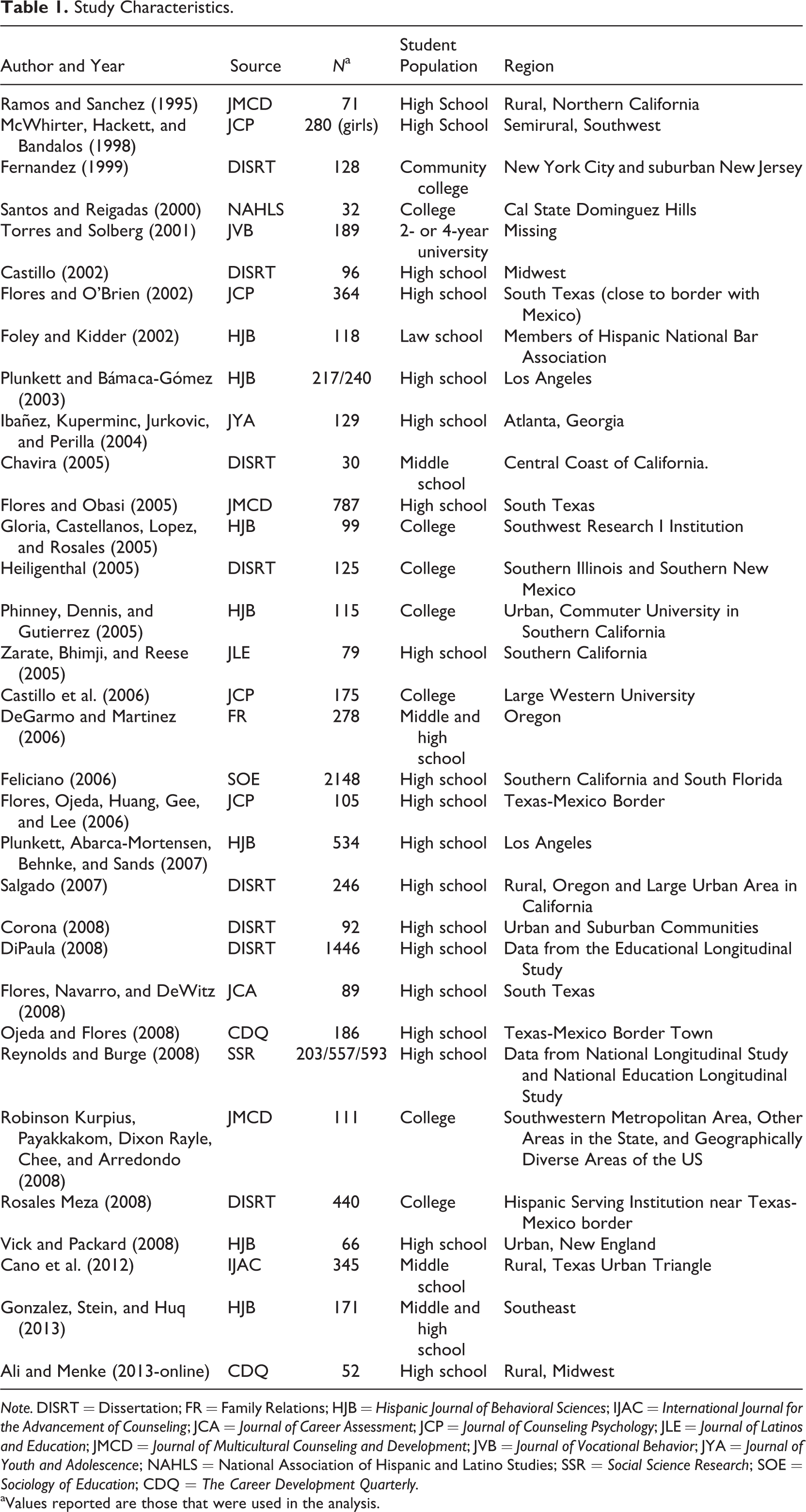
Note. DISRT = Dissertation; FR = Family Relations; HJB = Hispanic Journal of Behavioral Sciences; IJAC = International Journal for the Advancement of Counseling; JCA = Journal of Career Assessment; JCP = Journal of Counseling Psychology; JLE = Journal of Latinos and Education; JMCD = Journal of Multicultural Counseling and Development; JVB = Journal of Vocational Behavior; JYA = Journal of Youth and Adolescence; NAHLS = National Association of Hispanic and Latino Studies; SSR = Social Science Research; SOE = Sociology of Education; CDQ = The Career Development Quarterly.
aValues reported are those that were used in the analysis.
Unbiased Effect Size Estimates for Goal Outcomes
Goal outcomes were partitioned into groups based on the type of outcome coded in the first coding sequence. Groupings were conducted by the first author and checked by the second author. Four distinct classes were identified: educational/vocational aspirations (i.e., what one hopes to achieve in an ideal sense), educational/ vocational expectations (i.e., what one believes will occur given real circumstances), educational/vocational goals and plans (i.e., the desired objective), and persistence intentions (i.e., effort to be expended toward goal completion).
With regard to the sociocultural person variables (i.e., acculturation), studies that reported a correlation between a goal outcome and acculturation were partitioned into three groups based on the type of assessment of acculturation (i.e., bidimensional or unidimensional). The three groups included Anglo acculturation, Latino acculturation, and studies that used a unidimensional assessment of acculturation wherein the midpoint represented biculturalism and high scores indicated Anglo acculturation.
For the contextual variable of support, studies were partitioned into two groups representing support from an important adult (e.g., parent, teacher, and mentor) and support from peers (e.g., friends and classmates). Summary data for the meta-analyses of goal outcomes are presented in Table 2 and delineated across the four distinct classes of goal outcomes. The number of effect sizes utilized for population estimations ranged from 2 to 6. All reported effects are under the random-effects model. Significance was assessed wherein the confidence interval did not include 0.
Main Effects for Goal Outcomes.
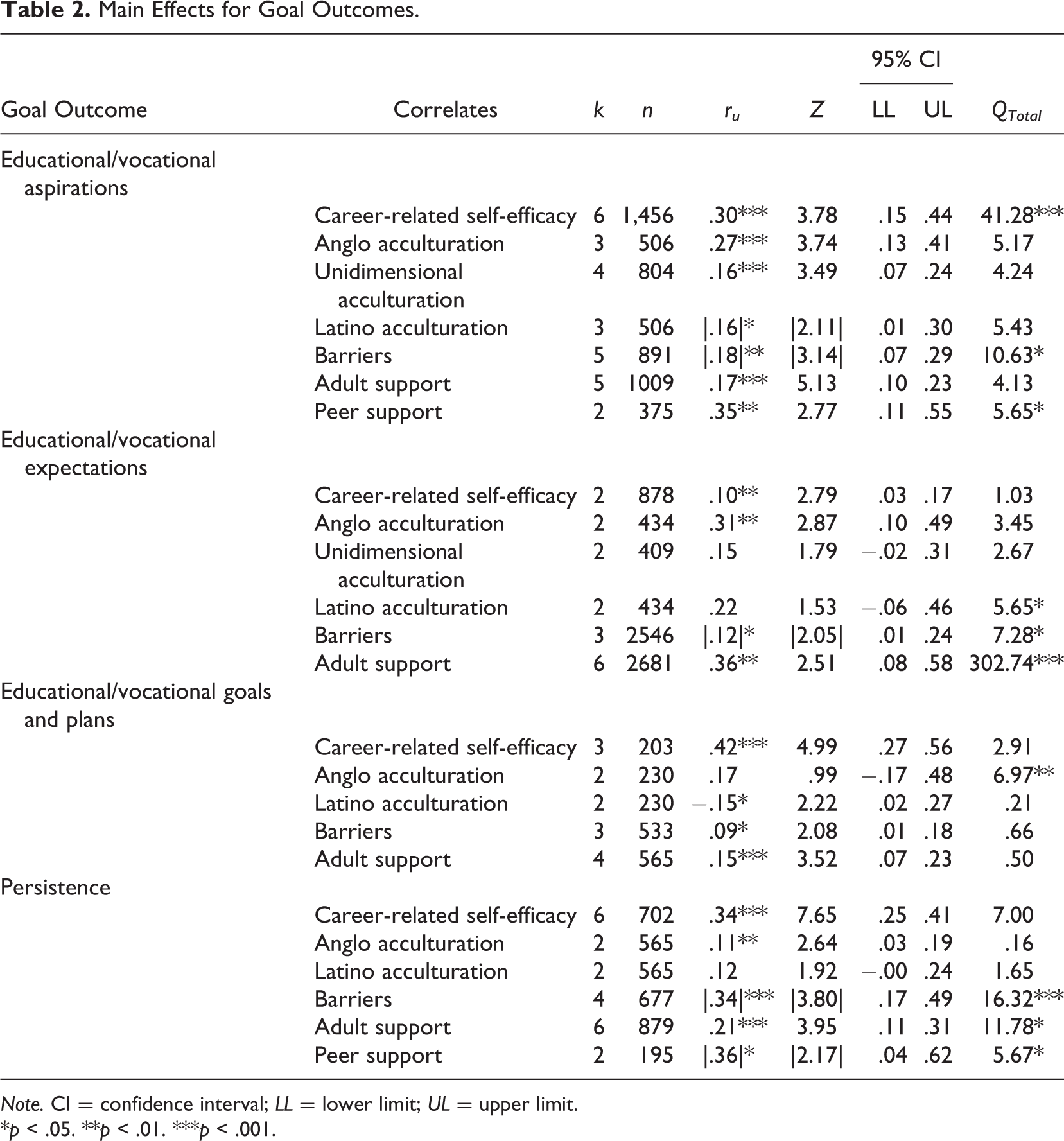
Note. CI = confidence interval; LL = lower limit; UL = upper limit.
*p < .05. **p < .01. ***p < .001.
Educational/vocational aspirations
A positive unbiased effect size (ru) of .30 was estimated for the relation between career-related self-efficacy and educational/vocational aspirations (p = .00). Anglo acculturation and unidimensional assessments of acculturation each had a positive association with aspirations, with ru estimates of .27 and .16, respectively. For Latino acculturation, findings for the direction of the association were mixed with two of the studies reporting a negative association and one reporting a positive association. Because ru estimates are based on the absolute value of the association, the strength of the association remained determinable despite contrasting results for the direction of the effect. The absolute value of the ru estimate was .16. The effects for all three classifications of acculturation were small and significant (p ranged from .00 to .04). Finally, for the contextual variables, ru estimates were .17 (p = .00) for adult support and .35 (p = .01) for peer support. Effects were small to moderate and in the positive direction. For the contextual variable of barriers, findings for the direction of the association were in the negative direction with the exception of one study in which a positive association was reported between likelihood of encountering barriers and career aspirations. The ru estimate for barriers was .18 (p = .00). Calculations of the homogeneity statistic QT revealed significant heterogeneity among effect sizes for the associations between aspirations and career-related self-efficacy, QT(5) = 41.28, p = .00, as well as peer support, QT(1) = 5.65, p = .02.
Educational/vocational expectations
A positive ru of .10 was estimated for the relation between career-related self-efficacy and educational/vocational expectations (p = .01). Anglo acculturation had a positive, medium association with expectations, with an ru estimate of .31 (p = .00). For unidimensional assessments of acculturation and Latino acculturation, the effects were not significant under the random-effects model. The ru estimate for barriers was small at .12 (p = .041), and the direction of the effect was not in the expected direction in one study (i.e., a greater perception of barriers was positively associated with career expectations). The ru estimate for adult support was .36 (p = .01), a medium effect in the positive direction. There was only one study that examined peer support and expectations, thus an effect size could not be estimated. Calculations of the homogeneity statistic QT revealed significant heterogeneity among effect sizes for the associations between expectations and Latino acculturation, QT(1) = 5.65, p = .02, as well as expectations and barriers, QT(2) = 7.28, p = .03, and adult support, QT(5) = 302.74, p = .00.
Educational/vocational goals/plans
A positive ru of .42 was estimated for the association between career-related self-efficacy and educational/vocational goals/plans (p = .00). The effect for Anglo acculturation was not significant under the random-effects model. Latino acculturation had a small, negative association with goals/plans with an ru estimate of .15 (p = .03). Barriers evidenced a modest, positive ru estimate of .09 (p = .04). There was only one study that examined the relationship between goals/plans and unidimensional assessments of acculturation, thus an effect size estimate could not be calculated. The same was true for peer support. The ru estimate for adult support was .15 (p =.00) and in the positive direction. Calculations of the homogeneity statistic QT revealed significant heterogeneity among effect sizes for the association between Anglo acculturation and goals/plans, QT(1) = 6.97, p = .01.
Persistence
A positive unbiased effect size estimate ru = .34 was found for the relation between career-related self-efficacy and persistence (p = .00). Anglo acculturation had a small, positive association with persistence, with unbiased effect size estimates of ru = .11 (p = .01) and ru = .21 (p = .00), respectively. The effect for Latino acculturation was not significant under the random-effects model. There was a medium effect for barriers with an ru estimate of .34 (p = .00). Effects were in the expected direction with the exception of one study that reported a positive association between university climate and nonpersistence attitudes. There were no studies that examined the relationship between unidimensional assessments of acculturation and persistence, thus an effect size could not be estimated. Estimates for adult and peer support were ru = .21 (p = .00) and ru = .36 (p = .03), respectively. Both effects were medium and in the positive direction with the exception of one study in which a negative association was observed between peer support and academic persistence decisions. Calculations of the homogeneity statistic QT revealed significant heterogeneity among effect sizes for the associations between persistence and barriers, QT(3) = 16.32, p = .00, as well as persistence and peer support, QT(1) = 5.67, p = .02, and adult support, QT(5) = 11.78, p = .04.
Discussion
The current study examined the magnitude of the overall associations between career-relevant person variables (i.e., career-related self-efficacy), sociocultural person variables (i.e., Anglo and Latino acculturation), contextual variables (i.e., barriers and support), and educational/vocational goal outcomes in the emergent literature on Latina/o students. Across studies, career-related self-efficacy, peer support, adult support, barriers, and Anglo acculturation had moderate effects (≥.30) on educational–vocational aspirations, expectations, goals/plans, or persistence.
Career-related self-efficacy was salient (i.e., had moderate effect size estimates) across all goal outcomes with the exception of educational/vocational expectations for which it evidenced a weak association. The broader SCCT literature provides support for the interplay between self-efficacy and other social–cognitive variables as predictors of process aspects of career development (Brown & Lent, 2016). Similarly, studies of Latina/o individuals have also highlighted the important role of self-efficacy with regard to vocational and educational outcomes (Ali & Menke, 2014; Garriott & Flores, 2013), suggesting that self-efficacy as a prospective predictor of goal outcomes is relevant for all groups. Interestingly, educational/vocational expectations were the single goal category for which career-related self-efficacy evidenced a weak association. It is possible that this finding emerged because of low direct correspondence between confidence and expectations. Given that self-efficacy represents a constellation of self-referent beliefs connected to specific domains of performance and activities, we expect that associations would be stronger between goal measures of a parallel domain (e.g., educational degree behavior self-efficacy and academic persistence decisions) versus a less parallel domain (e.g., nontraditional career self-efficacy and educational expectations).
Peer support also evidenced moderate effects for all goal outcomes for which estimates could be computed (i.e., educational/vocational aspirations and persistence). This is consistent with findings from a recent study on Latina/o high school seniors that emotional and instrumental support from peers contributed to college-going behavior such as applying to college (Rivera, 2014). Based on the current findings, attending to peer support in career interventions targeting Latina/o students would be important and perhaps have more robust and broader impact than adult support. More work is needed to better understand the role of peers across goal outcomes and at various stages of development.
Adult support evidenced moderate effects for educational/vocational expectations only. In the current study, the methodological class of adult support included support from parents, mentors, and school personnel. These various sources of support were unable to be differentiated because of the small number of effect sizes that would have resulted in each class. Thus, one direction for future research is to examine the relative impact of varying sources of support (e.g., mother, father, teacher, and mentor).
Anglo acculturation was important with regard to educational/vocational expectations and aspirations, while Latino acculturation evidenced small effects for all outcomes for which an estimate could be computed. The interpretation of these findings should be considered in light of the fact that four of these effects (i.e., unidimensional and Latino acculturation with expectations; Anglo acculturation with goals/plans; Latino acculturation with persistence) were not significant under the random-effects model. Given that the institutions of education and work in the United States reflect the values, beliefs, and practices of the predominate Anglo culture, those students who felt connected with Anglo culture may have felt more congruent in these settings and thus more capable in their education and career pursuits (Flores et al., 2008).
In their longitudinal work, Garriott and Flores (2013) found that Anglo acculturation did not predict educational goals two years later suggesting that this association is reduced over time. Consistent with the findings observed here, previous research has found that Mexican-oriented acculturation had a nonsignificant and/or small relationship with career outcomes (Flores Robitschek, Celebi, Anderson, & Hoang, 2010). Moreover, the direction of the effect of Latino acculturation on educational–vocational goals was indeterminable, as some studies indicated a negative relation and others a positive relation. These findings have important implications regarding the role of acculturation to majority culture and one’s culture of origin among Latina/o students, particularly for those with less exposure to majority culture (e.g., recent immigrants, living in culturally homogenous environments). Future meta-analyses with larger samples would allow for a more powered examination of potential moderating factors such as stage of career development, generation status, and racial/ethnic composition of educational setting.
Finally, across studies, barriers evidenced a moderate effect with persistence. A fundamental assumption of the SCCT framework is that individuals are more likely to translate their goal intentions into action if they perceive that there are minimal barriers to be encountered in their pursuits (Lent, 2005). Persistence reflected the likelihood that the student would make the decision to voluntarily drop out of college (e.g., nonpersistence attitudes; Castillo et al., 2006). Thus, this finding supported the SCCT proposition that characteristics of the environment that are considered to be constraining (i.e., perception of barriers) were closely associated with proximal choices (i.e., asking a college student to determine the likelihood of dropping out of college). This finding also reflects previous research suggesting that rural Latino students perceive barriers to postsecondary education as difficult to overcome (McWhirter, Torres, Salgado, & Valdez, 2007). It is important to note that expanding the construct of perception of barriers to include perceptions of structural barriers, such as academic under preparation and neighborhood qualities (e.g., unemployment, availability of drugs and alcohol, crime), might enhance the predictive efficiency of this variable, particularly for Latina/o adolescents. The current SCCT literature on Latina/o students reflects a dearth of studies that examine the processes through which perceptions of structural barriers can influence goal outcomes. Studies that combine both individual and structural predictors would be instrumental for theory building, policy makers, and researchers.
A critical finding from our statistical synthesis is that much of the variance of educational and vocational goals was unexplained. Methodological limitations in the 33 studies included in the meta-analysis may have contributed to these findings. Most studies that assessed educational and/or vocational goals used a single-item measure to assess this construct. For example, one item prompted students to indicate the highest level of education they expected to complete and another item asked participants to indicate the highest level of education they hoped to complete. Possible responses were the same for both items and ranged from “some high school” to “doctoral or professional degree” (Flores et al., 2008). The extent to which a single-item adequately covers the construct of interest is indeterminable as is the degree to which the item is free of measurement error because indices of reliability cannot be calculated. In addition, as has been done in recent meta-analyses of the career literature (Choi et al., 2012), average effect sizes could not be corrected for measurement error (Hunter & Schmidt, 1990) because mean reliabilities for variables measured by a single item could not be calculated (corrected r values tend to be higher). These limitations might be corrected in future research that utilizes composite scales with established psychometric properties to more comprehensively assess goal outcomes.
Furthermore, it is possible that other social–cognitive mechanisms in the goal formation process as posited by SCCT that were unexamined may account for significant variance. Outcome expectations were not included in the current meta-analysis, as there were not enough studies that had examined the association between outcome expectations and goals. Research has demonstrated that, as a result of systemic oppression, outcome expectations exert a greater influence than self-efficacy beliefs on the career choice behavior of racial–ethnic minority adolescents (Morrow, Gore, & Campbell, 1996). That is, racial/ethnic minority adolescents may have learned that their ability to successfully accomplish certain tasks will not necessarily result in the same outcomes as their White peers. In support of this proposition, Sheu et al.’s (2010) meta-analysis of previous research that had tested the SCCT choice model found that self-efficacy tended to contribute to the prediction of choice goals more indirectly, through outcome expectations and interests, than directly.
The current findings provided support for including career-related self-efficacy and peer support in interventions designed to augment educational–vocational goals. However, more work is needed that examines the extent to which self-efficacy beliefs, peer support, and other factors related to educational and career development provide incremental validity relative to cognitive abilities to influence goal outcomes (Lubinski, 2010). Because the majority of studies did not account for the unique variance of cognitive ability or academic performance, this question could not be tested in the current meta-analysis. Lubinski (2010) contended that researchers must first account for the variable that explains the largest amount of variance. In his critique of the research on SCCT, Lubinski highlighted the accumulation of studies, including longitudinal work, which provided strong evidence for the predictive value of cognitive ability. In our analyses of the applicability of SCCT with Latina/o students, a similar critique is warranted. Thus, a fruitful direction for future research is to assess the simultaneous effects of cognitive ability and the variables of interest in the current study.
The findings in the current study should be considered in light of a number of limitations. First, while the overall sample size per estimate was large, the number of studies available per estimation were few (k ranged from 2 to 6). For this reason, we limited our interpretations and discussion of findings for cases where the estimate was significant under the random-effects model. Moreover, roughly one half of the 24 estimates calculated (10 of 24) had significant heterogeneity. Effect size heterogeneity can be impacted by sample size; that is, if the number of studies used to calculate the estimate is too low, there is reduced tendency for homogeneity (see Choi et al., 2012). Thus, the small number of studies available per estimate may have impacted our results. Future work with the accumulation of additional studies to allow for more stable estimates of the effect size are required to make interpretations and generalizations about nonsignificant findings and/or significant findings.
Second, it is possible that the current meta-analysis represented bias in sampling by virtue of the inclusion/exclusion criteria used and the methods implemented for the literature search (Rosenthal & DiMatteo, 2001). A substantial number of studies reporting on the variables of interest for Latina/o students were omitted because zero-order correlations were not reported by the authors nor could they be calculated based on the statistical information that was provided. Conventional practices in data reporting were a limiting factor and can be addressed in the future if researchers attend to adequate reporting of summary statistics (Pascoe & Smart Richman, 2009). As recommended by authors of earlier meta-analyses (see Multon et al., 1991), means and standard deviations of all measures for all groups at all measurement points should be included, as well as values of all test statistics, degrees of freedom, and exact probability levels. It is critical that this information be reported regardless of whether statistical significance was obtained (Pascoe & Smart Richman, 2009).
A strength of meta-analysis is that investigators do not have to rely on the significance test of any one finding as an indicator of its value. Thus, even small and nonsignificant effects contribute to the overall pattern of the results (Rosenthal & DiMatteo, 2001). However, considerations of power in terms of the interpretation of the current findings represented a limitation in the current study. In the current meta-analysis, there may not have been enough statistical power in the methodological classes with only two effect sizes. Although meta-analysis only requires two bivariate effects for the estimation of relevant statistics (e.g., population correlations), it has been suggested that a k of 3 is the minimum number of source studies from which population estimates should be derived (Hedges & Pigott, 2004). For this reason, a rejecting of the null was not interpreted in the current meta-analysis.
Meta-analysis typically includes studies that vary considerably in quality as indicated, for example, by sample size and reliability of measures (Rosenthal & DiMatteo, 2001), and this was a limitation in the current study. Future investigators might weight each study by a global estimate of study quality, determined according to characteristics associated with the design quality of the study such as sample size adequacy (i.e., statistical power) and reliability of measures. As most goal outcomes in the current meta-analysis were assessed with a single item, weighting each effect size by internal consistency reliability of measures was not possible.
The current meta-analysis, as is consistent with meta-analytic methods more broadly, systematically assessed only individual effects (zero-order correlations). This type of meta-analysis has been critiqued to the extent that there is an overemphasis on individual effects to the detriment of examination of the interactive/indirect or effects of independent and dependent variables, such as those hypothesized by the SCCT model. However, it has been argued that this simple systematic approach is essential (Rosenthal & DiMatteo, 2001), as researchers need a clear picture of the straightforward relations among the variables of interest prior to examining the interactive/indirect effects. Future research can then be generated based on what has been shown to be important from a meta-analysis of singular effects (Rosenthal & DiMatteo, 2001).
To conclude, overall, the results of this meta-analysis of 33 studies suggested that career self-efficacy and peer support are salient constructs with regard to educational/vocational goal outcomes for Latina/o students. The current study provided a statistical integration and critical examination of the emergent literature as well as directions for future research. In light of the increase in Latina/o communities in the United States, and the disparities that exist in educational and career attainment, it is critical that vocational researchers continue to investigate the factors and interventions that enable the educational and career development and success of Latina/o students.
Footnotes
Declaration of Conflicting Interests
The author(s) declared no potential conflicts of interest with respect to the research, authorship, and/or publication of this article.
Funding
The author(s) received no financial support for the research, authorship, and/or publication of this article.