







Abstract
Career adaptability is an important resource for dealing with career transitions such as the transition from university to work. Previous research emphasized the importance of focusing on career adapt-abilities instead only on general career adaptability. The aim of this research was to investigate whether career adaptability can be conceptualized as a bifactor model and whether general and specific dimensions of career adaptability have a relationship with job-search self-efficacy of graduates. In an online cross-sectional study, 667 graduates completed the Career Adapt-Abilities Scale and Job Search Skill and Confidence Scale. The CFA analysis showed that the bifactor model of career adaptability had a good fit where general factor explained most of the items’ variance. The SEM analysis revealed that general career adaptability and the specific factor of confidence positively correlated with job-search and interview performance self-efficacy. Control only correlated with interview performance self-efficacy. Neither concern nor curiosity showed a significant relationship with job-search and interview performance self-efficacy.
The transition from study to work is an important step in one’s career development. For graduates, job-search can be challenging because they have limited career knowledge and skills, and they lack professional networks (Kanfer et al., 2001; Liu et al., 2014). One of the important factors in a job-search process is job-search self-efficacy (JSSE), since it is related to the number of job-search outcomes such as job-search behaviors (Blau, 1994), the number of job interviews (Saks, 2006), and employment status (Guan et al., 2013). Graduates with enhanced JSSE have a better chance to succeed in the job market. Thus, it is important to identify antecedents of JSSE. Given the changing nature of today’s and future job market (Hirschi, 2018), great emphasis is placed on the role of personal resources when dealing with career transitions and the job-search process. One of the personal resources that may contribute to JSSE is career adaptability. It is a psychosocial construct that denotes an individual’s ability to cope with current or future tasks, transitions, or career traumas (Savickas, 2013; Savickas & Porfeli, 2012). Career adaptability comprises resources that represent self-regulation strengths or capacities to deal with career challenges. It has been shown that these resources remain mostly stable over time (Monteiro et al., 2019), although they can be elevated during unemployment and career transitions (e.g., Johnston, 2016). Based on the model of career adaptability, within the career construction theory (CCT; Savickas, 2013; Savickas & Porfeli, 2012), career adaptability should lead to higher JSSE. Previous research focused mainly on the role of general career adaptability in self-efficacy beliefs. However, to better understand this relationship, research should examine career adaptability resources, that is, concern, control, curiosity, and confidence (Rudolph et al., 2017a, 2019). This research took the bifactor approach to career adaptability to establish the possible incremental value of career resources in explaining JSSE. The aim of this study was to investigate whether career adaptability can be conceptualized as a bifactor model and if so, to evaluate the predictive value of the general factor and specific factors of career adaptability on JSSE of graduates.
Conceptualization of Career Adaptability
Career adaptability is the key concept of the career construction theory. It is a multidimensional construct which consists of four dimensions that represent different resources: concern, control, curiosity, and confidence (Savickas, 2013). Concern is a resource centered around the future of an individual. Individuals with a high concern are interested in their career and often prepare ahead. On the other hand, those who do not possess this recourse tend to be indifferent toward their career and life outcomes. They can be apathetic, pessimistic, and without any future plans. Control is a resource which represents the level of responsibility that persons have towards their career and future. A high control can be expressed with self-discipline and organized and directed approach when pursuing goals. An individual with a high control will actively engage in career tasks and transitions such as the school-to-work transition. According to Savickas (2002), control develops since childhood, by engaging in proactive behaviors, delaying gratification, and developing assertiveness. This all can help a person to acquire a sense of autonomy. A lack of control can lead to indecisiveness, which can manifest itself as confusion and impulsivity in decision-making or even in postponing decisions. Curiosity involves the exploration of options. Therefore, those with a highly developed curiosity will know more about the world of work. A lack of curiosity may lead to unrealistic views on the labor market or themselves. Confidence reflects one’s beliefs about their own ability to pursue and accomplish career goals. It develops with successful accomplishments of everyday tasks (Savickas, 2013). These positive experiences boost confidence which spills over to beliefs in the career path. To conclude, adaptable individuals are focused on their future and career, have control over it, show curiosity by investigating their surroundings, and believe in themselves.
The dimensions of career adaptability overlap, but are still conceptually different (Savickas, 2005; Savickas & Porfeli, 2012). Savickas (2002) postulated that career resources should have different predictors and outcomes. However, high correlations between four dimensions often complicate the differentiation of possible effects. Rudolph et al. (2017a) recognized this issue, so they used a relative weights analysis in their meta-analysis to establish unique contributions of four career adaptability resources in explaining several career-related outcomes, such as job and career satisfaction, commitment, and job performance. With this in mind, we decided to apply the bifactor model, which enables the differentiation between career resources within the structural equation framework. The proposed bifactor model of career adaptability consists of general career adaptability and four specific factors – concern, control, curiosity, and confidence. The specific factors in the bifactor model do not correlate with each other nor with the general career adaptability. Chen and Zhang (2018) stated that a bifactor model can be applied when i) there is a general factor that accounts for the commonality of all items of the related domains; ii) there are group factors which account for the unique variance of a specific domain, above the general factor; and iii) there is an interest in both general factor and specific domain-related factors. Bifactor models are a special form of hierarchical models and are often compared to higher-order models. While in bifactor models all items load on general factor directly, in higher order models this process is indirect, through first-order factors (Brown, 2015; Chen & Zhang, 2018). First-order factors can be specified as mediators between higher order factors and observed variables (Gignac, 2008; Yung et al., 1999). However, unlike the bifactor model, higher order models are not practical for investigating the differential role of first-order factors since first-order factors are represented by disturbances. Thus, these disturbances must be used as predictors, which is not often easy to implement in available software packages, and results are not as straightforward as in bifactor models (Chen & Zhang, 2018).
Career adaptability is usually measured with the Career Adapt-Abilities Scale (CAAS), developed by an international team of experts. It was validated in many countries such as in the USA (Porfeli & Savickas, 2012), Italy (Di Maggio et al., 2015), Brazil (Teixeira et al., 2012), and Croatia (Šverko et al., 2015). The validity of this instrument has been confirmed in more than 50 studies (Savickas et al., 2018). Most of the studies specified career adaptability as a second-order model with general career adaptability as a second-order factor and 4 career resources as first-order factors. One of the advantages of bifactor models is that they can be used to investigate the role of specific factors above the general factor, which can be particularly informative when investigating the predictive value of these factors to some external criteria. A possible conceptualization of career adaptability using a bifactor model was recognized by other researchers (Giordano et al., 2020; Johnston, 2016). However, to the best of our knowledge, there have been no previous papers that empirically tested this model. Our objective, therefore, was to test the bifactor model of career adaptability specified as one general factor and four orthogonal specific factors—concern, control, curiosity, and confidence—and compare it with a one-factor model, a four-factor model with correlated dimensions, and a second-order model. We decided to specify a one-factor model, although the theory assumes a multidimensional construct of career adaptability. This way we can empirically confirm that the bifactor model, which assumes strong general factor, will have a better fit than the one-factor model.
Relationship Between Career Adaptability and Job-Search Self-Efficacy
The model of career adaptability (Savickas, 2013; Savickas & Porfeli, 2012) assumes that an individual with enhanced readiness (adaptivity) and resources (adaptability) will engage in behaviors (adapting) that will result in successful career outcomes (adaptation) such as employment or a person-job fit. This study focuses on the central part of the model, that is, the relationship between adaptability resources and adapting behavior, more specifically, job-search self-efficacy. Although self-efficacy is not behavior per se, but a cognitive evaluation or a judgment of performance capabilities (Betz & Hackett, 2006), these judgments refer to specific behaviors, in this case, the ones related to job-search.
Job search self-efficacy (JSSE) is domain-specific and refers to confidence in performing general and specific job-search tasks (Ellis & Taylor, 1983). Job-search tasks may include job-search skills (e.g., writing a resume, finding information about organizations) and interview performance skills (e.g., presenting yourself, negotiating the salary). Therefore, the development of these two sets of skills is often a central point of job-search interventions (Liu et al., 2014). Career adaptability may facilitate adapting responses to changing conditions. Graduates with developed strengths of dealing with new and challenging career tasks will probably have more confidence in job-search tasks. Moreover, although capturing a somewhat different aspect of career adaptability, all career adapt-abilities may have a role in building the JSSE. Individuals with a developed sense of hopefulness and a planful attitude about future (concern), with increased self-regulation in making important career decisions and being responsible (control), who are curious and interested in finding relevant information (curiosity), and generally more confident (confidence) may develop higher confidence concerning job-search related skills. The effect of resources on confidence can be especially important since the two constructs partially overlap.
Previous research investigated the relationship between career adaptability and both general self-efficacy (Atitsogbe et al., 2019; Marcionetti & Rossier, 2019) and several domain-specific self-efficacy concepts, such as decision-making self-efficacy (Duffy et al., 2015; Guan et al., 2016; Rottinghaus et al., 2012), occupational-self-efficacy (Hirschi et al., 2015; Rudolph et al., 2017b), and job-search self-efficacy (Guan et al., 2013; Pajic et al., 2018; Tolentino et al., 2019). The results consistently show that enhanced general career adaptability correlates with higher self-efficacy (Rudolph et al., 2017b). However, there is a lack of studies that focus on exploring the role of four career adaptability resources on JSSE. The exception is a longitudinal research on graduate students in China, in which Guan et al. (2013) investigated the mediational role of JSSE in the relationship between career adapt-abilities and several career outcomes such as employment status and fit perceptions. Only the resources of concern and control predicted JSSE over time. However, additional analyses on the subsample of employed graduates showed it was only concern that affected JSSE. Thus, our goal was to investigate the relationships between general and specific factors of career adaptability, and job-search self-efficacy, while controlling for the employment status of graduates.
Method
Participants and Procedure
This cross-sectional study was conducted via an online survey during September and November 2019. Participants were recruited in several ways. Before the research started, leaflets with research information were sent to the Croatian Employment Service offices in five cities, including the capital. The counsellors distributed the leaflets to the graduates during their appointments. Graduates could apply for the research by leaving their e-mail using the link provided on the leaflet in form of a QR code. Before the start of the research, all major universities in Croatia were contacted. Those that decided to participate sent the Google forms link to their graduates’ e-mail addresses. They also advertised the research on the webpages and/or the university’s Facebook page. Several university careers centers across Croatia, also advertised the research. Furthermore, participants were recruited over Facebook (e.g., employment-related Facebook groups, student Facebook groups) or through personal contacts (e.g., university students, higher education lecturers). Finally, after completing the questionnaire, all participants were asked to forward the research link to other graduate students.
The participants were informed that they can withdraw from the study at any time. To motivate them, there was a prize pool. Five randomly selected participants received a gift voucher of 100 HRK (approx. 15$). The study was approved by the Ethical Committee of the Department of Psychology at the Faculty of Humanities and Social Sciences, University of Zagreb.
In the study, a total number of 705 graduates that had completed their master study in Croatia completed the survey. Due to multivariate outliers, 38 participants were excluded, so the final sample included 667 participants. Further description refers to the final sample. Most participants were women (76.5%). The average age was 25.30 years (SD = 3.28, C = 25, range 21–42). Participants reported their perceived financial status (1- significantly below average, 5-significantly above average), with an average of M = 3.13 (SD = 0.76). Most respondents had been full-time students (92.4%) during their master studies, and on average, they participated in the research 2.07 months (SD = 1.27) after the graduation study completion. The participants came from more than 40 universities and colleges, majoring in various fields. The most frequent majors were social work (6.7%), medicine (6.4%), psychology (6.3%), law (5.7%), and journalism (2.8%). Almost a half (49.8%) were employed at the time of the research and 56.7% stated that they had at least one interview in the previous 6 months.
Instruments
The Career Adapt-Abilities Scale (CAAS; Savickas & Porfeli, 2012) was used to measure career adaptability. The CAAS has four subscales: concern, control, curiosity, and confidence. Each of the subscales consists of six items, with responses rated on a 5-point Likert scale, from 1 (not strong) to 5 (the strongest). The scale was validated and used in Croatia before. Cronbach’s alpha coefficients for the total score (α = .92) and subscales (α ranging from .81 to .85) were high (Šverko & Babarović, 2016). CAAS positively correlated with the realization of specific goals in construction of one’s career measured with Student Career Construction Inventory, while adolescents in different vocational identity statuses showed expected difference in career adaptability (Šverko et al., 2015). In this research, the Cronbach’s alpha coefficients of the overall score (α = .97), as well as for the subscales of concern (α = .92), control (α = .88), curiosity (α = .90), and confidence (α = .92) were high.
The Job Search Skill and Confidence (Wanberg et al., 2010) scale was used to measure the beliefs about one’s ability to perform well in job-search tasks. It consists of 11 items, in which participants rate their confidence from 1 (not at all confident) to 7 (extremely confident). The items refer to tasks such as writing a good resume and a good cover letter, using the Internet in the job search, presenting oneself well in the interview, etc. One of the original items, “explaining why you no longer work for your last employer”, was modified into “explaining why you want to work for the current employer”, following a previous research on graduates (Guan et al., 2013). The scale was translated into Croatian using the back-translation method (Brislin, 1970). The first author translated the scale into Croatian. Another independent translator and professional linguist then translated it back to English. The first author and independent translator compared the original and back-translated English versions. Both versions were almost the same and the final version of the questionnaire was defined after minor stylistic differences were discussed. In the original validation (Wanberg et al., 2010) the scale had one factor. However, in this research, we obtained a two-factor solution (see Preliminary Analyses). Two subscales were named job-search self-efficacy and interview performance self-efficacy. The Cronbach’s alpha coefficients for the job-search self-efficacy and interview performance self-efficacy were .90 and .89, respectively.
The sociodemographic sheet comprised questions on gender, age, perceived financial status, the field of study, the student status (full-time/part-time), and the number of months since graduation study completion. The respondents also indicated whether they were employed (no/yes), and have they been on the job interview for the past 6 months (no/yes).
Data Analyses Plan
The confirmatory factor analyses (CFA) and structural equation modelling (SEM) were conducted using Mplus 8.3 (Muthén & Muthén, 1998-2017). The CFA was performed separately for four models, including the one-factor model, four-factor model, second-order model, and the bifactor model. Latent factors were scaled using the fixed factor method, setting the variance of each latent factor to one (Little, 2013). Several fit indices were used to evaluate the models: Root Mean Square Error of Approximation (RMSEA), Comparative Fit Index (CFI), Tucker-Lewis Index (TLI), and Standardized Root Mean Square Residual (SRMR). The RMSEA below .06 and SRMR below .08 indicate a good fit. The RMSEA below .08 indicated an acceptable fit. CFI and TLI values higher than .90 and .95 indicated an acceptable and good fit, respectively (Hu & Bentler, 1999). Additionally, BIC values were provided with a lower value, indicating the model with a better fit. We used the Satorra–Bentler scaled χ2-difference test to statistically compare the fit of the models (Satorra & Bentler, 2001, 2010).
To further evaluate the bi-factor model, we calculated omega hierarchical (ωH), hierarchical omega subscales (ωHS), and explained the common variance (ECV) and percent uncontaminated correlations (PUC) (Rodriguez et al., 2016b). The ωH indicates the reliability of the general factor, while ωHS reflects the reliability of a specific factor score after controlling for variance due to the general factor. The value of ωH >.80 implies that the total score can be defined as unidimensional, while ωHS >.80 indicates that the reliable variance is related to a specific factor(s) rather than to a general one. The ECV represents the percent of common variance explained by the general factor, while the PUC is the number of unique correlations that are influenced by a single factor divided by the total number of unique correlations. High ECV and PUC values (>.70) indicate strong general factor (Rodriguez et al., 2016a). We used Omega freeware software (Watkins, 2013) to calculate omega coefficients, ECV, and PUC indices.
Finally, the relationship between the general and specific factors of career adaptability and job-search self-efficacy were examined using a SEM approach. Employment status was added in the model as a control variable.
Results
Preliminary Analyses
Before conducting the analyses, we screened the data for multivariate outliers using Mahalanobis distances. Using a cut-off of p < .001 (Kline, 2015), we excluded 38 participants (4.96%). Since the data was not normally distributed, we applied the maximum likelihood estimation with robust standard errors (MLR). On all items in the Job Search Skill and Confidence scale and the Career Adapt-Abilities Scale response rate was 99% or without any missing data. Missing data were treated by the full information maximum likelihood (FIML) method. With this method, missing values are directly estimated from the incomplete data set (Little, 2013).
We performed CFA for the Job Search Skill and Confidence scale. The CFA for the one-factor model based on Wanberg et al. (2010) produced a poor model fit (χ2(44) = 540.67, RMSEA = .13 (90% CI [.12, .14], SRMR = .05, CFI = .87, TLI = .83). High residuals for covariances and several proposed modification indices implied underestimation of the items. Therefore, we specified a two-factor model with one factor representing self-efficacy concerning job-search skills (items 1-7) and other representing self-efficacy regarding interview performance (items 8-11). This model produced acceptable model fit (χ2(43) = 293.10, RMSEA = .09 (90% CI [.08, .10], SRMR = .05, CFI = .93, TLI = .92), with exception of RMSEA. Shi et al. (2019) pointed out that researchers should be cautious in the interpretation of RMSEA when they investigate models with small number of indicators with high factor loadings, regardless of the sample size. Given that the proposed modification indices for method variance did not improve the fit, and there is no theoretical support for the three-factor model, we decided to accept a two-factor model of JSSE. The inspection of local fit indices showed that all factor loadings were significant with average loadings λ = .77 (ranging from .49-.90).
Confirmatory Factor Analyses of Career Adaptability
We conducted four CFA analyses to investigate the fit of the one-factor, four-factor, second-order, and the bifactor models of career adaptability. In the one-factor model, all 24 items loaded on the same factor. For the four-factor model, each of the four factors (concern, control, curiosity, and confidence) were specified by the 6 corresponding items. All factors in this model correlated freely. For the second-order model, four lower-order factors loaded on one higher-order factor. Finally, for the bifactor model each item loaded both on the general factor and on one of the four specific factors. The correlations between all latent factors were set to zero. Modifications were not applied in either of the specified models, that is, there were no correlations between items’ residuals.
Table 1 contains fit indices of four competing models of career adaptability. The one-factor model had a poor fit to the data. Therefore, this model was rejected. The four-factor model and the second-order model had an acceptable fit. The bifactor model had good fit to the data, χ2(228) = 853.47, RMSEA = .06 (90% CI [.05, .06]), SRMR = .03, CFI = .95, TLI = .94, and the lowest BIC value (BIC = 2,8311.67). The Satorra–Bentler scaled χ2-difference test confirmed that the bifactor model of career adaptability had a better fit than one-factor and four-factor models, supporting the H1. Also, the results show that the bifactor model had a better fit than the second-order model (Table 1).
Model Comparison of the Career Adaptability Model.
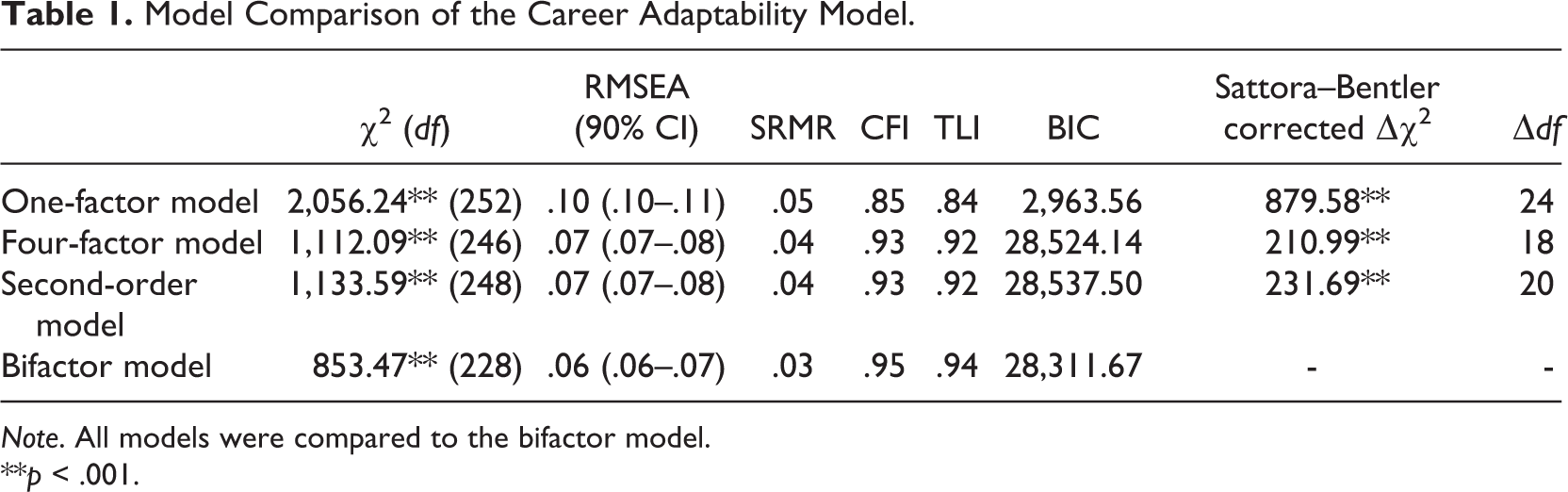
Note. All models were compared to the bifactor model.
**p < .001.
The general factor of career adaptability explained more than half of the items’ variance (52.8%). The specific factors of concern, control, curiosity, and confidence explained 14.9%, 10.7%, 9.3%, and 11.4% additional corresponding items’ variance, respectively. The values of ECV and PUC were .82 and .78, respectively. The examination of factor loadings (Table 2) revealed that all items had high loadings on the general factor (λ > .50) except for the item CAAS7 with the factor loading of .49. However, three items’ loadings (CAAS13, CAAS14, CASS18) of the specific factor of curiosity were insignificant (p > .05). One item loading (CAAS20) of the specific factor of confidence was also insignificant (p > .05). Furthermore, the reliability analysis showed that general career adaptability in the bifactor model was highly reliable (ωH = .93). The reliability of the specific factors of concern, control, curiosity, and confidence were ωHS = .20, ωHS = .16, ωHS = .10, and ωHS = .11, respectively.
Factor Loadings for the Bifactor Model of the Career Adaptability.
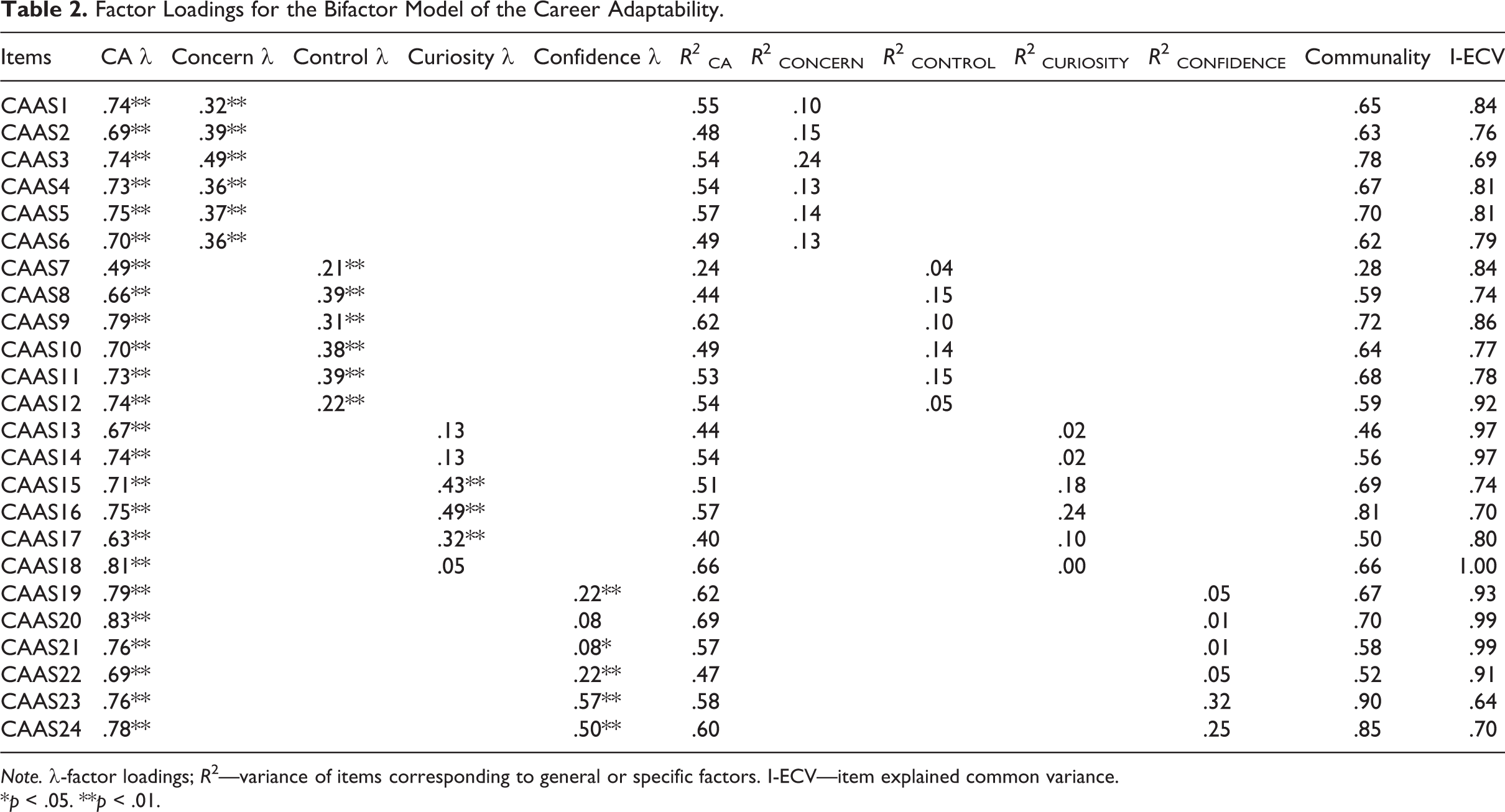
Note. λ-factor loadings; R2—variance of items corresponding to general or specific factors. I-ECV—item explained common variance.
*p < .05. **p < .01.
Relationship Between the General and Specific Factor of Career Adaptability and Job-Search Self-Efficacy
We specified the SEM model in which latent factors from the bifactor model were used to predict two factors of JSSE. Non-significant parameters from the bifactor model, that is, factor loadings for the specific factors of curiosity and confidence, were fixed to zero to obtain more degrees of freedom. Job-search self-efficacy and interview performance self-efficacy correlated freely. Employment status was added as a control variable on both self-efficacy factors, due to its possible effect on JSSE. As in CFA models, latent factors were scaled using the fixed factor method. The full information maximum likelihood estimation (FIML) with robust standard errors (MLR) was applied.
The model fitted the data well, χ2(562) = 1,617.31, RMSEA = .05 (90% CI [.05, .06]), SRMR = .04, CFI = .94, TLI = .93. The results (Figure 1) showed that general factor of career adaptability correlated positively with both job-search self-efficacy (β = .41, 95% CI [0.28, 0.53]) and interview performance self-efficacy (β = .39, 95% CI [0.26, 0.51]), supporting the H2a. Furthermore, confidence also correlated positively with job-search self-efficacy (β = .14, 95% CI [0.04, 0.23]) and interview performance self-efficacy (β = .13, 95% CI [0.03, 0.23]). Control had a positive correlation only with the interview performance self-efficacy (β = .17, 95% CI [0.05, 0.29]). Specific factors of concern and curiosity did not correlate with either of self-efficacy factors. Therefore, H2b was only partially supported. Employment status significantly controlled the variance of the interview performance self-efficacy (β = .09, 95% CI [0.05, 0.38]), but not the variance of the job-search self-efficacy (β = .04, CI [−0.06, 0.17]).
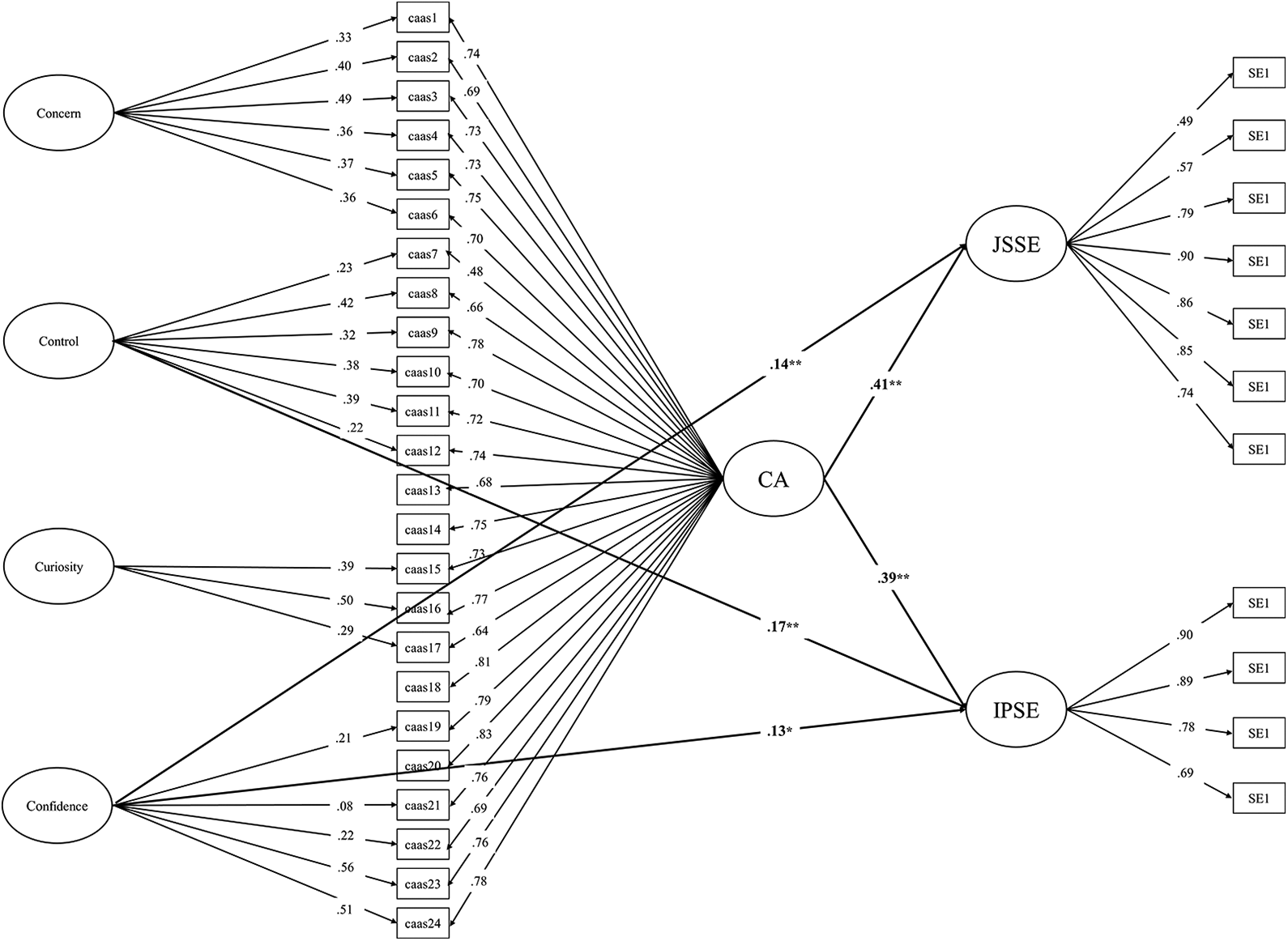
The relationships between general and specific factors of career adaptability and job-search self-efficacy.
Discussion
This study aims to contribute to the growing literature on career adaptability, with special emphasis on the relationship between career adapt-ability resource and JSSE. More specifically, we investigated whether career adaptability may be specified as the bifactor model with general factor and four specific factors that explain the additional variance of CAAS items, above the general factor of career adaptability. Furthermore, we examined whether both the general factor of career adaptability and four specific factors of concern, control, confidence, and curiosity had relationships with JSSE of graduates. First, the result has shown that CAAS measure can be represented by a bifactor model with strong general factor and four career resources that contribute to the explanation of only a small part of the items’ variance. Second, higher general career adaptability and higher confidence are related to higher job-search self-efficacy and interview performance self-efficacy of graduates, while higher resource of control is only related to interview performance self-efficacy. Other career resources—concern and confidence—are related to neither job-search nor interview performance self-efficacy.
Bifactor Model of Career Adaptability
The good fit of the bifactor model is expected since career adaptability construct consists of four dimensions, but with a strong general factor. Previous research specified career adaptability mostly as a second-order model, with general factor and four first-order factors (e.g., Rudolph et al., 2017a; Savickas & Porfeli, 2012). The career adaptability of graduates seems to be mostly defined by a strong general factor and only a small part of variance was explained with the residual specific factors. High ECV and PUC values also imply that career adaptability is mostly unidimensional.
It seems that the specific factor of curiosity represents this career resource particularly poorly after the variance of general factor is extracted, with three insignificant factor loadings. These results raise the question of whether low saturations imply a poor conceptualization of curiosity. In her review, Johnston (2016) singled out the item “Looking for opportunities to grow as a person” (CAAS14) as problematic since it refers to behavior, thus possibly reflecting an adapting response instead of adaptability resource. However, in this research, the low factor loadings of specific factor curiosity are expected, given that most of the items’ variance is already explained by the general factor, therefore, suggesting that curiosity is mostly represented by general career adaptability. The item “Keeping upbeat” (CAAS7) has the lowest communality than all other items and it is poorly explained by both general career adaptability and specific factor of control. A validation study across 13 countries also showed that this item has the lowest factor loading (Savickas & Porfeli, 2012). This item was not included in the initial form of the Portuguese CAAS-form because the translation of this item does not have meaning (Duarte et al., 2012; Savickas & Porfeli, 2012). It is reasonable to assume that the original item’s meaning is just partially captured by translation into other languages.
Often in research, career adapt-ability raw subscale scores are used in the analyses with Cronbach’s alpha as a sign of good reliability of measures. However, in some cases, such as when the multidimensionality of a measure exists, other coefficients such as omega seem to be a more appropriate measure of reliability (Cho & Kim, 2015). Although Cronbach’s αs in this research were high (presented in the method section), different results were obtained with omega coefficients. High omega coefficient for the general factor of career adaptability and rather low for specific factors emphasize the possible misleading interpretation of raw subscale scores (Rodriguez et al., 2016a). When omega hierarchical subscale values are low, subscales scores mostly represent a general factor. Therefore, it is misleading to interpret subscale scores as a unique measure of each resource without pointing out a strong resemblance they share, which arises from a strong general factor. There would probably not be much added value if we used subscale scores as predictors of some outcomes, compared to using only a total score of career adaptability. Also, multicollinearity may lead to model misspecification. To conclude, if researchers are interested in the unique variance of career adapt-abilities, other approaches such as bifactor modelling or relative weights analysis (Rudolph, et al., 2017a) seem more appropriate.
Relationship Between Career Adaptability and JSSE
As we hypothesized, general career adaptability positively correlated with both forms of JSSE. Graduates who possessed resources to deal with obstacles and transitions had more pronounced self-efficacy regarding their skills to find information and apply for a job, but also to perform well in the interview. These findings are in line with previous research (Guan et al., 2013; Pajic et al., 2018; Tolentino et al., 2019). We would like to acknowledge that we initially did not expect to differentiate between the two aspects of JSSE since it was shown to be a unidimensional construct (Wanberg et al., 2010). A different factor structure of JSSE may occur due to sampling difference, but also due to a different statistical approach. In the original study (Wanberg et al., 2010), participants were unemployed adults averagely in their 40 s. Since they already had a job, they probably had more experience with the job-search process, including job interviews. However, taking part in a job interview is mostly a new experience for graduates and therefore represents a different aspect from the job-search skills, such as finding information or writing and editing a CV. During their studies, they may have applied for student jobs. However, the situation in which they had to present themselves as experts in their field were probably rare, at least in the Croatian job market. Furthermore, from a statistical point of view, in the validation study of JSSE (Wanberg et al., 2010), authors included items from several constructs in the one EFA and CFA analysis simultaneously. Also, in the CFA they randomly combined items of the JSSE scale in three parcels, which may have decreased the opportunity to detect the dimensionality of the JSSE scale.
The specific factor of confidence had a positive relationship with both types of JSSE. These results were expected since confidence and JSSE partially overlap. The specific factors of career adaptability are orthogonal to the general factor in the bifactor model. Therefore, confidence has incremental validity over the general factor in explaining JSSE. As Savickas (2013) noted, career confidence develops from solving everyday problems. Success at different tasks may increase the feeling of self-acceptance, which in the long run reinforces the confidence to try new things. Therefore, a more confident person will have higher confidence in new activities, such as finding a job after university. In other words, the resource of confidence can have a spillover effect on more specific JSSE. Interestingly, career control had a relationship only with interview performance self-efficacy. Good job interview performance provides an opportunity to distinguish oneself from other candidates. Since higher control assumes agency and self-determination in career construction (Hartung & Cadaret, 2017), it may promote the self-efficacy of graduates’ interview performance. However, prior research showed that control did not predict JSSE within a sample of employed graduates (Guan et al., 2013). In the current research, this effect was significant even when controlling for employment status. However, more research is needed to clarify this relationship with the emphasis on the role of employment status.
Although Savickas (2005) singled out concern as the most important adaptability resource, it was not related to JSSE. An important aspect of concern is future orientation. Individuals with pronounced concern are aware that the choices they make will have an impact later in their career. They are thinking, planning, and preparing for the future. Concern may have more impact on the behavioral job-search aspects, such as job-search intensity. Finally, curiosity is not correlated with either dimension of JSSE. We expected that the inquisitive attitude and exploring competences of those with high concern will result in pronounced confidence in a job search. However, if the current labor market is disadvantageous for the new entrants, the resource of curiosity may not be necessary beneficial, given the feedback they receive. The discovery that the rate of employment is low may have reduced the positive effect of curiosity on JSSE, especially for those who want to work in the field of their expertise. This topic should be explored further by including the measure of objective employability as possible moderator.
Limitations, Strengths, and Implications for Future Research
This research has several limitations that should be considered when interpreting the results. The research was based on a cross-sectional design. Hence, we cannot make firm conclusions about the directionality of the effects. Based on the model of career adaptability (Savickas, 2013; Savickas & Porfeli, 2012), we specified the direct effect of career adaptability on JSSE. However, the reverse direction is also possible. Increased JSSE, upon a successful job-search process, may lead to the elevation of career adaptability resources. Graduates who feel confident about carrying out job search tasks can consequently develop their resources to cope with other career-related tasks.
Secondly, the general factor could imply a common method variance, which is often specified within bifactor models (e.g., Arias et al., 2018). The issue of the common method variance is more prominent when the source of information are self-reports (Podsakoff et al., 2012), such as those used in the current study. However, the general factor of career adaptability in the bifactor model accounted for more than 50% of the most items’ variance. Also, it had a theoretically meaningful correlation with JSSE. These reasons imply the existence of a meaningful factor rather than only a method factor (Highhouse et al., 2017). Both the issue of the common method variance and the directionality of the effects can be better addressed using a longitudinal design. In a longitudinal design, such as a cross-lagged panel design, researchers can estimate whether there is a significant across-time relationship between the hypothesized antecedent and outcome variable once the baseline level of the outcome variable has been controlled for. Additionally, direct and reverse causal relationships can be statistically compared, thereby identifying which one is more justifiable.
Furthermore, it should be noted that specific factors could be biased due to low factor loadings and it is questionable how well are they represented and how they capture the true meaning of adaptability resources. Although the findings on the relationships between specific factors and JSSE are partly in line with our hypotheses, they should be replicated in future research.
Finally, this research was conducted on Croatian graduates. The European Commission recently investigated the employability of graduates in eight EU countries, including Croatia (Meng et al., 2020). Croatia came second in terms of youth unemployment after completing higher education, having 23.8% of the unemployed. Also, it is estimated that as many as 40% of students who have completed a graduate school are in the risk category, which in addition to unemployment includes those who are employed in jobs that do not require higher education (vertical mismatch), or jobs that do not require higher education and are outside their field of expertise (double mismatch). Given these contextual factors, it would be interesting to examine whether obtained relationships would be replicated in other countries. Career adaptability may be even more important for JSSE when the job-search process is challenging, and the number of jobs is limited.
We believe that the current research adds to the growing literature on career adaptability. To the best of our knowledge, past research did not conceptualize career adaptability within the bifactor model. Future research could investigate more complex mediation models with bifactor approach (see Gonzalez & MacKinnon, 2018). Bifactor models can be also used to inform further development in the measurement of career adaptability. Given the suggestions to focus on four career resources instead only on general career adaptability (Rudolph et al., 2017a, 2019), there is a need for the instrument or another form of CAAS that would capture a more specific variance. The item variance of specific factors from the bifactor model may be used as a starting point.
Also, this study adds to the research on the role of career adaptability and its resources in the career transitions of graduates. Future studies may extend these findings by investigating the role of career adaptability in employment processes of populations with different social background. Duffy et al. (2016) in the Psychology of Working Theory postulated that both economic constraints and marginalization may have a negative effect on career adaptability. Therefore, it would be interesting to replicate the current study on people who seek employment after high school. If their decision not to continue education is a result of economic hardship, this may influence career construction processes and employment outcomes.
People entering the labor market today must be willing to adapt. Due to the changing nature of jobs, higher education cannot guarantee the knowledge and skills that will be needed and desirable in future. But it can encourage the development of resources that will allow an individual to better adapt to the unknown demands of the future.
Footnotes
Acknowledgments
The authors would like to express their gratitude to all the graduates who participated in the project. Also, the authors wish to thank the Croatian Employment Service, universities, career centers, and all the professors and students who helped with the recruitment.
Declaration of Conflicting Interests
The author(s) declared no potential conflicts of interest with respect to the research, authorship, and/or publication of this article.
Funding
The author(s) received no financial support for the research, authorship, and/or publication of this article.
