






Abstract
Experiencing career as a calling has implications for an individual’s career trajectory; yet, little is known about whether calling relates to career plateaus, which have the potential to stall an employee’s career path. This relationship is particularly interesting for members of the U.S. military, who have a relatively prescribed set of career experiences and opportunities. Serving in the U.S. military requires potential sacrifice, loyalty, and a sense of moral duty, all characteristics of what it means to experience one’s career as a calling. Yet, research has largely neglected to examine callings in the context of military service. We address these gaps by examining the relationships between career calling, career plateaus, and organizational commitment. We also examine whether social capital moderates these relationships via complementary or substitution effects. Using a two-wave survey sample of 237 officers, we found that calling negatively related to content career plateaus which in turn mediated calling’s positive relationship to commitment. Social capital moderated this mediation in a manner to suggest substitution effects. We discuss the implications of our findings for research on military careers, career as a calling, and affective commitment, as well as for practicing military officers and their leadership.
The men and women of the armed forces represent an important and dynamic asset for the U.S. military. Significant investment is made to ensure military personnel are well-trained to handle any range of hardships. Yet, reaping the full benefits of these investments remains a challenge for military leadership, as studies have documented the substantial impact of high turnover among military personnel (Dichter & True, 2015; Lancaster et al., 2013). Indeed, former Chief of Naval Personnel, Vice Admiral Robert P. Burke, recently advised the Senate Armed Services Committee that the “Navy’s ability to retain our most outstanding talent clearly depends on our ability to offer opportunities for personal growth and to appeal to their sense of service and connection to the mission” (On the Officer Personnel Management and the Defense Officer Personnel Management Act, 2018, p. 5). Along these lines, while motivations for military service vary (Wrzesniewski et al., 2014), examining the extent to which military personnel feel “called to serve” may yield useful insights for how to develop and retain them.
The question of what it means to experience career as a calling has received much attention among scholars recently (Dik & Shimizu, 2018; Thompson & Bunderson, 2019). When career is a calling, it is a consuming, meaningful passion (Dobrow & Tosti-Kharas, 2011) and a transcendent summons to serve others (Dik & Duffy, 2009). Calling has recently been the subject of both a comprehensive literature review (Thompson & Bunderson, 2019) and a comprehensive theory, the work as a calling theory (Duffy et al., 2018); yet, there is still much to understand about how callings relate to important work and career outcomes.
Given the nature of sacrifice involved, military service is a particularly relevant and powerful context in which to study calling. Serving in the armed forces involves prototypical characteristics of a strong calling, such as a sense of moral duty, service to others, and personal sacrifice (e.g., Bunderson & Thompson, 2009; Dik & Duffy, 2009). Yet, a study of West Point cadets found variance both in their motivation for serving being intrinsic and/or extrinsic, as well as their career expectations following graduation (Wrzesniewski et al., 2014). People’s senses of calling vary greatly, even in the same job roles (Wrzesniewski et al., 1997), and this is likely true even in a highly-structured institution like the U.S. military.
As such, this study seeks to examine how callings relate to important work and career outcomes for active-duty members of the U.S. military. Specifically, we look at how callings relate to the experience of career plateaus and affective organizational commitment among uniformed junior officers (equivalent to front-line and mid-level managers). Given the constraints around military careers in terms of advancement within the hierarchy and number of years in service, military personnel may reach plateaus earlier in their careers than do civilians (Cheng & Su, 2013). As opposed to structural career plateaus whereby one does not expect to advance within the organizational hierarchy, we focus instead on content career plateaus, or the “absence of new, challenging or varied tasks without possibilities of improvement or learning” (Nachbagauer & Riedl, 2002, pp. 719–720), which seem more salient and actionable for military leadership given the institutional constraints on their promotion policies. Focusing on content versus structural plateaus also makes sense given the contemporary career context in general, where advancement may not follow a traditional upward track, and both physical and psychological barriers to advancement may occur (Sullivan & Arthur, 2006). While callings have been studied in the context of employability and career flexibility (Lysova et al., 2018), they have not been examined in relation to career plateaus.
Perceiving a career plateau, whether in content or structure, matters in part because it may reduce affective organizational commitment (Nachbagauer & Riedl, 2002). The relationship between calling and commitment to the organization, occupation, and career has been well-established (Duffy et al., 2011, 2018, 2019; Sawhney et al., 2020). We draw upon work as a calling theory (WCT) to assess the extent to which this is true for our sample, that is, that they are committed to remaining in the military. Despite numerous technological advances, personnel remain among the military’s most valuable assets and the cost to replace service members is high (Lancaster et al., 2013). Thus, improving officer commitment to remain in the military seems critical to its success.
Moreover, to better understand the factors that might influence the relationship between calling and commitment through career plateaus, we consider one such factor: social capital, or the resources that accompany personal relationships, often viewed together as a social network (Coleman, 1988). Social capital is one form of organizational support and a central moderator in the WCT. Social capital increases career prospects and likelihood of mobility (e.g., Granovetter, 1973; Podolny & Baron, 1997), which may enable service members to overcome perceived career plateaus by either complementing one’s calling or compensating for a lack thereof. Our investigation aims to provide clarity to these contrasting, yet equally plausible, effects.
This research makes several contributions to research and practice. First, we provide a foundational view of calling in the active-duty U.S. military, bringing a previously unexplored lens to understand the military experience from the view of personal fulfillment and engagement. Although the military is a specific context, it could shed light on the experience of calling for other people in high-risk first responder roles, like police officers, firefighters, security guards, and even healthcare workers during the COVID-19 pandemic (Zhou et al., 2020). Second, we contribute to research on calling by considering a novel career-relevant outcome: perceived content-related career plateaus and their impact on organizational commitment. To the extent that those with strong callings are less likely to perceive a career plateau in terms of their learning and development, we hypothesize that this will have positive implications for their commitment to their organizations. Finally, we add to the growing list of studies to employ WCT to test novel hypotheses (e.g., Ehrhardt & Ensher, 2020; Presbitero & Teng-Calleja, 2020; Sawhney et al., 2020), as WCT incorporates key components of our proposed model.
When Career Is a Calling
In one of the foundational conceptual papers on calling, Hall and Chandler (2005, p. 160) state, “One of the deepest forms of satisfaction or psychological success can occur when the person experiences work as more than a job or career—when it is a calling.” Though calling does not necessarily entail a religious or spiritual connotation, it does typically include a sense that work can be helpful to people or society, even if indirectly, and is believed to fulfill one’s purpose in life (Hall & Chandler, 2005; Wrzesniewski et al., 1997). Rather than viewing calling as a binary concept that one either experiences entirely or not at all, contemporary conceptualizations view calling as a continuous variable that individuals experience to varying degrees and at various points in their life (Dobrow & Tosti-Kharas, 2011; Dobrow, 2013).
Calling may provide extensive career advantages for individuals as it is thought to enable greater self-awareness, self-efficacy, and proactivity which ultimately increase one’s potential to achieve both objective and subjective success (Briscoe & Hall, 2006; Hall & Chandler, 2005). Moreover, the benefits of calling likely extend beyond the career domain as people with a calling “may improve their career decision making and their lives overall” (Dobrow, 2013, p. 446). Further, calling can also be felt at the organizational level, enhancing employees’ attendance and commitment, and reducing turnover intentions (Duffy et al., 2011; Wrzesniewski et al., 1997).
Yet, for all the benefits that accrue both to individuals who experience career as a calling and their employing organizations, recent research has viewed calling as a “double-edged sword” that has attendant downsides (Bunderson & Thompson, 2009, p. 39). Although those with strong callings are more engaged, they may be less likely to disengage from their work in their off hours, negatively affecting physical health (Clinton et al., 2017), personal relationships (Oelberger, 2018), and pay (Bunderson & Thompson, 2009). In addition, calling may result in a kind of rigid career inflexibility that negatively affects both employability (Lysova et al., 2018) and advice-taking (Dobrow & Tosti-Kharas, 2012).
WCT (Duffy et al., 2018) acknowledges the complexity inherent in pursuing one’s calling. That is, WCT examines both positive—job satisfaction and performance—and negative—workaholism, withdrawal, burnout, exploitation—outcomes of calling. The theory also acknowledges the distinction between perceiving and living a calling, addressing that not everyone is able to live out their calling through their work (Berg et al., 2010; Duffy et al., 2013).
We draw on WCT because it directly addresses several of the key components of our hypothesized model. First, it examines career commitment as an outcome of perceiving a calling, which relates to our key dependent variable, affective commitment. Second, the main mediating mechanism between calling and commitment in the model is person-environment fit, which relates to our focal construct of career plateaus in that one of the main reasons people experience a plateau is because they feel a lack of fit with the career environment which will not allow them to pursue their desired goals (Godshalk & Fender, 2015). Third, WCT considers organizational support, “the level of provision, care, assistance, and encouragement that employees experience within their work environment that can be attributed to the organization” (Duffy et al., 2018, p. 429), as a moderator of the relationship between perceiving a calling and person-environment fit, which in turn leads to commitment. Our proposed moderator, social capital, is a form of organizational support, as it includes the personal network of relationships the person has formed within organization (Duffy et al., 2018), and which can in turn be beneficial to their careers (Seibert et al., 2001). We add a novel factor, career plateaus, to extend the model.
Hypothesis Development
In this study, we focus specifically on the relationship between calling and organizational commitment among United States military officers. As illustrated in Figure 1, we suggest that calling enhances service members’ commitment by reducing their experience of career plateaus. Organizational commitment is the strength of an employee’s association with and involvement in an organization (Steers, 1977). It entails a strong belief in and acceptance of the organization’s goals and values, a willingness to exert considerable effort on behalf of the organization, and a strong desire to maintain membership in the organization (Porter et al., 1974). Following prior research (e.g., Duffy et al., 2011) we focus specifically on calling’s effect on affective commitment—which refers to one’s emotional attachment to the organization and expressed in a person’s identification with the organization (Allen & Meyer, 1990).

Hypothesized model. T1 = Time 1, T2 = Time 2.
As reflected in WCT, research in non-military contexts has shown that those who experience a calling are more likely to be committed to their vocation and employer (Duffy et al., 2011). We anticipate that these relationships are potentially even stronger in the military setting as well. Given that people with a calling are more committed to their career goals (Hirschi, 2011), those who feel called to serve in the armed forces must enact their career goals within the military. Service members may, to some extent, be able to pursue their callings across branches of service, but their options are necessarily limited to these few organizations. Moreover, a calling involves personally meaningful work coupled with a prosocial motive to help others, both of which are associated with higher levels of persistence, satisfaction, citizenship, and commitment (e.g., Duffy & Autin, 2013; Lysova et al., 2018; Peterson et al., 2009; Praskova et al., 2014; Rodriguez et al., 2019). Being “called to serve” in the military represents a personally meaningful way to serve the greater good, so we should expect similar effects with respect to calling among military officers.
The Explanatory Role of Career Plateaus
A career plateau represents a lack of career growth either in terms of upward mobility, referred to as a structural career plateau, or in terms of opportunities for development, a content career plateau (Nachbagauer & Riedl, 2002). Individuals experiencing plateaus perceive stagnation in their careers, which can have severe deleterious effects for them and their organizations by reducing satisfaction and commitment, while increasing physical and psychological withdrawal, emotional stress, turnover, and depression (McCleese et al., 2007; Nachbagauer & Riedl, 2002; Near, 1985).
As previously mentioned, this study focuses on calling’s relationship to content career plateaus as they represent one’s capacity to grow by acquiring new skills, pursue graduate education, or develop expertise based on the career field. Content plateaus occur when people feel that their opportunities to experience, for example, challenging assignments, skill acquisition, and continued learning are limited (Nachbagauer & Riedl, 2002). In line with WCT, we are more concerned with the feelings of growth and meaning within one’s current position/rank that can facilitate both perceiving a calling and living a calling (Duffy et al., 2018) and potentially foster psychological well-being (Deci & Ryan, 2002; Ryff, 1995). That is, growth-in-position rather than position-advancement represents a potentially more valuable pathway to organizational commitment.
Moreover, drawing further upon WCT, we argue that the experience of content plateaus may signal a lack of fit within the organization and/or career. Duffy et al. (2018) suggest that person-environment fit is a central mediating mechanism linking perceived calling and career commitment because fit enables individuals to meet their particular needs. In contrast, content plateaus are indicative of poor fit with one’s environment, suggesting that individual needs for growth, learning, challenge, and mastery are not being met. As such, we examine the influence of content plateaus in the relationship between calling and affective organizational commitment.
The relationship between calling and career plateaus has not yet been studied. Yet, there is reason to believe that a strong calling will accompany a lack of perceived content career plateaus. Those with strong callings may be better able to overcome content career plateaus that confront them. Callings have been linked to career goal self-efficacy (Allan & Duffy, 2014), career decidedness and self-clarity (Duffy & Sedlacek, 2007), and better coping skills (Treadgold, 1999). Calling among the unemployed led to a more proactive job search and more positive assessment of their situations (Duffy et al., 2015). Moreover, people with strong callings are likely to be resilient because an important part of resilience is “finding meaning in one’s environment” (Coutu, 2002, p. 6). Resilience is defined as “the process of, capacity for, or outcome of successful adaptation despite challenging or threatening circumstances” (Howard & Johnson, 2000; Martin & Marsh, 2006, p. 3; Powley, 2009). Resilient people “build bridges from present-day hardships to a fuller, more construed future” (Coutu, 2002, p. 5). As such, resilience within individuals with a calling will allow them to adapt to and overcome obstacles that may contribute to career plateaus. Taken together, the proactivity, self-efficacy, coping skills, and resilience that accompany a calling should help individuals to quickly push past content plateaus or even avoid perceiving them altogether.
Previous research has shown career plateaus to have negative implications on satisfaction, commitment, and turnover (Nachbagauer & Riedl, 2002; Tremblay et al., 1995; Wang et al., 2014). When plateaus occur, employees become less motivated and often feel less valued by the organization, causing them to psychologically detach from their work (Elsass & Ralston, 1989; Rotondo & Perrewé, 2000). Content plateaus can be particularly demotivating because a lack of developmental opportunities hinders not only one’s personal growth and well-being, but also one’s potential value in both the organization and the broader labor market (DiRenzo et al., 2015). As such, when deprived of chances to increase skills and career capital, individuals begin searching outside their current organizations for better alternatives in which to grow (DiRenzo & Greenhaus, 2011).
Social Capital: A Complement or Substitute for Career Calling
Extending WCT, which suggests that organizational support is a proximal moderator on the influence of calling (Duffy et al., 2018), we propose that additional forms of support may impact the influence of calling on plateaus and commitment as well. In particular, social capital represents “the aggregate of resources embedded within, available through, and derived from the network of relationships possessed by an individual” (Inkpen & Tsang, 2005, p. 151). Social capital plays a major role in a variety of employee experiences pertaining to career growth and development, including work design (Grant & Parker, 2009), employability (Fugate et al., 2004), job search and turnover (DiRenzo & Greenhaus, 2011), and career success (Ng et al., 2005; Seibert et al., 2001). This is because social relationships are resources that can be tapped for career guidance, expertise, learning, exposure, and information (Defillippi & Arthur, 2006; Eby et al., 2003), which can give individuals a strategic advantage in their careers (Forret & Sullivan, 2002).
Social capital can either complement or substitute for other resources that individuals possess, and vice versa (Adler & Kwon, 2002). With regard to our model, calling represents a motivational resource that provides meaning and resilience in one’s career (Thompson & Bunderson, 2019). Hence, a complementary perspective suggests that the negative effect of calling on content plateaus is particularly strong when accompanied by high levels of social capital. This perspective assumes that the availability of both types of resources has synergistic effects. For instance, a strong calling is necessary to drive individuals to capitalize on their social capital for career advice and utilize contacts for continued learning and career growth. Drawing from DeFillippi and Arthur’s (2006) foundational model of career competency, these individuals will be empowered with both the “knowing why” (calling) and “knowing whom” (social capital) pillars of career development. The complementary perspective also aligns with the rationale underlying WCT. The authors highlight potential synergistic effects when arguing that greater fit and commitment may be driven by “the social capital that may result from the interaction of an employee with a perceived calling and a supportive organization” (Duffy et al., 2018, p. 429). Hence, contemporary theorizing suggests a complementary effect.
On the other hand, a substitution perspective would suggest that the effect of calling on content plateaus is particularly strong when individuals lack the social resources that would otherwise foster continued career growth. That is, the motivational resources that flow from a strong calling (e.g., proactivity, resilience) compensate for the lack of resources embedded in one’s social capital (e.g., exposure, support). Under this perspective, the internal drive inherent in a strong calling is especially important when individuals cannot tap their contacts for guidance or support. Absent the social network to facilitate career growth, the strength of one’s calling becomes more important. Because the two perspectives are both plausible and in line with current theorizing about social capital (Adler & Kwon, 2002), we present competing hypotheses:
Method
Participants and Procedure
To test the hypotheses, we surveyed active members of the U.S. armed forces at two time periods. Participants were officers from all branches of the military who were currently enrolled full-time in a 1.5-year graduate Master of Business Administration (MBA) degree program. The military members in our sample were junior officers who were at the front-line supervisory level and at mid-career, with approximately 10–12 years of service. Their primary role is to provide direct support for operations (e.g., logistics and supply management, data analytics, financial management, training and safety) and to supervisor the enlisted personnel under them. At the outset of their program, participants received an email with a link to complete an online survey (Time 1). Eighteen months later, just prior to graduation, participants received a follow-up survey (Time 2). Initially, 436 individuals received invitations to participate in the study. Of those, 341 respondents completed the survey at Time 1, representing an initial response rate of 78.2%. The final sample included 237 respondents who provided complete responses at both Times 1 and 2, resulting in an attrition rate of 30.5% across the two data collections. Comparison of Time 2 respondents and non-respondents indicated no significant differences in their scores across any of the Time 1 measures and no significant differences across demographic variables.
Officers are an appropriate sample in which to study calling because it may be argued that they carry more employability. Graduate education, and in particular the MBA, opens possibilities for future military positions, post-military contractor opportunities, or private sector employment. Furthermore, there are greater ‘costs’ associated with turnover due to the difficulty of replacing officers compared to replacing enlisted personnel.
Of the 237 respondents included in the sample, 84% were male, with an average age of 33 years (SD = 4.70, range = 23–57 years) at Time 1. The racial breakdown of the sample was: 74% Caucasian, 7% Asian American, 6% African American, 4% Latino/a, and 9% other. Eighty percent reported being married or living with a partner, and 60% had children under 18 years of age (M = 1.20, SD = 1.22, range = 1–5 children). The sample represented various branches of the U.S military, as follows: 47% Navy, 25% Marines, 14% Army, 9% Air Force, and 2% Coast Guard. The average tenure in the military was 11.62 years at Time 1 (SD = 5.22, range = 1–27 years), and the average rank was 3.43 (SD = 1.10, range = 1–8).
Measures
Calling
We used Dobrow and Tosti-Kharas’s (2011) 12-item Calling Scale to measure calling at Time 1. This is one of the most commonly-used scales to measure calling, and was initially validated using over 1,500 respondents across a number of domains, from music and the arts to business, and has been cross-validated in more recent studies (Duffy et al., 2015). The scale is designed to be adapted for the specific calling domain; accordingly, for this study, items were worded to represent a calling toward being in the military. For example, sample items were, “I feel a sense of destiny about being in the military” and “I would sacrifice everything to continue serving in the military.” As in the original scale, items were rated on a 7-point Likert-type scale (1 = strongly disagree, 7 = strongly agree). Coefficient α was .89. Reliability estimates between .80 and .90 are considered “very good” (DeVellis, 2003).
Organizational commitment
We assessed affective organizational commitment at Time 2 via Meyer and Allen’s (1997) 6-item Affective Commitment Scale. The scale was designed to specifically measure affective commitment, while normative and continuance commitment were measured using separate scales (Allen & Meyer, 1990). One of the most widely used scales to measure affective commitment, the Affective Commitment Scale has been shown to be unidimensional (Merritt, 2012). Items, such as “I would be very happy to spend the rest of my career in this organization” and “This organization has a great deal of personal meaning to me” were rated on a 5-point Likert-type scale (1 = strongly disagree, 5 = strongly agree). Coefficient α was .88.
Career plateaus
We assessed the extent to which respondents felt they had encountered career plateaus at Time 2. We use a novel scale developed by Godshalk and Fender (2015) to separate out the reasons behind a career plateau versus simply measuring the presence of a plateau—i.e. as a low chance for promotion. The authors developed and validated scale measures to separately address content- and structure-related career plateaus. We used their 5-item scale to measure content-related career plateaus. Participants rated items such as “I will learn and grow in my job,” and “My job responsibilities will increase significantly in the future” (reverse-scored) on a 5-point Likert-type scale (1 = strongly disagree, 5 = strongly agree). The coefficient α was .81.
Social capital
We measured social capital at Time 1 using an 11-item scale that we created for this study by combining two existing scales. First, we drew upon Eby and colleagues’ (2003) seven-item “knowing-whom” competency scale that was designed to measure breadth of personal network contacts both within and outside the organization. These items include “I have a lot of contacts within the organization” and “I am well networked with individuals outside my organization.” Second, we complemented this scale with four additional items developed by Colakoglu (2005) to broaden the existing items developed by Eby and colleagues to additional contact outside of the organization. These items include “I am well-connected in my community” and “I have a wide network of relationships with individuals from different civic and social groups, clubs, and organizations.” All items were rated on a 5-point Likert-type scale (1 = strongly disagree, 5 = strongly agree). These items were previously shown to have strong internal reliability (coefficient α = .89) despite being drawn from two sources (Colakoglu, 2005), and the same was true in our sample, where coefficient α was .88.
Controls
We included several control variables in our analyses, all of which were assessed at Time 1. Research on career plateaus tends to include demographic control variables, such as age, gender, and tenure in the organization (Godshalk & Fender, 2015), which we used as well. Age and tenure were reported in years. We also included specific controls aimed at better understanding the military officers’ career-relevant differences, in this case, branch in the armed forces and military rank. We created dummy codes for branch of the military using Navy as the default code since this was the branch more represented in the data (therefore, we created separate dummy codes for Marines, Coast Guard, Army, and Air Force). Rank is an ordinal scale ranging from 1-8, where higher numbers represent higher positions in the hierarchy.
Results
Descriptive statistics, scale αs, and Pearson correlations for all study variables can be found in Table 1. The average level of calling for the military officers in our sample was 4.84 (SD = .98), on a scale from 1 to 7. By comparison, previous studies using the same scale have reported that business students (M = 4.20, SD = .99) and managers (M = 4.40, SD = 1.28) reported similar levels of calling, while musicians (M = 5.84, SD = .83) and artists (M = 5.70, SD = .89) reported higher levels of calling (Dobrow & Tosti-Kharas, 2011). Calling was positively correlated with organizational commitment (r = .14, p = .03) and social capital (r = .24, p < .001), as well as gender (r = .16, p = .02), with men reporting stronger callings than women. Career plateaus were negatively correlated with both calling (r = −.18, p = .01) and organizational commitment (r = −.31, p < .001). The strength of military officers’ callings did not depend on their branch of the military—further supported by t tests between the different branches, all which were non-significant—their rank or tenure.
Means, Standard Deviations, Scale Reliabilities, and Pearson Correlations for Study Variables.
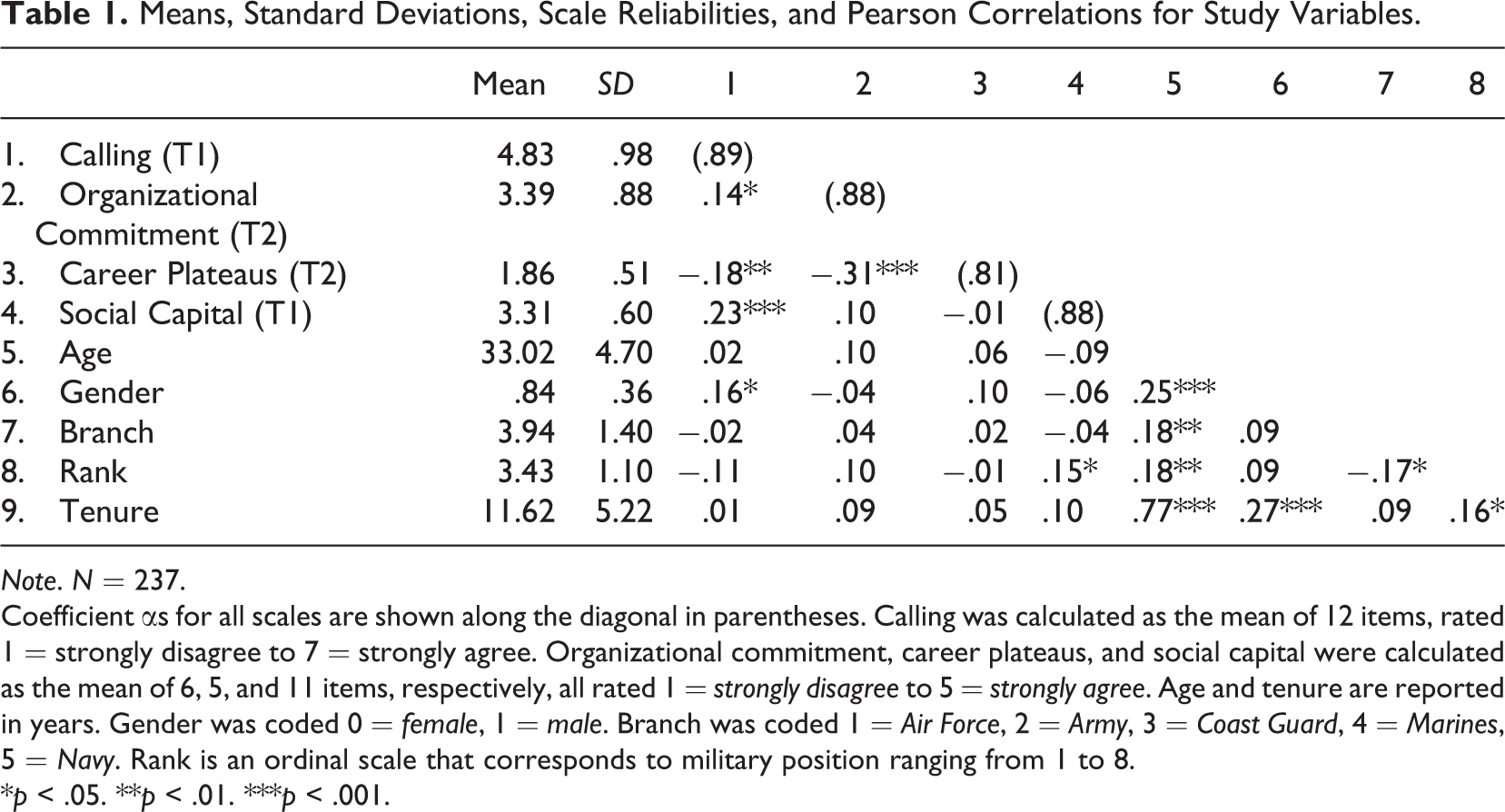
Note. N = 237.
Coefficient αs for all scales are shown along the diagonal in parentheses. Calling was calculated as the mean of 12 items, rated 1 = strongly disagree to 7 = strongly agree. Organizational commitment, career plateaus, and social capital were calculated as the mean of 6, 5, and 11 items, respectively, all rated 1 = strongly disagree to 5 = strongly agree. Age and tenure are reported in years. Gender was coded 0 = female, 1 = male. Branch was coded 1 = Air Force, 2 = Army, 3 = Coast Guard, 4 = Marines, 5 = Navy. Rank is an ordinal scale that corresponds to military position ranging from 1 to 8.
*p < .05. **p < .01. ***p < .001.
To test Hypotheses 1 and 2, we conducted multiple regression analysis, where the dependent variables were regressed on the control variables—age, gender, dummy codes for branch, rank, and tenure—and the independent variable, calling at Time 1. We found evidence of heteroskedasticity by examining both the residual plots and skewness and kurtosis coefficients for our models. Therefore, we adjusted for heteroskedasticity in our standard errors using the HCREG macro (Hayes & Cai, 2007). As predicted, calling at Time 1 was positively related to affective commitment at Time 2 (B = .16, SE = .07, p = .03), thereby supporting H1. Time 1 calling was negatively related to experiencing a content-related career plateau at Time 2 (B = −.10, SE = .04, p = .02), thus supporting H2a. Also, as expected, experiencing a content-related career plateau was negatively related to affective commitment, both at Time 2 (B = −.54, SE = .15, p < .001), in support of H2b. These results are presented in Table 2.
Multiple Regression Results.
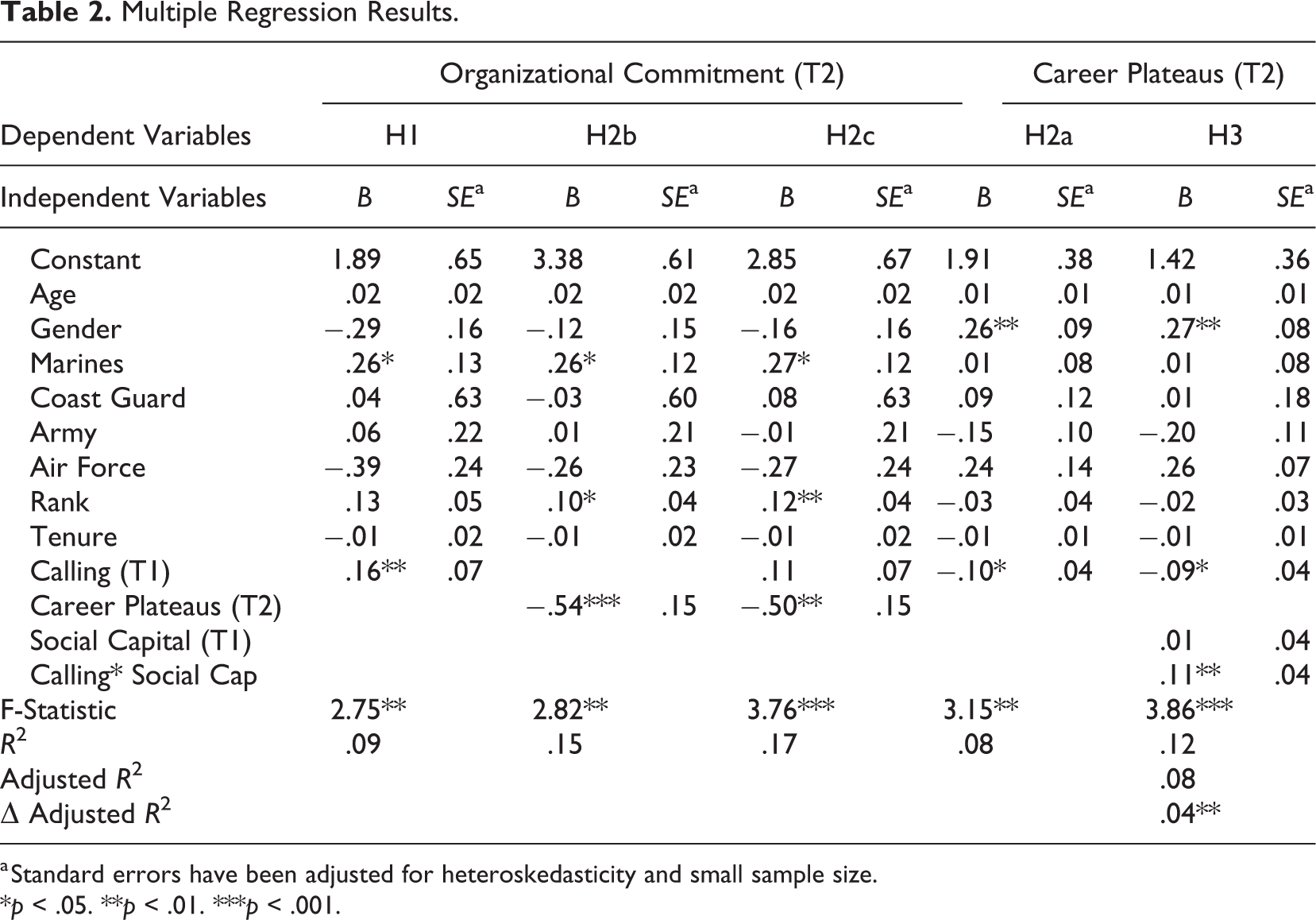
a Standard errors have been adjusted for heteroskedasticity and small sample size.
*p < .05. **p < .01. ***p < .001.
To test Hypotheses 2c and 3, we again used multiple regression via the HCREG macro so that we could again adjust standard errors for heteroskedasticity and sample size. 1 We found that, consistent with mediation (Baron & Kenny, 1986), when content-related career plateaus were added to the model, they remained significant (B = −.50, SE = .15, p = .001) while the effect of calling became non-significant (B = .11, SE = .07, p = .11). Thus, Hypothesis 2c was supported.
Finally, we examined Hypothesis 3 testing the interaction of calling and social capital on career plateaus. We created an interaction term using the centered variables for calling and social capital and entered that into the equation and estimated its value and significance (Baron & Kenny, 1986). Indeed, the interaction term was significant and positive (B = .11, SE = .04, p = .008). Full model results are presented in Table 2. The shape of the interaction for Hypothesis 3 can be found in Figure 2. As predicted by H3b, the negative relationship between calling and career plateaus was stronger for low levels of social capital compared to high levels of social capital. Therefore, the substitution versus complementary perspective on social capital was supported by our results. 2

Graph of interaction between calling and social capital on content-related career plateaus (Hypothesis 3).
Discussion
This paper provides an initial look into a highly relevant but often overlooked setting for examining career calling: the U.S. military. In doing so, we found that officers who felt more called toward being in the military perceived fewer career plateaus and as a result were more committed to remaining in the military. Social capital moderated this relationship such that officers with higher social capital were less affected by the negative relationship between calling and career plateaus, with a strong calling being particularly salient to individuals who lacked social resources.
Theoretical Contributions
This study stands to make several important theoretical contributions. First, we contribute to research on calling and our understanding of how calling relates to career plateaus, or people’s senses that their careers have stalled. While calling has been linked to employability (Lysova et al., 2018), the link between calling and perceived career plateaus has not been examined. The negative relationship between calling and career plateaus may exist because those with strong callings are less likely to experience plateaus, or because plateaus are less relevant to them because they work for fulfillment and not advancement (Wrzesniewski et al., 1997). Given the potential that those with strong callings can sometimes have an over-inflated sense of their career potential, compared to the perception of others such as trusted mentors (Dobrow & Tosti-Kharas, 2012) or judges of objective ability (Dobrow Riza & Heller, 2015), future research should seek to validate these self-perceptions of career growth potential (vs. plateau) with external perspectives and actual outcomes.
Second, we add an explanatory factor, career plateaus, to the relationship between calling and organizational commitment (e.g., Duffy et al., 2011). In particular, our findings contribute to and complement Work as a Calling Theory, which has proposed (Duffy et al., 2018) and tested (Duffy et al., 2019) a relationship between calling and career commitment, and has since been extended to consider occupational commitment (Sawhney et al., 2020). Those with strong callings may have heightened expectations of what their employers will provide them (Bunderson & Thompson, 2009), including being able to grow, develop, and approach new challenges at work. Employers who are able to provide employees with such novel experiences will have more committed employees. Future research should continue to explore both upstream drivers of organizational commitment as well as potential downstream outcomes of the relationship between calling and career plateaus, perhaps including positive outcomes like job satisfaction and performance, and decreased turnover and increased prosocial behavior, and negative outcomes like burnout, as prescribed by the WCT (Duffy et al., 2018).
Third, our findings regarding the moderating role of social capital on both the relationship between calling and career plateaus as well as the mediation of calling to organizational commitment via plateaus support a substitution versus complementary effect of social capital. Indeed, the effect of calling was not particularly strong when individuals also had extensive social capital resources. In this way, it seems the motivational resources embedded in calling and the relational resources embedded in one’s social network act to counterbalance one another. These findings are particularly interesting as they are in contrast to prior theorizing around the effects of organizational support (Duffy et al., 2018). One likely explanation is that individuals with strong callings are compelled by a sense of personal responsibility for their career and are driven by an inner desire or moral duty to develop both themselves and their career opportunities on their own (Bunderson & Thompson, 2009); while those who are less motivated by the work itself spend comparatively greater time cultivating network connections that can help them find greater fulfillment in their work. Moreover, our focus on career development and growth via notions of career plateaus likely informs perceptions of meaning and P-E fit as opposed to being direct correlates. Nevertheless, our findings draw attention to the nuanced relationships that calling may have with various types of career-related and organizational-related support. In this way, future research should endeavor to extend WCT by better understanding the relationship between calling and various forms of career capital (e.g., psychological, human, social) and the mechanisms leading to each, as well as how individuals differentially utilize these resources to achieve various career-related outcomes (e.g., internal vs. external employability, objective vs. subjective career success). Extending this notion further, given that mentors often serve as both useful contacts and an important means to making connections with others, our findings regarding social capital invoke questions about the relationship between calling and mentoring as well. The mentoring literature is quite rich, and while most work would suggest that highly motivated individuals are prone to seeking mentors to facilitate their careers, our results suggest that perhaps those with such an extreme form of intrinsic motivation, as is the case with calling, may indeed be less likely to capitalize on the relationships they develop and cultivate fruitful developmental networks. Further exploration of motivational dynamics that extend from callings and their influence on various forms of career development behavior and the acquisition of distinct forms of career capital seems warranted.
Finally, by examining calling in the context of the U.S. military, we add to the understanding of how calling operates within an “extreme” setting that requires sacrifice, loyalty, and moral duty, central elements of career calling (Bunderson & Thompson, 2009; Zhou et al., 2020). While it may be assumed that most military members, especially those who become officers, would experience strong callings toward their career, we found a mean calling comparable to that of managers and considerable variance. Previous studies have confirmed that newer military members experience a variety of motivations, intrinsic and extrinsic, toward their work (Wrzesniewski et al., 2014). Future research should continue to explore how career calling operates for members of the armed forces and similar extreme contexts.
Practical Contributions
There are several practical implications for military leadership and talent management. In line with the comments made by Vice Admiral Burke at the outset of this paper, it is imperative that all branches of the military focus on the continuous growth and development of their personnel, and this growth should be aligned with a sense of purpose and mission. While the growth of all personnel is important, those individuals with strong callings for serving in the military may be paramount. Hence, it will be useful to seek out those with strong callings and develop their careers so as to minimize their exposure to career plateaus. Doing so may require reassessing the current talent management system, rooted in an “up-or-out” culture, and instead turn toward the idiosyncratic needs of each individual. Moreover, given the very strong influence of social capital to those without strong callings, and the potential for social capital to substitute for calling when it comes to responding to plateaus, it likely behooves each military service branch to consider greater investment in mentorship programs to help build officers’ developmental networks. While these programs currently exist to varying levels of formality and usefulness in each branch of service, greater investment in and attention to these programs will likely pay dividends with respect to talent retention later on in service members’ careers. We believe these findings might also extend to others in highly bureaucratic or regimented career paths, such as government workers or organizations that reward seniority versus merit, or to other “strong-culture” contexts that require the dedication and potential for sacrifice of the military, including first responders such as police officers, firefighters, and emergency medical personnel.
Limitations
This study has several limitations to consider. First, our sample were officers in the military who were receiving their MBA degrees. Thus our findings may not generalize to other contexts, and should be validated using more traditional organizational settings and occupations. It is also worth noting that for the purposes of our study officers were an attractive sample because of their commitment to their military career and presumed desire for career growth. But their perspectives and experiences may not be entirely representative of members of the military in general, especially those at lower ranks. Compared to the average service member, the officers in our sample are likely more externally employable. This means that in the context of this study, if calling is weakened or the officer experiences a plateau—that is, they perceive that the content of their work diminishes in meaning—they may wait out time in a position and then decide to seek employment or opportunities elsewhere. Future research should seek to examine a wider variety of military positions and career paths to examine the generalizability of our findings even within the military, and also consider comparative tests across the enlisted and officer ranks as well as across branches of service and job functions.
Second, and related to the point above, we adjusted the variables included in the hypothesized model in part based on what made sense for our sample. The interplay of military promotion structure and commitment informed our choice of variables. We focused on affective commitment vs. normative or continuance commitment as our dependent variable, because we believed affect would best reflect variance in officers’ attachment to remaining in the military more so than normative or continuance committment. That said, normative and continuance commitment may play a minor and limited role in calling. Moreover, due to constraints endmeic to military hierarchy, we also focused on content-related versus structural career plateaus. While there is some variation in military career tracks, military officers have a very prescribed pathway for advancement and it is nearly impossible to change structural barriers related to rank and tenure. This led us to consider other mechanisms that explain military officers commitment and the relationship to calling. So, we also focused on social capital as a moderator and not human, financial, or physical capital, because we believed it might best reflect the amount of support, within and outside the military organization itself, available to the officers in our sample.
Third, while we sampled participants at two time periods to avoid bias in our results due to common method variance (Podsakoff et al., 2003), this approach does not allow a longer-term look at how participants’ careers played out over time. Future research should examine people’s careers longitudinally, over three or more periods spanning several years and potential career transition points. As mentioned earlier, it would be particularly interesting to examine actual career moves to gauge whether those with strong callings both perceive and actually experience fewer plateaus in their careers. The transition out of the military might be similar to other major cross-occupational career transitions, which raises the question of what knowledge, skills, and experience transfers to the new positions (Dokko et al., 2009).
Finally, our data were all self-reported from the employees’ perspectives, which makes sense given the cognitive nature of our focal variables. However, it would be useful to gauge the perspectives of others on calling and organizational commitment, such as co-workers and supervisors. Given how interdependent work in the military is—where officers’ lives rely on each other—the perspectives of others seems particularly important to understand. Future research could also examine a wider variety of outcomes, such as satisfaction and performance (Duffy et al., 2018; Kim et al., 2018) and organizational citizenship behavior (Elangovan et al., 2010) that may be observed by both employees themselves and others in the workplace. Moreover, this examination may enable calling research to extend to the team-level. Perhaps contagion effects occur, in which one individual’s calling inspires others on the team to higher levels of task and contextual performance. We may find that the benefits of calling carry on to second- and third-order effects, making it all the more valuable to adequately develop and retain these highly motivated employees.
Footnotes
Declaration of Conflicting Interests
The author(s) declared no potential conflicts of interest with respect to the research, authorship, and/or publication of this article.
Funding
The author(s) received no financial support for the research, authorship, and/or publication of this article.
