






Abstract
The present study examined critical consciousness in a sample of 476 adults of color from a Psychology of Working perspective. Using structural equation modeling, we tested three components of critical consciousness—perceived inequality, egalitarian beliefs, and sociopolitical participation—as moderators of relations between marginalization, economic constraints, work volition, career adaptability, and decent work. As hypothesized, perceived inequality and sociopolitical participation moderated paths from marginalization to career adaptability, work volition, and decent work. Perceived inequality moderated paths from economic constraints to career adaptability and decent work, but in inconsistent directions. We discuss practical implications and future research directions. Our results contribute to the growing support for the Psychology of Working Theory.
Decent Work Among People of Color: The Moderating Role of Critical Consciousness
Rapid changes in the labor market due to automation, globalization, political unrest, and economic shifts are projected to result in increased barriers to decent work for the global population (Blustein, 2019). Within the United States, People of Color (POC) are particularly vulnerable to barriers in securing stable jobs that provide an adequate living (Douglass et al., 2019; Duffy et al., 2018). Racial discrimination at interpersonal, institutional, and cultural levels may be especially salient for those seeking to obtain and retain decent work, a key factor in survival and well-being of oneself and one’s family (Duffy et al., 2016). It is imperative to identify factors that facilitate access to decent work for those who face injustice in the labor market. In the current study, we examined the moderating effect of critical consciousness (CC) on relations between contextual factors and decent work. Specifically, drawing from Psychology of Working Theory (PWT; Duffy et al., 2016), we examined three components of CC—perceived inequality, egalitarian beliefs, and sociopolitical participation—as moderators in the relations between racial marginalization, economic constraints, work volition, career adaptability, and decent work.
Racial Disparities in Decent Work
POC living in the United States have diverse vocational experiences but encounter collective disadvantages like educational and wealth disparities between themselves and white Americans (Duffy et al., 2018; Douglass et al., 2019). For example, Black workers, on average, make 75% of what white workers make in median hourly earnings (Patten, 2016). Similarly, unemployment rates are higher for POC, with rates doubling for Black workers as compared to white workers (Rodgers, 2008). These disparities are tied to the historical racial education gap in the United States; factors like stereotype threat (Steele, 1997), microaggressions (Solóranzo et al., 2000), and stigma consciousness (Pinel et al., 2005) contribute to educational and, in turn, vocational inequity. According to 2018 US Census data, educational attainment is lower for POC, with white Americans being more likely to earn high school and college degrees than other racial groups (United States Census Bureau, 2018). Furthermore, wage disparities and educational attainment are inextricably tied to economic barriers, which together with racial disparities predict access to decent work opportunities (Blustein, 2006; Diemer, 2009).
Racial discrimination in the labor market perpetuates disparities in access to decent work for POC as well as access to opportunities for upward mobility and diverse career options (Duffy et al., 2018). POC perceive more career barriers when evaluating their career choices than their white counterparts (Fouad & Byars-Winston, 2005). Experiences with racism have deleterious effects on POC’s job stress, environment fit, and turnover intentions (Jones et al., 2009; Sanchez & Brock, 1996). Wage disparities, educational gaps, and racial discrimination culminate into complex challenges for POC in their efforts to secure decent work (Duffy et al., 2018). As such, it is imperative to accurately explain and predict factors that contribute to access to decent work in this population.
Theoretical Background
Duffy et al. (2016) developed PWT to highlight influences of sociopolitical factors on vocational factors. The theory offers a unique structural perspective that situates economic constraints and experiences of marginalization as primary predictors of decent work (Duffy et al., 2016). Decent work is comprised of five factors: (1) safe working conditions, (2) adequate compensation, (3) working hours that allow for rest and leisure, (4 ) organizational values that align with social and family values, and (5) access to adequate health care (Duffy et al., 2016). PWT posits four direct predictors of decent work: economic constraint, marginalization, career adaptability, and work volition. Career adaptability and work volition are also hypothesized to mediate relations from economic constraint and marginalization to decent work (Duffy et al., 2016). The model also contains four moderating variables—proactive personality, social support, economic conditions, and CC (Duffy et al., 2016).
In the current study, we focused on CC, a tripartite construct composed of the ability to critically reflect on sociopolitical conditions, motivation to address perceived injustice, and subsequent action taken to combat that injustice (Diemer et al., 2015). Studying CC in relation to vocational factors is especially relevant to POC. CC is thought to not only enhance people’s comprehension of structural obstacles but also to increase their agency to successfully navigate those obstacles (Diemer et al., 2016). Experiences of racial microaggressions, discrimination, and harassment in the workplace are associated with negative psychological and physical health outcomes (Holder et al., 2015). PWT postulates that CC functions as a buffer against negative impacts of experiences of discrimination and marginalization. Thus, it is imperative to study this construct in relation to the work experiences of POC who encounter racially based mistreatment in the workplace (Duffy et al., 2016; Douglass et al., 2019).
Critical Consciousness
The construct of CC was coined by Paulo Freire, a Brazilian education scholar, and gained popularity within the pedagogical liberation discourse of the 1960s and 1970s (e.g., Freire, 1972). Freire used the term to describe a process of consciousness-raising with regard to the realities of oppressive structures that work to disempower society’s most vulnerable populations. He viewed CC as essential to combatting oppression, as the oppressed first had to develop a critical understanding of their social locations, which then fostered their development of agency and motivation to address unjust social and economic conditions, leading them to action against systems of oppression. Researchers have studied CC in diverse populations (e.g., youth of color and undocumented immigrants; Autin et al., 2018; Diemer, 2009), and research suggests that it may be a fruitful pathway to vocational development, with studies showing that higher levels of CC predict positive academic and work outcomes (Diemer & Hsieh, 2008).
Conceptualization and measurement
Over the last two decades, scholars have conceptualized CC according to varied definitions and dimensional structures (see Jemal, 2017 for a review). In the current study, we align with the conceptualization described by Diemer et al. (2017), in which CC consists of three distinct factors. Two of these factors capture the process of critical reflection, or the ability to analyze social inequalities as products of systems of privilege and oppression as well as an acknowledgment of one’s own social locations within those systems (Shin et al., 2016). The first type of critical reflection is perceived inequality, or one’s ability to conduct a critical analysis of social inequalities. The second is egalitarian beliefs, which reflects one’s thoughts, beliefs, and values regarding societal equality (Diemer et al., 2017). Perceived inequality and egalitarian beliefs are thought to be conceptually distinct. For example, one might be able to recognize disparities between socioeconomic or racial/ethnic groups but may not necessarily endorse that as problematic.
The third component is critical action, which reflects the extent to which one participates in sociopolitical action to address social injustice (Shin et al., 2016). Whereas the two subcomponents of critical reflection—perceived inequality and egalitarian beliefs—capture cognitive processes, the critical action captures behaviors. Scholarly conceptualizations of critical reflection and critical action have typically positioned reflection as an antecedent to action; that is, one is most likely to engage in critical action after they have developed tools to critically analyze the causes of social inequality. However, data show that this relation is complex. For example, Diemer et al. (2017) found that critical action, perceived inequality, and egalitarian beliefs were indeed empirically distinct. They found small positive associations between perceived inequality and critical action, supporting the idea that reflection and action are linked. They also found, however, that egalitarianism was negatively correlated with critical action. This preliminary finding suggested the relation between reflection and action may be dependent upon the cognitive process being engaged. In the current study, we conceptualize and measure CC according to these three independent factors; however, given the lack of previous vocational research consistent with this approach, our literature review will include studies that conceptualize CC as a unidimensional construct.
Critical Consciousness Among People of Color
Given the broad-reaching institutional, cultural, and interpersonal discrimination faced by POC in the United States, researchers have focused attention on CC as a variable of interest in this population. Specifically, researchers have proposed CC as a protective mechanism against the negative effects of racial oppression (Shin et al., 2016). Empirical findings have supported this claim. For example, Diemer & Blustein (2006) found youth of color with high CC were more likely to endorse clarity in their vocational identity, commitment to their future career, and anticipated work salience. Furthermore, Diemer et al. (2010) found that, over time, in a sample of African-American, Asian-American, and Latinx American youth, CC positively predicted work salience and vocational expectations. Authors highlighted similar results across racial/ethnic groups despite differing sociopolitical histories, suggesting that CC may be a general protective factor across racial groups. Finally, a similar longitudinal study of high school youth of color found CC to positively predict attainment of a high-paying job in adulthood (Diemer, 2009). Taken together, results suggest that CC may help people navigate racism, discrimination, and barriers to resources, thus functioning as an important tool in career development (Diemer & Blustein, 2006).
Critical Consciousness as a Moderator of Vocational Factors
Although previous research provides support for CC as a direct predictor of vocational variables, there is a dearth of literature regarding CC as a moderator. Workplace discrimination is often composed of combinations of racism, sexism, and classism that negatively impact work outcomes for POC (e.g., Velez et al., 2018). Previous research using the PWT model among POC suggests that racial marginalization as well as the distinct, but highly related, construct of economic constraints negatively predicts attainment of decent work (e.g., Douglass et al., 2019). Examining CC as a moderator of these relations among POC is necessary to gain a deeper understanding of their work experiences, ways in which they achieve decent work, and obstacles to their attainment of decent work.
Despite theoretical grounding (Duffy et al., 2016) for CC as a powerful factor in moderating outcomes of racial marginalization, few studies have examined this empirically, and no known studies have examined this within the PWT model. Of the three studies we identified examining CC as a moderator of vocational constructs, two supported the hypothesized protective mechanism. Zimmerman et al. (1999) found that a sense of sociopolitical control moderated the positive relation from helplessness to psychological symptoms and negative relation from helplessness to self-esteem such that all relations weakened when CC was high. Similarly, Velez et al. (2018) found that CC buffered the negative correlation between workplace discrimination and psychological distress among a sample of women of color. Conversely, Olle and Fouad (2015) found that CC weakened positive relations between positive outcome expectations and intentions to engage in career exploration in a sample of students at an inner-city high school.
Present Study
Taken together, theory and research generally provide support for CC as a protective factor. However, CC is a multifaceted variable, and little is known about how specific components may influence various paths in models of vocational development. Furthermore, research using Diemer et al.’s (2017) tripartite conceptualization of CC has resulted in counterintuitive findings, specifically the negative relation between egalitarianism and critical action. Given the aim of the current study specifically, we hypothesize that (a) high levels of perceived inequality will weaken the negative relations from economic constraints and marginalization to career adaptability, work volition, and decent work, (b) high levels of egalitarian beliefs will weaken the negative relations from economic constraints and marginalization to career adaptability, work volition, and decent work, and (c) high levels of sociopolitical action will weaken the negative relations from economic constraints and marginalization to career adaptability, work volition, and decent work.
Method
Participants
The sample consisted of 476 adults identifying as POC. Participants ranged in age from 18 to 68 years (mean age = 35.48 years, SD = 11.35). Participants self-identified as women (n = 279, 58.6%), men (n = 193, 40.6%), transmen (n = 2, <1%), and genderqueer (n = 1, <1%). Participants self-identified as African-American/Black (n = 256, 54.8%), Hispanic/Latina/o-American (n = 98, 20.6%), Asian/Asian-American (n = 98, 20.6%), American Indian/Native American/First Nation (n = 6, 1.7%), Asian Indian (n = 27, 5.7%), Arab American/Middle Eastern (n = 5, 1.1%), Pacific Islander (n = 5, 1.1%), and other (n = 3, 0.6%). Participants’ highest level of education completed was as follows: less than high school (n = 2, 0.4%), some high school (n = 2, 0.4%), high school graduate (n = 32, 6.7%), trade/vocational school (n = 22, 4.6%), some college (n = 138, 29.0%), college degree (n = 207, 43.5%), and professional degree (n = 73, 15.3%). Participants identified as full-time employed (n = 326, 68.5%), part-time employed (n = 86, 18.1%), voluntarily unemployed (n = 32, 6.7%), and involuntarily unemployed (n = 9, 2.6%). Participants’ reported current social class was as follows: lower class (n = 35, 7.4%), working class (n = 190, 39.9%), middle class (n = 210, 44.1%), upper middle class (n = 37, 7.8%), and upper class (n = 4, 0.8%). Reported annual household income ranges included less than US$25,000 (n = 84, 17.6%), US$25,000–US$50,000 (n = 146, 30.6%), US$50,001–US$75,000 (n = 123, 25.8%), US$75,001–US$100,000 (n = 11, 10.7%), US$100,001–US$125,000 (n = 32, 6.7%), US$125,001–US$150,000 (n = 14, 2.9%), US$150,001–US$175,000 (n = 9, 1.9%), US$175,001–US$200,000 (n = 7, 1.5%), and over US$200,000 per year (n = 8, 1.7%).
Instruments
Racial marginalization
We assessed racial marginalization with the 3-item Lifetime Experiences of Marginalization Scale (LEMS; Duffy et al., 2019). Participants were provided with the following paragraph: “We are interested in the degree to which you consider yourself to be marginalized in the United States. By marginalized, we mean being in a less powerful position in society, being socially excluded, and/or having less access to resources because you are a member of a specific group, have a specific identity, or life history. This often occurs due to one's gender, race/ethnicity, sexual orientation, disability status, religious beliefs, physical appearance, or being a part of other minority groups/identities. With this definition in mind, please respond to the following items below considering the experiences you have had throughout your entire life as a result of being an ethnic or racial minority.”
Participants were then asked to respond to the following items: “Throughout my life, I have had many experiences that have made me feel marginalized” and “I have felt marginalized within various community settings for as long as I can remember.” Participants responded on a Likert scale ranging from 1 (strongly disagree) to 7 (strongly agree). In the initial validation study, authors found that the scale strongly correlated with and accounted for variance above and beyond other measures of racial marginalization. Duffy et al. (2019) reported internal consistency reliability of α = .95; for the current study, the internal consistency reliability estimate was α = .94.
Economic constraints
Economic constraints were measured with the 5-item Economic Constraints Scale (ECS; Duffy et al., 2019). Sample items include, “For as long as I can remember, I have had difficulties making ends meet” and “For most of my life, I have not felt financially stable.” Participants responded on a Likert scale ranging from 1 (strongly disagree) to 7 (strongly agree). In the initial validation study, authors found that the scale strongly correlated with and accounted for unique variance in prediction of decent work above and beyond measures of established measure of social status. Duffy et al. (2019) reported internal consistency reliability of α = .95. The internal consistency reliability estimate for the current study was α = .93.
Work volition
We assessed work volition with the 13-item Work Volition Scale (WVS; Duffy et al., 2012). The WVS is comprised of three subscales: volition, financial constraint, and structural constraint. Sample items include, “I feel able to change jobs if I want to” and “I feel that outside forces have really limited my work and career options.” Participants responded on a 7-point Likert Scale ranging from 1 (strongly disagree) to 7 (strongly agree). In the initial validation study, Duffy et al. (2012) found the scale to correlate in expected directions with job satisfaction, work locus of control, and core self-evaluations. Duffy et al. (2012) reported internal consistency reliability estimates ranging from α = .70 to .81 for subscales and α = .86 for the total scale (Duffy et al., 2012). In the present study, estimates for the subscales ranged from α = .82 to .90, and the estimate for the total scale was α = .91.
Career adaptability
Career adaptability was assessed with the 11-item Career Adaptability subscale of the Career Futures Inventory (CFI; Rottinghaus et al., 2005). The Career Adaptability subscale examines perceptions of one’s capacity to adjust to and manage future change, comfortability with novel work-related responsibilities, and ability to recover from unexpected work events. Participants responded on a Likert scale ranging from 1 (strongly disagree) to 5 (strongly agree). Sample items include, “I can adapt to change in the world of work” and “My career success depends on my efforts.” In the initial validation study, authors found the scale to correlate in expected directions with career confidence, problem-solving confidence, and dispositional optimism. Previous researchers have demonstrated good internal consistency reliability (α = ≥.85; Rottinghaus et al. 2005); for the current study, the estimate was α = .89.
Decent work
We assessed decent work with the 15-item Decent Work Scale (DWS; Duffy et al., 2017). The DWS is comprised of five 3-item subscales: physical and interpersonal work-related safety, accessibility to health care, adequate compensation, capacity for free time and resting conditions, and organizational values. Sample items of the subscales include, “I feel emotionally safe interacting with people at work,” and “I get good healthcare benefits from my job.” Participants responded on a Likert scale ranging from 1 (strongly disagree) to 7 (strongly agree). In the initial validation study, authors found subscales and the total scale to correlate in expected directions with job satisfaction, work meaning, and withdrawal intentions. Previous researchers have found good internal consistency reliability in racial minority populations ranging from α = .79 to .97 (Duffy et al., 2017). In the current study, estimates ranged from α = .82 to .96 for subscales; the estimate for the total scale was α = .89.
Critical consciousness
The 22-item CC Scale (CCS; Diemer et al., 2017) was used to evaluate reflections about societal inequality and beliefs about engaging in sociopolitical action to mitigate these injustices. The CCS is comprised of three subscales: perceived inequality, egalitarian beliefs, and sociopolitical participation. The first 13 items, which comprise the perceived inequality and egalitarian beliefs subscales, were measured on a Likert scale ranging from 1 (strongly disagree) to 6 (strongly agree). Sample items include, for the perceived inequality subscale, “Poor people have fewer chances to get good jobs” and, for the egalitarian beliefs subscale, “All groups should be given an equal chance in life.” The final eight items, which comprise the sociopolitical participation subscale, are measured on a 5-point Likert scale. Participants responded with the frequency of their involvement in a variety of activities ranging from 1 (never did this) to 5 (at least once a week). A sample item of the sociopolitical participation subscale is, “participated in a political party, club, or organization.” Diemer et al. (2017) recommend against combining subscales for a total score and instead advise researchers to calculate subscales independently. Previous researchers have demonstrated high internal consistency reliability, with subscale estimates ranging from α = .85 to .90 (Diemer et al., 2017). Internal consistency reliability estimates for the current study ranged from α = .85 to .94.
Procedure
After obtaining IRB approval, we used Amazon Mechanical Turk (MTurk), a widely used online participant recruitment platform to distribute our online survey (generated via Qualtrics). We compensated participants US$1.00 for completing the survey. MTurk has a stable worker population and allows researchers access to more representative samples than those obtained through traditional sampling methods (Buhrmester et al., 2016). The quality and psychometric properties of data obtained from MTurk have also been demonstrated to mirror or exceed the quality and properties of data obtained through traditional sampling methods (Buhrmester et al., 2016).
To analyze the data, we used latent models in Mplus with robust maximum likelihood estimation (MLR; Muthén & Muthén, 2012). This analysis uses full information maximum likelihood to account for missing data. We first tested a measurement model with all study variables to ensure that all indicators loaded on their respective factors with good fit. For this model, we used fit indices that minimized the likelihood of Type I and Type II errors (Hu & Bentler, 1999), including the chi-square test (χ2), the comparative fit index (CFI), the root mean square error of approximation (RMSEA), and the standardized root-mean-residual (SRMR). A significant χ2 can indicate a poor fitting model, but this test is not reliable in larger samples. Criteria for the CFI and RMSEA have ranged from less conservative (CFI ≥ .90; RMSEA ≤ .10, SRMR ≤ .10) to more conservative (CFI ≥ .95; RMSEA ≤ .08; SRMR ≤ .06; Hu & Bentler, 1999).
After testing the measurement model, we tested three sets of models for each of the CC moderator variables. For each moderator variable, we tested the structural model without the latent interaction term and a structural model with the latent interaction term. We tested the moderators separately to allow the models to converge and assess the unique contribution of each interaction term. Mplus uses the latent moderated structural equations (LMS) method to determine if latent factor interactions significantly predict an outcome variable (using the XWITH command; Maslowsky et al., 2015; Muthén & Muthén, 2012). LMS uses mixture distribution and the expectation maximation algorithm to produce unbiased maximum likelihood estimated parameters for latent interaction terms (Klein & Moosbrugger, 2000). While LMS does not produce traditional fit statistics, Mplus provides the Akaike information criterion (AIC), the Bayesian information criterion (BIC), and the sample-adjusted Bayesian information criterion (SABIC) fit statistics, which researchers can use to compare non-nested models. For these fit statistics, lower values indicate better fitting and more parsimonious models, but there are no absolute thresholds for acceptably fitting models (Maslowsky et al., 2015).
To test if the model with interactions represented a significant improvement in fit over a model without interactions, we also conducted a log-likelihood (LL) ratio test (Maslowsky et al., 2015). This test uses the difference in LL between models, which create a D statistic that falls on a chi-square distribution and uses degrees of freedom calculated by subtracting the number of free parameters in the first model from the number of parameters in the second model (see Maslowsky et al., 2015). The significant of the D statistics can then be tested with a chi-square probability table, and if the statistic is significant, this suggests the models are significantly different; in other words, the interactions add value to the model and their coefficients can be interpreted (Maslowsky et al., 2015).
We created item parcels for several study variables. When conducting structural equation models with latent variables, creating item parcels has many advantages, such as more precise parameter estimates, better model fit, less bias in estimates, increased reliability, and reduced levels of skewness and kurtosis (e.g., Little et al., 2002). Therefore, for latent constructs comprised of measures with five items or less (i.e., economic constraints and egalitarianism), each of the five items was used as an indicator for its corresponding latent variable. However, we created parcels each for measures with six or more items. To create parcels, we either (a) used the subscales scores of the respective measure or (b) conducted an exploratory factor analysis on the measure and assigned items to parcels in countervailing order according to the size of the factor loading (Little et al., 2002; Weston & Gore, 2006).
Results
Preliminary Analyses
Factor Correlations Among Study Variables.

Note: *p < .05, **p < .01.
Structural Model Testing
Perceived inequality
Regression Paths for the Perceived Inequality Moderation Model.
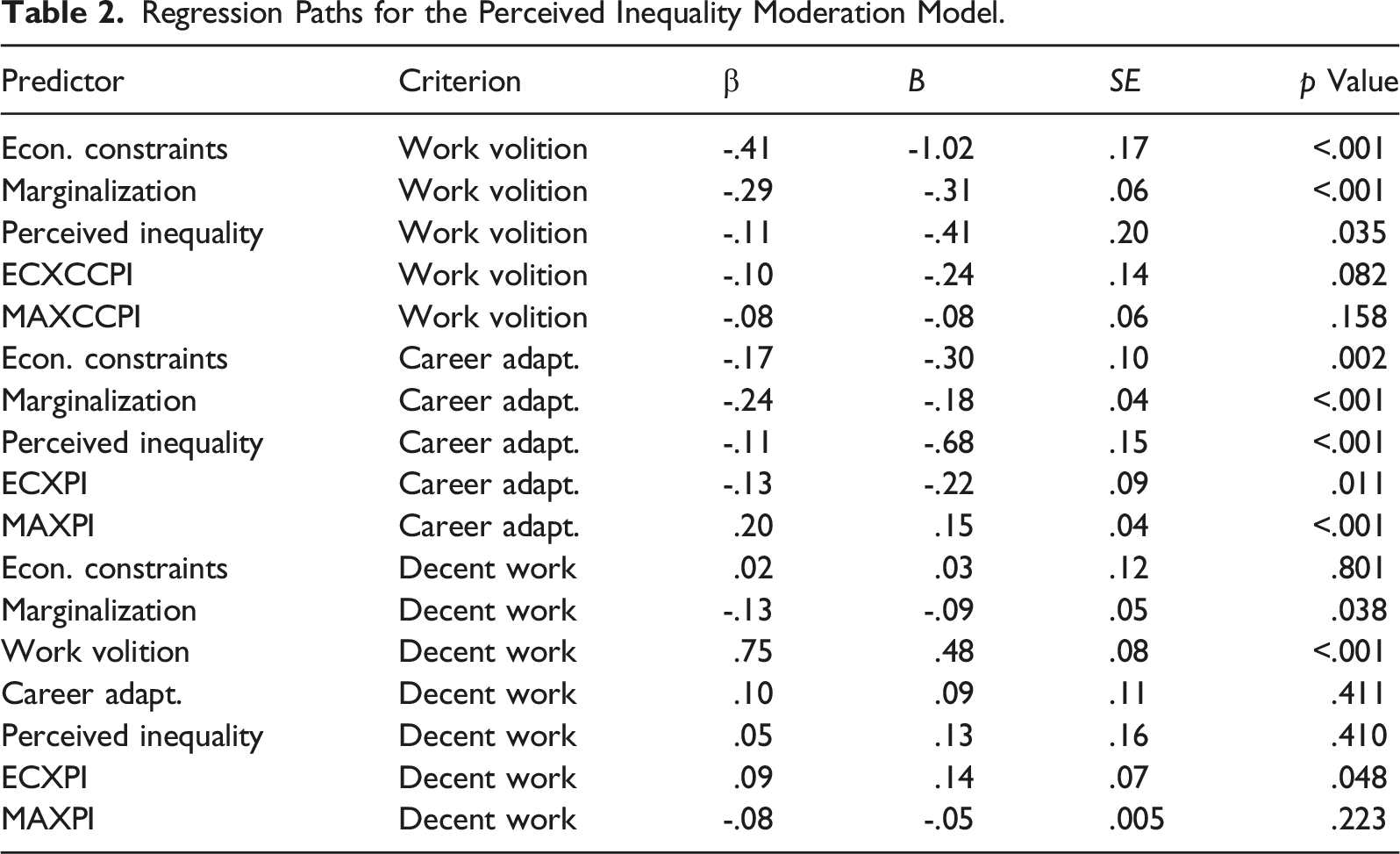
First, the economic constraints by perceived inequality interaction term significantly predicted decent work (β = 0.09, p = .045). As seen in Figure 1, people with moderate levels of perceived inequality had a slightly more negative relation between economic constraints and decent work. Second, the economic constraints by perceived inequality interaction term significantly predicted career adaptability (β = -.13, p = .015). As seen in Figure 2, people moderate and high in perceived inequality had stronger negative relations between economic constraints and career adaptability than people low in perceived inequality. Moderation of economic constraints and decent work by perceived inequality. Moderation of economic constraints and career adaptability by perceived inequality.

Finally, the marginalization by perceived inequality interaction significantly predicted career adaptability (β = 0.20, p < .001). As seen in Figure 3, people with lower levels of perceived inequality had a stronger negative relation between marginalization and career adaptability than those with moderate or high levels. Moderation of marginalization and career adaptability by perceived inequality.
Egalitarianism
Regression Paths for the Egalitarianism Moderation Model.

Sociopolitical participation
Regression Paths for the Sociopolitical Participation Moderation Model.

In this model, the marginalization by sociopolitical participation interaction significantly predicted decent work (β = .14, p = .004). As seen in Figure 4, people with low or moderate levels of sociopolitical participation had stronger negative relations between marginalization and decent work than people with high levels. The marginalization by sociopolitical participation interaction also significantly predicted work volition (β = .09, p = .032). As seen in Figure 5, people with low and moderate levels of sociopolitical participation had a slightly stronger negative relation between marginalization and decent work than people with high levels. Moderation of marginalization and decent work by sociopolitical participation. Moderation of marginalization and decent work by sociopolitical participation.

Discussion
In a large sample of adult workers of color, the current study examined CC as a moderator within the PWT. Specifically, we tested three components of CC—perceived inequality, egalitarian beliefs, and sociopolitical participation—as moderators in relations between economic constraints, marginalization, work volition, career adaptability, and decent work. Results demonstrated mixed support for hypotheses. Contrary to hypotheses, results showed that egalitarian beliefs were not a significant moderator in the model. Although inconsistent with PWT propositions, this finding does align with previous research showing egalitarian beliefs to behave in ways inconsistent with previous conceptualizations of components of CC (e.g., negative relations with critical action; Diemer et al., 2017).
Additionally, although we found perceived inequality and sociopolitical participation to significantly moderate five of the six relations hypothesized in the PWT, the moderating effect for two of these paths was in an unexpected direction. These unexpected results specifically appeared in the links from economic constraints to career adaptability and decent work, suggesting that CC may have a different moderating effect on outcomes of economic barriers than on outcomes of racial discrimination. Thus, results provide support for CC as a moderator in PWT paths but suggest specificity with regard to how and when the effect appears.
Critical Consciousness—Marginalization Interactions
Results partially support CC components as hypothesized moderators in links from racial marginalization to career adaptability, work volition, and decent work. People with low levels of perceived inequality had stronger negative relations between experienced racial marginalization and career adaptability. This suggests that awareness of inequalities between social groups buffers the negative impact that racial marginalization has on one’s ability to flexibly adapt to job demands. One reason for this may be the protective impact of critical reflection on an individual’s sense of self. One of Freire’s foundational propositions was that CC allows one to shift from a person-blame orientation to a system-blame orientation (Freire, 1972). That is, people with higher levels of CC may be less likely to blame themselves for barriers and, thus, suffer fewer negative impacts to internal resources such as self-efficacy and esteem (Gutiérrez and Ortega, 1991). We speculate that greater awareness of systemic inequalities helps to protect the internal resource of career adaptability from being degraded by experiences of racial marginalization via increased system-level attributions and decreased person-level attributions. Future research is needed to test these potential explanatory mechanisms.
Results also showed that engaging in sociopolitical participation weakened the relation from marginalization to both work volition and decent work. In other words, when people participated in political activities (e.g., writing a letter to their congresswoman), experiences of racial marginalization had a less negative impact on both their perceptions of work choice and their ability to secure decent work. Previous research has shown that sociopolitical participation is associated with feelings of sociopolitical control (Itzhaky & York, 2000) and that feelings of sociopolitical control are associated with positive perceptions of one’s vocational future (Diemer & Blustein, 2006). Furthermore, previous studies have shown that work volition and locus of control are highly related, suggesting that variables that contribute to sense of control may also contribute to perceived freedom of work choice (Duffy et al., 2012). Considering the documented associations between sociopolitical control, locus of control, and positive perceptions of vocational future, current findings align with the previous literature. Specifically, synthesizing previous and current findings, it may be that people who engage in sociopolitical action are more likely to experience a sense of control over their external world, including their freedom to make occupational choices and secure decent work.
These findings are consistent with previous research showing that CC plays a facilitative role in positive career development and that different aspects of CC (i.e., reflection vs. action) may be important for different career development processes (Diemer & Blustein, 2006). Although future research is needed to confirm and explain current findings, we found preliminary evidence that perceived inequality is specifically associated with increased career adaptability and sociopolitical action is specifically associated with work volition and decent work. This suggests that critical reflection may be especially important for internal resources and sociopolitical participation may be especially important for appraisal and attainment of work opportunities.
Critical Consciousness—Economic Constraints Interactions
Hypotheses regarding moderation of outcomes of economic constraints received mixed support. Only perceived inequality moderated links from economic constraints to career adaptability and decent work, and the direction of the moderating effect was inconsistent. The negative link from economic constraints to career adaptability was strongest for those with moderate and high levels of perceived inequality, indicating that people who have less awareness of social injustices tend to endorse less detrimental impacts of economic constraints to their adaptability at work. The negative link from economic constraints to decent work was weakest for those with high levels of perceived inequality as predicted. However, those who endorsed moderate levels of perceived inequality were those for whom economic constraints had the most detrimental impact on decent work, suggesting that the moderation effect is not straightforward.
Given that these findings are inconsistent with previous CC research and theory, they must be interpreted with caution and tested in future studies. With this cautious interpretation in mind, we offer the following tentative conclusions. First, it may be that when people are more aware of inequality, they are also more aware of the barriers presented by economic constraints and thus have negative perceptions of their ability to obtain decent work. This is consistent with previous research showing that high levels of CC attenuated the impact of positive outcome expectations on career development among urban high school students (Olle & Fouad, 2015). Applying this to the current findings, it may be that perceived inequality negatively impacts expectations regarding distal outcomes of occupational behavior, which may in turn indirectly affect career adaptability. If this explanation has merit, one must consider why it was not the case for marginalization as a predictor. It may be that there are more varied mechanisms for marginalization to negatively impact POC as opposed to economic constraints. For example, racial marginalization encompasses discrimination at the individual- and system-level, which varies in the degree to which it can be navigated effectively (e.g., a racist interaction with an individual vs. a system embedded with implicitly racist cultural and structural barriers). In future studies, researchers might examine the moderating effect of CC components on different types of marginalization.
Another explanation may be that people are less likely to attribute economic conditions to external forces than to personal flaws. Indeed, a qualitative study examining CC in low-income Americans found that participants tended to attribute economic hardship to individual factors rather than system-level factors (Godfrey & Wolf, 2016). The authors point to deep-seated beliefs of meritocracy in the United States and widespread messaging that economic barriers are the result of personal failures. More research is needed to confirm mechanisms behind this finding.
Practical Implications
In the present study, CC buffered the effects of racial marginalization on career adaptability. Thus, clients of color may benefit from a counseling focus that increases their awareness about the systemic nature of social inequalities and racial marginalization to strengthen internal resources like career adaptability. Results suggest it may be important to help POC create externalized attributions of oppression and inequality, rather than internalize them as a personal defect. Recognition of racial inequality as a structural issue may allow clients to advocate for themselves and seek out supportive resources to help mitigate the effects of racial marginalization. Results also showed that sociopolitical participation weakened the relation between marginalization and work volition and access to decent work. Encouraging clients to participate in sociopolitical activities and build a sense of community with like-minded individuals may strengthen internal resources to combat oppression while building resilience, increasing agency, and buffering the effects of marginalization on career development (Diemer & Blustein, 2006). We recommend that counselors make CC a primary topic of discussion, highlighting the impacts of marginalization and help clients identify ways to engage in critical action to advocate for their right to decent work (Duffy et al., 2012).
Limitations/Future Directions
The current study has limitations that may guide future research. First, the current study focused on shared experiences of racial marginalization for POC in the United States Thus, we did not distinguish between racial identities (e.g., African-American, Asian-American, and multiracial) but rather examined POC as a single group. Although previous CC research suggests that the construct may operate similarly across racial groups (Diemer et al., 2010), it will be important to examine potential group differences with regard to moderation and mediation processes in future studies. It may be particularly important to take the historical context unique to each racial/ethnic group into account. Thus, we advise caution when generalizing results until more is known about the manifestation of this model in specific racial/ethnic groups. Second, in the current study, we focused specifically on racial marginalization. However, because sociopolitical identities often intersect, it is important to future research to account for the cumulative impact of multiple marginalized identities on relations CC and vocational outcomes. Similarly, in the current study, our sample was relatively privileged in terms of education and social class. Over half the sample had at least a bachelor’s degree and identified as middle class or above. Given that education, social class, and racial identity are tightly intertwined, future studies might aim to focus specifically on those who experience classism and difficulty accessing power structures like education. We encourage future researchers to use methods that are sensitive to capturing nuances between and within groups (e.g., qualitative analysis of in-depth interviews). Finally, the current study utilized cross-sectional data, which limits conclusions about causality within the model. Future studies might also employ longitudinal methods to examine the extent to which moderations are sustained over time.
Footnotes
Declaration of Conflicting Interests
The author(s) declared no potential conflicts of interest with respect to the research, authorship, and/or publication of this article.
Funding
The author(s) received no financial support for the research, authorship, and/or publication of this article.
Public Significance Statement
This study examined three components of critical consciousness as moderators in the PWT model. Results were mixed, with sociopolitical participation having the clearest buffering effect within the model.
