







Abstract
The dual-process theory of career decision making (DTC) offers unique insights into how people’s responses to inevitable decision ambiguity affect career choice and outcomes as well as how to cope with such ambiguity. While the DTC advances career decision research by incorporating key findings from decision science, it remains largely focused on people’s psychological processes; consequently, how contextual challenges influence the ambiguity management process remains unclear. To enhance the DTC’s utility in explaining career choice and outcomes and to be more inclusive of marginalized populations, the present conceptual article draws on the science of environmental adversity to articulate mechanisms through which environmental adversity affects career choice and attained career, particularly with respect to career pursuits that facilitate resource accumulation and upward mobility. The discussion features ambiguity management as a key explanatory mechanism, given the inherent ambiguity about the outcomes of pursuing careers outside of socially prescribed norms. Seven propositions are offered centering on how environmental adversity influences career choice and attained career through ambiguity management. In general, the current article holds that environmental adversity could thwart resource accumulation through inducing ambiguity about the goodness of resource-accumulating careers and activating a need to prioritize short-term goals. The theoretical and practical implications are discussed.
Keywords
Work is one of the most important life activities because it serves to satisfy both biological and psychological needs. Accordingly, vocational psychology has focused on how people make educational and occupational choices and attain desired careers (Osipow, 1999). However, given contemporary volatility in the labor market and the inherent psychological challenges in career decision making and adaptation, scholars have called for more attention to inevitable ambiguity in predicting career outcomes and the need for adaptability in handing the fluid vocational world (Blustein, 2013; Savickas, 2019). Joining this scholarly movement, the dual-process theory of career decision making (DTC; (Xu, 2021a, 2023; Xu & Flores, 2023) was developed to address a key area that has been featured in general decision-making science for years (Kahneman, 2003; Thaler, 2016) but has not been articulated in the conceptual foreground of existing career theories—the importance and process of handling inevitable ambiguity about the “right” career choice (referred to as ambiguity management herein). The DTC currently comprises (a) a framework that delineates psychosocial factors responsible for inevitable decision ambiguity (Xu, 2023), (b) a predictive model that explains relations of key process and outcome constructs in ambiguity management (Xu, 2021a), and (c) a prescriptive model that outlines cyclic stages through which people can handle decision ambiguity (Xu & Flores, 2023). In its entirety, the “trilogy” of the DTC supplements existing career decision models that highlight information collection and matching and brings insights from decision science to update the career decision-making literature.
However, the DTC does not fully explain how psychosocial and economic adversity influences ambiguity management, limiting its utility for understanding and facilitating the working experience of marginalized populations. Notably, while the field has traditionally addressed work choices that require volition and privilege, scholars have recently advocated for an inclusive perspective that emphasizes the working experiences of people from socially, financially, and politically marginalized backgrounds (Blustein, 2013). From this perspective, an extensive body of literature has examined contextual and structural obstacles to career development, and a variety of theoretical frameworks have offered valuable insights in this regard (Blustein et al., 2019; Duffy et al., 2016). In general, scholars agree that many people have limited choice in their education and occupational areas because of psychological, social, and economic constraints (Ali et al., 2022; Duffy et al., 2016). The transition to acknowledging both contextual and personal factors in people’s work experiences helps combat problematic, overstressed personal agency and responsibility in career development and opens a door for interventions from a critical lens (Blustein et al., 2019). Although the DTC has acknowledged contextual challenges (as a background input) since its inception (Xu, 2021a, 2023), it clearly focuses more on the psychological process of ambiguity management and has not articulated how systemic issues affect career development through ambiguity management.
Expanding the DTC to articulate the relation of environmental adversity to ambiguity management not only enhances the social justice implications of the DTC but also adds to discussions about systemic issues a crucial and somewhat overlooked viewpoint on decision-making. Certainly, both individuals and their environments play roles in shaping career outcomes. While vocational psychology’s critical conversation has rightly emphasized the presence of limited volition and systemic issues, the individual decision-making process in the face of systemic challenges has been somewhat overlooked, likely due to concerns about overstating personal responsibility. While it is true that many individuals have restricted freedom in their choices, asserting that people have no choice at all overlooks personal autonomy amidst contextual challenges and may be disempowering. For example, even for survival jobs, people still need to decide which sectors of such jobs they should engage in and the role of survival jobs in potential long-term planning. Consequently, we suggest that the decision-making perspective, with a focus on ambiguity management, can complement models that focus on systemic issues, demonstrating how environmental and personal processes jointly influence the formulation of choice goals.
Viewing the limitations of the DTC and the potential benefits of its alliance with a contextual perspective, we believe that it is imperative to broaden and deepen the current discussion of the role of environmental adversity in relation to ambiguity management. This entails elaborating on forms of environmental adversity and articulating ambiguity management mechanisms through which contextual challenges influence career choice and attained career. To achieve these goals, we draw on the science of environmental adversity (Ellis et al., 2022; Usacheva et al., 2022) and the DTC (Xu, 2021a, 2023; Xu & Flores, 2023). While the science of environmental adversity (Ellis et al., 2022; Usacheva et al., 2022) provides a theoretical framework that systematically explains why and how contextual challenges influence a variety of human behaviors, the DTC (Xu, 2021a, 2023; Xu & Flores, 2023) informs our conceptualization of ambiguity management. We begin by introducing the DTC in the theoretical landscape of career development and reviewing current theories on the role of environmental adversity in career development, then discuss the relation of environmental adversity to career choice and attained career, particularly for marginalized populations, through the lens of ambiguity management, and finally offer implications for research and practice.
The DTC in the Theoretical Landscape of Career Decision Making: Adding Ambiguity Management to Career Decision-Making Research and Practice
Few decision-making scenarios rival career decision making in terms of psychosocial and economic implications (Lent & Brown, 2020; Savickas, 2013), but its complexity, combined with limited learning opportunities, renders this decision one of the most challenging scenarios in life (Kulcsar et al., 2020; Xu & Bhang, 2019). Three prominent theoretical frameworks have drawn great attention in the counseling and education literature: Holland’s (1997) interest typology, social cognitive career theory (SCCT; (Lent & Brown, 2013; Lent et al., 1994), and expectancy-value theory (EVT; (Eccles, 1983; Eccles & Wigfield, 2020). Holland’s theory highlights the centrality of interests in shaping choices and person-environment congruence and has received extensive support (Nauta, 2010; Xu & Li, 2020). Both SCCT and EVT also acknowledge the role of interests but expand the scope to include cognitive appraisals as the central psychological mechanism that translates the influence of contextual factors to entry and retention-related choices/behaviors. While SCCT emphasizes social cognitive learning and two social cognitive products (i.e., self-efficacy and outcome expectations), EVT highlights the expectancies for success and four subjective task values (i.e., intrinsic, utility, attainment, and cost).
Although these theories offer incredible value, they do not fully account for practical limitations that ordinary people encounter in real-life career decision making. For example, while people do consider probabilities and outcomes in the evaluation of individual career options (Lent & Brown, 2013), it is unrealistic to expect that people have unlimited psychosocial capacity to exhaust information and calculate an unequivocally optimal choice among competing options (Hastie & Dawes, 2010). As noted by Simon’s (1972) bounded rationality model and subsequent behavioral economics (Thaler, 2016), an appreciable amount of decision ambiguity exists not only in the evaluation of separate choices but also (and particularly) in the comparison of competing options. Thus, decision science has shown that (1) ambiguity in calculating the optimal choice is inevitable in real-life decision-making, (2) ambiguity is typically aversive and causes distress, and (3) ambiguity management strategies influence final choices (Kahneman, 2003; Thaler, 2016). In other words, people could be discouraged from certain careers not only by low interests, poor self-efficacy, and negative outcome evaluations but also by uncomfortable ambiguity regarding the goodness of those careers.
The DTC differs from existing career decision-making models in that it not only acknowledges the traditional focus on information collection and matching (i.e., Process I) but also features ambiguity regarding the “right” career choice in its conceptual foreground and highlights the ambiguity management process (i.e., Process II). The DTC argues that managing ambiguity differs from Process I because ambiguity cannot be eliminated through enhanced information collection and reasoning; rather, how to reduce the threat of ambiguity (as opposed to ambiguity itself) and find peace with it is critical. Contextualized in the trade-off between decision quality and effort, Process I emphasize a computation process that aims to maximize career rewards, while Process II emphasizes a de-computation process that aims to maximize the return of decision effort. In DTC’s analysis of the literature (Xu, 2021a, 2023), prominent career decision-making models, such as Holland’s (1997) theory and SCCT (Lent & Brown, 2013), offer insights mainly into the first process because they specify important decision parameters and the ways to use such information. Although postmodern career models, such as Krumboltz’s (2009) happenstance theory and career construction theory (Savickas, 2019), mention ideas related to ambiguity, such as unpredictability and ill-defined problems, they do not foreground ambiguity in their conceptualization of the career decision process and consequently offer limited explanations of how ambiguity affects career choice. Based on this analysis of the literature, the DTC presents a predictive model that outlines key constructs in the two decision processes through which psychosocial backgrounds lead to career decision-making outcomes (see (Xu, 2021a) for cumulative evidence for different sections of the model). Recently, the DTC developed a prescriptive model that lays out dynamic stages and tasks through which people can handle ambiguity in career decision making and adaptation (Xu & Flores, 2023).
A key element of the DTC concerns the idea that ambiguity management, including decision ambiguity, ambiguity management strategies, and their interaction, could shape career choice. While classic rational choice theory proposes that ambiguity is relevant only when considered as a calculating component of expected outcomes, prospect theory and research (Kahneman, 2003) have shown that ambiguity in itself (irrespective of expected outcomes) could influence decision making. Behavioral decision-making research has also shown that in a gain situation (such as career development), individuals typically dislike ambiguity and want to avoid it (Kahneman, 2003; Thaler, 2016). In other words, due to its threat to decision outcomes, ambiguity typically causes stress, and reducing ambiguity-induced stress reflects an important emotional and cognitive need (Mittal & Griskevicius, 2014). In fact, existential and psychodynamic writers have long ago proposed that ambiguity is an inherent element of human existence and intrapsychic functioning and that ambiguity is a stressor that individuals consciously and unconsciously attempt to avoid (Corey, 2017). Thus, the DTC proposes that ambiguity in evaluating particular career options can discourage people from selecting those options.
Additionally, the DTC proposes that ambiguity can create an unsettling experience that urges people to employ coping strategies. Typically, as proposed by the DTC (Xu, 2021a, 2023; Xu & Flores, 2023), such strategies involve ignoring or prioritizing some information so that individuals can be relieved of solving ambiguity. For example, individuals might ignore information that is theoretically relevant to person-environment fit but practically inaccessible. However, ignoring information in an unmindful and avoidant style could be maladaptive and rush people into biased decisions. For example, people might avoid the entire career decision process to avoid facing uncomfortable ambiguity but eventually end up making a premature choice. In general, when certain parameters (e.g., instant rewards) are highlighted (and other information is relatively ignored), people may view career options that align with the highlighted information favorably. Notably, the DTC’s conceptualization of ambiguity management strategies aligns with decision heuristics in terms of their process and functions because heuristics essentially ignore some information to help people make decisions more frugally and quickly (Gigerenzer & Gaissmaier, 2011; Green & Myerson, 2004). Extensive research has supported the role of heuristics in shaping choices (Hastie & Dawes, 2010). Additionally, ambiguity management in the DTC resonates with cognitive information processing theory (Peterson et al., 2002) by highlighting the importance of simplifying information for overwhelmed individuals and the role of metacognition in coordinating the complex decision-making cycle.
A Missing Account of Systemic Issues with Ambiguity Management
The DTC, however, is not without limitations. A notable one is that like decision science in general, the DTC focuses on the psychological process of career decision making and adaptation and has not placed contextual challenges in its conceptual foreground. As a result, other than acknowledging the general importance of contextual factors, the DTC has not specified important contextual factors and detailed how they relate to ambiguity management. Although this gap does not necessarily mean that the DTC overstates personal volition and responsibility, it certainly limits the DTC’s capacity to contribute to an emerging dialogue in vocational psychology, which draws on critical psychology and intersectionality frameworks to center systemic issues in career development (e.g., (Ali et al., 2022; Blustein et al., 2019). This social-justice-oriented dialogue turned the spotlight on environmental adversity and advocated more direct attention to the joint operation of multiple layers of oppressive societal structures (Ali et al., 2022; Blustein et al., 2019; Duffy et al., 2016). Therefore, viewing the DTC in the broader literature of vocational psychology, the DTC can be strengthened by incorporating a detailed account of how systemic issues affect ambiguity management and consequently hinder the career and life outcomes of marginalized populations.
Adding a contextual perspective to the DTC not only enhances its utility for understanding and helping marginalized populations but also lends an important decision-making perspective to the social-justice-oriented dialogue in vocational psychology. Notably, while contextually driven models, such as the Psychology of Working Theory (PWT; (Duffy et al., 2016), shed light on privilege, oppression, and equity in career development, they mainly explain how systemic issues shape career outcomes or the translation of choice goals to attained career, rather than the formulation of choice goals. For example, PWT (Duffy et al., 2016) builds on two forms of environmental adversity, marginalization and economic constraints, and delineates how they lead to career and life outcomes through access to decent work. While admittedly, people do not always have privileges or power to exercise their agency and select their career path, they still need to make decisions within the constraints of contextual affordances, even though the decision process might entail a nonnegligible compromise. Those decisions include but are not limited to selecting the most adaptive choice among feasible and likable options and balancing short-term necessity and long-term aspiration. Given the motivational nature of career choice (Kulcsar et al., 2020; Lent & Brown, 2013), we argue that career decisions have an important motivational function for directing career behaviors and can be used as intervention points. Thus, understanding how systemic issues shape career choice is important.
Career Decision under Environmental Adversity
Based on the DTC’s perspective on ambiguity management, this article aims to advance the literature of the DTC specifically and career decision under environmental adversity more generally by delineating the impact of environmental adversity on career choice and attained career through ambiguity management. We focus on delineating (1) forms of environmental adversity that affect career pursuits and (2) ambiguity management mechanisms through which environmental adversity influences career pursuits. Following the DTC predictive model (Xu, 2021a), we propose three key mechanisms: (1) the link from environmental adversity to decision ambiguity and career choice, (2) the link from environmental adversity to instant gratification and career choice, and (3) the moderation of decision ambiguity on the link from instant gratification to career choice. Because environmental adversity likely influences how people translate their choice goals to attained career (Duffy et al., 2016; Lent & Brown, 2013; Xu, 2021a), the proposed model also incorporates the direct influence of environmental adversity on attained career to depict a complete picture of career pursuits. In addition, we include a direct path from environmental adversity to career choice to accommodate the well-known mechanism pertaining to using decision parameters such as self-efficacy and interests to evaluate person-environment fit (corresponding to Process I of the DTC); however, we do not formulate a formal proposition because this mechanism does not focus on ambiguity and is not the focus of the current model. We discuss each mechanism along with relevant evidence in the following sections (see Figure 1 for an overview). Career decision under environmental adversity.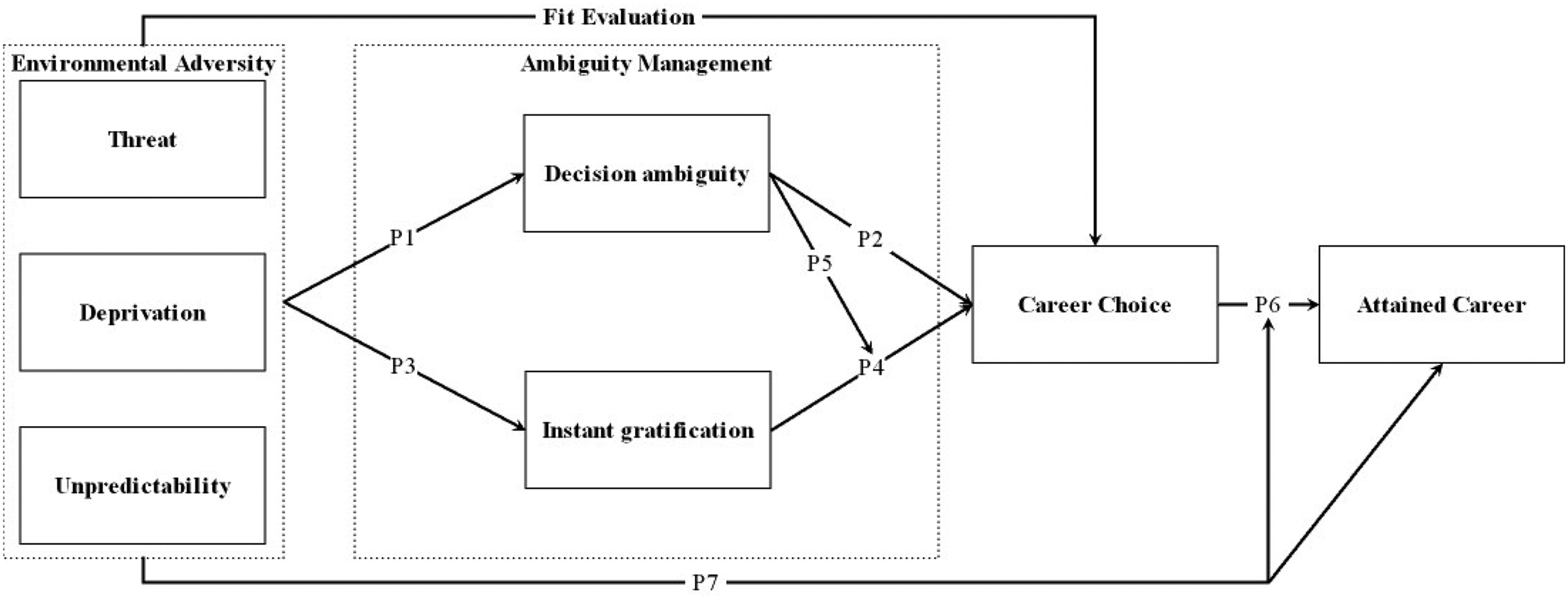
Three Forms of Environmental Adversity
Research on environmental adversity generally follows two frameworks of environmental adversity (Ellis et al., 2022; Usacheva et al., 2022): harshness-unpredictability (focusing on evolutionary and developmental motives or why) and threat-deprivation (focusing on neurobiological mechanisms or how). Building on the two frameworks, Ellis and colleagues (Ellis et al., 2022) recently proposed an integrated framework that consists of three relatively distinct adversity dimensions: threat-based harshness, deprivation-based harshness, and unpredictability. Research has supported this three-factor model in factor-analytic results and in the differential associations of the three forms of adversity with developmental criteria, including cognitive ability, physical health, aggressive behavior, emotional reactivity, and risk-taking behavior (Sheridan et al., 2020; Usacheva et al., 2022). Although the three forms of adversity represent conceptually distinct sources of stress, they often co-occur and can lead to similar psychopathologies through different pathways (Carozza et al., 2022). The three forms of adversity cover contextual and structural challenges that have been noted in career research (e.g., racism and poverty) but also call attention to a less explored issue, unpredictability.
Specifically, threat (or threat-based harshness) denotes experienced or anticipated harm to the physical integrity or psychological wellbeing of individuals (Ellis et al., 2022). Threat can manifest in many ways across the lifespan, such as with adverse childhood experiences, discrimination, and insecure employment. Racism is a classic example of threat that has implications for health and career development and can be harmful when it is experienced or anticipated. For example, anticipated racial discrimination predicts poorer career decision-making self-efficacy and vocational outcome expectations among youth of color (Conkel-Ziebell et al., 2019). Vocational theories similarly identify lifelong marginalization as a threat to occupational choice and adaptability (Duffy et al., 2016), and marginalization can include the many ways that intersecting forms of oppression cause harm to vulnerable workers, such as ableism, classism, transphobia, and sexism (Allan et al., 2021). In the integrative dimensional model of adversity, threat is expected to impact fear learning and disrupt emotional regulation (Ellis et al., 2022; Sheridan et al., 2020).
Deprivation (or deprivation-based harshness) denotes inadequate monetary or psychosocial resources (Ellis et al., 2022). At the broadest level, poverty is the primary cause of deprivation, and childhood poverty is particularly linked to disruptions in all life domains, such as cognitive and relationships (Mistry et al., 2002). In the work domain, working poverty, which is also concentrated among marginalized workers, also prevents workers from meeting their basic needs, such as food, housing, and health care, as well as advancing their careers through education and skill development. Before the COVID-19 pandemic, the United States had among the highest proportions of people working in poverty among postindustrial nations (BLS, 2022), and the COVID-19 pandemic exacerbated these inequities, with low wage workers disproportionately experiencing its effects because they were less likely to be able to work from home and socially distance (Cubrich, 2020). Therefore, working poverty not only deprives people of a living wage but also exposes people to a range of additional risks, such as workplace hazards. Deprivation can also represent inadequate psychosocial resources, often operationalized as social, human, and cultural capital, which are similarly linked to poorer outcomes (Author Citation). In the integrative dimensional model of adversity, deprivation is expected to constrain cognitive development (Ellis et al., 2022; Sheridan et al., 2020).
Unpredictability
Unpredictability denotes unstable contextual affordance and safety (Ellis et al., 2022), including but not limited to unstable family structure, employment, and residency. It also includes living in a war zone and dealing with unstable political and economic structures. Essentially, unpredictability refers to the stochastic variation in threat- and deprivation-based harshness (Ellis et al., 2022; Sheridan et al., 2020). Compared to threat and deprivation, unpredictability has not typically been included in the conceptualization of environmental adversity within vocational psychology. However, it can plausibly add another layer of stress to career development, particularly through the lens of ambiguity management (Ellis et al., 2022; Xu, 2021b). While constant threats and deprivation are undoubtedly stressful to deal with, they present stable and clear problems that people can potentially identify and learn to cope with. However, when these experiences appear unpredictably—for example, if parents have an unstable income—it becomes challenging to organize the experiences into a coherent schema (Ellis et al., 2022; Xu, 2021b), such as not knowing whether financial resources will be available for education. This ambiguity regarding the presence and severity of environmental adversity creates both cognitive and emotional challenges requiring people to develop coping strategies (Ellis et al., 2022). These strategies, according to the integrative dimensional model of adversity, may influence how people perceive and respond to immediate versus delayed rewards, risks, and uncertainty (Ellis et al., 2022; Xu, 2021b).
In the work domain, a growing body of research has identified a concerning rise in precarious work, which refers to employment that is risky, unpredictable, and marked by job insecurity (Allan et al., 2021; Kalleberg, 2018; Shoss, 2017). Precarious work is increasing due to many converging factors, such as rising wealth inequality, globalization, digitalization, and neoliberal policies, but it is historically and currently concentrated among marginalized workers, such as workers of color, immigrant workers, and workers with disabilities (Allan et al., 2021). Moreover, precarious work represents a salient danger because it often consists of short-term, temporary work where there is a consistent risk of losing employment, meaning a consistent risk of losing access to resources necessary for survival and psychological flourishing (Kalleberg, 2018). However, precarious work is just one example of how this era represents a unique confluence of uncertainty, which scholars have described as precarity (Blustein et al., 2022). Specifically, while precarious work represents riskiness in employment, precarity represents uncertainty in the sociopolitical and ecological system (e.g., populism, pandemics, climate change), which is embedded within systems of inequity that unfairly distribute risk and harm (Blustein et al., 2022). Precarity also captures a psychological experience that goes beyond anxiety to include existential threat and identity instability (Allan et al., 2021). In addition to precarity, public health crises (e.g., the recent COVID-19 pandemic) can create a sense of unpredictability regarding employment and safety.
Not surprisingly, unpredictability and uncertainty are associated with a host of negative outcomes, such as stress, but may also result in resistance and resilience (Blustein et al., 2022). Similarly, job insecurity predicts many negative outcomes, such as mental and physical distress, burnout, and disrupted family relationships, but could lead some people to engage in collective action and pursue opportunities for career development, such as additional education (Shoss, 2017). This is also consistent with emerging evidence suggesting that work conditions that threaten loss of resources – such as involuntary temporary work – are most predictive of mental health over time (Allan et al., 2022). In addition, research has generally shown that unpredictability hinders inhibitory control, but it may also enhance cognitive flexibility (Ellis et al., 2022; Usacheva et al., 2022). In short, unpredictability likely creates many challenges but may also accustom people to changes.
Adversity in the Proximal and Distal Backgrounds of Career Pursuit
Although environmental adversity can occur throughout the life span, the literature on environmental adversity often examines environmental adversity that people encounter in early life (Boullier & Blair, 2018). The reason is that children and adolescents exhibit heightened neural plasticity and are more vulnerable/sensitive to environmental influence. However, research has shown that environmental adversity in adulthood also has a significant impact on human functions and preferences, as seen in extensive research on the detrimental effects of discrimination (Lent et al., 2000). Additionally, there is a close link between early life and adulthood environmental adversity because (1) some forms of adversity are identity-based (e.g., racism) and likely persist throughout developmental stages, and (2) some forms of adversity (e.g., poverty) tend to perpetuate themselves through intergenerational transmission (Haushofer & Fehr, 2014). Given the relevance and interconnectedness of both early life and adulthood environmental adversity, we acknowledge both in the model. In general, early environmental adversity could be particularly impactful to ambiguity management strategies that are developed in early life, whereas current environmental adversity could be particularly important to the experience of decision ambiguity.
Adversity to Ambiguity and Career Choice
The first mechanism of environmental adversity shaping career pursuit concerns the mediation of decision ambiguity in the link between environmental adversity and career choice. Unless otherwise specified, career choice in the current model focuses on choices regarding pursuing careers that facilitate resource accumulation (i.e., resource-accumulating careers), which often entails moving beyond the socially prescribed or anticipated zone for marginalized populations. More specifically, depending on the intersectional identities of a specific marginalized population, socially prescribed or anticipated occupations can include but are not limited to precarious, labor-intense jobs for people from lower or working class backgrounds and traditionally female-dominated occupations for women and people who are nonbinary. This type of work ultimately denies equitable financial and social opportunities for marginalized populations because it consumes the mental, physical, and time resources of marginalized populations in exchange for precarious, low wage salaries or social approval. In other words, while this type of work might be necessary at a particular point, it meets proximate needs at the potential cost of resources that can empower life improvement and thriving (e.g., low-paying but busy service jobs meet basic survival needs but deprive people of the energy and time needed for further education).
Conversely, pursuing careers that move beyond normative constraints and facilitate resource accumulation likely has salient psychological, social, and financial benefits, especially for marginalized populations, which is a key motivation for the current article to focus on this line of careers. These careers can be assessed either through self-reported measures that directly capture perceived potential for resource accumulation or through specific career fields that are likely to lead to resource accumulation (e.g., professional careers). However, as Gottfredson’s (2005) circumscription model suggests, moving beyond the socially acceptable zone of occupations is likely an adventure with unpredictable outcomes.
More specifically, while decision ambiguity is inevitable for most people, environmental adversity could give rise to ambiguity in evaluating resource-accumulating careers due to plausible impacts of threat, deprivation, and unpredictability. Based on the relational perspective of work and Gottfredson’s circumscription (Gottfredson, 2005), when people’s backgrounds and identities (e.g., lower social class) are underrepresented or threatened in careers of interests (e.g., legal practice), such threats conflict with the potential benefits of resource-accumulating careers and could create uncertainty about committing to such careers. Deprivation likely gives rise to decision ambiguity about pursuing resource-accumulating careers because they deviate from life norms and socially modeled choices for given positionalities and often require additional resources and support (e.g., information and role modeling) that marginalized people have trouble accessing. Relatedly, psychosocial deprivation (particularly in childhood) disrupts cognitive development due to inadequate social cognitive stimulation (Ellis et al., 2022). However, higher-order cognitive abilities are crucial for the weighing process for resource-accumulating careers because they involve more parameters to consider than socially prescribed careers (e.g., socioemotional challenges). Unpredictability likely gives rise to decision ambiguity because the experiences of unstable contextual affordance and safety could sensitize individuals to risks (Ellis et al., 2022) and consequently heighten the risk perception of resource-accumulating careers (e.g., identity-based maltreatment). In addition, concerns about unstable affordance and safety could cultivate a general sense of uncertainty about committing to a single career because no career has a guaranteed reward structure.
Although research that directly examined the association between environmental adversity and decision ambiguity is still nascent, Xu (2022a) found that racial/ethnic and sexual minorities experienced more career decision ambiguity than White and heterosexual individuals, respectively. Additionally, Xu’s (2022a) study offered initial evidence for the association between deprivation and career decision ambiguity by revealing that people with lower social class tended to experience more career decision ambiguity. Given the theoretical reasoning and preliminary evidence, we propose that environmental adversity leads to decision ambiguity (Proposition 1).
While we anticipate environmental adversity to give rise to decision ambiguity, the DTC (Xu, 2021a, 2023; Xu & Flores, 2023) suggests that decision ambiguity could influence choice goals. Thus, ambiguity may function as a mediator between environmental adversity and career choice. Laboratory evidence in decision science has shown that when people anticipate a gain, they tend to avoid options with uncertain outcomes (Kahneman, 2003; Thaler, 2016). Career decision making clearly represents a gain scenario in that individuals anticipate gaining psychological, social, or financial benefits through their selected work. Therefore, we propose that decision ambiguity influences career choice because marginalized individuals who experience ambiguity about the outcomes of resource-accumulating careers tend to avoid choosing such options (Proposition 2).
Adversity to Instant Gratification and Career Choice
In addition to the experience of ambiguity, environmental adversity could shape career choice through ambiguity management strategies. Specifically, environmental adversity could restrict people’s ability to delay gratification, which could subsequently influence their intent for resource-accumulating careers. Gratification delay denotes forgoing immediate, smaller rewards in the hope of obtaining larger rewards in the future (Hoerger et al., 2011), while its opposite (i.e., instant gratification) refers to prioritizing readily available or foreseeable rewards over unpredictable but potentially larger future rewards. Gratification delay is a core paradigm in research on self-control and persistence and has spawned extensive research on its role in development, physical health, and psychopathology (Hoerger et al., 2011). In a nutshell, gratification delay was found to facilitate time-consuming human endeavors that emphasize long-term rewards, including exercise and academic and socioemotional development (Daugherty & Brase, 2010; Green & Myerson, 2004).
Following Amir and colleagues’ (2018) uncertainty management perspective, we conceptualize gratification delay, or more precisely, instant gratification, as an important ambiguity management strategy that influences career choice. As noted by the DTC (Xu, 2021a, 2023; Xu & Flores, 2023), heuristics can serve as ambiguity management strategies because they allow individuals to ignore part of the information and consequently help people circumvent ambiguity and make decisions more quickly, more frugally, and even more accurately (Gigerenzer & Gaissmaier, 2011). Prioritizing immediate rewards is a decision heuristic that has an evolutionary root because long-term rewards might not be realized in the harsh and unstable survival environment that human beings historically experienced and thus could be discounted to save cognitive resources. In modern human endeavors (such as career development), workers experiencing environmental adversity are likely forced to focus on short-term goals to meet their survival needs and are deprived of the opportunities and resources to conduct long-term career planning. In this context, prioritizing immediate rewards is necessary in the short term but might function at a suboptimal level in the long run, particularly when the pattern is prolonged and overgeneralized while the goal is to accumulate resources to improve living standards. Other than its socioeconomic necessity, instant gratification, by quickly ending decision-making scenarios like other heuristics, also serves an emotional need: to protect individuals from ambiguity-induced stress (Kahneman, 2003; Thaler, 2016). Likely due to its evolutionary, socioeconomic, and emotional functions, prioritizing short-term benefits remains powerful in decision making and persistence (Meier & Sprenger, 2012; Reynolds & Schiffbauer, 2005; Saunders & Fogarty, 2001).
The present article focuses on instant gratification not only because it can function as an ambiguity management strategy but also because it is subject to contextual influences and likely has an important role in shaping career choice. In other words, we anticipate that prioritizing readily available or predictable rewards could serve as an ambiguity management mechanism through which environmental adversity affects intent for resource-accumulating careers. The evolutionary and neurobiological perspectives on environmental adversity shed light on the role of environmental adversity in gratification delay. According to the evolutionary perspective, environmental cues such as physical/emotional abuse (threat), poverty (deprivation), and parental employment instability (unpredictability) likely promote a fast life history strategy, which features prioritizing immediate rewards (Ellis et al., 2022). According to the neurobiological perspective, environmental adversity likely enhances emotional reactivity and undermine higher-order cognitive functions and thus are anticipated to thwart the emotional and cognitive foundations of gratification delay (Ellis et al., 2022).
Ample evidence has supported the link from environmental adversity to instant gratification. For example, Callan and colleagues (2009) found that when experiencing threat to a just world belief, individuals exhibited preference for smaller, immediate monetary rewards. Carr and Steele (2010) found in three studies that stereotype threat, which denotes concerns about confirming negative stereotypes about one’s group, led to risk-aversion behaviors among women (prioritizing immediate rewards is essentially a way to avoid risk; (Green & Myerson, 2004). Regarding deprivation, Amir et al. (2018) found that individuals with higher socioeconomic status exhibited greater gratification delay. Carvalho et al. (2016) found that low-income individuals exhibited present-focused choices in decisions concerning monetary rewards, which is understandable given the struggle to meet survival needs. Regarding unpredictability, Martin et al. (2012) found that family chaos was negatively associated with gratification delay among children, and Martinez et al. (2022) found that childhood unpredictability positively predicted delay discounting. Building on this body of research, we propose that environmental adversity gives rise to instant gratification (Propositions 3).
Given the inherent challenges in moving beyond normative constraints for workers experiencing environmental adversity, individuals’ ability to prioritize long-term rewards despite immediate needs and hardship could translate into career choice. Resource-accumulating careers often represent a combination of larger rewards and longer investment timeframes. For example, although professional jobs offer a pathway to resource accumulation, they typically entail a good deal of training and competition; consequently, people who cannot afford long-term educational investment and need to prioritize immediate rewards often cannot pursue these options. Additionally, these careers often involve a battle with systemic barriers (Fouad & Santana, 2017), which likely require persistence and appreciation of long-term payoffs. Saunders and Fogarty’s (2001) study offered evidence for the role of instant gratification in career preferences. They found that employees increasingly preferred a middle management position available earlier to a senior management position available later when the delay difference between the two options became increasingly meaningful. Similarly, Hesketh et al. (1998) and Schoenfelder and Hantula (2003) found that the subjective values of career options decreased when reward delay increased, supporting the applicability of gratification delay to career decision making. Xu and colleagues (Xu, 2021c; Xu & Yin, 2020) more directly examined the role of gratification delay in career decision making and persistence. They found that the cognitive and emotional foundations of gratification delay, delay discounting and distress tolerance, together with gratification delay, facilitated persistent career pursuit (indicated by career commitment) and career satisfaction. Given the theoretical and empirical support, we propose that instant gratification discourages marginalized people from pursuing resource-accumulating careers (Proposition 4).
Interaction of Decision Ambiguity and Instant Gratification
The DTC adversity model not only embraces the additive, separative roles of decision ambiguity and instant gratification in shaping career choice but also anticipates that decision ambiguity interacts with instant gratification in shaping career choice. The interactionist mechanism of decision ambiguity and instant gratification builds on a proposition of the DTC that ambiguity management strategies interact with ambiguity perception in shaping career choice (Xu & Flores, 2023). In other words, ambiguity perception could trigger the use of ambiguity management strategies. This theoretical position resonate with two theoretical frameworks, the strength model of self-control (Baumeister et al., 2007) and trait activation theory (Tett et al., 2021).
The strength model of self-control posits that self-control behaviors (including gratification delay) consume mental resources and will be hindered once resources are depleted (termed ego depletion; (Baumeister et al., 2007). The reason is that overriding the short-term goal tendency entails combating energy-saving decision shortcuts and thus requires energy (Baumeister et al., 2007). Both experimental and neurobiological research has supported the strength model of self-control (Hagger et al., 2010; Yu, 2016). For example, Hagger et al. (2010) meta-analytically summarized 83 tests of ego depletion and found that depleting tasks undermined self-control performance and increased the perceptions of effort, difficulty, and fatigue. Similarly, Yu (2016) reviewed behavioral and neuroimaging studies on decision making under stress and found that when stressed, individuals tend to rely on decision heuristics to make intuitive decisions as opposed to making deliberate, goal-directed decisions. Thus, he proposed that stress likely triggers activities in subcortical regions (responsible for intuition) and diminishes activities in the prefrontal cortex (responsible for deliberation).
While the strength model of self-control speaks to diminished gratification delay under the presence of ambiguity-induced stress, trait activation theory (Tett et al., 2021) offers a supplementary perspective regarding why instant gratification could be activated when ambiguity is present. Trait activation theory (Tett et al., 2021) addresses a special case of person-environment interaction and posits that environments, when requiring behaviors that are relevant to certain traits, can encourage the expression of those traits and consequently enhance the trait-behavior link. Research has shed light on the validity and application of trait activation theory in explaining personality-performance links. For example, Judge and Zapata’s (2015) study offers important evidence for trait activation theory in that several Big Five traits were found to better predict job performance in contexts that require trait-relevant behaviors/skills (e.g., extraversion in environments requiring social skills). Tett et al. (2021) recently reviewed 99 key sources applying trait activation theory and found support for the theory in theory-prescribed moderation effects. Drawing on trait activation theory, one could argue that decision ambiguity likely promotes the expression of individual differences that help manage ambiguity, which as discussed before include prioritizing immediate rewards.
The interactionist mechanism, which is informed by decision and organizational science, is supported by initial evidence in career decision-making research. Although direct research on decision ambiguity as a moderator is still in its early stages (Xu, 2022b), Xu’s (2020b) study demonstrated that ambiguity-induced stress moderated the relationship between intuitive decision-making styles and job satisfaction. Specifically, people experiencing greater stress due to ambiguity found intuitive decisions more helpful. Because instant gratification is a type of intuitive decision responding to emotional and economic needs, Xu’s (2020b) study may suggest that ambiguity-induced stress could trigger employing instant gratification as a way to cope with decision stress. Therefore, we propose that decision ambiguity enhances the power of instant gratification in shaping career choice (Proposition 5).
Career Choice to Attained Career: Direct Influence of Environmental Adversity
Through the mechanisms discussed above, environmental adversity could inhibit the intent for resource-building careers. Because of the motivational function of choice goals (Lent et al., 1994), career choice is generally expected to lead to the attainment of corresponding careers (Proposition 6). However, one could argue that attained career is not fully determined by career choice. For example, the constructivist perspective of career development (Savickas, 2019; Xu, 2020a) disputes a deterministic relationship between choice goals and attained career, and the systemic issues of career development (Duffy et al., 2016) also challenge a context-blind view regarding personal agency in translating choice goals to attained career. Technically, the translation process of choice goals can be understood from two perspectives that hold that contextual constraints could directly control what careers are accessible (direct prediction) and diminish the importance of personal factors (moderation). However, these two mechanisms go hand in hand because controlled accessibility naturally suppresses the power of personal motivation. Given this consideration, we do not differentiate the two mechanisms in the current analysis and use the term, the translation of career choice, to broadly denote the process that leads to attained career based on career choice.
Threat could directly influence the translation of career choice because physical or psychological harms, such as various forms of marginalization, often involve derogatory messages about threatened individuals and could create unfair hiring processes and limit access to resource-accumulating careers. Deprivation could directly influence the translation of career choice because individuals with inadequate resources, partly represented by lower socioeconomic status, will likely have trouble accessing necessary training or education and find themselves in disadvantaged positions when applying for jobs that lead to resource accumulation. Similarly, unpredictability could directly influence the translation of career choice because unstable affordance and safety cannot support the long-term and persistent investment that is needed for marginalized individuals to excel in resource-accumulating careers. The well-documented hiring bias clearly speaks to the direct influence of environmental adversity on the translation of choice goals (Hardy et al., 2022). Therefore, we propose that environmental adversity directly shapes the translation of career choice in that the three forms of adversity diminish the predictive power of career choice and hinder the attainment of corresponding careers (Proposition 7).
Discussion
Joining the conversation about the effects of structural forces on work and career development, this article expands the dual-process theory of career decision making (DTC; (Xu, 2021a, 2023; Xu & Flores, 2023) and elaborates on ambiguity management mechanisms through which environmental adversity impacts career choice and attained career. Viewing the dilemmas marginalized populations face in career selection (e.g., survival vs. thriving and social expectations vs. personal aspiration), we particularly focus on careers that enable resource accumulation for marginalized populations, which may also move beyond their socially prescribed occupational norms. Our DTC-informed analysis highlights ambiguity about the outcomes of such careers, instant gratification, and the interaction of ambiguity and instant gratification as three important mechanisms that translate the contextual influence of threat, deprivation, and unpredictability. Based on this analysis, several important and interesting implications for career research and practice could be derived, particularly with respect to working with marginalized populations.
Theoretical Implications
While the DTC unravels and raises awareness of a key psychological mechanism in career decision making (i.e., ambiguity management), the current discussion on environmental adversity in relation to ambiguity management has the potential to enhance the utility of the DTC by connecting it to the conversation about contextual barriers in work. We specify three broad types of environmental adversity that could shape ambiguity management, which correspond to a wide array of specific forms of oppression and inequities. This theoretical effort clarifies how ambiguity perception and responses are developed under the influence of systemic issues. In other words, the present article supplements existing DTC models in demonstrating not only the importance of ambiguity management but also the development of ambiguity perception and responses in the context of environmental adversity. Such an expansion enables the DTC to align itself with the forefront of the conversation in vocational psychology regarding systemic work-related issues and uncover the DTC’s potential contributions to this discourse.
The present article also expands theoretical perspectives derived from other frameworks about the linkage between contextual challenges and career choice. First, the PWT’s focus on marginalization and economic constraints is a reasonable choice given the theoretical and practical importance of the two issues; however, while marginalization and economic constraints capture aspects of threat and deprivation, respectively, they do not fully account for unpredictability, which is a core adversity dimension particularly in the evolutionary framework of environmental adversity (Ellis et al., 2022). We argue that this type of adversity is particularly relevant for decision making about resource-accumulating careers because these careers involve inevitable ambiguity about their potential outcomes for marginalized individuals and marginalized individuals may learn how to handle ambiguity frequently through interaction with unpredictable environments (Allan et al., 2021; Kalleberg, 2018; Shoss, 2017). Second and relatedly, the ambiguity management perspective of the present article has the potential to complement existing career choice models, such as SCCT (Lent et al., 1994) and Holland (1997), in explaining the linkage between environmental adversity and career choice.
Research Implications
The current article offers theoretical guidance for researchers who are interested in the link between environmental adversity and career pursuits through the ambiguity management lens, but perhaps one of the most important tasks moving forward is to examine the validity of the seven propositions through data. Note that like any new models, the proposed mechanisms build on evidence in several bodies of literature (including decision science, self-control, and vocational psychology) but still needs more research to solidify its validity, particularly on the structural relations among environmental adversity, decision ambiguity, instant gratification, and career choice. In this regard, our propositions (especially Propositions 1–5) create direct research opportunities. To unlock this research program, it is necessary to develop formal measurement tools that specifically target ambiguity about the outcomes of resource-accumulating careers and intent for such careers. An economical, alternative strategy in this regard is to adapt existing measures, such as the Career Decision Ambiguity scale (Xu, 2022a) and scales about intent/aspiration for careers that are financially rewarding (e.g., STEM fields).
Although it might not be the primary focus of the current article, our discussion on instant gratification being an ambiguity management strategy points to a potentially interesting but less explored research area: competing goals about reducing stress versus improving decision quality. Conventionally, research tends to focus separately on how to reduce decision stress and improve decision quality, which implicitly assumes that the two processes work synergistically. However, the current analysis suggests (if further supported by evidence) that long-term decision quality (in terms of accumulating resources and improving living standards) could be compromised by a coping strategy that responds to normative, short-term emotional and survival needs. In other words, individuals, particularly those facing multiple forms of environmental adversity, likely experience a decision dilemma/trade-off between decision stress and quality. This dilemma perspective differs from Gottfredson’s (2005) circumscription and compromise model because the latter does not focus on the competition of short- and long-term rewards. However, the dilemma perspective is much in line with the broader literature on intertemporal choice in decision science and economics (Green & Myerson, 2004). We hope that the current analysis can encourage more research on the possible competition between reducing stress versus improving quality.
Practical Implications
Since research remains needed to test the validity of the propositions, we offer tentative recommendations for practice at this moment, describing how practitioners can possibly use the mechanisms discussed to facilitate career development in the presence of environmental adversity. As noted by the DTC and the current article, decision ambiguity is inevitable for career choice in general and resource-accumulating careers in particular and cannot be eliminated through enhanced information collection. At the highest level, career practitioners have a role in addressing systemic inequities with those who experience environmental adversity. Many scholars in vocational psychology have written extensively on these inequities, such as how racism, sexism, heterosexism, and classism shape opportunities for careers. However, such discrimination will inevitably continue into the future without a radical liberatory transformation of society, which undoubtedly has implications for the career decisions of marginalized workers. For example, gender- or race-related discrimination in STEM fields is a continual problem, which renders potential threat a persistent concern and could lead to persistent ambiguity about the goodness of STEM careers. Thus, the goal of individual interventions concerning decision ambiguity is not necessarily to reduce decision ambiguity; rather, it is probably more helpful to help clients/students be cognizant of the impact of ambiguity on their career choice and possibly encourage them to keep exploring ambiguous career options despite emotional discomfort.
Perhaps one of the most important practical implications of the current article concerns the double-edged effects of ambiguity management strategies. We recommend that counselors and educators develop (and help clients/students develop) critical conscientiousness regarding the double-edged effects of ambiguity management strategies and facilitate a more mindful approach to employing these strategies. According to the current model, people facing environmental adversity might gravitate toward careers of immediate returns and deem these careers a good fit given their positionality. While this is not necessarily maladaptive and likely helps meet survival needs, counselors and educators should remind clients/students of the long-term ramification of their career choice. On the flip side, this article recommends that counselors and educators develop empathy for clients/students’ career dilemmas and support their career choice without judgment (even though the choice might be reinforcing the status quo for the time being). Ideally, counselors and educators should consider helping clients/students strategically employ ambiguity management strategies in that the short-term benefits of these strategies (e.g., easing decision making and enabling a quick start of career preparation) should be used to facilitate a sustainable, liberating career in the long run.
Conclusions
A key tenet or contribution of the DTC is that in real-life career decision making, individuals almost always (in a descriptive sense) and must (in a prescriptive sense) ignore part of the information to circumvent inevitable ambiguity and mitigate the threat of ambiguity. However, mechanisms to simplify information are subject to psycho-socioeconomic influences. The present article elaborates on environmental adversity and its links to career pursuits through the lens of the DTC. In short, the present article proposes that environmental adversity could discourage the pursuit of resource-accumulating careers among marginalized populations through inducing ambiguity and activating instant gratification. It is worth mentioning that while ambiguity—whether induced by environmental adversity or not—typically causes stress, it can also lead to positive outcomes and strengths, such as wisdom and resilience, especially when these challenges are successfully navigated. However, a full discussion of this positive possibility is beyond the scope of the current article. In conclusion, we hope that the current article calls for more attention to the relation between systemic issues and career decision making in research and practice and offers a new approach (i.e., ambiguity management) to understanding environmental adversity in relation to the career pursuit of marginalized populations.
Footnotes
Declaration of Conflicting Interests
The author(s) declared no potential conflicts of interest with respect to the research, authorship, and/or publication of this article.
Funding
The author(s) received no financial support for the research, authorship, and/or publication of this article.
