






Abstract
Work values—a key aspect of global value systems—play an important role in people’s career and work lives. In this paper, we report on three studies that explored, developed, and established validity evidence for the structure of work values held by Chinese university students. In Study 1, we conducted an open-ended survey (N = 881) and coded the responses using a grounded theory approach. Informed by these results, in Study 2, we developed a new scale—the Work Values Measure (WVM)—and extracted its structure using exploratory factor analysis (N = 507). In Study 3, we established validity evidence for scores on the WVM by examining its psychometric properties (Nsample1 = 589, Nsample2 = 547, Nsample3 = 84). Results revealed a 10-factor structure of work values among Chinese university students, consisting of pay, comfort, security, fairness, development, relationships, prestige, meaning, variety, and self-direction. Scores on the WVM demonstrated good test-retest reliability, internal consistency reliability, construct validity, convergent validity, discriminant validity, and criterion-related validity. Overall, the results suggest that the WVM offers a reliable and valid means to assess the work values of Chinese university students.
Values refer most simply to what people find important and serve as key criteria for guiding evaluations and behaviors based on their personal significance (Schwartz, 1992). In a broad system of life values, work values occupy a crucial position because work, perhaps more than any other life role, provides a domain in which people can take tangible steps toward satisfying their needs and achieving their goals (Jin & Rounds, 2012). Work values refer to the relative importance people place on various work characteristics as contributors to their satisfaction (Jin & Rounds, 2012). Work values often guide people’s career choices and work behaviors (Judge & Bretz, 1992; Schreurs et al., 2014). Young people with insight and awareness of their work values are, in theory, well-positioned to choose a suitable career. Similarly, organizations benefit from a clear understanding of their employees’ work values to attract and manage them.
Because values are often influenced by personal experiences, social structures, and cultures (Hitlin & Piliavin, 2004; Schwartz & Bardi, 2001), people who grew up with different social, cultural, and historical life events may develop different work value systems (Twenge et al., 2010). It is important to explore the structure of work values across different contexts to more fully understand the work value systems in specific environments. Research has offered important insights on the structure of work values in the West (e.g., Albrecht et al., 2020; Cable & Edwards, 2004; Consiglio et al., 2017; Gay et al., 1971; Robinson & Betz, 2008; Super, 1970). Research attention has also been directed to work values in non-Western environments such as in China (e.g., Jin & Li, 2005; Ling et al., 1999), a country where rapid economic, social, and cultural changes have occurred over the last decades and are still taking place. China’s increased openness to the global market, rapid technological advancements, expansion of higher education, and remarkable economic growth – alongside traditional and modern cultural influences – may have reshaped work values of Chinese people (Ralston et al., 2018; Tang et al., 2017). For instance, a study of Chinese university students between 2005 and 2021 revealed a growing emphasis on salary and job stability, a shift that was significantly correlated with socio-economic factors such as per capita Gross Domestic Product (GDP), urbanization rates, and university enrollment figures (Na & Zhang, 2024). This suggests that work values in China may possess distinct characteristics. Investigating the structure of these work values could contribute to a deeper understanding of work values in non-Western contexts.
Although prior research has explored the structure and measurement of work values in Chinese populations (e.g., Jin & Li, 2005; Ling et al., 1999), some dimensions and items in existing scales may not resonate with contemporary Chinese participants due to China’s social and economic changes over the past few decades. For instance, in one of the most widely-used work values scales among Chinese university students (Jin & Li, 2005), certain items refer to obtaining a registered permanent residence (known as Hukou in Chinese) and apartment through an employer, a practice no longer common or relevant to the younger generation in China. These concerns regarding item relevance likely account for the scale’s poor reliability and validity when applied to contemporary Chinese university students (Jin et al., 2020). In response to such research concerns, in the present study we explore the work values of Chinese university students by extracting their underlying structure, developing a new scale, and evaluating its psychometric properties. By doing so, our study makes two important contributions to the literature. First, it provides a comprehensive understanding of work values among university students in contemporary China. Second, it introduces a new measure of work values that yields scores with strong evidence of reliability and validity.
The Construct and Measurement of Work Values in Western Contexts
Work values have been empirically studied for decades. For example, the Minnesota Importance Questionnaire (MIQ; Gay et al., 1971; Rounds et al., 1981) identified six work values composed of 20 work needs: achievement (ability utilization, achievement), comfort (activity, independence, variety, compensation, security, working conditions), status (advancement, recognition, authority, social status), altruism (coworkers, social service, moral), safety (company policies and practices, supervision-human relations, supervision-technical), and autonomy (creativity, responsibility). Alternatively, the current version of Super’s Work Values Inventory–Revised (SWVI-R) includes 12 work values: achievement, coworkers, creativity, income, independence, lifestyle, mental challenge, prestige, security, supervision, variety, and work environment (Robinson & Betz, 2008; Super, 1970). The MIQ and SWVI-R remain among the most popular measures of work values in Western contexts.
Researchers have also explored work values using Schwartz’s (1992) theory of basic values. Schwartz’s value structure initially included 10 basic values: self-direction, stimulation, hedonism, achievement, power, security, conformity, tradition, benevolence, and universalism. These values can be classified along two bipolar dimensions: (a) openness to change versus conservation and (b) self-enhancement versus self-transcendence (Sagiv et al., 2017). Openness to change emphasizes independence of thought, actions, feelings, and readiness for change. It is typically characterized by values such as self-direction, stimulation, and hedonism. In contrast, conservation emphasizes order, self-restriction, preservation of the past, and resistance to change. It consists of values such as security, conformity, and tradition. Self-enhancement emphasizes pursuit of one’s own interests, success, and dominance over others, consisting of power, achievement, and hedonism. This contrasts with self-transcendence, which emphasizes concern for the welfare and interests of others. Self-transcendence is typically indicated by universalism and benevolence. Hedonism shares a common component with both openness to change and self-enhancement.
Based on Schwartz’s (1992) framework, Cable and Edwards (2004) identified eight work values: altruism, relationships, pay, prestige, security, authority, variety, and autonomy. Consiglio et al. (2017) developed a scale consisting of 10 work values which exactly corresponded to Schwartz’s (1992) 10 basic values. Moreover, Albrecht et al. (2020) also developed a scale and identified 11 work values based on Schwartz’s (1992) framework: authority, ambition, enjoyment, variety, autonomy, social justice, environmental sustainability, helping and supporting, rule respecting, traditional values, and safety.
The Construct and Measurement of Work Values in Chinese Context
Work values as a construct has attracted considerable scholarly attention in China within recent decades. Ling et al. (1999) developed a scale and identified three work values among Chinese university students: prestige, materialism, and development. However, they did not examine the psychometric properties of this scale. Several items from the scale may be less suitable for capturing the work values of contemporary Chinese university students such as “having the opportunity to go abroad” and “providing me with an apartment,” as these are no longer as relevant to the current workforce in China. The emphasis on going abroad specifically relates to the trends of the 1990s, when many students sought opportunities to study or work overseas. Similarly, the provision of an apartment was characteristic of China’s planned economy, the dismantling of which began in 1992.
Another popular measure of work values was developed by Jin and Li (2005), who distinguished two general types of work values and subsequently developed two subscales: intentional and instrumental. Intentional work values were defined as the implicit motivational criteria for evaluating and choosing a job, consisting of four values: family-supporting, status, achievement, and social improvement. In contrast, instrumental work values were defined as the explicit conditional criteria for evaluating and choosing a job, consisting of six values: comfort/stability, interest/personality, norms/morality, salary/prestige, career development, and welfare. They established evidence of construct validity for scores on the two subscales but did not report reliability coefficients. Several items on this scale may also be unsuitable reflections of the work values that contemporary Chinese university students hold, such as “the organization helps me get a registered permanent residence in the city” and “the organization provides me an apartment,” both of which pertain to the dimension of welfare. The issue of obtaining registered permanent residence is no longer a primary concern for university graduates, as the eligibility threshold has significantly decreased, from 98.8% in 1999 to just 12.6% in 2024 (Zhang & Chen, 2024). This dimension was found to have an alpha coefficient lower than .60 among a large sample of Chinese university students (Jin et al., 2020). In Jin et al.’s (2020) study, six of the 10 dimensions from this instrument had an alpha coefficient lower than .70.
In a later study, Chen et al. (2012) developed another scale and found four work values among Chinese university students: talent performance, self-realization, social status and reputation, and work environment and welfare. However, no psychometric properties were reported. Hou et al. (2014) focused on Chinese young adult employees and identified five work values: utilitarian orientation, intrinsic preference, interpersonal harmony, innovative orientation, and long-term development. However, they considered these five work values to be expressions of a single higher-order work value factor, a structure that offers little theoretical or practical advantage. In sum, although these dimensions and scales are notable in the literature on work values among Chinese people, all of the instruments possess serious shortcomings. Unfortunately, researchers still rely heavily on these measures to assess the work values of Chinese young adults. Therefore, it is important to develop a new instrument that can capture the core structure of work values in contemporary Chinese university students and that has strong psychometric support.
Work Values of Chinese University Students
Chinese university students’ work values are influenced by China’s social, cultural, and economic development. Since the reform and opening up policy in 1978, China has experienced undeniable social, cultural, and economic changes (Lu et al., 2019). In 1978, China restored the national examination for admissions to universities, which had been cancelled for more than ten years. This examination provided a pathway for high school students to gain admission to a university. Since then, the number of university students in China started to expand. However, because China implemented a planned economy, university students did not have to find jobs when they graduated. Instead, their jobs were arranged and assigned by the government (Wei, 2015). University students strongly emphasized prestige, status, and respect; because state-owned enterprises carried the highest levels of these, they became the most sought-after opportunities (Feng, 1989).
In 1984, China started to transfer its planned economy to the planned commodity economy, gradually transforming into a market system. As a result, in 1985, China started to alter the policy of assigning jobs to university graduates (Wei, 2015). Instead of waiting for their assigned job, graduates had more opportunity to find and choose jobs themselves. This job search process, for many, became driven by how the job fits their personal interests and by the pursuit of a high salary and social status (Teng & Yin, 1989). During this period, students often preferred to work in enterprises that have foreign investments such as foreign trading companies (Teng & Yin, 1989). These realities reveal the impacts of foreign enterprises and cultures on Chinese university students’ job preferences in the late 1980s (Lu et al., 2019).
In 1992, China reformed its economy policy further, adopting a socialist market economy. In response, China’s economy steadily grew in the 1990s. Because of the repeal of the planned economy in 1993, China proposed that the government only assign jobs for a small percentage of university graduates; most had to find jobs on their own (Wei, 2015). As the economy grew in China, graduates increasingly emphasized salary and utilizing their abilities when choosing a job (Gong et al., 1995, 1999; Ling et al., 1999; Xu & Zhao, 1994; Yin et al., 2000). In comparison, the importance of prestige and status decreased (Gong et al., 1995, 1999; Xu & Zhao, 1994; Yin et al., 2000). University students preferred joint ventures, foreign companies, and the finance industry over the state-owned enterprises (Gong et al., 1995, 1999; Xu & Zhao, 1994). This may be because state-owned enterprises experienced serious reform in the 1990s, leading to layoffs and comparatively low salaries (Lam & Schipke, 2017).
In 1999, China implemented a policy of expanding student enrollment at universities. As a result, the number of university students in China has increased steadily since then. In 1998, only 33.8% of high school graduates had enrolled in a university or college. By 2023, this number increased to 80.7% (NetEase, 2024). China’s higher education system has increasingly shifted from an elitist privilege to a more accessible public right. In 2000, China officially cancelled the policy of arranging jobs for university graduates. Subsequently, those seeking jobs emphasized salary, fitting to personal interest, and utilizing personal ability when engaged in a job search (Lin, 2002; Lou et al., 2002; Yin, 2009). Moreover, they became more inclined to emphasize having a stable job (Yin, 2009). Research using a representative national database from 2013 to 2018 found that foreign companies were no longer the first choice of Chinese university graduates (Liu, 2020). Instead, they once again preferred state-owned enterprises and public institutions because jobs from these organizations were deemed to offer adequate salary and stability (Liu, 2020).
In 2020, the COVID-19 pandemic dramatically impacted the economy and employment circumstances in China. This likely affected university students’ work values. Based on a survey (2019–2024) conducted by Zhaopin.com, one of the largest job search companies in China, university graduates increasingly emphasized salary and stability and de-emphasized learning new things and fitting to personal interests (Zhaopin, 2024). State-owned enterprises continued to be highly attractive employment options (Zhaopin, 2024).
The Present Study
We aimed to conduct a rigorous, systematic investigation of work values among Chinese university students. First, an open-ended questionnaire survey was administered to qualitatively extract the structure of work values expressed by Chinese university students. Second, a new, quantitative work values scale was developed to investigate the structure of work values. Third, a series of psychometric tests was conducted to establish reliability and validity evidence for scores on the scale.
Study 1: Open-ended Questionnaire Survey
In Study 1, we aimed to qualitatively extract the structure of work values in Chinese university students via an open-ended questionnaire survey. Study 1 provided a basis for item generation in Study 2.
Method
Participants and Procedure
Data were collected from students attending four comprehensive universities located in southwest, northwest, and south regions of China. We first contacted university staff (e.g., teachers, administrators) to obtain their support for our data collection efforts. With their help, we invited university students in their classes or meetings to participate in an online open-ended questionnaire on work values. To improve the response rate, we offered 5 China Yuan (CNY) as an incentive to each participant who provided a response. A total of 881 participants (response rate of 55%) responded. Most participants were women (65%). The sample reported a mean age of 20.30 years (SD = 1.31, ranging from 18 to 22 years); 42% of the participants were first-year students, 36% were second-years, 14% were third-years, and 8% were in their fourth year.
Measures
We administered two open-ended questions with no limits on length or time in responding. The questions were as follows: “For the job you want to take in the future, what characteristics do you value most?” “Please describe what your ideal job would be like.”
Coding and Analyses
Responses to the two questions were coded and analyzed using grounded theory methodology (Corbin & Strauss, 2015). Grounded theory is an inductive approach used to develop theory or construct a framework derived directly from the data (Corbin & Strauss, 2015). It identifies core concepts or themes that reflect the data, and then can be used to construct a theory by linking connections between concepts. It consists of three steps: open coding, axial coding, and selective coding.
In open coding, data were broken down into meaningful words and sentences that highlighted important points within the text. These conceptual points were then clustered to reflect more abstract categories. In axial coding, the categories were subsumed into main categories if they convey broader and more meaningful themes. Axial coding aimed to reassemble categories that were fractured during open coding, which are the basis of forming constructs. Selective coding is the final stage. In this stage, a core category is selected and is related to all other categories, developing an abstract integration.
To test data (or thematic) saturation (Guest et al., 2020), we also collected 50 questionnaires (approximately 5% of the total participants) from students in a university located in northwest China. After completing the initial coding, these 50 questionnaires were coded next. In this procedure, if no new concepts or categories are extracted from these additional questionnaires, the coding process can be considered complete (Guest et al., 2020). However, if new concepts or categories are found, additional data are needed and the above process is repeated until saturation is reached.
The coding was conducted by the second and third authors independently with NVivo12. We calculated the intercoder consistency between the two coders using Cohen’s kappa. The kappa coefficient in this study was .89, indicating high reliability between the coders (Landis & Koch, 1977). In addition, a process requiring intercoder consensus was implemented. The two coders compared and discussed all the conceptual points and categories and then identified some coding discrepancies. These discrepancies were discussed by the two coders, and revisions were made until consensus was achieved. Finally, the first author reviewed all labels independently. The decision about the final conceptual points and categories was made until consensus was achieved among all researchers.
Results
Open coding was used to extract meaningful keywords or sentences from the responses and assign them to corresponding concepts. Initially, 4,922 reference points were extracted, yielding 85 concepts. However, concepts that provided ambiguous information (e.g., “job content,” “striving,” and “courage”) and only one participant mentioned were removed. This led to that a total of 4,851 reference points and 75 concepts were marked. Concepts were then summarized into 33 categories such as “monetary gain” (including concepts of salary, income, earning a lot of money, supporting a well-off life, etc.) and “benefits” (including concepts of treatment, vacation, overtime allowance, insurance and housing provident fund, etc.).
Main categories in axial coding.

Finally, using the additional 50 questionnaires, data saturation was tested. A total of 229 reference points were extracted in these questionnaires, yielding 38 concepts. None of these concepts were new. They all can be grouped into the existing concepts. Thus, we concluded that saturation was achieved, and we concluded the coding process.
Study 2: Developing the Work Values Measure (WVM)
In Study 2, we aimed to develop a work value measure to investigate the structure of work values as expressed by Chinese university students.
Method
Participants and Procedure
Data were collected from students at two comprehensive universities located in the southwest and northwest regions of China. As was the case in Study 1, we first contacted university staff to obtain their support, then invited students to participate in an online survey of work values. A 5 CNY incentive was offered to boost the response rate. To monitor response quality, we included two data quality monitoring items in the survey (i.e., please select “not important at all” for this item). Participants who failed to answer correctly to either of them were excluded. A total of 507 participants (response rate of 42%) responded. Most were women (82%). The sample reported a mean age of 19.63 years (SD = 1.27, range = 17–22 years); 34% of the participants were first-year students, 20% were second-years, 42% were third-years, and 4% were fourth-year students.
Measures
We developed a brief instrument, the Work Values Measure (WVM), to assess work values. The second and third authors generated 86 items based on qualitative findings (13 factors and 33 categories) in Study 1. These items covered all categories and their representative concepts in Study 1. We followed best practices in writing items, such as keeping statements simple, clear, unambiguous, and reflecting the definition of the specific value being assessed. Next, the first author evaluated the content validity. Seven items were revised because their statements were judged to be insufficiently simple and clear. For example, the item “The benefits from work for statutory holidays are good” was revised to “The benefits of the job are good” because the benefits for statutory holidays represented only a narrow type of job benefits. Ten items were added because they were regarded as important for enhancing the representativeness of the item pool. For example, the item “The work is stable” was added to the dimension of comfort and “The relationship between colleagues is harmonious” was added to the dimension of relationships. This resulted in 96 items in the initial pool. We then invited 10 university students, all psychology majors, to qualitatively evaluate whether the items corresponded to their respective dimensions based on their content. Based on their evaluations, we revised nine items. Ultimately, we retained 96 items for the work values scale. The instrument consisted of scales that measured 13 dimensions: pay (eight items), comfort (nine items), meaning (eight items), workplace (four items), development (seven items), fit (seven items), relationships (six items), autonomy (six items), prestige (six items), fairness (nine items), climate (five items), variety (six items), and family (four items). The items were answered on a five-point scale ranging from 1 (not important at all) to 5 (very important). They were evaluated using exploratory factor analysis (EFA).
Results
First, several methods for determining the number of retained factors were used, including empirical kaiser criterion (EKC), comparison data (CD), parallel analysis, and the minimum average partial test (MAP). These were performed in R using the EFA tools and EFA dimensions packages (Steiner & Grieder, 2020). The CD method suggested an eight-factor solution, whereas EKC suggested a seven-factor solution, parallel analysis suggested a 10-factor solution, and MAP suggested 10- or 11-factor solutions. According to the recommendations by Auerswald and Moshagen (2019), the results of CD, EKC and parallel analysis are considered more reliable when different methods yield divergent results. Thus, we concluded the number of factors was likely seven, eight, or 10. Moreover, Auerswald and Moshagen (2019) suggested that a hypothesized factor structure needs to be considered when determining the number of factors.
Factor loadings of the WVM in the EFA from study 2 and the ESEM from study 3.
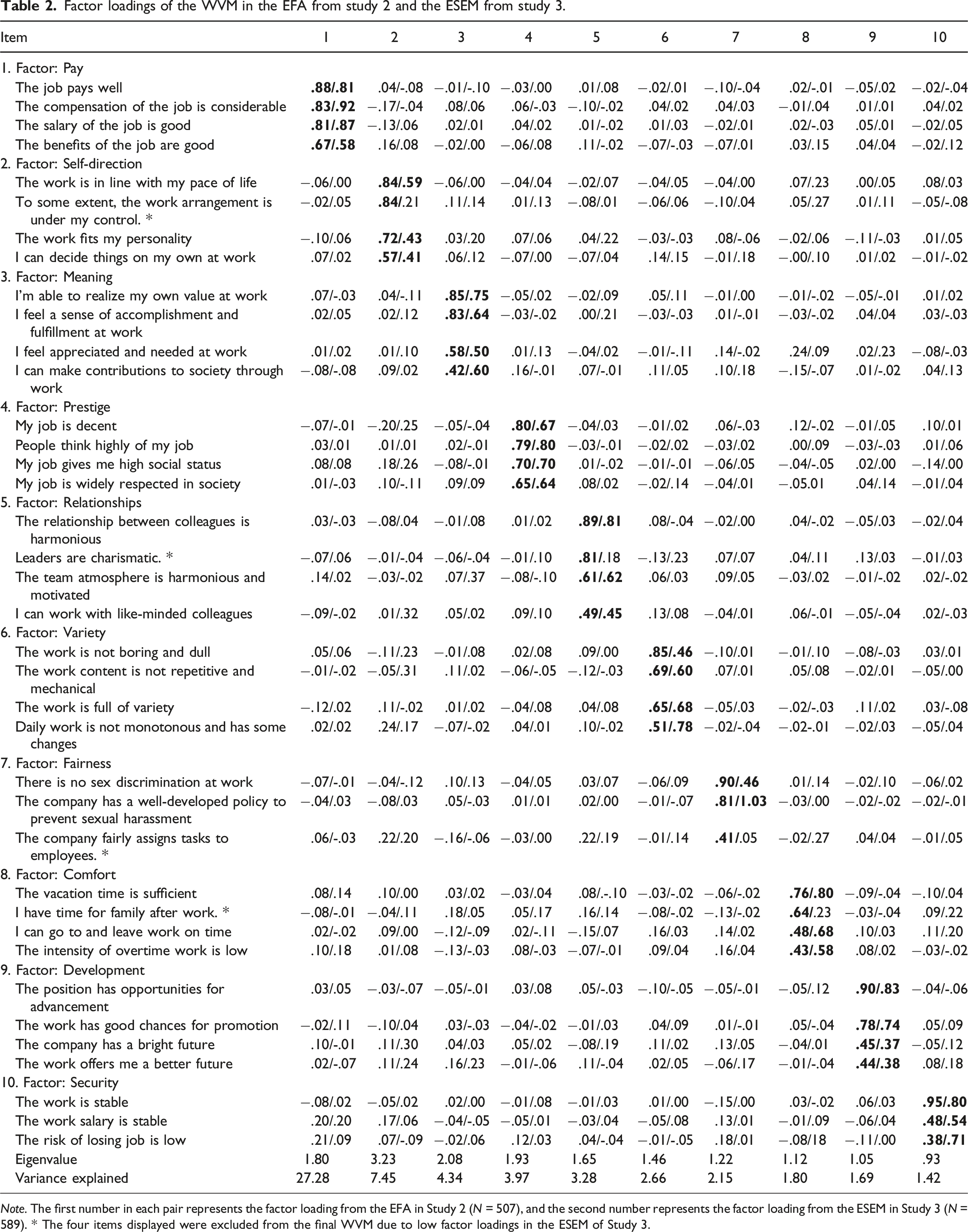
Note. The first number in each pair represents the factor loading from the EFA in Study 2 (N = 507), and the second number represents the factor loading from the ESEM in Study 3 (N = 589). * The four items displayed were excluded from the final WVM due to low factor loadings in the ESEM of Study 3.
Study 3: Establishing Psychometric Support, Examining Structure
In Study 3, we aimed to test the psychometric properties of the WVM. Specifically, we examined the reliability, construct validity, convergent validity, discriminant validity, and criterion-related validity of the instruments’ scores.
Research Hypotheses
Construct Validity
The EFA in Study 2 yielded 10 distinct, yet related, factors. The next step was to confirm the factor structure of this measure. We primarily used exploratory structural equation modeling (ESEM) to examine the factor structure. Traditional confirmatory factor analysis (CFA) relies on a strict independent cluster assumption, forcing each item to load on a single factor with all cross-loadings constrained to be zero. This strict assumption is rarely satisfied given the nature of items (Marsh et al., 2014; Swami et al., 2023). Items almost always display some degree of construct-relevant association with non-target constructs assessing conceptually-related dimensions (Marsh et al., 2014). For example, the security dimension item, “The work salary is stable” primarily corresponds to this dimension. However, because it mentions salary, the item may also to a lesser extent tap into the dimension of pay. Indeed, based on the results of the EFA in Study 2, this item cross-loads on the dimension of pay, albeit at a low level. Restricting this item to have no cross-loading on pay in CFA is not appropriate. ESEM integrates EFA and CFA into a single framework by relying on the overarching CFA model while allowing for cross-loadings, as is typical in EFA (Levesque-Côté et al., 2018; Marsh et al., 2014; Swami et al., 2023). By doing so, ESEM examines whether items primarily loaded on their dimensions (Levesque-Côté et al., 2018; Marsh et al., 2014). We considered the ESEM to be highly suitable to further examine the factor structure and items of the WVM given the potential cross-loadings of items corresponding to the underlying 10 distinct but related factors. We expected that the ESEM would still extract 10 factors, consistent with the Study 2 results (Hypothesis 1a). We also anticipated that the ESEM would provide a better fit than the CFA model (Hypothesis 1b).
Convergent Validity and Discriminant Validity
Convergent and discriminant validity were examined via comparisons with other work values measures. Specifically, we examined correlations between the WVM’s 10 work values and the eight work values from Cable and Edwards (2004). These eight work values corresponded to Schwartz’s (1992) theory of basic values, including altruism, relationships with others, pay, security, authority, prestige, variety, and autonomy. Based on the definitions, altruism shared some conceptual overlap with WVM meaning. Thus, we expected their correlation to be positive and moderate-to-strong in magnitude (Hypothesis 2a). Autonomy shared some conceptual overlap with WVM self-direction. We also expected their correlation to be positive and moderate-to-strong in magnitude (Hypothesis 2b). Moreover, five pairs of values have particularly strong conceptual overlap: relationships with others with WVM relationships, pay with WVM pay, prestige with WVM prestige, security with WVM security, and variety with WVM variety. Accordingly, we expected these five pairs of correlations to be positive and very strong (Hypotheses 2c). These would provide evidence of convergent validity.
However, authority shared little conceptual overlap with any of the 10 work values in the WVM. Thus, we expected its correlations with scores on the 10 WVM work values would be comparatively weak (Hypothesis 2d). Moreover, development, comfort, and fairness in the WVM shared little conceptual overlap with any of Cable and Edwards’s (2004) eight work values. Thus, we expected their correlations with Cable and Edwards’s (2004) work values to be comparatively weak (Hypothesis 2e), serving as evidence of discriminant validity.
Criterion-Related Validity
Next, we turned to criterion-related validity analyses. We examined whether the WVM’s 10 work values concurrently predicted important career outcomes. Work orientation was chosen for these analyses. Work orientation represented the way people view work as meaningful and purposeful in their personal lives (Willner et al., 2020), indicating people’s primary meaning and purpose for working (Cho & Jiang, 2021). It is conceptually different from work values (Rosso et al., 2010; Willner et al., 2020). However, work orientation is regarded as being strongly shaped by work values (Nord et al., 1990; Rosso et al., 2010; Willner et al., 2020). Considering the potential effects of work values on work orientation, we chose work orientation in examining the criterion-related validity.
Based on Willner et al.’s classification, we specifically focused on four work orientations that may be related to work values: job, career, calling, and social embeddedness. First, job-oriented individuals view work principally as a means to obtain income and economic security. They would not work if they had enough money. In this regard, we expected that university students who place greater emphasis on pay and comfort would score higher on a measure of the job orientation (Hypothesis 3a). Second, career-oriented individuals view work as a means for advancement and development in the workplace. Therefore, we expected this orientation to be positively related to the development value (Hypothesis 3b). Third, people with calling orientation regard their work as making a positive contribution to society, leading us to predict that this orientation would relate positively to the meaning value (Hypothesis 3c). Fourth, people with a social embeddedness orientation view their work as a means of gaining a sense of belonging that makes them part of a group. Accordingly, we expected that those who value relationships are more likely to hold a social embeddedness orientation (Hypothesis 3d).
Method
Participants and Procedure
Data were collected from three samples of students. The first two samples were recruited using the same procedures described for Study 2.
Sample 1
Participants were recruited from a university located in northwest China. Only work values were assessed in this sample. No compensation was offered as an incentive. A total of 589 participants (response rate of 59%) responded. Most were women (75%). The sample reported a mean age of 18.06 years (SD = .72; range = 16–23 years). All participants were first-year students.
Sample 2
This sample was drawn from students attending five comprehensive universities located in the southwest, northwest, north, and east regions of China. A total of 547 participants (response rate of 39%) responded. Most were women (57%). The sample reported a mean age of 19.27 years (SD = 1.26, ranging from 16 to 22 years); 39% were first-year students, 35% were second-years, 17% were third-years, and 9% were in fourth-years.
Sample 3
Participants were recruited from a psychology course at a university located in northwest of China. Only work values were assessed in this sample. To improve the response rate, we offered 5 CNY as an incentive to each participant who provided a response. A total of 89 participants (response rate of 98%) responded at Time 1; 94% (N = 84) participated again at Time 2, five weeks later. Most participants were female (80%). The sample reported a mean age of 19.63 years (SD = .65, ranging from 18 to 21 years); all were in their second year.
Measures
The English items of the Work Values Survey and Work Orientation Questionnaire (used Sample 2 in Study 3) were translated into Chinese. Specifically, the first author translated the original English items into Chinese independently, and the second and third authors evaluated the translated items. The final Chinese versions of the items were confirmed after consensus was achieved among the three authors.
Work Values Measure (WVM)
The 38-item WVM developed in Study 2 was used to measure participants’ 10 work values. The items were answered on a five-point scale that ranged from 1 (not important at all) to 5 (very important).
Work Values Survey (WVS)
The 24-item WVS developed by Cable and Edwards (2004) was used to assess participants’ eight work values. The items were answered on a 5-point Likert-type scale ranging from 1 (not important at all) to 5 (extremely important). An example item is “The amount of pay” (pay). The subscales were found to exhibit good reliability (α = .73–.87; Cable & Edwards, 2004). Studies involving Chinese samples have also reported acceptable to good reliabilities for the subscale scores (α = .65–.88) and have supported the scale’s construct validity (Chang et al., 2024; Valero et al., 2025). In this study, Cronbach’s α for each scale’s score were .91 (altruism), .87 (relationships with others), .92 (pay), .83 (prestige), .88 (security), .78 (authority), .90 (variety), and .82 (autonomy).
Work orientation
The 25-item Work Orientation Questionnaire developed by Willner et al. (2020) was used to measure participants’ five work orientations. Participants were asked to rate on a 7-point Likert-type scale how well each item describes them from 1 (not at all) to 7 (very much). An example item is “If I had enough money, I would not look for work” (job orientation). Willner et al. (2020) found the subscales to exhibit adequate reliability (α = .76–.88) and construct validity. In this study, Cronbach’s α values for each scale’s scores were .77 (job), .85 (career), .84 (calling), and .80 (social embeddedness).
Control Variables
We controlled for gender (0 = male, 1 = female) in the analysis examining criterion-related validity to reduce their potential confounding effects in Sample 2. Gender has been shown to relate to work values and work orientations (Willner et al., 2020).
Results
Preliminary Analysis
We assessed the skewness and kurtosis of the items to evaluate potential violation of multivariate normality. In Sample 1, skewness values ranged from −1.83 to −.03 and kurtosis values ranged from −.59 to 3.94. In Sample 2, skewness values ranged from −1.62 to −.32 and kurtosis values ranged from −.39 to 2.90. In Sample 3, skewness values ranged from −2.04 to .17 and kurtosis values ranged from −.87 to 5.67. These results indicated that the distributions for some items were moderately nonnormal (skewness < |2| or kurtosis values < |7|, Finney & DiStefano, 2013). Therefore, we used the robust maximum likelihood estimation (MLR) to test the ESEM and CFA models.
ESEM and CFA
Fit indices of the ESEM and CFA.
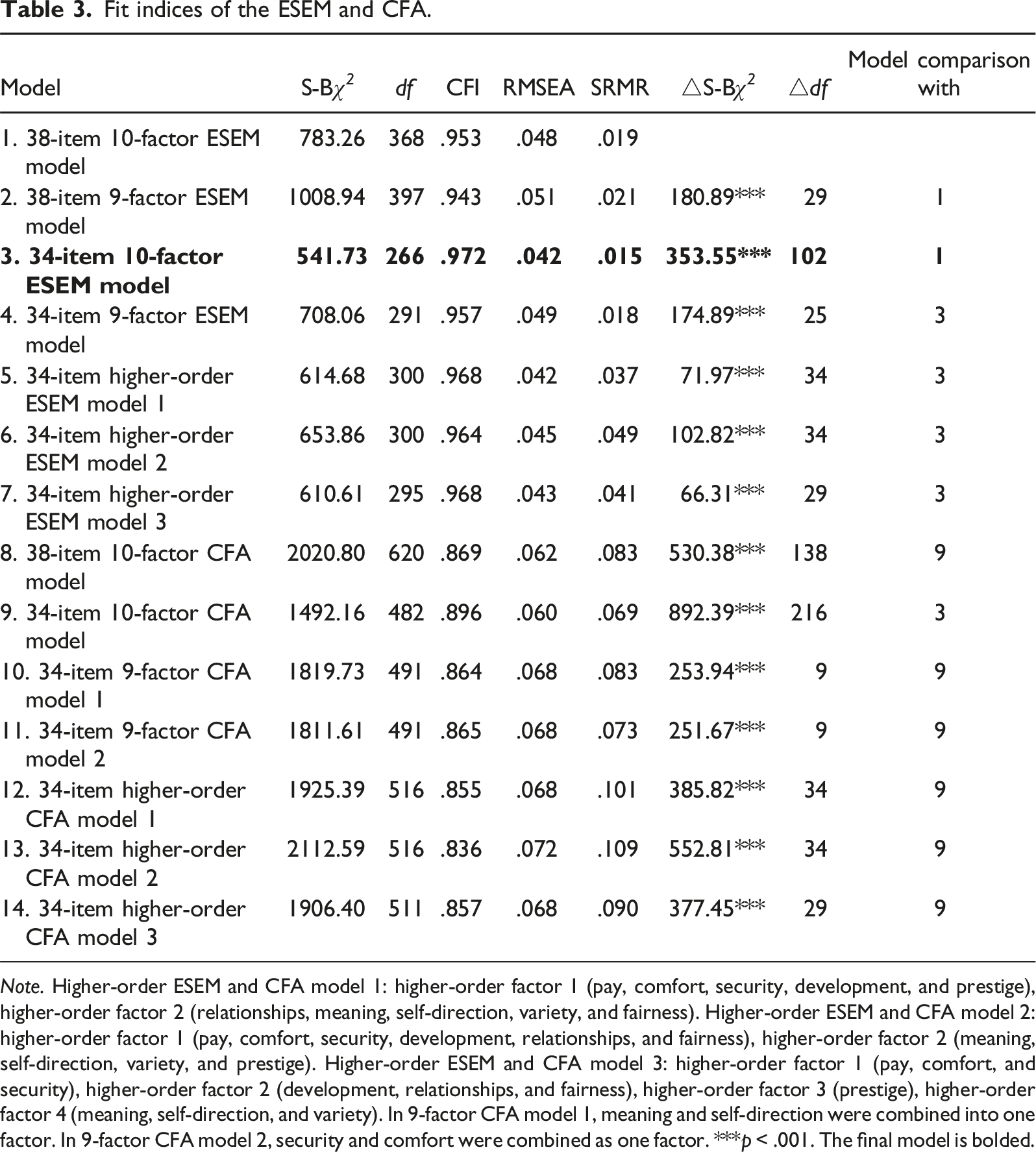
Note. Higher-order ESEM and CFA model 1: higher-order factor 1 (pay, comfort, security, development, and prestige), higher-order factor 2 (relationships, meaning, self-direction, variety, and fairness). Higher-order ESEM and CFA model 2: higher-order factor 1 (pay, comfort, security, development, relationships, and fairness), higher-order factor 2 (meaning, self-direction, variety, and prestige). Higher-order ESEM and CFA model 3: higher-order factor 1 (pay, comfort, and security), higher-order factor 2 (development, relationships, and fairness), higher-order factor 3 (prestige), higher-order factor 4 (meaning, self-direction, and variety). In 9-factor CFA model 1, meaning and self-direction were combined into one factor. In 9-factor CFA model 2, security and comfort were combined as one factor. ***p < .001. The final model is bolded.
We also explored the possibility of higher-order factors underlying the 34-item 10-factor ESEM model. To decide the number of second-order factors, we conducted an EFA based on the 10 factor scores. The EFA results suggested two potential factors: one encompassing relationship, meaning, self-direction, variety, and fairness, and another encompassing pay, comfort, security, development, and prestige. We then tested the second-order ESEM model with two higher-order factors. This model fit the data well (see the 34-item higher-order ESEM model 1 in Table 3), but it demonstrated a significantly poorer fit compared to the 10-factor ESEM model. Two additional second-order ESEM models were then tested, both of which fit the data significantly worse than the 10-factor ESEM model. Taken together, these findings suggest that the alternative second-order ESEM models were not supported. Cumulatively, these results provide strong support for the 10-factor structure proposed in Hypothesis 1a and 1b. Therefore, a work values scale consisting of 10 factors and 34 items was formed, the WVM. The Chinese version of the WVM is reported in Appendix 2 of the online supplements.
Reliability Analysis
Means, standard deviations, reliability coefficients and correlation among the 10 factors.

Note. The McDonald’s ω coefficient is shown in italics on the diagonal. The correlations from Sample 1 in Study 3 (N = 589) are presented above the diagonal and the correlations from Sample 2 in Study 3 (N = 547) are presented below the diagonal. *p < .05. **p < .01.
Convergent and Discriminant Validity
We examined convergent and discriminant validity of scores on the 34-item WVM using Sample 2. Before conducting further analysis, we assessed the fit of the 10-factor ESEM and CFA models in this sample. Consistent with the results from Sample 1, the ESEM model (S-Bχ 2 = 620.51, df = 266, CFI = .948, RMSEA = .049, SRMR = .017) showed a significantly better fit to the data than the CFA model (S-Bχ 2 = 1196.36, df = 482, CFI = .895, RMSEA = .052, SRMR = .059; △S-Bχ 2 = 557.71, △df = 216, p < .001). McDonald’s ω for each factor ranged from .74 to .87 in Sample 2 (see Table 4). These also supported the construct validity and internal consistency reliability of WVM scores.
Next, bivariate correlations among work values used to test convergent and discriminant validity were calculated; these are presented in Table S2 in Appendix 1 of the online supplements. Scores on the WVM meaning scale were moderately positively correlated with altruism scores on the WVS (r = .66, p < .01), supporting Hypothesis 2a. Similarly, WVM self-direction scores were moderately positively correlated with autonomy scores the WVS (r = .65, p < .01), supporting Hypothesis 2b. WVM security scores were highly positively correlated with WVS security scores (r = .75, p < .01), and WVM pay scores were highly positively correlated with WVS pay scores (r = .85, p < .01). The pattern continued when examining the high correlations between WVM prestige and WVS prestige (r = .80, p < .01), WVM relationships and WVS relationships (r = .71, p < .01), and WVM variety and WVS variety (r = .72, p < .01). These results supported Hypothesis 2c, the convergent validity of the WVM. However, scores on the WVS authority scale were not highly related to any of the 10 work values from our study (r = .27 - .54), supporting Hypothesis 2d. Similarly, development, comfort, and fairness on the WVM were not highly correlated with any of the WVS values (r = .10 - .54), supporting Hypothesis 2e. These relatively lower correlations supported the discriminant validity of the instrument’s scores.
Criterion-related Validity
Criterion-related validity was tested using multiple regression to examine whether a given work value related to different work orientations (see Table S3 in Appendix 1 of the online supplements). Pay (β = .35, p < .001) and comfort (β = .28, p < .001) positively related to the job orientation, whereas meaning negatively related to it (β = −.31, p < .001), supporting Hypothesis 3a. Development was the strongest positive predictor of the career orientation (β = .39, p < .001, supporting Hypothesis 3b), while meaning was the strongest positive predictor of the calling orientation (β = .41, p < .001, supporting Hypothesis 3c) and relationships was the strongest positive predictor of social embeddedness orientation (β = .36, p < .001, supporting Hypothesis 3d). These results provided evidence of criterion-related validity of scores on the WVM.
Discussion
The objectives of this series of studies were to develop and establish psychometric support for a new measure of work values for Chinese university students and examine the structure of work values for this population. In pursuit of these objectives, we qualitatively analyzed responses to open-ended items and found 13 work values. Drawing from these work values, we proceeded to develop a 34-item work values scale—the WVM—with a 10-factor structure. Finally, we examined the psychometric properties of this scale and found evidence of reliability as well as construct, convergent, discriminant, and criterion-related validity for this new scale’s scores. These findings extend knowledge about existing work value structures of Chinese populations and establish a reliable and valid measure to assess the work values of Chinese university students.
The key contribution of this study is the establishment of a psychometrically sound measure of work values—the WVM—useful for capturing the core work value structure of contemporary Chinese university students. This is especially relevant in light of significant economic, social, and cultural changes in China over the last two decades, which have rendered the existing work values measures (e.g., Jin & Li, 2005; Ling et al., 1999) less applicable to contemporary Chinese populations than they once were. The WVM addresses measurement issues identified in prior measures such as a lack of psychometric evidence and/or inadequate psychometric properties, especially for use among new generations of Chinese university students (e.g., Jin et al., 2020). Our new scale demonstrated strong psychometric qualities, including test-retest reliability, internal consistency reliability, construct validity, and criterion-related validity.
This research revealed that the structure of work values among Chinese university students consists of 10 distinct values: pay (the amount of pay from work), comfort (reasonable workload levels), security (job stability), fairness (absence of sex discrimination or harassment), development (career growth prospects), relationships (harmonious workplace relationships), prestige (gaining social status and prestige through work), meaning (achieving meaningfulness and fulfillment through work), variety (the variety in work), and self-direction (alignment between work and self-attributes). This structure contributes to the broader work value theories in a non-Western context, highlighting potential differences in work value systems between Chinese and Western contexts. For example, eight of the 10 values aligned with Super’s structure (Robinson & Betz, 2008; Super, 1970), but unlike Super’s model, our findings did not include creativity, mental challenge, supervision, or work environment as key factors. Similarly, neither comfort nor fairness corresponded with the work values identified in Schwartz’s (1992) theory. We did not find values focused on compliance with rules or maintaining traditions, which appeared in structures based on Schwartz’s (1992) theory (e.g., Albrecht et al., 2020; Consiglio et al., 2016), suggesting that Chinese university students may place less importance on tradition and conformity. Moreover, self-transcendent values like benevolence and universalism were not identified in our findings, indicating that these may be less relevant for this demographic.
Our results offer insights on the current work values of Chinese university students. Pay and security emerged as the most emphasized work values, aligning with recent studies (Na & Zhang, 2024; Zhaopin, 2024). This suggests that Chinese university students today prioritize meeting their basic needs and securing essential living conditions through work. Such an emphasis may be shaped by China’s economic, social, and cultural changes (Na & Zhang, 2024). Over the last two decades, for example, the number of university graduates in China has risen significantly (National Bureau of Statistics of China, 2024), intensifying job competition and increasing pressure to secure a stable income post-graduation (Li, 2020). The COVID-19 pandemic also has exacerbated economic challenges and heightened employment uncertainty, possibly influencing students to focus on work values that address these immediate needs (Cao & Hamori, 2022). In addition, the work value of comfort, which aligns with findings from Jin and Li (2005), also emerged in our study. This highlights the growing importance of work-life balance and manageable workloads for Chinese university students. Recent decades of economic prosperity have fostered a work culture marked by high-achievement, particularly in high-tech sectors, where long working hours (e.g., “996” – 9 am to 9 pm, six days a week) have sparked heated debates around excessive work and work-life balance (Xiao et al., 2020; Yip, 2021). Given this context, the emphasis on comfort likely reflects a reaction against these demanding work cultures.
In contrast to earlier generations of Chinese university students (Jin & Li, 2005), our study did not identify family maintenance, social promotion, or morality and ethics as prominent work values, but we did find variety and fairness. This shift suggests that contemporary Chinese university students, at least in these samples, may have different priorities compared to previous generations. For instance, compared to earlier cohorts (e.g., Jin & Li, 2005), today’s students appear less concerned with work role in supporting family obligations, perhaps because family roles are not yet central to their lives. Alternatively, this may indicate a broader societal shift away from traditional family expectations. Indeed, young Chinese adults are increasingly delaying marriage, with China’s marriage rate steadily declining since 2013 (National Bureau of Statistics of China, 2024), and a growing preference for later family formation (Blair & Madigan, 2021). In addition, the work value of fairness, particularly regarding sex discrimination and harassment in the workplace, was also strongly emphasized in our study, with women placing a greater emphasis on this value than men. This may reflect heightened awareness of gender inequality in Chinese workplaces (Gao et al., 2016), underscoring the need for organizations to address these issues effectively.
Our findings also provide new insights into the relationship between work values and work orientations, extending previous research (e.g., Abessolo et al., 2021; Lan et al., 2013; Nord et al., 1990; Willner et al., 2020). Among the 10 work values, meaning and comfort were two important values that related to all four work orientations. Those who prioritized meaning were less likely to endorse the job orientation and more likely to endorse other orientations, particularly the calling orientation. In contrast, those who prioritized comfort were more likely to endorse the job orientation and less likely to endorse other orientations. The job orientation has been associated with negative career- and job-related outcomes (e.g., Lan et al., 2013; Willner et al., 2020; Wrzesniewski et al., 1997), suggesting that future research should examine whether the comfort value contributes to negative outcomes as well, either by predicting them, resulting from them, or both.
Limitations and Future Research
This series of studies has limitations that should be acknowledged when interpreting our results. First, with the exception of Sample 3 of Study 3, we relied on cross-sectional research designs in this research. For the other samples, longitudinal relationships could not be examined and causal inferences cannot be made. Future research should examine these relationships using longitudinal designs. Second, the majority of our sample was female. This may bias the results. For example, women reported significantly higher levels of valuing fairness than men. Although we had controlled for gender in the analyses, it would be helpful to recruit a more gender-balanced sample in future research. Recruiting from fields traditionally dominated by men (e.g., engineering) could address this bias. Third, we selected work orientations as criterion variables to examine the criterion-related validity. These variables offered a helpful starting point, but additional evidence on the scale’s criterion-related validity is needed, such as the correlation of the scale scores with specific career choice outcomes, career-related behaviors, and well-being variables. These relations might be complex, needing more theoretical frameworks and advanced designs to facilitate the examination of these relations. Future research should explore such relations to further examine the scale’s validity. Fourth, the EFA in Study 2 did not extract the factor of workplace. However, the qualitative results in Study 1 suggested that physical environment and location of the workplace may be a major work value of Chinese university students. Future research should consider adding this to the 10 work values. Fifth, we used a continuous response format for the items in our WVM. Although this approach resulted in an instrument with strong psychometric support, many other values instruments use a forced-choice format to ensure greater variability in responses. Subsequent research might do well to compare continuous versus forced-choice formats for measuring work values among Chinese university students. Finally, future research should consider extending the scale to workers with diverse educational backgrounds, as the majority of China’s workforce lacks a university degree (National Bureau of Statistics, 2023). Understanding the work values of this broader population is crucial for capturing a more comprehensive understanding of work values across the country.
Practical Implications
This study’s results have practical implications for career assessment, counseling, and management interventions. First, the WVM offers a psychometrically sound measure for assessing the work values of contemporary Chinese university students. Career counselors could use the WVM to clarify their clients’ work values and facilitate discussion regarding the implications of their values for career decision-making and career development. For instance, if meaning is a top priority for a client, counselors should guide them in identifying career options or work environments that align with this value, helping them set clear, actionable career goals. Similarly, if a client struggles with career indecision, counselors can use the WVM to assess whether competing or unclear work values might be influencing their decision-making process. Second, our results offer important insights on work values for contemporary Chinese university students as they continue to enter the workforce after graduation. Organizations with a clear understanding of their work values, theoretically, can more effectively attract, engage, and retain this emerging cohort of employees. For example, since work values related to meeting basic needs, such as salary and security, were highly emphasized, organizations are advised to ensure that compensation packages are adequate to meet these fundamental needs. Our study also found that women placed more emphasis on fairness compared to men, highlighting the importance of addressing gender equality, sex discrimination, and harassment in the workplace. Organizations must take meaningful and effective actions to create safe and inclusive environments, as failing to meet these expectations may lead to dissatisfaction and higher turnover rates among young employees. Finally, career counselors and educators should recognize that different work values (e.g., meaning vs. comfort) play different roles in university students’ career-related outcomes, and may lead to distinct career paths and outcomes, requiring that careful attention be directed toward values when delivering interventions. For instance, if a student prioritizes comfort in their work, counselors might help them weigh the pros and cons of pursuing a job that aligns with this value, enabling them to make more informed career decisions.
Supplemental Material
Supplemental Material - Structure and Measurement of Work Values of Chinese University Students
Supplemental Material for Structure and Measurement of Work Values of Chinese University Students by Chunyu Zhang, Yifei Guo, Xuehan Li, Bryan J. Dik and Jia Wei in Journal of Career Assessment
Footnotes
Author Contributions
The second and third authors contributed equally to this work.
Declaration of Conflicting Interests
The author(s) declared no potential conflicts of interest with respect to the research, authorship, and/or publication of this article.
Funding
The author(s) disclosed receipt of the following financial support for the research, authorship, and/or publication of this article: This research was supported by the National Social Science Fund of China (21BSH102).

Supplemental Material
Supplemental material for this article is available online.
References
Supplementary Material
Please find the following supplemental material available below.
For Open Access articles published under a Creative Commons License, all supplemental material carries the same license as the article it is associated with.
For non-Open Access articles published, all supplemental material carries a non-exclusive license, and permission requests for re-use of supplemental material or any part of supplemental material shall be sent directly to the copyright owner as specified in the copyright notice associated with the article.
