







Abstract
With the rapid expansion of gig economy, platform work has become a major force shaping contemporary labor markets. In China, rural-migrant food-delivery riders constitute a dynamic yet underrepresented group, often lacking access to decent work. Grounded in Psychology of Working Theory (PWT) and Work Precarity Framework, this study primarily examined their subjective experiences of decent work and future aspirations. As a secondary aim, we explored their view of work. Semi-structured interviews were conducted with 18 participants, and data were analyzed using the Consensual Qualitative Research method. Our findings revealed sources of dissatisfaction such as income instability and risky working conditions, alongside sources of satisfaction like flexible schedules and positive colleague relationships. While some were trapped in precarious employment and harbored turnover intentions, others had developed concrete strategies to improve their circumstances, such as transitioning to ride-hailing driving or pursuing promotion to manager roles. Finally, participants framed work as a means to meet survival needs, foster professional growth, and contrubute to others. This study marks the first application of PWT and precarious work scholarship to understanding how rural-migrant food-delivery riders navigate precarious work within gig economy. Directions for future research and implications for policymakers, platform operators, and career counselors are discussed.
Keywords
China’s gig economy has undergone substantial expansion since the early 2010s, propelled by urbanization, digitization, and changing consumption patterns (Huang, 2023). Amid this landscape, the food delivery industry has established itself as both a dominant and widely accessible segment within the platform economy, engaging an estimated 10 million riders (i.e., workers riding e-bikes for food delivery; Qian et al., 2024) across China in 2023. A salient demographic trait of the food delivery workforce is its strong rural ties: nearly 80% of riders originate from rural areas, migrating to urban areas primarily to seek higher income, support family livelihoods, and access opportunities unavailable in their regions of origin (Sun & Zhao, 2024). For these rural-migrant riders, food delivery work offers unique appeal—low entry barriers, flexible working hours, and immediate income feedback—making it a transitional or even long-term career choice amid limited rural-urban mobility options (Lin, 2025). Despite these seemingly appealing benefits, platform-based delivery work entails notable challenges, including economic insecurity, lack of workplace protections, and unsafe working conditions (Galière, 2020; Kellogg et al., 2020; Zheng & Wu, 2022). Additionally, Chinese rural migrant workers often face widespread social inequality and unjust treatment in the urban workplace due to their outsider status (Chan, 2021; Mohabir et al., 2017). These issues make it extremely critical to understand how rural-migrant riders perceive their work experiences and form expectations for their future, particularly given that work quality has a great impact on individuals’ overall well-being and work fulfillment (Blustein et al., 2016).
The Psychology of Working Theory (PWT; Duffy et al., 2016) was developed to delineate the vocational development of all workers, with a particular emphasis on those facing systemic barriers (e.g., migration status) in their pursuit of decent work. To date, a wealth of research has used PWT to explore the work experiences of marginalized populations, both in the Western context (e.g., Allan et al., 2019; Kim et al., 2018; Tokar & Kaut, 2018) and in China (e.g., Han et al., 2022; Shen et al., 2024). However, these studies have predominantly focused on formal employment groups, with relatively little attention devoted to the fast-growing segment of digital platform workers—who typically experience significant precarity due to job instability and inadequate protection against health risks (Blustein et al., 2023). Additionally, extant studies have typically employed quantitative methods to explore the relationships between decent work and its predictors and outcomes among disadvantaged employed adults (Duffy et al., 2024). While useful for identifying broad patterns, such approaches may overlook the nuanced, lived experiences and subjective meanings individuals attach to their work (Blustein, 2006).
To address the aforementioned research gaps, this study adopts qualitative methods to explore the work experiences of Chinese rural-migrant food-delivery riders. Our inquiry is guided by the PWT (Duffy et al., 2016) and the Work Precarity Framework (WPF; Allan et al., 2021). This dual-lens framework allows us to examine the subjective experience of decent work within conditions of precarious platform employment. Specifically, we investigate how these riders perceive and navigate their work lives by focusing on three interrelated dimensions central to both theoretical perspectives: (1) their present evaluations of work through sources of satisfaction and dissatisfaction, which illuminate the immediate experience of work quality and constraints; (2) their future career aspirations and prospects, reflecting their agency and volition within a precarious labor market; and (3) the subjective meaning they ascribe to work, revealing how they interpret their role and find value amidst instability. The focus on present well-being, future orientation, and the meaning of work directly addresses the core concerns of PWT regarding decent work and WPF’s analysis of precarious employment. Notably, this research represents the first known application of PWT and WPF to understand how rural-migrant food-delivery riders navigate the evolving world of work within a non-Western, collectivist cultural context. The findings are anticipated to provide implications for policymakers, platform operators, and career counselors who strive to help this vulnerable group to obtain decent and meaningful work.
Rural-Migrant Food-Delivery Riders in China
The rise of algorithm-driven gig work (i.e., short-term, task-based employment coordinated entirely through digital platforms) marks a profound shift in China’s labor market, granting workers greater flexibility yet also deepening precarity (Huang, 2023; Lin, 2025). Against this backdrop, food delivery has emerged as a dominant sector heavily reliant on rural-to-urban migrants, who make up nearly 80% of riders on leading platforms like Meituan and Ele. me, which together hold over 90% of the Chinese market (Sun & Zhao, 2024). Typically young and male, these migrants are drawn to the sector by higher earnings than rural jobs offer, yet they have to navigate algorithmic governance—the use of digital algorithms to manage and regulate worker behavior, including through real-time route optimization, performance metrics (e.g., order completion speed, customer ratings), and automated penalty systems—alongside intense competition and pervasive insecurity (Chen & Sun, 2020; Huang, 2023; Sun & Zhao, 2024).
Classified as independent contractors, food delivery riders are typically excluded from core statutory labor rights—including social insurance coverage, minimum wage guarantees, legally mandated rest breaks, and collective bargaining rights—as well as broader social protections (Chen & Sun, 2020; Huang, 2023; Wu et al., 2022). For instance, a substantial number of riders work daily shifts exceeding 12 hours, enduring extreme seasonal temperatures—from frigid winters to sweltering summers—and pervasive urban pollution, all of which have documented adverse impacts on their physical health (Lin, 2025; Zheng & Wu, 2022). Additionally, income volatility resulting from fluctuating order volumes, variable incentive structures, and discretionary penalties entrenches their long-term financial insecurity (Chan, 2021; Huang, 2023).
These labor issues are compounded by institutional marginalization under China’s household registration (Hukou) system. Introduced in the 1950s to control rural-urban migration and allocate resources under state planning, the Hukou system categorizes citizens at birth as either rural or urban residents. This policy has long reinforced a structural divide: rural Hukou holders who migrate to cities are systematically denied equal access to public services such as healthcare, education, and housing (Cooke & Zhao, 2021; Wong et al., 2007). Although recent reforms have aimed at relaxing Hukou restrictions in certain smaller cities, major metropolitan cities like Shanghai and Beijing continue to limit migrants’ access to full social entitlements, thereby sustaining workplace inequality and indecent work conditions (Qian & Wen, 2021; Wang et al., 2023). As a result, migrant riders face greater difficulty securing a decent living compared to urban-registered residents.
Beyond institutional barriers, these riders often confront deep-seated social discrimination and cultural alienation. Stereotyped as “members of the underclass,” they are frequently barred from using elevators in upscale residential and commercial buildings, forcing them to climb multiple flights of stairs during deliveries. They also endure daily microaggressions from customers and restaurant staff, such as dismissive remarks or unreasonable demands (Huang, 2023; Sun & Zhao, 2024). Many reside in cramped, low-cost housing on the city’s peripheries, where access to social infrastructure like healthcare and education is limited, further restricting their community integration and entrenching their outsider status in urban spaces.
Theoretical Frameworks
The present study is primarily informed by the PWT, which focuses on how contextual factors shape the work experiences of individuals, particularly those from underprivileged backgrounds (Blustein, 2006; Duffy et al., 2016). More specifically, marginalization and economic constraints experienced throughout an individual’s life course erode their work volition, defined as the perceived capacity to exercise agency in occupational decision-making despite external limitations (Duffy et al., 2012). These contextual barriers also restrict people’s access to decent work, conceptualized as employment encompassing safe conditions, fair compensation, healthcare access, adequate rest, and organizational values aligned with family and social ones (Duffy et al., 2016). Decent work not only constitutes the minimum conditions for fulfilling basic human needs (power and survival, social contribution, and self-determination) but also upholds inherent human rights, dignity, and holistic well-being (Allan & Blustein, 2022; Blustein et al., 2018). Consequently, individuals who obtain decent work to meet their fundamental needs are more likely to experience overall well-being and work fulfillment. Since 2016, hundreds of studies have empirically validated the core tenets of the PWT across diverse employed adult populations and contextual settings (Duffy et al., 2024). In recent years, an increasing number of Chinese scholars have adopted PWT as a theoretical framework to investigate the work experiences of marginalized groups in the workplace, with rural migrant workers emerging as one of the most extensively studied populations (Han et al., 2022; Shen et al., 2024). However, these studies have typically employed quantitative methods to explore the associations between decent work and its antecedents and outcomes among Chinese rural migrant workers. Additionally, while PWT helps examine how marginalization and economic constraints interact to shape these workers’ access to decent work, it is insufficient for a deeper understanding of the precarious characteristics of their employment and how precarity affects their work experiences and aspirations.
To address this limitation, the present study integrates the Work Precarity Framework (WPF; Allan et al., 2021) to complement the PWT. Conceptualizing work precarity as multifaceted experiences encompassing uncertainty, insecurity, and instability in employment, the WPF elucidates how systemic marginalization and broader economic conditions shape an individual’s exposure to precarious work (the antithesis of decent work) and their subsequent experiences of work precarity. Specifically, individuals from marginalized groups often encounter three distinct dimensions of precarity: (1) precarity of work (fears related to job continuity), (2) precarity at work (physical or interpersonal risks within the workplace), and (3) precarity from work (financial instability stemming from employment). Rooted in the recognition that precarious work entails violations of human dignity and the disempowerment of workers, the WPF advocates for scholarly attention to be directed toward workers who lack the social privilege to access secure and dignified employment (Allan & Blustein, 2022; Allan et al., 2021). Informed by this framework, a recent qualitative study on paid domestic cleaning workers in Switzerland found that these workers experienced work precarity, driven by insecure and inadequate income, lack of labor protections and rights, and exposure to physical and psychosocial risks (Borges et al., 2025). Another study focusing on Korean women without college degrees demonstrated that this group faced substantial struggles in securing and maintaining decent employment, attributable to their lack of both a college education and male privilege (Garrison et al., 2025).
In sum, based on the above two frameworks, rural-migrant food-delivery riders—a marginalized group shaped by China’s Hukou system and stringent platform policies—may experience obstacles in securing decent work and different forms of work precarity. However, the intricate process through which these socio-political constraints are translated into daily work experiences and shape career aspirations remain inadequately captured by quantitative approaches that dominate the existing literature (Han et al., 2022; Shen et al., 2024).
The Present Study
Given that food delivery riders from rural backgrounds represent a particularly vulnerable group within China’s rapidly expanding gig economy (Sun & Zhao, 2024), their work trajectories demand greater attention from both vocational psychologists and social justice advocates. Previous research based on PWT has relied predominantly on quantitative methods to explore how structural factors influence rural migrant workers’ access to decent work (Han et al., 2022; Shen et al., 2024). Qualitative approaches can complement such studies by offering deeper insights into the subjective work experiences and how migrant workers envision their futures. Moreover, existing studies have largely concentrated on rural migrants in traditional labor-intensive industries (e.g., the construction sector; Shen et al., 2024), neglecting the lived experiences of those employed in precarious platform economies—a grwoing yet understudied population facing distinct challenges in the Chinese labor market. To addresses these gaps, the current study aimed to elucidate the subjective work experiences of rural-migrant food-delivery riders in China. Drawing on PWT and WPF, we focused on their present circumstances through the lens of their perceived sources of job satisfaction and dissatisfaction, and how these perceptions shape their future aspirations and view of work. The focus on present well-being, future orientation, and the meaning of work directly addresses the core concerns of PWT regarding decent work and WPF’s analysis of precarious employment. These objectives lead to three research questions: (1) How do participants perceive their current situation in terms of sources of job satisfaction and dissatisfaction? (2) How do they envision their future career prospects? and (3) What meaning do they ascribe to work? By studying these variables, we hope to reveal the complex interplay between participants’ pursuit of decent work and the realities of platform-mediated precarity, thereby offering a holistic perspective on their work-related well-being within China’s unique socio-political context. In doing so, this qualitative study echoes Blustein et al. (2023) call for deeper engagement with the decent work experiences of platform workers, while simultaneously diversifying the broader literature on precarious employment.
Method
The Consensual Qualitative Research (CQR) approach developed by Hill et al. (2005) was employed to analyze interview data. Hill and Knox (2021) noted that CQR is “particularly useful for investigations of inner events about which participants may have ambivalent or suppressed feelings that cannot be easily observed by outsiders” (p. 7). Migrant food-delivery workers are seldom asked about their subjective experiences of decent work or how they ascribe meaning to work. Qualitative interviews are thus well-suited to explore this understudied phenomenon, as they can illuminate these complex, subjective dimensions of vocational experiences. Guided by Ponterotto (2005) qualitative research paradigm framework, this study adopts a primarily postpositivist stance, acknowledging an objective reality exists but can only be partially understood. It also integrates constructivist elements by centering participants’ subjective interpretations. Specifically, follow-up prompts were used during data collection to elicit their lived experiences. In analysis, systematic coding and consensus procedures aligned with postpositivist rigor were balanced with constructivist principles, which prioritized participants’ original phrasing and inherent narrative logics in codebook development.
Participants and Procedure
Participant Demographics
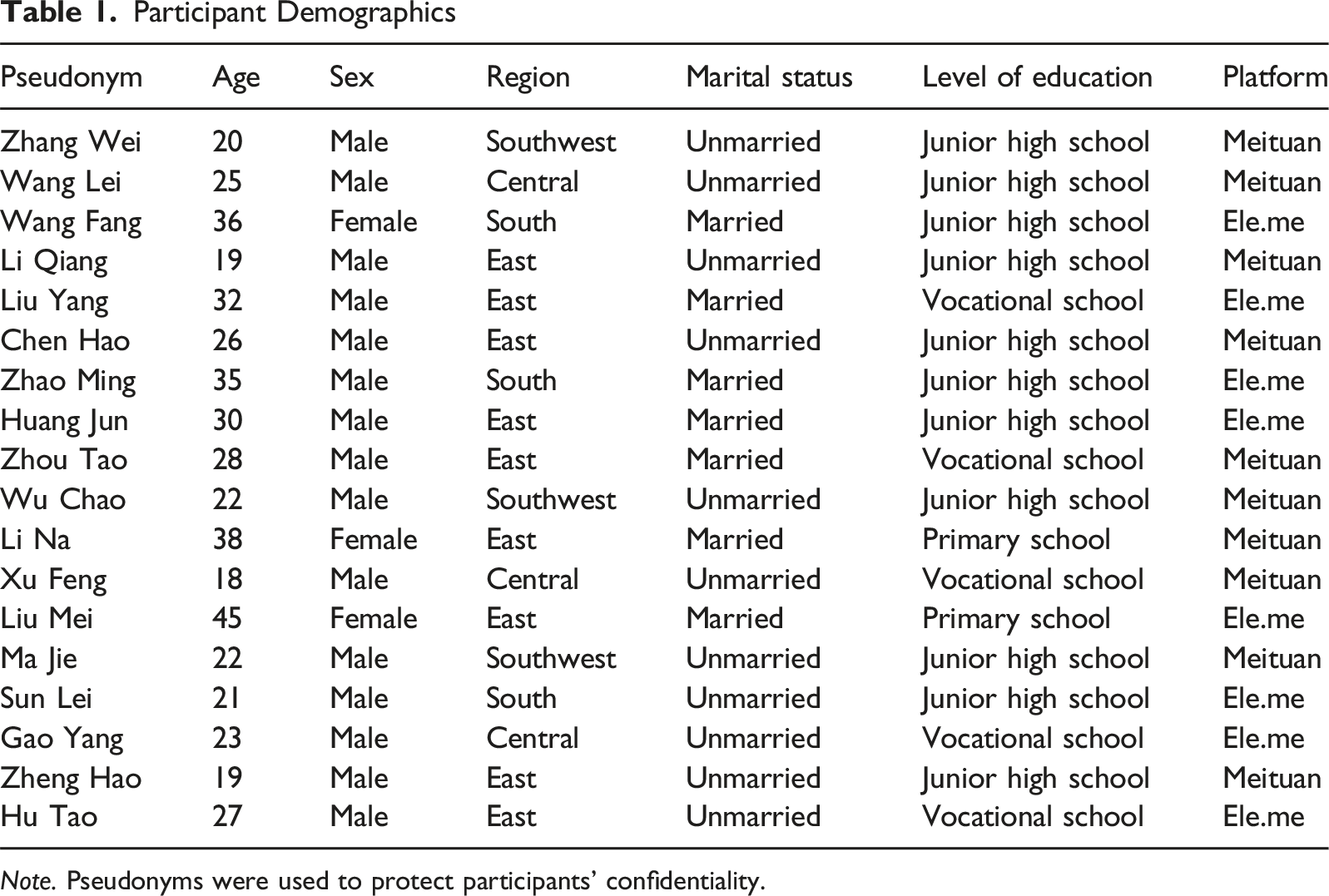
Note. Pseudonyms were used to protect participants’ confidentiality.
After obtaining approval from the institutional review board, we utilized a maximum variation sampling approach—a specific type of purposive sampling (Patton, 2002)—for participant recruitment. To capture the contextual and socioeconomic variations across China that significantly shape working conditions and lived experiences, we intentionally recruited participants from multiple geographic regions. This strategy was selected not only to capture a broad spectrum of working experiences but also to facilitate an in-depth and comprehensive examination of how localized contexts influence our core research questions (Creswell, 2013). Moreover, participants were recruited through multiple channels, including offline delivery stations and social media platforms. Specifically, at delivery stations, we collaborated with site managers to disseminate targeted recruitment advertisements through their internal online working groups. Concurrently, on social media platforms, we posted tailored advertisements in relevant rider communities and forums. Interested individuals were invited to contact the author for additional information and to schedule a semi-structured interview.
Prior to the interviews, all participants completed a demographic questionnaire designed to capture key background characteristics, including age, gender, and educational background. We thoroughly explained the research objectives and assured participants of the strict confidentiality of their data. Informed consent was obtained from each individual, with emphasis on their right to withdraw from the interview at any point should they feel uncomfortable. Consistent with Hill et al. (2005) recommendations for CQR-based qualitative studies, our study exceeded a minimum sample size of 12 participants. We continued conducting interviews until data saturation was attained (Morrow, 2005). Specifically, following each interview, the research team iteratively coded transcripts and cross-referenced emerging themes with existing datasets. We also maintained a saturation memo to document whether novel insights were identified from subsequent participants, thus terminating data collection upon the 18th interview—at which point no additional themes or nuanced perspectives emerged.
A combination of in-person and online interviews was adopted to accommodate participants’ geographic distribution. Nine participants living in the same city as the author of this study were interviewed in-person, while the other nine interviews were conducted via video call. All semi-structured interviews, which were conducted in Chinese between January 2024 and December 2024, were audio-recorded, transcribed verbatim, and had a duration ranging from 60 to 90 minutes per session. Following transcription, all transcripts were shared with participants to verify factual accuracy and allow them to request the removal of any content they wished to exclude from the analysis. All participants confirmed that they had no revisions to make to the transcripts. To protect participant confidentiality, we ensured anonymity by using pseudonyms and removing all identifiable information from the data. Additionally, our contact with the platform companies was strictly limited to site managers solely for recruitment purposes; no participant information or interview data was shared with any company entities, and all data is securely stored on encrypted servers. While our participants did not receive any financial incentives, free career counseling was offered as non-monetary compensation to encourage participation, and this service was provided only after interviews to prevent potential bias. Interestingly, all participants declined, stating that the interview itself provided substantial reflective value, which served as an unexpected benefit of the research process.
Upon completion of all data analysis, the author of this study—who holds a bachelor’s degree in English and a master’s degree in linguistics—translated the Chinese coding results into English. To address potential researcher subjectivity in translation, a two-step verification process was implemented. First, an American scholar proficient in Chinese conducted a blind back-translation of the English results into Chinese, comparing them with the original coding framework to identify discrepancies stemming from the author’s subjective interpretations. Second, the scholar provided targeted feedback on terminological precision, contextual nuances, and culturally loaded expressions. Notably, significant discrepancies emerged in conveying culturally specific concepts. For example, a participant’s description of social stigma included the term “suzhi (素质)”, which was initially translated literally as “quality”. This failed to capture its layered meaning—encompassing educational background, ethical standards, and behavioral conduct—a term often used to marginalize rural migrants. This iterative process mitigated the coder’s biases, ensuring translations accurately reflected participants’ intended meanings.
Protocol Development
The author systematically reviewed the literature on rural-migrant food-delivery riders, decent work, and key PWT and WPF constructs. Based on this, an initial semi-structured interview outline was developed to explore the participants’ career trajectories. This draft was reviewed by two vocational psychology experts, and revisions were made to the wording and sequence of questions based on their recommendations. Subsequently, pilot interviews were conducted with two eligible participants, both of whom confirmed the relevance and clarity of the questions to their actual experiences. Incorporating their feedback, we further refined the phrasing of several questions to enhance clarity and added prompts for better participant engagement. The finalized outline consists of 11 open-ended questions (see Appendix). The first question (“What was your training like, and what kinds of jobs did you have before becoming a delivery rider?”) aimed to build rapport, while laying the foundation for subsequent questions by retracing the participants’ career histories. Other interview questions focused on participants’ perceptions of food delivery work (e.g., “What makes you happy/unhappy about your food delivery work?”). In combination with decent work standards, the interview protocol included a question for participants to assess whether their current work meets these criteria. Informed by PWT-based studies (e.g., Autin et al., 2018; Masdonati et al., 2022; Wan et al., 2025; Wan & Xiong, 2025), we were also interested in participants’ career aspirations (e.g., “What are your professional goals and plans for the future?”) and view of work (e.g., “What does work mean to you personally?”).
Research Team and Reflexivity
The research team consisted of three coders and one external auditor. The study’s author, a female vocational psychologist born and raised in the city, served as the primary coder. Her work is informed by a social justice perspective, with a particular focus on advocating for marginalized people facing substantial barriers to obtaining decent and dignified work. During data analysis, she collaborated with two female graduate student coders from rural backgrounds. To mitigate potential groupthink effects, a male career counselor with an urban Hukou and extensive experience in CQR was engaged as an external auditor. In his professional practice, he offers psychological support to socially disadvantaged adults and is committed to addressing workplace inequalities. Within this study, the auditor was responsible not only for reviewing the interview protocol but also for providing an external assessment of the coding results following each round of analysis. It should also be noted that none of the researchers have direct lived experience as food delivery riders.
The primary coder, being highly experienced in CQR, provided training to the two student coders in its procedures. All members of the research team were required to read Hill et al. (2005) article and examine recent examples of CQR analysis (e.g., Kenny et al., 2023). Furthermore, a crucial aspect of qualitative research involves researchers’ deliberate management of subjectivity through systematic reflection on their biases and expectations, both individually and collectively (Morrow, 2005). Research rigor is strengthened when investigators acknowledge how their standpoints may shape interpretations and adopt procedures to minimize related influences (Levitt et al., 2017). Accordingly, we engaged in explicit discussions concerning potential biases and expectations related to the study before initiating coding. Specifically, the primary coder reflected upon her thorough familiarity with PWT-related research, which emphasizes how structural barriers hinder access to decent work. Having an urban Hukou and lifelong residency in the city, she approached the analysis with an understanding of how the Hukou system creates unequal access to urban resources, leading her to anticipate that such Hukou-based structural barriers may similarly constrain the meaningful urban integration of rural-migrant delivery riders. The student coders, with rural Hukou backgrounds, brought a distinct perspective: their personal experiences of navigating the urban-rural divide under the Hukou system heightened their awareness of the vulnerability of rural-migrant riders, as they could relate to the systemic exclusion faced by this population. All coders expected that participants would describe multiple challenges within the precarious gig economy, with their positionalities shaped by the Hukou system influencing their interpretations of these challenges.
The team prioritized strict adherence to the CQR protocol and avoidance of premature conclusions. Throughout coding, members consistently re-examined interview transcripts to verify coding accuracy and engaged in deliberative discussions to resolve discrepancies. Given the supervisory relationship between the primary coder and the graduate student coders, specific measures were implemented to uphold the consensual principle of the method. The primary coder actively fostered an egalitarian atmosphere during consensus meetings to encourage open expression of viewpoints. All members expressed confidence in communicating freely despite hierarchical differences. To further reduce potential power effects, student coders were invited to speak first in selected discussions.
Data Analysis
Following the completion of participant recruitment, the interview transcripts were analyzed from January 2025 to June 2025 using the CQR approach (Hill et al., 2005), which comprises three core procedural stages: domain identification, core ideas formulation, and cross-analysis. During each phase of analysis, the three coders performed coding independently. Subsequently, the coding team convened to compare their respective code lists, discuss points of divergence, and collaboratively reach a consensus on the final codes. To further enhance validity and mitigate potential groupthink, an external auditor was invited to review the consensus-based codes.
Coding of Domains
The research team members independently reviewed all transcriptions to identify segments pertaining to the four study domains: source of satisfaction, source of dissatisfaction, future aspirations, and view of work. Following the individual analysis, the team convened to discuss initial impressions and collaboratively organize the extracted data within the established domain framework.
Core Ideas
Following the initial phase, the retained interview segments were divided into meaning units. We took special care to ensure that all core ideas remained strictly grounded in the data, avoiding the introduction of personal interpretations. Each coder independently formulated core ideas prior to team discussions, during which discrepancies were examined and a consensus was systematically achieved. Regarding discrepancies in code frequencies, we resolved them through iterative cross-referencing with the original interview data and collective deliberation, while acknowledging the interpretive nature of frequency-based inferences in qualitative research and emphasizing our focus on thematic depth over statistical representation.
Cross-Analysis
The coding team performed a cross-analysis to identify recurring themes across interviews and develop a set of categories for each domain. This phase involved a greater degree of interpretive input from the researchers compared to prior stages. Specifically, each coder first conducted the cross-analysis independently, then presented their proposed categories to the group for critical review. Through collaborative discussion, consensus was reached regarding both the precise wording of categories and the allocation of core ideas within them.
Auditing
Following each round of analysis, the external auditor was invited to review and provide feedback on the coding team’s outcomes. The auditor submitted written comments that largely affirmed the team’s work; however, several categories were recommended for renaming to enhance clarity and conciseness. For example, he suggested revising “positive relationships” to “positive colleague relationships”, noting that participants’ descriptions of supportive interactions were exclusively with other riders, not with customers or platform staff. After verifying that the transcript data substantiated the auditor’s suggestions, the coding team integrated the proposed revisions into the final findings. Drawing on Motulsky (2021) recommendations and our participants’ vulnerability, member checking was omitted from this study to avoid overburdening participants, who would sacrifice pay to participate without ensuring commensurate gains in research quality.
Trustworthiness
Following Morrow (2005) suggestions, we employed several strategies to ensure the trustworthiness of our research. To ensure credibility, our research team held frequent discussions to interpret the interview transcripts collectively. We also enriched our findings with detailed descriptions of the participants’ experiences and their environment. To address transferability, we clearly outlined the unique characteristics of rural-migrant food-delivery riders within China’s context. We also explicitly discussed the limitations of applying our findings to other cultures or different profiles of delivery workers. To establish dependability and confirmability, we provided a meticulous, step-by-step account of our data analysis process. We also integrated feedback from an external auditor to refine our work. Finally, to uphold ethical standards, we used pseudonyms to protect every participant’s confidentiality. We also gave all participants an opportunity to review their interview transcripts for accuracy and invited them to request any adjustments or deletions they deemed necessary.
Results
List of Domains, Categories, and Frequencies
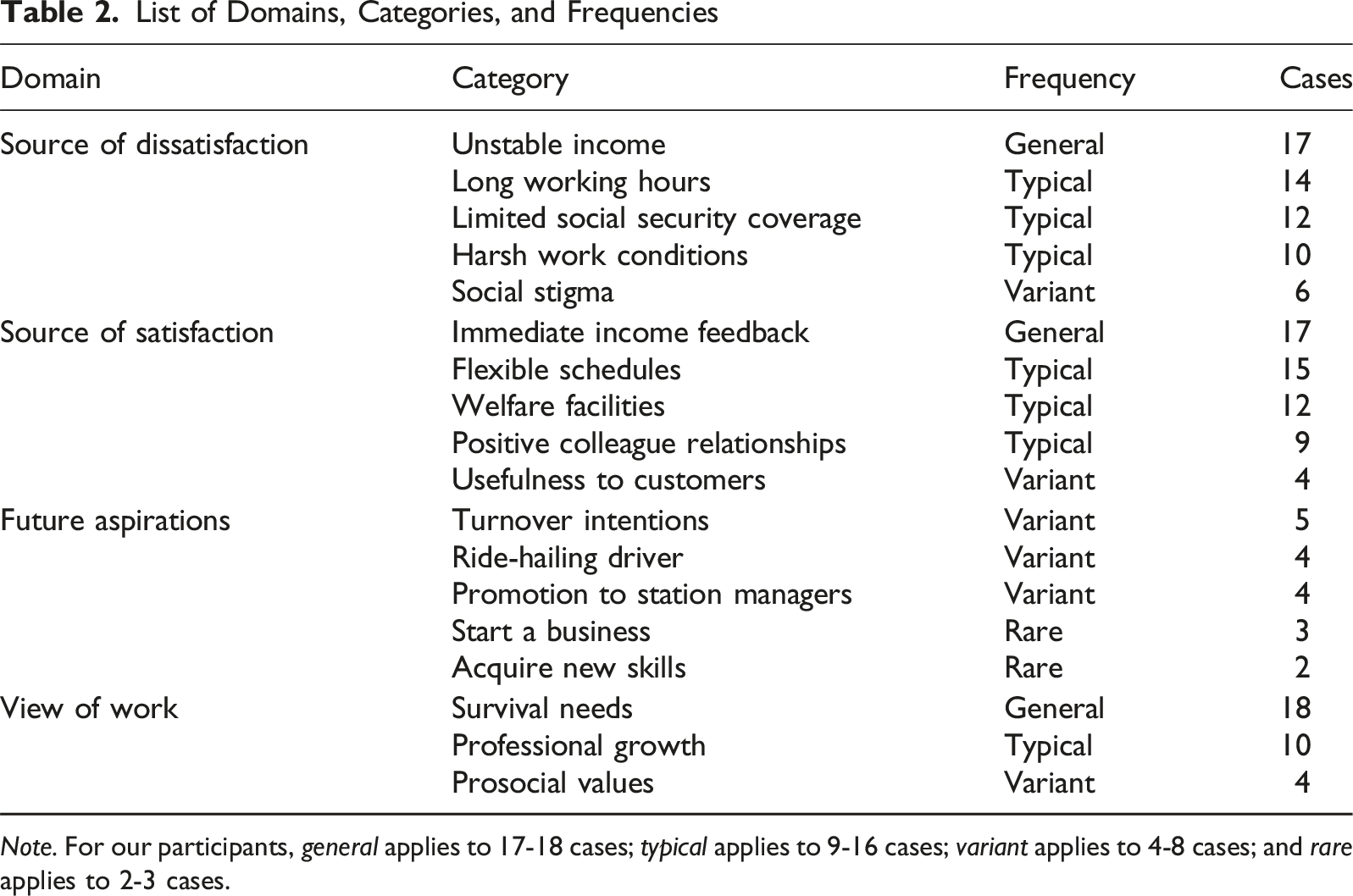
Note. For our participants, general applies to 17-18 cases; typical applies to 9-16 cases; variant applies to 4-8 cases; and rare applies to 2-3 cases.
Source of Dissatisfaction
The “Source of Dissatisfaction” domain reflects participants’ negative work-related experiences and comprises five categories that elaborate on the underlying factors contributing to such dissatisfaction. The primary issue, reported by 17 participants, was unstable income. Their discussions highlighted a heavy reliance on volatile daily order flow, capricious bonus structures, and frequently inexplicable penalties, which collectively created a precarious financial situation. Zhang Wei’s comment exemplifies this frustration: “The app is so unpredictable. One day you’re making good money, the next it’s dead silent. It feels like the platform just decides whether we eat or not, and there’s no way to know what the rules are.” Zhou Tao also voiced his dissatisfaction with the unstable income: Last year, I worked 10 hours a day and could earn over 10,000 RMB per month (around $1,400). But now, even after putting in 13 hours a day, my monthly income has dropped to less than 8,000 RMB (about $1,120). The platform keeps cutting down both our delivery time limits and the pay per order. It’s truly disheartening.
Fourteen participants also found the long working hours frustrating or unbearable. They reported routinely working over 12 hours per day, with only three or four days off each month. Many also noted that online labor platforms often assign more tasks during holidays or in severe weather, which further extends their working hours and eliminates days off. Wu Chao shared his experience of dealing with the excessive workload on rainy days: When it rains, orders pour in non-stop. During a typhoon, I once delivered over 80 orders—a record. But it’s brutal: slippery roads, poor visibility, constantly soaked. You can’t stop though because the algorithm rewards activity. Decline orders or go offline, and they punish you with fewer offers later. So you push through exhaustion. That day, I worked 14 hours straight without a break—not even water.
Moreover, twelve participants cited limited social security coverage as a major source of job dissatisfaction. They reported that the platforms offered only accident insurance—a provision made in light of the high risk of occupational injury—but did not provide access to healthcare or pension benefits. Zhang Wei elaborated on this issue: “The platform deducts 3 RMB (around $0.4) from the earnings of our first delivery each day as a premium for daily accident insurance. However, the coverage under this policy is far less comprehensive than that of standard employee work-related injury insurance.” Those participants who were more aware of social security options had to seek alternatives, such as purchasing medical insurance privately or arranging contributions through companies affiliated with friends.
Ten participants also expressed dissatisfaction with the harsh work conditions, particularly their frequent exposure to extreme weather. For instance, Zheng Hao highlighted the severe impact of high temperatures on his work: “The summer here is way too hot—often over 35°C. Working long hours under the scorching sun makes us prone to heatstroke. As someone who is overweight and heat-sensitive, it’s especially challenging to perform well under such conditions.” Additionally, some participants reported various safety concerns related to riding e-bikes in traffic. Zhao Ming shared his experience as follows: I was waiting at an intersection and didn’t see any cars coming, so I decided to cross quickly. Out of nowhere, a car sped right past me—it completely caught me off guard. My only thought was to avoid a collision so I wouldn’t be late for the delivery. Fortunately, I wasn’t injured, but the soup in my bag ended up spilling everywhere.
Finally, one third of the participants expressed dissatisfaction with the social stigma they encountered in urban social interactions. They reported being viewed as inferior by the public, a perception often reinforced by negative social media portrayals. For example, Sun Lei shared: “They say we don’t have suzhi 2 and break traffic rules and things like that. This kind of stigma is really discouraging. Even though I didn’t have much schooling, I still hope people can respect me for working hard.” Similarly, Ma Jie stated: “Sometimes you can feel the look in people’s eyes, like this job is at the bottom. But we’re just making an honest living. Everyone’s just trying to get by in this city… Why shouldn’t we deserve basic respect?”
Source of Satisfaction
Despite the frustrations and challenges encountered in their work, the “Source of Satisfaction” domain reflects participants’ positive work-related experiences and comprises five categories that elaborate on the factors underpinning such satisfaction. First, immediate income feedback was the most frequently mentioned advantage, highlighted by 17 participants. They emphasized that their daily earnings were deposited directly into their accounts on the same day. Chen Hao, who had previously worked in a factory, expressed strong satisfaction with this payment mechanism. He stated: “Back in the factory, we had to wait a full month to get paid. Now, as soon as I finish my deliveries each day, I can see the money in my account that very night. Getting paid immediately feels much more secure, because I don’t have to worry about delayed wage payments.”
Moreover, 15 participants described that their work offered them flexible schedules, appreciating the ability to decide when to start and end their shifts. Wang Fang, a mother of two, shared how this flexibility helped her balance work and family responsibilities. She stated: “This job allows me to drop off and pick up my kids from school each day. If one of them gets sick, I can log off immediately without having to ask a boss for permission. It’s not easy, but being able to adapt my work around my family’s needs makes all the difference.”
Over half of the participants considered the availability of welfare facilities—such as low-cost accommodations and dedicated rider service stations—a significant advantage of their work. Li Qiang, a single youth, expressed appreciation for the company-provided housing. He stated: “Renting my own place would cost me at least 2,000 RMB per month (around $280), but with the company dorm, where I share a room with three colleagues, I only pay 500 RMB (approximately $70).” Similarly, Gao Yang spoke highly of the rider service station. He elaborated: “Having a rider station near the commercial district has been a real game-changer. It’s not just for parking or taking a break—we can charge our phones and e-bikes, refill water, and even take a nap during off-peak hours. It gives me a slight sense of warmth like home amid my busy work.”
Half of our participants identified positive colleague relationships as a crucial factor contributing to their job satisfaction. They expressed appreciation for the supportive atmosphere among peer riders. For instance, Liu Yang shared: “During a rainy lunch rush, my e-bike suddenly broke down. A fellow rider working nearby noticed and immediately came to help. He transferred my food into his own thermal bag and even offered to deliver the orders for me. That gave me enough time to contact our manager and solve the problem. It’s not just about competition here—we really look out for each other.”
Finally, four food delivery riders highlighted a sense of usefulness to customers as a particularly rewarding aspect of their work. They expressed satisfaction when receiving genuine gratitude from customers, noting that such moments made them feel truly needed and appreciated. For example, Xu Feng said: “One time I was delivering groceries to an elderly lady who lived alone. I noticed she had trouble moving around, so I helped her carry the bags into the kitchen. She said ‘thank you’ a bunch of times, and later she even left me this really nice comment in the app, saying how kind and responsible I was. Honestly, that feeling of being needed and recognized… It’s what makes this job truly meaningful to me.”
Future Aspirations
The “Future Aspirations” domain reflects the participants’ expectations and directional plans for their subsequent work or career development, with its manifestations closely linked to the precarity of their current employment. This domain includes five distinct categories. First, five participants articulated turnover intentions unaccompanied by clear alternative plans. For these riders, turnover functioned as a short-term strategy to escape the precarious conditions of their current delivery work. For instance, Liu Mei stated: “I’m tired of this job—the unstable pay and constant exhaustion aren’t worth it. I know I need to leave eventually, but I haven’t thought about what’s next.” Wang Lei also intended to quit but had no specific occupation in mind. He said: “I can’t deliver food forever—it’s unsustainable. I want a more stable, dignified job, maybe an office role, but I’m unsure of my qualifications or where to start. For now, I’m just saving money until I decide.”
Additionally, four participants expressed a clear intention to transition into becoming ride-hailing drivers. For example, Huang Jun explained, “I’ve already started saving for a car. Driving offers more flexibility than delivery, and it’s much safer than driving e-bikes. I plan to get licensed and start within the next year.” Another four participants aimed for promotion within the platform’s ecosystem. For instance, Zhou Tao shared his ambition to become a team leader: “Right now I’m working on getting better at two things: figuring out rider schedules and sorting out delivery disputes. If I nail these, I can go for a supervisor spot. That job’s not just about making more money—It’ll also give me a steadier gig and a real way to move up in my career.”
Three participants expressed a desire to start a business. They stressed how much they resented being controlled by others, adding that their end goal was to take on the role of CEO in their own lives. For example, Zhou Tao described his goal of opening a fruit store: “I’ve been studying which fruit products sell well in different neighborhoods and talking to different suppliers. I know it will take a lot of time and money, but I’d rather build something of my own than always work for the platform.”
Finally, two participants mentioned plans to acquire new skills in order to adapt to the new world of work, despite not having explicitly defined their broader career goals. For example, Gao Yang stated: “I used to work at a factory and saw many assembly line jobs were taken over by robots. That got me thinking—we’ve gotta learn new skills, otherwise we might end up getting replaced by AI too. So I’ve decided to take a machine learning course. You can never have too many skills—who knows, it might come in handy someday.”
View of Work
The “View of Work” domain captured participants’ core perspectives on work. Three categories emerged from this domain: survival needs, professional growth, and prosocial values. When discussing the meaning of work, all participants framed it as a crucial means of meeting their survival needs—including securing food and housing—emphasizing that work should enable them to support both themselves and their families. For example, Li Qiang noted, “Work needs to give me the money to take care of myself: to buy food and rent a place of my own.” Li Na, a mother of three, underscored work’s fundamental role in sustaining her family, stating, “Work is what keeps us alive...It puts food on the table and a roof over our heads. Without it, we have nothing.” Similarly, Liu Mei, a single mother of two, echoed this sentiment, stressing how work directly ensures her family’s well-being: “Every shift I work ensures my kids can have three meals a day and a safe place to live. It’s not just about my own survival; it’s about ensuring that they never have to worry about having enough to eat.”
Beyond viewing work merely as a means of income, participants also saw it as a vital pathway to upward mobility. Ten participants specifically regarded work as an opportunity for professional growth. For instance, Hu Tao shared his perspective on the meaning of work: “To me, work is more than a job. It’s a career where I grow my abilities and build my future. I’m constantly learning new skills, whether technical or soft skills like communication and leadership. Each project I take on is a step toward a higher position and a more fulfilling role. I believe that dedicating myself now will open doors to greater opportunities down the road.”
Finally, four participants integrated prosocial values into their interpretations of work, explicitly articulating a desire to contribute to others through their labor. For example, Liu Yang, who had received assistance from fellow riders during difficult situations, explained his motivation: “There were many times when other riders helped me out—when my bike broke down, or when I couldn’t find an address. So I always try to pay it forward. If I see someone struggling with a heavy order or looking lost, I’ll stop and give them a hand. It makes the job feel more meaningful when you’re part of a community that looks out for each other.”
Discussion
This study examined rural migrants working in the food delivery industry in terms of their experiences of decent work reflected by job dissatisfaction and satisfaction, as well as their expectations regarding professional development. A secondary aim was to explore their overall view of work. In the following section, we discuss the theoretical and practical implications of our findings and suggest directions for future research.
Subjective Experiences of Decent Work
The primary goal of this study was to understand how the participants perceived their current work situation. Consistent with previous findings on food delivery work (Allon et al., 2023; Gregory, 2021; Huang, 2023), our participants reported that their work was characterized by a range of adverse conditions, including income instability, prolonged working hours, limited social security coverage, and precarious work environments. Despite their precarious nature, these jobs also offered certain advantages, such as immediate income feedback, flexible scheduling, and access to welfare facilities—all of which were frequently cited as key sources of job satisfaction. As noted by Zheng and Wu (2022), many rural migrants are drawn to food delivery platforms because of daily payments and autonomy. Additionally, our participants incorporated both subjective and relational considerations into their evaluation of their job’s decency. While experiences of social stigma contributed to dissatisfaction, positive relationships with colleagues and a sense of usefulness to customers served as significant sources of satisfaction.
Notably, the sources of dissatisfaction reported by participants align with deficits in established indicators of decent work (Duffy et al., 2017), including insufficient rest and free time, exposure to mental or emotional abuse, and lack of access to adequate healthcare. In contrast, sources of satisfaction extend beyond the mere presence of such decent work indicators, encompassing aspects such as perceived flexibility and opportunities to develop constructive interpersonal relationships. This pattern supports the relevance of PWT recommendations, which emphasize both the fundamental prerequisites of decent work and the interplay between its objective and subjective dimensions (Blustein et al., 2016). To put it another way, while objective decent work conditions appear necessary to prevent dissatisfaction, they are not sufficient to foster satisfaction; the latter also relies on subjective factors such as the sense of meaningfulness individuals derive from their work. Interestingly, the same pattern was also found in Masdonati et al. (2022) study on low-qualified young workers in Switzerland.
Facets of Work Precarity
Aligning with the WPF (Allan et al., 2021) and recent empirical studies on work precarity (Blustein et al., 2022; Borges et al., 2025; Garrison et al., 2025), our participants encountered multiple forms of work precarity. In terms of precarity of work, they faced institutional insecurity stemming from their informal employment status and rural Hukou. Many riders worked without formal contracts or labor protections, subject to algorithmic deactivation and opaque platform rules, which perpetuated job instability and exclusion from social insurance systems.
Regarding precarity at work, some participants reported physical risks and emotional strains exacerbated by algorithmic monitoring, tight delivery schedules, and frequent disrespect from others. Several described being perceived as socially inferior, which eroded their sense of psychological safety and compounded the stresses of their jobs. This experience mirrors broader patterns of social discrimination and cultural alienation commonly reported among rural-to-urban migrants in China (Huang, 2023; Sun & Zhao, 2024), suggesting that stigma operates as a layered form of marginalization within platform-based labor.
Finally, precarity from work manifested as persistent financial insecurity, despite long working hours. Income unpredictability, lack of minimum wage guarantees, and the absence of employer-sponsored benefits left many unable to secure stable livelihoods or plan for the future. Confronted with this economic instability, our participants often felt compelled to adopt coping strategies such as sustaining excessive workloads or accepting hazardous working conditions—choices that are likely to compromise their long-term physical health, particularly in the absence of adequate social security protections.
Career Aspirations
When discussing their future aspirations, our participants demonstrated a mix of vague and clearly defined career plans. Some individuals were unable to articulate concrete career pathways, suggesting that certain rural-migrant food-delivery riders feel more trapped than others within the precarious gig economy. Rather than being motivated by engaging or long-term professional aspirations, these individuals were primarily focused on finding ways to escape their current instability or acquiring practical skills. For this group, forming plans appeared to serve mainly as a means of coping with—and making tolerable—their present dissatisfying situation, allowing them to view their job as temporary. This is not surprising given the evidence in the WPF scholarship that precarious work conditions are associated with employees’ withdrawal intentions (Allan et al., 2021).
Consistent with Zwettler et al. (2024) observation that gig workers often use online platforms as a stepping stone for career advancement, other participants in our study maintained relatively clear career plans despite their current challenging circumstances. These individuals expressed a strong desire to transition into more stable and decent positions—such as becoming ride-hailing drivers or advancing to station managers. For them, career planning represented a continuity of their present work, with the goal of consolidating their professional standing—that is, avoiding future job insecurity while remaining within the gig economy. Several participants also showed interest in starting their own businesses when the opportunity arises. It is plausible that participants reporting these positive career aspirations possessed existing resources and support networks in urban settings. Drawing on the WPF (Allan et al., 2021), future research could investigate how access to relational and human capital resources shapes the association between contextual barriers and precarious work experiences among rural-migrant food-delivery riders.
View of Work
A further objective of this study was to examine the meaning participants ascribed to work, and our findings largely resonate with the PWT’s proposition that decent work serves as a pathway to fulfilling individuals’ needs for survival and power, self-determination, and social contribution (Duffy et al., 2016). First, given that rural migrants typically confront economic constraints (Shen et al., 2024), it is unsurprising that meeting basic needs emerged as a salient theme in their work perceptions. When discussing the survival value of work during interviews, participants’ accounts extended beyond individual subsistence to encompass supporting their families. This finding aligns with prior research emphasizing that in collective cultural contexts such as China, workers from rural backgrounds are often motivated by a sense of obligation to uphold their families’ well-being (Zheng & Wu, 2022).
Additionally, some participants perceived work as an avenue to achieve professional growth and to contribute positively to others’ lives. Within the PWT framework, this perception is significant because it reveals that, despite experiencing work precarity, riders actively strive to fulfill core psychological needs through work—such as developing competence and establishing relatedness or contributing to others. This active pursuit of meaning not only highlights their agency but also suggests that these meaning-making strategies may serve as a critical psychological resource, potentially buffering against the negative effects of precarity outlined earlier. However, further research is needed to explicitly examine how decent work and meaningful work are related among rural-migrant food-delivery riders, particularly to uncover the contextual factors and mechanisms that strengthen or weaken this connection.
Practical Implications
The findings of this study have significant practical implications for policymakers, platform operators, and career counselors. First, in line with the key dimensions of decent work (Duffy et al., 2016), policy initiatives should directly address the primary sources of dissatisfaction uncovered in this study. For example, policymakers could introduce regulations that require platforms to implement transparent and equitable payment algorithms, underpinned by minimum earning guarantees. Such measures would provide riders with greater income security and reduce precarity. Meanwhile, social security policies ought to be extended to offer more inclusive and portable benefits—including pension and health insurance—tailored to the mobile nature of migrant delivery workers. Furthermore, it is essential to enforce stricter regulations that limit daily working hours, mandate adequate rest breaks, and systematically improve safety protocols both during delivery trips and at service points. These steps would not only protect riders’ well-being but also promote a more sustainable and dignified work environment. To address the social stigma faced by migrant riders, policymakers should initiate public recognition campaigns that highlight their essential role in urban economies and everyday life. Such efforts can help shift public perception and foster greater respect for their contributions. Additionally, integrating themes of equality and dignity into public discourse—through media collaborations, public service announcements, and community dialogues—can further reduce prejudice and enhance the social inclusion of this often marginalized workforce.
Second, platform operators should actively identify riders’ diverse work values—a core dimension of decent work—and tailor supportive measures accordingly. For riders who prioritize survival and family provision, platforms should strengthen economic security through stable income mechanisms and emergency financial assistance. For those who value professional development, companies ought to establish clear skill-building pathways and create opportunities for internal advancement. By aligning organizational practices with the varied values of delivery workers, platforms can not only enhance their job satisfaction and retention but also promote a more dignified and fulfilling work environment.
Finally, career counselors should adopt differentiated support strategies based on riders’ aspirations. For riders lacking clear career plans and harboring only turnover intentions, counselors could consider employing critical consciousness techniques to help examine systemic constraints and foster a sense of personal agency. Interventions should focus on building work volition through resilience training and identifying accessible resources. For those with concrete career plans like pursuing promotion to station manager roles, support should emphasize strategic implementation, helping riders leverage existing skills and develop new competencies to achieve their objectives. In both cases, counseling should respect riders’ diverse value systems—whether oriented toward livelihood, professional development, or social contribution—and integrate these values into culturally attuned vocational guidance.
Limitations and Future Directions
This study has several limitations that invite opportunities for future research. First, given that the present study was conducted in the Chinese context and restricted to full-time food delivery riders, future research could broaden the scope to explore the career experiences of this occupational group across a more diverse range of employment statuses and cultural backgrounds. Second, our participants were predominantly male, with only three female riders included in the sample. Since gender may shape key aspects of riders’ experiences, such as workplace safety concerns, work-family balance challenges, or interactions with customers and platform managers (Bingqian, 2024; Milkman et al., 2021), the underrepresentation of female participants means we were unable to capture potential gender-specific patterns in experiences of decent work. Future studies could recruit gender-balanced samples or conduct targeted research on female riders’ unique needs, barriers, and aspirations to address gaps in gender-industry intersections. Third, cross-sectional interviews captured only a snapshot of participants’ perspectives, limiting our ability to track career plan implementation or understand precarious career pathways dynamically. Following Masdonati et al. (2024) call for longitudinal qualitative research, future studies could adopt multi-wave interviews to trace changes in participants’ views of vocational experiences over time. Finally, while member checking was omitted to minimize participant burden in our study, this may have compromised the trustworthiness of our findings. Future research should consider integrating participatory methods to authentically center the voices of rural migrant delivery workers and enhance the validity of their lived experience narratives.
Conclusion
This study represents the first application of PWT and WPF to examine how rural-migrant food-delivery riders navigate precarious employment in China’s gig economy. By centering the riders’ own voices, this research reveals the complex interplay between their pursuit of decent work and the realities of platform-mediated precarity—providing a holistic, grounded perspective on their work-related well-being within China’s distinct socio-digital landscape. In doing so, the study responds to Blustein et al. (2023) call for deeper engagement with platform workers’ experiences of decent work, while diversifying the broader literature on precarious employment. Moreover, it further highlights the culturally-specific challenges confronting rural-migrant riders, underscoring the urgent need for policymakers, platform operators, and career counselors to collaborate in advancing decent work opportunities for this marginalized group in China.
Supplemental Material
Supplemental material - Subjective Experiences of Decent Work and Future Aspirations Among Rural-Migrant Food-Delivery Riders in China
Supplemental material for Subjective Experiences of Decent Work and Future Aspirations Among Rural-Migrant Food-Delivery Riders in China by Wei Wan in Journal of Career Assessment
Footnotes
Acknowledgements
The author deeply appreciates the participants for their participation. Special thanks go to Dr. Jonas Masdonati for his valuable suggestions on earlier drafts of this manuscript.

Ethical Considerations
This article received ethical approval from the author’s university, and was conducted according to the guidelines of the Declaration of Helsinki. All subjects were informed about the study and participation was fully on a voluntary basis. Participants were ensured of confidentiality and anonymity of the information associated with the survey.
Funding
The authors disclosed receipt of the following financial support for the research, authorship, and/or publication of this article: This project was supported by the China Scholarship Council.
Declaration of Conflicting Interests
The authors declared no potential conflicts of interest with respect to the research, authorship, and/or publication of this article.
Data Availability Statement
The data that support the findings of this study are available upon reasonable request from the corresponding author. The data is not publicly available due to privacy or ethical restrictions.
Supplemental Material
Supplemental material is available online.
References
Supplementary Material
Please find the following supplemental material available below.
For Open Access articles published under a Creative Commons License, all supplemental material carries the same license as the article it is associated with.
For non-Open Access articles published, all supplemental material carries a non-exclusive license, and permission requests for re-use of supplemental material or any part of supplemental material shall be sent directly to the copyright owner as specified in the copyright notice associated with the article.
