







Abstract
This study examined how university graduates’ work values relate to their career adjustment outcomes during the university-to-work transition from a proactive perspective. Using a four-wave time-lagged design that tracked 455 Chinese university graduates from two weeks before graduation to 18 months after entering the workforce, structural equation modeling results showed that the variety dimension of openness-to-change values was positively related to a job-growth mindset, which was in turn associated with subsequent proactive career behaviors and, ultimately, higher person-job fit and job satisfaction. In contrast, the comfort dimension of conservation values showed a negative association with this sequence. By demonstrating a temporally ordered pathway from value orientations to context-specific beliefs, proactive behavior, and adjustment, these findings provide insight into value-based proactive processes underlying career adjustment during the university-to-work transition.
Keywords
Introduction
The transition from university to work is a consequential period with long-term implications for individuals’ career trajectories (Akkermans et al., 2024). Successfully navigating this transition involves ongoing adjustment to unfamiliar tasks, roles, and organizational environments (Bauer et al., 2025; Wendlandt & Rochlen, 2008). Because such adjustment is shaped in part by how individuals prioritize, interpret, and respond to their early career experiences (Harris et al., 2020; Sortheix et al., 2015), graduates differ markedly in how effectively they manage this process (Akkermans et al., 2024). These systematic differences point to the role of underlying orientations that guide how individuals make sense of and regulate their early career experiences.
Work values—defined as the relative importance individuals attach to different characteristics of work (Jin & Rounds, 2012)—provide such an orienting framework, as they shape what individuals seek, evaluate, and prioritize in their work lives (Arieli et al., 2020; Judge & Bretz, 1992; Lechner et al., 2018). Prior research has linked work values to a range of early career transition outcomes (Lechner et al., 2018; Sortheix et al., 2013, 2015), yet less is known about the pathways through which these value orientations are expressed in career adjustment after workforce entry. Examining these pathways is essential for understanding how work values are translated into beliefs and behaviors that shape adjustment during the university-to-work transition.
To address this issue, we adopt a proactive motivational perspective on career adjustment, drawing on the Proactive Motivational Model (Parker et al., 2010; Parker & Liao, 2016). This perspective suggests that value orientations, particularly openness-to-change versus conservation values, shape career outcomes by influencing individuals’ proactive motivation and behavior. Specifically, we argue that these values may shape how individuals interpret the developmental potential of their work context, conceptualized here as job-growth mindset (Berg et al., 2023). Such beliefs, in turn, may encourage proactive career behavior and facilitate subsequent career adjustment. Building on this perspective, the present study examines a proactive process linking pre-entry work values to career adjustment during the university-to-work transition. We investigate how openness-to-change and conservation values assessed before graduation are related to subsequent career adjustment outcomes (i.e., person–job fit and job satisfaction) through the sequential mediating roles of job-growth mindset and proactive career behavior. Using a four-wave time-lagged design among Chinese university graduates, we capture work values prior to workforce entry and track subsequent beliefs, behaviors, and outcomes, enabling a temporally ordered test of the proposed relationships.
This study makes three contributions to the literature. First, we extend the work values literature by explaining how work values are associated with career adjustment during the university-to-work transition through a proactive process involving context-specific beliefs and proactive career behavior. Second, we advance research on career proactivity by identifying work values as a broad motivational foundation that shapes how individuals interpret their work context and engage in proactive career management. Third, we contribute to the university-to-work transition literature by conceptualizing career adjustment during this period as a value-based proactive process and examining how this process relates to commonly studied adjustment outcomes such as person-job fit and job satisfaction.
Theoretical Background
This study draws on the Proactive Motivation Model (Parker et al., 2010), which explains how individual and contextual factors foster proactive behavior and subsequent work and career outcomes. The model proposes that proactive behavior is driven by motivational states reflecting whether proactive action is seen as appealing (“reason-to”) and feasible (“can-do”). When individuals perceive proactive behavior as worthwhile and possible, they are more likely to initiate and sustain proactive efforts that promote positive career outcomes. Such proactive efforts are especially important during the university-to-work transition, a period characterized by substantial uncertainty and change that often requires individuals to actively shape their adjustment process (Jiang et al., 2023).
From this perspective, values are particularly relevant because they shape what individuals desire and how they respond to change-related opportunities (Parker et al., 2010). Among higher-order value dimensions, openness-to-change and conservation are especially important because they capture a fundamental orientation toward change versus stability (Sagiv & Schwartz, 2022; Schwartz, 1992). Openness-to-change values emphasize independence, novelty, and change in thought or action, whereas conservation values emphasize security, predictability, and preserving the status quo. Because proactive career behavior inherently involves self-initiated change (Parker et al., 2010), these value orientations are especially relevant for understanding proactive career adjustment.
Beyond shaping the desirability of proactive action, these values may also influence can-do motivation by affecting how individuals attend to and interpret their work environment (Sagiv & Roccas, 2021). Individuals high in openness-to-change values may be more attentive to cues signaling growth, learning, and personal influence (Woltin & Sneddon, 2025), leading them to view work context as developable and open to improvement. In contrast, individuals high in conservation values may be more attentive to cues signaling constraint, routine, and stability (Sagiv & Roccas, 2021), leading them to view work as relatively fixed and less open to change. We conceptualize these context-specific beliefs as job-growth mindset, a domain-specific form of can-do motivation. Job-growth mindset refers to the belief that one’s job tasks, roles, and relationships are malleable and can be developed over time (Berg et al., 2023). Unlike traditional growth mindset, which concerns the malleability of personal attributes (Yeager & Dweck, 2020), job-growth mindset concerns the malleability of external work characteristics (Berg et al., 2023). It also differs from learning goal orientation, which reflects motivation to self-develop (Vandewalle, 1997), and from perceived developmental opportunities, which capture the availability of growth opportunities in the environment (Salminen & Miettinen, 2019). Rather, job-growth mindset captures whether individuals believe their current work context itself can be improved through proactive effort.
When individuals believe their work can be shaped and developed, they are more likely to engage in proactive career behavior such as seeking learning opportunities, crafting job roles, and building career resources (Parker & Liao, 2016; Strauss et al., 2012). Through these actions, individuals are better able to navigate the demands of the university-to-work transition and achieve successful career adjustment, as reflected in person-job fit and job satisfaction (Akkermans et al., 2024). Proactive efforts can create work conditions that better match individuals’ needs and preferences (Bazine et al., 2025), thereby enhancing person-job fit. Likewise, when individuals are able to shape their work in ways that better reflect their values and preferences, they are more likely to experience higher job satisfaction (Yu, 2014).
Taken together, we conceptualize career adjustment during the university-to-work transition as a proactive process through which openness-to-change and conservation values are expressed via job-growth mindset and proactive career behavior.
Hypothesis Development
Openness-to-Change Values, Conservation Values, and Proactive Career Behavior
According to the Proactive Motivation Model (Parker et al., 2010), proactive behavior is more likely when individuals possess reason-to motivation—that is, when they see proactive action as desirable and worthwhile. From this perspective, work values are important antecedents of proactive career behavior because they reflect what individuals seek and prioritize in their careers. The Proactive Motivation Model further suggests that openness-to-change values are particularly relevant to proactive behaviors because they emphasize growth, autonomy, and change (Parker et al., 2010).
Openness-to-change values emphasize independence, novelty, and change in thought or action (Sagiv & Schwartz, 2022) and in the work domain, are typically reflected in self-direction and variety (Cable & Edwards, 2004; Consiglio et al., 2017). Self-direction reflects valuing autonomy and discretion in managing their work, whereas variety reflects a preference for diverse and stimulating work activities. Individuals who prioritize these values may be more motivated to pursue learning, change, and personal development (Arieli et al., 2020; Sagiv & Roccas, 2021). Because proactive career behavior involves self-initiated efforts to improve one’s career situation, such as seeking opportunities, shaping roles, and building career resources (Strauss et al., 2012), these values may provide strong reason-to motivation for engaging in such behaviors (Arieli et al., 2020; Parker et al., 2010).
In contrast, conservation values emphasize stability, predictability, and the minimization of change (Sagiv & Schwartz, 2022), and are commonly manifested in preferences for security and comfort at work (Cable & Edwards, 2004; Zhang et al., 2026). Security refers to valuing stability and a low risk of job loss, whereas comfort reflects a preference for a manageable and low-strain work environment. Individuals who prioritize these values may be less motivated to engage in proactive behaviors that may introduce uncertainty or disrupt existing arrangements. This tendency may be particularly salient during the university-to-work transition, when graduates face unfamiliar and ambiguous work environments. Under such conditions, individuals high in conservation values are likely to prioritize loss prevention and stability maintenance rather than self-initiated change (Grant & Rothbard, 2013). Although security concerns may motivate instrumental actions aimed at protecting one’s position, such motives are less consistent with proactive career behavior, which is future-oriented and change-focused (Parker et al., 2010). Consistent with this reasoning, prior research found that security values were negatively related to proactive behavior under uncertain work conditions (Grant & Rothbard, 2013).
Although openness-to-change and conservation represent higher-order value orientations, their work-related dimensions (self-direction, variety, security, and comfort) capture more proximal motivational preferences that may show distinct relationships with proactive career behavior (Grant & Rothbard, 2013). Accordingly, we draw on the higher-order framework while examining these constituent dimensions in our analyses.
University graduates’ openness-to-change values (self-direction and variety) are positively related to their proactive career behaviors after entering employment.
University graduates’ conservation values (security and comfort) are negatively related to their proactive career behaviors after entering employment.
The Mediating Role of Job-Growth Mindset
We propose that openness-to-change and conservation values may relate to proactive career behavior not only directly, but also indirectly through job-growth mindset—a context-specific can-do motivation. According to the Proactive Motivation Model (Parker et al., 2010), proactive behavior is more likely when individuals believe that action is feasible and that their efforts can produce desired change. Values may shape such beliefs because they influence what individuals attend to and how they interpret situational cues (Sagiv & Roccas, 2021). Individuals high in openness-to-change values emphasize autonomy, novelty, and change (Sagiv & Schwartz, 2022). Accordingly, they may be more attentive to cues signaling learning opportunities, role flexibility, and possibilities for personal influence (Sagiv & Roccas, 2021; Woltin & Sneddon, 2025), leading them to perceive their work context as more open to development and change. In contrast, individuals high in conservation values emphasize stability, predictability, and minimizing change. They may be more attentive to cues reinforcing routine, role boundaries, and existing structures, leading them to view their work context as less open to self-initiated development. We conceptualize these beliefs as job-growth mindset—that is, the belief that one’s job tasks, roles, and relationships can be shaped and developed over time (Berg et al., 2023; Rogers et al., 2023). Thus, openness-to-change values may foster stronger job-growth mindset, whereas conservation values may weaken it.
Job-growth mindset may, in turn, promote proactive career behavior. When individuals believe that their work can be shaped and improved, investments in activities such as skill development, networking, and role crafting are more likely to be seen as feasible and effective. This belief may be especially important during the university-to-work transition, when role boundaries, task assignments, and developmental opportunities are still taking shape (Akkermans et al., 2024; Wendlandt & Rochlen, 2008). Under such conditions of uncertainty and role ambiguity (Ellis et al., 2015), beliefs about whether one can influence the work context become an important basis for deciding whether to invest effort in proactive career behaviors. Accordingly, graduates with a stronger job-growth mindset may be more likely to engage in proactive career behavior aimed at shaping their work and career direction.
Taken together, we propose:
Job-growth mindset mediates the positive association between openness-to-change values and proactive career behavior.
Job-growth mindset mediates the negative association between conservation values and proactive career behavior.
Career Adjustment Outcomes
Finally, we propose that the value-based proactive career process described above facilitates career adjustment during the university-to-work transition. Career adjustment during this period involves establishing a satisfying and compatible relationship with one’s early work role. In this study, we focused on two commonly examined indicators: person-job fit and job satisfaction (Akkermans et al., 2024).
Through proactive career behavior, individuals do not merely react to their work environment but actively shape their early career experiences to be better aligned with their needs, values, and goals (Bazine et al., 2025). By seeking learning opportunities, expanding developmental networks, and crafting their roles in ways that support future growth, they acquire resources and modify task and relational boundaries so that what the job provides more closely matches what they personally require (Sylva et al., 2019). From the employee’s perspective, this self-initiated alignment is experienced as higher needs–supplies fit, a central dimension of person–job fit (Cable & DeRue, 2002; Yu & Davis, 2016).
Proactive career behavior may also enhance job satisfaction. By taking initiative, individuals are more likely to make observable progress toward personally valued career goals (Smale et al., 2019). Experiencing such self-directed progress can generate a stronger sense of control and positive self-evaluative affect at work (Chong et al., 2024; Smale et al., 2019), which may increase satisfaction with one’s job. Consistent with this reasoning, newcomer socialization research has documented positive associations between proactive behavior and both person-job fit and job satisfaction during early career stages characterized by uncertainty and developmental change (Bauer et al., 2019; Zhao et al., 2023).
Taken together, we propose that openness-to-change values will promote career adjustment by directly encouraging proactive career behavior and indirectly encouraging such behavior through stronger job-growth mindset. In contrast, conservation values will show the reverse pattern by weakening job-growth mindset and reducing proactive career behavior.
Job-growth mindset and proactive career behavior sequentially mediate the positive association between openness-to-change values and person–job fit and job satisfaction.
Job-growth mindset and proactive career behavior sequentially mediate the negative association between conservation values and person–job fit and job satisfaction.
Method
Participants
The data of this study were collected from several universities located in Shandong, Guizhou, Shanghai, Sichuan, Jiangsu, Liaoning, and Chongqing provinces in China. We first contacted university administrators and staff to obtain permission and support for the survey. They assisted in recruiting participants for our online time-lagged survey by distributing invitation messages. Participants who agreed to take part joined a WeChat group, through which the survey links were distributed at each wave. The first wave (Time 1, T1) was conducted in mid-June 2023, approximately two weeks before graduation. The second wave (Time 2, T2) took place in mid-December 2023, about six months after graduation. The third wave (Time 3, T3) was administered in mid-June 2024, and the fourth wave (Time 4, T4) in mid-December 2024, when participants had graduated for about one and a half years. Work values were measured at T1, job–growth mindset at T2, proactive career behavior at T3, and person–job fit and job satisfaction at T4. To improve response rates, participants received small monetary incentives for each completed survey: 5 China Yuan (CNY) at T1, 10 CNY at T2, 15 CNY at T3, and 20 CNY at T4. To ensure data quality, two attention-check items were included (e.g., “This item is to monitor data quality. Please answer with ‘1 – strongly disagree’”). Participants who failed either of these checks were excluded from further analysis. At each wave (T2-T4), participants reported their current employment status and occupation. To ensure alignment with the study’s focus on post-entry career processes, we retained only those participants who had entered full-time employment. Participants who continued full-time study or were not employed were excluded from subsequent analyses.
A total of 2,265 university students were invited to participate. Among them, 1,698 completed the T1 survey (response rate = 75%); 54 were excluded because they failed the attention-checks, resulting in 1,644 valid responses. At T2, 44% (N = 740) participated again; 279 were excluded because 226 remained full-time students, 53 were not employed, and 73 failed the attention-checks, leaving 413 valid responses. At T3, 38% (N = 646) participated; 202 full-time students, 65 not employed, and 27 failed attention-checks were excluded, resulting in 360 valid responses. At T4, 30% (N = 506) participated; 175 full-time students, 55 not employed, and 12 failed attention-checks were excluded, leaving 274 valid responses. The final sample consisted of 455 participants who provided data for at least two time points, of whom 202 participants completed all four surveys. A slightly higher proportion of the participants were female (67%), with a mean age of 21.96 years (SD = 0.87, ranging from 19 to 24 years). Participants represented a variety of majors, including management, education, engineering, accounting, and psychology.
Measures
Work Values (T1)
Work values including self-direction, variety, security, and comfort were measured using the Chinese version of the Work Values Measure developed by Zhang et al. (2026). The variety subscale consisted of four items, while each of the other three subscales contained three items. Participants responded to the items on a five-point scale ranging from 1 (not important at all) to 5 (very important). Example items include: “I can decide things on my own at work” (self-direction), “The work is full of variety” (variety), “The intensity of overtime work is low” (comfort), and “The risk of losing job is low” (security). Previous studies have reported good reliability (McDonald’s ω = .74 - .85) and demonstrated the subscales’ construct and criterion-related validity (Zhang et al., 2026). In the present study, Cronbach’s α and composite reliability (CR) values were .61/.62 (self-direction), .81/.81 (variety), .71/.71 (comfort), and .70/.70 (security).
Job-Growth Mindset (T2)
Job-growth mindset was measured using the subscale from the growth mindset scale developed by Berg et al. (2023). The English items were translated into Chinese using the standard translation-back translation procedure (Brislin, 1970). The original subscale included six items. One reverse-coded item (“I see my job description as fixed”) was removed due to its very low factor loading (0.03), resulting in a five-item scale. Participants responded to the items on a seven-point scale ranging from 1 (strongly disagree) to 7 (strongly agree), with higher scores reflecting a stronger job-growth mindset. A sample item is “I can think of ways to redefine the scope of my responsibilities at work.” Berg et al. (2023) reported the subscale’s good reliability (α = .83 - .88) and the subscale score’s positive association with work-related well-being. Prior studies in Chinese samples also demonstrated the subscale’s high reliability (α = .89 - .96, e.g., Jiang et al., 2025). In the present study, Cronbach’s α was .79 and CR was .80.
Proactive Career Behavior (T3)
Proactive career behavior was measured using a Chinese version of a five-item scale developed by Smale et al. (2019). Participants reported how frequently they engaged in proactive career behaviors, such as “I have discussed my aspirations with a senior person in the department/organization” and “I have sought feedback on my performance.” Participants responded to the items on a seven-point scale ranging from “never” to “very frequently”, with higher scores indicating greater engagement in proactive career behaviors. Smale et al. (2019) demonstrated the scale’s good reliability (α = .85) and measurement invariance across countries. Cronbach’s α and CR in this study were both .85.
Person-Job Fit (T4)
Person-job fit was assessed using a Chinese version (Astakhova et al., 2014) of the needs–supplies fit subscale from Cable and DeRue (2002), which measures the extent to which individuals perceive their jobs as meeting their personal needs. The subscale consists of three items (e.g., “There is a good fit between what my job offers me and what I am looking for in a job”). Responses were answered on a five-point scale ranging from 1 (not at all) to 5 (completely). Previous studies reported high reliability (α = .89 - .93, Cable & DeRue, 2002), including in Chinese samples (e.g., α = .89 - .93, Astakhova et al., 2014; Kim et al., 2020). Cronbach’s α and CR were both .84 in the present study.
Job Satisfaction (T4)
Job satisfaction was measured using a Chinese version (Zhang & Hirschi, 2021) of the five-item scale developed by Judge et al. (1998). Example items include “I find real enjoyment in my work” and “Most days I am enthusiastic about my work.” Participants rated their agreement on a seven-point scale ranging from 1 (strongly disagree) to 7 (strongly agree). Judge et al. (1998) reported good internal consistency reliability (α = .84 - .92), and the scale has shown good reliability in Chinese samples (e.g., Zhang & Hirschi, 2021). In the present study, Cronbach’s α and CR were both .90.
Control Variable
Gender (0 = men, 1 = women) was controlled for due to its potential association with work values and job satisfaction (e.g., Rounds & Leuty, 2020). In this study, women reported higher self-direction value, job-growth mindset, proactive career behaviors, person-job fit, and job satisfaction than men. Age was also considered as a potential control variable given its reported links with work values and job attitudes (e.g., Dobrow et al., 2018). However, because the age range was narrow and only job satisfaction was significantly correlated with age (r = −.13, p = .034), age was not controlled in the main analysis.
Analytic Approach
To test the hypotheses, we used Mplus 8.0 to conduct mediation analysis. All constructs were modeled as latent variables, with their respective items as indicators: self-direction (three items), variety (four items), comfort (three items), security (three items), job-growth mindset (five items), proactive career behavior (five items), person-job fit (three items), and job satisfaction (five items). Model fit was evaluated using the comparative fit index (CFI), the Tucker–Lewis index (TLI), the root mean square error of approximation (RMSEA), and the standardized root mean square residual (SRMR). Acceptable model fit was indicated by CFI and TLI values greater than .90, and SRMR and RMSEA less than .08 (Hu & Bentler, 1999). Indirect effects were tested using bias-corrected 95% confidence intervals based on 5,000 bootstrap samples.
Results
Preliminary Analyses: Missing Data and Measurement Model
Correlations, Means, and Standard Deviations of the Assessed Variables
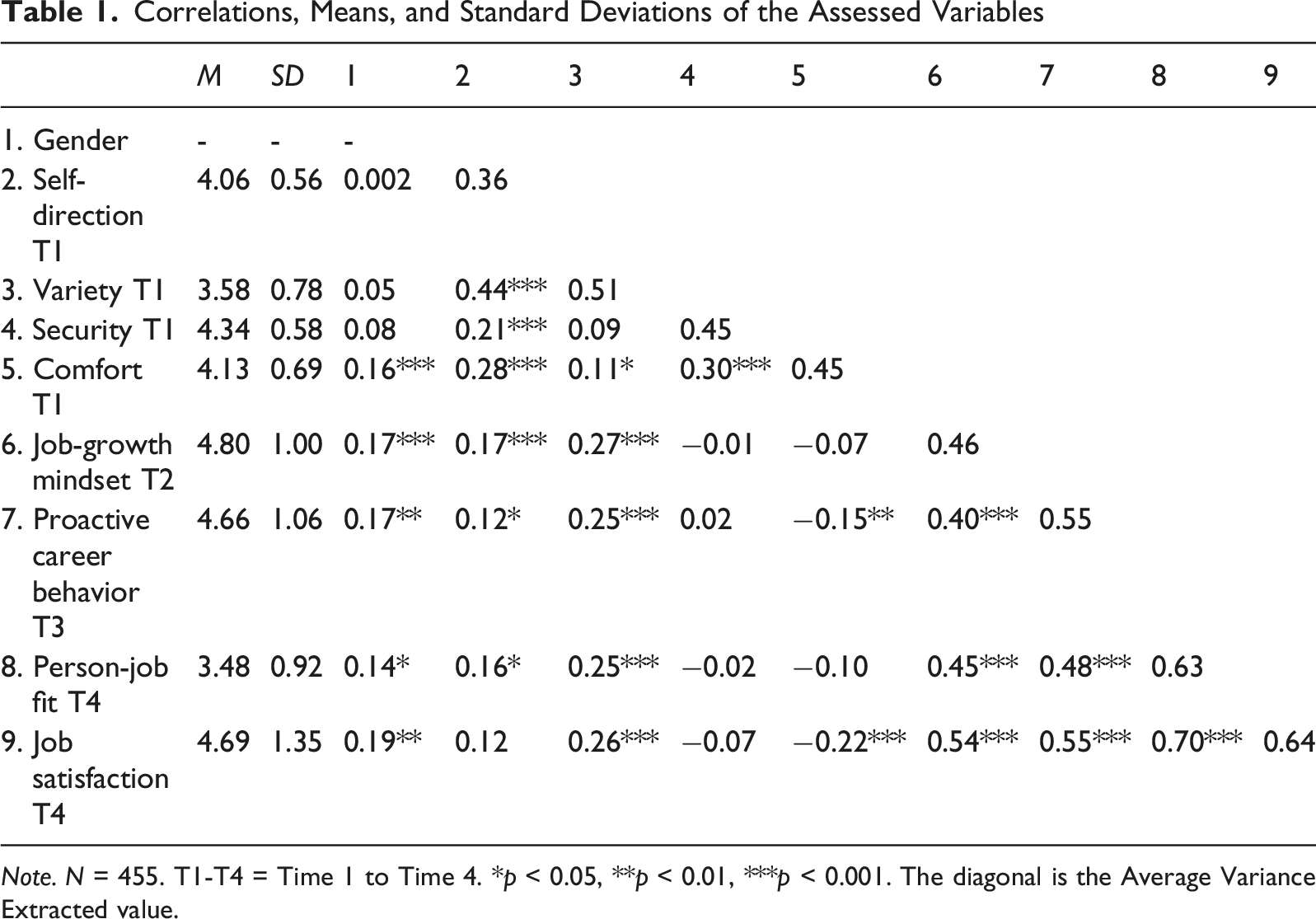
Note. N = 455. T1-T4 = Time 1 to Time 4. *p < 0.05, **p < 0.01, ***p < 0.001. The diagonal is the Average Variance Extracted value.
Before testing the hypothesized models, we examined the skewness and kurtosis of all variables to assess multivariate normality. The absolute values of skewness and kurtosis for all study variables did not exceed 1, indicating approximate normal distributions. Accordingly, maximum likelihood (ML) estimation was used in model testing.
To assess construct validity, we conducted a series of CFAs in Mplus 8.0. The hypothesized eight-factor model included the eight latent study variables. The model demonstrated acceptable fit indices (χ 2 = 801.04, df = 406, CFI = .91, TLI = .90, RMSEA = .05, SRMR = .06), with factor loadings ranging between .54 and .87. Three alternative models were also tested for comparison: a six-factor model combining variety and self-direction into one factor and comfort and security into another, along with the four other constructs (χ 2 = 1055.63, df = 419, CFI = .86, TLI = .84, RMSEA = .06, SRMR = .07); a five-factor model combining all work value items into a single latent factor, along with the four other constructs (χ 2 = 1457.24, df = 430, CFI = .77, TLI = .75, RMSEA = .07, SRMR = .09); and a one-factor model with all items loading on a single factor (χ 2 = 2647.75, df = 434, CFI = .51, TLI = .47, RMSEA = .11, SRMR = .11). All alternative models showed poor fit and fit significantly worse than the eight-factor model (the six-factor model: Δχ 2 = 254.59, Δdf = 13, p < 0.001, ΔCFI = .05; the five-factor model: Δχ 2 = 656.20, Δdf = 24, p < 0.001, ΔCFI = .14; the one-factor model: Δχ 2 = 1846.71, Δdf = 28, p < 0.001, ΔCFI = .40). These results support the construct validity of the eight-factor measurement model in this study. Based on this measurement model, we further assessed convergent and discriminant validity using average variance extracted (AVE) and related criteria (Fornell & Larcker, 1981; Rönkkö & Cho, 2022). As shown in Table 1, the AVEs for variety, proactive career behaviors, person-job fit, and job satisfaction exceeded the recommended threshold of 0.50, supporting their convergent validity. Although the AVEs for self-direction, security, comfort, and job-growth mindset were slightly below 0.50, their CR values were all above 0.60, indicating acceptable convergent validity (Fornell & Larcker, 1981). Discriminant validity was evaluated using the Fornell-Larcker criterion. For most constructs, the AVEs exceeded the corresponding squared inter-construct correlations, supporting discriminant validity. The construct correlation between person-job fit and job satisfaction was relatively high (r = 0.82, 95%CI [0.77, 0.88]). However, the upper bound of the CI remained below 0.90, suggesting that these constructs are empirically distinguishable, albeit closely related (Rönkkö & Cho, 2022).
Hypothesis Testing
We tested the hypothesized structural model in Mplus 8.0. Gender was included as a control variable for job-growth mindset, proactive career behavior, person–job fit, and job satisfaction. The model demonstrated an acceptable fit to the data (χ
2
= 844.20, df = 433, CFI = 0.91, TLI = 0.90, SRMR = 0.06, RMSEA = 0.05). The structural model is presented in Figure 1. Variety at T1 was significantly and positively related to job-growth mindset at T2 (β = .24, SE = 0.09, p = .007) and proactive career behavior at T3 (β = .24, SE = 0.09, p = .01), whereas self-direction showed no significant relationships with either job-growth mindset (β = .18, SE = 0.11, p = .115) or proactive career behavior (β = −.03, SE = 0.12, p = .814). These results partially supported Hypothesis 1a. Among conservation values, comfort at T1 was significantly and negatively related to job-growth mindset at T2 (β = −.18, SE = 0.08, p = .025) and proactive career behavior at T3 (β = −.21, SE = 0.08, p = .014), whereas security showed no significant associations with job-growth mindset (β = −.004, SE = 0.07, p = .959) or proactive career behavior (β = .13, SE = 0.07, p = .084). These results partially supported Hypothesis 1b. Results of Hypothesized Model. Notes. Standardized path coefficients are reported. Dashed lines represent non-significant paths. Gender is included as a control variable in the model but is not displayed in the figure for simplicity. The direct effects are also not displayed in the figure for simplicity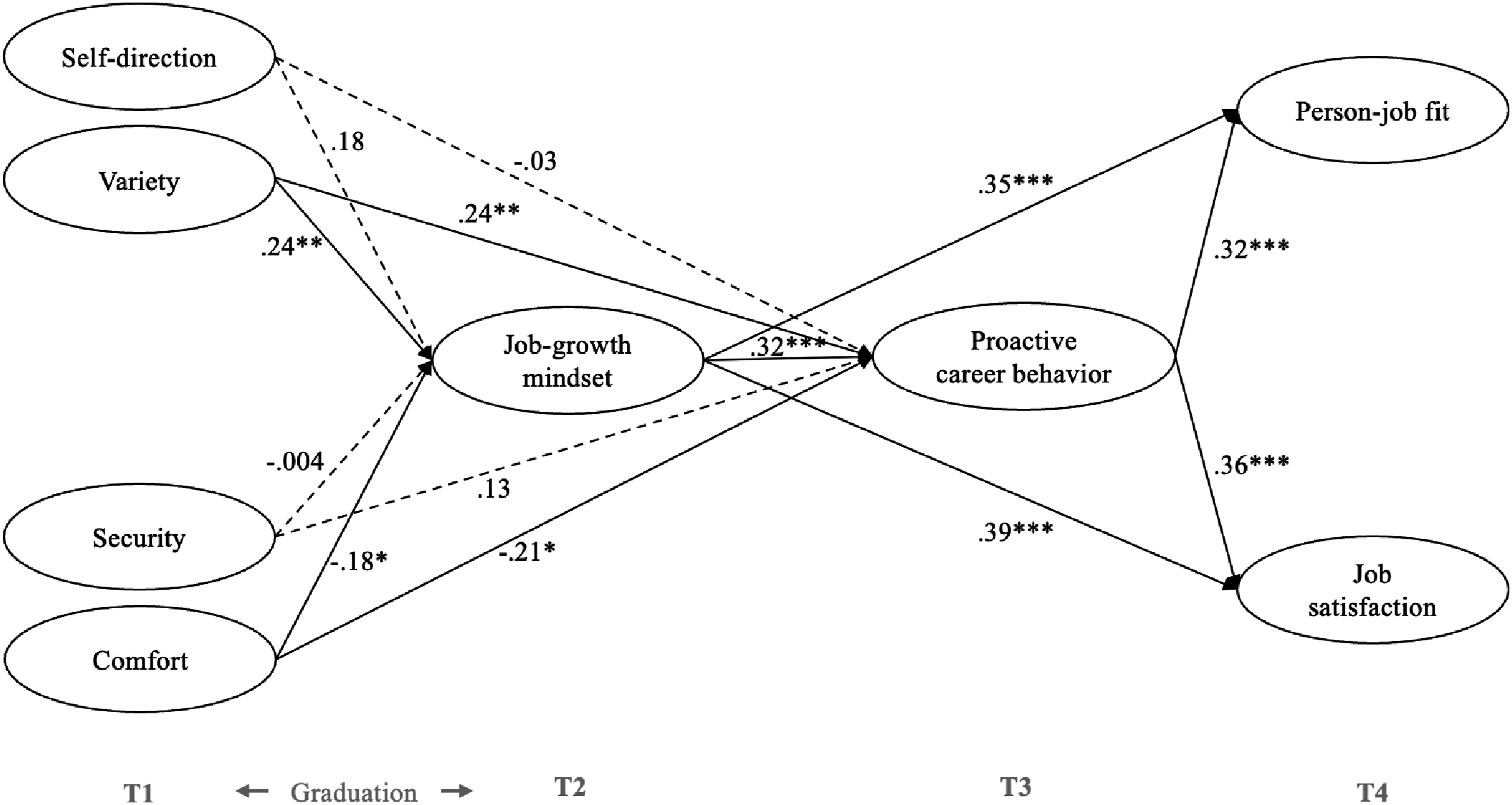
Job-growth mindset at T2 was positively related to proactive career behavior at T3 (β = .32, SE = 0.07, p < .001), person-job fit at T4 (β = .35, SE = 0.08, p < .001), and job satisfaction at T4 (β = .39, SE = 0.07, p < .001). Proactive career behavior at T3 was also positively related to person-job fit at T4 (β = .32, SE = 0.08, p < .001) and job satisfaction (β = .36, SE = 0.07, p < .001). With respect to direct effects, only comfort at T1 showed a significant negative relationship with job satisfaction at T4 (β = −.20, SE = 0.08, p = .018); no other direct effects of work values on career outcomes were significant. Overall, 54% and 40% of the variance was accounted for in person-job fit and job satisfaction, respectively.
Results of Indirect Effects
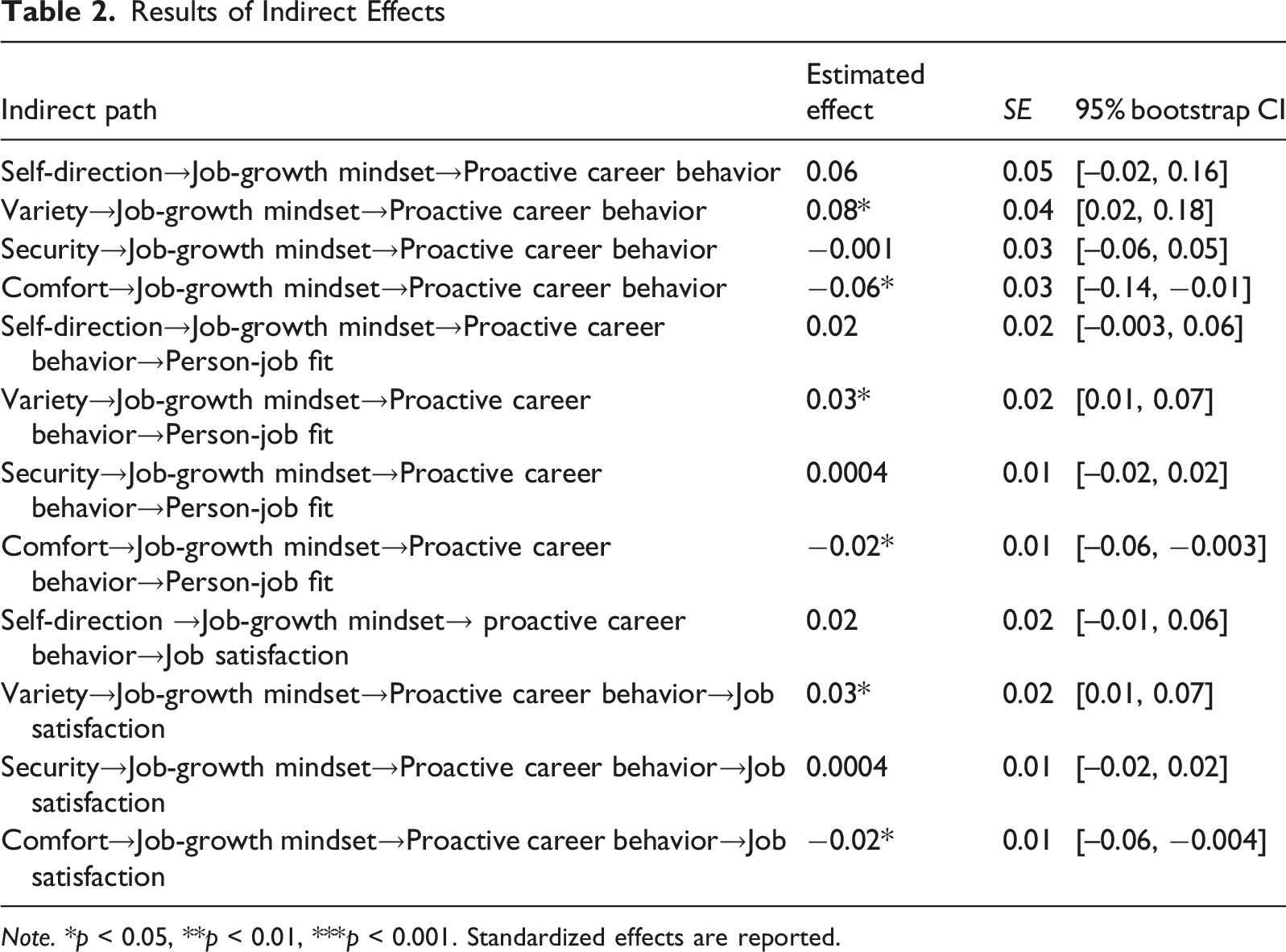
Note. *p < 0.05, **p < 0.01, ***p < 0.001. Standardized effects are reported.
Discussion
This study examined how work values are associated with career adjustment outcomes during the transition from university to the workplace. Overall, the findings support a proactive adjustment process in which work values were related to how graduates construed their early work contexts, the extent to which they engaged in proactive career behavior, and their subsequent adjustment outcomes. Specifically, variety value was positively associated with a job-growth mindset, which was in turn related to greater proactive career behavior and more favorable post-entry person–job fit and job satisfaction. In contrast, comfort value was associated with a weaker job-growth mindset and lower proactive career engagement, which may in turn undermine post-entry person–job fit and job satisfaction.
A first important finding concerns the adaptive role of variety value. Variety reflects a preference for novelty, challenge, and changing experiences (Sagiv & Schwartz, 2022). Because values shape how individuals attend to and interpret their environments, graduates who strongly endorse variety value may be more likely to perceive uncertainty, flexibility, and change in early work contexts as opportunities for learning and development rather than as constraints (Sagiv & Roccas, 2021). Such interpretations may foster a stronger sense that work roles are open to growth and can be shaped through personal initiative, thereby encouraging proactive career behavior after organizational entry. Over time, these proactive tendencies may facilitate more favorable career adjustment outcomes. This interpretation is consistent with the Proactive Motivation Model, which links openness-to-change values to proactive behaviors and adaptive outcomes (Parker et al., 2010), and with value theory suggesting that such values foster more exploratory and development-oriented interpretation of the environment (Sagiv & Roccas, 2021). Extending prior transition research, which has paid limited attention to how values relate to successful career transitions (e.g., Sortheix et al., 2013, 2015), the present findings suggest that variety value may support adjustment by fostering a growth-oriented construal of one’s job that promotes proactive career behavior.
A second notable finding concerns the constraining role of comfort value. Comfort emphasizes ease, routine, and low strain (Zhang et al., 2026), priorities that may be less compatible with the uncertainty, exploration, and self-initiated effort often required during organizational entry. Consistent with theorizing that values guide attention and interpretation of the environment (Sagiv & Roccas, 2021), graduates who prioritize comfort may be more likely to focus on structure, routines, and role boundaries in their early work contexts. As a result, they may be less likely to construe their jobs as open to development and less willing to engage in proactive career management, which often involves uncertainty and experimentation. This finding complements prior evidence suggesting that conservation-oriented values may be less adaptive in dynamic transition contexts (Sortheix et al., 2015) and further clarifies a potential psychological process underlying such associations. Specifically, stronger comfort value may be associated with a less proactive adjustment pattern and, in turn, less favorable early career outcomes.
The pattern of nonsignificant findings is also theoretically informative. Although self-direction and security belong to the same higher-order value domains as variety and comfort, respectively, they were not significantly related to the proposed pathway. One possible explanation is that self-direction emphasizes autonomy and independent choice rather than novelty and challenge per se (Sagiv & Schwartz, 2022; Zhang et al., 2026), making it less directly relevant to change-oriented engagement in early work contexts. Similarly, although security emphasizes stability and predictability, it may not necessarily inhibit proactive behavior in the same way as comfort value. For some individuals, proactive behavior may even serve as a means of attaining greater certainty and stability at work. This interpretation is broadly consistent with prior findings showing that security values were not directly related to proactive engagement (Grant & Rothbard, 2013; Sortheix et al., 2013). Taken together, these findings suggest that specific value facets may be more informative than broad higher-order value dimensions when explaining career adaptation processes.
Taken together, these findings make several theoretical contributions. First, they extend work values research by identifying a process through which value orientations may become expressed in early career adjustment, shifting attention beyond direct value–outcome associations toward value enactment through job-growth mindset and proactive career behavior. Whereas prior research has primarily emphasized direct links between work values and career outcomes (e.g., Sortheix et al., 2013, 2015), the present findings suggest that values may also relate to adjustment through how graduates interpret and proactively respond to their work environments. Second, the findings contribute to career proactivity research by positioning work values as a motivational basis associated with whether individuals develop growth-oriented beliefs about their jobs and proactively shape their careers. Prior research has paid limited attention to work values as antecedents of proactive career behavior, particularly during career transitions (Jiang et al., 2023). The present findings suggest that different work values may relate to proactive career behavior both directly and indirectly through job-growth mindset. Third, the findings enrich university-to-work transition research by showing that successful adjustment may partly reflect the value priorities graduates bring into the workplace. Akkermans et al.’s (2024) self-regulation framework proposes that career transitions involve ongoing regulation of cognition, motivation, affect, and behavior. The present findings complement this perspective by suggesting that work values may serve as an important motivational basis for such self-regulatory processes. More broadly, career adjustment during the university-to-work transition may be understood as an active process through which graduates interpret contextual opportunities and shape work experiences in ways that reflect what they value most.
Practical Implications
This study offers practical implications for career counseling and university-based transition support by identifying work values as a meaningful entry point for facilitating adaptive university-to-work transitions. Assessing graduates’ relative emphasis on openness-to-change versus conservation values can provide counselors with a useful basis for understanding how individuals are likely to construe the developmental potential of their initial jobs and their propensity to engage in proactive career behavior. Such value-based insights allow transition support to be more differentiated. For example, for graduates with stronger conservation values such as comfort, counseling can place greater emphasis on fostering a growth-oriented view of the job and on framing proactive career behaviors as manageable and worthwhile. For those with stronger openness-to-change values such as variety, support can focus on helping them translate this motivational orientation into sustained and constructive forms of proactive career self-management. In this way, incorporating work values into transition support may help align counseling strategies with the mechanisms through which graduates differ in their early career adjustment.
Limitations and Future Research
Despite its contributions, this study has several limitations that offer directions for future research. First, the sample contained a higher proportion of female participants. Although gender was controlled for in the analysis, the findings should be interpreted with caution, and future research is needed to examine whether the observed associations replicate in samples with a more balanced gender composition. Second, the study was conducted within an Eastern cultural context, which may limit the generalizability of the results. Because work values and proactive tendencies are embedded in broader cultural systems (Urbach et al., 2021; Zhang et al., 2026), future research could examine whether the proposed motivational pathway holds across different cultural and national contexts. Third, the self-direction subscale showed relatively low internal consistency reliability and AVE value, a pattern also reported in the original scale development study (Zhang et al., 2026). Further refinement of this dimension would allow a more precise assessment of its role in proactive career development. Fourth, the variables were not repeatedly assessed, and thus changes in these variables and their relationships were not examined. In particular, work values may exhibit mean-level change during major life transitions (Jin & Rounds, 2012). However, their rank-order stability remains relatively high over time, enabling values to predict subsequent attitudes and behaviors over shorter intervals (Sagiv & Schwartz, 2022). Nevertheless, future research would benefit from employing repeated measurements to more precisely capture the dynamic nature of work values during the school-to-work transition. Finally, this study focused on individual characteristics and did not incorporate contextual influences that may shape the expression of proactive motivation and behavior. Future research could adopt a person-context approach to examine how environmental factors, such as organizational climate or leadership (Parker et al., 2010), are associated with the strength of the value-based motivational process identified in this study.
Conclusion
This study examines how work values are associated with career adjustment during the university-to-work transition from a proactive perspective. The findings suggest that the variety facet of openness-to-change values is positively related to a job-growth mindset and proactive career behavior and, in turn, to higher person–job fit and job satisfaction, whereas the comfort facet of conservation values shows the opposite pattern. By modeling a sequential pathway from value orientations to context-specific beliefs and proactive career self-management, the study highlights a value-based proactive process underlying career adjustment during the university-to-work transition.
Footnotes

Funding
The authors disclosed receipt of the following financial support for the research, authorship, and/or publication of this article: This research was supported by the National Social Science Fund of China (21BSH102).
Declaration of Conflicting Interests
The authors declared no potential conflicts of interest with respect to the research, authorship, and/or publication of this article.