






Abstract
We examined the applicability of the social cognitive career self-management (CSM) model of proactive career behaviors in a new cultural, economic, and linguistic context. A sample of 536 Turkish workers completed measures of supervisory support, proactive personality, proactive career behavior, self-efficacy, outcome expectations, two indicators of subjective career success (career satisfaction and organizational rewards), and job marketability. The measurement and structural models provided good fit to the data, with the structural model also showing invariance across gender and educational level (i.e., workers with and without a college degree). The results extend previous research by providing preliminary evidence for the international applicability of the CSM model of proactive career behaviors and its linkage to subjective career success and job marketability. We discuss future directions for research and practice on career progress and sustainability through a social cognitive lens.
Keywords
The job stability of many workers has been challenged in recent years by a host of developments, such as technological innovations, fluctuations in the global economy, and demographic shifts (Hirschi, 2018; Lent, 2018). This flux in the world of work underscores an increasing need for workers to attend to their own career development rather than relying exclusively on work organizations or other entities to look out for their best interests (ILO, 2025; OECD, 2023, 2025). While individuals cannot control systemic changes or guarantee that their career self-management efforts will succeed, they are able to deploy a variety of proactive behaviors aimed at protecting and advancing their careers (e.g., Strauss et al., 2012), and such behaviors have been linked to employability and other positive outcomes (e.g., Lent et al., 2022, 2024).
Proactive career behaviors refer to an individual’s active attempts to advance their career rather than passively responding to the work situation (Parker & Collins, 2010). This behavior has been operationalized with a variety of different measures, with names such as career engagement (Hirschi et al., 2013), taking charge (Morrison & Phelps, 1999), proactive person-environment fit, career initiative behavior (Parker & Collins, 2010), self-advocacy (Moturu & Lent, 2023), and career competencies (Blokker et al., 2019). While some of the measures emphasize somewhat different behaviors, many overlap conceptually or employ similar items (Lent et al., 2024; Parker & Collins, 2010). Crant (2000) had described the literature on career proactivity as fragmented: “There is no single definition, theory, or measure driving this body of work; rather, researchers have adopted a number of different approaches toward identifying the antecedents and consequences of proactive behavior, and they have examined them in a number of seemingly disconnected literatures” (p. 435). While proactive career behavior has remained a popular topic of inquiry, researchers have not fully resolved the issues of competing conceptual and operational definitions (cf. Lent et al., 2024).
Proactive Career Behavior Through a Social Cognitive Career Theory Lens
In one recent effort at integration, Lent et al. (2022) used the social cognitive career self-management (CSM; Lent & Brown, 2013) model as a framework for studying proactive career behaviors (Strauss et al., 2012), along with their hypothesized predictors and outcomes. The CSM model is an extension of social cognitive career theory (SCCT; Lent et al., 1994) that focuses on the ways in which people help to guide their own educational and career behavior, including processes involved in career preparation, entry, adjustment, and change. The model features social cognitive, personality, contextual, and experiential variables that help to motivate and sustain adaptive career behaviors.
As in other SCCT models, three basic social cognitive variables (self-efficacy, outcome expectations, and goals) play a central role in the CSM model. For example, self-efficacy and outcome expectations are hypothesized to predict goals and, together with goals, to foster engagement in adaptive career behaviors which, in turn, yield such outcomes as career decidedness, career satisfaction, and perceived employability. Additionally, contextual factors (e.g., supports and barriers), personality traits (e.g., proactive personality), and learning experiences (e.g., past mastery experiences) are hypothesized to predict self-management outcomes both directly and through their links to social cognitive variables (Lent & Brown, 2013). Model variables are operationalized in ways that match each other and the outcomes of interest in terms of content and domain specificity. The model may be adapted to study a wide range of career behaviors (Brown & Lent, 2019), such as career decision-making (Lent et al., 2016), job search behaviors (Lim et al., 2016), and coping with job loss (R. Wang & Lent, 2024).
Building on a recent study by Lent et al. (2022), we assessed proactive career behavior with a popular measure that includes four basic strategies: career planning, proactive skill development, career consultation, and network-building (Strauss et al., 2012). Lent et al. constructed companion measures of self-efficacy and outcome expectations linked to each of these strategies. In this context, self-efficacy refers to individuals’ beliefs about their ability to implement each strategy, while outcome expectations involve the anticipated benefits of engaging in them. In addition to employing these measures of proactive career behavior, self-efficacy, and outcome expectations, we incorporated measures of contextual support (e.g., supervisory support) and personality traits (e.g., proactive personality) that were posited to predict proactive career behaviors, both directly and through self-efficacy and outcome expectations. We also examined the relation of proactive career behavior, self-efficacy, and supervisor support to subjective career success and, in turn, to job marketability.
Previous research has found bivariate relations between proactive career behavior and the constructs of the CSM model. In their meta-analysis, Fuller and Marler (2009) found a positive correlation between proactive personality and proactive career behaviors, career satisfaction, and organizational reward. Similarly, other meta-analytic results indicated that proactive personality was positively correlated with career decision-making self-efficacy (N. Wang et al., 2023) and salary and promotion increases and career satisfaction (Ng et al., 2005; Zhang et al., 2022). Eby et al. (2003) also found that proactive personality was positively associated with job marketability, and Ni et al. (2024) found that proactive personality was positively associated with career self-management behaviors. Occupational self-efficacy has been found to relate positively to organizational growth and career satisfaction (Bhawna et al., 2024) and to mediate the relationship between proactive personality and proactive career behaviors (Hirschi et al., 2013).
Supervisory and organizational support have shown positive meta-analytic relationships with subjective career success (Ng & Feldman, 2014). Supervisory support was found to relate positively to career self-management behaviors (Martins et al., 2024), career satisfaction, and organizational growth (Ng et al., 2005). Engagement in proactive career behaviors has yielded a positive meta-analytic correlation with career satisfaction (Ng & Feldman, 2014). Additionally, proactive career behaviors have been found to relate to organizational reward (Weng & McElroy, 2012) and external job marketability (Eby et al., 2003) and to mediate the relationship between proactive personality and career satisfaction (Barnett & Bradley, 2007). The CSM model may offer promise as a framework for organizing and integrating some of these findings on the correlates and outcomes of proactive career behavior. Such an approach may also aid in understanding how proactive career behaviors are naturally acquired and can be facilitated in practice.
The CSM model has been applied to proactive career behaviors with a sample of working adults in the United States (Lent et al., 2022). Model testing results indicated that proactive personality was positively related to proactive career behaviors both directly and through proactive career self-efficacy and outcome expectations. Self-efficacy and outcome expectations also mediated the relationship of supervisory support to proactive career behaviors. Those with greater supervisory support and self-efficacy were more likely to report higher career satisfaction, organizational rewards, and job marketability. Enactment of proactive career behaviors was linked to two of the three outcomes (organizational rewards and marketability).
While the Lent et al. (2022) study offered promising results regarding the applicability of the CSM model to proactive career behaviors, it was tested only with a US-based sample. Therefore, its generalizability across different cultural and economic settings remains to be examined. It should be noted that the proactive behaviors individuals use to help guide their careers and the way they cope with contextual obstacles may vary across cultures (Urbach et al., 2021; Wu et al., 2018). Cultural dimensions such as high power distance and collectivist values may influence the perception and implementation of proactivity. For example, in a collectivist context, certain proactive career behaviors (e.g., employee-initiated skill development or consultation with co-workers) may be perceived as disrupting group harmony or questioning authority, and there could be a greater reliance on supervisory support as a basis for engaging in proactive career behaviors. Likewise, in countries with more fragile economies and greater instances of work precarity, workers may need to be especially cautious about engaging in career self-management behavior that could violate cultural norms. Such cultural considerations may affect the predictive utility and generalizability of the CSM model.
Turkish Context
The economic landscape in Türkiye is characterized by fragile and fluctuating economic conditions as well as high inflation and unemployment rates (OECD, 2025; Turkish Statistical Institute, 2025). Many adults in Türkiye currently work in precarious, temporary, and contract jobs (Eralp, 2024), often with long working hours, low wages, and insufficient benefits (Carkit, 2025). In this context of labor market instability and economic uncertainty, job marketability (or employability) is not merely a desirable or discretionary outcome; it can rather function as a core resource for sustaining careers and maintaining a sense of security. At the same time, macroeconomic constraints may attenuate the links among proactive career behaviors, social cognitive percepts, organizational rewards, career satisfaction, and job marketability. Put differently, proactive behavior and confidence in one’s career self-management capabilities are likely to translate into career success and marketability only insofar as the broader economic context provides viable opportunities and rewards.
Türkiye also has a cultural landscape dominated by collectivism, high power distance, and uncertainty avoidance (Hofstede et al., 2010). Collectivism encourages group cohesion and collective action; individuals often identify with “we” rather than “I”. High power distance is manifested by an emphasis on hierarchy and formal attitudes toward managers. Intolerance of uncertainty is associated with a tendency to feel threatened by ambiguous situations (Hofstede Insights, 2025). Such cultural characteristics may affect the ways in which employees exhibit proactive career behaviors, perceive supervisory support, and evaluate proactive personality traits. For example, in Türkiye, supervisory support may play a pivotal role in determining whether proactive career behaviors are expressed and subsequently rewarded or met with negative reactions. In the absence of such support, proactive behaviors could be interpreted as challenging the hierarchy of authority or as disrupting group harmony, thereby weakening the relationship between proactive personality and proactive behavior.
Despite these cultural and economic considerations, existing research on individual CSM model elements in Türkiye has yielded encouraging results. For example, the likelihood of engaging in proactive work behaviors was found to be higher among workers with higher perceptions of supervisory support (Kılıçaslan et al., 2022; Tufan et al., 2024), proactive personality disposition (B. Şeker & Özgen, 2022; Yolcu & Çakmak, 2017a, 2017b), and occupational self-efficacy (Aksoy, 2019). In addition, proactive personality and supervisory support positively predicted career satisfaction among Turkish workers (Kale, 2019; Soydan et al., 2022). Proactive personality traits (Doğanülkü & Korkmaz, 2025) and social support (Doğanülkü & Tanrıtanır, 2022) were associated with engagement in proactive career behaviors among Turkish undergraduates. Students with higher career planning self-efficacy (G. Şeker, 2025) and positive vocational outcome expectations (Yam & Korkmaz, 2024) reported greater career engagement. Career decision-making self-efficacy (Koçak & Ural, 2023), career competencies (Gerçek, 2024), and career engagement (Ayvaz & Elhatip, 2026) have also been found to be predictive of perceived employability in Turkish samples.
On balance, previous research suggests that particular CSM model variables are relevant to the initiation of proactive career behaviors and to career advancement in Turkish workers and students. However, these studies have often focused on bivariate relationships among variables, without examining their mediating or additive effects on proactive career behaviors and outcomes. Testing the CSM model of proactive career behaviors in a sample of Turkish workers would allow for a more comprehensive examination of how these variables jointly interrelate to predict positive career self-management outcomes. Furthermore, this model could provide a theory-based and empirically supported unifying framework to guide the development of interventions to facilitate career self-management in Turkish workers.
The Present Study
The present study contributes to the literature on the CSM model of proactive career behaviors by examining the model’s explanatory utility in relation to perceived employability (Lent, 2026) in Turkish workers. Figure 1 displays the expected relations among the variables in the model. In addition, we were able to assess the psychometric adequacy of each of the model’s variables (except for proactive personality, which had been previously validated in Türkiye) in a novel cultural, economic, and linguistic context. Given the increasing focus of research on employability and career sustainability (e.g., Greenhaus et al., 2024), we modified our test of the CSM model compared to that of Lent et al. (2022). The latter had treated career satisfaction, organizational rewards, and job marketability as covarying indicators of career advancement. However, Lent (2026) has recently proposed a social cognitive perspective on employability that, among other things, suggests distinguishing perceived employability (or marketability) from the various forms of employability capital that, theoretically, enhance or diminish one’s ability to obtain or maintain work. Career self-management model of proactive career behaviors. Note. *p < .05, one-tailed. S = Career satisfaction, R = Organizational rewards
From this social cognitive perspective, career satisfaction and organizational rewards can be viewed as key indicators of market-value capital that reflect one’s perceptions of their prior career success (or subjective career success, SCS). Importantly, SCS is assumed to partly mediate the relations of proactive career behaviors, self-efficacy, and supervisor support to job marketability. That is, workers who exhibit higher levels of proactive career behavior and self-efficacy and who receive greater amounts of supervisor support are seen as more likely to perceive higher SCS, with prior success translating into expectations of future employability.
Parenthetically, SCS is often assessed with measures tapping internal appraisal of one’s career progress (career satisfaction) and/or self-reported acquisition of organizational rewards such as salary increases and promotions. In their meta-analysis, Ng and Feldman (2014) conceptualized measures of career satisfaction and organizational success as valid, alternative representations of SCS. Though conceptually related, we modeled them as correlated predictors, rather than as a singular latent construct, thereby allowing examination of their individual and joint contributions to the prediction of job marketability.
As shown in Figure 1, we posited that proactive personality and supervisor support would both predict proactive career self-efficacy, outcome expectations, and behaviors (e.g., planning, networking, skill development). In addition, self-efficacy was assumed to yield a direct path to outcome expectations and, along with outcome expectations, to contribute to the prediction of proactive career behaviors. In other words, a supportive context (social capital) and proactive dispositions (psychological capital) should translate into greater confidence and positive outcome expectations, thereby motivating proactive career actions. As noted above, along with supervisor support and self-efficacy, proactive career behaviors were posited to predict SCS (career satisfaction and organizational rewards) and, in turn, job marketability. Finally, in addition to providing a general test of the CSM model of proactive career behaviors and its linkage to perceived employability, we sought to assess the model’s generalizability by examining its invariance across gender and education levels, two person variables that may affect the relations among variables in the CSM model (Blokker et al., 2019; Ren et al., 2024; Talluri & Uppal, 2023).
Method
Participants
Participants were 536 Turkish working adults (287 women and 249 men) representing 51 different provinces (the majority were from Kayseri, Ankara, Adana, and Mersin) and seven different geographic regions of Türkiye. Participants’ ages ranged from 18 to 68 (M = 31.22, SD = 9.78). All participants reported working in an organizational setting (i.e., were not self-employed). Participants worked an average of 41.80 hours per week (SD = 14.17), and their monthly income ranged from 10,000 to 250,000 Turkish Liras (M = 48,303, SD = 24,905). Seven participants did not wish to report their monthly income. In terms of educational level, 57% held a bachelor’s or higher degree, while 19% held a two-year associate degree, and 24% had a high school degree or less education. They represented many occupational groups (e.g., crane operator, private security, nurse, bartender, and pharmacist); teachers were the single largest group (15%).
Procedure and Instruments
After approval from the university ethics committee, data were collected online via Google Forms using two recruitment sources: (a) an open invitation to participate posted on two social media platforms commonly used by public and private sector workers in Türkiye for communication purposes, and (b) snowball sampling in which volunteer students, friends, relatives, and colleagues were invited to share the survey link with workers they could reach personally or through other social media outlets and reflector lists. Participants were first presented with a detailed explanation of the study procedures along with an informed consent form. No rewards or incentives were offered for participation. Measures of proactive career behavior, self-efficacy and outcome expectations for proactive career behavior, proactive personality, supervisory support, career satisfaction, organizational reward, and job marketability as well as several demographic questions were presented in random order. Total scale scores were calculated by summing the item responses and dividing by the number of items on each scale. Participants were informed that completion of each item was necessary to advance to subsequent items and that they could terminate participation at any point by closing their browser. This strategy prevented missing data.
In line with the study aims, we specified inclusion and exclusion criteria to ensure that the focal CSM processes and outcomes would be relatively salient across participants. First, we included organizational employees who worked at least 30 hours per week in order to set a reasonable criterion for sustained exposure to organizational practices, supervisors, and internal opportunity structures, increasing the likelihood that CSM strategies can be enacted and linked to work outcomes such as organizational rewards. Second, we excluded business owners and self-employed individuals because key constructs, particularly supervisory support and organizational rewards, presuppose an employee–supervisor relationship and an organizational context in which work conditions and rewards are not determined only by the self. Third, to ensure data quality, only participants who correctly answered at least two of the three attention questions included in the survey were retained in the final dataset.
A total of 688 participants completed the entire survey, but 52 respondents were screened out because they reported being self-employed, 24 because they reported working less than 30 hours per week, and 76 because they did not respond accurately to at least two of the three control items, which had been placed in the survey to identify careless respondents. Except for proactive personality, there were no previously validated Turkish versions of the scales, which had been developed in English. We translated these scales into Turkish following the translation and back-translation procedures of Ægisdóttir et al. (2008). Specifically, the seven new scales were translated into Turkish by two counseling academics fluent in both English and Turkish. The academics who did the initial translation were familiar with the subject area and the target culture. After independently completing the translations, the two academics compared them and agreed on the final form. The translated measures were then back-translated into English by a language education professor. The original and back-translated forms were compared, and a consensus was reached regarding the linguistic equivalence of the two versions.
Proactive Career Behavior
We used the proactive career behavior scale developed by Claes and Ruiz-Quintanilla (1998) and Strauss et al. (2012). The scale assesses four aspects of proactive career behaviors (career planning, skill development, network building, and career consultation) (e.g., “I develop knowledge and skill in tasks critical to my future work life.”). Each subscale is represented by three items, and the four first-order factors load onto a common second-order factor. Participants indicate agreement with each item on a 5-point Likert scale (1 = strongly disagree; 5 = strongly agree). Strauss et al. found internal consistency estimates ranging from .80 to .92 for the subscales, and the scale was positively correlated with career aspirations, commitment, and salience. In the current study, we found internal consistency estimates of .92 for the total scale score, .92 for the career planning subscale, .75 for the proactive skill development subscale, .87 for the career consultation subscale, and .85 for the network building subscale.
Self-Efficacy and Outcome Expectations
We assessed workers’ beliefs in their abilities to exhibit proactive career behaviors, and their expectations about the positive outcomes of engaging in proactive career behaviors, respectively, with the self-efficacy scale and outcome expectations scales developed by Lent et al. (2022). Both scales have four subscales, each consisting of three items, that were designed to parallel the subscales on the Strauss et al. (2012) behavioral scale. Self-efficacy items asked, “How much confidence do you have in your ability to…?” Participants responded to each item (e.g., “Adjust your career plans to deal with changes in your line of work”) on a 5-point Likert scale (0 = no confidence at all; 4 = complete confidence). Outcome expectations instructions asked, “If you were to do each of the following activities, how useful do you think it would be for your career advancement or security?” Item (e.g., “Improve your occupational knowledge and skills”) responses were made using a 5-point Likert scale (1 = mostly useless; 5 = mostly useful).
Lent et al. (2022) found Cronbach alpha coefficients of .92 and .88 for the measures of self-efficacy and outcome expectations, respectively, and reported positive relationships with proactive career behaviors, proactive personality, supervisory support, and occupational self-efficacy, and negative relationships with negative career outlook. In the current study, we found a Cronbach alpha coefficient of .91 for the total scores of both measures. The internal consistency estimates for the subscales of the self-efficacy for proactive career behaviors measure were as follows: career planning (.81), proactive skill development (.71), network building (.79), and career consultation (.78). For the outcome expectations measure, Cronbach alpha coefficients for the career planning, proactive skill development, network building, and career consultation subscales were .83, .77, .88, and .80, respectively.
Supervisory Support
We used Greenhaus et al.’s (1990) supervisory support scale to measure the career support employees report receiving from their managers. This scale has nine items (e.g., “My supervisor cares about whether or not I achieve my career goals”), with responses ranging from 1 (strongly disagree) to 5 (strongly agree). Lent et al. (2022) found an alpha of .92 and positive correlations with proactive career behaviors, self-efficacy, outcome expectations, and career satisfaction. In the current sample, the alpha coefficient was .96.
Proactive Personality
We employed the short version (Seibert et al., 1999) of the proactive personality scale (Bateman & Crant, 1993), translated into Turkish by Akın and Arıcı Özcan (2015), to assess employees’ tendency to engage in proactive behavior, show initiative, and persevere in change efforts. The scale consists of 10 items (e.g., “I am constantly on the lookout for new ways to improve my life”) rated from 1 (strongly disagree) to 7 (strongly agree). Akın and Arıcı Özcan reported a Cronbach alpha of .86. Köktaş et al. (2025) found the scale to correlate positively with professional self-efficacy and negatively with turnover intentions. In the current sample, the Cronbach alpha estimate was .88.
Career Satisfaction
We used Greenhaus et al.’s (1990) career satisfaction scale to measure employees’ satisfaction with their career progress. Participants rated five items (e.g., “I am satisfied with the progress I have made toward meeting my goals for advancement”) on a 5-point scale, from strongly disagree (1) to strongly agree (5). The scale had a Cronbach alpha estimate of .88 (Greenhaus et al., 1990) and has yielded positive relationships with proactive career self-efficacy, organizational support, and proactive personality (Lent et al., 2022). The Cronbach alpha estimation in the current sample was .93.
Organizational Rewards
We used the Organizational Rewards subscale of the Organization Career Growth Scale (Weng & McElroy, 2012) to assess employees’ progress in achieving promotions and salary increases within their organizations. Participants responded to seven items (e.g., “My salary is growing quickly in my present organization”) on a scale of 1 (strongly disagree) to 5 (strongly agree). Weng and McElroy reported an internal consistency coefficient of .85 and positive relationships with occupational commitment and career goal progress. The current sample yielded an internal consistency coefficient of .92.
Job Marketability
We employed Eby et al.’s (2003) job marketability scale to measure employees’ perceptions of their internal and external marketability. The scale consists of three internal and three external marketability items (e.g., “Given my skills and experience, the company that I work for views me as a value-added resource” and “There are many jobs available for me given my skills and experience”), which participants rated on a 5-point Likert scale (1 = strongly disagree; 5 = strongly agree). Lent et al. (2022) reported an internal consistency estimate of .71 for both scales and positive correlations with proactive career behaviors, career satisfaction, and proactive personality. In the current study, we found Cronbach alpha estimates of .86 and .84 for internal and external marketability, respectively.
Data Analysis
During the data screening process, 17 multivariate outliers were identified using the Mahalanobis distance test. When the model-based analyses were re-run excluding these outliers, no significant differences were observed in the magnitude, direction, or statistical significance of either bivariate correlations or path coefficients. Since the results remained robust despite the presence of these outliers, the final analyses were conducted with the full sample to maintain statistical power and data integrity. In the initial phase of the study, we evaluated the psychometric characteristics of the Turkish versions of the instruments, excluding the proactive personality measure. For this purpose, 200 participants were randomly drawn from the larger data set to generate evidence regarding the reliability and validity of the Turkish scales. This process included confirmatory factor analyses to verify the underlying factor structures, followed by calculating indices of internal consistency, descriptive statistics, and intercorrelations.
In the subsequent phase of the study, the measurement and structural models were evaluated using data from the remaining 336 participants. Model estimation was carried out with MLM procedures in Mplus 8.5 (Muthén & Muthén, 2019). To decide the adequacy of model fit, we relied on the two-index strategy proposed by Hu and Bentler (1999). According to this approach, model fit is considered satisfactory when (a) SRMR is at or below .08 and (b) CFI is at least .95 or RMSEA is .06 or lower. Somewhat more liberal criteria (e.g., CFI ≥ .90 and RMSEA ≤ .10) are also often viewed as indicating acceptable fit (Weston & Gore, 2006).
Results
Measurement Validation
In the measure validation phase, we first tested the validity of the higher-order structure of the proactive career behavior, self-efficacy, and outcome expectations scales in a sub-sample of Turkish workers (n = 200) using confirmatory factor analysis (CFA). We set each item to load on a first order factor corresponding to its designated subscale (career planning, career consultation, skill development, and network-building) and each first order factor to load on a common second order factor (e.g., proactive career behavior). All three measurement models provided good fit to the data, confirming the factor structures obtained by Strauss et al. (2012) and Lent et al. (2022). Specifically, for proactive behavior, SRMR = .04, RMSEA = .03 (90% CI = .00, .05), CFI = .99, S-B χ2 (50) = 61.30, p > .05. For self-efficacy, SRMR = .07, RMSEA = .06 (90% CI = .03, .08), CFI = .94, S-B χ2 (50) = 85.72, p < .01. For outcome expectations, SRMR = .07, RMSEA = .06 (90% CI = .04, .08), CFI = .95, S-B χ2 (50) = 89.42, p < .01. Item loadings on the first order factors ranged from .57 to .96. Loadings of the first order factors on their second order factors ranged from .53 to .94.
We next ran a series of CFAs to test the first-order factor structures of the four scales that had not previously been used in their Turkish forms. For career satisfaction: SRMR = .01, RMSEA = .05 (90% CI = .00, .11), CFI = 1.00, S-B χ2 (5) = 7.46, p > .05. For job marketability, SRMR = .07, RMSEA = .10 (90% CI = .05, .15), CFI = .95, S-B χ2 (8) = 24.87, p < .01. For the supervisory support scale, SRMR = .03, RMSEA = .11 (90% CI = .09, .14), CFI = .95, S-B χ2 (27) = 98.23, p < .05. For organizational reward, SRMR = .05, RMSEA = .17 (90% CI = .14, .20), CFI = .90, S-B χ2 (14) = 96.18, p < .001. The CFA results generally met the two-index guideline for fit adequacy, with the exception of organizational reward. Allowing error covariances among three reward items (items 5, 6, and 7) with similar content (referring to salary increases in one’s organization) yielded acceptable fit, SRMR = .02, RMSEA = .06 (90% CI = .01, .10), CFI = .99, S-B χ2 (11) = 20.43, p < .05. Item-factor loadings for all scales ranged from .57 to .98.
Correlation Coefficients Among Variables and Descriptive Statistics
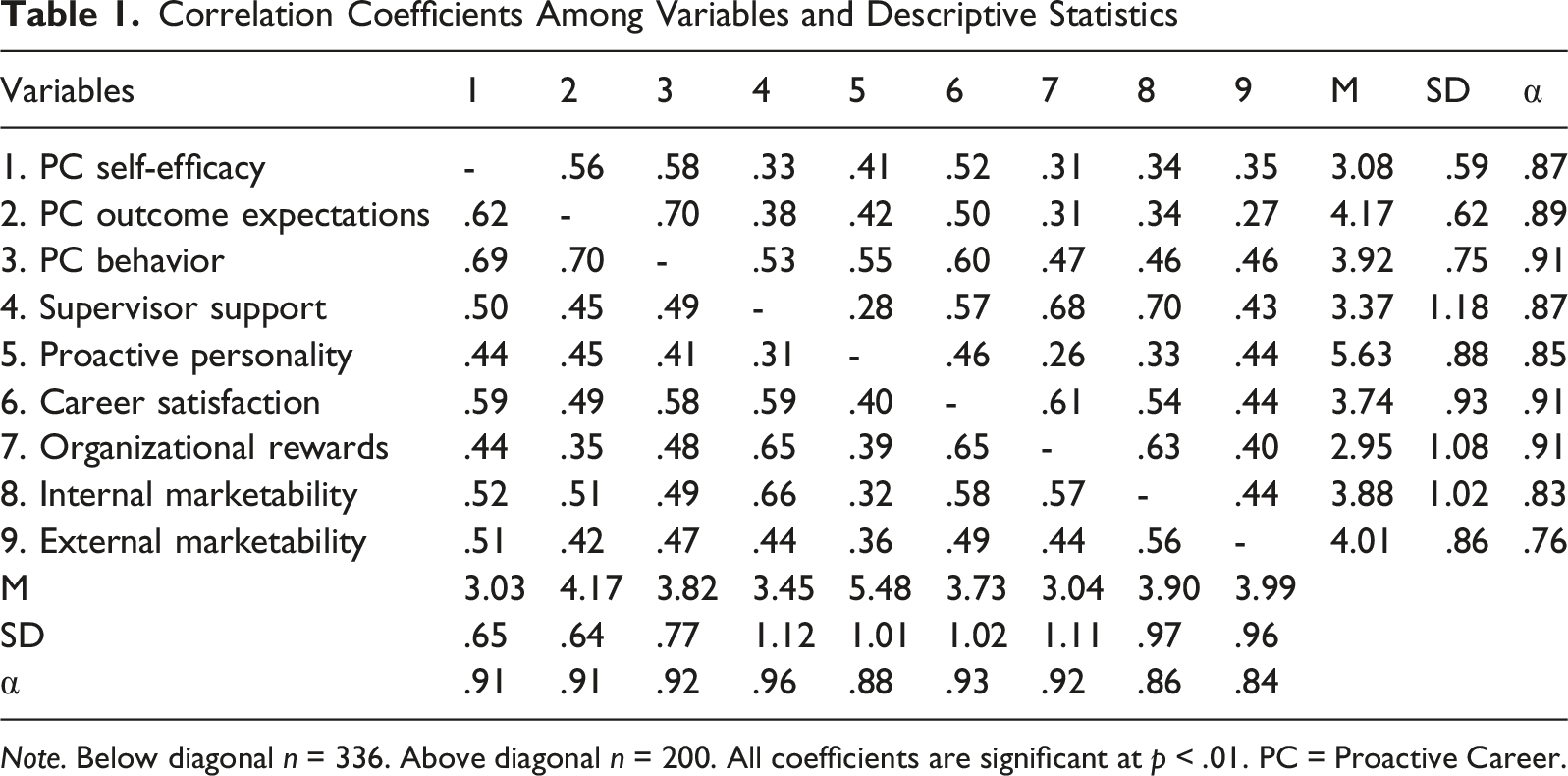
Note. Below diagonal n = 336. Above diagonal n = 200. All coefficients are significant at p < .01. PC = Proactive Career.
Measurement and Structural Model Tests
To reduce the number of parameter estimates, we represented each latent variable with observed indicators. We modeled career satisfaction, organizational reward, supervisory support, and proactive personality with three item parcels each, using the balancing approach of Little et al. (2013). (We did not model error covariances for the organizational reward item parcels, instead using Little et al.’s balancing procedure to reduce the influence of item-level residual correlations across indicators.) Job marketability was represented by its two subscales: internal and external job marketability. Self-efficacy, outcome expectations, and behavioral structures were represented by four sub-facets each. With eight latent variables and 26 observed variables, a minimum of 177 participants was required to achieve a statistical power of .80, assuming an anticipated effect size of .30 and a probability level of .05 (Soper, 2025). Therefore, we deemed the current sample size as adequate. Following Lent et al. (2022), we allowed the four parallel facets of the proactive behavior, self-efficacy, and outcome expectation constructs (career planning, skill development, career consultation, and networking) to covary across the three constructs to control for common variance that might arise from content similarities.
Measurement Model
A correlated 8-factor measurement model offered good fit to the data, SRMR = .05, RMSEA = .05 (90% CI = .04, .06), CFI = .96, S-B χ2 (259) = 475.08, p < .001. All indicators loaded highly on their relevant factors (range = .66 – .95) and the constructs were significantly interrelated, with latent variable correlations ranging between .34 (supervisory support with proactive personality) and .76 (supervisory support with job marketability, proactive behavior with self-efficacy). Due to the similarity in the behaviors referenced by the measures of proactive behavior, self-efficacy, and outcome expectations, we also evaluated a 6-factor alternative model in which the parcels associated with the three constructs were assigned to a common factor, while the remaining constructs were modeled as distinct but correlated. This model variation, used to examine whether proactive career behavior, self-efficacy, and outcome expectation might constitute a single underlying dimension, fit the data less well than the 8-factor model: SRMR = .06, RMSEA = .08 (90% CI = .07, .08), CFI = .91, S-B χ2 (272) = 812.49, p < .001; ΔS-B χ2 (13) = 295.74, p < .001.
Structural Model
The target structural model fit the data well: SRMR = .05, RMSEA = .05 (90% CI = .04, .06), CFI = .96, S-B χ2 (265) = 496.24, p < .001. We also examined an alternative model containing direct (as well as indirect) paths from proactive personality to job marketability. This alternative model fit the data well but did not improve model fit, and the direct path from proactive personality to job marketability was small and non-significant: SRMR = .05, CFI = .96, RMSEA = .05 (90% CI = .04, .06), S-B χ2 (264) = 496.06, p < .001, ΔS-B χ2 (1) = .02, p = .90. We therefore examined the structural path coefficients within the target model (in Figure 1).
Consistent with hypotheses, supervisory support and proactive personality were each positively linked to self-efficacy and outcome expectations which, in turn, predicted proactive career behavior. Supervisory support also produced a direct path to proactive career behavior, but contrary to expectations, the direct path from proactive personality to proactive career behavior was not significant. The paths from supervisory support to career satisfaction, organizational rewards, and job marketability were significant. While self-efficacy was predictive of career satisfaction and job marketability, its path to organizational rewards was not significant. Proactive behavior uniquely predicted career satisfaction and rewards, though not marketability. Of the two indicators of SCS, only rewards were uniquely predictive of job marketability, though its structural coefficient (.17) differed only slightly from that of career satisfaction (.13, p = .06). (In supplementary analyses where each indicator of SCS was included by itself, their individual structural coefficients to marketability were quite similar: satisfaction, .21; rewards, .23). The full model explained significant amounts of the variance in each of the endogenous variables (see Figure 1), with R2 values ranging from .42 (self-efficacy) to .75 (job marketability).
All indirect effects in the model are shown in Supplemental Table S1. Proactive personality and supervisory support were associated with proactive career behaviors through both self-efficacy and outcome expectations. Proactive career behaviors and outcome expectations mediated the relationships between self-efficacy and the SCS indicators (career satisfaction and organizational reward). Organizational reward mediated the relationship between proactive career behaviors and job marketability, while career satisfaction did not.
Invariance Test
Following Lent et al. (2022), we examined the generalizability of the measurement and structural model with the full sample (N = 536) across the gender groups (287 women, 249 men) and education levels (305 with a bachelor’s degree or higher, and 231 with less than a bachelor’s degree). For measurement invariance, we tested configural (same factor structure without parameter constraints), metric (constraining factor loadings to be equal across samples), and scalar (constraining item intercepts to be equal across groups) invariance models, respectively, and hierarchically compared the constrained model with the less constrained model. For structural equivalence testing, we evaluated the fit of a model constraining both factor loadings and structural paths to be equivalent across groups against a model that constrained only the factor loadings while allowing the structural paths to differ between groups. Because the χ2 value is sensitive to sample size, we considered the deterioration in CFI (≤ .010) and RMSEA (≤ .015) values when comparing the constrained and unconstrained models (Chen, 2007; Cheung & Rensvold, 2002).
Before testing for gender and educational level invariance, we verified that the measurement and model-testing sub-samples could be combined. Invariance tests confirmed their structural and measurement equivalence (see Supplemental Table S2), allowing us to aggregate the data over the sub-samples. Next, we evaluated invariance by gender and educational level (see Supplemental Table S3). The measurement model demonstrated structural, metric, and scalar invariance across genders, and the structural model showed no significant gender differences. Finally, we compared participants with a bachelor’s degree or higher against those with less than a bachelor’s degree. Both the measurement and structural models proved invariant across these education levels.
Discussion
The current study aimed to expand research applying the social cognitive CSM model to proactive career behaviors (Lent & Brown, 2013) and employability (Lent, 2026) in Türkiye, representing a relatively novel cultural, economic, and linguistic context in which to test the CSM model. We begin by examining the psychometric properties of the proactive career behaviors, self-efficacy, outcome expectations, supervisory support, career satisfaction, job marketability, and organizational reward scales in the first subsample of participants. We found that the measures generally yielded adequate validity and reliability estimates; in one instance (organizational rewards), however, residual correlations among three similarly worded items were allowed to enhance the fit of a one-factor CFA.
We also found that the proactive career behavior measure yielded a higher order factor structure, with items loading on one of four subscales (career planning, skill development, career consultation, and networking) which, in turn, loaded on a common second-order factor. The self-efficacy and outcome expectation measures produced factor structures that paralleled that of the proactive career behavior scale. The three variables were strongly interrelated and moderately to strongly related with the other variables in the CSM model. These findings were consistent with those of Lent et al. (2022) who had studied a US-based sample.
In the second subsample, we first compared the fit of 8 and 6-factor measurement models. The 8-factor model (see Figure 1) represented the latent variables in the CSM model as distinct yet correlated constructs, whereas the 6-factor model portrayed proactive career behavior, self-efficacy, and outcome expectation as indicators of a single latent factor. The 8-factor model provided better fit to the data and thus was used as the basis for testing the structural path model. The latter was found to yield satisfactory fit indices, and the observed path linkages were generally consistent with social cognitive hypotheses (Lent & Brown, 2013) and previous findings on the CSM model in relation to proactive career behaviors (Lent et al., 2022). In particular, supervisory support and proactive personality, which were moderately interrelated, each produced significant paths to self-efficacy and outcome expectations, suggesting that workers with higher levels of proactive traits and perceived supervisor support reported greater self-efficacy at performing proactive career behaviors and more optimistic beliefs about the advantages of engaging in such behavior. In addition, self-efficacy was linked to outcome expectations, and both sets of beliefs predicted engagement in proactive career behaviors.
The structural model also accounted for substantial portions of the variance in the SCS indicators (career satisfaction and organizational rewards) and in job marketability, though not all direct paths to these variables were statistically significant. In particular, the paths from (a) self-efficacy to organizational reward, (b) career satisfaction to job marketability, and (c) proactive career behavior to job marketability did not conform with expectations. They were also somewhat at odds with the findings of Lent et al. (2022), though the latter study had not modeled paths from career satisfaction and rewards to job marketability. Our findings may suggest that engaging in proactive career behaviors are less likely to be linked directly to employability under the less stable economic conditions in Türkiye versus the US (Lent, 2026). Likewise, in such an economic climate, self-efficacy at proactive career behaviors may less reliably predict salary and promotion increases, though self-efficacy was nevertheless linked to job marketability.
Previous research has found that participation in proactive career or sustainability behaviors (which are conceptually related to proactive career behaviors) positively predicts job marketability (Eby et al., 2003; Lent et al., 2022, 2024). Though we did not find evidence of a direct path between proactive career behavior and job marketability, there was support for an indirect path via organizational rewards. That is, as suggested by Lent’s (2026) model of employability, proactive career behavior may contribute to career success which, in turn, is linked to workers’ marketability. In addition, we found that self-efficacy produced a direct path to career satisfaction as well as an indirect path to organizational rewards via engagement in proactive career behaviors (Lent et al., 2022).
Consistent with CSM model assumptions (Lent & Brown, 2013), supervisory support was positively associated with proactive career behaviors both directly and indirectly through self-efficacy and outcome expectations. These findings are also consistent with previous research with Turkish workers, which linked higher perceptions of supervisory support with a higher rate of engaging in proactive work behaviors (Kılıçaslan et al., 2022; Tufan et al., 2024). The findings align as well with research indicating that supervisory support predicts career self-management behaviors (Martins et al., 2024) and career sustainability behaviors (Lent et al., 2024). Those with higher levels of supervisory support reported higher career satisfaction, greater access to organizational rewards, and more marketability, which is consistent with the CSM model and previous tests (Lent & Brown, 2013; Lent et al., 2022, 2024). This is also consistent with prior findings that supervisory support positively predicts career success among Turkish workers (Soydan et al., 2022). Thus, supervisor support may function as a valuable cross-cultural environmental asset to career advancement.
Interestingly, among the two indicators of SCS, only organizational rewards contributed uniquely to job marketability. It is possible that workers reasoned that the recognition they had achieved for their past performance would translate into favorable future job prospects. That career satisfaction did not account for unique variation in marketability may have been due to its covariation with rewards. Alternatively, as an internal marker of success, career satisfaction may not be as compelling a sign of value to one’s organization as is the receipt of external rewards. It is also possible that career satisfaction is partly informed by one’s receipt of such rewards.
We found that proactive personality was only indirectly related to engagement in proactive career behaviors through self-efficacy and outcome expectations. These findings differ from those of other studies that have found a significant direct relationship between proactive personality and engagement in proactive career behaviors, both outside of (Lent et al., 2022) and within Türkiye (B. Şeker & Özgen, 2022; Doğanülkü & Korkmaz, 2025; Yolcu & Çakmak, 2017a, 2017b). It may be, then, that while it does not always play a direct role in promoting use of proactive behavior, proactive personality traits may nevertheless link indirectly to proactive behavior by fostering self-efficacy and outcome expectations which, in turn, predict engagement in proactive behavior.
Finally, multigroup analysis results supported the equivalence of both the measurement and structural models across gender, aligning with the findings of Lent et al. (2022). The current results extend previous research by demonstrating that the measurement and structural models were also invariant across levels of education (i.e., those with a bachelor’s degree or higher versus those with lower educational attainment). Thus, the findings regarding the dimensionality of the variables in the CSM model, and their structural relations with one another, may be generalizable across both of these grouping variables.
Limitations and Implications for Research and Practice
The results should be interpreted in light of the study’s limitations. First, although we included participants from all geographic regions and most cities in Türkiye, our online data collection was prone to self-selection bias and exclusion of workers without internet access or with limited computer or smartphone skills. Second, although use of a cross-sectional design was appropriate in this study given our scale adaptation and initial model testing aims, future research using longitudinal and experimental designs is needed to study the temporal ordering among the variables and to test causal assumptions. Third, the findings are based on self-report alone. While certain variables, such as self-efficacy and outcome expectations, require subjective appraisals, it would be useful in future research on the CSM model to also engage the perspectives of others (e.g., supervisors, colleagues) regarding workers’ career success and marketability. Since perceived marketability is expected to predict objective indications of employability (e.g., job offers, job retention), future longitudinal research is needed to track this sequence over time (Lent, 2026).
Fourth, at a methodological level, the present findings suggest the need to further explore the best options for representing SCS. While career satisfaction – the most popular indicator of SCS (Ng & Feldman, 2014) – and organizational rewards are viable options, the latter exhibited some issues with localized dependence at the item level. While we were able to manage this with a balancing parcel strategy, and prior research has found organizational rewards to represent a coherent factor (Weng & McElroy, 2012), it would be useful to explore whether promotion speed and remuneration growth might be better represented by distinct yet correlated reward factors. In addition, it would be useful to explore other multidimensional measures of SCS (e.g., Shockley et al.’s, 2016, recognition and influence scales) as well as more objective measures of career success (e.g., salary, rank, record of promotions).
Fifth, while quantitative methods are ideal for model testing, future use of qualitative and mixed methods would be useful to gain greater insight into particular variable relations, especially those involving relational dynamics characteristic of collectivist cultural settings. For example, interviews may help to illuminate the interpersonal and work performance basis (e.g., voluntary involvement in organizational citizenship behavior) upon which supervisors may differentiate between subordinates deemed more and less worthy of developmental support and organizational rewards. Sixth, the current study included a subset of the CSM model aimed at proactive career behaviors. It would be beneficial to include additional model variables (e.g., goals) in future research that could help clarify the motivational basis for engagement in proactive career behaviors. Likewise, a focus on the experiential sources of self-efficacy and outcome expectations could aid understanding of how proactive career behaviors are acquired and how they may be cultivated via intervention.
Seventh, while the CSM model has now been applied to proactive career behaviors in at least two countries (the US and Türkiye), further research is needed to ascertain its utility in different cultural and economic contexts. There is a particular need to examine the extent to which engagement in proactive career behaviors complements work performance as a predictor of continuing employability or career sustainability (Lent, 2026). Eighth, it is important to study worker characteristics, such as socioeconomic level or occupational type, that may moderate the model’s predictive utility. Finally, it may be useful to extend the CSM model to examine engagement in proactive career behaviors prior to formal work entry, for example, in university students (Hirschi et al., 2014), which may aid understanding of the education to work transition process as well as initial adjustment to work.
Implications for practice are offered tentatively, given the early stage of inquiry extending the CSM model to the study of proactive career behaviors and job marketability. One possibility is to provide explicit training to supervisors on mentoring and ways to enhance the skill development and networking of their subordinates. Our findings show that supervisor support directly predicts workers’ self-efficacy and outcome expectations, which in turn relates to engagement in proactive behaviors such as career planning, consultation, and networking. In the Turkish context, supervisor training would need to be sensitive to issues of power distance and group harmony characterizing work relationships in collectivist cultures. At the same time, workers may be coached on the performance of proactive behaviors and ways to enlist the support of their supervisors in their career advancement, keeping sensitivity to cultural differences in mind (e.g., emphasis on how one’s skill development may contribute to organizational goals and work group functioning).
Role-playing and homework activities may be used to encourage growth of self-efficacy and outcome expectations regarding proactive career behaviors. Workers may be informed that their career sustainability may require a delicate balance between meeting their job responsibilities and investing in their own career development and ability to capitalize on opportunity (Lent, 2026). In the Turkish context, where power distance and hierarchy are prominent, counselors may focus not only on helping workers plan their careers but also on teaching them how to communicate strategically with their managers. For example, assisting workers to present their proactive skill development goals in ways that align with their manager’s goals may help them to receive the support they need and diminish the possibility that employees’ proactive behaviors will be experienced as disrespectful to authority.
Finally, our findings showed that participation in proactive career behaviors is associated with perceptions of organizational rewards and career satisfaction. Given the high inflation and economic fluctuations in Türkiye, workers’ salaries and promotion expectations may be central to their subjective career success. Organizations might therefore be encouraged to integrate workers’ self-initiated skill development training and career planning efforts into performance appraisal and reward systems. Workers might thus be explicitly rewarded for engaging in proactive behaviors via salary increases, promotions, and organizational retention efforts.
In sum, the current study contributes to the literature by providing evidence regarding the international applicability of the CSM model of proactive career behaviors, their linkage to job marketability, and the invariance of model fit across gender and educational level in the Turkish context. The study also created Turkish versions of CSM model scales that can be used in future research. Further research is needed to examine the model’s applicability across different cultural, economic, and linguistic contexts as well as across developmental levels.
Supplemental Material
Supplemental Material - Proactive Career Behaviors, Subjective Career Success, and Job Marketability: Test of a Social Cognitive Model Among Turkish Workers
Supplemental Material for Proactive Career Behaviors, Subjective Career Success, and Job Marketability: Test of a Social Cognitive Model Among Turkish Workers by Ersoy Carkit, Robert W. Lent, Mehmet Saricali in Journal of Career Assessment.
Footnotes

Funding
The authors received no financial support for the research, authorship, and/or publication of this article.
Declaration of Conflicting Interests
The authors declared no potential conflicts of interest with respect to the research, authorship, and/or publication of this article.
Supplemental Material
Supplemental material for this article is available online.
References
Supplementary Material
Please find the following supplemental material available below.
For Open Access articles published under a Creative Commons License, all supplemental material carries the same license as the article it is associated with.
For non-Open Access articles published, all supplemental material carries a non-exclusive license, and permission requests for re-use of supplemental material or any part of supplemental material shall be sent directly to the copyright owner as specified in the copyright notice associated with the article.
