






Abstract
Bringing together the knowledge-, identity-, and morality-based accounts of trust, this article proposes a multilevel framework where all variants of interpersonal/institutional trust are factorially distinct yet collectively subsumed by a moralistic propensity to trust. As such, trust has both object-general and object-specific properties. With the integrated theorizing on trust, I attempt to uncover the causes and consequences of generalized trust toward international institutions, namely, international institutional trust. Specifically, I argue that international institutional trust is derived from a combination of outward exposure (knowledge-based), transnational identity (identity-based), and belief in human goodness (morality-based). Besides, people’s general orientations toward international institutions spill over and shape their more concrete views about world affairs. Individuals high in international institutional trust are expected to hold more favorable attitudes toward immigration and foreign nations. More importantly, given cross-national variability, such spillover effects are moderated by a country’s degree of openness to the international community. While the effects of international institutional trust become stronger in countries with low and high levels of openness, they decrease in countries with middle levels of openness, resulting in a U-shaped pattern. Analyses of the AsiaBarometer Survey and the World Values Survey lend empirical support to the above arguments.
Keywords
Introduction
Since the end of the Second World War and the Cold War in particular, international institutions, such as the United Nations (UN), International Monetary Fund (IMF), World Health Organization (WHO), and World Trade Organization (WTO), have played a vital part in building trust and cooperation between states. From a structural perspective, scholars argue that international institutions not only reduce information asymmetries and transaction costs (Keohane, 1984) but also define standards of socially appropriate behavior for states (Wendt, 1999). Meanwhile, as an innate, stable disposition, trust may precede and undergird international institutions. For example, Rathbun (2012) points out that moralistic trust, an overarching belief in human benevolence, explains the creation of the US-led multilateral system. In this article, I advance the concept of international institutional trust—a general belief in the trustworthiness of international institutions—to synthesize the seemingly contrasting propositions into one coherent framework.
Building on the knowledge-, identity-, and morality-based accounts, I theorize that trust has a multilevel structure where various object-specific subtypes of trust (e.g., social and political trust), albeit factorially distinct, are interconnected and collectively subsumed by a holistic, object-general propensity to trust (i.e., moralistic trust). With this theorizing on trust, I elaborate on the causes and consequences of international institutional trust. On the one hand, international institutional trust is driven by a combination of informational, categorical, and moral/dispositional forces: Individuals with higher levels of outward exposure (knowledge-based), transnational identity (identity-based), and belief in human goodness (morality-based) are more likely to trust international institutions (Hypotheses 1–3). On the other hand, (abstract) international institutional trust can be regarded as a cognitive shortcut in organizing (concrete) opinions about world affairs. Independent of other trust subtypes, international institutional trust has spillover effects that lead people to favorable attitudes toward immigration and foreign nations (Hypothesis 4). Given cross-national variability, such spillover effects are further expected to depend on a country’s degree of openness to the international community. That is, the effects of international institutional trust are stronger in countries with low and high levels of openness but weaker in countries with middle levels of openness, resulting in a U-shaped pattern (Hypothesis 5). Analyses of the AsiaBarometer Survey (2003–2007) and the World Values Survey (2017–2022) lend empirical support to the above arguments.
This paper makes advancement on the existing literature in several aspects. First, I propose an integrated approach to trust by weaving together the informational (knowledge-based), categorical (identity-based), and moral/dispositional (morality-based) schools, for the trifurcation in trust scholarship hinders interdisciplinary dialogue (Schilke et al., 2021). The multilevel structure that I formulate accounts not only for the object specificity, multidimensionality, and malleability of trust but also for the object generality, commonality, and stability of it. All variants of trust (e.g., social and political trust) are factorially distinct yet moderately correlated and collectively encompassed by a superordinate factor (i.e., moralistic trust).
Second, this work adds to the trust literature on foreign policy opinions. Extensive research reveals that individuals high in social trust (generalized trust in most people) are more likely to advocate foreign aid (Bayram, 2017; Brewer & Steenbergen, 2002), trade liberalization (Kaltenthaler & Miller, 2013), multilateralism (Rathbun, 2012), immigrants’ civil rights (Fierro & Parella, 2023), and conciliatory responses to territorial dispute (Justwan & Fisher, 2020). Another line of research points to outgroup trust (generalized trust in other nations/foreigners) and finds a positive correlation between it and cooperative internationalism (Brewer, 2004; Brewer et al., 2004; Wals et al., 2015). In addition to interpersonal trust, political trust (generalized trust in national political institutions) is found to predict pro-immigration/refugee (Macdonald, 2021; Macdonald & Cornacchione, 2023) and pro-trade policy preferences (Macdonald, 2024). Alternatively, I center on international institutional trust and expect it to shape public reasoning about world affairs independently of other forms of trust.
Third, this article engages with prior studies on attitudes toward international organizations (IOs). 1 To date, the vast majority of research revolves around regional organizations (ROs), such as the African Union (AU) (Schlipphak, 2015) and the European Union (EU) (Harteveld et al., 2013). However, factors that shape attitudes toward IOs may differ from those found in ROs where “the costs and benefits of membership are more evident and the issue of territorial identity is more salient” (Diven & Constantelos, 2011, pp. 4–5). Additionally, the concentration on one single IO like the UN (Torgler, 2008) and the WHO (Bayram & Shields, 2021) limits the scope and boundary conditions because of particularized institutional/functional differences between IOs. As such, I conceptualize and operationalize international institutional trust to be generalized trust in a variety of IOs or, echoing Ku and Mitzen (2022), “trust in an abstraction.”
Fourth, past research predominantly examines the antecedents of legitimacy beliefs or attitudes toward IOs, including institutional quality (Dellmuth et al., 2019), elite communication (Dellmuth & Tallberg, 2023; Schlipphak et al., 2022), government criticism and citizen protest (Ghassim, 2024), skill level (Bearce & Jolliff Scott, 2019), financial satisfaction (Dellmuth et al., 2022; Edwards, 2009), geographical identification (Dellmuth et al., 2022), and political ideology (Dellmuth et al., 2022; Edwards, 2009). To the best of my knowledge, only Kaya and Walker (2014) explore the explanatory power of IO attitudes. According to their observation, individuals who trust the UN, WTO, and World Bank tend to perceive that their country is treated fairly in world affairs. This article builds on and enriches the above literature by investigating both the causes and consequences of trust in IOs.
Fifth, with respect to the spillover of international institutional trust, I propose an interaction effect by taking cross-cultural variation into account. According to Zaller’s (1992) model of American politics and mass opinion, the relationship between individual-level predispositions and opinions depends on the intensity of information flows at the societal level, with different levels of intensity producing different kinds of (linear or curvilinear) relationships. Extending Zaller’s model from the case of the United States to global public attitudes toward immigration and foreign nations, I seek to offer a more nuanced understanding of the mechanisms where the spillover effects of international institutional trust at the individual level, conditional on openness at the country level, follow a U-shaped pattern.
In terms of policy implications, recent years have witnessed mounting popular backlash against the liberal international order. Euroscepticism is a case in point. Many European citizens believe that the EU is overly elite-driven, pro-capital, and unresponsive to their needs (Mair, 2007). In relation to this research’s focus on international institutional trust, global policymakers, faced with challenges from ethnopopulist/authoritarian forces, may try to facilitate intergroup contact (knowledge-based) and bolster the development of transnational identifications (identity-based), other than addressing the material concerns of globalization “losers.” Over time, general trust in IOs may spill over and lay the mass attitudinal foundation of interstate cooperation and global governance.
An Integration of Three Theoretical Approaches to Trust
In extant research, there are three major conceptualizations of trust, respectively based on knowledge, identity, and morality. The first school defines trust as A’s expectation, drawn from personalized experiences, that it will be in B’s interest to be trustworthy and reciprocate (Hardin, 2006). Ideally, A will trust B if “the probability of a good outcome outweighs the risks that her trust will have adverse consequences” (Larson, 1997, p. 715). However, since cost-benefit calculus on a case-by-case basis are time-consuming, people tend to trust those with whom they are familiar and have regular contact in reality (Freitag & Traunmüller, 2009; Glanville & Paxton, 2007; Paxton & Glanville, 2015). In this regard, trust is driven by personal familiarity and social interaction, such as active involvement in voluntary associations (Putnam, 1993). Differing from the informational account, the second school considers trust to be based on identification and categorization (Brewer, 1981). Social identities are central to people’s understanding of who they are by offering emotional attachments and a sense of belonging or togetherness (Van Bavel & Packer, 2021). Shared identity fosters “depersonalized trust” for group members that bypasses the uncertainty of reciprocity or the need for personal knowledge. As such, trust “extends from the people one knows to those whom one does not know in person, but who is identifiable as a member of a group to which one feels close” (Stolle, 2002, p. 402). Finally, the third school contends that trust is a personality-like trait, learned chiefly from parents during one’s formative years (Bauer, 2015; Bergh & Öhrvall, 2018; Dawson, 2019; Wu, 2020). Once formed in early childhood, trust level is largely immutable across the life course and resistant to adult life experiences. Such moralistic trust reflects a general outlook on the world and a deep-rooted faith in human goodness: “The world is a beneficent place composed of people who are well-intentioned” (Uslaner, 2002, p. 2). Hence, trust is neither informational nor categorical but dispositional. In contrast to the other two schools where trust is object-specific, multidimensional, and malleable, the morality-based account holds trust to be object-general, holistic, and stable.
While thought-provoking independently, the above trichotomy has made trust literature divided and incoherent (Schilke et al., 2021). An ideal type of personalized trust, group-based trust, or moralistic trust may rarely exist in our daily lives. Instead, our trust toward a variety of objects is likely to be based jointly, albeit to different degrees, on familiarity, identity, and morality. For the sake of interdisciplinary dialogue and knowledge accumulation, it is beneficial to go beyond the trifurcation. According to Liu et al. (2018, p. 790), trust is “a system of meaning that encompasses both the subcomponents of and an overall grasp of the risks of opening oneself up to a range of dependencies on others. These range from the interpersonal to institutional.” As evidenced by a series of studies (Brewer, 2004; Brewer et al., 2005; Dellmuth & Tallberg, 2020; Kongshøj, 2019; Newton & Zmerli, 2011), all variants of trust (e.g., ingroup trust, outgroup trust, social trust, and political trust) are moderately yet positively correlated, suggestive of the commonality in addition to the target specificity of trust. Moreover, recent longitudinal research has demonstrated that trust is relatively stable in the long term, but its level fluctuates and reacts to the changing sociopolitical context in the short term as well (Dawson, 2019; Devine & Valgarðsson, 2024).
This study eclectically builds on the three schools and develops an integrated approach to trust. I theorize that trust has both object-specific, multidimensional, malleable and object-general, holistic, stable properties. On the one hand, trust, as the informational and categorical schools suggest, is contingent in that people “choose whom and what to trust and combine varying degrees of trust or distrust in different objects” (Newton & Zmerli, 2011, p. 193). In response to varying objects, one’s level of trust will ebb and flow. On the other hand, in line with the dispositional school, there exists an underlying moralistic propensity to trust, which is innate and enduring. Moralistic trust predisposes people to internally consistent beliefs about human nature and manifests itself in various targets. Together, trust can be understood in a multilevel framework: Discrete subcategories, regardless of interpersonal or institutional trust, are object-specific and driven by a combination of informational, categorical, and moral/dispositional forces. Meanwhile, all subcategories of trust are also interrelated and, when overlapping with one another, indicative of moralistic trust that entails a global system of societal meaning. In this way, trust helps people with social interactions that link them to different levels of society, from the close and tangible to the distant and broad, from family and neighborhood to the state and the world.
International Institutional Trust: Causes and Consequences
International institutional trust refers to one’s general belief in international institutions—the UN, IMF, World Bank, and so on—symbolizing the international system since the end of World War II. 2 Unlike Chu et al. (2024) and Dellmuth et al. (2022) where between-IO variation in citizen confidence is probed, I define international institutional trust to be generalized or, echoing Ku and Mitzen (2022), “trust in an abstraction.” In other words, level of international institutional trust is not dependent on an IO’s performance or on particularized functional differences between IOs (e.g., economic vs. humanitarian IOs). Following the multilevel framework of trust, I argue that (1) international institutional trust is factorially distinct from other subtypes like social and political trust given target specificity and multidimensionality, and that (2) international institutional trust has some overlap with other subtypes since all of them are partially derived from moralistic trust which is target-general and holistic.
Integrating the three trust schools, I expect international institutional trust to be jointly knowledge-, identity-, and morality-based. First, concerning intergroup relations, contact offers outgroup information to ingroup members, which reduces intergroup bias caused by ignorance or strangeness (Allport, 1954). As Gundelach (2014, p. 128) puts it, “the presence and visibility of people from different cultural backgrounds in the media, art, and public institutions should lead gradually to familiarity with the unknown other, developing trust toward outgroups over time.” In particular, the mass media facilitate cross-border communication and enhance public awareness of other nations and peoples (Norris & Inglehart, 2009). For example, Brewer et al. (2018) find that television viewing is a significant predictor of trust in other nations. Johnson (2011) reveals that global exposure has a positive association with trust toward the World Bank, IMF, and UN. Accordingly, from the informational perspective, individuals with greater outward exposure are hypothesized to have higher levels of international institutional trust (Hypothesis 1).
Second, with reference to the categorical account of trust, people are inclined to trust those with whom they identify, even in the absence of interpersonal contact (Bilgic et al., 2019). At the national level, it is suggested that national identity nurtures trust toward fellow nationals (i.e., social trust) and trust toward national institutions (i.e., political trust) (Gustavsson & Stendahl, 2020; Johnston et al., 2010). For instance, Robinson (2016) finds that priming a common national identity in multiethnic Malawi reduces ethnic-based trust discrimination among conationals so that coethnic and non-coethnic members of the nation are equally trusted. Beyond national identification, a growing body of research indicates that cosmopolitan social identifications (e.g., global citizenship) facilitate trust in IOs (Dellmuth et al., 2022; Dellmuth & Tallberg, 2020; Diven & Constantelos, 2011; Torgler, 2008). These more inclusive superordinate identities “increase public support for international institutions and inspire individuals to act as members of the world community” (Bayram, 2015, p. 472). As such, individuals who adopt a stronger transnational identity are hypothesized to be more trusting of international institutions (Hypothesis 2).
Third, moralistic trust is characterized by a general belief in humanity. According to Uslaner (2002), people are prone to be trusting because they are socialized to have an optimistic view of human nature in early childhood. They deem the social world to be a safe, harmonious, and cooperative place in which most people are inherently kind and care for one another (Rathbun, 2012). For them, the principle of being benevolent, tolerant, friendly, and altruistic has become internalized and entrenched. Meanwhile, beliefs about human nature influence intergroup relations (Putra et al., 2021). Ingroup members who believe that human nature is good are other-regarding humanitarians being able to humanize and feel a sense of moral obligation toward outgroup members. Drawing on Christian and Muslim participants in Indonesia, Putra et al. (2021) find that priming the idea of human kindness made both religious groups less likely to dehumanize and discriminate against each other. As belief in the goodness of human nature leads to outgroup affinity, I argue that it also fosters trust toward IOs. Following the moral/dispositional account of trust, individuals who embrace human goodness are hypothesized to have higher levels of international institutional trust (Hypothesis 3). Together, international institutional trust, as illustrated in Figure 1, is derived from a combination of outward exposure (knowledge-based), transnational identity (identity-based), and belief in human goodness (morality-based). Three bases of international institutional trust.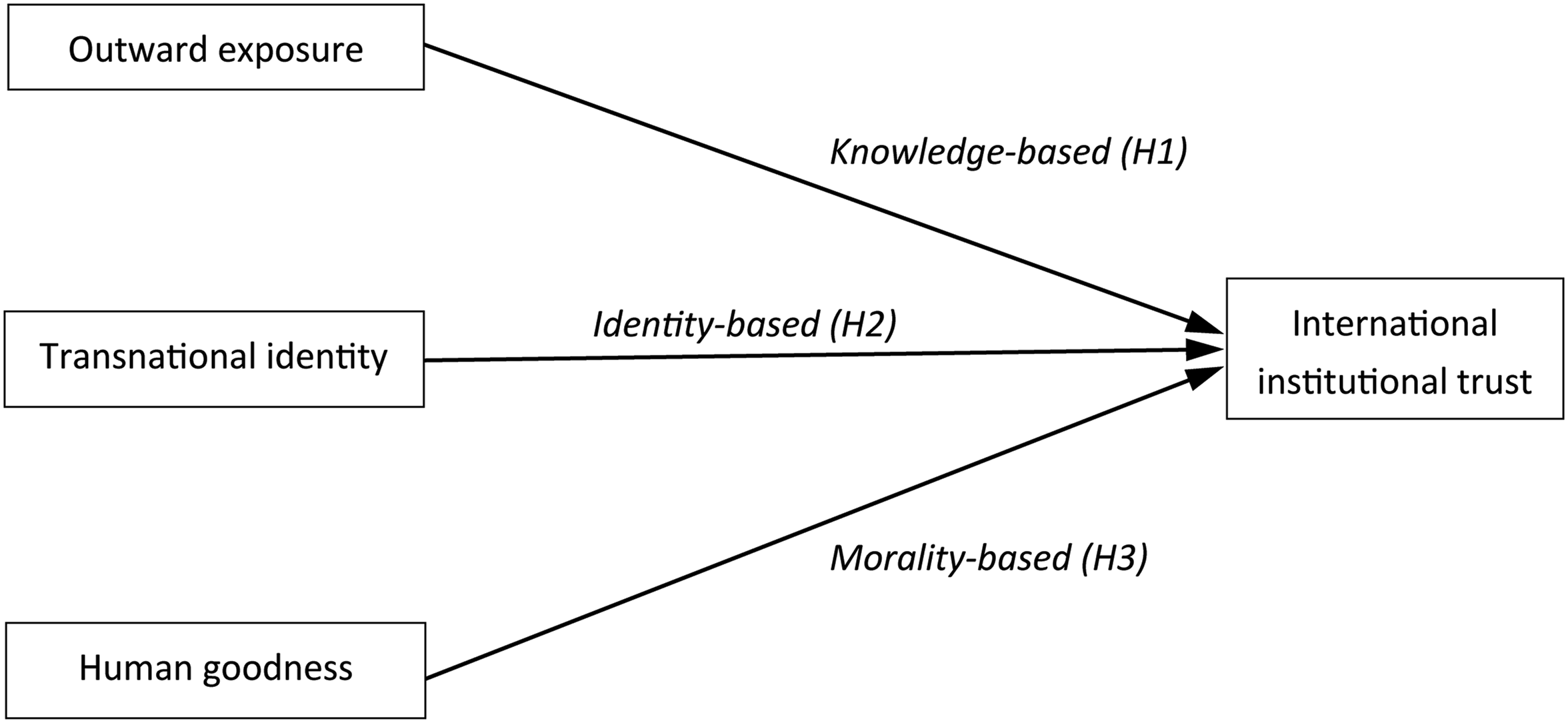
What’s more, I contend that trust in international institutions has spillover effects that shape public reasoning about immigration and foreign nations. In general, people are apt to draw on core values and beliefs to assemble foreign policy opinions (Bartels, 1994; Binning, 2007; Peffley & Hurwitz, 1993). “Just as social and political trust play key roles in shaping citizens’ judgments about the social and political realms, international trust may provide them with a shortcut for making sense of the complex and often unfamiliar domain of world affairs” (Brewer et al., 2018, p. 658). For example, US citizens who trust other nations are found to support humanitarian aid and diplomatic (vs. military) means in ensuring peace (Brewer, 2004; Brewer et al., 2004). Wals et al. (2015) find that trust in foreigners predicts Mexicans’ support for regional integration with the United States. In a similar vein, I argue that people extrapolate from IOs—a symbol of multilateral cooperation and global governance—to form their views of a distant outgroup: Individuals high in international institutional trust are more likely to hold favorable attitudes toward immigration and foreign nations (Hypothesis 4). Particularly, the positive impact of international institutional trust is expected to be independent of that of political trust, social trust, and/or outgroup trust.
Considering cross-national variability, I further argue that the spillover effects of international institutional trust are heterogeneous and contingent on a country’s degree of openness to the international community. According to Zaller’s (1992) model of mass opinion formation, the relationship between individual-level predispositions and political attitudes depends on the intensity of information flows at the societal level, with different levels of intensity producing different kinds of (linear or curvilinear) relationships. Therefore, attitudes toward immigration and foreign nations are likely shaped not only by preexisting values but also by informational environments. In relatively closed countries, people are short of direct experiences with outgroup members and of access to news about foreign nations, so they are more reliant on general beliefs about IOs to organize their outgroup attitudes. Meanwhile, for countries that are densely connected with the world, there are numerous opportunities to obtain messages on global issues. Assuming that one is cognitively capable and motivated enough, the greater the amount of information, the more complicated the chain of reasoning will be in responding rationally to a policy issue (Zaller, 1992). Yet, ordinary citizens in informationally crowded and noisy environments tend to be cognitive “misers” who use heuristics or cues to simplify decision making (Popkin, 1991). In particular, given the inconsistency caused by different issue frames and news media, people will base their opinions on preexisting beliefs instead of paying attention to all relevant messages (Sniderman & Theriault, 2004). To save brain resources, they are more likely to rest on international institutional trust, a low-effort strategy in high-information settings, when evaluating a distant outgroup. Together, the association between international institutional trust and outgroup attitudes is posited to increase in the above two contexts. By comparison, people in countries with a middle level of openness are the least likely to draw on their beliefs about IOs. Because information on world affairs is moderately accessible (between information shortage and information overload), individuals can learn about immigration and foreign nations with reduced dependence on trust in IOs. To sum up, the spillover effects of international institutional trust are moderated by openness at the country level: The effects are stronger in countries with low and high levels of openness but weaker in countries with middle levels of openness, resulting in a U-shaped pattern (Hypothesis 5).
Data and Measurement
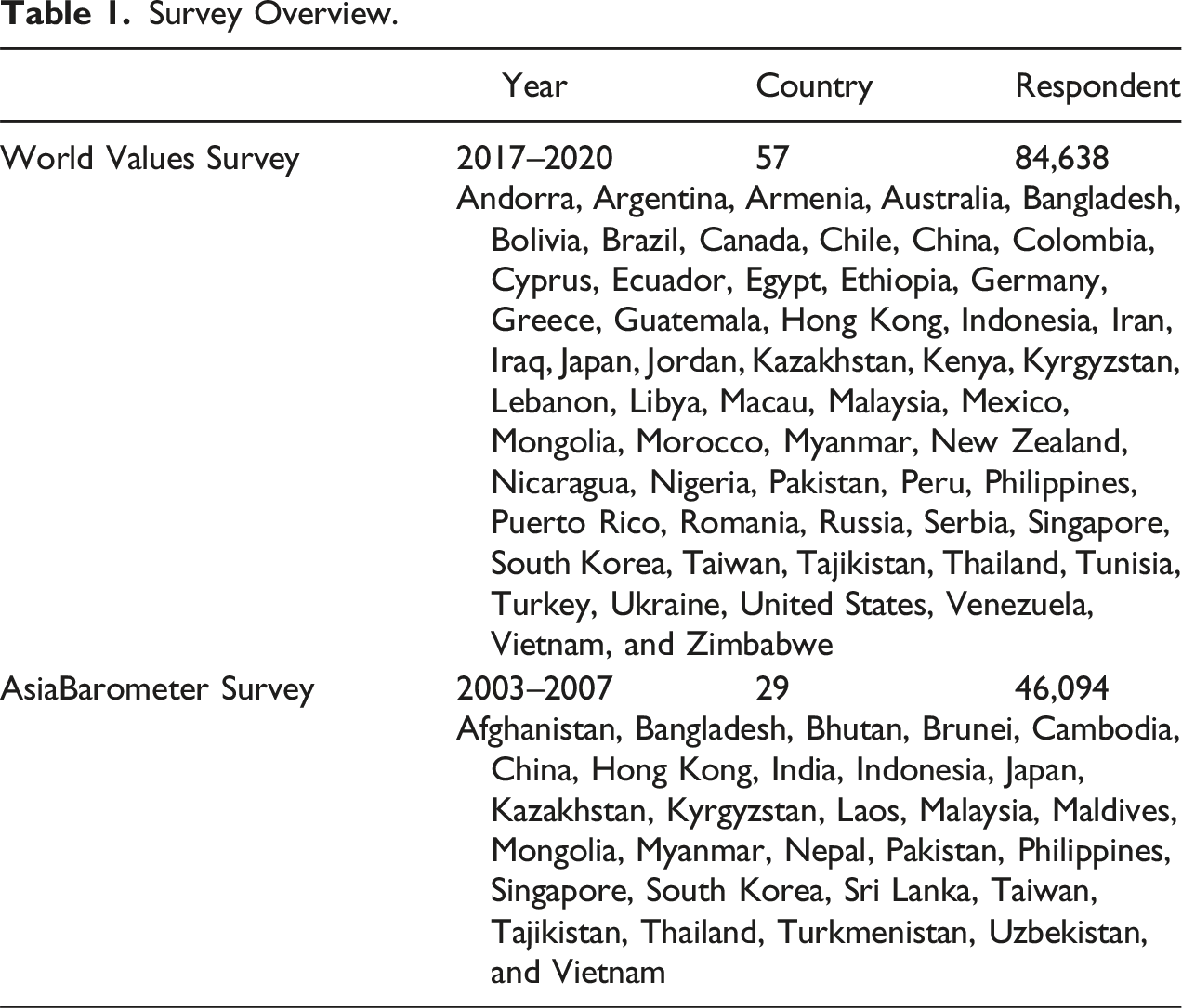
Survey Overview.
Factor Analysis
Factor Loadings in WVS (Principal Factor Method).
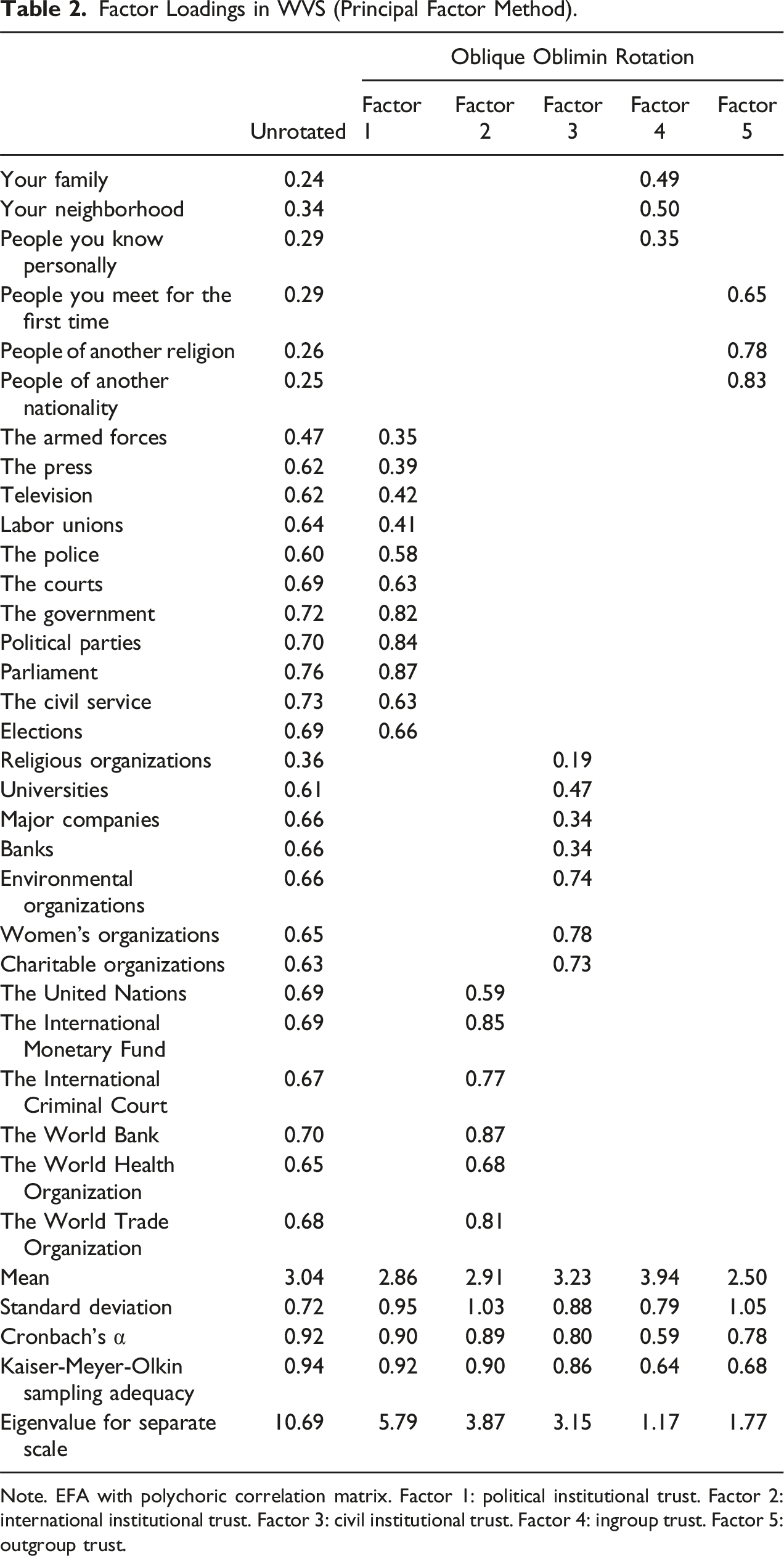
Note. EFA with polychoric correlation matrix. Factor 1: political institutional trust. Factor 2: international institutional trust. Factor 3: civil institutional trust. Factor 4: ingroup trust. Factor 5: outgroup trust.
Factor Loadings in ABS (Principal Factor Method).
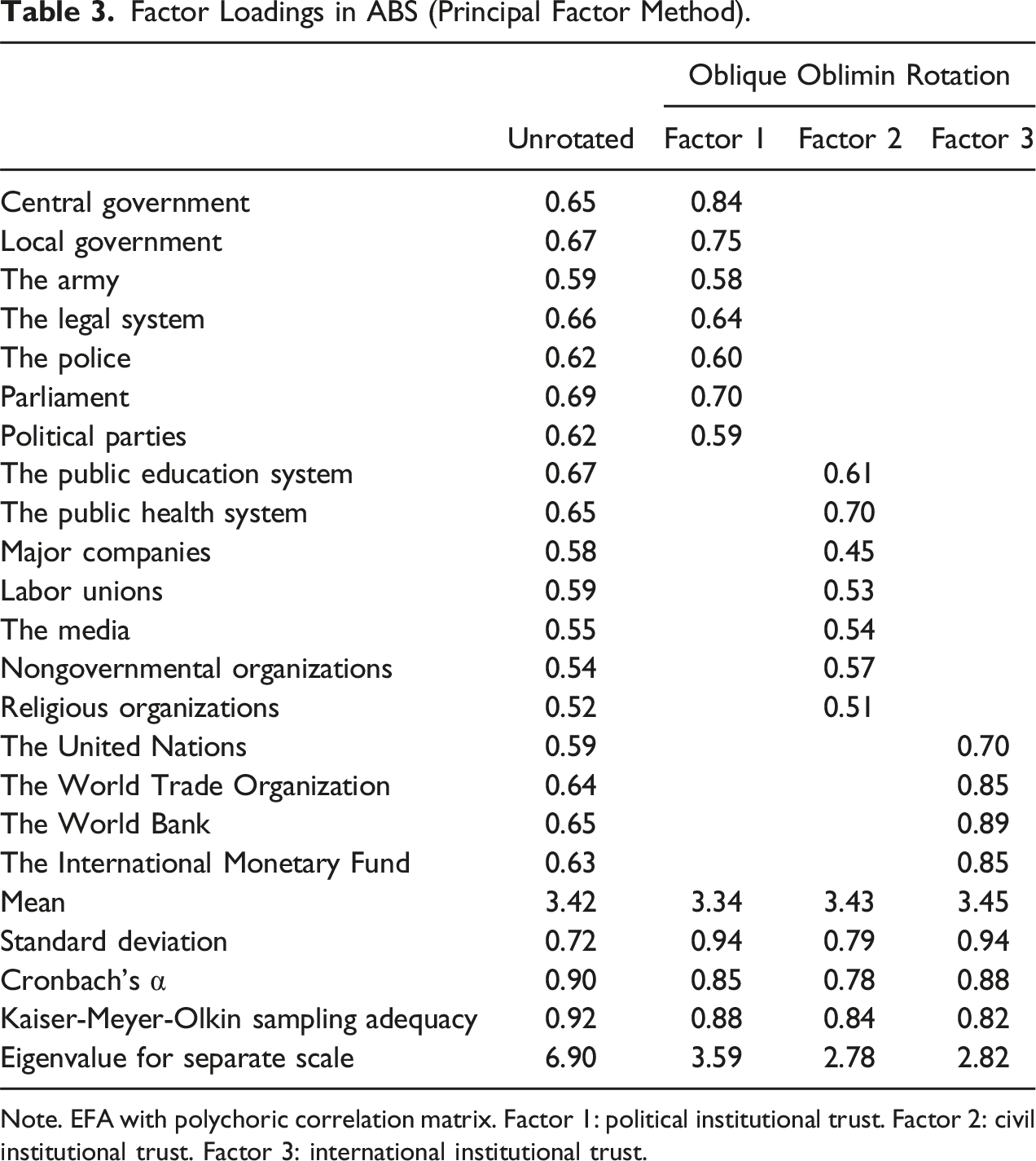
Note. EFA with polychoric correlation matrix. Factor 1: political institutional trust. Factor 2: civil institutional trust. Factor 3: international institutional trust.
Table 2 reports the factor loadings of trust items in WVS. According to exploratory factor analysis (EFA), when unrotated, all items load, to varying degrees, onto a single factor that accounts for 65.4% of the common variance (eigenvalue = 10.69; Cronbach’s α = 0.92), implying the commonality of all trust subtypes. Next, I conduct EFA with oblique oblimin rotation.
7
In spite of modest cross-loadings, the results generally point to a five-factor solution with acceptable reliability and substantive interpretability: political (institutional) trust (factor 1), international institutional trust (factor 2), civil institutional trust (factor 3), ingroup trust (factor 4), and outgroup trust (factor 5).
8
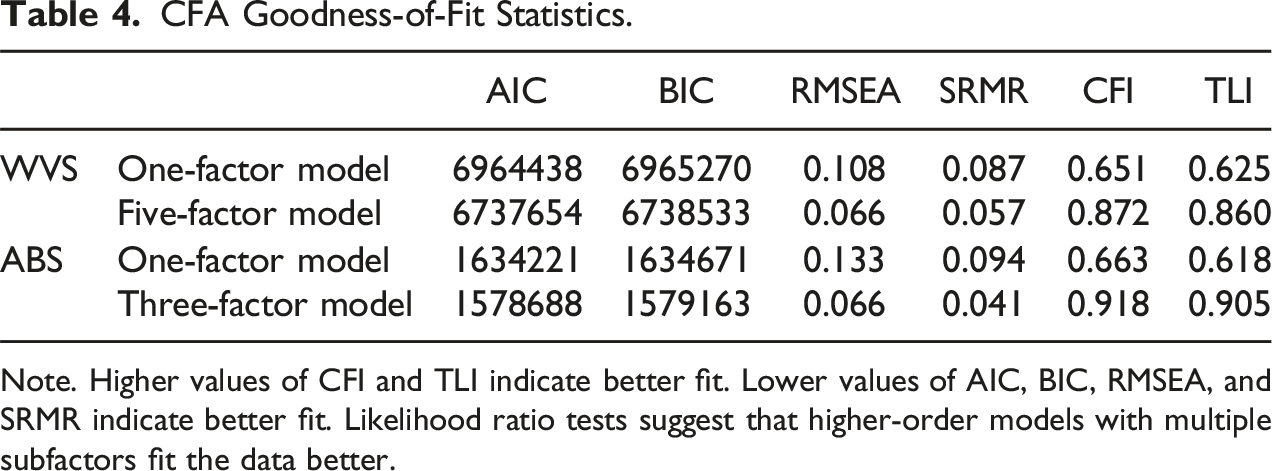
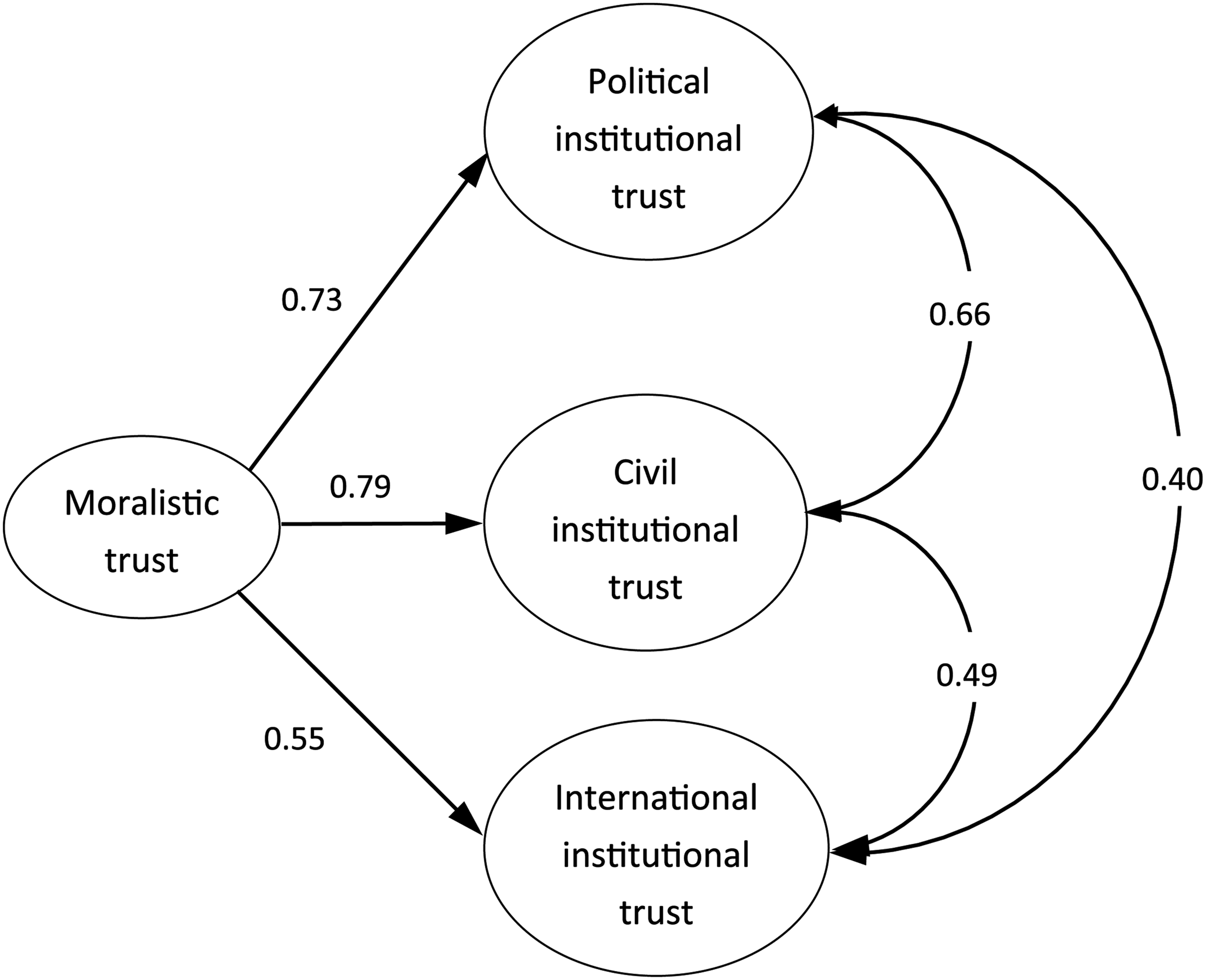
These factorially distinct dimensions embody the target specificity and multidimensionality of trust. Then, I test a second-order model of one superordinate factor with five subfactors. Factors 1 to 5 are subfactors responsible for the intercorrelations of their respective indicator variables, whereas moralistic trust is a broad general factor responsible for the intercorrelations of all subfactors (see Figure 2). The higher-order factor accounts for 36.26% of the total variance, suggesting that trust also has object-general and holistic properties. The second-order factor loadings range from 0.25 to 0.75 (left half of Figure 2), and the interfactor correlations for factors 1 to 5 range from 0.15 to 0.65 (right half of Figure 2). After that, I employ confirmatory factor analysis (CFA) to compare the second-order model with a single-factor model that assumes one latent construct underlying all items without subfactors. Model fit indices and likelihood ratio test indicate that the former model fits the data better (see Table 4). On the whole, factor analytic findings support the multilevel framework of trust: one superordinate factor with multiple subfactors, namely, moralistic trust with different subtypes of trust. Analysis of the data in ABS yields substantively similar results (see Table 3, Figure 3, and Table 4). Higher-order five-factor EFA model (WVS). Note: Entries on the left are second-order factor loadings. Entries on the right are interfactor correlations. CFA Goodness-of-Fit Statistics. Note. Higher values of CFI and TLI indicate better fit. Lower values of AIC, BIC, RMSEA, and SRMR indicate better fit. Likelihood ratio tests suggest that higher-order models with multiple subfactors fit the data better. Higher-order three-factor EFA model (ABS). Note: Entries on the left are second-order factor loadings. Entries on the right are interfactor correlations.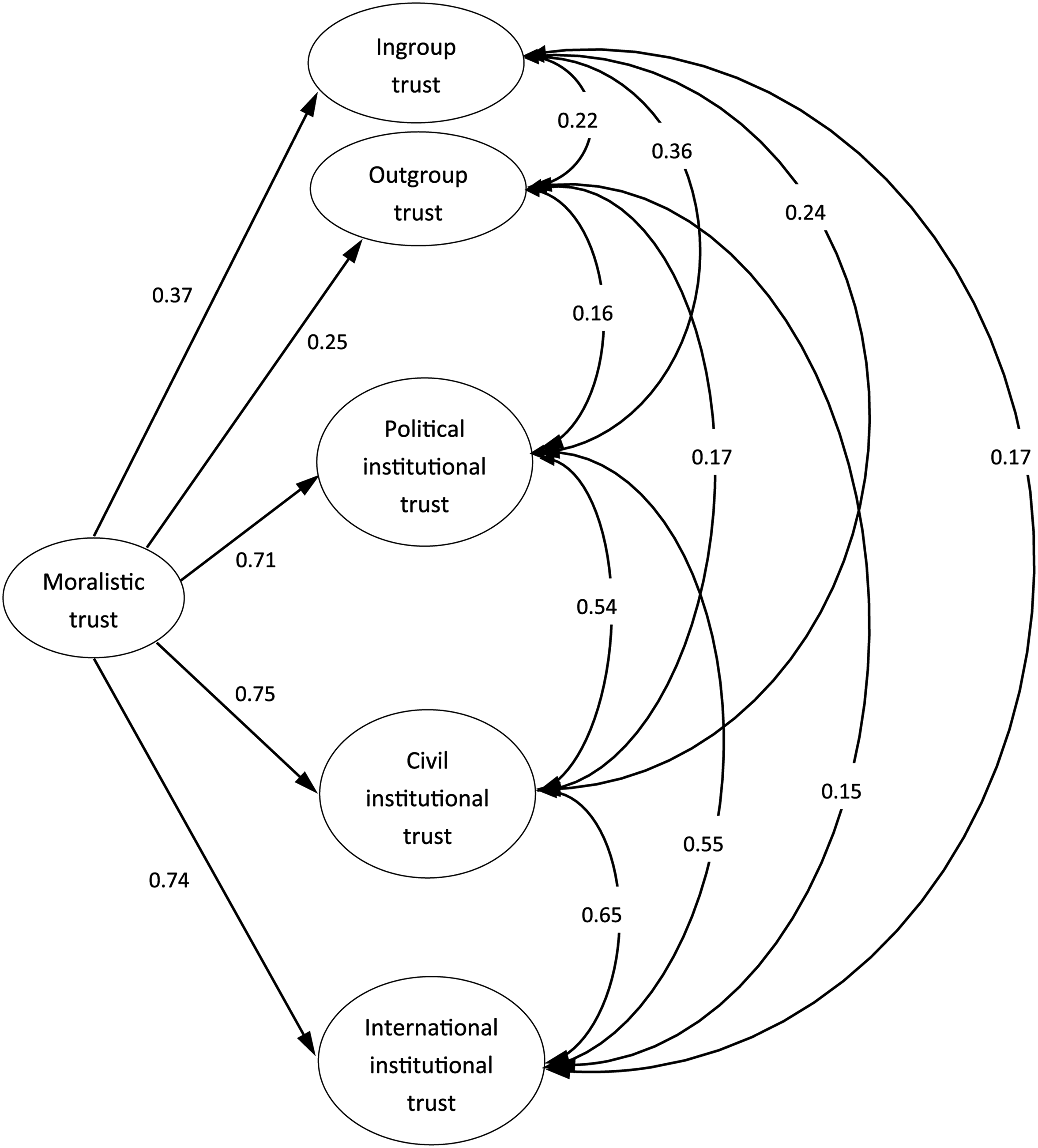
Variables
Variables in Hypotheses 1–3
The dependent variable in Hypotheses 1–3 is international institutional trust. On the basis of EFA, items that load saliently on the factor of international institutional trust are averaged into an index (Cronbach’s α = 0.89/0.88 in WVS/ABS). According to Figure 1, the knowledge-, identity-, and morality-based correlates of international institutional trust are outward exposure (H1), transnational identity (H2), and belief in human goodness (H3). First, outward exposure is tapped by eight items on a five-point scale in WVS asking respondents how often they depend on newspaper, television, radio, mobile phone, email, the Internet, social media, and friends/colleagues to learn information about the world (1 = never, 5 = daily). Item responses are averaged to form a scale. In ABS, respondents were asked whether any of the six statements about outward exposure applies to them (e.g., “I often watch foreign-produced programs on TV” 1 = yes, 0 = no). The answers are summed into an index. Second, I use two items in WVS for the operationalization of transnational identity asking respondents how close they feel to the continent and to the world, each rated on a five-point scale (1 = not close at all, 5 = very close). The two items are strongly correlated and averaged into an index. In ABS, respondents were asked whether they identify with any transnational group in Asia (1 = yes, 0 = no). 9 Third, belief in human goodness is a binary variable. In WVS, it is tapped by the item asking participants whether tolerance and respect for other people is considered to be an especially important quality that children can be encouraged to learn at home (1 = yes, 0 = no). Similarly, respondents in ABS were asked whether they would wish their sons and daughters to become a loving and charitable person (1 = yes, 0 = no). Those who agreed with the statement are categorized as embracing the idea of human goodness. Despite differences in question wording and response options, I try to make variables in the two data sets as comparable as possible.
Variables in Hypothesis 4
The dependent variable of interest is attitudes toward immigration and foreign nations. In WVS, I center on attitudes toward immigration, immigrants, and migration policy. First, immigration attitudes are tapped by six items about the social effects of immigration (e.g., “Immigration strengthens cultural diversity”) on a three-point scale (0 = disagree, 2 = agree). Responses to these items are averaged so that higher scores indicate pro-immigration attitudes. 10 Second, immigrant attitudes are assessed with one item (i.e., “How would you evaluate the impact of immigrants on the development of your country”) on a five-point scale (1 = very bad, 5 = very good). Third, respondents were asked a question that captures their favored national migration policy. I create a four-point scale from 1 “most restrictive” to 4 “most liberal.” In ABS, I employ Asian public opinions of the United States, China, Japan, South Korea, and North Korea to operationalize attitudes toward foreign nations. Respondents were asked whether each of the five foreign countries has a good or a bad influence on their own country. 11 All responses are given on a five-point scale (1 = bad, 5 = good). Alternatively, the above five items are averaged into a composite measure of outgroup attitudes. The key explanatory variable is international institutional trust, with the same operationalization explained earlier.
Variables in Hypothesis 5
KOF Index of Globalization.
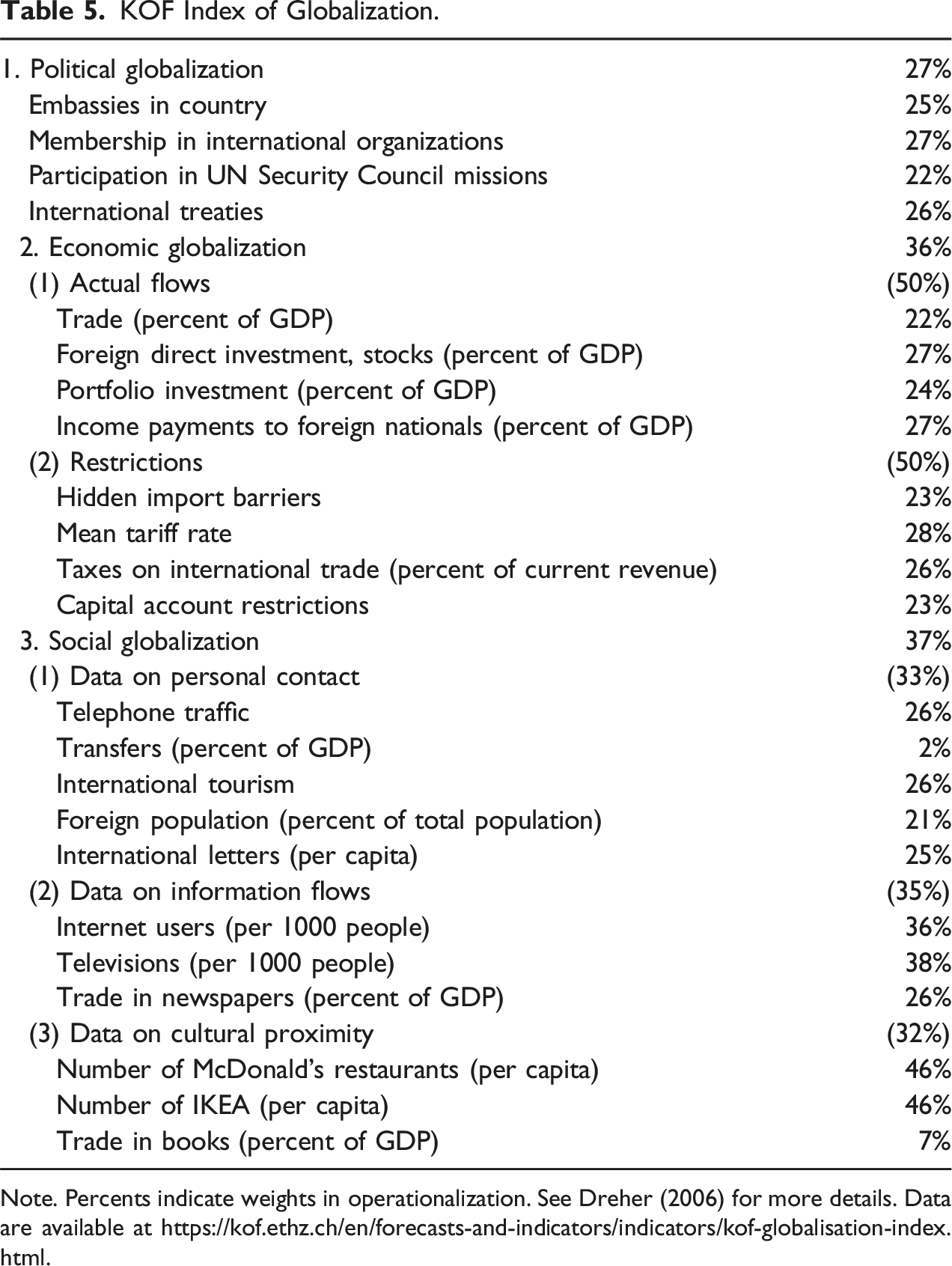
Note. Percents indicate weights in operationalization. See Dreher (2006) for more details. Data are available at https://kof.ethz.ch/en/forecasts-and-indicators/indicators/kof-globalisation-index.html.
Control Variables
To present a more fully specified model, I add a battery of control variables widely adopted in prior studies: democratic values, subjective economic well-being, national pride, right-leaning ideology, traditionalism, religiosity, and demographics (i.e., education, age, gender, marital status, employment status, and income). For Hypothesis 5, I further incorporate some country-level covariates aside from the KOF index: human development index, civil liberties index, government effectiveness, gross domestic product (GDP), and GDP growth. Summary statistics are reported in the supplemental material (see Tables A1 and A2).
Model and Result
Ordered Logit Analysis of International Institutional Trust.
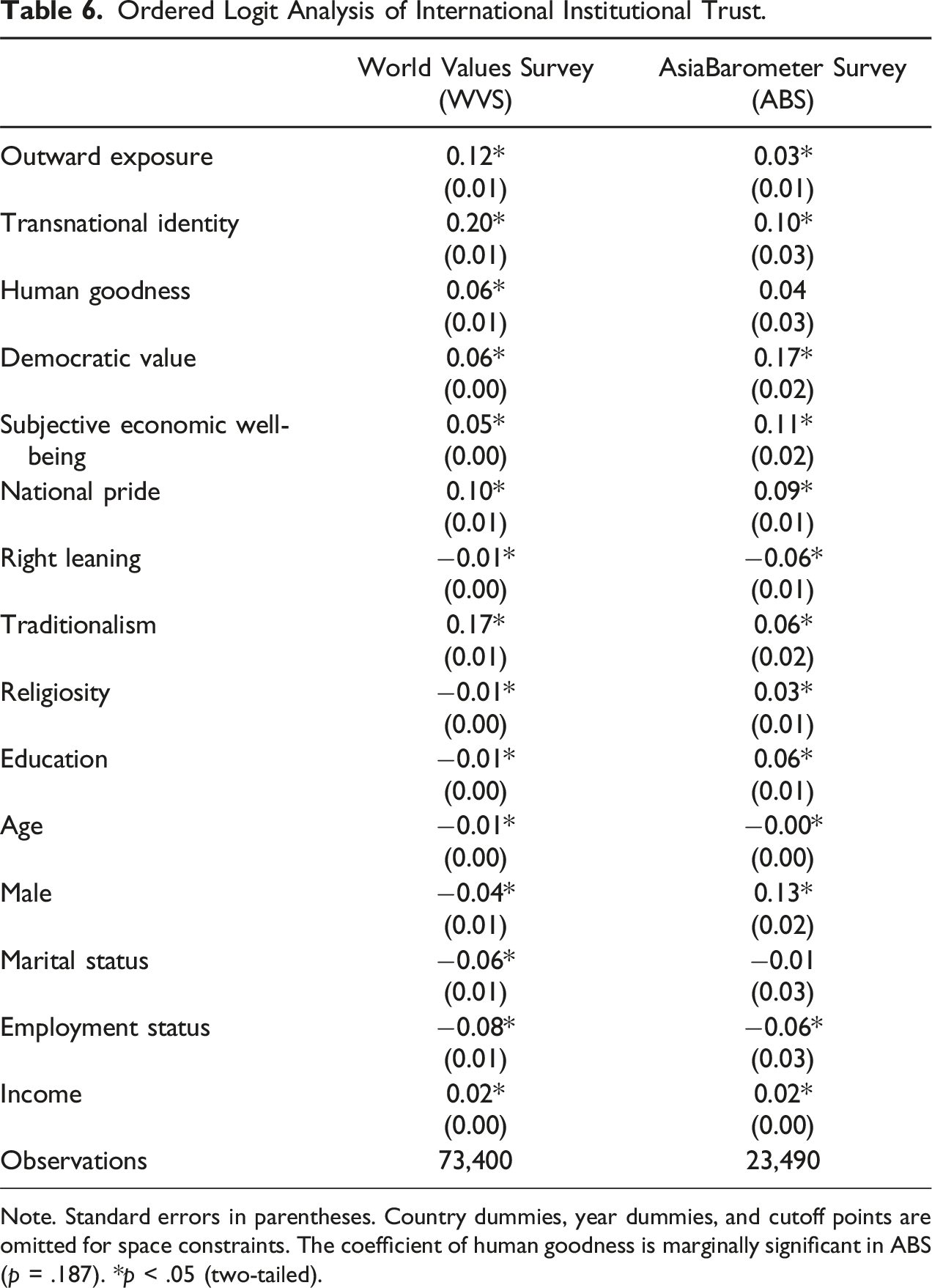
Note. Standard errors in parentheses. Country dummies, year dummies, and cutoff points are omitted for space constraints. The coefficient of human goodness is marginally significant in ABS (p = .187). *p < .05 (two-tailed).
Ordered Logit Analysis of Immigration Attitudes (WVS).
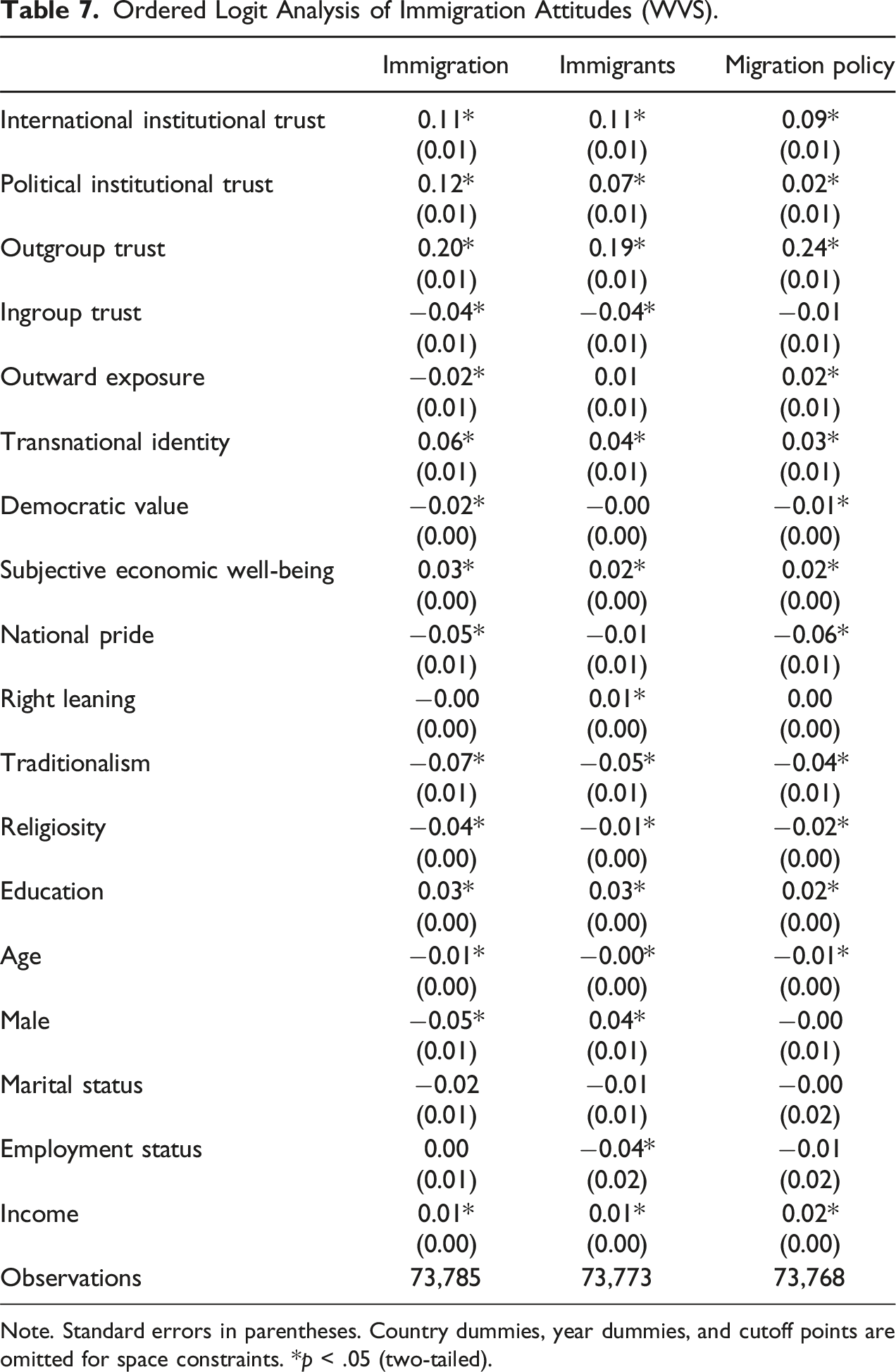
Note. Standard errors in parentheses. Country dummies, year dummies, and cutoff points are omitted for space constraints. *p < .05 (two-tailed).
Ordered Logit Analysis of Attitudes Toward Foreign Nations (ABS).
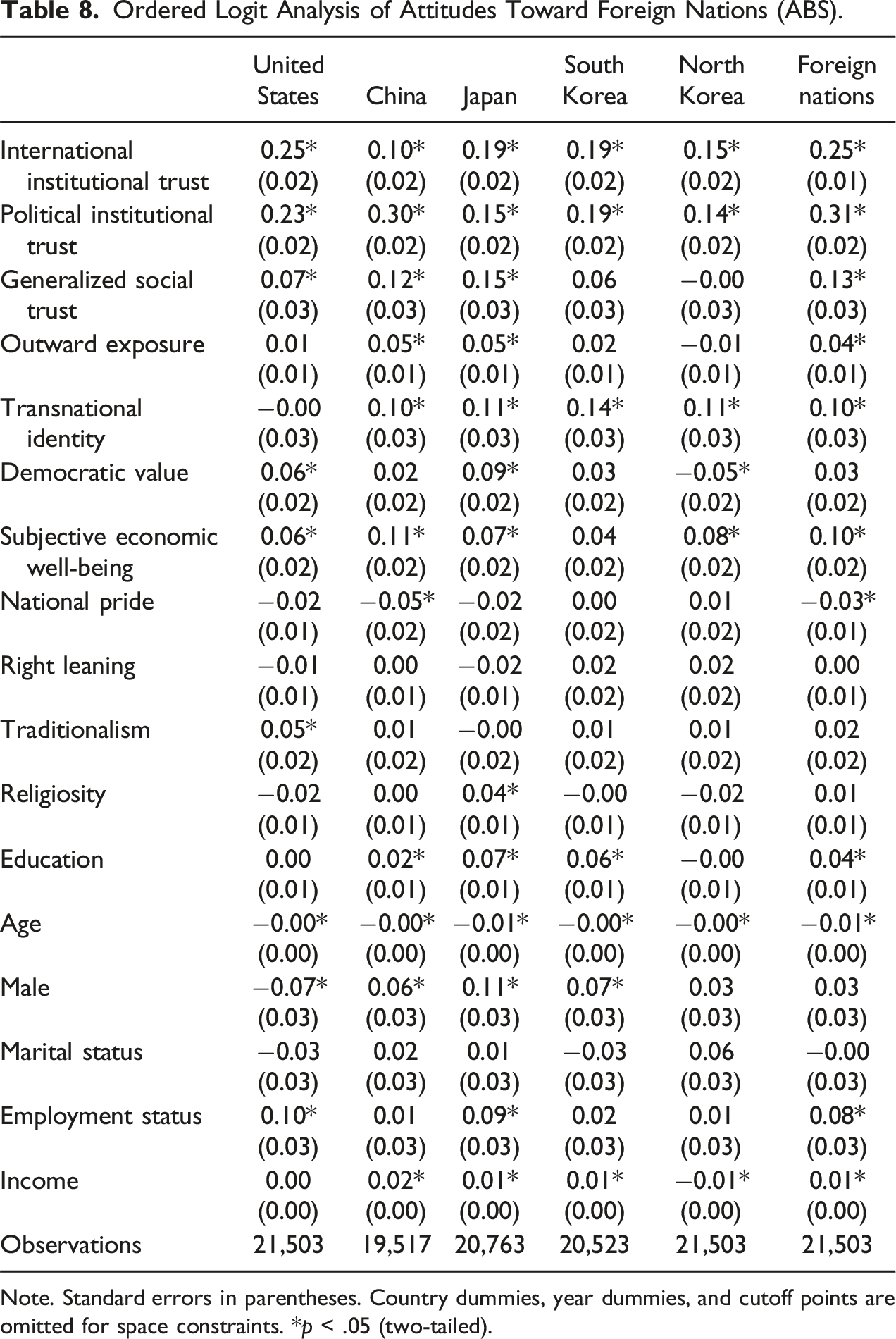
Note. Standard errors in parentheses. Country dummies, year dummies, and cutoff points are omitted for space constraints. *p < .05 (two-tailed).
Multilevel Analysis of Attitudes Toward Immigration (WVS).
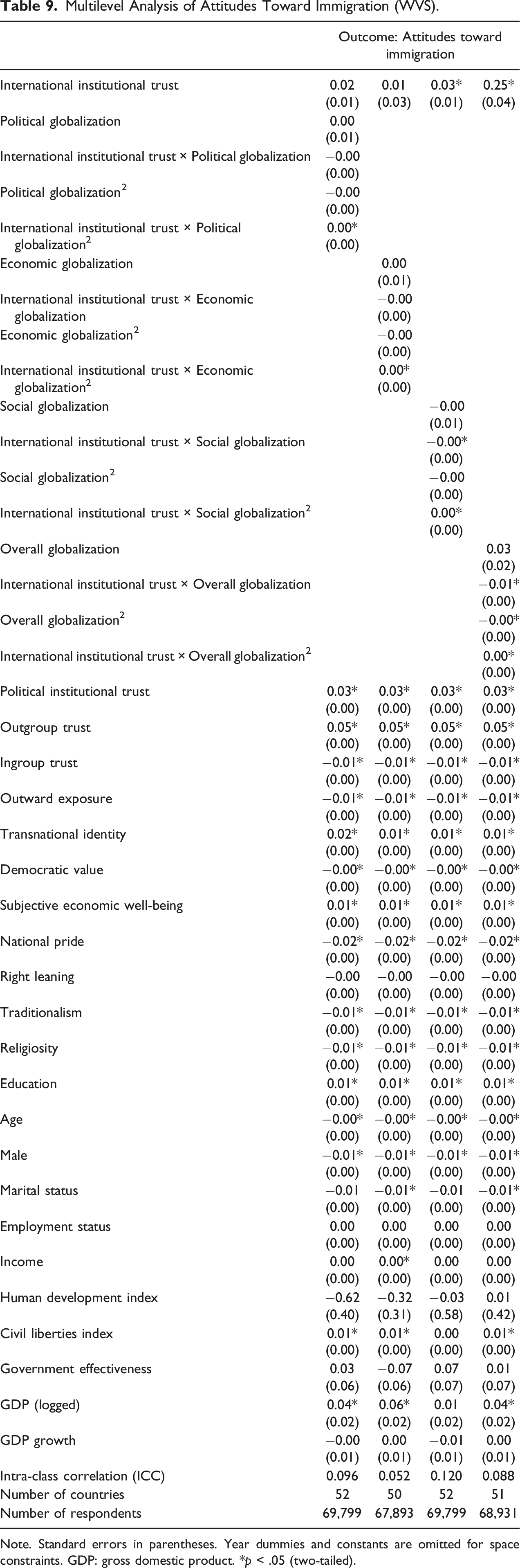
Note. Standard errors in parentheses. Year dummies and constants are omitted for space constraints. GDP: gross domestic product. *p < .05 (two-tailed).
Multilevel Analysis of Attitudes Toward Foreign Nations (ABS).
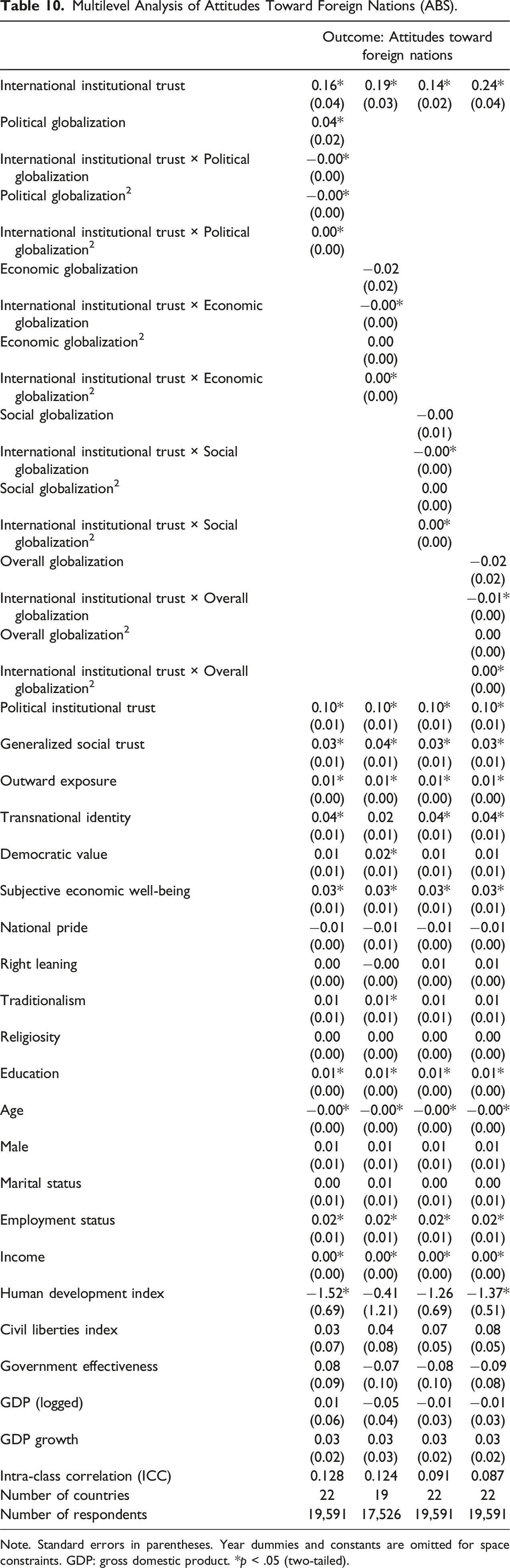
Note. Standard errors in parentheses. Year dummies and constants are omitted for space constraints. GDP: gross domestic product. *p < .05 (two-tailed).
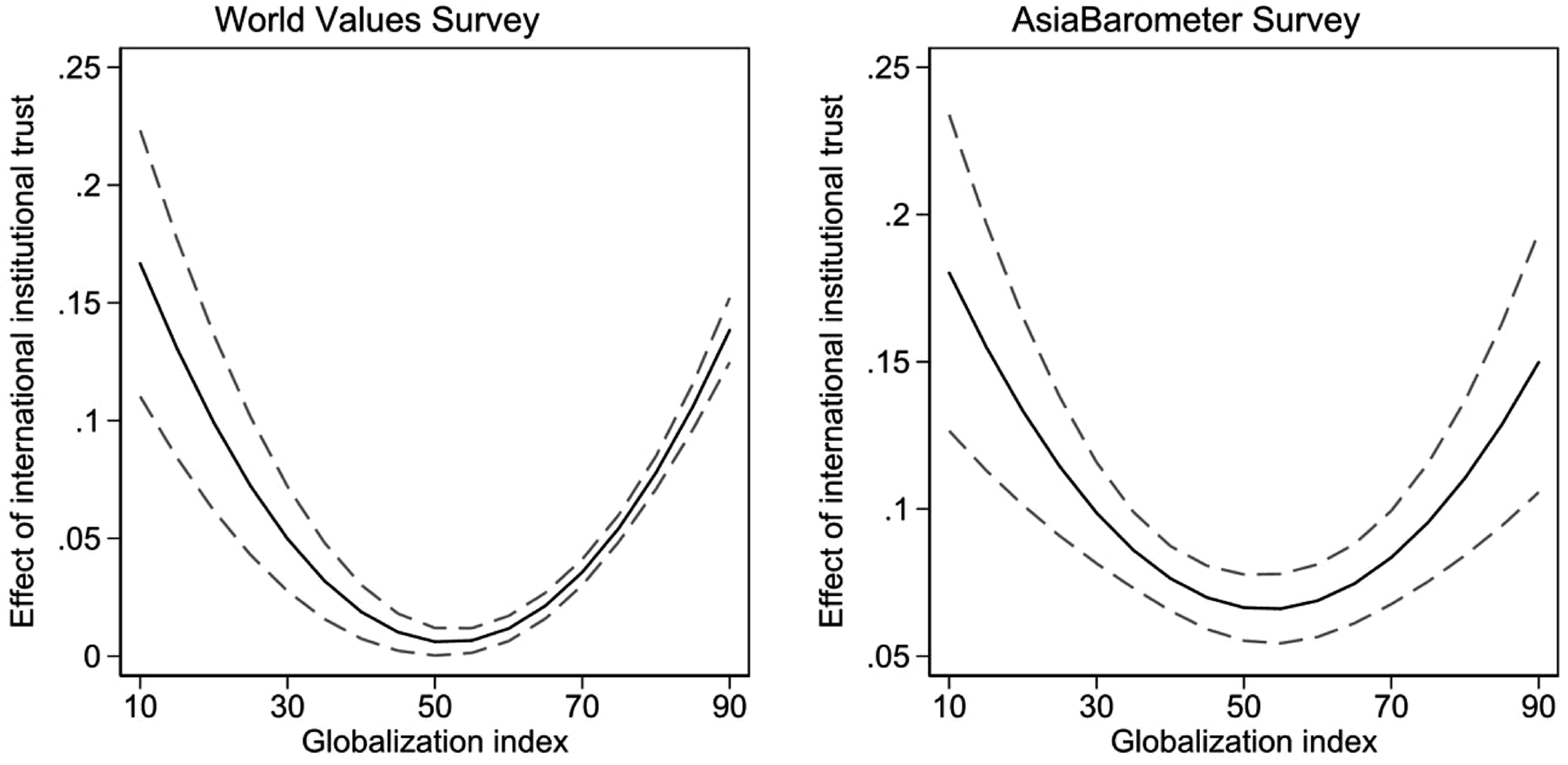
Marginal effects of international institutional trust, conditional on overall globalization. Note: Dashed lines are 95% confidence intervals. Outcomes are attitudes toward immigration (left panel) and attitudes toward foreign nations (right panel).
Marginal Effects of International Institutional Trust on Outgroup Attitudes.
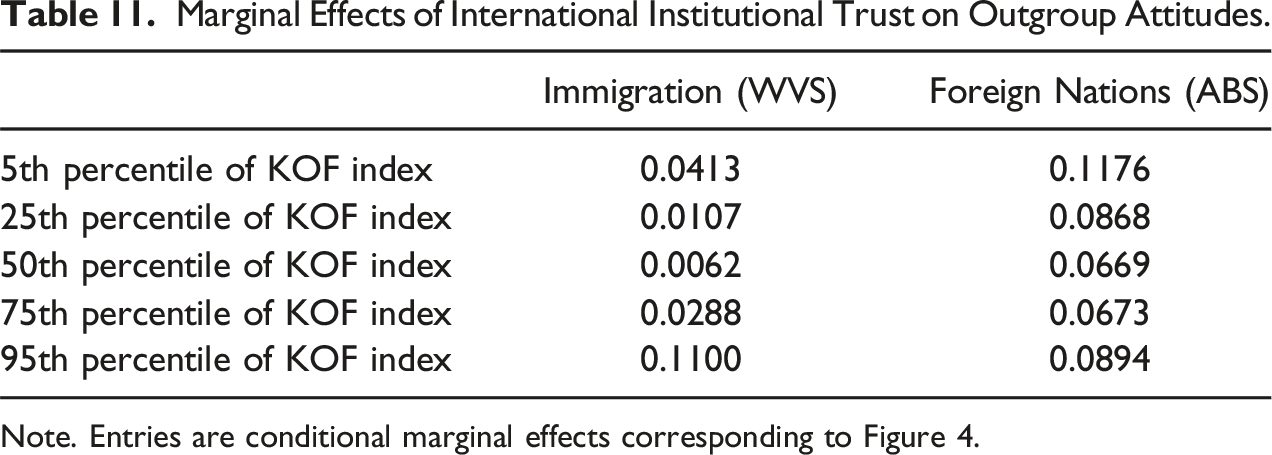
Note. Entries are conditional marginal effects corresponding to Figure 4.
Conclusion and Discussion
Bringing together the knowledge-, identity-, and morality-based accounts of trust, this article proposes a multilevel framework where all variants of trust are factorially distinct yet collectively subsumed by a moralistic propensity to trust. As such, trust has both object-specific, multidimensional, malleable and object-general, holistic, stable properties. With this integrated approach to trust, I shed light on the causes and consequences of generalized trust toward international institutions, namely, international institutional trust. Specifically, I argue that international institutional trust is driven by a combination of informational, categorical, and moral/dispositional forces: Individuals with higher levels of outward exposure (knowledge-based), transnational identity (identity-based), and belief in human goodness (morality-based) are more likely to trust international institutions (Hypotheses 1–3). Moreover, general beliefs about IOs can be cognitive shortcuts that shape public reasoning about world affairs. I thus expect that international institutional trust spills over and orients people to favorable attitudes toward immigration and foreign nations (Hypothesis 4). In particular, given cross-national variability, such spillover effects are moderated by a country’s degree of openness to the international community: The effects of international institutional trust are stronger in countries with low and high levels of openness but weaker in countries with middle levels of openness, resulting in a U-shaped pattern (Hypothesis 5). Analyses of the ABS and WVS lend credence to the above arguments.
On the other hand, there are limitations in this paper that warrant continuing reflection and investigation. First of all, Hypothesis 3 is only partially supported by the data given that the association between belief in human goodness and international institutional trust is not statistically significant in the ABS model. Indeed, belief in human goodness, albeit significant in the WVS model, plays a weaker role than outward exposure and transnational identity in explaining trust toward IOs. It seems that the informational and categorical bases of trust are substantively more important than the moral base.
What’s more, resonating with the aggregation debate in behavioral international relations (Gildea, 2020), it is unclear whether and how an internationally trusting public opinion corresponds to a state’s implementation of cooperative foreign policy. While some scholars contend that foreign policy making is driven in a top-down fashion where politicians play a more decisive role (Berinsky, 2009; Zaller, 1992), others believe elite discourse to follow and reflect public opinion, rather than the other way around (Fanis, 2011; Page & Shapiro, 1992). Future research can try to unpack the pathways that link micro-level mass attitudinal factors to higher levels of analysis.
Further, when decomposing social trust into ingroup trust and outgroup trust in WVS, the two subtypes are found to exhibit differential correlations with immigration attitudes. In contrast to outgroup trusters who are as pro-immigration as international institutional trusters, ingroup trusters hold less tolerant attitudes. This coincides with previous research indicating that particularized ingroup trust erodes cooperation in the larger society (Binning, 2007; Uslaner, 2002). In spite of some overlap, ingroup trust may actually weaken the pro-social/outsider impacts of outgroup trust and international institutional trust. Therefore, it is worthwhile to examine the interplay between ingroup trust and other forms of trust.
Methodologically, there is room for improvement too. First, the factorial structure of trust that I bring forth is more exploratory than confirmatory. It is suggested that item response models be employed to more rigorously test the psychometric properties of trust (sub)scale. Second, due to cross-sectional data from ABS and WVS, the regression-based findings are more suggestive than conclusive. For causal inference, longitudinal and/or experimental research designs are preferable. Another direction for future work is to identify the temporal differences of international institutional trust. Durand et al. (2021) have recently created a database on institutional trust covering 1327 surveys in 142 countries from 1995 to 2017. A preliminary four-level multilevel analysis shows that over 90 percent of the variance in institutional trust is at the individual level and that there is more variance between countries than over time. By taking temporal variation into account, researchers will have a deeper understanding of the dynamics of trust.
Michalos (1990, p. 620) notes that “the world is to some extent constructed by each of us, that it can and ought to be constructed in a more benign way, that such construction will require more trust than most people are currently willing to grant, and that most of us will be better off if most of us can manage to be more trusting in spite of our doubts.” To protect a collaborative, harmonious, and peaceful global community from ethnopopulist/authoritarian forces, we need to build trust beyond the small personally known circle of families and friends. As this integrative study illustrates, international institutional trust—driven by outward exposure, transnational identity, and belief in human goodness—plays a promising role in making us approach the social world and distant others with a positive attitude, especially in the least and the most globalized countries.
Supplemental Material
Supplemental Material - Toward a Cooperative Social World: An Integrative Study of International Institutional Trust
Supplemental Material for Toward a Cooperative Social World: An Integrative Study of International Institutional Trust by Gong Chen in Cross-Cultural Research
Footnotes
Acknowledgments
The I would like to thank and acknowledge valuable feedback from Toby Bolsen, Ryan Carlin, the anonymous reviewers, and the editorial team. Earlier versions of this article were presented at the 2020 American Political Science Association (APSA) Annual Conference, 2021 Northeastern Political Science Association (NPSA) Annual Conference, 2022 Atlanta Symposium on Political Science (ASOPS), and 2022 Midwest Political Science Association (MPSA) Annual Conference. I am grateful to the discussants and participants for helpful comments.
Declaration of Conflicting Interests
The author declared no potential conflicts of interest with respect to the research, authorship, and/or publication of this article.
Funding
The author received no financial support for the research, authorship, and/or publication of this article.

Supplemental Material
Supplemental material for this article is available online.
Notes
Author Biography
References
Supplementary Material
Please find the following supplemental material available below.
For Open Access articles published under a Creative Commons License, all supplemental material carries the same license as the article it is associated with.
For non-Open Access articles published, all supplemental material carries a non-exclusive license, and permission requests for re-use of supplemental material or any part of supplemental material shall be sent directly to the copyright owner as specified in the copyright notice associated with the article.
