







Abstract
The rise of authoritarian populism has disrupted the patterns of party competition in many Western societies. Related to this development, the current debates in the United States and European Union illustrate how empirical science on climate change may become intensely politicized, and all ambitious climate policies challenged in the contemporary political landscape. We set out an analytical framework with three ideal types of political strategies for opposing climate policies: climate science denialism, climate policy nationalism, and climate policy conservativism. Empirically, the article investigates populist resistance to ambitious climate change policy in the Nordic context, where countries have sought to assume global leadership in climate politics and have considerable public support for climate action. In an analysis of the evolving positions of populist parties in Denmark, Finland, and Sweden in recent elections, the article sheds light on the interconnection between populism and climate change policy.
Introduction
The rise of populism has disrupted long-established patterns of party competition in many Western societies. A crucially important theme is the connection between populism and climate change, with climate change policies being described as “an ideal target” for the populist agenda (Huber, 2020).
The intersection between climate change and populism is typically analyzed with regard to climate change science. There is considerable academic literature on climate change denialism and a growing body of work focusing on how such denialism features in populist platforms and among right-wing extremists (Lockwood, 2018; McCright & Dunlap, 2011). Emphasizing and exaggerating uncertainty about what is known about climate change, rejecting the scientific consensus, and implying that uncertainty justifies inaction are integral parts of the denialist discourse (Lewandowsky et al., 2015; Schmid-Petri, 2017). While the research on denialism has shed light on these phenomena, this line of inquiry needs to be complemented with a broader perspective. Our hypothesis is that many populist parties engage in potentially powerful arguments that are not based on science denialism, at least in the conventional sense. Opponents of ambitious climate policy have, on several instances, replaced the focus on uncertain evidence with other strategies, such as political smear campaigns, or by arguing that climate policies would have drastic impacts on the economy (Fisher 2019; McKie 2019).
There is a need for both conceptual and empirical work to improve our knowledge of the broader argumentation on climate change put forward by authoritarian populists (see also Skoglund & Stripple, 2019). We take initial steps in addressing this research gap through the introduction of an analytical framework for various political strategies aimed at opposing ambitious climate policies. The framework sets out three ideal types of opposition, namely, climate science denialism, climate policy nationalism, and climate policy conservativism.
Empirically, we present three short cases and analyze the populist parties in Denmark, Finland, and Sweden. It is particularly interesting to explore the patterns of authoritarian populism and climate policy in the Nordic context: the respective countries have sought to assume global leadership in climate politics, they have projected an overall “green” image with a tradition of being environmentally pioneering states, and they have attracted considerable public support for climate action (see e.g., Bäckstrand & Kronsell, 2015). However, as previous research has shown, climate denialism in different forms is also influential in the Nordic countries (Anshelm & Hultman, 2014; Krange et al., 2019). In this article, we ask if climate change features regularly in the recent political campaigns of Nordic populists, and if there is a qualitative shift toward more assertive and/or nuanced positions on climate policy? Are the leading populist politicians turning to science denialism, familiar from the US debates? Alternatively, do Nordic populist parties’ campaign more subtly, highlighting nationalism and/or policy costs?
Climate Change Through Populist Lenses
Populism consists of politics based on a distinction between “the pure people” and “the corrupt elites” (Müller 2017). Leading scholars have further defined and analyzed populism as a “thin ideology” attached to right-wing or left-wing host ideology (Mudde & Kaltwasser, 2017), or as a discursive strategy (Laclau, 2005). We apply and emphasize the perspective of strategic communication, populism as a “toolbox” for a political movement (Ylä-Anttila, 2017). This is due to our focus on the parties and politicians—the pragmatic and strategic “supply side” of populism. Apart from left-wing or right-wing extremism, populism is an important variable in itself (Huber, 2020), and our study investigates the different types of populist argumentation that parties and politicians decide to communicate in climate policy field at a given time. The flexibility of the populist framing of politics has recently been highlighted by scholars also in the climate context (Huber et al., 2021).
We adopt the term “authoritarian populism,” reflecting the work of Norris and Inglehart (2019). Authoritarian is more analytically sound as a prefix than the commonly used “right-wing,” given that the economic policies promoted by authoritarian populists may well be interventionist and oriented toward social policy programs. However, it is worth pointing out that the word “authoritarian” does not imply fascism. On a broader level, it means that the populist movement in question challenges the norms underpinning liberal democracies, such as the separation of powers, the protection of minorities, and a free media ecosystem. An authoritarian populist seeks to turn a “failing” liberal democracy into a more illiberal variant. The term is also helpful in narrowing down the focus of this article and excluding other types of populist parties, for example, Movement Now (Liike Nyt) in Finland, inspired by the Five Star Movement.
Authoritarian populism challenges the legitimate authority of “the establishment” and the pluralist ideas of the rightful location of power and authority in the state. The voice of the “ordinary citizen” is considered the only truly democratic voice—even and especially when it is contrasted with the expert judgment of elected representatives, the legal system, scholars, or journalists. The vox populi is perceived as unified, authentic, and morally right. According to this definition, populism remains somewhat silent about second-order principles, such as what should be done, what policies should be followed, and what decisions should be made (Norris & Inglehart, 2019).Where, then, and does climate policy fit in? It has recently been noted that the populist parties in Europe oppose ambitious climate change policies (Schaller & Carius, 2019). Some earlier studies have analyzed the broader issue of anti-environmentalism in European right-wing parties, noting that active opposition to environmental protection has been practiced by many of these parties in Western Europe (Gemenis et al., 2012). Authors have also associated authoritarianism with “climate skepticism” or denialism (e.g., Poortinga et al., 2011). Huber (2020) highlights the need to focus on the populist orientation of the climate change deniers—not only the left–right axis, nationalism, or authoritarianism. Populist attitudes may have important explanatory power, as climate policy is a suitable target for populist politics in several ways (Huber, 2020; Lockwood, 2018). First, climate change is abstract and climate policy is technical: They can be portrayed as elite driven agendas, “detached from citizens’ everyday needs” (Huber, 2020, p. 964). Climate change can be framed as a manifestation of post-materialist politics, an elitist by-product of the triumph of progressive values, and the Silent Revolution (Norris & Inglehart, 2019, p. 32-35). Furthermore, climate politics is international almost by default, and thus it can be dismissed as a cosmopolitan agenda, driven by proponents of EU integration and stronger global governance.
Climate Denialism, Climate Nationalism, And Climate Conservativism
We construct three somewhat caricatured ideal types to facilitate the analysis of the positions and arguments of the Nordic populist parties. The distinctions set out below are ideal-typical in a Weberian sense. We acknowledge that the complexity and contextuality of real-world politics do not exactly correspond to these ideal types, and that politicians will often combine different elements in their messaging. However, the types could be taken as “reference models,” and they may be helpful for analytical purposes in terms of identifying and describing political ideologies and rhetorical devices (Weinert, 1996).
In sum, the following three arguments against ambitious climate policies stand out in contemporary debate—and all of them have featured in climate politics since the issue was first thoroughly politicized in the early 1990s: There is no evidence to act, climate change is not real We are not the ones who should act We should only act if the cost is minimal
Three Strategic Perspectives on Opposing Ambitious Climate Change Policies.
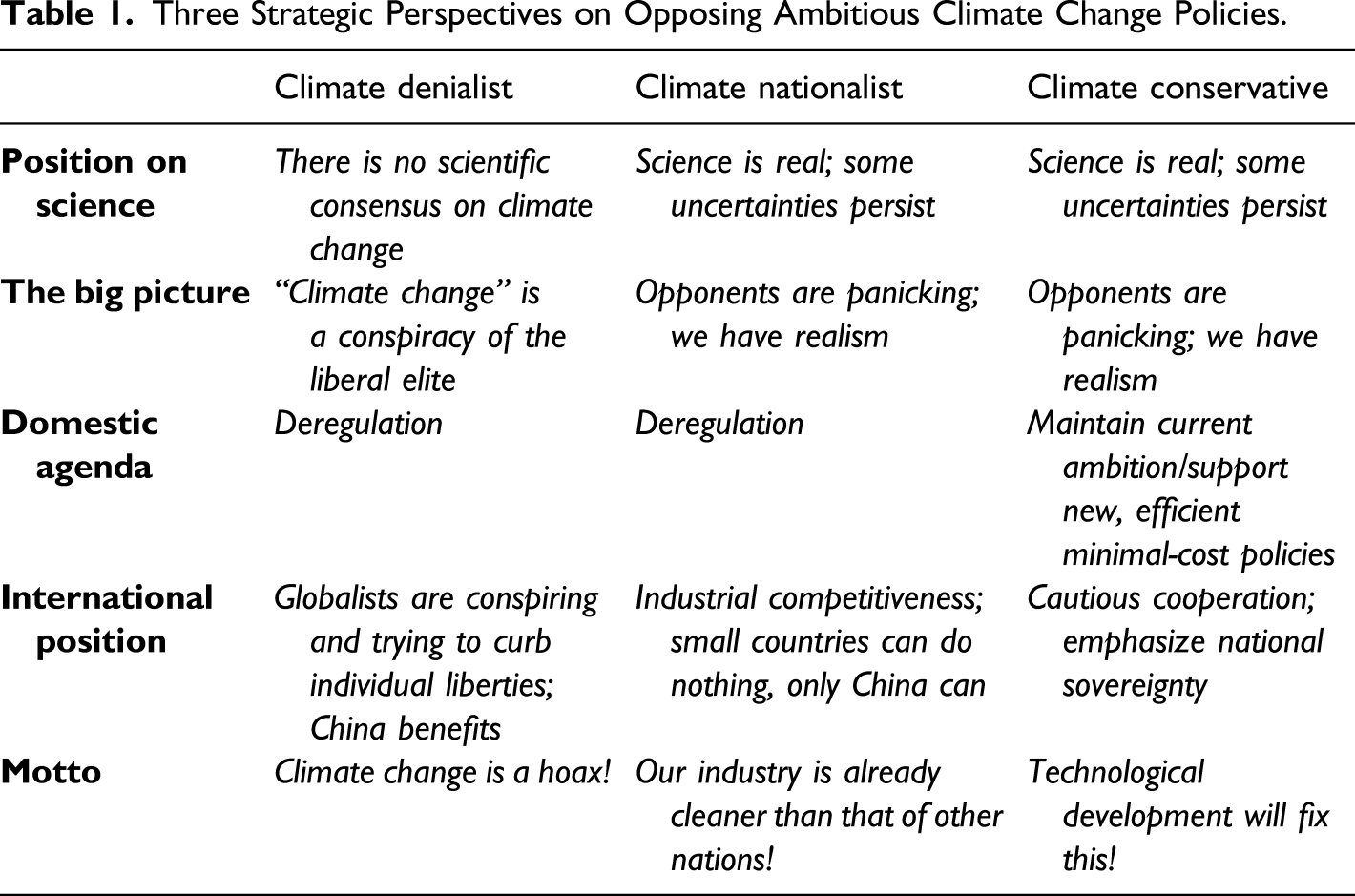
First, as noted above, the climate science denialist position has attracted substantial scholarly interest over the years, particularly in the US context (e.g., Boussalis & Coan, 2016; Jacques et al., 2008). Climate science denialism has many definitions, including several “broad” and “narrow” conceptions. In our analysis, denialism includes claims that i) climate change is not real, ii) climate change is real but the role of human activity is unclear, and iii) climate change is real, caused by human activity, but its impacts are mainly positive.
Climate science has for long been subjected to organized denial campaigns, which has affected the public discourse (Oreskes & Conway, 2011). Recent studies also show how disorganized climate “skeptics” seek an underdog position in the debates in order to “speak truth to power” (Skoglund & Stripple, 2019). According to Fischer (2019, p. 148), for example, climate science deniers are convinced that climate scientists are part of the political strategy of a “left-wing truth regime that promotes planning and regulation of the economy, strictures on social and economic freedoms, and more top-down (if not authoritarian) forms of government.” Similarly, studies have analyzed and confirmed the link between a far-right ideology and climate denialism, for example, in the German context (Forchtner et al., 2018). Denialism has also been studied from a historical perspective, in the long tradition of popular distrust of power, in this case “elitist” and modern natural science (Brown, 2014).
Second, the climate policy nationalist position has been vocally promoted in recent years in many countries, domestically as well as internationally. As Dubash (2019) notes, “[a] turn toward nationalism in multiple countries has created a short-term, look-out-for-our-own mentality that is inimical to the global collective action needed to address climate change.” The argument is typically centered on China, which is presented as the crucial actor, the only country whose emissions and actions really matter in the big picture (Cann & Raymond, 2018). A remarkably similar argumentation has been outlined by politicians in the United States, Europe, and developing countries. In developed countries, the case is often made that domestic industries are already cleaner than those in the South, and that “we have already done our share,” whereas other countries are free-riding (Nisbet, 2009).
Third, the climate policy conservative position questions the economic and political measures proposed to deal with climate change (e.g., Hoffman, 2011). The emphasis is on the costs and risks of the policies, not on the costs of inaction via climate impacts. Hopes are typically pinned on innovation and technological progress, which will curb emissions at a later stage. In defending current economic structures, the argumentation is inherently conservative (Jacques, 2006). In a similar vein to the nationalist position, the climate conservatives emphasize realism and cool judgment, and argue against the perceived emotionality of those who support ambitious climate policies (Van Rensburg & Head, 2017). However, unlike the climate denialists and climate nationalists, they do not deny the meaningfulness of domestic climate action. Proponents of the conservative position might acknowledge and support current levels of policy ambition and the co-benefits of climate action such as improved air quality, increased energy efficiency, and new business opportunities for sustainable entrepreneurship (see also Tranter & Booth, 2015).
Poortinga et al. (2011) have analyzed public attitudes and different types of “skepticism” in Britain. Following Rahmstorf (2004), they differentiate between trend skeptics (uncertainty that climate change is really happening), attribution skeptics (uncertainty about the role of human activity in climate change), and impact skeptics (uncertainty about the seriousness of climate change impacts). 10 years later, we argue, the politics of “skepticism” in the Nordic countries have become somewhat more nuanced—although the long gradient scale of “impact skepticism” is certainly a prevalent factor. In our framework both trend and attribution “skepticism” are located under climate denialism (see Table 1).
Van Rensburg (2015) offers a more varied taxonomy of “skepticism,” by dividing the climate skeptic arguments into “core” and “concomitant” branches. Core skepticism includes argumentation on evidence (climate trends, causes, and impacts) and correlates well with denialist messaging in our framework. The “concomitant” skepticism consists of critique of scientific knowledge formation, decision-making processes, policy instruments, and policy style. Many of these arguments correlate with climate conservativism in the terms of this article. What seems to be missing is the prominent role of the nationalist argument, typically focused on responsibility of other countries, role of China, and dangers of carbon or industrial leakage to other countries.
The ideal types introduced in Table 1 translate into different strategic perspectives, with different policy implications. However, this is clearly not an exhaustive listing of the positions authoritarian populist parties may take on climate policy. As we have emphasized, the populist framing is flexible when it comes to substance. Several experienced theorists in the field, including Laclau (1977) as early as the 1970s, have drawn attention to this kind of flexibility. Recent research on beliefs about climate change in the United States supports this notion of flexibility, and challenges the claim that climate change is a partisan issue on which beliefs on both sides are firmly held and polarized (Jenkins-Smith et al., 2020). In fact, it seems that partisans on the political right—overlapping authoritarian populism in the terminology of this article—are much more unstable in their beliefs about climate change and policy than partisans on the left (Jenkins-Smith et al., 2020).
Methodological Approach
In order to investigate these questions in practice, we present three examples, or short case studies, from the most recent round of parliamentary elections in three Nordic countries: Denmark, Finland, and Sweden. The main populist parties in these countries are the subjects of the study: the Danish People’s Party (DF), the Finns Party (PS), and the Sweden Democrats (SDs). These parties were selected because they have disrupted “politics as usual” in their respective countries with effective authoritarian populist messaging. The parties have different histories and political trajectories, but share a great deal in successfully applying populism in the Nordic context. The main unit of analysis in our study comprises the parties and how they position themselves on climate change. NGOs, think tanks, message boards, or other actors and platforms loosely associated with the parties were not included. Original data were collected from Denmark, Finland, and Sweden.
The ideal types outlined above serve to clarify the main features of the parties’ messaging, and allow for a structured analysis of different positions and strategies in the debates. In this way, the framework supports the qualitative text analysis of the political messaging embedded in campaigns, talking points, and debates (e.g., Kuckartz, 2014).
The data collection focused on the pre-election debates, and to a lesser extent on post-election debates during the latest parliamentary elections that took place in Denmark and Finland in 2019, and in Sweden in 2018. The timespan of the material covers 6 months leading up to these elections, respectively, and 3 months after them. The material includes official party positions as outlined in their respective programs and electoral manifestos, election debates among the party leaders, and interviews with party leaders or spokespersons on climate change. In addition, transcripts of interviews with party leaders, spokespersons, party officials, and parliamentarians were collected from the national news media. 1 The parties’ own media outlets or newspapers closely linked to the parties, particularly Suomen Uutiset in Finland and Samtiden in Sweden, were included. The collected empirical material was almost exclusively in Danish, Finnish, and Swedish, and all of the quoted material was translated into English by the authors.
Case Studies From Denmark, Finland, And Sweden
The Danish People’s Party: Turning The Page On Climate Policy
The 2019 elections stood out as the first one in Danish politics in which climate change was a predominant theme. This seems to have come about as a combination of an intensified international focus on the urgency of climate change, as well as the unusually severe and long drought in the summer of 2018. Up to 2018, the Danish People’s Party’s (DF) position on climate change had been one of disinterest, often bordering on science denialism. For example, the party’s spokesperson on transportation stated: “There is no one in the DF who believes that today’s changes in the climate are created by humans.” 2 DF Mayor of Hvidovre noted that whether climate change is human induced is “a question of belief.” 3 However, in the summer of 2018, the party leadership started to shift its position, as they no longer welcomed this type of denialist communication. The parliamentary group leader, Mr. Peter Skaarup, rejected both comments cited above. He noted that “human beings impact the climate […] we have to do something,” and that these actions would “change the everyday life of Danes in order to protect the environment and climate.” 4
Although the party leadership had sensed the need to renew the DF position on climate, the party came distinctly unprepared to the 2019 elections. In light of the coming election campaigns, the party magazine Dansk Folkeblad warned party members against believing rating agencies and opinion polls showing that climate change would become a major theme, predicting that refugee and immigration policies would probably overshadow other concerns, as had previously been the case. 5 The unpreparedness was visible in an interview with unusually hesitant Mr. Skaarup in which he noted that “I think it [climate policy] is a continuous process […] However, we still haven’t found what can really make a difference.” 6
In the two major party-leader debates broadcasted on the two national TV channels a few days before the election, Mr. Thulesen Dahl only commented on climate policies when asked directly. The passive position was noticeable, given that the majority of the other right-wing parties presented various ideas on how to reduce CO2 emissions, such as green taxes and energy efficiency. Mr. Thulesen Dahl attempted to formulate a conservative line in order to appeal to those who were concerned about radical changes in their daily lives. Contending that internet streaming was equally CO2-heavy as flying, he argued that just as no one would ban the use of the internet, he did not think that similar taxes making daily commodities expensive for low-income families were the answer. 7
As a result, the DF was depicted in the press as “the only party in Christiansborg without a climate policy,” 8 and the reluctant response proved insufficient for voters. The initial reactions of the party leaders were to criticize the climate activists. Mr. Skaarup stated that “climate hysteria” was overshadowing the election campaigning and that it was causing “unhealthy competition” over who was the greenest. 9 On election night, party founder Ms Pia Kjærsgaard launched the term “climate fools.” 10 The following day, party leader Mr. Kristian Thulesen Dahl commented in a more moderate and reflective tone on how climate had been “a difficult issue for the DF to handle.” 11
The Danish People’s Party lost 21 of its 37 parliamentarians in the 2019 election and attracted only 8.7% of the vote—the largest defeat in Danish parliamentary history since 1918. One of the conclusions drawn by DF itself was that the party had lost votes because it had no policy or message in response to climate change. Dansk Folkeblad repeated its criticism of what it called “climate hysteria.” 12
In September 2019, three months after the election, the DF launched a 12-page climate document entitled “A Green Denmark with the Citizen at the Center.” The document describes climate and the environment as a matter of moral and national leadership, noting that “Denmark must be a leading nation in the green transition” (Dansk Folkeparti 2019, p. 2). In light of what other European populist parties postulate, this is a strong statement (Schaller & Carius, 2019). A core argument in the new climate policy is that Denmark should return to the line it was following in the 1990s, but that it should also learn from its mistakes. These mistakes, according to the DF, concerned that the environmental policies of the 1990s had hit the poor groups hardest (Dansk Folkeparti 2019, p. 3).
Stressing that the low-income groups should not bear the cost of the green transition, the action plan also states that the party is against a ban on diesel and petrol cars, arguing that electric and hydrogen-fueled cars are still too expensive. Instead, the party proposes both a change in the registration tax that would make sustainable cars cheaper, and the inclusion of a climate tax in the production phase. The party argues against taxes on meat and flights based on the premise that such taxes would be socio-economically biased. As far as the politically and economically important agricultural sector is concerned, the need to protect Danish agriculture is stressed by seeking “simple but effective measures to reduce the climate impact of the agricultural sector” (Dansk Folkeparti 2019). It also calls for the strengthening of research on carbon capture, and referring to the successful export of Danish windmills. Green transition can “create good export opportunities, just as both the environment and our society benefit from new technologies” (Dansk Folkeparti 2019).
To understand the significance of the DF climate plan, including the indirect reference to the Social Democratic-led government in the 1990s, some background on the previous relations between the party and the Social Democrats is needed. The environment was the top priority for the Social Democratic governments of Mr. Poul Nyrup Rasmussen in 1993–2001. Tense relations between the rising DF and the Social Democrats peaked in 1999 when former Prime Minister Rasmussen called out DF as “extremists” in an often-cited speech in Parliament: “You will never become house-trained!” 13 According to DF founder Ms Pia Kjærsgaard, this speech became a personal motivating force (Kjærsgaard & Carlsen, 2013).
A novelty in the 2019 election was the more accommodating tone in the communications between Social Democrats and DF. The party made it clear that it would be open to future collaboration should the Social Democrats win under Ms Mette Frederiksen, which they did. DF’s climate action plan is thus another example of this new hesitant, yet conciliatory relationship between the two parties, which have begun to show increasing similarities on a number of issues.
The Finns Party: Climate Panic And Media Critique
In December 2018, in the run-up to the 2019 parliamentary elections, eight Finnish parties announced their common climate change policy objectives. 14 The populist Finns Party was the only party represented in parliament that did not sign up to this common position. The climate objectives endorsed by the other parties included limiting global warming to 1.5° and achieving carbon neutrality in the EU by 2050. At the national level, Finland would “reach a situation where our greenhouse gas emissions are clearly negative in the 2040s.” 15
The negotiations among the Finnish parties, led by then Prime Minister Mr. Juha Sipilä (Center Party), lasted for 1 month. The Finns party left the negotiations during the final week, claiming that the other parties were “setting ambitious goals without a step-wise approach or price tags for policies.” 16 The main counter-argument, as articulated by the representative of the working group and current vice-chair of the party Ms Riikka Purra, was a climate nationalist one: the Finnish targets would be unfair compared to the efforts of other EU countries, including Germany and Poland, and they would lead to carbon leakage to third countries. If achieved, the targets would result in “unemployment in Finland, more production in China, and an increase in global emissions.” 17
The 2019 parliamentary elections were frequently characterized as “the first climate elections in Finland” (Tiihonen & Vadén, 2019). As one prominent expert observed, the climate theme was perhaps not as predominant as economic recovery was in the previous 2015 election, but it was certainly a major theme. 18 Helsingin Sanomat newspaper and the Finnish Broadcasting Company, the leading journalistic media, organized climate change–themed debates among the parties. The discussion was inspired by both the 2018 IPCC Special Report (IPCC, 2018), as well as the everyday politics concerning climate change such as youth climate activism and Greta Thunberg, meat consumption and public dietary choices, as well as transportation and energy politics.
The election manifesto of the Finns Party, entitled “Vote Finland Back,” echoed the heightened public focus on climate change (The Finns Party 2019a). The manifesto focused on enhancing the competitiveness of Finnish industries, with climate and energy policies emerging as a major concern, and a suggestion that climate policies should be relaxed (The Finns Party 2019a). The Finns Party also published its first-ever party program for energy and the environment in January 2019. The program’s section on energy and climate is categorically critical of climate change policies, asserting that any such policy should be based on “technical and economic realism,” not “blind idealism and moralism” (Perussuomalaiset 2019).
The main substantive arguments against ambitious climate policies concern Finland’s role in the international realm. First, climate policies cause carbon leakage and relocate industrial production to deregulated, polluting countries. Second, Finland has been treated unfairly in the EU policymaking on climate.
The Finns Party documents, news items in party newspaper Suomen Uutiset, the party’s press releases, and MPs’ argumentation in the debates frequently claim that industrial relocation renders climate policy in Finland meaningless—or even harmful to the planet and “suicidal” for the Finns, as global emissions would increase. 19 One of the party’s spokespersons, Ms Purra, identifies China as the main concern, pointing out that in global climate politics, “China is treated like a developing country, although its economy is the world’s biggest.” 20 The Finns Party’s program for energy and the environment emphasizes the insignificance of Finnish emissions in the big picture, pointing out that Finland accounts for only “about 0.1% of global CO2 emissions” (Perussuomalaiset 2019). The real causes of emissions at the global level, accordingly, include the population explosion, the rapid growth in the consumption of fossil fuels in developing countries, and the relocation of industrial production to these fossil fuel–intensive developing countries.
The second recurrent theme in the Finns Party material and election debates is that the EU climate policy treats Finland in an unfair manner. This is in line with the party’s traditional EU-critical or even anti-EU stance, which has been an important way for the Finns Party to profile itself among the major parties. According to the Finns Party program for energy and the environment, Finland has “one of the heaviest loads, while many polluting countries are free-riding” in the EU effort-sharing. 21 According to the party material concerning the 2019 EU election, EU countries with the cleanest production, Finland included, were subsidizing the biggest polluters (The Finns Party 2019b). Furthermore, other Finnish parties have been guilty of softness and failing to stand up for Finnish interests, with the result that Finland has been “fawning” in the EU meetings, bringing home climate policies that are expensive for the Finnish taxpayer. 22
The common framing of arguments in Suomen Uutiset is that the mainstream media and other parties were “panicking” or “hysterical,” and that there is a lot of “climate fuss” that is not based on rationalism or reason. 23 Climate panic and climate anxiety are being used by other parties and the media to promote a left-green worldview. Several articles concerned Greta Thunberg, the young Swedish climate activist, with multiple unflattering pictures. Ms Thunberg is described as a creation of the liberal mainstream media, and “a human shield for climate activists.” 24 According to the updated and applied populist narrative, climate change is being used as a political tool by the media and other parties (“the elite”) to induce panic (among “the people”).
Furthermore, Mr. Matias Turkkila, editor-in-chief of Suomen Uutiset, has introduced conspiratorial elements into his media criticism of climate change, claiming that the mainstream media have lost status due to the increasingly strong presence of the internet and social media, and are now invoking climate panic. According to Turkkila, climate alarmism allows mainstream media to reclaim their lost authority “like a shaman in an ancient Indian village” because they know more about the higher powers than the rest of us (Turkkila, 2019, p. 125).
The Finns Party’s programs and other electoral material do not engage in denialism at the level of questioning the scientific basis of climate change, nor by highlighting uncertainties related to scientific inquiry. Chairman Halla-aho has stated several times that “climate change is real.” 25 This has also been noted internationally. The recent report by Adelphi on the comparative positions of European right-wing populist parties, for example, places the Finns Party among the few populist parties in Europe that are “affirmative” about climate change (Schaller & Carius, 2019).
The official party line is akin to climate nationalism, with a pronounced industrial twist. However, climate denialism is also tolerated within the party ranks—denialism is still flirted with by high-profile parliamentarians, for example, Member of the European Parliament Mr. Teuvo Hakkarainen stated in the summer of 2019 that “it is our heavenly Father who controls the weather.” 26 Mr. Mauri Peltokangas, a new Member of Parliament, observed immediately after the election that “climate change is a fact, but in which direction it is changing—that no human being can know.” 27
The Sweden Democrats: Denying Denialism
In Sweden, the September 2018 election followed an unusually warm and dry summer (SMHI 2018). The country had experienced extremely high temperatures in July 2018, and many regions had been ravaged by forest wildfires. This created a surge of anxiety, and the impacts of climate change were widely discussed in the media. Climate activist Greta Thunberg started her school strike outside the Swedish Parliament and called for stronger action. 28 “Flight shame,” the social pressure to avoid flying, became a buzzword and gained political momentum. The government introduced a tax on air travel in June 2018, which drew fierce criticism from the opposition. 29
Even though the SD’s electoral manifesto for 2018 devoted slightly more space to climate and environmental issues than its previous manifestos, it did not reflect the new political urgency and focus on climate change. The manifesto underscores that the SD supports discontinuing the subsidy on biofuels and lowering the tax on diesel (Sverigedemokraterna, 2018). Another goal is to abolish the tax on air travel imposed by the government. The manifesto emphasized the need for different means of transportation throughout the country, hinting at an appeal to voters in rural areas. The suggestions include lowering the tax on diesel for agriculture and forestry, loosening environmental regulations for rural areas, and making efforts to resolve environmental issues by means of technology and innovation (Sverigedemokraterna, 2018, p. 24). The line of argumentation, safeguarding the interests of “the common people” laced with some anti-elite rhetoric, reflects traditional rural populism.
During the debates, the SD often dismissed the climate policies of the other parties as expensive, ineffective, or even useless. When party chairman Mr. Jimmie Åkesson was pressed about what measures could be taken nationally, he pointed out that emission targets and equivalent goals set by the other parties were empty words. 30 He stated that the SD would do more for the environment than the current policies, sarcastically highlighting the subsidies for electric bicycles as particularly ineffective. 31
The SD’s main climate policy initiative is a promise to finance climate action outside Sweden, which the party claims to be easier, cheaper, and more effective than national action. 32 Mr. Åkesson stated that Sweden also had to reduce its emissions, but that it was even more important to adapt to climate change. 33 The exact nature of the SD’s preferred international efforts is not clear. Mr. Åkesson added that there were many options, and many organizations working quite effectively on climate finance, including under the UN. 34
This amounts to a novel type of climate nationalism. The emphasis on international action in climate policy is noteworthy, given that the party is not known to favor international cooperation in other policy areas. The SD’s approach to the Paris Agreement is also complicated: the party states that it does not oppose the 2015 Paris Agreement, despite voting against its ratification in the Swedish parliament. 35 According to Mr. Åkesson, this was not because the party was against the agreement in principle, but because the ratification would cede too much decision-making power to the EU. 36
The newspaper Samtiden, which is sympathetic to the SD, 37 had no articles containing the word “climate change” before 2015, 38 but in the months leading up to the 2018 elections, there were several pieces on the topic. With regard to the extensive forest fires affecting Sweden in the summer of 2018, the editor-in-chief argued that if journalists wanted to connect the fires to climate change it would be to the SD’s advantage in the elections. He also stated that it was the mainstream media that was trying to shift the focus of the elections onto climate change. 39
Mr. Åkesson noted in several pre-election interviews that he was indeed worried about climate change. 40 He repeatedly affirmed that climate change was ongoing and was caused by human activity, while also stressing the importance of “not politicizing the weather of one single summer.” 41 However, he also questioned the interviewer’s wording when she referred to climate change as “a threat,” and noted that climate change had always been present. 42
According to Mr. Åkesson, the SD perceives climate change as a defining issue for the future. When confronted by accusations of being a climate change denialist and using the same rhetoric as Donald Trump, he rejected both claims, pointing out that the SD was the party willing to spend the most on international climate cooperation in its budget proposal. 43 He was further asked whether he believed in the science behind the recent climate reports. He replied that he did, but underlined that there was hardly consensus on the probabilities of the scenarios presented. 44 His acknowledgment of the science was hesitant, using the word “believed” and then subtly diverting attention to the lack of consensus. Furthermore, both Mr Åkesson and Mr Kinnunen have referred to the potential benefits of a warmer climate for Sweden. 45
The SD representatives often referred to the climate policies of other parties as “symbolic politics,” “alarmism,” and “climate populism.” Explaining the term “climate populism,” used by SD party members to describe other parties’ politics, Mr. Åkesson repeated that it was populist to politicize the weather of one summer. 46
Mr. Kinnunen and the party’s finance spokesperson Mr. Oscar Sjöstedt claimed that the government was working hard to make mobility by private cars impossible. They also pointed out that not everyone could travel by bicycle or bus as easily as in Stockholm, and claimed that the government did not seem to notice the number of people protesting against rising petrol prices. They referred to petrol taxes as “symbolic political hysteria.” 47
A recent report on European right-wing populist parties and climate change characterizes the SD as “denialist/skeptical” (Schaller & Carius, 2019). This position would most likely have been difficult to uphold in the 2018 election without losing voters. Instead, the party acknowledges climate change as a problem, but criticized the climate policies of other parties as “hysterical,” and pointed to the economic burden they carry, particularly for people in rural areas.
Summary And Analysis of the Cases
The three cases illustrate how the climate policy positions of the Nordic populist parties are evolving, in that they are not fixed or set in stone by the parties. The Danish People’s Party came to the elections underprepared and could not communicate effectively on climate change. The party’s defensive line on climate action shows how a dismissive stance in general may become a problem for a populist framing of politics, as the populist party itself may seem “alienated” and out of touch with the concerns of the people. The DF response was to move away from vaguely denialist rhetoric and to initiate a more progressive position than most European populist parties. One factor seemed to be the new-found rapprochement with its old political competitor, the Social Democratic Party. It is also noteworthy that a newcomer party in the Danish parliament, the New Right, has assumed a sharp climate nationalist stance. 48
The Finns Party, in contrast, quickly embraced the politicization of climate change, and saw it as an opportunity to raise its profile. It did so by breaking the consensus concerning the relatively ambitious climate policies of other parties, especially in the process of long-term target-setting. The Finns Party also seeks to benefit from polarization in traditional populist terms, by positioning itself against the Green Party: the opponent is framed as elitist, urban, alienated from the people, naïvely cosmopolitan, and “bicycle communist.” Accordingly, the party claims that green policies would disproportionately harm the common, morally upstanding people in industrial and rural communities. This echoes Hatakka and Välimäki (2019, 146) who suggest that the Finns Party has actively challenged the calls by the “establishment” to combat climate change.
While moving toward the Swedish political mainstream in several ways, the Sweden Democrats are also eager to play the opponent when it comes to ambitious climate policies. The party does not believe that the environment in general is an important topic as far as its voters are concerned. Akin to the Finns Party, it seeks to benefit from polarizing identity politics, criticizing the hypocrisy and “hysteria” of other parties, and ironizing their support of electric bicycles. Sweden Democrats and the Finns Party challenge the “politics of consensus,” or what they perceive as “political correctness” in the context of climate change, using the topic to distance themselves from the established political parties.
In terms of the ideal types outlined above, all three populist parties are moving away from a categorical climate science denialist position. Earlier research has shown that, for example, the Swedish Democrats used more explicit denialist messaging, which was based on anti-establishment rhetoric and marketing of science doubt (Hultman et al., 2019). In 2018, outright science denialism appears to have been less focused.
All the parties believe that the term “denialism” carries negative connotations, and perceive it as a term primarily applied by the liberals and greens as a political tool. However, the expression of doubt about climate change is still present and is tolerated within the parties. The party leaders, the official documents, and spokespersons frequently rally against “climate alarmists,” especially in Finland and Sweden, but they do not typically deny the existence of climate change, its human causation, or the problems it causes globally.
The Finns Party and the Sweden Democrats have both advocated an active climate policy nationalist stance. It became evident in the analysis that this was a well-prepared and articulated position and in line with a populist communicative strategy. Climate change is already a priority for the Finns Party, as recently noted by its party secretary, “immigration and climate change in particular are themes that the party wants to talk about.” 49 At the core of the climate communications of these parties is the notion that ambitious domestic action does not matter globally, or that it is even detrimental in the big picture due to carbon leakage. International decision-making is framed as being particularly susceptible. The EU and UNFCCC are considered dubious platforms on which the elite—represented by other parties—betrays the national interest and the good of the people. The Finns Party has taken the perspective of industrial competitiveness to heart, a topic that does not engage the other Nordic populist parties anywhere near as strongly.
The talking points of the Finns Party and the Sweden Democrats—as well as those of the brand new New Right Party in Denmark—imply that other parties are reacting emotionally, in a state of panic and fuss, whereas they are rational and cool-headed. These parties also air suspicions of bias in the mainstream media, claiming that the main news outlets favor “alarmist” voices and silence critics. According to the Sweden Democrats, the national debate on climate policy is very narrow and they seek to expand it. The climate nationalist line is seemingly driven by the opportunity to raise the party profile, engage in populist “breaking of taboos,” and conspiracy-induced ideas about the elite and media.
An interesting complementary element of the Sweden Democrats’ climate policies is the stated willingness to increase spending on international climate financing. The argument is that increasing funding for international efforts is more effective than the symbolic and costly domestic climate action that the other parties pursue. Populists typically criticize public spending on third countries. When the Finns Party joined the government for the first time in 2015, for example, the budget for development cooperation was cut dramatically, and further large reductions were on the party’s agenda. 50 However, the Sweden Democrats face a more climate-conscious public than most populist parties, and in all likelihood the party perceives international spending as a way to soften its nationalist criticism of domestic climate policy.
The Danish People’s Party did some soul-searching after its losses in the 2019 elections and is currently looking toward a moderate climate policy conservative position. The party will advocate both a domestic and an international climate policies, in which co-benefits and technological development play a key role. This is in sharp contrast to the previous party line, which was vague and dismissive, and included science denialism and references to climate change as a matter of personal belief. Currently, even wordings such as “leadership,” taking national pride in being a green leader, are invoked in the party’s communications on climate change. The policy change seems strategic, driven by election results and party dynamics.
A key difference in the cases is that the impacts of climate change have entered the political discussion in Denmark and Sweden, but remain marginal in Finland. The melting ice cap in Greenland and droughts in agricultural Denmark, as well as the forest fires in Sweden, are tangible topics that connect everyday experiences to climate politics. This has yet to take place in the Finnish context.
There are also some common elements in all three parties’ current positions and strategic communication, in spite of the differing national political contexts. All three have continuously framed climate policy in terms of “the urban elite” versus “the people” outside the city centers, in the most typical populist tradition. The positions also give the nod to “the common people” in general, who should not be burdened with the excessive cost, or shamed for their lifestyle choices. All three criticize “climate hysteria” and “alarmism” and argue against the youth climate activism personified by Greta Thunberg. Realism is a key word for all three, although what it means in practice differs significantly. All parties emphasize that their respective Nordic country should already be considered clean and environmental at the international level. Finally, all three parties share a more favorable attitude to traditional environmental issues—such as nature conservation and the protection countryside landscapes—compared to international and “elitist” climate policy, echoing previous analysis (Forchner & Kolvraa, 2015).
Conclusion
The starting point for the article, supported by literature review, was that the intersection between climate change and populism is typically analyzed with regard to climate science, and a hypothesis that the study of denialism or “skepticism” needs to be complemented with a broader perspective. Many populist parties—including all those in the Nordic countries studied in this article—engage in potentially powerful populist arguments that are not science denialist at their core. In terms of the ideal types introduced, it would be beneficial to bring climate nationalist and climate conservative argumentation to the forefront in further analyses of populism and climate change.
Despite its remarkable flexibility, populism is not easily compatible with ambitious climate policy. First, populism undermines political institutions. It questions the integrity and motives of other political parties, bureaucracy, the courts, and journalism in its project of returning political power to “the people.” By contrast, a successful and ambitious climate policy requires a considerable level of trust, as the state apparatus needs to make effective interventions. Second, populist arguments are typically reductive, and promote moral outrage. This may well limit the possibilities of having an informed, fact-based public debate. Even though the populist rhetoric is more benign in the Nordic countries than in the United States, for example, it seems that the authoritarian populist messaging turns to collective resentment rather than policy choices and their nuances. This is evident in the nationalist arguments in Finland and Sweden, for example, as well as in the identity political slurs such as “climate fools” and “climate hysteria” in all three countries.
The analysis we have presented is tentative, given the short time period and the number of parties and elections covered. Further research is needed, involving more elections in which climate change is a key topic, and including more countries with diverse political contexts. In addition, our analysis hints that the positions and strategies related to climate change policy may well vary depending on the forum and the audience. The data analyzed in this study largely comprise extracts from official texts and statements from party leaders targeting a broad audience. Further research would be needed on the interlinkages between authoritarian populist parties and anti-climate policy activism on social media platforms and in the counter-media landscape.
There is also a need to identify and analyze political strategies beyond science denialism from a policy-oriented perspective. How could one engage with and challenge the different arguments? What kind of political coalitions could work in practice? Where are the key differences concerning climate politics within an authoritarian populist movement? Questions such as these should be on the lips of those who actively participate in contemporary climate change politics.
Footnotes
Acknowledgments
We would also like to thank Sofie Berglund for invaluable research assistance.
Declaration of Conflicting Interests
The author(s) declared no potential conflicts of interest with respect to the research, authorship, and/or publication of this article.
Funding
The author(s) disclosed receipt of the following financial support for the research, authorship, and/or publication of this article: We would like to thank the Nordic Council of Ministers for the financial support that enabled this article.
