







Abstract
This study examines how bonding, bridging, and linking social capital shape community engagement with urban air quality governance in Lahore, Pakistan. Employing a convergent parallel mixed-methods design, the research triangulates survey findings with insights from semi-structured interviews. Bonding social capital facilitates local coping and mutual aid but remains confined to symptomatic relief rather than structural change. Bridging capital is weak, constrained by socio-spatial segregation, the dissolution of elected local governments, and the absence of cross-community deliberative platforms. Linking capital is the most critically deficient dimension, characterised by low institutional trust, data manipulation by authorities, and minimal participatory channels, yet survey evidence reveals substantial latent civic willingness to engage when accessible mechanisms exist. The study argues that social capital cannot substitute for formal governance but is an indispensable component of inclusive, participatory environmental policy. Durable air quality improvement requires institutional architectures that actively cultivate trust, cross-class collaboration, and citizen co-production.
Keywords
Introduction
Lahore’s chronic smog crisis is as much a governance failure as it is an environmental one. Despite successive policy frameworks, judicial interventions, and seasonal emergency measures, air quality in Pakistan’s second-largest city continues to deteriorate. This persistence raises a broader governance puzzle central to this study: why have formal institutional responses remained ineffective, and to what extent can civic networks compensate for these shortcomings in urban environmental governance?
Each winter, the megacity of over 13 million residents is enveloped in a dense grey smog that immobilises public life, exacerbates respiratory illness, and disrupts urban normalcy. Over the past decade, air quality indices have routinely registered “hazardous” levels, contributing to an estimated 235,000 premature deaths annually and reducing average life expectancy by up to 2.7 years (Iqbal et al., 2020; Nasar-u-Minallah et al., 2024; World Bank, 2019a, World Bank, 2019b). Critically, smog is not merely a seasonal phenomenon but a manifestation of a year-round air quality crisis that the government has repeatedly framed as a bounded winter problem, a framing that, as several environmental governance experts consulted for this study observed, obscures the scale of the challenge and dampens the urgency of the public response.
Key Governance and Civic Events Shaping Social Capital Dynamics in Lahore (2016–2024)
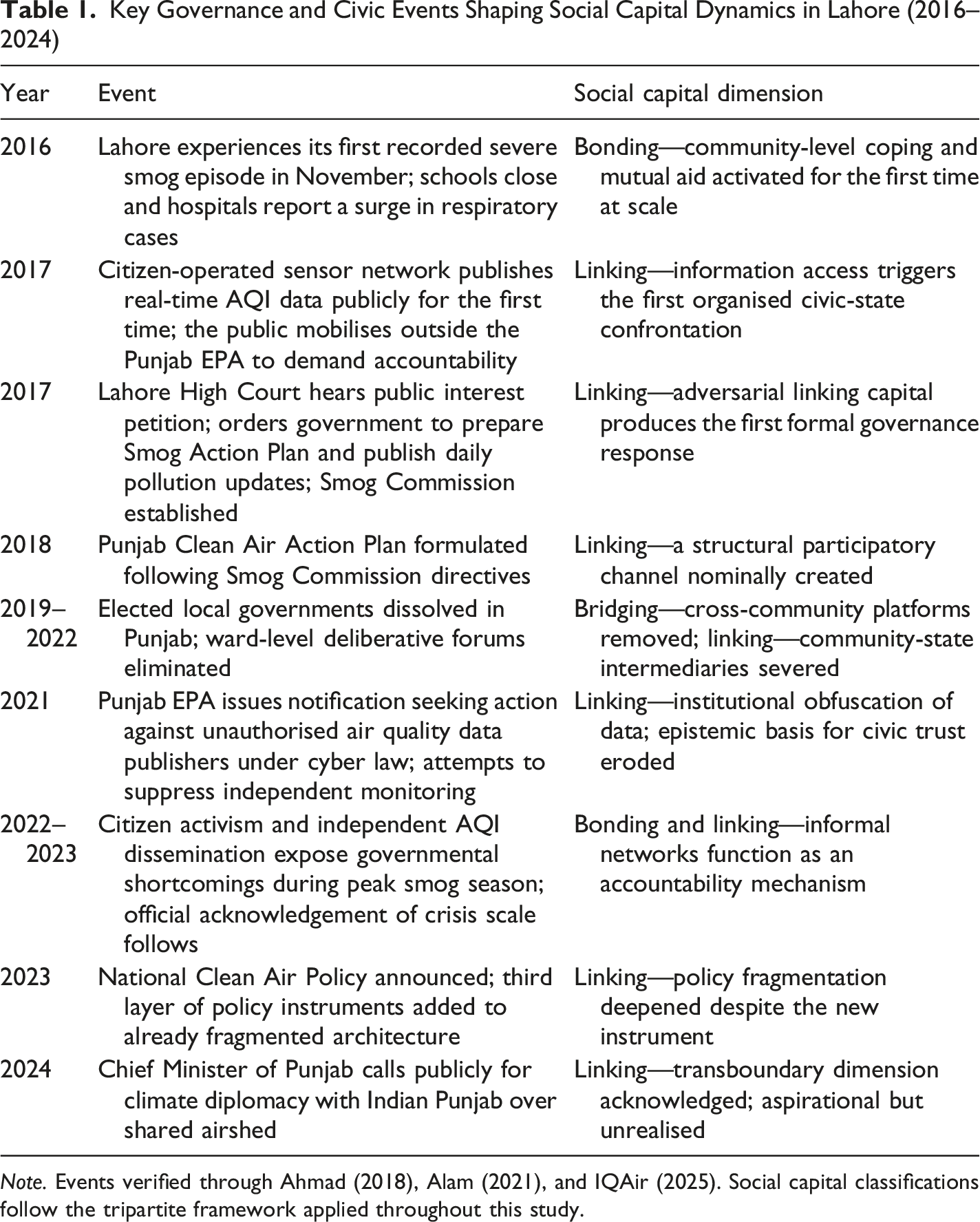
Note. Events verified through Ahmad (2018), Alam (2021), and IQAir (2025). Social capital classifications follow the tripartite framework applied throughout this study.
The consequences of this governance gap are not borne equally. Low-income communities living in close proximity to industrial zones, major traffic arteries, and unregulated brick kilns face disproportionate exposure to air pollution, yet have the least capacity for self-protection and the fewest channels for demanding redress (Nasar-u-Minallah et al., 2024; Schlosberg, 2007). Outdoor workers, inner-city residents, children, and the elderly bear the heaviest health burden, while affluent communities retreat behind air purifiers and private healthcare (Nasir et al., 2020). This socio-spatial inequality is not incidental to Lahore’s smog governance; it is constitutive of it.
Against this backdrop, the study examines the role of social capital in shaping both informal and formal responses to Lahore’s smog crisis. Social capital is broadly defined as the networks, norms of reciprocity, and trust that enable collective action (Putnam, 2000; Woolcock, 2001). The central premise of this study is that social capital in Lahore partially compensates for governance failures by fostering community-level coping and advocacy, but it cannot fully substitute for effective state intervention. Three interrelated research questions guide the study: first, how do different forms of social capital, that is, bonding, bridging, and linking, manifest in Lahore’s societal response to the smog crisis? Second, what barriers impede the scaling-up or integration of civic initiatives into formal environmental governance? Third, to what extent can social capital complement government efforts in mitigating urban air pollution?
Existing scholarship identifies regulatory failures and fragmented mandates as key contributors to poor air quality management (Nasar-u-Minallah et al., 2024; Nasir et al., 2020), but far less attention has been paid to how civic structures might compensate for or be constrained by these gaps. Ballet et al. (2007) caution that social capital is not a straightforward panacea for collective environmental challenges; its outcomes depend heavily on the cultural context, power asymmetries, and institutional conditions in which it is embedded, a warning directly relevant to Lahore’s deeply stratified urban landscape. Neither study employs the tripartite social capital framework, distinguishing bonding, bridging, and linking capital, as an analytical lens for examining how residents, communities, and institutions interact in responding to the smog crisis.
This study fills that gap by triangulating survey data with insights drawn from semi-structured expert interviews, offering the first systematic, empirically grounded assessment of social capital in Lahore’s urban environmental governance. Its central contribution is the finding that latent civic willingness to engage exists independently of institutional trust levels. This result has direct implications for governance design across comparable Global South megacities.
The study’s findings are relevant to policymakers, urban planners, civil society organisations, and public health practitioners in Lahore and carry wider implications for researchers and policymakers across South Asia’s megacities, where institutional weakness, socio-spatial inequality, and civic underinvestment converge. Key stakeholders examined include residents across income groups, the Punjab Environmental Protection Department, the Lahore High Court’s Smog Commission, local government bodies, civil society organisations, and the media.
Theoretical Framework
Social capital theory provides the conceptual foundation for this study, examining how different types of social ties shape communities’ collective capacity to address shared challenges (Bourdieu, 1986; Coleman, 1990; Ostrom, 1990; Woolcock, 2001). The tripartite distinction between bonding, bridging, and linking capital has become the dominant typology in scholarship on collective action, environmental governance, and community resilience (Adger, 2003; Putnam, 2000). This framework is applied as a critical lens rather than a neutral grid: Ballet et al. (2007) caution that social capital’s contribution to environmental outcomes depends on cultural context, power asymmetries, and institutional conditions, and in deeply unequal urban settings, it may reproduce existing hierarchies rather than challenge them (Cleaver, 2005).
Bonding Social Capital
Bonding social capital refers to dense networks and strong ties among people who share a similar background, identity, or circumstance, such as family members, close neighbours, or members of a tight-knit residential community (Coleman, 1990; Ostrom, 1990). These bonds are inherently inward-looking, reinforcing solidarity, mutual support, and shared norms of reciprocity within relatively homogeneous social circles. In theory, high bonding capital enables neighbours to share protective resources, exchange health information, or coordinate local coping measures during peak smog episodes (Coleman, 1990; Putnam, 2000). Putnam (2000) argues that bonding ties are crucial for micro-level resilience, helping communities navigate adversity through reciprocity and shared understanding.
However, because bonding networks are socially homogeneous, they offer limited access to new information, external resources, or cross-community alliances (Adger, 2003). Insular groups may cope internally with environmental stresses but lack the reach to influence broader policy. Ballet et al. (2007) reinforce this point, demonstrating that outcomes of bonding capital in resource management depend heavily on power relations and cultural norms. In Lahore’s context, bonding social capital is expected to be the most readily observable form, given the density of neighbourhood ties and the immediacy of smog’s health impacts. Consistent with Cleaver (2005) and Ballet et al. (2007), however, it is expected to be limited in transformative potential, providing coping capacity at the micro-level without generating the cross-community solidarity necessary for systemic governance change.
Bridging Social Capital
Bridging social capital is outward-looking and encompasses connections that link members of different communities, classes, ethnicities, or geographic locations on broadly equal footing (Putnam, 2000). Unlike bonding ties, bridging networks expose individuals to new ideas, information flows, and opportunities that would not circulate within closed homogeneous circles (Woolcock, 2001). In an urban environmental context, bridging social capital may manifest as cross-neighbourhood alliances or citywide civic coalitions in which residents of different income levels collaborate around a shared concern. Its strength is measured by the frequency and quality of interaction across social divides and by the degree to which collective identity can form around a common goal (Adger, 2003; Coleman, 1990).
For a citywide crisis such as smog, bridging capital would theoretically enable a more unified public response, allowing citizens to present a collective front to authorities and share knowledge across communities. Woolcock (2001) argues that the absence of bridging ties is itself a form of social inequality, since the capacity to demand redress remains concentrated among those with sufficient social networks to advocate effectively. In Lahore, bridging social capital is anticipated to be notably weak for three reinforcing reasons. First, pronounced socio-spatial segregation physically separates communities by income and reduces cross-class social interaction. Second, the periodic dissolution of elected local government bodies has removed institutional platforms through which residents of different backgrounds might deliberate on shared environmental concerns (Cleaver, 2005). Third, divergent material circumstances, where affluent households deploy private coping strategies and low-income households are preoccupied with economic survival, reduce the shared basis for joint environmental action (Adger, 2003; Woolcock, 2001).
Linking Social Capital
Linking social capital represents the vertical dimension of the tripartite framework. It refers to the ties that connect ordinary citizens, informal community groups, and civil society organisations with formal institutions and authorities, including government officials, environmental regulators, elected representatives, and international agencies (Woolcock, 2001). Where linking capital is strong, communities have meaningful channels through which to voice concerns, access resources, and co-design solutions with decision-makers, producing more responsive and accountable governance (Adger, 2003; Folke et al., 2005). Where it is weak, communities disengage from formal governance or resort to confrontational means to compel institutional attention (Bourdieu, 1986; Cleaver, 2005).
A critical analytical distinction must be drawn between the structural and relational dimensions of linking capital. The structural dimension refers to whether ties to formal institutions exist at all, for instance, whether citizens have access to complaint portals, public hearings, or designated reporting mechanisms. The relational dimension refers to the quality of those ties, specifically whether they are characterised by trust, transparency, responsiveness, and reciprocity, or by bureaucratic indifference and obstruction (Folke et al., 2005; Woolcock, 2001). The presence of formal participatory mechanisms does not in itself constitute effective linking capital if those mechanisms are perceived as perfunctory and fail to generate substantive institutional responses. This study examines both dimensions, since the argument is not simply that linking channels are absent in Lahore but that their quality is compromised by institutional distrust, data manipulation, and the closure of participatory space.
A further conceptual clarification concerns adversarial forms of linking capital. The literature sometimes implies that linking social capital is inherently collaborative. In practice, citizen engagement with the state often takes confrontational forms, including public interest litigation, judicial activism, organised protests, and media pressure campaigns. Following Ahmad (2018) and Alam (2021), this study treats these adversarial forms as a constrained but operative variant of linking capital rather than as its absence. When citizens resort to courts or the media to compel state action on smog, they exercise a form of connection to formal governance structures. Such engagement is strained and distrustful, but it still represents a linkage between civil society and the state. It is more accurately understood as linking capital operating under institutional dysfunction, where cooperative channels have broken down, and adversarial ones have taken their place.
Linking social capital is particularly pertinent to environmental governance because it determines whether community innovations and civic demands are translated into formal policy (Folke et al., 2005). In Lahore, linking social capital is anticipated to be the most constrained of the three dimensions, characterised by low institutional trust, minimal direct civic-state engagement, and a pattern of adversarial rather than collaborative interaction. At the same time, consistent with the study’s central premise, the analysis expects to find latent citizen willingness to engage with institutions if accessible, credible, and responsive mechanisms were made available.
Theoretical Expectations and Analytical Approach
The three forms of social capital are analytically distinct but closely interrelated in practice. Strong bonding capital without bridging produces insular resilience that cannot scale. Strong bridging without linking produces civic momentum that cannot reach the levers of formal governance. Strong linking without the foundation of bonding and bridging produces elite-captured participation that excludes those most affected by environmental harm (Cleaver, 2005; Folke et al., 2005; Woolcock, 2001).
This framework guides the analysis of findings in the sections that follow. Evidence from the survey and semi-structured expert interviews is examined through the lens of whether observed patterns of community action and inaction reflect bonding, bridging, or linking social capital, what each pattern reveals about conditions enabling or constraining collective environmental action, and where the most significant gaps and latent opportunities lie in Lahore’s current governance landscape. By applying this critical, contextually sensitive reading of the social capital framework, the study aims to generate insights that are theoretically grounded, empirically substantiated, and practically relevant for governance reform in Lahore and comparable developing-world megacities.
Literature Review
The literature on urban environmental governance has increasingly focused on the challenges posed by rapidly growing megacities and their inability to manage complex crises, such as air pollution. This body of scholarship identifies several key themes: the persistence of governance failures in developing-world cities, the inequitable distribution of environmental harms across social groups, the potential contributions of social capital to environmental outcomes, and the limitations of community action in the absence of state capacity. Scholars also draw lessons from comparative international experiences where air pollution has been mitigated through combinations of civic mobilisation and institutional reform. This review synthesises these themes to situate Lahore’s smog crisis within the wider theoretical and empirical literature.
Nasir et al. (2020) argue that the governance challenge in Punjab lies primarily in fragmented institutional mandates and weak enforcement of environmental regulations, leading to piecemeal anti-smog interventions that address symptoms rather than root causes. Nasar-u-Minallah et al. (2024) concur, noting that overlapping responsibilities and inadequate resources hinder the implementation of long-term strategies. Adger (2003) extends the debate by emphasising that governance challenges are not merely technical but also social, since adaptation to environmental stresses requires trust and collective action that cannot be decreed from above. Cleaver (2005), however, argues that even where participatory frameworks exist, they are often undermined by entrenched inequalities and elite capture. Together, these perspectives suggest that Lahore’s difficulties stem not only from regulatory weakness but also from the absence of mechanisms to integrate community concerns into formal policymaking.
A further structural impediment, particularly acute in Pakistan’s governance context, is the periodic dissolution of elected local governments. Scholars of decentralisation argue that local government bodies serve as critical intermediaries between citizens and the state, providing forums for deliberation and participatory resource management (Ostrom, 1990; Poteete et al., 2010). The suspension of elected local councils in Punjab between 2019 and 2022 eliminated limited institutional space for community voices to reach environmental decision-makers, a loss linked to the weakening of both bonding and linking social capital at the neighbourhood level (Cleaver, 2005; Woolcock, 2001). Without these representative structures, engagement with environmental governance became the preserve of a narrow civil society elite, reinforcing the socio-spatial fragmentation that already constrains collective action on smog.
The environmental justice literature further sharpens the lens on how pollution impacts are unequally distributed across society. Schlosberg (2007) argues that environmental justice requires attention not only to the distribution of harms but also to recognition and participation in decision-making. Nasir et al. (2020) find that poorer neighbourhoods in Lahore are more exposed to vehicular emissions and open burning, yet have the least capacity to protect themselves. Nasar-u-Minallah et al. (2024) confirm that residents of affluent enclaves rely on air purifiers and private healthcare, while low-income communities bear the brunt of respiratory illnesses. Woolcock (2001) links this injustice to deficits in bridging social capital, since groups divided by class and geography rarely join forces to advocate for equitable policy responses. Social inequality and environmental harm thus reinforce one another with direct implications for governance.
A dimension that receives comparatively little attention in the governance literature, yet emerges forcefully from Lahore’s experience, is the role of data transparency in enabling or suppressing civic engagement. Scholars of environmental communication argue that accurate, publicly accessible air quality data is a prerequisite for informed collective action (Folke et al., 2005). When independent air quality monitors were first installed in Lahore and their readings made public, citizens mobilised outside the Punjab Environmental Protection Department to demand accountability, demonstrating that access to information is a catalyst for civic action. However, the EPA subsequently refused to recognise data from low-cost laser-based monitors, and the provincial government altered the AQI scale by widening threshold intervals from the globally accepted 50-point standard to 100-point intervals, effectively reclassifying hazardous readings as merely unhealthy. Ahmad (2018) and Alam (2021) identify this as a pattern of institutional obfuscation that erodes the informational foundations on which social capital-based linking depends. When the state manipulates the metrics through which citizens understand their environment, it severs the epistemic basis for trust, participation, and advocacy. Data transparency is, therefore, a governance matter, and its absence constitutes a structural barrier to linking social capital in Lahore.
Against this backdrop, scholars have examined how social capital shapes collective responses to environmental crises. Putnam (2000) argues that networks of trust and reciprocity enable communities to act collectively for mutual benefit. Woolcock (2001) distinguishes between bonding ties that provide cohesion within homogeneous groups, bridging ties that connect diverse groups, and linking ties that connect communities with institutions of power. Adger (2003) supports this typology, emphasising that social capital facilitates coordination and collective action across scales. Aldrich and Meyer (2015) further argue that social capital is a predictor of resilience, showing that communities with denser networks recovered faster from the 2011 Japanese tsunami than those with greater material wealth. In the absence of effective state intervention, communities rely on their own networks to navigate crises.
Yet literature also cautions against uncritical celebration of social capital. Cleaver (2005) argues that community networks can reproduce social hierarchies, as powerful actors often monopolise resources and decision-making. Woolcock (2001) similarly contends that bonding capital can become exclusionary, generating insular solidarities that resist cross-group cooperation. Adger (2003) notes that strong bonding without bridging may help communities cope in the short term but limits systemic transformative change. Ballet et al. (2007) extend this critique by demonstrating that social capital’s contribution to resource management is conditioned by the cultural values, norms, and power relations in which social networks are embedded. This conditionality is evidenced beyond the air quality domain. Shrestha and Hales (2025), find that social capital facilitates adaptive practices only when it operates alongside adequate financial, physical, and institutional resources. It reinforces that the governance value of social capital is always context-embedded and cannot be assessed in isolation from structural conditions. Cross-national empirical analysis further supports this scepticism. Grafton and Knowles (2004) find that neither civic nor public social capital reliably predicts improved national environmental performance, cautioning that the assumption that social capital is always good for the environment may be as misplaced as earlier presumptions about income and environmental quality. In highly stratified urban settings, social capital may reproduce rather than challenge existing hierarchies, making its governance value contingent on broader equity conditions.
International experiences illustrate how the interaction of social capital and state action yields diverse outcomes. Rahman (2018) argues that in Delhi, citizen activism combined with judicial intervention forced the government to adopt cleaner fuel policies, demonstrating the power of bridging and linking ties mobilised through litigation. Sridhar et al. (2019) show how sustained coalitions of parents and civil society groups eventually altered regulatory behaviour. By contrast, Zhang et al. (2012) describe how Beijing’s decisive top-down regulation achieved dramatic air quality improvements but relied less on participatory mechanisms. Arrozaaq and Firmansyah (2023) argue that Jakarta’s rigid state-centric approach, devoid of meaningful civic engagement, led to policy stagnation. Even where developing-world cities have pioneered market-based instruments for pollution control, institutional design and enforcement capacity have proven decisive. Coria and Sterner (2010), examining Santiago’s tradable permit programme, find that technical innovation alone cannot compensate for weak regulatory infrastructure and limited civic accountability mechanisms. These cases collectively highlight that robust regulation is essential, but sustainable improvements typically depend on social capital that channels citizen input into governance structures.
Ostrom (1990) argues that collective action problems can be overcome when communities establish rules and norms fostering trust and reciprocity, though success depends on scale and institutional support. Poteete et al. (2010) note that heterogeneity among actors can both hinder and enable cooperation depending on institutional design. Ebel et al. (2023) find that communities with similar external linkages to government produced divergent environmental outcomes because only those with internal cohesion were able to mobilise effectively, underscoring that linking capital requires not only institutional access but also community unity.
The literature affirms that addressing crises like Lahore’s smog requires a synthesis of robust governance and empowered social capital (Nasir et al., 2020; Woolcock, 2001). The gap in existing scholarship is the absence of a systematic, empirically grounded assessment of how bonding, bridging, and linking social capital function within Pakistan’s urban environmental governance. Neither Nasir et al. (2020) nor Nasar-u-Minallah et al. (2024) employ the tripartite social capital framework as an analytical lens, nor do they examine the relational dynamics among residents, communities, and state institutions. This study fills that gap by drawing on a resident survey triangulated with expert interviews, responding to broader calls for empirical studies examining how community networks and formal institutions intersect in developing-world megacities facing chronic environmental crises (Ebel et al., 2023; Folke et al., 2005).
Methodology
The study employs a convergent parallel mixed-methods design, collecting both quantitative and qualitative data simultaneously and then triangulating the results. In the quantitative strand, a structured survey was administered to residents of Lahore to capture public perceptions, behaviours, and social connections related to smog and air quality. The survey yielded 1279 responses from individuals residing in a wide range of localities across the city, from high-income planned suburbs to low-income inner-city neighbourhoods. The questionnaire employed two response formats: binary and ternary categorical items using Yes, No, and Unsure options, and ordinal items using 1-to-10 rating scales to measure the intensity of perceptions on dimensions such as smog severity, institutional trust, and willingness to coordinate.
The sample was drawn through purposive sampling and is not demographically representative of Lahore’s full population. The sample of 1,279 respondents is statistically grounded in the finite population correction principle, which holds that, beyond a population threshold of approximately 100,000, the required sample size stabilises and no longer scales proportionally with population size (Cochran, 1977). For a population of Lahore’s scale, the minimum sample required to achieve a 95% confidence level and a 5% margin of error is approximately 384 respondents. The present sample exceeds this threshold by more than 3, yielding a margin of error of approximately ±2.7%. This is consistent with established practice in mixed-methods urban governance studies, where comparable sample sizes have been employed in megacity contexts without compromising analytical validity (Creswell & Plano Clark, 2018).
The survey was administered online via an open-access link, initially distributed to approximately 120 seed contacts across lower-, middle-, and upper-income strata, with recipients asked to share the link within their own networks and communities. This network-based distribution strategy was adopted to maximise socioeconomic reach. Given the open-link format, a formal response rate cannot be calculated. However, the approach is consistent with established practice in mixed-methods urban studies where maximising diversity of respondent profiles takes precedence over probabilistic sampling (Creswell & Plano Clark, 2018).
The respondents’ mean age was 28.7 years (SD = 9.9), with a broadly equal gender split of 50.3% female and 47.6% male. Educational attainment was high, with 55.2% holding a bachelor’s degree and 35.7% a master’s qualification, reflecting the survey’s reach through university networks and professional channels. Household incomes spanned all six income bands in the questionnaire, with the largest group in the PKR 100,000–250,000 monthly range (31.5%). Approximately 18.6% of respondents fell in the two lowest income bands combined, and 9.8% reported incomes above PKR 500,000. The majority of respondents (63.0%) had been residents of Lahore for more than 10 years.
Spearman Correlations Among Key Social Capital Variables (N = 1,279)
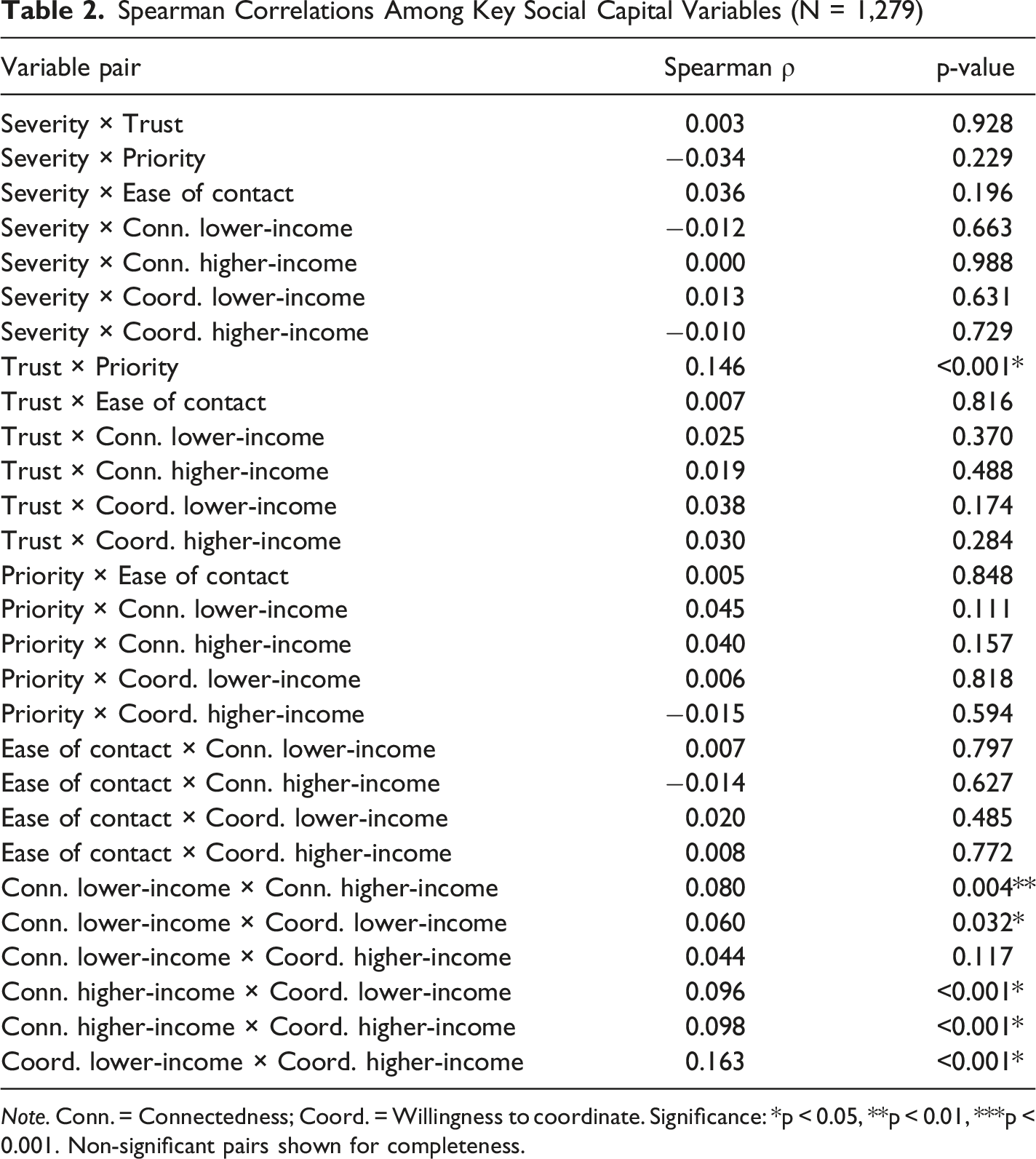
Note. Conn. = Connectedness; Coord. = Willingness to coordinate. Significance: *p < 0.05, **p < 0.01, ***p < 0.001. Non-significant pairs shown for completeness.
In the qualitative strand, semi-structured online interviews were conducted with 16 key informants with expertise in Lahore’s environmental governance and civic mobilisation. Informants were selected through purposive and snowball sampling. An initial cohort was identified based on documented contributions to environmental governance, civic advocacy, or urban policy in Punjab, and expanded through peer referrals. Profiles spanned five domains: environmental law, climate policy consulting, urban governance, civil society leadership, and academic research. Interviews were conducted between June and July 2025, both in person and online, with prior informed consent. Sessions ranged from 40 to 90 minutes and followed a semi-structured protocol organised around five thematic areas: institutional governance performance; community-level civic action and its limitations; citizen-state engagement; data transparency and information access; and structural barriers to cross-community collaboration. Interviews were conducted bilingually in English and Urdu, and verbatim notes were taken.
Qualitative data were analysed thematically, with coding categories corresponding to the three forms of social capital and to emergent themes regarding governance challenges and solutions. The interviews provided nuanced context, examples, and explanations that complement the survey’s quantitative trends, for instance, illustrating how trust (or distrust) in institutions is experienced on the ground, or how community initiatives are initiated and sustained. Two transparency considerations warrant acknowledgement. The interview sample comprised senior professionals, whose perspectives may skew toward advocacy-oriented readings of governance failure; divergences with the broader resident survey were treated as analytically informative rather than resolved away. Coding reliability was strengthened by independently recoding 20% of transcripts, yielding a mean Cohen’s Kappa of 0.78, which exceeds the 0.60 threshold for acceptable qualitative agreement (Landis & Koch, 1977).
Triangulation was operationalised by systematically comparing survey findings with qualitative themes derived from interview coding, assessing each pairing for corroboration, complementarity, or divergence. Convergent findings, such as the 87.2% survey willingness to use a digital reporting platform, which aligned with interview evidence of latent civic engagement among 12 of 16 informants, were treated as mutually corroborating. Divergent findings, such as the survey’s cross-class distribution of tax refusal contrasting with interview accounts of elite-dominated refusal, were treated as analytically productive, revealing differences between structured survey and deliberative interview contexts. Quantitative data provided population-level breadth; qualitative data supplied contextual depth and explanatory mechanisms.
Findings
The presentation of results is organised around the three forms of social capital. Survey findings are integrated with interview insights to illustrate each dimension.
Bonding Social Capital: Community-Level Solidarity and Coping
Evidence from Lahore suggests that bonding social capital has been activated to some extent in response to the smog crisis. A large majority of survey respondents (72.4%) reported discussing smog with their neighbours, indicating that the issue is a common topic of concern in social circles. Such discussions are a first step toward collective awareness and potentially collective action (Putnam, 2000). However, a Spearman correlation between smog severity and neighbourhood discussions showed no significant relationship:
This indicates that conversations are not directly driven by perceived severity. An environmental governance expert consulted for this study observed that smog discussions in Lahore’s neighbourhoods are widespread precisely because the problem is chronic rather than acute: when a crisis becomes normalised, it generates conversation without necessarily generating an organised response. A climate policy expert echoed this, noting that much of the social mobilisation around smog is reactive, informal, and short-term, and that very few mechanisms exist for channelling community-level concern into structured initiatives (Cleaver, 2005). Bonding social capital thus exists in the form of shared awareness and neighbourly sympathy, but it often fails to progress into enduring community organisations or projects due to a lack of external support and institutionalisation (Adger, 2003).
The scale and sustainability of bonding-based actions appear limited. Survey data show that 33.5% of respondents reported that their community or neighbourhood had taken some initiative to improve air quality, a figure that, while higher than anecdotal impressions might suggest, reflects the predominantly small-scale and episodic nature of such efforts, including tree-planting drives, waste-collection campaigns, and mask distribution. A chi-square test comparing respondents who reported discussing smog with their neighbours and those who had participated in awareness campaigns or civic activities showed no significant association:
This confirms that, while conversations are widespread, they do not reliably translate into organised action. Interview respondents consistently described community efforts as confined to visible, low-barrier tasks that offer a sense of accomplishment but do not address root causes such as vehicular emissions or industrial smoke (Iqbal et al., 2020; Nasar-u-Minallah et al., 2024). A researcher at a Lahore-based think tank noted that government campaigns, such as mass tree-planting drives, have inadvertently reinforced public perceptions that symbolic actions are sufficient to combat smog, obscuring the structural drivers of the crisis. An environmental lawyer consulted for this study argued more sharply that by framing smog as a seasonal problem amenable to plantation-based fixes, authorities have systematically misdirected the public’s willingness to act, suppressing the more demanding forms of civic engagement that meaningful governance reform would require.
Positive examples of bonding capital nevertheless emerged from both the survey and interviews. A university-led programme that sent daily SMS alerts with neighbourhood-level air quality data prompted small groups of residents to discuss and adopt protective measures. A civil society volunteer network distributed free masks in crowded marketplaces during peak smog days, drawing on tight-knit volunteer communities motivated by a shared sense of responsibility. These instances of mutual aid underscore the capacity of bonding ties to provide immediate relief and coping mechanisms, even where they fall short of systemic change (Putnam, 2000).
A critical analytical question is whether any bonding-level activities extended across neighbourhood boundaries. Survey and interview evidence consistently indicates they did not. Information sharing remained confined to immediate residential circles, community initiatives operated within single localities, and no neighbourhood-based group established durable links with counterparts in different socioeconomic areas. The university SMS alert programme reached households across localities but generated no inter-community networks; mask distribution similarly operated within a single volunteer community. Bonding capital in Lahore thus remained analytically distinct from bridging capital: inward in reach, homogeneous in solidarity, and micro-level in effect (Adger, 2003; Woolcock, 2001).
There is, however, latent potential for stronger collective action. When asked whether they would support a neighbourhood initiative if a trusted leader or organisation took the lead, 61.8% of respondents answered yes, 34.0% said no, and 4.1% were unsure. A chi-square test between community initiative-taking and willingness to support collective action did not reach conventional statistical significance:
While the association falls short of the p < 0.05 threshold, the descriptive pattern is consistent with the broader theoretical expectation that bonding social capital in Lahore is dormant rather than absent. Interview respondents across several professional domains observed that residents demonstrate goodwill and concern for their neighbours’ wellbeing, but need coordination, trusted leadership, and institutional scaffolding to convert that concern into sustained collective action (Adger, 2003). When community initiatives have succeeded, they have typically done so through integration with NGO support or governmental programmes rather than through purely grassroots momentum (Cleaver, 2005).
Bridging Social Capital: Cross-Community Collaboration (or Lack Thereof)
The research findings indicate that bridging social capital is notably weak during Lahore’s smog crisis. Bridging social capital would manifest as cooperation and information sharing between different socioeconomic or geographic communities within the city, for example, residents of a wealthy neighbourhood working alongside those in an inner-city locality to advocate for clean air policy, or citywide networks cutting across class lines (Putnam, 2000; Woolcock, 2001). Both the survey and the interviews suggest that such cross-group linkages remain scarce. On a scale of 1 to 10, respondents rated their connectedness with lower-income neighbourhoods at a mean of 4.60 and with higher-income neighbourhoods at 5.03, both falling in the lower half of the scale. Spearman correlations showed modest but statistically significant positive relationships between cross-class connectedness and willingness to coordinate:

These correlations indicate that stronger cross-class connectedness is associated with greater willingness to collaborate on environmental initiatives, though the effect sizes are modest, suggesting that connectedness alone is insufficient to generate coordinated action in the absence of facilitating structures. A senior professional from a provincial urban policy unit observed that cross-community collaboration on environmental issues in Lahore is currently very limited, and that affluent areas tend to focus inward, relying on air purifiers and private healthcare, while low-income communities, preoccupied with economic survival, lack the time and resources for environmental activism. Chi-square tests found no significant association between income group and cross-class connectedness:

This indicates that perceptions of cross-class connectedness do not vary systematically by income level. In other words, the disconnect is not one-sided: residents across all income groups report similarly limited social ties beyond their own socioeconomic sphere.
Survey data on neighbourhood preparedness further illuminate the class dimensions of smog vulnerability. A slight majority of respondents (47.5%) believed their neighbourhood was better prepared to deal with smog than lower-income localities, while 44.5% disagreed. Conversely, 44.9% felt their neighbourhood was less well-equipped than wealthier ones, against 47.8% who disagreed. These near-even splits, across income groups, suggest widespread uncertainty about relative vulnerability, reflecting the limited cross-community knowledge that weak bridging capital produces.
The survey data on willingness to pay for smog mitigation reveal a more nuanced picture than qualitative accounts alone would suggest. A climate policy expert from a provincial urban advisory body noted that in prior studies conducted in Lahore, residents from elite areas refused to contribute financially to environmental improvements, citing their existing tax burden and asserting that environmental quality is the state’s responsibility. This pattern, commonly reported in interview contexts, is partially borne out by the present survey but requires careful interpretation. Among the lowest income group (below PKR 30,000), 37.6% were unwilling to pay any additional tax for smog mitigation. Refusal rates among higher-income groups were somewhat lower: 29.6% among those earning above PKR 500,000 and 28.0% among those earning PKR 250,000 to 500,000. These figures suggest that resistance to environmental taxation is distributed across income groups rather than concentrated among the elite, and that the anecdotal picture of elite refusal does not straightforwardly align with survey responses. The divergence likely reflects differences in the framing and social context of survey responses compared with deliberative settings, as well as the influence of social desirability on self-reported willingness to pay.
Several structural factors constraining bridging capital emerged from the qualitative data. A recurring theme was Lahore’s socio-spatial segregation, with wealthier planned suburbs physically and socially removed from less affluent settlements (Cleaver, 2005). A civil society professional observed that mainstream discourse on smog seldom addresses the unequal distribution of its burdens, and that the voices of the marginalised are largely absent from both policy debates and civil society advocacy (Adger, 2003). A senior urban governance expert identified the dissolution of elected local governments in Punjab between 2019 and 2022 as a significant structural setback, noting that elected local councils had previously served as forums where residents of different backgrounds could deliberate on shared community concerns, and that in their absence, institutional spaces for cross-community engagement on environmental issues have all but disappeared (World Bank, 2019b). A climate and environment consultant cited rare instances of bridging across strata, including a private development authority that improved infrastructure in nearby villages to facilitate community relocation, as evidence that deliberate effort and mutual interest can bridge social divides even in Lahore’s stratified context. Such examples, however, remain exceptions (Adger, 2003).
The net effect of weak bridging capital is that action against smog remains fragmented and inequitable (Putnam, 2000; Woolcock, 2001). Middle-class activists may organise protests or social media campaigns, but participation rarely extends into working-class neighbourhoods. As a climate policy expert described, lower-income groups end up as marginalised spectators to both the problem and its supposed solutions, while higher-income groups deploy private coping strategies that insulate them from the worst effects without contributing to collective mitigation (Cleaver, 2005; Folke et al., 2005).
Linking Social Capital: Citizen-State Engagement and Trust
Linking social capital in Lahore’s smog crisis appears to be the most constrained of the three dimensions, yet arguably the most crucial for long-term governance improvement (Woolcock, 2001). Data reveal a pronounced trust deficit and communication gap between the public and the authorities responsible for environmental management (Adger, 2003). The mean trust rating for the government’s ability to control smog was 4.02 out of 10, and the mean rating for the priority the government assigned to smog control was 4.20 out of 10. Over 76.6% of respondents rated their trust in government at 5 or lower, and 71.9% rated the government’s priority for addressing smog as equally low, reflecting a broadly shared public perception that authorities are not treating the issue with sufficient urgency or competence. A Spearman correlation between trust in government and perceived governmental priority was statistically significant:
The positive association confirms that citizens who perceive higher governmental priority on smog also report greater institutional trust. While the effect size is modest, the direction is consistent with accounts from multiple expert informants, who argued that citizens evaluate government credibility largely through visible signals of policy commitment and that the chronic gap between official announcements on smog and observable enforcement has systematically eroded whatever trust previously existed. This scepticism is reinforced by the finding that 60.0% of respondents consider smog control primarily the government’s responsibility, yet large majorities simultaneously rate both governmental trust and priority as low, reflecting the central tension between role attribution and performance perception that characterises weak linking capital.
Direct civic engagement with formal institutions remains minimal. Only 14.2% of respondents had ever contacted a government department to report an environmental issue. A Spearman correlation between trust in government and perceived ease of contacting authorities was not significant:
This indicates that accessibility perceptions and trust operate largely independently of one another. Multiple interview informants explained that even where complaint channels nominally exist, the absence of responsiveness and follow-through renders them ineffective, and that citizens report not out of distrust alone but because they perceive reporting as pointless under current institutional conditions (Nasar-u-Minallah et al., 2024). Approximately 60.1% of respondents reported having never received any smog-related awareness communication from a government department. Those who had recall messages cited generic seasonal advisories, a pattern that several informants described as symptomatic of a one-way, top-down communication approach that does not constitute meaningful civic engagement.
Several interview informants highlighted practices of institutional data manipulation that have further eroded public trust. An environmental lawyer described how the Punjab Environmental Protection Department has refused to recognise data from low-cost air quality monitors accepted in comparable international contexts, on the grounds that their laser-based methodology does not meet official standards. More significantly, a climate policy expert described how the provincial government altered its AQI scale, widening category thresholds from the globally standard 50-point intervals to 100-point intervals, effectively reclassifying internationally hazardous air quality readings as merely unhealthy under the provincial standard. These acts, characterised by one informant as deliberate obfuscation, sever the informational basis on which linking social capital depends: when the state controls and manipulates the data through which citizens understand their environment, it systematically undermines the epistemic foundations of trust, participation, and civic advocacy (Ahmad, 2018; Alam, 2021).
Interview evidence illuminates how citizens interpreted these manipulations. Informants described reactions of anger and cynicism, with many abandoning official AQI sources entirely in favour of independent platforms such as IQAir, whose readings diverged dramatically from government figures. Paradoxically, the manipulation deepened civic awareness rather than suppressing it, but heightened scepticism produced withdrawal rather than organised pressure, as no credible reporting mechanism existed to channel distrust into engagement. This confirms the distinction between structural and relational linking capital: formal channels existed, but their perceived illegitimacy rendered them functionally inoperative (Folke et al., 2005; Woolcock, 2001).
Despite these constraints, the findings indicate that linking social capital is latent rather than wholly absent. An overwhelming 87.2% of respondents stated they would use an easily accessible digital platform to report environmental violations. A chi-square test between institutional trust levels and willingness to report via such a platform was not significant:
This finding is analytically important: the near-universal willingness to report across all trust levels demonstrates that the low rate of actual reporting reflects not public apathy but the absence of credible, accessible, and responsive reporting mechanisms. Citizens are willing to engage; the institutional infrastructure for that engagement is not adequately in place.
Some linking capital has been exercised through adversarial and mediated routes. Environmental lawyers and civil society activists leveraged the Lahore High Court to compel government action, resulting in the formation of the Smog Commission and the eventual formulation of the Punjab Clean Air Action Plan, demonstrating that judicial engagement represents a form of linking capital, adversarial but operative, through which citizen-state connection can generate policy change even in conditions of low institutional trust (Ahmad, 2018; Alam, 2021; Woolcock, 2001). One informant who had been directly involved in this litigation process noted, however, that such engagement is sporadic and dependent on a small number of legally trained individuals rather than a broad-based civic partnership. Without continuous pressure, enforcement stalls, and Smog Commission recommendations go unimplemented.
Interview informants also noted the transboundary dimension of Lahore’s linking capital deficit. Technical experts on both sides of the India-Pakistan border acknowledge the shared airshed, but formal governmental engagement on cross-border air quality has been negligible, constrained by political tensions. The Chief Minister of Punjab’s call in late 2024 for climate diplomacy with Indian Punjab represented a rare instance of transnational linking of capital, but, at the time of the interview, it remained aspirational.
Summary of Statistical Tests (N = 1,279)
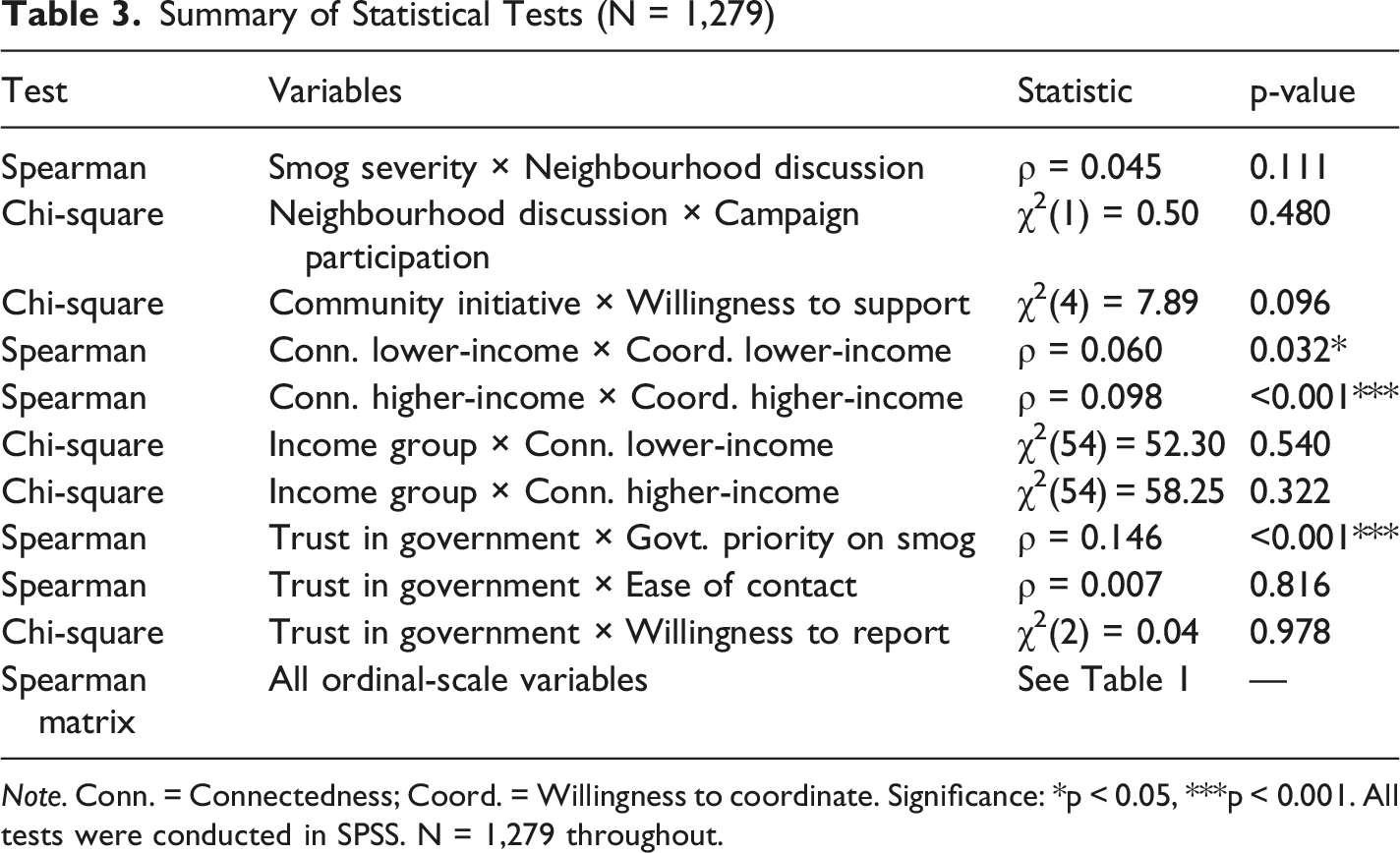
Note. Conn. = Connectedness; Coord. = Willingness to coordinate. Significance: *p < 0.05, ***p < 0.001. All tests were conducted in SPSS. N = 1,279 throughout.
Discussion
Findings suggest that social capital can complement formal governance efforts and fill certain gaps, but it cannot fully substitute for the state’s responsibilities. This section interprets the results in light of the three research questions, drawing on comparative contexts and outlining the implications for urban environmental governance and the modest but significant association between trust and priority governance in Lahore and similarly situated megacities in the Global South.
Bonding: Resilience Without Transformation
Addressing the first research question reveals a mixed but theoretically coherent picture. Bonding social capital is present and, within its limits, valuable. Evidence of local tree plantings, mask distribution, and information-sharing among neighbours illustrates that many Lahore residents leveraged existing social bonds to cope rather than passively await government intervention, consistent with studies of disaster response where communities mobilise internal resources when external support is inadequate (Aldrich & Meyer, 2015). The finding that 72.4% of respondents discuss smog with their neighbours, and 61.8% express willingness to support a collective initiative given leadership, confirms that the social raw material for collective action exists across Lahore’s residential communities.
However, bonding-based action has been confined to alleviating symptoms rather than causes. A neighbourhood can organise a cleanup or self-impose a waste-burning ban, but it cannot reduce citywide vehicular emissions or enforce industrial regulations. Bonding capital has thus enhanced coping capacity without generating transformative capacity and has not produced structural changes in environmental policy. This resonates with Cleaver’s (2005) caution that local social capital alone, without connections to higher scales of action, cannot achieve systemic objectives. Ballet et al. (2007) further observe that social capital’s governance value is conditioned by its institutional context: in Lahore, the absence of enabling structures and the misdirection of community effort through symbolic government campaigns have together suppressed the transformative potential that bonding capital might otherwise carry.
The non-significant chi-square for the relationship between community initiative-taking and willingness to support future collective action (χ2(4) = 7.89, p = 0.096) requires careful interpretation. It should not be read as evidence that prior community experience is irrelevant to future mobilisation. The descriptive pattern remains consistent with the theoretical expectation that collective experience builds social infrastructure for future action, and interview informants confirmed that neighbourhoods with some organisational history were more receptive to further engagement. The non-significance is more plausibly explained by sample diversity and the small proportion of respondents with sustained initiative experience. In a mixed-methods design, qualitative evidence supplies the contextual interpretation that survey data alone cannot furnish.
Bridging: Fragmentation and Inequity
Bridging social capital in Lahore has been notably weak, with significant governance implications. The data reveal a fragmented public sphere: pockets of activism concentrated among the educated middle class, isolated community efforts in some localities, and minimal coordination between them. This fragmentation dilutes pressure on authorities and perpetuates inequity, as wealthier communities deploy private coping strategies while poorer communities bear the brunt of pollution without the networks to demand redress (Cleaver, 2005).
The modest but significant Spearman correlations between cross-class connectedness and willingness to coordinate (ρ = 0.060–0.098, all p < 0.05) confirm that bridging ties, even when weak, predict a collaborative orientation. Woolcock (2001) argues that the absence of bridging capital is itself a form of structural inequality, concentrating advocacy capacity among the already advantaged. This is clearly visible in Lahore, where, as one climate policy expert observed, only the middle class makes noise about smog while lower-income groups function as marginalised spectators to both the problem and its supposed solutions. Chi-square tests confirming no significant variation in connectedness perceptions across income groups (p = 0.540 and p = 0.322) indicate that this disconnect is symmetrical: residents across all income levels report similarly limited cross-class ties, meaning the bridging deficit reflects the structural absence of platforms that would bring diverse groups into contact, not the reluctance of any single group.
These findings carry explicit environmental justice implications. Schlosberg (2007) identifies three dimensions of justice: distributive, recognitional, and procedural. All three are compromised in Lahore. Weak bridging capital means low-income communities are not recognised as equal stakeholders in smog discourse. Weak linking capital denies them procedural channels through which to demand redress. Both deficits compound the distributive injustice of disproportionate exposure to pollution, producing a self-reinforcing cycle in which the most affected communities remain the least empowered to act.
The dissolution of elected local governments in Punjab between 2019 and 2022, as revealed by qualitative data, is a significant proximate cause of this deficit. Elected local councils had previously provided institutional forums where residents of different backgrounds could deliberate on shared concerns. Their removal concentrated environmental governance within provincial agencies that lacked the mandate or inclination to facilitate cross-community dialogue (Cleaver, 2005; World Bank, 2019b).
The willingness-to-pay data further complicate the picture. Tax refusal rates ranging from 28.0% among upper-middle-income respondents to 37.6% among the lowest-income group indicate that environmental fiscal reluctance is a cross-class phenomenon rather than the elite-refusal narrative suggested by qualitative accounts. This divergence, which a convergent mixed-methods design is specifically equipped to surface, likely reflects social desirability effects in survey responses and differences in how willingness to pay is framed in structured versus deliberative contexts. Among lower-income groups, refusal reflects genuine affordability constraints; among higher-income groups, it reflects a political disposition that assigns environmental responsibility to the state.
Linking: The Critical Missing Piece
Linking social capital is both the most constrained dimension and the most consequential for long-term governance improvement (Woolcock, 2001). The barriers to integrating civic action into formal governance are rooted in linking capital deficits: low institutional trust (mean = 4.02 out of 10), minimal direct civic engagement (14.2% have ever contacted a government department on an environmental issue), and governance practices that actively undermine the informational conditions on which citizen-state trust depends (Folke et al., 2005; Woolcock, 2001).
Lahore’s case exemplifies how institutional distrust becomes self-perpetuating. Citizens distrust the government, so they disengage or resort to confrontational means. The government, meanwhile, continues top-down decision-making and sometimes actively obscures data, reinforcing distrust and suppressing civic engagement (Human Rights Watch, 2022). The EPA’s manipulation of the AQI scale and its refusal to recognise low-cost monitor data constitute what Ahmad (2018) and Alam (2021) identify as deliberate institutional obfuscation. By controlling the information environment, the state severs the epistemic basis on which linking capital depends, ensuring that citizens cannot accurately perceive the severity of problems, hold authorities to measurable standards, or participate meaningfully in governance. This is not merely a conventional governance failure of weak enforcement; it is an active suppression of the conditions that would enable social capital to connect productively with institutional structures.
The finding that 87.2% of respondents would use an accessible digital reporting platform regardless of institutional trust levels (χ2(2) = 0.04, p = 0.978) is among the most analytically significant results of the study. Low civic engagement with environmental authorities reflects not public apathy but the absence of credible, accessible, and responsive mechanisms. Investments in well-designed, transparent civic engagement platforms could unlock a substantial reservoir of latent linking capital without requiring prior transformation of trust levels.
The adversarial linking capital exercised through Lahore High Court litigation and the resulting Smog Commission produced tangible outcomes, including the Punjab Clean Air Action Plan, demonstrating that linking capital can drive governance change even amid institutional distrust (Ahmad, 2018; Alam, 2021). However, such engagement is sporadic, legally demanding, and dependent on a small cohort of trained professionals rather than a broad civic base. Its sustainability as a governance mechanism depends on continuous pressure that Lahore’s civil society cannot consistently sustain.
Social Capital as Complement, Not Substitute
The third research question asked to what extent social capital can complement state efforts in mitigating urban air pollution. The evidence consistently supports the view that social capital is a necessary but insufficient condition for effective environmental governance. Bonding and bridging networks provided early warning, immediate relief, and kept the issue alive in public discourse. During the 2022 to 2023 smog season, citizen activism, including the dissemination of independent AQI data and organised public pressure, exposed governmental shortcomings and prompted more candid official acknowledgement of the crisis (Sridhar et al., 2019). Social capital thus functioned as an informal accountability mechanism even in the absence of formal participatory structures. Systemic smog reduction, however, requires coordinated, sustained, and technically equipped action that only governmental authorities, potentially in partnership with the private sector, can orchestrate at the necessary scale.
Lahore’s social capital, in its current state, only partially compensates for governance failures. Bonding ties have provided community-scale resilience without transformative momentum. Bridging ties are too weak to mount citywide movements or reduce disparities in civic voice. Linking ties remain nascent and predominantly adversarial, emerging through crisis-driven confrontation rather than institutionalised partnership. The study’s central hypothesis, that social capital can complement but not substitute for state action, is strongly supported by the combined evidence.
Governance reform and social capital development are mutually constitutive rather than parallel processes. Strengthening bonding capital requires trusted community leadership and NGO scaffolding. Building bridging capital requires restoring institutional platforms for cross-community deliberation. Developing linking capital requires responsive, transparent channels grounded in accurate environmental data. Without progress on all three dimensions simultaneously, Lahore’s smog governance will continue to oscillate between episodic crisis response and structural inaction.
Conclusion
Lahore’s smog crisis has illuminated the twin realities of governance shortcomings and untapped civic potential. Social capital plays a significant yet supporting role: it is an indispensable component of any durable solution, but cannot overcome structural failures in policy and enforcement alone. Bonding social capital has provided communities with resilience and local coping capacity. Bridging social capital remains weak, reflecting deep socio-spatial segregation and the dissolution of institutional platforms for cross-community deliberation. Linking social capital is the most constrained and consequential dimension, held back by institutional distrust, data manipulation, and the near-absence of responsive participatory mechanisms. Effective governance of urban air pollution requires a synthesis of bottom-up and top-down approaches, as without public engagement, technical interventions will falter, and without robust institutional support, civic efforts will dissipate.
The findings carry concrete governance implications. Neighbourhood associations and NGOs should move beyond symbolic plantation drives toward emissions monitoring and polluter reporting, supported by dedicated coordination funding. Elected local government structures must be reinstated, with ward-level environmental committees constituted across income groups to rebuild cross-community deliberation. A mobile-first, voluntary digital reporting platform with mandatory follow-up notifications would mobilise the 87.2% of citizens willing to report violations but currently lacking a credible mechanism. The Punjab EPA should restore the WHO-standard 50-point AQI thresholds and recognise validated low-cost monitor data to rebuild the informational trust on which civic engagement depends. Finally, the transboundary dimension of Lahore’s smog requires federal engagement in the shared Punjab airshed, a challenge that the provincial government cannot address alone.
This study offers the first systematic assessment of all three social capital dimensions in Pakistan’s urban environmental governance, with findings relevant to comparable Global South megacities where weak institutions, civic underinvestment, and socio-spatial inequality converge. Lahoris are not apathetic. Willingness to engage, report, and coordinate exists across the city’s social spectrum. The task for governance is to build the institutional architecture that deserves and channels that willingness.
Supplemental Material
Supplemental Material - Leveraging Social Capital for Urban Environmental Governance: A Case Study of Lahore’s Smog Crisis
Supplemental Material for Leveraging Social Capital for Urban Environmental Governance: A Case Study of Lahore’s Smog Crisis by Ameer Abdullah Khan, Shaheen Akhtar in The Journal of Environment & Development.
Supplemental Material
Supplemental Material - Leveraging Social Capital for Urban Environmental Governance: A Case Study of Lahore’s Smog Crisis
Supplemental Material for Leveraging Social Capital for Urban Environmental Governance: A Case Study of Lahore’s Smog Crisis by Ameer Abdullah Khan, Shaheen Akhtar in The Journal of Environment & Development.
Footnotes
Acknowledgements
The authors are grateful to all interview respondents for generously sharing their expertise and insights. Special thanks are due to Ms Rameen Shahid, whose assistance was instrumental in facilitating access to key informants. The authors also acknowledge Ms Asra Faheem for her valuable guidance on the quantitative analysis.

Ethics Considerations
No prior approvals were required for conducting this study.
Consent to Participate
All survey participants and interviewees gave informed consent prior to participation.
Author Contributions
Ameer Abdullah Khan: Conceptualisation, survey design, data collection and analysis, drafting of the manuscript. Shaheen Akhtar: Research supervision and review of the manuscript.
Funding
The authors received no financial support for the research, authorship, and/or publication of this article.
Declaration of conflicting interests
The authors declared no potential conflicts of interest with respect to the research, authorship, and/or publication of this article.
Data Availability Statement
The survey dataset and anonymised interview transcripts generated during this study are available from the corresponding author on reasonable request.
Ethical Use of AI
Artificial intelligence tools were used in a supporting capacity during this study. Claude AI (Sonnet 4.6, Anthropic) assisted with qualitative thematic coding and verification of triangulation results. Grammarly Pro was used for grammar and proofreading checks. All substantive analytical decisions, interpretations, and conclusions remain the sole responsibility of the authors.
Supplemental Material
Supplemental material for this article is available online.
Author Biographies
References
Supplementary Material
Please find the following supplemental material available below.
For Open Access articles published under a Creative Commons License, all supplemental material carries the same license as the article it is associated with.
For non-Open Access articles published, all supplemental material carries a non-exclusive license, and permission requests for re-use of supplemental material or any part of supplemental material shall be sent directly to the copyright owner as specified in the copyright notice associated with the article.
