







Abstract
Payment-for-Ecosystem-Services (PES) has been promoted as an innovative approach to environmental governance capable of simultaneously advancing conservation and sustainable development objectives. While studies commonly assess the ecological and economic performance of PES schemes, less attention has been given to their organizational and administrative effectiveness. This study examines these governance dimensions of one of Latin America’s most prominent PES initiatives—the Water Producer Program (WPP) in Brazil. Drawing on a meta-synthesis of 125 publications, the analysis investigates how regulative, normative, and cultural-cognitive institutional forces shaped WPP implementation. Guided by neo-institutional theory and institutional bricolage, findings show that WPP governance operated through hybrid and adaptive institutional arrangements developed in response to administrative constraints, land tenure ambiguities, and uneven organizational capacity. These exploratory findings highlight a need for expanded social science inquiry into the administrative dimensions of PES schemes to aid initiatives like the WPP in achieving their objectives in the future.
Keywords
Introduction
Payments-for-Ecosystem-Services (PES) have become a widely adopted instrument for environmental management that has been promoted as effective for advancing both social and ecological sustainable development objectives (Salzman et al., 2018; Schomers & Matzdorf, 2013; Stevenson et al., 2021; Waylen & Martin-Ortega, 2018; Wunder et al., 2020). By assigning monetary value to ecosystem functions and incentivizing their protection, PES schemes have been championed as more flexible and efficient alternatives to conventional command-and-control approaches to natural resource management (Bennett & Gosnell, 2015; Börner et al., 2017; Engel et al., 2008; Schulz et al., 2015; van Noordwijk et al., 2012; Wunder, 2007, Wunder et al., 2020) that have been criticized as being cumbersome and ineffective and their punitive nature resulting in poor social outcomes (Holling & Meffe, 1996; Paavola & Hubacek, 2013).
The notion of eliminating unwieldy regulatory mechanisms and replacing them with a tool that harnesses the power of economic interests has appealed to policy makers and natural resource managers alike and led to wide adoption of PES around the globe (Ioris, 2013; Pereira, 2010; Salzman et al., 2018; Schomers & Matzdorf, 2013; Waylen & Martin-Ortega, 2018). Although PES-related research has expanded rapidly, most studies focus on ecological outcomes and economic efficiency (Bennett & Gosnell, 2015; Börner et al., 2017; Engel et al., 2008; van Noordwijk et al., 2012; Wunder, 2007, Wunder et al., 2020). Comparatively less attention has been given to the governance arrangements and administrative processes through which PES schemes are implemented. This is an important limitation because PES effectiveness depends not only on financial incentives and ecological metrics but also on the institutional arrangements that support contracting, coordination, monitoring, and long-term program management. This study begins to fill this gap by investigating the administrative and institutional dimensions of one of the most notable PES initiatives in Latin America, Brazil’s Programa Produtor de Água or Water Producer Program (WPP). While numerous studies have focused on the environmental outcomes and economic valuations associated with the WPP, its governance and administrative dimensions remain understudied, making it an important case for examining how PES schemes are executed in practice.
To orient investigation of the administrative features of the WPP, this study draws primarily on neo-institutional theory in sociology, which emphasizes how distinct regulative, normative, and cultural-cognitive forces shape organizational behavior and define legitimate forms of action (Meyer and Rowan, 1977; Powell & DiMaggio, 1991; Scott, 2013). Nonetheless, while neo-institutional theory helps guide identification of institutional forces shaping PES governance, its utility is limited for explaining how governance arrangements are assembled and implemented in practice. The concept of institutional bricolage is ideal for orienting this type of analysis as it highlights how actors purposively adapt governance practices in context-specific ways to form workable institutional arrangements (Bebbington & Batterbury, 2001; Cleaver, 2012; Gebara, 2019). This perspective is particularly useful for understanding how PES programs are executed, as their formal designs are often constrained by existing organizational structures and contextual factors that diverge from administrative models (Salzman et al., 2018; Schomers & Matzdorf, 2013).
In this way neo-institutional theory helps explain how organizational behavior is shaped by distinct types of institutional pressures, while institutional bricolage provides a framework for understanding how governance arrangements are assembled and adapted in practice under conditions of institutional complexity. This study therefore asks: to what extent do institutional and organizational dynamics shape the governance and administrative effectiveness of PES schemes?
Although this investigation focuses on Brazil’s WPP, the institutional dynamics identified are not unique to this case. PES programs around the globe operate within complicated governance environments characterized by overlapping institutional structures, uneven administrative capacity, and competing social and economic objectives. Thus, the findings from this investigation provide broader insights into the governance and administrative challenges shaping PES schemes.
The analysis contributes to organizational and institutional understandings of PES implementation in three key respects. First, it advances PES-related research beyond outcome evaluation by focusing on the governance and administrative processes that underpin implementation. Second, it develops an institutional bricolage perspective on PES governance, showing how implementation frequently depends on adaptive and hybrid institutional arrangements rather than formal program designs alone. Third, it highlights how administrative coordination and implementation burdens and costs remain underexamined dimensions of PES governance. Collectively, the findings provide a broader comprehension of how institutional complexity shapes PES implementation that is applicable not only to Brazil’s WPP but also to other PES programs operating in similarly complex institutional environments. Because the organizational dimensions of PES governance remain understudied, this exploratory analysis focuses on identifying institutional dynamics and implementation challenges that may inform both future research and PES administration in practice.
PES and the Genesis of Brazil’s Water Producer Program
The global expansion of PES programs accelerated during the 1990s, increasing interest in the use of economic incentives to support natural resource management in Brazil.
Groundbreaking initiatives such as Projeto Oásis, led by the NGO Fundação Boticário, alongside projects supported by the Brazilian affiliates of The Nature Conservancy and the World Wildlife Fund, helped demonstrate the potential of PES approaches (Pagiola et al., 2013; Zanella et al., 2014). Advocates not only emphasized the environmental and social benefits of PES, but also promoted administrative models intended for replication, contributing to the institutionalization of PES as a natural resource management tool across Brazil (Calvache et al., 2012; Fundação Grupo Boticário de Proteção à Natureza, 2017; Kfouri & Favero, 2011; Pagiola et al., 2013). Enthusiasm surrounding these initial NGO-led projects spurred governmental entities to develop PES programs such as the ProdutorES de Água and Mina d’Água in the states of Espírito Santo and São Paulo, respectively (Pagiola et al., 2019).
While adoption of PES initially took root at the state and local levels, the Brazilian federal water agency—Agência Nacional de Águas e Saneamento Básico (ANA) sought to expand its use and initiated the WPP in 2001 (ANA, 2018; Pagiola et al., 2013). In terms of governance and project administration, ANA stipulated that all WPP projects have multi-party Unidades de Gestão do Projeto (UGP) (project management units) and established obligations not only for rural landowners receiving PES but also for local governments, watershed committees, NGOs, and other organizations executing activities through the WPP UGPs (ANA, 2008).
Projects supported under the WPP have varied over time, with some entirely new initiatives emerging and others continuing programs that had initially been implemented through state or municipal PES programs (Pagiola et al., 2013; Viani & Bracale, 2015; Viani et al., 2019). Since its inception, 84 projects in 14 states have been funded, with a total investment by the Brazilian federal government and its project partners of R$140.8 million (US$25.47 million) and R$23.8 million (US$4.31 million) in PES payments (ANA, 2025). The scale, diversity, and organizational complexity of the WPP make it an important case for examining the institutional and governance dynamics shaping PES implementation.
Insights From Institutional and Organizational Theory
Institutional analysis is common within economics and political science (North, 1990); however, neo-institutional theory in sociology places particular emphasis on how institutional forces shape organizational behavior and define legitimate forms of action (Powell & DiMaggio, 1991; Scott, 2013). Rather than assuming actors simply pursue instrumental self-interest, this perspective highlights how organizational behavior is shaped by socially embedded norms, expectations, and routines. Scott (2013) identifies three key institutional dimensions that influence organizational behavior: regulative, normative, and cultural-cognitive. Regulative institutions operate through rules, incentives, and sanctions; normative institutions shape organizational goals and appropriate forms of conduct through values and social expectations; and cultural-cognitive institutions influence behavior through taken-for-granted assumptions and shared interpretive frameworks (Scott, 2013). Together, these institutional dimensions provide a useful framework for analyzing how PES governance arrangements are structured and enacted across different social and organizational contexts.
Institutional bricolage complements neo-institutional analysis by illustrating how actors selectively recombine formal rules, informal norms, organizational routines, and available social resources to construct workable governance arrangements in response to local uncertainty and complexity (Cleaver, 2012). Emphasizing adaptation and practical problem-solving, this perspective is especially useful for understanding PES governance where formal program designs frequently interact with uneven administrative capacity and overlapping institutional authorities.
Figure 1 summarizes the analytical framework guiding this study and illustrates how institutional dynamics shaped WPP governance and implementation. Drawing on Scott’s institutional pillars framework, the framework emphasizes how regulative, normative, and cultural-cognitive forces influenced organizational behavior, administrative practices, and PES implementation processes. It also illustrates patterns of institutional bricolage to help focus on understanding how WPP actors adapted existing governance structures in response to limited administrative capacity and institutional complexity. Together, these institutional influences shaped governance arrangements and implementation practices that ultimately connect to the administrative effectiveness of WPP initiatives. Conceptual Framework for Analyzing PES Governance and Administration.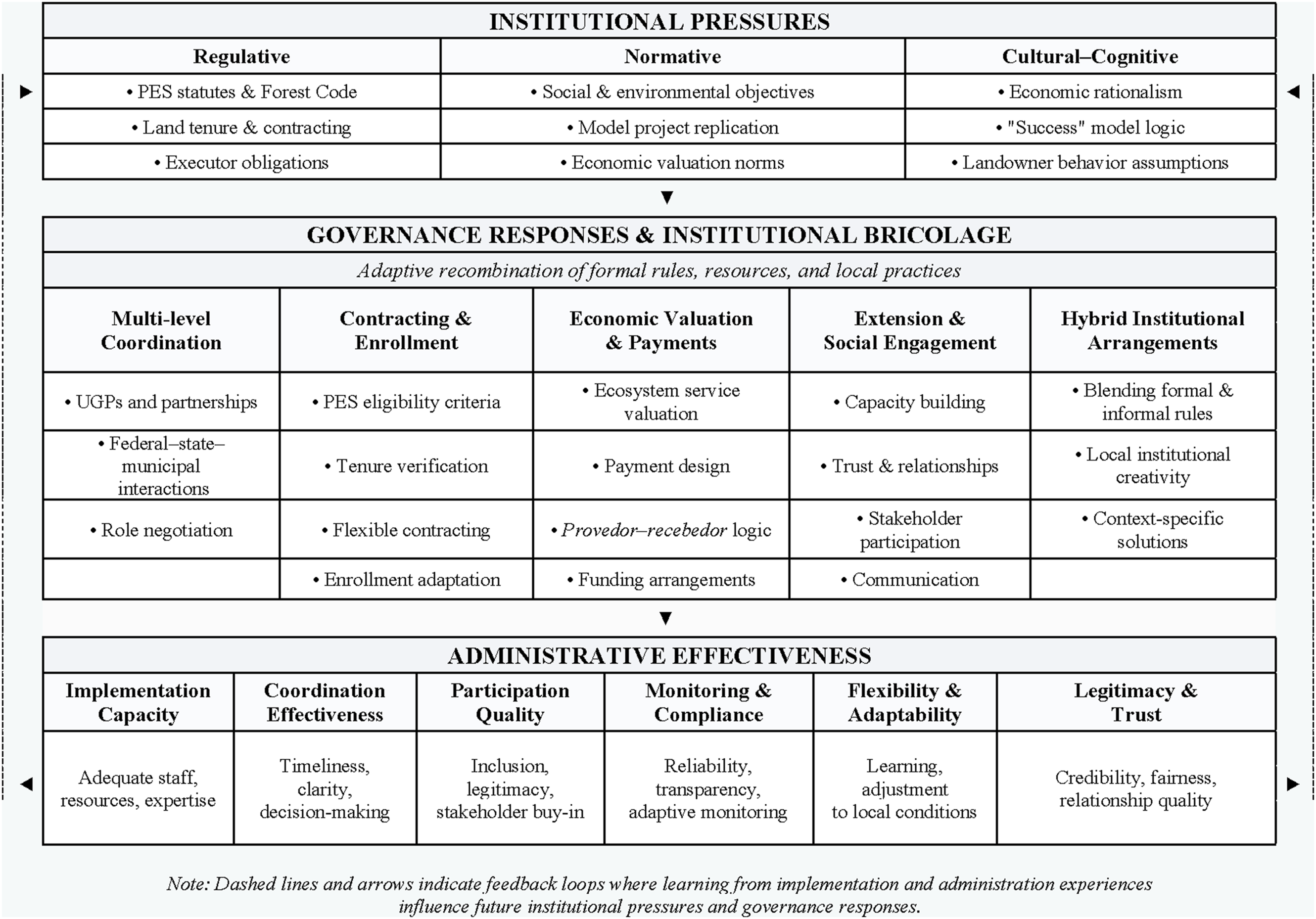
Conceptual Framework for Analyzing PES Governance and Administration
Drawing upon this analytical framework, this study employed a qualitative meta-synthesis approach to identify recurring institutional patterns, governance dynamics, and implementation processes shaping the administration of WPP PES schemes across diverse social and organizational contexts in Brazil.
Research Design and Methodological Approach
Existing research on WPP initiatives has focused primarily on ecological and economic questions, while less attention has been given to governance and administrative processes. Nonetheless, many WPP studies contain ancillary observations that indirectly provide insight into organizational dynamics, implementation challenges, and institutional relationships shaping PES administration. Because these studies vary substantially in disciplinary orientation, research design, and analytical focus, conventional meta-analysis was not well suited for this investigation. Instead, this study employed a qualitative meta-synthesis approach that connects insights and interpretations across diverse forms of evidence to identify recurring institutional patterns and governance dynamics (Finlayson & Dixon, 2008; Hoon, 2013; Rousseau et al., 2008).
Meta-Synthesis Literature Identification and Screening Procedures
Figure 2 summarizes the literature identification, screening, and source-selection procedures used to develop the study corpus for the meta-synthesis. The first phase of research consisted of targeted searches of scholarly databases Scopus, ProQuest, SocIndex, Sociological Abstracts, and Google Scholar. Initial inclusion criteria were intentionally broad to capture the wide range of disciplinary perspectives and publication types associated with WPP-related research. Sources were included in the preliminary corpus if they: (1) referenced the Water Producer Program (WPP) or one of the 84 ANA-supported WPP projects (ANA, 2025) and (2) contained empirical, evaluative, or policy-relevant discussion related to implementation of WPP PES schemes. Meta-Synthesis Literature Identification and Screening Procedures.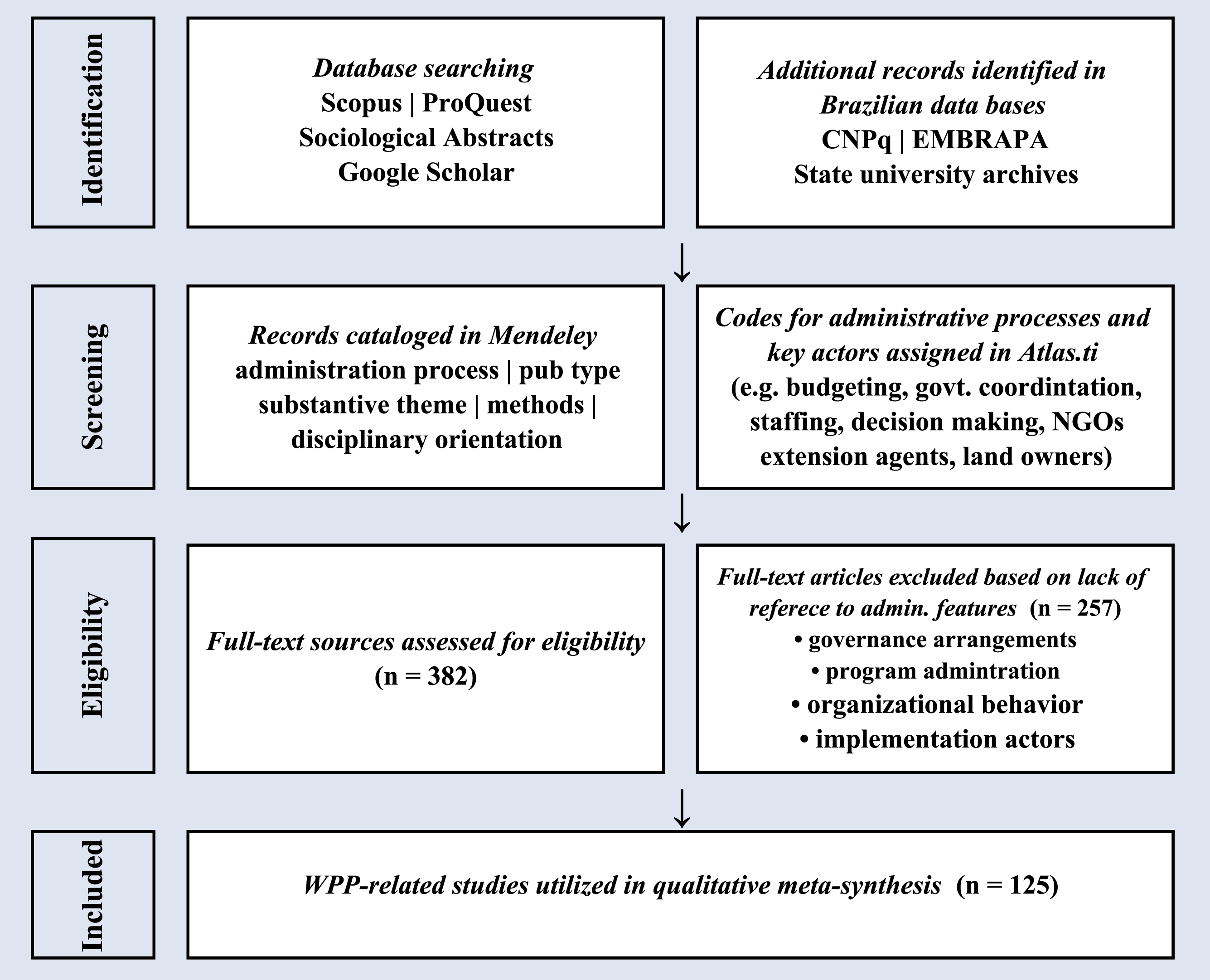
Subsequent screening focused more narrowly on the study’s analytical emphasis on governance and administration. Sources were retained only if they contained content discussing (1) administrative processes (e.g., contracting, monitoring, staffing, and coordination), (2) organizational behaviors or governance arrangements (e.g., planning, execution, and evaluation), or (3) actors directly involved in WPP execution (e.g., landowners, municipal authorities, NGOs, watershed committees, and extension agents). Because most of the relevant studies were published in Brazil, additional searches were conducted using databases maintained by the Brazilian national scientific agency (CNPq), the national agricultural research agency (EMBRAPA), and digital repositories from 23 universities located in states with WPP projects. In total, the bibliographic search included five international scholarly databases, two Brazilian government databases, and twenty-three university repositories, yielding 382 publications referencing the WPP or one of its funded initiatives.
Using Mendeley, publications were cataloged and tagged by WPP project, geographic location, publication type, substantive focus, research methods, and disciplinary orientation. The inventory was then exported to Atlas.ti for qualitative coding and relational analysis. First-level codes were assigned to references involving administrative processes (e.g., budget allocation, staffing levels, and technical capacity), organizational behaviors and governance (e.g., UGP procedures, inter-governmental coordination, and evaluation criteria), key actors (e.g., landowners, NGOs, and extension agents), and social relationships (e.g., collaborative initiatives, conflict resolution, and joint decision-making).
Preliminary code-frequency assessments were used to identify recurring administrative themes and institutional relationships warranting further interpretive analysis; however, code frequency was not treated as a proxy for analytical importance because references varied substantially in length, disciplinary orientation, and evaluative purpose. Consistent with qualitative meta-synthesis approaches, the analysis emphasized relational interpretation rather than quantitative aggregation (Finlayson & Dixon, 2008; Noblit & Hare, 1988; Toye et al., 2014).
Studies lacking references to program administration, organizational behavior, governance arrangements, or implementation actors were excluded. Based on these criteria, 125 of the initial 382 publications were retained for analysis. The final corpus continued to be highly diverse, including dissertations, conference proceedings, qualitative case studies, policy evaluations, and disciplinary analyses spanning ecology, economics, sociology, and public policy. This diversity reinforced the need for a flexible interpretive approach using meta-synthesis rather than conventional quantitative aggregation.
Subsequent analysis focused on identifying relationships among codes, including co-occurring themes, actor-process linkages, and connections between administrative practices and evaluative outcomes. These terms were then tagged for connections to first level codes related to administration, organizational behaviors/governance, and key actors. For example, for a first level code such as “program evaluation” would then have multiple second level assessment codes such as economic valuation, inventory of ecosystem services, stakeholders participation, as well as tags for references to terms like “successful” or “inefficient” to identify text associated with assessments of program management. This systematic coding enabled analysis of factors supporting or impeding effective administration of WPP PES schemes. Finally, code groupings were organized according to Scott’s institutional categories (regulative, normative, and cultural-cognitive), which guided interpretation of the institutional dynamics shaping WPP governance and implementation.
Because the final corpus included wide-ranging source types, they differed substantially in research design, conceptual framing, evaluative criteria, and units of analysis, making quantitative analysis inappropriate for the objectives of this investigation. Instead, the subsequent analysis focused on interpretive synthesis aimed at identifying recurring institutional patterns, governance dynamics, and organizational processes shaping WPP implementation across wide-ranging forms of evidence (Finlayson & Dixon, 2008; Hoon, 2013; Rousseau et al., 2008). This inductive and relational analytical approach is also consistent with institutional bricolage, which emphasizes how governance arrangements emerge through the recombination of existing practices, norms, and organizational relationships under conditions of constraint (Cleaver, 2012).
Results
The ensuing results section is organized around institutional themes that emerged from the meta-synthesis as key factors shaping the organization and administrative effectiveness of WPP projects. Guided by Scott’s (2013) institutional pillars framework, the analysis considers how regulative, normative, and cultural-cognitive forces structured PES governance and influenced program administration across the diverse organizational contexts where WPP projects operated. At the same time, drawing on the concept of institutional bricolage (Cleaver, 2012), the analysis also considers how WPP executors attempted to adapt and restructure existing organizational arrangements, governance processes, and social relationships in response to administrative constraints and implementation challenges.
Appendix A organizes the reviewed studies by institutional theme and catalogs the materials used in the meta-synthesis. Illustrative examples from these sources are referenced throughout the discussion below, while the appendix provides additional detail regarding the cases, studies, and themes identified in the analytical process. Finally, it is important to note that effectiveness is multidimensional and that assessments of what constitutes an “effective” natural resource management or development program may vary depending on the evaluative criteria employed (Börner et al., 2017; Calvet-Mir et al., 2015; Santos de Lima, 2017). Accordingly, this study focuses more narrowly on the institutional and organizational dynamics shaping the governance of WPP projects that ultimately affect their administrative effectiveness.
Key Institutional Themes: Formalizing PES as a Natural Resource Management Tool
Although PES is framed as a market-based approach to environmental governance, its implementation depends heavily on formal institutional structures capable of administering contracts, coordinating actors, and regulating participation. One of the most important regulative influences shaping WPP initiatives across Brazil was the program’s role in formalizing PES within law and public policy.
Regulative Influences: Enactment of PES Statutes
Brazilian states and municipalities had already begun considering PES-related laws at the inception of the WPP, but patterns in the synthesis data highlight important connections between the formation of WPP projects and the passage of PES laws. Analysis of these connections shows that the program created an important impetus for local governments to establish statutes that codified the use of PES as a natural resource management tool (e.g., Barreto et al., 2020; Klamt et al., 2019; Pagiola et al., 2013; Santos, 2018). While WPP projects helped generate new markets for ecosystem services, their administration required governmental oversight. The passage of municipal laws institutionalized PES as a legitimate management tool and facilitated key administrative functions such as contracting, fund disbursement, and technical assistance provision. Perhaps most importantly, they established administrative procedures that have continued to shape PES implementation over time.
While enabling the legal use of PES was a key administrative advancement, an assessment of code connections in the synthesis data found little evidence that local statutes spurred organizational changes to support these new administrative responsibilities. What this analysis uncovered was that on-the-ground execution of WPP activities relied heavily on municipal natural resource agencies, with little mention of adding economic expertise or training to support the new finance-related tasks associated with PES (e.g., Bernardo, 2016; Chiodi, 2015; Fernandes, 2021; Fiore et al., 2017; Marra, 2020; Mendonça, 2016; Viani & Bracale, 2015). Rather, WPP implementation frequently involved layering market-oriented PES mechanisms onto municipal environmental agencies designed primarily for conventional regulatory enforcement. This institutional mismatch strained existing administrative capacity and complicated implementation of finance-related PES activities. These institutional mismatches also likely increased the informational, coordination, and administrative burdens associated with implementing PES contracts, even though such transaction costs were rarely evaluated explicitly in the extant literature.
Further assessment of the synthesis data showed that codes for administrative difficulties were closely connected to issues of capacity and expertise. Executors frequently assembled hybrid governance arrangements involving NGOs, universities, consultants, and private-sector actors to compensate for gaps in administrative expertise and organizational capacity (e.g., Fiore et al., 2017; Klamt et al., 2019; Pagiola et al., 2013; Pereira, 2017; Viani & Bracale, 2015). However, these collaborative arrangements appeared less driven by formal WPP requirements than by pragmatic efforts to make PES implementation workable under conditions of administrative constraint. Collectively, these findings suggest that the WPP played an important role in formalizing PES governance without simultaneously developing the institutional infrastructure and organizational capacity necessary to support implementation effectively. While PES statutes shaped the formal institutionalization of WPP governance, existing environmental regulations also influenced how PES schemes were implemented in practice.
Regulative Influences: Compliance With Brazil’s Forest Code
Interestingly, one area where WPP governance appeared comparatively effective was in supporting compliance with Brazil’s forest-related regulations. Under Brazil’s National Forest Code (Law 12.651), landowners are required to conserve a designated portion of their property as “reserva legal” (legal reserve). Across the synthesis data, codes related to reserva legal frequently connected to references describing WPP PES schemes as more effective than traditional fines for encouraging compliance with forest conservation requirements (e.g., Aguiar, 2017; Comitê de Bacia do Rio Macaé, 2016; Klamt et al., 2019; Mendoça, 2016; Richards et al., 2015; Rose, 2016).
Despite its pragmatic value for encouraging Forest Code compliance, linking WPP enrollment to environmental regulation also created tensions. Participation in PES contracts provided landowners with a mechanism for satisfying legal conservation obligations and helped expand WPP enrollment. However, several studies noted confusion and skepticism among proprietors when officials who had previously imposed fines for Forest Code violations later offered PES payments for maintaining the legally required reserva legal (e.g., Fiorini et al., 2020; Gonçalves, 2013; Marra, 2020; Mendoça, 2016). These tensions suggest that participation in PES schemes did not simply reflect responses to economic incentives or legal requirements. Landowners’ decisions were also shaped by perceptions of legitimacy, prior experiences with state enforcement, and trust in program administrators.
Collectively, these patterns suggest that WPP implementation frequently operated through forms of institutional bricolage in which PES mechanisms were woven into pre-existing environmental governance structures rather than administered through entirely new institutional systems. These hybrid arrangements appear to have enabled pragmatic implementation, but they also generated coordination challenges and taxed administrative capacity raising questions about their overall effectiveness.
Key Institutional Themes: Land Tenure, Contracts, and Purchasing Ecosystem Services
Alongside the formalization of PES governance and support for Forest Code compliance, land tenure uncertainty emerged as a key regulative influence shaping WPP implementation.
Regulative Influences: Contracting and Administrative Effectiveness
Analysis of the synthesis data showed that uncertain land tenure complicated both administrators’ efforts to identify eligible participants and landowners’ willingness to enter PES contracts (e.g., Bernardo, 2016; Castello Branco, 2015; Chiodi, 2015; Guedes & Seehusen, 2011; Pagiola et al., 2013; Ribeiro, 2015; Viani & Bracale, 2015). Although PES enrollment was intended to follow technical assessments of ecosystem services, participation in practice was strongly shaped by land tenure security and landowners’ perceived ability to engage in contractual arrangements. Several WPP projects allowed exceptions for renters or individuals with uncertain tenure yet concerns regarding ownership and legal insecurity continued to complicate enrollment and contract administration (e.g., Bernardo, 2016; Chiodi, 2015; Guedes & Seehusen, 2011).
These conditions also likely increased the informational and administrative burdens associated with participant selection and contract management, even though such transaction costs were rarely assessed by WPP executors or analysts. From a bricolage perspective, WPP contracting practices appear to have emerged through adaptive negotiation between formal PES requirements and local realities of land tenure insecurity. Executors and participants informally adjusted eligibility expectations, participation criteria, and enrollment practices to make PES implementation workable under conditions of institutional ambiguity.
Normative Influences: Integrating Social and Environmental Objectives
The WPP’s broader objective of promoting rural socioeconomic development alongside ecosystem conservation also shaped enrollment and implementation practices (ANA, 2008). Across the synthesis data, social objectives were frequently linked to administrative challenges, particularly where executors attempted to balance technical ecosystem-service selection criteria with social inclusion goals (e.g., Chiodi, 2015; Ribeiro, 2015; Rose, 2016). In practice, ambiguities surrounding land tenure, uneven contracting capacity, and competing social and environmental priorities limited the feasibility of strictly technical enrollment processes (e.g., Aguiar, 2017; Bernardo, 2016; Fernandes, 2021; Mendoça, 2016; Pagiola et al., 2013). These tensions suggest that WPP implementation depended not only on formal program rules, but also on negotiated judgments regarding equity, participation, and local feasibility.
Regulative Influences: Administrator Obligations
Although ANA’s guidelines established obligations for both landowners and WPP executors (ANA, 2018), the synthesis data show an overwhelming focus on participant compliance with PES contracts rather than on the effectiveness of program executors as administrators. References to landowner obligations and monitoring were common, whereas assessments of executor accountability, administrative performance, and the effects of governance practices on long-term participation were comparatively rare. This asymmetry suggests that WPP evaluations emphasized recipient behavior more heavily than institutional capacity and governance performance, despite the importance of these factors for effective PES implementation. Expanded investigation of how contractual arrangements shape both administrator and participant behavior are needed to strengthen understanding of PES governance more broadly. Beyond contracting and enrollment, institutional dynamics also shaped how WPP projects interpreted and replicated broader models of PES governance.
Key Institutional Themes: Following Models of “Success”
National narratives surrounding the “success” of pioneering PES initiatives strongly influenced the organization and administration of WPP projects. Environmental NGOs and early PES advocates promoted model projects as administratively effective and environmentally successful, encouraging their replication across diverse regional contexts. However, these claims often rested more on symbolic legitimacy and ecological outcomes than on systematic assessment of governance.
Normative Influences: The Illusion of Exemplary Administration
Analysis of “success” narratives within WPP-related publications showed that model PES initiatives were typically evaluated using ecological indicators such as land conservation and benefits from direct payments to landowners (e.g., Bremer et al., 2016; Fiorini et al., 2020; Jardim & Bursztyn, 2015; Kfouri & Favero, 2011; Kroeger et al., 2019; Viani et al., 2019). While these studies frequently documented environmental and economic outcomes, systematic evaluation of governance structures, administrative procedures, and implementation costs was rare. As a result, governance effectiveness was often implicitly inferred from ecological and economic achievements rather than directly assessed. Alignment with recognized “successful” projects also provided local executors with institutional legitimacy and political credibility within emerging PES governance networks, reinforcing pressures toward organizational imitation even where local administrative conditions differed substantially.
Extrema, Minas Gerais, emerged as one of the WPP’s most influential model projects and was widely referenced as an example for subsequent PES initiatives (e.g., Bremer et al., 2016; Fernandes, 2021; Garcia & Longo, 2020; Gonçalves, 2013; Jardim & Bursztyn, 2015; Kfouri & Favero, 2011; Pagiola et al., 2013; Pereira, 2017; Richards et al., 2015; Viani et al., 2019; Viani et al., 2019). Its reported environmental and economic successes contributed to broader assumptions that its organizational structures represented best practices suitable for replication across Brazil.
However, synthesis data from Extrema and other widely referenced projects such as Pipiripau, Goiás, and Guandú, Rio de Janeiro, also documented recurring governance difficulties, including stakeholder conflicts, limited organizational capacity, contracting challenges, and coordination problems within multi-party UGPs (e.g., Chiodi, 2015; Fernandes, 2021; Gonçalves, 2013; Jaime, 2018; Melo, 2013; Mendonça, 2016; Pereira, 2017; Wilburn et al., 2017). Similar implementation challenges appeared in projects modeled after these initiatives, suggesting that organizational forms were often replicated without equivalent consideration of local administrative capacity, implementation burdens, or institutional context (e.g., Aguiar, 2017; Andrade et al., 2020; Benincá, 2019; Bernardo, 2016; Fernandes, 2021; Marra, 2020; Rose, 2016).
While program designers promoted replication of “successful” organizational models, synthesis evidence suggests that effective PES governance depended less on adherence to standardized designs than on context-specific adaptation. These dynamics once again reflect institutional bricolage, where governance arrangements emerge through locally embedded practices, relationships, and organizational capacities rather than through transplantation of externally defined models. These patterns of organizational behavior suggest that replication frequently reflects institutional pressures toward conformity and legitimacy rather than demonstrated administrative superiority.
Cultural Cognitive Influences: Adaptive Administrative Designs
In contrast to standardized “model” projects, synthesis data associated with more effective PES governance closely connects with flexible and locally adaptive arrangements. Projects in Vera Cruz, Rio Grande do Sul and Camboriú, Santa Catarina were repeatedly linked to collaborative leadership, strong university and industry engagement, and administrative approaches tailored to local organizational conditions (e.g., Bremer et al., 2020; Klamt et al., 2019; Kroeger et al., 2019; Santos, 2018). These findings suggest that no singular organizational design reliably produced effective PES governance. In these instances, implementation capacity and effectiveness depended on adaptive coordination and context-specific institutional arrangements consistent with institutional bricolage, rather than through strict adherence to externally defined administrative models.
Key Institutional Themes: Economic Rationale as Paramount
Economic rationality occupied a central place within WPP governance, and references to valuation, compensation, and financial incentives were among the most prevalent themes in the synthesis data. However, these patterns also revealed important asymmetries in the types of economic information emphasized within PES implementation and evaluation. In practice, economic rationalism operated less as a purely technical framework than as a normative institutional logic shaping administrative priorities and organizational behavior.
Normative Influences: Valuation and Administrative Costs
Because monetary compensation was key to WPP design, valuation processes became deeply embedded within program administration. Across the synthesis data, substantial attention was devoted to determining payment levels, estimating opportunity costs, and assessing the economic value of ecosystem services (e.g., Aguiar, 2017; Chiodi, 2015; de Souza Paiva & Coelho, 2015; Fernandes, 2021; Junqueira et al., 2017; Melo, 2013; Moreira, 2019; Kroeger et al., 2019; Ramos et al., 2016). These patterns reflected a widespread assumption among executors and analysts that carefully calibrated financial incentives were necessary to influence landowner behavior and encourage PES participation. Consequently, considerable organizational effort was invested in estimating ecosystem-service values and payment equivalencies, including assessments comparing the costs of watershed protection, water treatment, and agricultural production (e.g., Aguiar, 2017; Börner et al., 2017; Castello Branco, 2015; Chiodi, 2015; de Souza Paiva & Coelho, 2015; Fernandes, 2021; Junqueira et al., 2017; Kroeger et al., 2019; Melo, 2013; Moreira, 2019; Ramos et al., 2016; Santos, 2018).
In contrast, explicit consideration of transaction and administrative costs was comparatively limited. Although several studies referenced coordination, monitoring, contracting, and implementation burdens as important governance challenges (e.g., Fernandes, 2021; Kroeger et al., 2019; Pagiola et al., 2013; Viani & Bracale, 2015), systematic assessment of these costs was uncommon relative to the extensive attention devoted to opportunity costs and ecosystem-service valuation (e.g., Aguiar, 2017; Pagiola et al., 2013; Viani & Bracale, 2015; Zanella et al., 2014). These asymmetries suggest that ecosystem valuation functioned not only as a technical tool but also as a legitimizing institutional logic that shaped organizational priorities and evaluative attention within PES governance.
Executors therefore behaved logically by prioritizing data collection and analysis related to ecosystem-service valuation, including comparisons between watershed protection and water treatment costs or assessments of agricultural opportunity costs used to establish PES payment equivalencies (e.g., Bernardo, 2016; Comitê de Bacia do Rio Macaé, 2016; Kfouri & Favero, 2011; Kroeger et al., 2019). Precise valuation data was clearly both useful and important for PES initiatives. However, its normative importance may also have diverted organizational attention away from administrative coordination and implementation burdens that were equally important to long-term governance capacity.
From a bricolage perspective, these patterns reflect how WPP actors developed governance practices using the institutional tools, expertise, and evaluative frameworks most readily available to them. In practice, ecosystem valuation received greater institutional attention than administrative coordination or implementation burdens because valuation metrics aligned more closely with dominant PES governance logics and existing technical capacities.
Cultural Cognitive Influences: Assumptions About Landowner Decision Making
The WPP’s “provedor-recebedor” (provider-receiver) framework symbolically reinforced the idea that landowners actively produced ecosystem services and should therefore receive compensation for conservation activities. This economic framing strongly influenced program design and administrative practices. Nonetheless, synthesis data examining landowners’ experiences suggests that extension activities, technical assistance, and collaborative relationships were often valued as highly as direct financial payments (e.g., Aguiar, 2017; de Souza Paiva & Coelho, 2015; Santos, 2018; Zanella et al., 2014).
Many landowners recognized that PES payments associated with government programs could be temporary, whereas extension activities generated more durable improvements in land management capacity. Outreach and technical assistance also strengthened trust and communication between participants and executors, allowing for discussion of broader management objectives beyond immediate economic incentives (e.g., Chiodi, 2015; Mendonça, 2016; Moreira, 2019; Ribeiro, 2015). These patterns suggest that landowners’ participation decisions were shaped not only by financial incentives, but also by social connections, practical knowledge, and perceptions of long-term benefit.
Collectively, these findings highlight the limits of narrow economic models of PES governance. WPP implementation depended not only on financial incentives, but also on trust, experiential knowledge, and locally adaptive governance practices. These dynamics further reinforce a bricolage perspective in which PES administration emerged through negotiated and context-dependent institutional arrangements rather than through purely market-based coordination mechanisms.
Discussion
The complexity of contemporary social-environmental challenges has increased interest in innovative governance approaches such as PES. While market-based incentives are often promoted as efficient alternatives to conventional regulatory approaches, the WPP experience illustrates that the effectiveness of PES schemes depends heavily on administrative capacity, institutional coordination, and locally adaptive governance practices. Although PES initiatives may generate important ecological and social benefits, the WPP demonstrates how difficult such programs can be to implement effectively across diverse organizational and institutional contexts. This is where insights from neo-institutional theory and institutional bricolage can aid in uncovering the myriad institutional forces underpinning these programs and understanding the adaptation processes so critical for ensuring the effective administration of PES schemes (Cleaver, 2012; Safford, 2010; Scott, 2013).
The WPP experience further suggests that formal institutionalization alone is insufficient to ensure effective PES governance and administration. The development of PES statutes helped legitimize markets for ecosystem services and facilitated contracting, fund disbursement, and technical assistance. However, these legal frameworks did not resolve persistent land tenure ambiguities, nor did they substantially expand the administrative and financial expertise available to executors responsible for PES implementation. Without adequate organizational capacity, even well-designed payment systems and governance frameworks remained difficult to administer effectively.
Linking PES enrollment with Forest Code compliance helped expand WPP participation and strengthened forest conservation efforts. However, these arrangements complicate assumptions regarding additionality, as many landowners received PES compensation for conserving forest areas they were already legally required to protect. In this sense, WPP implementation often reflected pragmatic adaptation to existing governance conditions rather than the idealized efficiency commonly associated with market-based conservation models.
The WPP also illustrates how institutional legitimacy and model-project narratives shaped PES governance. Advocates, analysts, and practitioners understandably sought replicable examples of “successful” PES administration, yet many widely emulated governance models such as those from Extrema were adopted without systematic evaluation of their administrative effectiveness. Although these initiatives often generated environmental and social benefits, the relationship between specific organizational structures and implementation outcomes remained poorly understood. These patterns suggest that replication frequently reflected institutional pressures toward legitimacy and conformity rather than demonstrated administrative superiority.
In contrast, findings from this study suggest that implementation capacity was more strongly associated with administrative flexibility, locally adaptive governance, and collaborative executor-participant relationships than with adherence to standardized organizational models. These dynamics are consistent with institutional bricolage, where governance structures emerge through the reformulation of existing institutional arrangements, social connections, and organizational resources (Cleaver, 2012). Rather than implementing fully coherent top-down designs, WPP actors often assembled hybrid governance systems shaped by local capacities, norms, and practical implementation challenges.
Although PES governance is grounded in assumptions about economic rationality, findings from the WPP experience indicate that landowners often value extension activities, technical assistance, and collaborative relationships as much as direct financial compensation. At the same time, WPP executors devoted substantial effort to ecosystem valuation and payment calibration while comparatively limited attention was given to transaction costs, administrative coordination, and developing organizational capacity. These asymmetries suggest that valuation-centered governance logics shaped what forms of knowledge and administrative activity received institutional priority within PES execution. Landowners involved with the WPP schemes welcomed remuneration, and recognition for their contributions to protecting critical ecosystem services, but extension activities that built landowner capacity and fostered collaboration and trust were also valuable.
More broadly, isomorphic tendencies within PES governance, as well as with related research, appear to have reinforced attention to ecosystem valuation and financial incentives while comparatively neglecting implementation capacity, administrative coordination, and non-monetary dimensions of participation (Meyer and Rowan, 1977; Powell & DiMaggio, 1991). WPP executors’ emphasis on establishing precise monetary values for key services such as water conservation and purification is both logical and necessary given the incipient understanding of the value ecological services (Bezerra et al., 2025). However, this focus appears to have diverted attention from transaction costs, assessments of the administrative capacity, and whether executors possessed sufficient administrative expertise, that, while more mundane, are likely crucial for program effectiveness. These patterns merit further investigation and are an area where connecting sociological and economic analysis seems promising, as theorizing in institutional economics suggests that analyzing transaction costs is critical for understanding organizational efficiency and success (North, 1990).
Conclusion
Research on PES has focused heavily on ecosystem valuation and the economic dimensions of environmental services. While these elements are important, this study suggests they are insufficient for understanding PES governance and implementation. As Scott (2013, p. 71) observes, organizations require not only material resources and technical information but also legitimacy and social credibility. The effectiveness of PES schemes therefore depends not only on ecological and economic design but also on how programs are organized and administered.
Findings from the WPP experience suggest that flexible and context-sensitive governance arrangements may be as important to PES success as legal frameworks, ecosystem inventories, or precise economic valuation. Particularly in Global South contexts where administrative resources vary substantially, governance systems adapted to local organizational capacity and institutional conditions may prove more feasible and sustainable than highly standardized models. These insights from the WPP further suggest that PES programs are not simply implemented through technical procedures but are actively constructed through ongoing processes of institutional adaptation and bricolage.
More broadly, the WPP illustrates the importance of expanding social-science investigation of PES governance, implementation, and administration. Greater attention to organizational capacity, governance practices, social relationships, and institutional contexts will be essential if PES initiatives are to achieve their long-term environmental and social objectives across diverse settings.
Supplemental Material
Supplemental Material - Institutional Influences and the Governance and Administration of the Programa Produtor de Água Payment for Ecosystem Services Program in Brazil
Supplemental Material for Institutional Influences and the Governance and Administration of the Programa Produtor de Água Payment for Ecosystem Services Program in Brazil by Thomas G. Safford in The Journal of Environment & Development.
Footnotes
Acknowledgements
The author would like to thank the College of Liberal Arts at the University of New Hampshire for their funding support for this research. This project would also not have been possible without the assistance of collaborators—Paulo Vieira, Marcus Polette, and Alexsande de Oliveira Franco, all of whom provided invaluable input and strategic thinking regarding water and natural resource management in Brazil.

Ethical Considerations
This project used only publicly published secondary sources.
Funding
The author disclosed receipt of the following financial support for the research, authorship, and/or publication of this article: Funding for this project was provided in part by the College of Liberal Arts at the University of New Hampshire.
Declaration of conflicting interests
The author declared no potential conflicts of interest with respect to the research, authorship, and/or publication of this article.
Data Availability Statement
Sources used in the meta-synthesis for this study are listed and available in Appendix A.
Supplemental Material
Supplemental material for this article is available online.
Author Biography
References
Supplementary Material
Please find the following supplemental material available below.
For Open Access articles published under a Creative Commons License, all supplemental material carries the same license as the article it is associated with.
For non-Open Access articles published, all supplemental material carries a non-exclusive license, and permission requests for re-use of supplemental material or any part of supplemental material shall be sent directly to the copyright owner as specified in the copyright notice associated with the article.
