






Abstract
Financial inclusion is the provision of affordable, customized, and easy to use financial products and services to all the segments of society. It is an enabler of sustainable development goals that target sustainable development of economies. Nevertheless, numerous barriers within the financial sector impede the attainment of an optimal level of financial inclusion, and a significant gap remains in the development of effective solutions. This research article aims to identify and classify all the barriers and place them in a conceptual matrix of barriers to financial inclusion. This matrix provides a view of all the barriers to financial inclusion and provide a distinct insight to work on their mitigation. Furthermore, this research proposes and provides conceptual demonstration on the concept of intelligent financial inclusion, which leverages intelligent technologies to address these barriers by using fuzzy inference mechanism. Analytical results of fuzzy logic demonstrate the implementation of AI tools and other cognitive technologies into national financial infrastructures. The study informs policymakers for the modernization of financial systems, enhanced decision-making, and increase access for underserved populations to financial sector. Research provides support for intelligent financial inclusion and highlights its alignment with the United Nations’ 2030 agenda for sustainable development.
Keywords
Introduction
Financial inclusion is the provision of affordable, customized and basic financial products and services to all the segments of society (Fazal et al., 2025). Financial inclusion is significant in advancing global sustainable development goals by easing everyday financial transactions, promoting entrepreneurial activities, encouraging savings and investments, and enhancing the overall well-being of individuals (CGAP, 2022). It is a significant enabler of 17 Sustainable Development Goals (SDGs) (United Nations, 2016). It serves as a prominent factor in achieving targets of SGDs 1, 2, 3, 5, 8, 9, 10 and 17 (Fazal et al., 2025). As an instance, financial inclusion helps in achieving SDG 1 through its target 1.4 of providing financial services too all the segments of economy. However, limited access to financial services has been identified as a significant barrier to inclusive growth, as it hinders individuals’ ability to save and invest, thereby perpetuating poverty (Neaime & Gaysset, 2018; Yasir et al., 2022). “Financial inclusion and sustainability are two sides of the same coin, aimed at the UN SDG’s core objective: promoting prosperity while balancing risks” (Arner et al., 2020, p. 12). In contrast, financial exclusion is the process of leaving certain segments of society unserved, leading to inequality and discrimination (Kling et al., 2020). Financial exclusion can be voluntary or involuntary in a society. Voluntary exclusion arises from individuals’ personal choices, whereas involuntary exclusion is typically driven by barriers from personal circumstances, institutional practices, or market imperfections (Allen et al., 2016; World Bank, 2014). These barriers or obstacles put certain challenges for the growth of economies by hindering the participation of people in the financial sector (Barruetabeña, 2020; Schuetz & Venkatesh, 2019). Removal of these barriers can lead economies to achieve financial inclusion.
Industry 4.0. is driving the technological revolution in the countries with the development of technologies like Artificial Intelligence (AI), Machine Learning (ML), blockchain, nanotechnology and virtual reality (Mhlanga., 2020). AI is a self-learning system capable of analyzing data, deriving insights, and making decisions without explicit programming (Hassani et al., 2020; Truby et al., 2020). Technological revolution has dramatically changed the operations of traditional financial services, from automation of systems to decision-making (Agidi, 2020; Biallas & O’Neill, 2020; How et al., 2020; Kshetri, 2021). Arner et al. (2020) in their paper showed the direct and indirect impact of financial inclusion and fintech with all of the 17 SDGs, depicting the importance of financial inclusion in the process of human development agenda. Digital and technological innovations help in the achievement of green economy objectives of countries also (Jiakui et al., 2023).
This research reviews literature to identify key barriers to financial inclusion and examines how AI can help overcome them by addressing exclusion factors through intelligent systems. Moreover, linking financial inclusion and AI with SDGs help in the achievement of financial stability as well as long-term economic objectives (Arner et al., 2020; IMF, 2021). The transformative impact of AI on financial services cannot be denied; however, its full potential remains untapped unless it is applied to eliminate barriers to financial inclusion. Literature lacks a comprehensive study that provides a single solution to overcome all barriers to financial inclusion. Addressing this gap, this research paper aims to identify these barriers and proposes AI-driven solutions. The adoption of such approaches leads to Intelligent Financial Inclusion, a strategic pathway toward achieving human development goals and fostering economic growth. There is a pressing need to explore fintech strategies and digital finance models that support financial inclusion and the SDGs. Barruetabeña (2020) also mentioned that adoption of technology facilitates only a specific segment of population and leaves others. This research addresses the issue by proposing an AI-based financial inclusion model, emphasizing the integration of advanced technologies into national infrastructures. Targeted AI implementation can help institutions effectively overcome specific barriers and better meet the needs of all customers. While many studies explore barriers to financial inclusion, a unified solution with empirical support is lacking. Therefore, this research proposes intelligent financial inclusion as a comprehensive approach by introducing technology in financial infrastructure. The research moves with the objective of identifying and classifying all barriers to financial inclusion by providing one matrix and introducing system barriers to financial inclusion also. After this, the research defines the role of AI in mitigation of these barriers and introduces the concept of intelligent financial inclusion to remove all barriers by intelligent systems and to provide support for the concept of Intelligent Financial Inclusion (IFI). Furthermore, the research article intends to provide empirical support for this new concept introduced by Fazal and Ahmed (2023). Digital products are computerized based products that provide ease of access and use in financial sector. Fintech enabled financial inclusion or inclusive fintech targets all people in financial sector with the help of any technology. A recent study reported that financial inclusion is associated with ecological pollution across countries (Shang, Samour, & Abbas, 2025). IFI is a solution to such problems also by introducing intelligent systems for achieving optimal level of financial inclusion. IFI is the implementation of characteristics of the human mind, cognitive sciences, and AI tools and applications in the financial sector to provide efficient and suitable services by removing the barriers to the traditional financial system. Purpose of this research is to be fulfilled by using fuzzy inference mechanism for the role of intelligent systems in mitigation of selected barriers to financial inclusion. Computations are performed in MATLAB software using fuzzy logic.
The section of literature review provides the matrix of barriers to financial inclusion, understand the dimensions of all barriers and defines the concept of intelligent financial inclusion. Section three lays out the research methodology of fuzzy inference mechanism employed in current research. Simulation results and defuzzification of parameters are discussed in section four. Conclusion in section five sum up the findings of research and implications of research.
Literature Review
A Conceptual Matrix of Barriers to Financial Inclusion
A barrier to financial inclusion is defined as any obstacle that limits or prevents individuals from accessing basic and formal financial services. Financial exclusion in an economy can be voluntary or involuntary. Literature mentions that factors of access to financial products are from supply-side and usage involves demand-side factors (Camara & Tuesta, 2014). Voluntary financial exclusion is caused by the will of people from not using basic financial services (Kebede et al., 2021; Martínez et al., 2013). It may include lack of funds, high costs, or distance of branches (Ezzahid & Elouaourti, 2021). These barriers represent behaviors of people, non-affordability or unawareness (Beck et al., 2006). On the other side, involuntary financial exclusion is not caused by personal choices, rather this is caused by the inability of service providers (Allen et al., 2016; Johnson & Arnold, 2012; World Bank, 2014). Incapacity or failure of financial service providers represent significant supply-side barriers. Expensive financial services, information barrier, non-customized products (Beck & De La Torre, 2007; Honohan, 2005), less lending facilities to poor people due to high risk (Fischer, 2011; IFC, 2015) are significant supply-side barriers.
A review of literature highlights that there are not clear boundaries among demand-side and supply-side barriers. Some of the significant barriers are also not mentioned in the literature. For instance, the economic system of a country has a huge impact on financial sector like political situations or currency risk. In this regard, this research paper introduces “system barriers” as important obstacle to financial inclusion. These are defined as barriers within the overall economic system of a country that have a significant impact on financial inclusion. Other factors like distance, unaffordability, documentation requirements are the perceptions of people that they are unable to use financial services. This discussion implies the need for clear distinctions between voluntary and involuntary financial exclusion, demand-side and supply-side barriers, usage and access barriers, as well as perceived and systemic barriers. To address this gap in literature and for the provision of comprehensive understanding of all barriers to financial inclusion, this research presents a matrix for clear understanding of all dimensions. This contribution is significant with respect to effective solutions that can only be proposed once the problems are precisely identified. Figure 1 represents this matrix. A conceptual matrix of barriers to financial inclusion. Source: Authors’ description
Another objective of this research article is to provide support for intelligent financial inclusion. Researchers have selected barriers based upon the importance and their solution in intelligent system. Yasir et al. (2022) identified 16 barriers to financial inclusion which have a direct solution in AI. After analyzing the identified barriers, several were either eliminated or consolidated for analysis based on their overlapping characteristics. For instance, transactional and operational costs were merged under the broader category of high costs due to their inherent similarities. Following the modifications, a total of 10 barriers were finalized for analytical purposes. These barriers serve as key parameters in the present study.
Understanding Barriers to Financial Inclusion: Basis for Fuzzy Inference Mechanism
Information Asymmetry
Information asymmetry is the presence of uneven, asymmetrically distributed, hidden or private information in financial markets (Connelly, Certo, Ireland, & Reutzel, 2011; Stiglitz, 2002). Bergh et al. (2019) state that structural barriers to information propagation and strategic and behavioral barriers are factors of information asymmetry in financial markets. A structural barrier is the obstacle in the financial infrastructure that hinders the access and diffusion of information in the market (Ecker et al., 2011; Ryu et al., 2018; Shin et al., 2016). People in financial markets keep some information hidden for the purpose of their own organizational benefits leading to strategic barriers to information asymmetry (Connelly, Certo, Ireland, & Reutzel, 2011). Different factors like social interactions, cognition, bounded rationality and absorptive capacities shape the behaviors of people and they tend to hide some sort of information leading to behavioral barriers (Bergh, Ketchen Jr., Orlandi, & Boyd, 2019). Considering all this discussion, this research acknowledges information asymmetry as a barrier to financial inclusion, with its dimensions of structural barriers and strategic and behavioral barriers.
Inefficient Processes
Inefficient processes of financial markets mean the processes are not up to the mark, screening and monitoring are unproductive, volumes of data entry are high leading to errors, manual processes are dominating and turnover is high (Anagnoste, 2017; Cincinelli & Piatti, 2021). Customers got frustrated by manual processes and long queues (Lee, 2021) as it leads to higher costs and low quality (Seasongood, 2016; Butler & O’Brien, 2019). Inefficient processes are highlighted when there are a lot of errors (Dong, 2018). Involvement of humans is redundant and monotonous tasks reduce the speed and take too much time, that otherwise can be spent in some productive work (Butler & O’Brien, 2019). Considering this, this research proposes that manual processes, high error rate and time consumption make the processes inefficient making it a strong barrier to financial inclusion.
High Costs
Besides the non-involvement of people, small businesses are unable to participate in formal credit due to the high transactional and operational costs (Wang, 2016). Operations of physical branches, maintaining high quality staff and their daily office expenditures lead to non-involvement of people in the financial sector (Chikalipah, 2017). Transaction costs include all costs related to an economic trade that restricts the entry of people in the financial sector (Demirgüç-Kunt, Klapper, Singer, Ansar, & Hess, 2017; Kshetri, 2021; Schuetz & Venkatesh, 2019). Operational costs are incurred for driving financial products and services that excludes small customers from being involved in formal financial sector (Kshetri, 2021; Schuetz & Venkatesh, 2019). Therefore, this study proposes transactional and operational costs as drivers of high costs in financial system that leads to low levels of financial inclusion in an economy.
Poor Credit Risk Analysis
Lack of access to formal credit leaves a major segment of the unserved population leading to financial exclusion (Chen & Jin, 2017). Traditional financial systems are unable to establish a good credit risk analysis process due to unavailability of data, collateral, documentation, long processes and huge costs (Biallas & O’Neill, 2020). Manual operations of credit risk analysis process consume a lot of effort and leads to error rate in the acceptance of applications (Biallas & O’Neill, 2020) as the characteristics of each of the debtor are different from one another (Gu et al., 2018). Another important factor in credit risk analysis of legacy financial systems is biasness of credit managers (Dobbie et al., 2021). In the light of this discussion, traditional methods, time consumption, biasness and high costs are factors of poor credit risk analysis which lead to low levels of financial inclusion in an economy.
Risk
Country risk is the overall risk of the state of a country (Schroeder, 2008) that affect income distribution and financial development (Chiu & Lee, 2019). Financial markets are also exposed to market risk owing to instability in financial markets sue to price movements (Aduda & Kalunda, 2012; Dittus & Klein, 2011). Foreign exchange rate fluctuations also have an impact on market valuations of financial assets (Mhlanga, 2020). Regulators occasionally impose restrictions and cap the quantity of foreign currency loans to prevent currency devaluation (Morgan et al., 2018). Fraud is one of the biggest risk of financial markets that is the deliberate adoption of illegal activities for financial gains (West & Bhattacharya, 2016). Financial fraud or financial crimes are crimes of elite that happened at the cost of people’s money and trust (Yasir et al., 2021). Frauds highly discourage people from taking financial decisions and involve themselves in financial sector. This research article proposes that country risk, market risk, currency risk and fraud are dimensions of risk in financial markets that cause financial exclusions in an economy.
Regulatory Issues
Financial regulations are important to maintain security and to protect financial sector. However, strict regulations come at the cost of financial exclusion (Alexandar, 2021). Creating a framework that guarantees a stable financial system and attracts many people to the financial sector is a difficult assignment for regulators. To achieve financial inclusion, financial system regulations should be adjusted to balance financial stability and risk. However, to improve financial inclusion, they must promote financial intermediation (Kodongo, 2018). Although it is undeniable that paperwork and KYC monitoring are required for AML/CFT, the absence of a universal identification system limits the appeal of neglected and unserved members of society. In the age industry 4.0. and AI, it is another challenge for financial regulators to consider the role of innovation in designing regulations (Truby et al., 2020). One of the examples is cryptocurrency. Despite the huge trading and investor’s interest, these currencies do not find the support of legislation in many developing countries (Yasir & Ahmed, 2021). Therefore, regulatory issues are a barrier to financial inclusion when rigid rules and challenge of innovation becomes critical.
Financial Illiteracy
Financial literacy is a direct enabler of financial inclusion in an economy (Chikalipah, 2017; Ozili, 2020). People who do not possess basic knowledge of financial services remain excluded from formal financial sector as they are unable to take their financial decisions wisely (Bansala, 2014; Yaroslava et al., 2018). Financial illiteracy is caused by the absence of financial knowledge, financial behavior, and financial attitude (Morgan & Long, 2020; Rai et al., 2019). Financial knowledge is the basic information about financial products and services and the implications of concepts of interest, risk, time value of money, inflation and diversification (Morgan & Long, 2020). Financial behavior is the application of financial knowledge and it can be seen in terms of timely bill payments, taking information before investing, savings inclination, looking for financial affairs, thinking process before purchase, and long-term setting of financial goals (Kadoya & Khan, 2020). Financial attitude is the tendency to improve financial well-being and resilience. Spending and saving viewpoints of a person and timely preference for future benefits represent positive financial attitude that removes present biasness to favor for future (Xiao & Porto, 2019). Considering literature, this study takes poor financial knowledge, bad financial behavior and negative financial attitude responsible for financial illiteracy that excludes people’s involvement from financial sector.
Inefficient Customer Service
Customer service is an important element in services industry (El-Gohary et al., 2021). Literature states that 89% of customers change their service provider after a bad experience with the quality of customer service (Aivo, 2021). Customer satisfaction in the banking industry is influenced by employee conduct and expertise, internal bank guidelines, account statement accessibility, and the range of service offerings (Anjum et al., 2017). For a variety of reasons, including lengthy application processing wait times or negative interactions with the rules governing the usage of financial products or services, dissatisfied clients depart the financial industry (Ozili, 2020). Inefficient customer service causes a big cost to financial institution in terms of lost customers that makes it one of the significant barriers to financial inclusion.
Dishonest Advisory Services
Agency theory states that the agent might not behave in the best interests of principal that lays the foundation of dishonest advisory services in financial sector. Advisory services should be improved in financial markets for better advice and non-discrimination in financial markets (Varghese & Viswanathan, 2018). In the presence of dishonest advisory services, customers are compelled to use expensive financial products and services leading to loss of wealth. Therefore, this article assumes that dishonest advising services impede financial inclusion in an economy.
Heavy Documentation
According to global findex database 2021, 1.4 billion unbanked people reported lack of documentation as one of the primary barriers for not having an account in formal financial institution. Lack of documentation is one of the highly cited problem of not having account ownership (Noor et al., 2020). A certain demographic group is impacted by the documentation requirement, particularly women and those who reside in rural areas. This barrier has also been demonstrated by empirical research articles to be one of the primary barriers to financial inclusion in economies (Zulfiqar et al., 2016).
The Role of AI in Mitigating Barriers to Financial Inclusion
AI has changed the operations of financial industry dramatically (Ryll et al., 2020). Specifically, the role of AI is mitigating barriers to financial inclusion and enhancing its levels is mentioned in the literature (Fazal et al., 2025; Kshetri, 2021; Senyo & Osabutey, 2020; Yasir et al., 2022). A renowned name in the literature is of Mhlanga (2020) who used documentary analysis to provide evidence on the role of AI on financial inclusion. Some of the supporting examples include dramatic impact of M-Pesa, digitalization of China’s financial system and increase in financial access in India as a result of “India stack” (AFI, 2018). Literature mentions that any kind of fintech innovation plays a positive role in enhancement of financial inclusion in the society (Barruetabeña, 2020; Elia et al., 2022; Hua et al., 2019). Ease of opening accounts, attracting a large number of consumers, robo-advisory services, AI credit scoring models and changing trends of technology have shifted the society towards more involvement of people in financial sector (Hentzen et al., 2021; Lee, 2021; Shanmuganathan, 2020). ML techniques use big data for building credit scores of customers in lieu of traditional data (Agarwal et al., 2020; Bazarbash, 2019; Óskarsdóttir et al., 2020). This approach works for the improvement of credit scoring and assist in the involvement of more people especially youngsters and old ones in terms of access to formal financial credit. Fazal et al. (2023) presented systematic literature review on the topic of AI and financial inclusion. This paper has provided evidence on the strong role of AI and ML in enhancing the level of financial inclusion in an economy.
Description of AI in response to barriers to financial inclusion

Source: Authors’ compilation from research articles.
Intelligent Financial Inclusion: A Way Forward
The proposal of this research article is to implement intelligent systems in the financial infrastructure of any country. Intelligence is a human ability that signifies learning and thinking. Intelligence science is an interdisciplinary field taking concepts from brain science, cognitive science, and artificial intelligence (Shi, 2009). Specifically, the term intelligence in the mimicry of human intelligence in machines, that is, AI. Russell and Norvig (2003) mentioned four modes of AI: Acting humanly, thinking humanly, thinking rationally, and acting rationally. Antsaklis (1999) explained intelligent control as a field where control mechanisms are able to learn, plan and change as the characteristics of human intelligence (Meyer et al., 2009). These control modes work on the basics of computer operations, mathematics, and biological sciences. These systems serve as a base for robotics, communications, fuzzy, expert and hybrid systems.
Intelligent financial inclusion is the implementation of characteristics of the human mind, cognitive sciences, and AI tools and applications in the financial sector to provide efficient and suitable financial products and services to all the segments of population by removing the barriers to the traditional financial system. This system forecasts solutions and their applicability for clients by learning from the data and parameters that are already available. The only way to overcome financial exclusion and achieve the ideal degree of financial inclusion is through such a system. The ultimate outcome of this IFI will be the effective and reasonably priced provision of financial services and products to all societal sectors, together with a decrease in fraud and malpractice and the provision of appropriate services to the appropriate individuals and locations. Scholarly work is demonstrating this fact that financial inclusion and sustainable finance is associated with reduction in hazardous effects of climate including its role in decarbonization (Said & Acheampong, 2024; Zhang et al., 2026). Research model of this research takes the support from systems theory of financial inclusion (Kim et al., 2018; Ozili, 2018). It states that financial inclusion relies on all the sub-systems of economy including social and economic systems also, which in return affects the provision of financial services in an economy. Systems theory addresses the main purpose of this research by involving all the people in financial sector. Figure 2 represents the barriers selected for analysis in current research with their dimensions, to achieve intelligent financial inclusion by removing these barriers from economic system. Research model, Layer 1 consists of barriers, while Layer 2 presents their dimensions
Research Methodology
Fuzzy Inference Mechanism
For the current study, the researchers adopted pragmatic paradigm that integrates interpretivist insights with quantitative reasoning. At first, they have explored the literature subjectively to provide inputs for the fuzzy inference mechanism. Parameters that are barriers to financial inclusion have been taken from a deep review of literature in line with interpretivism. This research is based upon theoretical and conceptual simulation of fuzzy logic using ranges derived from literature review. The defined parameters represent generalized linguistic scales that provide conceptual understanding of the intensity of variables rather than exact numerical values. Within this framework, fuzzy logic serves as a bridge between qualitative perceptions and quantitative analysis by translating them into measurable linguistic variables. Fuzzy logic is an ML tool that supports loose end data having unclear boundaries. The idea of fuzzy logic was presented by Zadeh (1965) who worked on Memberships Functions (MFs) to develop fuzzy logic as a qualitative tool for analyzing hypothesis (Jahantigh, 2019). Fuzzy logic has been widely applied across diverse research domains as an effective approach for modeling uncertainty and supporting complex decision-making and analytical processes (Estefania-Salazar et al., 2025; Wurster & Hagemann, 2020).
In this research, Mamdani fuzzy logic has been used. Fuzzification, execution, and defuzzification are its pillars (Mamdani, 1974). Based on MFs, fuzzification assigns a numerical value to the system input. Uncertainty regarding a situation is represented by any number between 0 and 1. A value of 0 indicates that it has no relationship to fuzzy sets, whereas a value of 1 indicates that it belongs to a fuzzy system. The foundation of the inferencing process is fuzzification, from which data is sent to processing control systems (Almeida et al., 2017). After fuzzification, rules are formulated to generate output functions. At the end, defuzzification generates output based on input sets and corresponding MFs. Figure 3 represents the fuzzy inference model of current study. Model of fuzzy inference mechanism crisp input → fuzzified values → fuzzy inference → crisp output
Input Variables
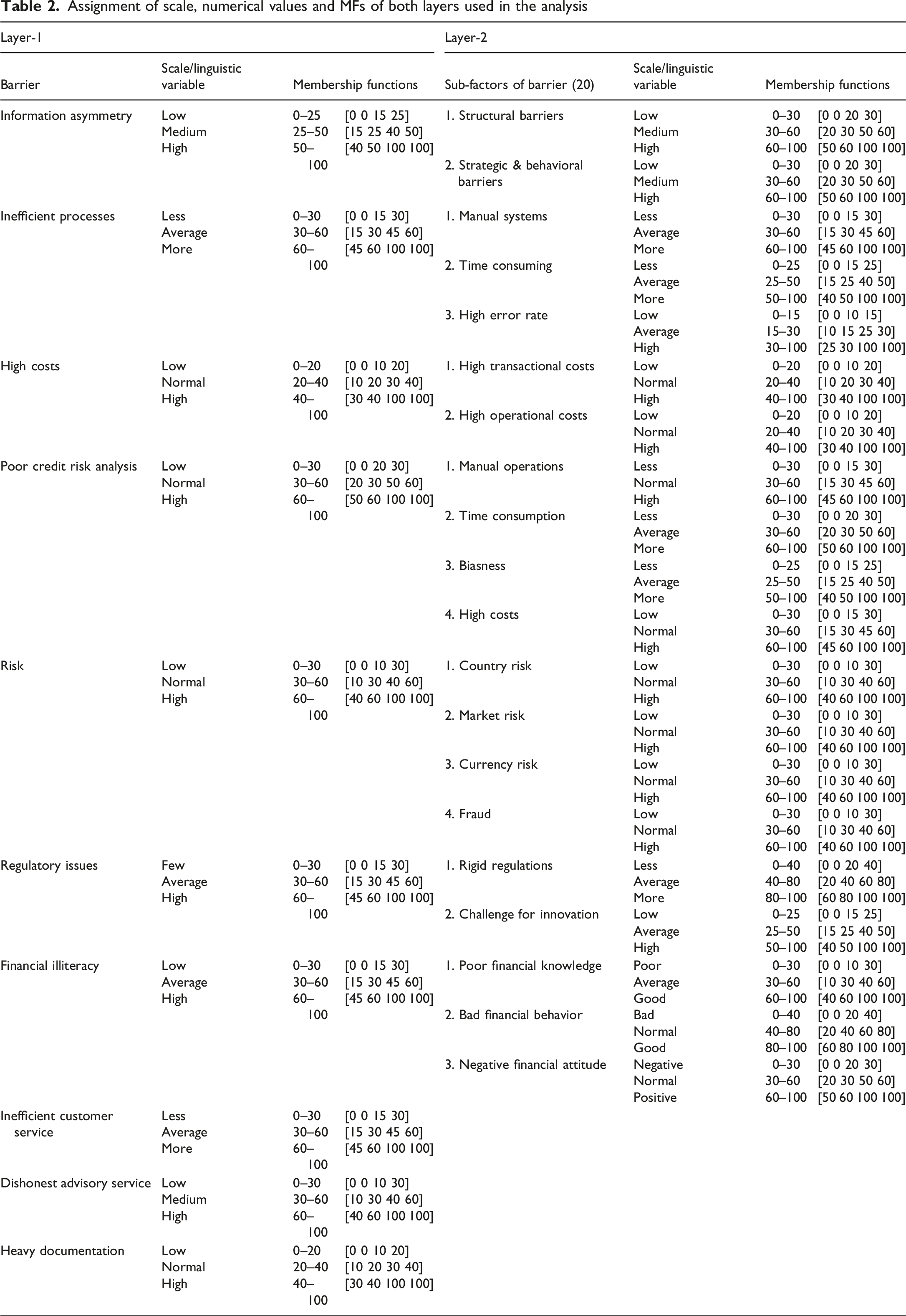
Assignment of scale, numerical values and MFs of both layers used in the analysis
Membership Functions (MFs)
The fuzzy logic framework employed in this study relies on MFs to define individual input and output sets. These MFs assign numerical values to each set, enabling their representation in statistical form (Nadeem et al., 2019). MFs operate within a binary range between 0 and 1. The proposed system model utilizes triangular membership functions (Tramp MFs), assigning three linguistic scales to each input parameter. For example, the “cost” parameter is categorized as “high,” “normal,” or “low,” while “regulatory issues” are defined using the labels “few,” “average,” and “high.” All input parameters across both layers are assigned to appropriate scales, and corresponding MFs are developed. Appendix 1 presents the mathematical calculation and graphical representation of MFs of layer 1 and 2. All fuzzy inference mechanism diagrams were generated using MATLAB R2017a, Fuzzy Logic Toolbox (MathWorks, Natick, MA, USA).
Fuzzy Decision Rules
The rule base in fuzzy inference mechanism follows a knowledge-driven approach, where IF–THEN rules are constructed through extensive literature synthesis and conceptual reasoning. The purpose is to translate qualitative and conceptual knowledge from literature into linguistic fuzzy rules that can model complex and uncertain real-world phenomena. The strength of each rule depends on the degree of membership of the inputs in the fuzzy sets (Ross, 2010).
For the first and final layer, 10 input parameters are divided into demand-side and supply-side classes. There are two input variables in demand-side class namely financial illiteracy and heavy documentation. For this, 9 rules are formed. There are 8 variables of supply-side barriers from the matrix. A total of 6,000 rules were made to analyze the system model of intelligent financial inclusion by supply-side input variables. Example of rule is: IF (Information asymmetry is low and inefficient processes are less and costs are low and poor credit risk analysis is low and risk is low and inefficient customer service is less and Regulatory Issues are few and dishonest advisory Services are low) THEN Intelligent Financial Inclusion is high.
In the second layer of the model, two sub-factors of information asymmetry are evaluated using a set of nine fuzzy inference rules. The component of inefficient processes comprises three sub-factors, resulting in 27 rules. For the high-cost component, both transactional and operational costs are defined at three levels and are combined to create nine rules. The model also addresses poor credit risk analysis, which includes four sub-factors: manual operations, time consumption, bias, and high costs. This results in 81 rules. An equivalent number of rules (81) is generated for the “risk” input parameter, which also comprises four sub-factors: country risk, market risk, currency risk, and fraud. Regulatory issues are influenced by two sub-factors: rigid regulations and challenges related to innovation. Lastly, financial illiteracy is assessed through three sub-factors: inadequate financial knowledge, poor financial behavior, and negative financial attitudes. This framework generates 81 rules.
Intelligence Mechanism
Intelligence mechanism of fuzzy logic employs IF–THEN logic with fuzzy rules base. This mechanism generates output by mapping between fuzzy input sets and rules which are mentioned in lookup tables in next section. Appendix 2 contains graphical representation of final layers of inference mechanism.
Defuzzification
Fuzzy application generates output from respective inputs by defuzzification. Output parameters acquire results corresponding to input parameters. The proposed system of this research article has three output states. A country can have low, average and high levels of intelligent financial inclusion when AI is being implemented in financial infrastructure to remove barriers to financial inclusion (Figure 4). In MATLAB, intelligent financial inclusion is represented as IFI. MFs of output “Intelligent Financial Inclusion”
Discussion of Results
Simulation Results
There are two input variables in the demand-side barriers to financial inclusion and eight in supply-side barriers in current fuzzy inference mechanism Lookup tables map the combinations of fuzzy input sets to corresponding outputs based on fuzzy rules. One lookup table from layer one is shown in Figure 5. The values represent that when financial illiteracy and heavy documentation has high values, IFI is low. IFI generates a value of 15.3 when financial illiteracy is 67.4 and heavy documentation is equal to 65. Look up diagram of proposed IFI by demand-side variables (financial illiteracy and heavy documentation)
Layer 2 consists of 20 sub-factors of 10 barriers to financial inclusion. Let’s consider the breakup of second parameter, that is, inefficient processes. There are three sub-factors of inefficient processes; therefore, 27 rules were formed. Like, if (manual system is less) and (time-consuming is average) and (high error rate is average) then (inefficient processes is average). According to lookup table, high values of time-consuming processes and high error rates are cause of more inefficient processes even though the manual system has some average value Figure 6. Rest of lookup tables are presented in Appendix 3. Look up diagram of inefficient processes for manual system, time-consuming and high error rates
Defuzzification
Defuzzification is an important element of fuzzy inference mechanism which generates output and highlights areas for operations. Figure 7 is the rule surface of IFI by demand-side input parameters of financial illiteracy and heavy documentation. Yellow area is excellent IFI with minimum intensity of financial illiteracy and heavy documentation. Greenish area is satisfactory and average while blue area represents the poor results for IFI with maximum intensity of financial illiteracy and heavy documentation. Rule surface of IFI by demand-side input parameters of financial illiteracy and heavy documentation (Layer 1)
A total of eight supply-side input parameters were considered for the analysis of IFI. Representative defuzzification graphs are presented in Figures 8 and 9. Figure 8 illustrates the fuzzy inference system for IFI with inefficient processes and high costs as inputs. The 3D surface plot reveals that lower values for both inputs correspond to higher IFI scores. The yellow region denotes excellent performance (low input intensity, high output), green indicates satisfactory performance, and blue reflects deficient performance (high input intensity, low output). An inverse relationship between inefficient processes and high costs is shown in Figure 9. IFI reaches its maximum when both inputs are at zero (yellow) and declines to zero when inputs reach 100 (dark blue). Rule surface of IFI using inefficient processes and high costs Rule surface of IFI using high costs and inefficient processes

This study utilizes 10 parameters as input variables in a fuzzy logic-based framework to assess Intelligent Financial Inclusion (IFI). Each input is analyzed through its sub-factors to enhance clarity, for instance, financial illiteracy is broken down into poor financial knowledge, behavior, and attitude. Most variables are further modeled in layer 2, except for heavy documentation and dishonest advisory services. Multiple 3D surface graphs in defuzzification illustrate how intensities of inputs influence outputs. For example, high structural and behavioral barriers increase information asymmetry, which negatively affects IFI (Figure 10). Financial illiteracy rises with stronger negative financial behaviors and attitudes (Figure 11). Each relationship is visually represented through 3D graphs, demonstrating the varying degrees of influence input intensities exert on their respective outcomes. Rule surface of information asymmetry based upon structural and strategic & behavioral barriers Rule surface of financial illiteracy based upon poor financial knowledge and bad financial behavior

There are certain practical examples of use of AI and other innovative technologies in financial sector that has increased the level of financial inclusion among economies. Greeman bank of Bangladesh has used innovative technologies to automate their processes in reaching underprivileged segments of population that increased the involvement of people in financial sector. One of the successful example is Mexico’s Kueski that reduced the transactional costs of banks to almost 0. An online form in filled in for 2 min and the amount is credited in account within 8 min (Fazal et al., 2025). Another example is AI-based equities fund introduced by BIMB Investment in Malaysia that helped to comply with Shariah, religious, and regulatory criteria. Such examples demonstrate that all the barriers are influential in reducing the level of financial inclusion in economies.
Conclusion
This research paper identifies and evaluates several critical barriers to financial inclusion using a fuzzy logic-based inference model. All the barriers to financial inclusion are presented in a classification in the form of a matrix of barriers to financial inclusion including usage, access, perceived and system barriers. The removal of all these barriers is possible with the implementation of AI in financial infrastructure of the countries. A total of 10 barriers from all the classes were included in fuzzy inference mechanism to provide justification for resultant intelligent financial inclusion. Intelligent financial inclusion is the implementation of intelligent products in the financial sector to automate the systems for the involvement of people in the financial sector.
The results demonstrate that information asymmetry driven by structural, strategic, and behavioral barriers negatively impacts financial inclusion. A more symmetric flow of information, enabled by AI technologies, is linked to greater financial access and participation. Inefficient processes, including manual operations, high error rates, and time-consuming procedures, hinder user engagement with financial systems. Automating processes through AI significantly reduces these inefficiencies that promote broader inclusion. High transactional and operational costs make financial services unaffordable for a large segment of population. AI help lower down these costs by reducing reliance on manual labor and time consumption. Intelligent systems improve the accuracy, speed, and fairness of credit assessments that enhance financial inclusion. The study also finds that financial sector risks (e.g., market, currency, country risk, and fraud) deter vulnerable populations. Intelligent systems help mitigate these risks through tools like fraud detection and anomaly tracking and build trust of customers. Regulatory issues, such as rigid rules and innovation challenges, can be reduced by smart compliance and flexible regulatory interactions. As the financial illiteracy is concerned, AI applications support personalized financial education and planning, improving literacy and financial inclusion of people. Furthermore, inefficient customer service and dishonest advisory services discourage involvement of people in financial sector. Automated customer support and robe-advisors offer dependable, cost-effective, and 24/7 services, addressing these concerns. Heavy documentation requirements exclude rural and low-income populations. AI facilitates the usage of alternative data sources and simplifies onboarding leading to the removal of these barriers too.
Concludingly, the research states that intelligent financial inclusion (IFI) can effectively reduce all the barriers to financial inclusion and expand equitable access to financial services for all people. Achievement of this intelligent financial inclusion will lead to the sustainable development in alignment with United Nations 2030 agenda. By addressing two demand-side and eight supply-side barriers, intelligent financial inclusion leverages AI and other technologies to automate operations, enhance service delivery, and reduce exclusionary practices. The findings, supported by a fuzzy inference system, demonstrate that IFI not only mitigates these barriers but also reinforces the role of institutions in advancing financial inclusion.
This study offers key practical contributions by introducing a comprehensive matrix of demand- and supply-side barriers to financial inclusion and proposing a clear pathway to achieve Intelligent Financial Inclusion. It also addresses the digital divide by recommending integration of technologies into national infrastructure to avoid further exclusion. Aligned with the UN SDGs, this research provides a practical framework for policymakers to build inclusive, technology-driven financial ecosystems that improve livelihoods and advance sustainable development. The findings offer a robust framework for transforming financial ecosystems, improving governance, and enhancing the quality of life through AI-assisted, inclusive financial systems that bridge the gap between theoretical models and real-world impact. This research provides guidance to policymakers to embrace AI-driven models to enhance the experience and trust of customers to include them in financial sector. Financial institutions should be directed towards the implementation of AI enabled KYC, credit scoring models using non-traditional sources of data, machine learning algorithms to track transaction processing systems, and training of robo-advisors. Regulatory sandboxes and open banking frameworks can also benefit fintech companies.
Despite the significance of AI-specific and other complementary intelligent technologies for financial inclusion, there can be some negative consequences also. Algorithmic bias can create discrimination especially in lending and risk assessment. Issues pertaining to cybersecurity, data privacy and challenges in financial data protection can be significant challenges in implementing intelligent financial inclusion. Therefore, effectiveness of this system rely on technological advancement and regulatory oversight. This research does not address negative effects of intelligent technologies. Furthermore, current research is conceptual demonstration of the concept of intelligent financial inclusion and has not used real-world data. Future research should consider these challenges and adopt real-world quantitative data to provide further insights into the concept of intelligent financial inclusion.
Supplemental Material
Supplemental Material - Nexus of Intelligent Financial Inclusion and Sustainability: Leveraging Fintech Innovations to Overcome Barriers to Financial Inclusion
Supplemental Material for Nexus of Intelligent Financial Inclusion and Sustainability: Leveraging Fintech Innovations to Overcome Barriers to Financial Inclusion by Puja Sunil Pawar, Anam Fazal, Madad Ali, Shoaib Nisar, Bayan A. Alsedais in The Journal of Environment & Development.
Footnotes

Ethical Considerations
All authors certify that they have no affiliations with or involvement in any organization or entity with any financial interest or non-financial interest in the subject matter or materials discussed in this manuscript.
Consent for Publication
All authors have consent for publication of this article.
Author Contributions
All authors read and approved the final manuscript. Anam Fazal worked on main idea, write up and analysis in MATLAB. Shoaib Nisar worked on the structure of study and write up. Madad Ali proofread the article and written the methodology section.
Funding
The authors received no financial support for the research, authorship, and/or publication of this article.
Declaration of Conflicting Interests
The authors declared no potential conflicts of interest with respect to the research, authorship, and/or publication of this article.
Data Availability Statement
The associated data consist of a MATLAB file that will be available on demand.
Research Design
This research article aims to address barriers to financial inclusion and explores how intelligent financial inclusion can be achieved within an economic system by removing these. For the current study, the researchers adopted pragmatism paradigm that integrates interpretivist insights with quantitative reasoning. At first, they have explored the literature subjectively to provide inputs for the fuzzy inference mechanism. Parameters that are barriers to financial inclusion have been taken from a deep review of literature in line with interpretivism. Within this framework, fuzzy logic serves as a bridge between qualitative perceptions and quantitative analysis by translating them into measurable linguistic variables. Research is explanatory, based on the description of variables from the literature review. Fuzzy inference mechanism has been applied in MATLAB.
Supplemental Material
Supplemental material for this article is available online.
Author Biographies
References
Supplementary Material
Please find the following supplemental material available below.
For Open Access articles published under a Creative Commons License, all supplemental material carries the same license as the article it is associated with.
For non-Open Access articles published, all supplemental material carries a non-exclusive license, and permission requests for re-use of supplemental material or any part of supplemental material shall be sent directly to the copyright owner as specified in the copyright notice associated with the article.
