







Abstract
Background:
Women continue to be underrepresented in orthopaedic surgery. This study seeks to evaluate gender diversity of faculty and trainees at foot and ankle surgery fellowship programs.
Methods:
In this cross-sectional analysis of 49 US foot and ankle fellowship programs, all publicly available data on program faculty (as of July 2023) were collected, as well as data on current and past fellows between 2018 and 2024.
Results:
Of 49 programs with 195 foot and ankle surgery faculty, 26.5% (n = 13) had at least 1 female on faculty, with only 8.2% (n = 4) having female fellowship directors. Female faculty made up 9.7% (n = 19) of foot and ankle surgery faculty overall. Of 307 total fellows identified within the 6-year period, 19.5% (n = 60) were female. Geographic distribution of programs was as follows: 29% (n = 14) Northeast, 31% (n = 15) South, 19% (n = 9) Midwest, and 21% (n = 10) West. Northeast programs made up 62% of all programs with female faculty, whereas Midwest programs made up the least at 8% (P = .048). Programs with female faculty had more female fellows from 2018 to 2024 than programs without female faculty (33.7% vs 14%, P < .001).
Conclusion:
Our findings suggest that females remain underrepresented in foot and ankle surgery fellowship director positions, despite an increasing proportion of females entering orthopaedic surgery. Foot and ankle surgery fellowship programs with female faculty had a higher number of female trainees; as such, diversification of foot and ankle fellowship departments may be an important factor in ongoing efforts to promote gender diversity within the specialty.
Level of Evidence:
Level IV, observational cross-sectional analysis
Introduction
Despite an increase in the proportion of women matriculating medical school, orthopaedic surgery continues to harbor a substantial gender gap. According to the Association of American Medical Colleges (AAMC) 2022 Report on Residents, 18.3% of orthopaedic surgery residents are women, the lowest proportion among all surgical specialties. 2 Recent projections estimate >200 years until gender parity of the overall medical profession (36.3% women) is reached in orthopaedics. 1 Within trainees of various subspecialties of orthopaedic surgery, there is an even further range in gender gap, with one study of fellowship applicants between 2010 and 2014 reporting proportions of female trainees to be as low as 3% in spine, and as high as 25% in pediatrics. 4
Few studies have evaluated gender diversity within the foot and ankle subspecialty. One tstudy of the American Orthopaedic Foot & Ankle Society (AOFAS) demonstrates an increase in female membership from 7.5% to 13% from 2012 to 2022. 7 The authors identify a corresponding increase in female committee participation from 6.5% to 18.5%; however, they find that representation of women in leadership positions within AOFAS simultaneously decreased from 12.8% to 5.1%. Other recent studies have demonstrated the homogenous make-up of foot and ankle surgery leadership (ie, fellowship directors and division chiefs), reporting approximately 94% of fellowship directors as male and 90% white.6,8,23 To better understand these trends, and to assess gender diversity changes in the works, we sought to evaluate recent gender diversity trends in foot and ankle surgery fellowship programs.
The purpose of this study was to analyze gender diversity among faculty and trainees within foot and ankle surgery fellowship programs. To do this, we set out to characterize the percentage of female faculty at these programs, including the percentage of female fellowship directors, and the percentage of female foot and ankle surgery fellows within the last 6 years. Lastly, we evaluated whether programs with female faculty were more likely to match female fellows.
Methods and Materials
This was an observational cross-sectional analysis of US foot and ankle surgery fellowship programs as obtained from the American Orthopaedic Foot & Ankle Society (AOFAS) website. We collected baseline information on geographic location, fellowship director, and number of available positions directly from the AOFAS fellowship directory. All other data on program leadership and faculty were collected via a combination of the program directory and hospital and/or practice websites. All fellowship and faculty data were collected in July 2023. Fellowship program locations were categorized per US Census Bureau regions (West, Midwest, Northeast, South). 21
Data on current and past fellows were collected per fellowship class year using official fellowship program websites and AOFAS fellowship match postings. For programs without publicly available rosters of current and/or past fellows, fellowship coordinators were contacted directly via email asking for a list of fellows and/or deidentified gender make-up of fellows categorized by year. In total, 6 years of fellowship match data were collected, starting with the 2018-2019 fellowship class and ending with the 2023-2024 fellowship class. These years were chosen to correspond to published match statistics available on the AOFAS website, which were also used to determine the total number of fellows annually and to infer completion of data collection. Gender of each faculty and fellow was ascertained from Internet query using photos, hospital, practice, and university website biographies, and social media such as LinkedIn.
Descriptive statistics was employed for program, faculty, and fellow demographics. Pearson chi-square test of independence and Student t test were used to compare all categorical variables (number of female fellows and/or female faculty by geographic region and programs with vs without female faculty) and Pearson correlation coefficient was used to measure the correlation of female fellows over the 6-year study period. Odds ratios were calculated for the odds of matching a female fellow given the presence of any female faculty at a fellowship program. For all analyses, fellowship faculty data (collected in July 2023) were extrapolated across all 6 years of fellowship classes. Statistical significance was defined as P <.05.
Results
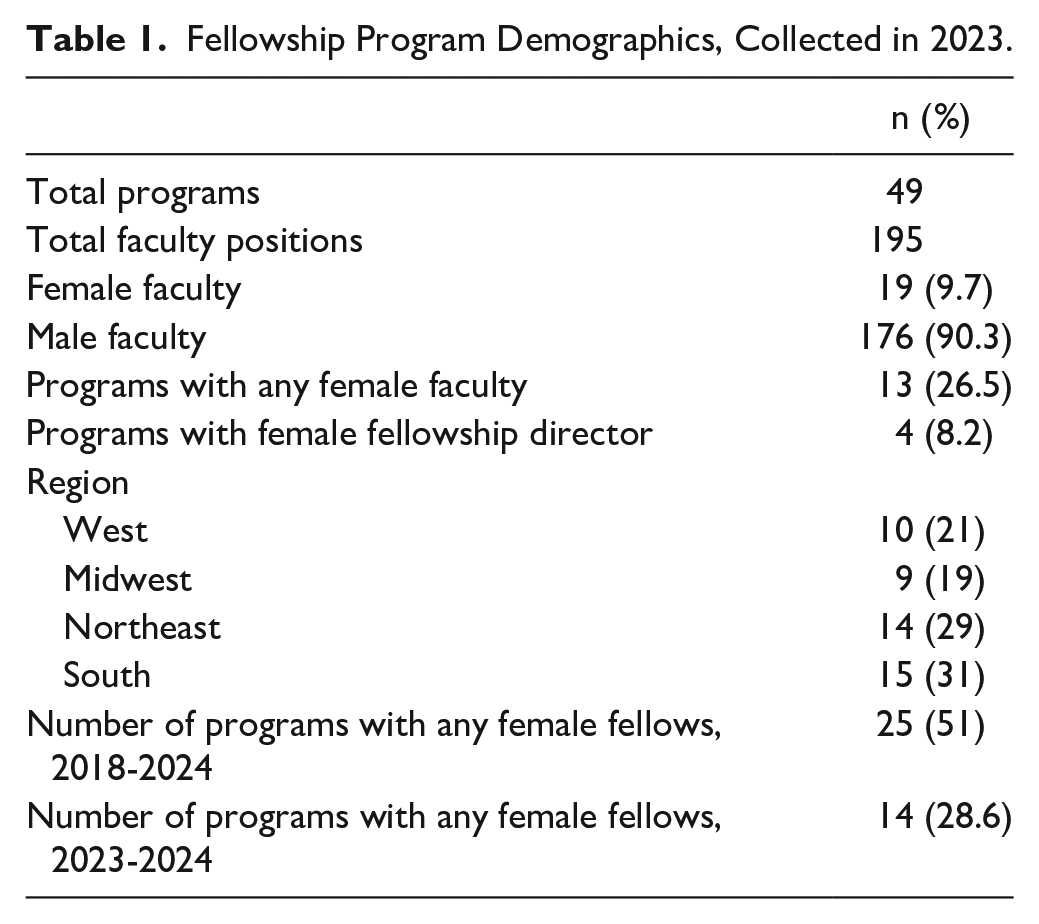
A total of 49 foot and ankle surgery fellowship programs with 81 available fellowship positions were listed on the AOFAS fellowship directory. A total of 195 total faculty surgeons were identified across all programs. Overall, female faculty made up 9.7% (ratio of 19:176, female to male) of foot and ankle surgery faculty overall. Thirteen (26.5%) programs had at least 1 female foot and ankle surgeon on faculty. Of fellowship directors, 91.8% (n = 45) were male and 8.2% (n = 4) were female. Geographic distribution of programs was as follows: 29% (n = 14) Northeast, 31% (n = 15) South, 19% (n = 9) Midwest, and 21% (n = 10) West. A summary of fellowship program demographics as collected in 2023 is shown in Table 1.
Fellowship Program Demographics, Collected in 2023.
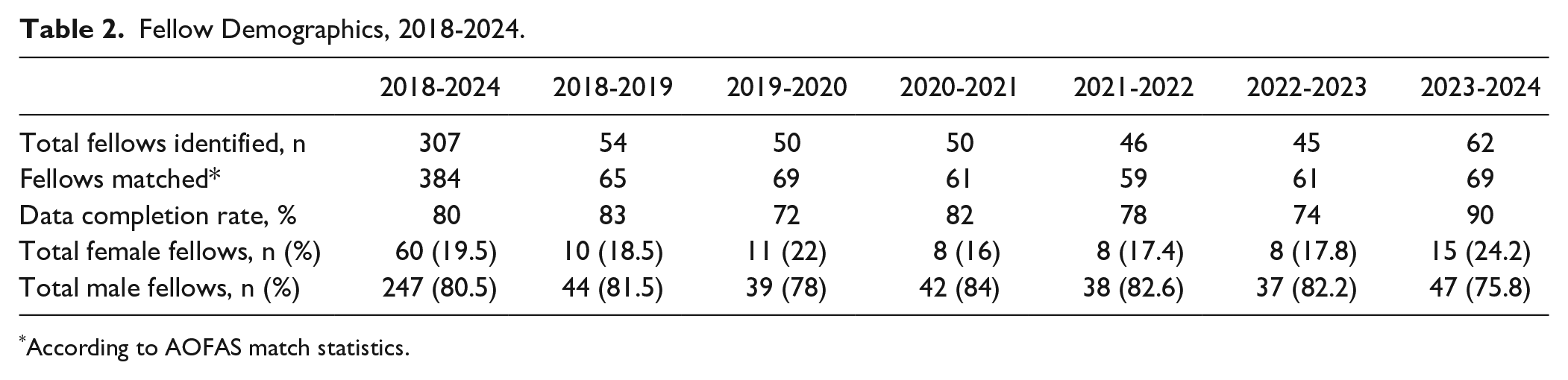
A total of 307 fellows were identified within the 6-year study period. Data collection completion rates (inferred by comparison to AOFAS’s match statistics) were 90% for fellows from the 2023 to 2024 class, and 80% for fellows from all 6 classes over 2018-2024. In addition, 24.2% (n = 15/62) of fellows within the 2023-2024 fellowship class year were female, and 19.5% (n = 60) of fellows within the 2018-2024 fellowship class years were female. Breakdown of gender makeup per fellowship class year is shown in Table 2.
Fellow Demographics, 2018-2024.
According to AOFAS match statistics.
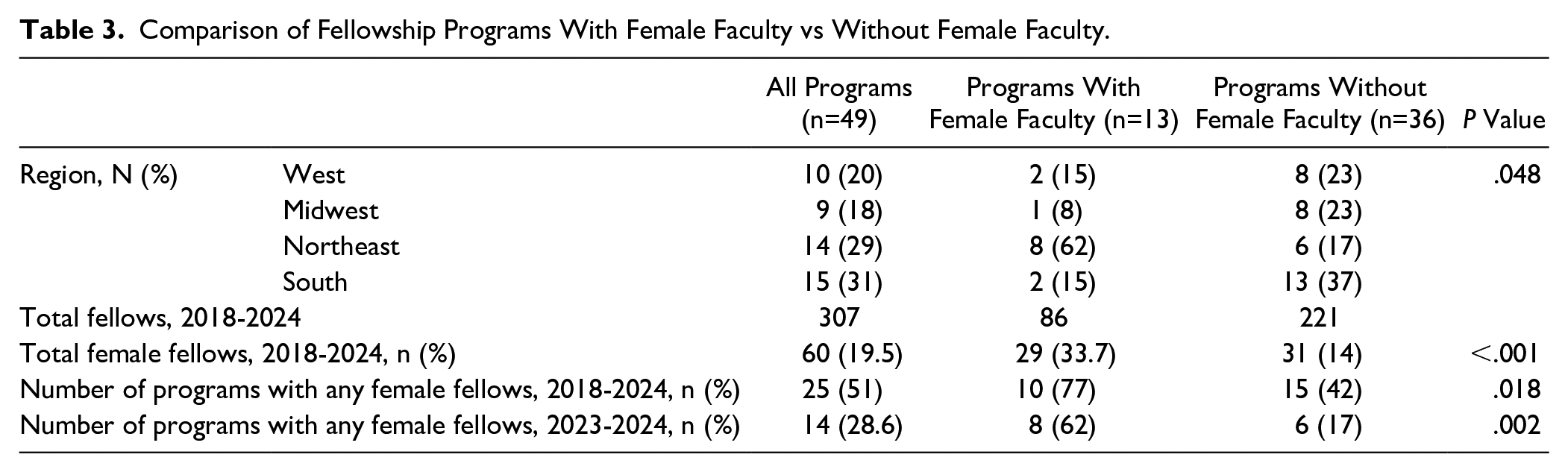
When stratified by presence vs absence of female faculty, Northeast programs made up 62% of all programs with female faculty, whereas Midwest programs made up the least at 8% (P = .048) (Figure 1). Of programs with female faculty, 33.7% (n = 29) of fellows over the 6-year period were female, vs 14% (n = 31) of female fellows at programs without female faculty (Figure 2). Comparison of fellowship programs with vs without female faculty is shown in Table 3.
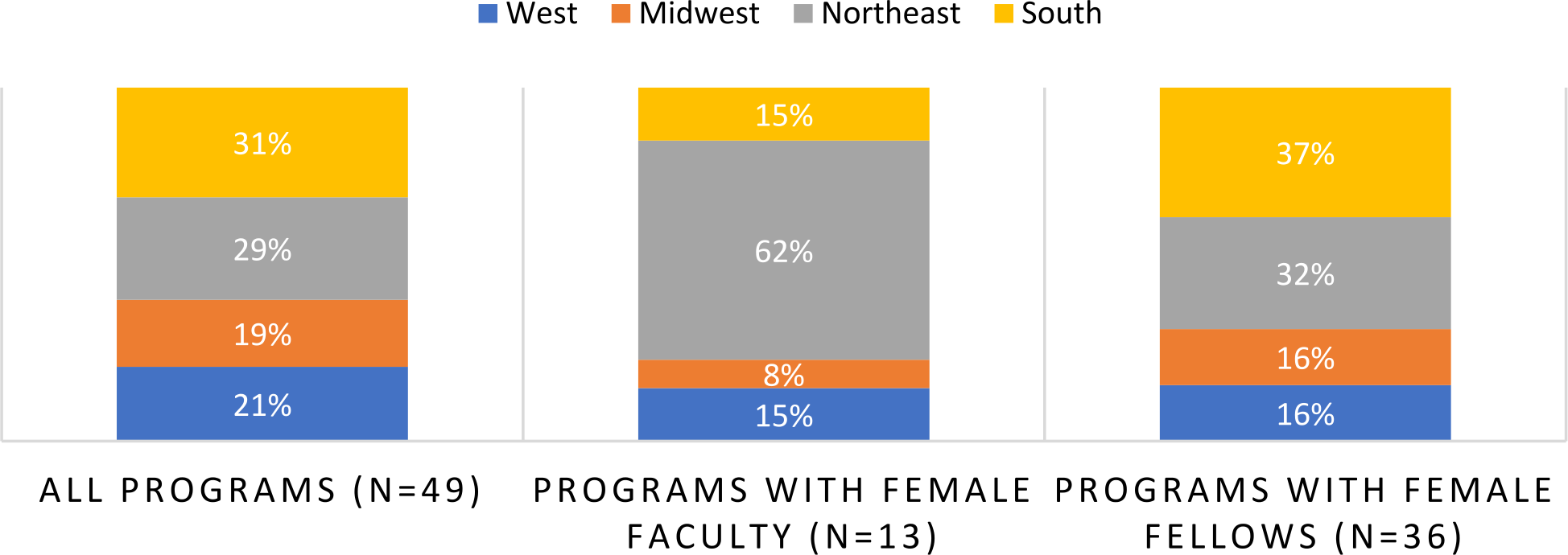
Geographic distribution of all programs and of female faculty and fellows.*
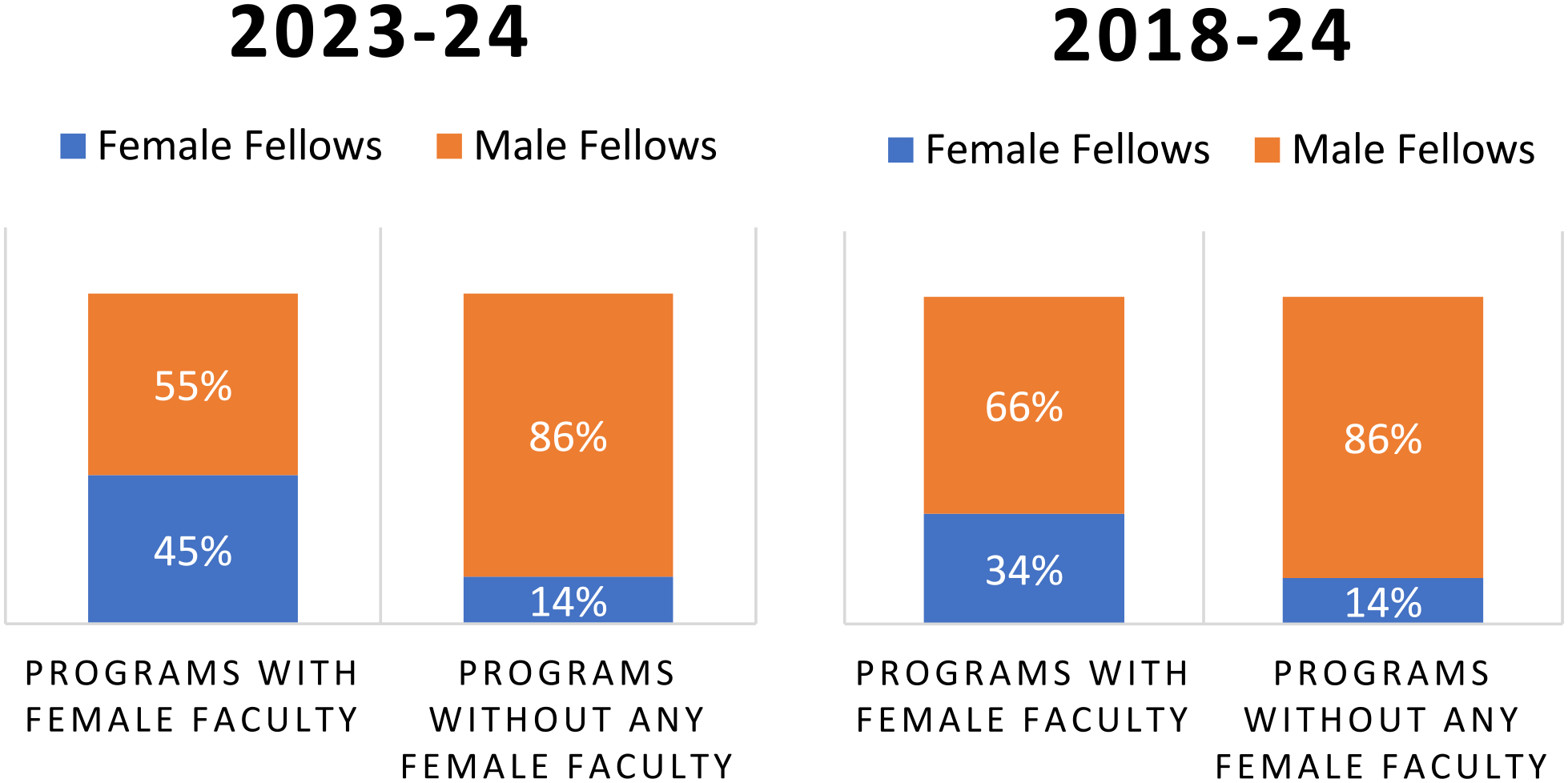
Gender makeup of fellows at programs with vs without female faculty.
Comparison of Fellowship Programs With Female Faculty vs Without Female Faculty.
Discussion
Our study found that female foot and ankle surgeons make up only 8.2% of fellowship directors. In contrast to the rate of 15.3% of female practicing foot and ankle surgeons and current fellows reported in a 2020 study by Shazadeh Safavi et al, 19 our finding suggests that females remain underrepresented in this academic leadership position. Prior studies have found slightly lower make-up of female fellowship directors, with Elahi et al 8 reporting a female fellowship director rate of 6.4% in 2020, Weissman et al 23 reporting 4.4% in 2021, and Chopra et al 6 reporting 6.2% in their 2022 study. Although 8.2% is still greater than for other orthopaedic subspecialties such as arthroplasty (4%), trauma (5%), sports (3%), and spine (0%), gender diversity within foot and ankle surgery fellowships still trails behind other orthopaedic subspecialties including oncology (27%), pediatrics (12%), and hand (13%), as well as general surgical specialties, where 18% of fellowship director positions are held by females.10,11
When assessing the geographic distribution of female faculty across fellowship programs, our study found the majority of programs with female faculty to be located within the Northeast United States, which is consistent with findings of prior studies evaluating geographic trends among foot and ankle surgeons, with Shazadeh Safavi et al 19 finding the highest rates of gender diversity to be within the Pacific and New England. Similarly, within orthopaedic surgery overall, Chapman et al 5 found the greatest prevalence of female orthopaedic surgeons to be in the New England and Pacific regions. In one geospatial analysis, Peterman et al 18 found positive correlation between higher numbers of female surgeons and higher recruitment of female surgeons, finding that these hotspots, which were largely in the Northeast and West, saw higher rates of increasing gender diversity than in areas with less female representation. However, even in high gender diversity areas, rates of increase in gender diversity translated to an increase of 4.7 male orthopaedic surgeons for every 1 female.
Although the definite number and trend of female trainees entering foot and ankle surgery fellowship is not explicitly known, our findings indicate an overall upwards trend of female trainees entering foot and ankle surgery within the 6-year study period, with a weakly positive correlation seen (R = 0.3). The proportion of female fellows in this study was 24.2% within the 2023-2024 fellowship class, and 19.5% when averaged over the 2018-2024 classes. One prior study evaluating fellowship match rates among female vs male orthopaedic residents found that from 2010 to 2014, foot and ankle surgery had the second highest number of female applicants (14%) after pediatrics (25%). 4 This study also found that female applicants had higher match rates than men. Although there may be some discrepancy in gender breakdown of applicants who match vs those who do not match, these numbers suggest an overall growth of female trainees entering foot and ankle surgery fellowship.
Our study also showed that fellowship programs with female faculty (as determined in 2023) had more than twice as many female trainees from 2018 to 2024 than programs without female faculty (33.7% vs 14%). Diversification of foot and ankle departments, within programs with fellowships as well as those without, appears to be an important factor in ongoing efforts to promote gender diversity within the specialty. We speculate that having a female foot and ankle surgeon may play a part both at the residency level for potential applicants to the subspecialty and for fellowship applicants considering fellowship at residency programs who also have fellowship programs. Female mentors have been shown to play an important role for other female trainees entering orthopaedic residency and fellowship, with one survey study by Kroin et al12,15,17 reporting that the presence of female residents and faculty at a residency program was an important factor for female medical students applying to orthopaedic surgery residency. Similarly, the presence of female faculty at orthopaedic residency programs has been found to be associated with recruitment of female residents.13,20 On the other hand, a survey study of residents pursuing fellowship did not find female mentorship to be a significant influence in fellowship subspecialty choice. 14 One may consider, however, that most orthopaedic departments are unlikely to have a female attending in each subspecialty division, which may serve as a limitation of that study, especially at smaller residency programs. Nevertheless, our study findings suggest the role that female foot and ankle surgeons may play for other female trainees interested in pursuing the subspecialty.
Although present-day leadership in foot and ankle surgery appears to remain predominantly male and white, our study suggests that the pathway of women entering foot and ankle surgery remains a positive prospect that may not be reflected in leadership trends for years to come. Several factors have been identified in determining academic rank within orthopaedic departments, including higher h-index and longer career duration.9,23 Although differences in h-index among female and male foot and ankle surgeons is not known, a study by Vora et al 22 found that female representation in academic foot and ankle surgery research has doubled in the last 20 years. Additionally, because of the effect of academic seniority and longer career duration, it is important to consider that changes in leadership may take several years to take effect. A comprehensive study of faculty across all orthopaedic residency programs in 2020 found relatively high percentages of women in junior leadership positions (namely, 27% of all assistant program directors), which may be a promising finding for changes to come in future generations of orthopaedic leadership overall. 3 AOFAS membership data from November 2023, which was provided to us for this study, corroborates the growing female make-up of the specialty (Table 4), with females making up 19.4% of candidate surgeons (practicing surgeons not yet board-certified) and 21.7% of surgeon in training members (residents and fellows), in contrast to only 13.9% of board-certified practicing surgeons.
Gender Breakdown of AOFAS Members by Member Type.*
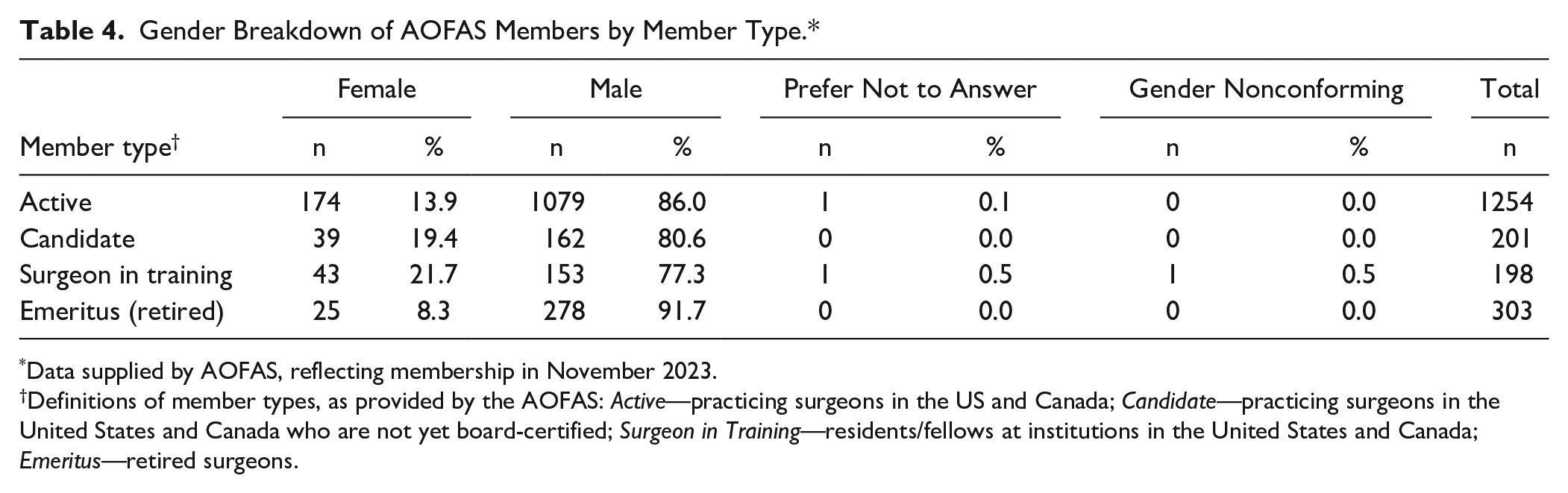
Data supplied by AOFAS, reflecting membership in November 2023.
Definitions of member types, as provided by the AOFAS: Active—practicing surgeons in the US and Canada; Candidate—practicing surgeons in the United States and Canada who are not yet board-certified; Surgeon in Training—residents/fellows at institutions in the United States and Canada; Emeritus—retired surgeons.
Strengths of this study include an in-depth analysis of recent foot and ankle fellows, with the ability to trend the gender make-up of recent fellows and current fellowship faculty. To the authors’ knowledge, this is also the first study in foot and ankle surgery to find an association between gender of fellow and gender make-up of fellowship program faculty. Limitations of our study include the cross-sectional nature of this study, which consisted of a single capture for fellowship program demographics and faculty rosters. We are unable to account for changes in faculty and leadership at fellowship programs, including the effect of fellow retention, between fellowship program and current practice, within the 6-year study period. Additionally, although our study found that programs with female faculty trained a higher number of female fellows, this association may or may not be accurate given the fellowship match system in place. Generalizing that female applicants have a strong desire to be at a program just because they matched there would not be fully accurate; the converse also applies for female fellowship faculty seeking out female applicants. Without access to rank lists, we are unable to corroborate the true nature of this finding and whether it is based on actual preference from either the applicant or the program perspective. Further limitations of this study include that we investigated only foot and ankle departments with fellowship programs; therefore, estimates of female faculty in leadership positions within residency programs may differ. Lastly, findings of this study may apply to not only unmatched applicants to foot and ankle surgery, but also applicants and fellows of other orthopaedic subspecialties.
Conclusion
In conclusion, the number of female trainees entering foot and ankle surgery appears to be increasing in recent years. Although females remain underrepresented as fellowship directors within foot and ankle surgery, there may be a corresponding shift in gender diversity in the coming years, with efforts to recruit female faculty at fellowship programs being a potential strategy for diversifying the field of foot and ankle surgery. Findings from this study also suggest the need to focus gender diversity efforts particularly within those institutions and geographic regions with smaller make-up of female foot and ankle surgeons. Pathway programs for women in orthopaedics overall such as Nth Dimensions, the Ruth Jackson Orthopaedic Society, and the Perry Initiative, as well as foot and ankle specific mentorship and exposure programs such as AOFAS’s resident scholar program, all remain important efforts to continue to encourage gender diversity before the fellowship stage. 16 Future research efforts may be directed toward investigating the influence that female foot and ankle faculty may have at a more upstream level, that is, for female residents during their formative years that ultimately dictate their fellowship subspecialty of choice. Another area of future research pertains to the geographic and practice preferences of graduating female foot and ankle fellows, and exploring what subset of female fellows may seek academic practices compared with their male counterparts.
Supplemental Material
sj-pdf-1-fai-10.1177_10711007231224426 – Supplemental material for Analysis of Gender Diversity Within Foot and Ankle Surgery Fellowship Programs
Supplemental material, sj-pdf-1-fai-10.1177_10711007231224426 for Analysis of Gender Diversity Within Foot and Ankle Surgery Fellowship Programs by Elizabeth Cho, Arianna L. Gianakos and Adam P. Schiff in Foot & Ankle International
Footnotes
Ethical Statement
Ethical approval for this study was waived by the Loyola University Institutional Review Board because of minimal risk.
Declaration of Conflicting Interests
The author(s) declared no potential conflicts of interest with respect to the research, authorship, and/or publication of this article. ICMJE forms for all authors are available online.
Funding
The author(s) received no financial support for the research, authorship, and/or publication of this article.

References
Supplementary Material
Please find the following supplemental material available below.
For Open Access articles published under a Creative Commons License, all supplemental material carries the same license as the article it is associated with.
For non-Open Access articles published, all supplemental material carries a non-exclusive license, and permission requests for re-use of supplemental material or any part of supplemental material shall be sent directly to the copyright owner as specified in the copyright notice associated with the article.
