







Abstract
This systematic review identified stressors faced by firefighters from the existing literature and categorized them into individual, occupational, and environmental stressors. Synthesis of the articles revealed 87 different stressors, which were qualitatively coded into 6 individual stressors, 12 occupational stressors, and 10 environmental stressors. The findings highlight that firefighters endure stress from multiple sources, affecting both their physical and mental health. The categorization of stressors offers an integrated approach for stress assessment and allows for developing stress mitigation strategies and training programs. This study provides the scope for future research aimed at reducing stress-induced risks in firefighting and other emergency response professions.
Introduction
Organizational stress elevates when job demands exceed an individual’s abilities and available resources (Morman et al., 2020). Firefighters work in high-stress environments where exposure to extreme life-threatening conditions and time pressure contributes to stress and burnout. For instance, Granberg et al. (2023) found that 78% of firefighters in a survey reported that they experienced stress and mental health issues on duty. Firefighters are exposed to physical, psychological, and environmental stressors during fire incidents. Moreover, they often experience post-traumatic stress disorder (PTSD) even after the incidents (Bryant & Harvey, 1996; Healy & Vujanovic, 2021). Additionally, firefighting activities increase the risk of sudden cardiac events (SCEs) by 10 to 100 times compared to non-emergency duties (Gonzalez et al., 2024). Arbona et al. (2019) revealed that stress at the fireground causes emotional numbing, dysphoric arousal, impaired cognitive functioning (Kivimäki & Lusa, 1994), and operational ineffectiveness (Arbona et al., 2019).
Past studies have explored the effects of various stressors on firefighters, such as sleep deprivation (Cramm et al., 2021), job insecurity (Lingard et al., 2024), family issues (B. W. Smith et al., 2019), and extreme weather conditions (Games et al., 2020). While these studies are valuable, they look at each stressor separately instead of collecting and grouping similar stressors together. The reason for SCE, PTSD, and other stress-induced physical and mental health issues can be caused by a single stressor or a combination of multiple stressors (Murphy et al., 1999). If other similar stressors remain unidentified, they can negatively affect the work efficiency and physical and mental well-being of firefighters. Hence, it is critical to not only identify these stressors but also to converge similar stressors.
This systematic review aims to summarize the findings from existing articles on firefighter stress and categorize them as individual, occupational, and environmental stressors. Individual stressors are experienced regardless of work responsibilities and usually occur due to personal reasons (Psarros et al., 2018). Occupational stressors arise from demanding job circumstances and cause psychological (Duran et al., 2018), physical (Canetti et al., 2022), and organizational inefficiency (Rajabi et al., 2020). Environmental stressors include external factors, including outside interference (Duran et al., 2018) and weather-related stressors (Games et al., 2020). Thus, the overarching objective of this study is to identify the stressors experienced by firefighters and categorize them as individual, occupational, and environmental stressors.
Method
A systematic search of scientific databases was conducted to identify research articles investigating the various stressors and their effects on firefighters’ performance. A thorough literature search across Scopus, APA PsycInfo, and PubMed, as well as a bibliometric search from the references of initially identified articles, resulted in 874 articles. The search strategy incorporated keywords such as “stress,” “firefighter stress,” “mental exhaustion,” “burnout,” “mental fatigue,” and “firefighter stressors.” Additionally, MeSH terms related to stress and mental exhaustion, including “psychological stress,” “chronic stress,” and “workplace stress,” were used in combination with Boolean operators to refine the search results. The identified articles were screened using the Preferred Reporting Items for Systematic Reviews and Meta-Analyses (PRISMA) guidelines (see Figure 1). Initially, 749 articles were excluded based on the irrelevance of the titles of the articles. The abstracts and full text of the remaining 125 articles were screened, and 56 articles were excluded based on language, irrelevance to the review objective, and possible duplication across databases. After the screening stage, 68 studies met all selection criteria and were included in the study. The articles were then synthesized to identify all the mentioned stressors and categorized using qualitative coding.
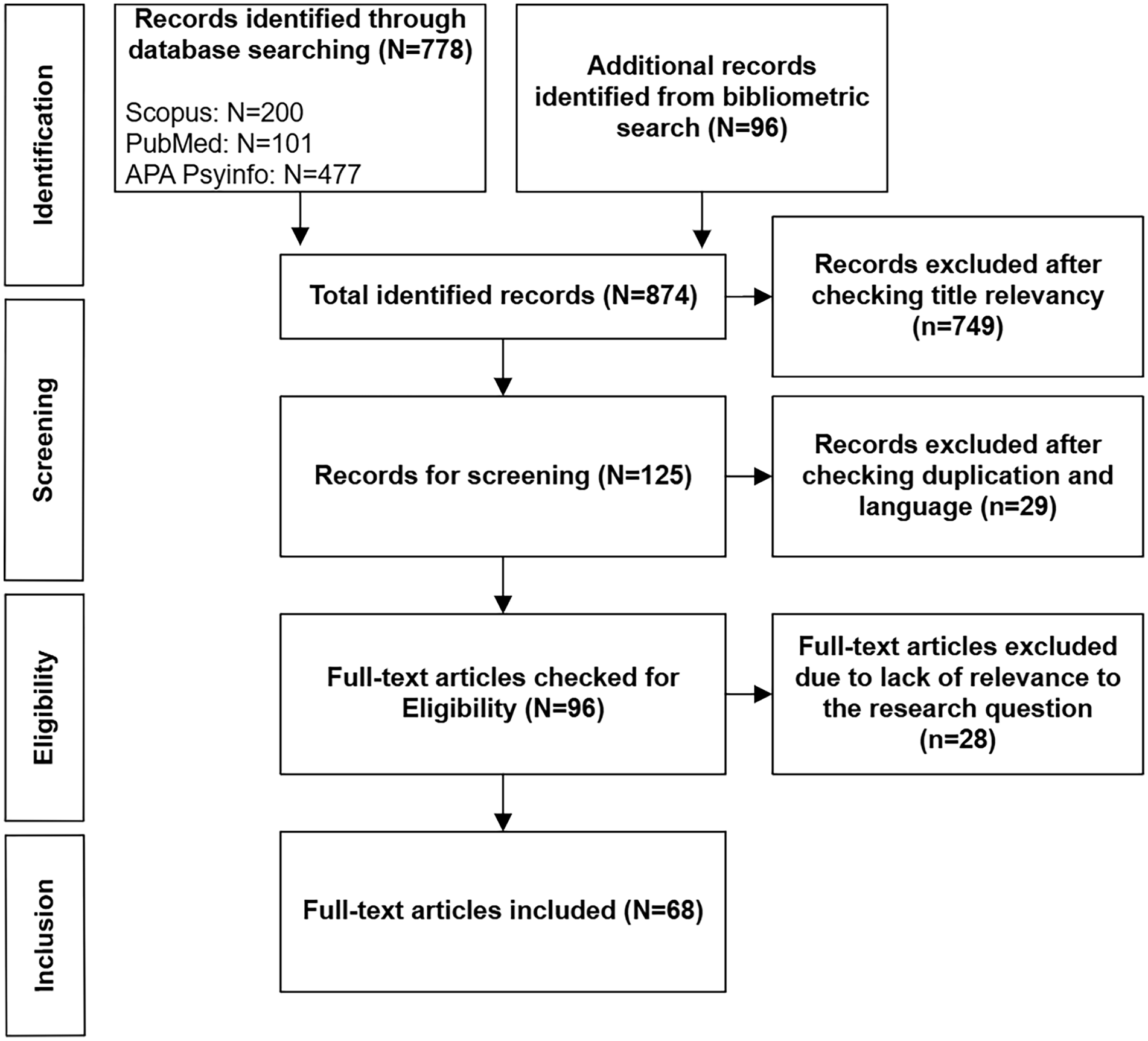
PRISMA diagram.
Two reviewers reviewed the 68 articles, and relevant textual data describing each stressor were extracted. Then, the textual data was thematically coded using an inductive approach and an open coding method to identify the stressors and group them into three categories. Disagreements during the coding process were resolved by collective discussion of the authors until complete consensus was achieved.
Results
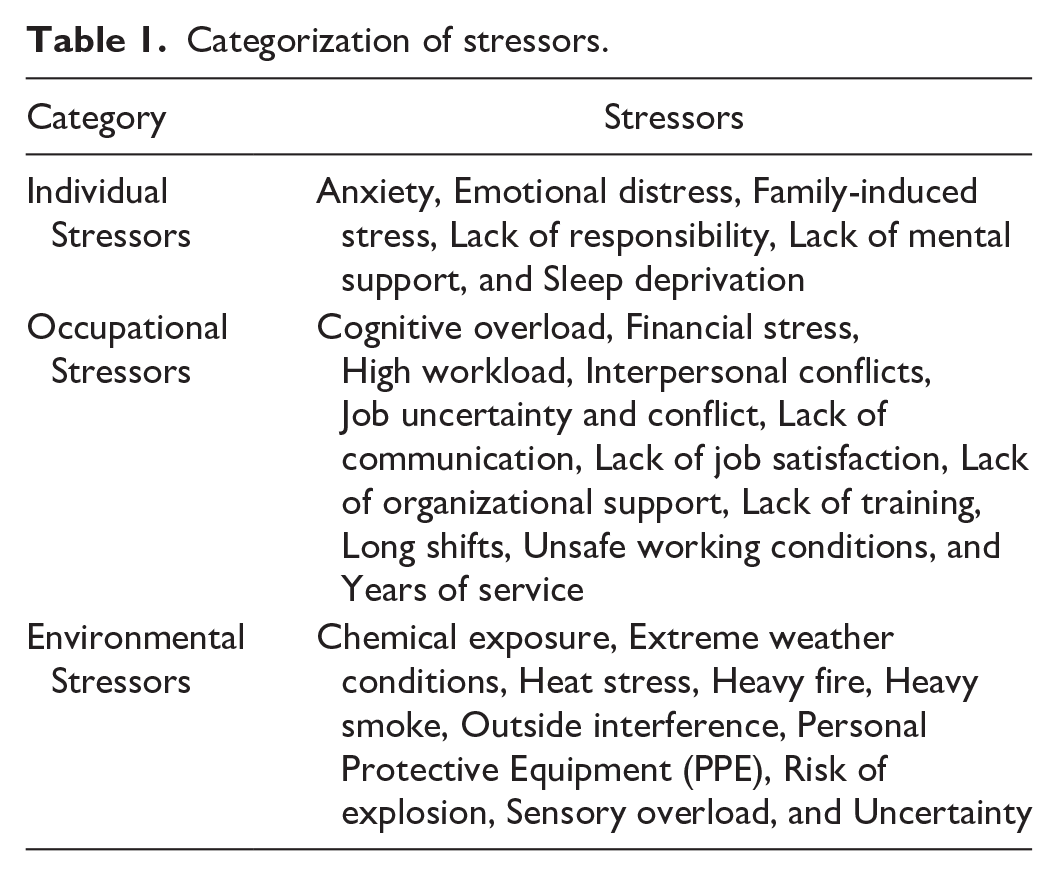
Findings from systematic synthesis revealed 87 different stressors, which were qualitatively coded into 6 individual stressors, 12 occupational stressors, and 10 environmental stressors as shown in Table 1.
Categorization of stressors.
Individual Stressors
Individual stressors arise from psychological and personal challenges experienced by firefighters, regardless of their professional responsibilities. These stressors significantly influence firefighters’ overall well-being and job performance. The highest cited individual stressor was sleep deprivation, as reported in 16 articles. Studies have shown that extended working hours, long shifts, and cumulative stress collectively impair sleep quality and resting periods (Barnes, 2000; Kelly et al., 2021; Lusa et al., 2002; Milligan-Saville et al., 2018). Moreover, L. J. Smith et al. (2018) surveyed 639 urban firefighters and found that sleep disturbances increased posttraumatic stress and alcohol usage. Dyal et al. (2022) found that 40% to 60% of firefighters experience poor sleep quality in a sample of 161 firefighters, while Wolkow et al. (2015) revealed that many firefighters sleep for just 5 hours per night. Anxiety was also reported as a significant individual stressor, caused by the high mental and temporal demands of firefighting (Young et al., 2013), insufficient mental support (Regehr et al., 2000), lack of safety (T. D. Smith et al., 2023), and dealing with traumatic events (Haslam & Mallon, 2003). Similarly, Becker et al. (2023) highlighted the lack of mental support as a stressor and mentioned that stigma surrounding stress and emotional suppression limit the possibility of seeking mental support. Individuals with a lack of responsibility suffer from diminishing organizational morale (Granberg et al., 2023) and emotional distress (Baker & Williams, 2001). Emotional distress also causes exhaustion, disengagement (Duran et al., 2018), burnout, and sub-optimized job performance (T. D. Smith et al., 2023). Individual stressors, such as anxiety and emotional distress, cause vulnerability to post-traumatic stress disorder (PTSD) by increasing reactivity to traumatic events (Noor et al., 2019; Zegel et al., 2023; Zwetzig et al., 2022). Lastly, family-induced stress was also mentioned as a prominent individual stressor, particularly due to work–family conflict, which was found to be a strong predictor of firefighter burnout (Wong et al., 2014). Studies also reported that difficulty maintaining personal and family responsibilities due to unpredictable schedules and high job demands increased overall stress (T. D. Smith et al., 2023).
Occupational Stressors
Occupational stressors arise from several sources, including job demands, workplace conflicts, and lack of management support. These stressors affect smooth and efficient day-to-day performance and long-term psychological health. The highest cited stressor in this category was High workload (14 articles), along with cognitive overload (3 articles). High workload is caused by the cumulative impact of long shifts (Khoshakhlagh et al., 2024), high job demand (Payne & Kinman, 2019; Wong et al., 2014), dealing with accidents (Brown et al., 2002; Rodrigues et al., 2018), and administrative workload (Lingard et al., 2024). Moreover, Kim et al. (2016) showed that high job demands were significantly associated with a greater risk of occupational injuries, with an odds ratio of 1.43 in a survey among 30,630 firefighters. Similarly, Heinemann et al. (2024) showed that decision-making under high pressure and operational demands during long shifts increased cognitive overload. Financial stress was mentioned by Rajabi et al. (2020) as one of the most severe managerial stressors. Additionally, Lingard et al. (2024) highlighted that wildland firefighters perceived their compensation as insufficient, given the risks and physical demands of their work. Other studies have also mentioned long shifts as an occupational stressor, especially in the case of understaffed departments with resource limitations (Moran & Colless, 1995). Long shifts (especially 4-day on/4-day off cycles) contribute to extensive fatigue, sleep deprivation, and difficulty in dealing with work-family responsibilities (Duran et al., 2018). Moreover, Říha and Hůla (2023) showed that insufficient recovery time between shifts affected the mental well-being and physical health of Czech fire and rescue service operators. Interpersonal conflict was also a frequently reported occupational stressor, contributed by factors like poor team dynamics (Aust et al., 2023), passive leadership (Larson et al., 2022), and communication breakdowns (Lingard et al., 2024). Moreover, job uncertainty and role conflict also impact the quality of the performance of firefighters (Bandolos et al., 2024), ultimately causing reduced morale, frustration, and psychological strain (Lingard et al., 2024). Aust et al. (2023) highlighted that lack of communication causes delayed or unclear information sharing and a lack of coordination on the fireground. Firefighters with longer years of service experienced high depression, anger, and overall stress during working hours, with stress indicators getting worse over the years of firefighting (Angleman et al., 2022). De Oliveira et al. (2012) found that longer-serving military firefighters reported higher depression and anger scores compared to newer recruits. Other studies have also shown that a lack of organizational support (Zhang et al., 2023) and a lack of training (Lingard et al., 2024) induce significant occupational stress among firefighters. Overall, a lack of job satisfaction (Khoshakhlagh et al., 2024) and unsafe working conditions (Rajabi et al., 2020) cause an increase in cumulative occupational stress and emotional exhaustion.
Environmental Stressors
Environmental stressors include chemical hazards, adverse weather conditions, and uncertainty, creating risks to safety and operational effectiveness. The most frequently mentioned stressors in this category were heavy smoke (4 articles) and Uncertainty (4 articles). Adetona et al. (2013) posited in their study that heavy smoke during wildfire causes increased oxidative DNA damage in firefighters. Uncertainty associated with the profession was also identified as a key stressor among firefighters, particularly during the COVID-19 pandemic (Ansah et al., 2024). Additionally, Rapisarda et al. (2024) mentioned that job-related uncertainty and lack of support systems cause PTSD and depression symptoms. Moreover, other extreme conditions like heat stress (Canetti et al., 2022; Thompson et al., 2024; Young et al., 2014) and overexposure to heavy fire (Duran et al., 2018) interfered with the smooth performance of firefighters. Firefighters working in extreme weather conditions, such as hot, humid environments, experience high body temperature and skin burns, ultimately causing injuries and reduced performance (Games et al., 2020). In a study by Kim et al. (2016), firefighters reported that exposure to toxic chemicals in the workplace increased injury rates and occupational hazards. Additionally, Rajabi et al. (2020) mentioned the risk of explosion during a fire incident as a significant environmental stressor. Outside interference during operations is another stressful factor, especially when civilians and media personnel disrupt active rescue and operational control (Duran et al., 2018). Significant stress can also be caused by sensory overload (Skogstad et al., 2015), since flashbacks triggered by traumatic sensory stimuli (e.g., smell of burning flesh and graphic visual scenes) are difficult to forget (Haslam & Mallon, 2003). Additionally, working for hours while wearing Personal Protective Equipment (PPE) was also reported to contribute to physical discomfort and heat stress (Abreu et al., 2017; Hunt et al., 2019). Additionally, other studies also showed that working with PPE increases heart rate, oxygen consumption, and perceived exertion (Carballo-Leyenda et al., 2021; Petruzzello et al., 2009).
Discussion and Conclusion
This study synthesized 68 articles to identify stressors experienced by firefighters and divided them into individual, occupational, and environmental stressors. The findings emphasize that firefighters are exposed to multiple stressors from several sources. While prior research had studied firefighter stressors individually, our study outlined how clustering specific stressors within distinct categories can be helpful in stress management. For example, heat stress, heavy fire, and heavy smoke are all physical hazards firefighters face during operations, and grouping them under the environmental stressor category can help mitigate them together. Thus, our study provides a foundation for developing coping strategies for individual, occupational, and environmental stress.
Previous review studies have highlighted the impact of several stressors on firefighters’ performance, but our study broadens the scope by categorizing the stressors. For example, García-Iglesias et al. (2025) focused on burnout-related occupational stressors, but this review expands beyond burnout to identify and categorize other stressors that fall within diverse areas of stress (e.g., exhaustion, anxiety, depression). Similarly, Igboanugo et al. (2021) emphasized the mental and physical health outcomes of psychosocial stressors in firefighting, but did not necessarily identify all the stressors. Unlike other professions, firefighters simultaneously cope with individual (e.g., anxiety, sleep deprivation), occupational (e.g., high workload, long shifts), and environmental stressors (e.g., heavy smoke, heat stress). Our study identifies several stressors in each category that have received comparatively limited attention in previous reviews on firefighter stress.
Prior studies have shown the influence of unidentified stress on decision-making (Keren et al., 2013), inducing PTSD (Khan et al., 2018; Lee et al., 2022; Wagner et al., 1998), emotional trauma (Meyer et al., 2021), and self-harm (Stanley et al., 2018) among firefighters. The findings of our study can be used to develop quantitative stressor scales to measure stress severity and their correlation with the adverse effects of stress. Stress assessment tools like the Firefighter Assessment of Stress Test (FAST; Schuhmann et al., 2022), heart rate variability, and the accelerometry tool (Meina et al., 2020) can also be used to assess the effect of multiple stressors together. Furthermore, firefighters will become aware of coping with stress and maintaining mental well-being. The findings would benefit fire service departments, policymakers, and mental health professionals within the departments, providing them with a stressor inventory to develop institutional training programs and mental health resources to help firefighters cope with stress effectively. For example, resilience training can be implemented to address individual stress (Skeffington et al., 2016), revise shift schedules to mitigate organizational fatigue (Kauffman et al., 2022; Wohlgemuth et al., 2024), improve PPE design to reduce environmental stressors like chemical exposures (Games et al., 2020). Furthermore, the findings can be used to develop quantitative stressor scales to measure stress severity and its correlation with fatigue, burnout, and anxiety.
Although our study provides a thorough identification of stressors for firefighters, some limitations remain. Inconsistencies in defining stressors create challenges in identifying commonalities for categorization while reviewing multiple articles. Furthermore, this variability also complicates the development of themes for classifying each identified stressor. Another limitation was a lack of research articles focusing on the coping strategies of stressors. Future studies can expand the inclusion criteria to include more articles on stress coping strategies. Additionally, our study provides the scope for future research aimed at reducing stress-induced risks in firefighting and increasing their overall performance.
Footnotes
Declaration of Conflicting Interests
The author(s) declared no potential conflicts of interest with respect to the research, authorship, and/or publication of this article.
Funding
The author(s) disclosed receipt of the following financial support for the research, authorship, and/or publication of this article: Funding support for this project was partially provided by the Southwest Center for Occupational and Environmental Health (SWCOEH), the Centers for Disease Control and Prevention (CDC)/National Institute for Occupational Safety and Health (NIOSH) Education and Research Center (grant # T42OH008421) at The University of Texas Health Science Center at Houston (UTHealth) School of Public Health.
