







Abstract
The research on firefighter decision-making has expanded over the years, but the findings are scattered, and gaps persist in understanding the factors affecting the cognitive performance of firefighters. Hence, it is essential to reveal the latent cognitive, physical, and operational factors in firefighter decision-making. This study employs Latent Dirichlet Allocation (LDA) topic modeling to analyze firefighter decision-making by mining themes from abstracts of 57 research articles. The findings revealed eight distinct topics, each characterized by 10 keywords. Thematic analysis of the topics revealed four major clusters: (1) the effect of safety and training on decision-making, (2) the effect of overall health on firefighter performance, (3) the influence of stress on decision-making, and (4) expertise in firefighter decision-making. Findings provide a thorough understanding of current research trends and inform training design and future research in firefighter decision-making.
Introduction
Firefighters often work in high-risk, uncertain environments, where decision-making is challenging due to stress, lack of safety, and the pressure of choosing the best alternative from multiple options (Butler et al., 2023). Firefighters also deal with several simultaneous sensory stimulants like visual (e.g., color and intensity of smoke), auditory (e.g., alarms), olfactory (e.g., smell of chemicals and smoke), and perception (e.g., expertise, awareness) (Coehoorn et al., 2020; Heydari et al., 2022), while wearing heavy gear (Maglio et al., 2016). Several studies have shown that developing accurate decision-making strategies is a crucial standard operating procedure (SOP) for firefighters (Okoli et al. 2022; Waring and Hillon 2025). Decisions made by fire chiefs and commanders have a direct impact on the safety of the crew and victims. For example, Cohen-Hatton (2019) highlighted that human error, avoidable mistakes, poor decisions, and misunderstood risks cause 80% of fire service accidents. Therefore, an understanding of the diverse factors influencing decision-making is critical for effective firefighter performance and safety. With the increased occurrences of wildland-urban interface fires (Castellnou et al., 2019; Fillmore et al., 2024), firefighter decision-making is a high-priority topic for researchers in cognitive ergonomics and fire safety.
Although past research has studied the factors affecting firefighter decision-making (e.g., risk, communication, training), these factors have often been explored individually. However, these factors can be interrelated, with one factor dictating one or more of the other factors. For example, factors such as coordination and communication are important for effective firefighter decision-making (Bearman et al., 2023), but these factors are also influenced by other factors like leadership and team dynamics (Curral et al., 2023). Despite the growing research on firefighter decision-making, the findings are scattered, and gaps persist in understanding the challenges in decision-making and cognitive performance during critical incidents. Addressing these gaps will inform future research and encourage the development of training programs for firefighters.
Many factors influencing firefighter decision-making are either latently embedded or explicitly discussed within the broader context of existing literature. Latent Dirichlet Allocation (LDA) topic modeling helps identify these underlying themes in textual data and has been widely studied (Blei, 2012; Zou, 2018). As an unsupervised probabilistic technique, LDA is particularly well-suited for discovering latent structures in large text corpora, making it an alternative to traditional Natural Language Processing (NLP) methods and manual systematic reviews (Griffiths & Steyvers, 2004).
This study aims to identify the most recurring themes in research articles on firefighter decision-making and cluster similar themes together to develop decision-making strategies that can address multiple factors. Specifically, this study seeks to answer the following questions: (1) What are the prominent themes in the literature on firefighter decision-making and cognitive performance? (2) How do these themes address the challenges associated with ensuring overall safety in firefighting? (3) What research gaps exist in current literature, and how can they influence future research directions? Overall, the objective of this study is to qualitatively mine research articles on firefighter decision-making and, through Latent Dirichlet Allocation (LDA) topic modeling, to discover the current and recurrent themes.
Method
Data Collection
The abstracts of research articles used in this study were collected by a thorough literature search across Scopus, APA PsycINFO, and PubMed, which resulted in 505 articles. The literature search involved using the keywords “decision,” “decision-making,” “firefighter,” “safety,” and other MeSH terms, as well as the use of Boolean operators. Following that, more articles were obtained from the bibliometric search of the initially selected articles. After removing duplicates and conducting article screening, 57 articles remained for text mining. The articles published in non-English languages and other articles that were irrelevant to the research objectives were excluded.
Text Preprocessing
The corpus of documents was cleaned through four preprocessing steps. All steps were performed using Python’s NLTK and spaCy libraries (Bird et al., 2019; Honnibal, 2017). In Step 1, all text were converted to lowercase. This is a common normalization step in NLP. In Step 2, Tokenization was applied to split each abstract into individual word tokens. This step converts unstructured text into analyzable units by separating text according to its constituent words. For example, the sentence “Firefighters make quick decisions under extreme pressure” is tokenized into the following word units: [“firefighters,” “make,” “quick,” “decisions,” “under,” “extreme,” “pressure”]. Then, stop words such as “the,” “and,” and “of” were removed in Step 3. These high-frequency, low-value words are often excluded because they do not contribute to the topic extraction. In Step 4, lemmatization, a process of finding the dictionary form of a word, was done. For example, “responding,” “responded,” and “response” were converted to “respond.”
LDA Topic Modeling
LDA is one of the most preferred topic modeling processes for analyzing large unstructured documents (Griffiths & Steyvers, 2004). LDA is a probabilistic model, assuming that each topic is a mixture of a collection of words and each document is a mixture of several topics (Blei, 2012). Compared to other methods, LDA offered the best balance between interpretability and scalability (Blei, 2012), which is important for our goal of mining and clustering topics in the literature. Gensim implementation of LDA was used with the Bag-of-Words model as input in a Python coding environment. To determine the optimal number of topics, semantic coherence scores were calculated across multiple topic counts (Mimno et al., 2011; Zhao et al., 2015). Then, an inter-topic distance map was generated using pyLDAvis. This tool visualizes each topic as a circle in a two-dimensional space, where the size of the circle indicates its prevalence in the corpus, and the distance between circles shows the semantic dissimilarity of their word distributions.
The topics were clustered based on the inter-topic distance map’s similarities and proximity. This approach is common in topic modeling studies to develop clustered themes across multiple topics (Blei, 2012; Zou, 2018). Two independent researchers conducted topic labeling and thematic clustering to ensure reliability. Disagreements were resolved through discussion and consensus.
Results
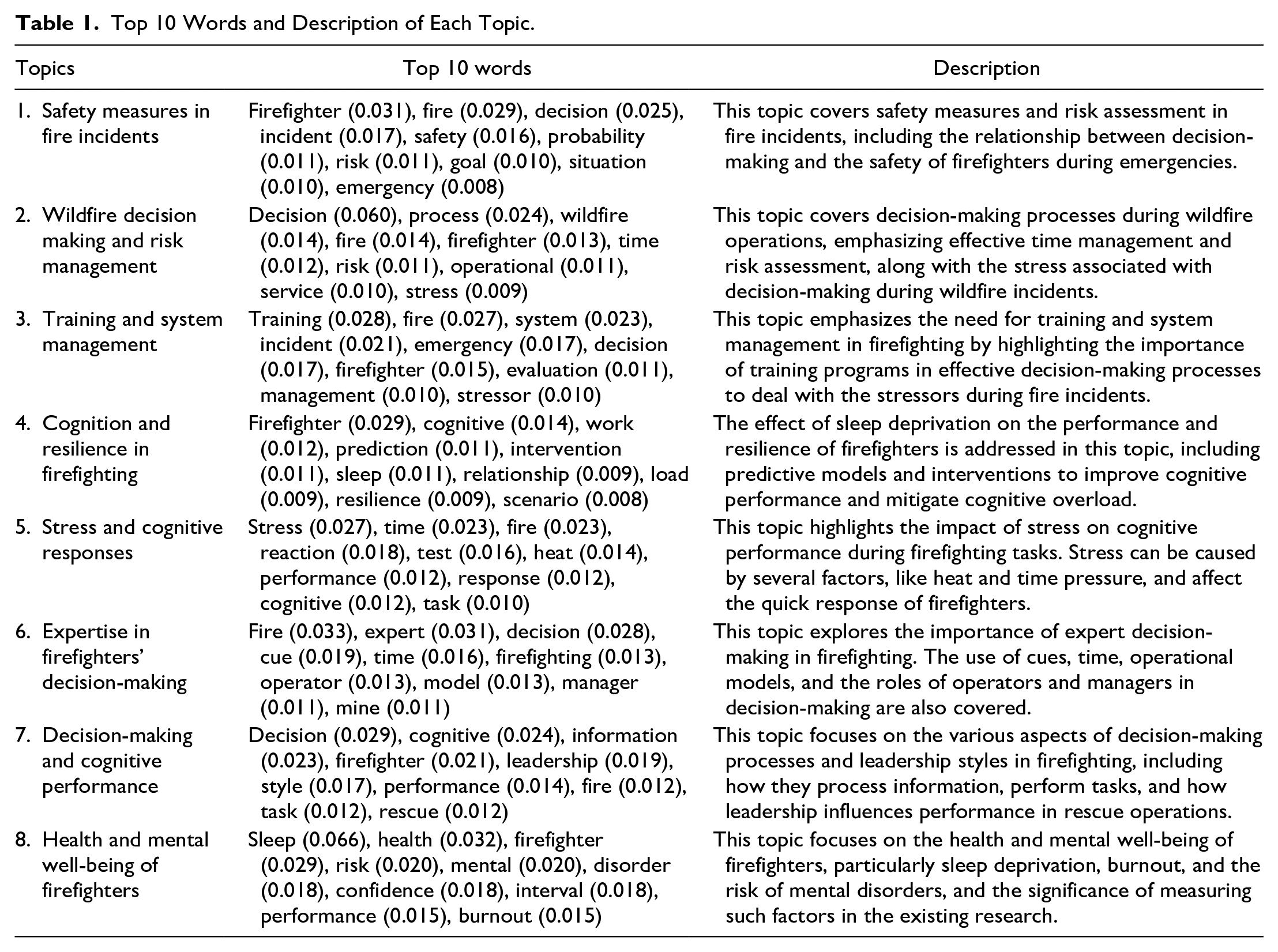
The results indicated that models with 5 to 10 topics offered the best balance between the probability of words within topics and their distribution between topics. After conducting a coherence test, the eight-topic model was identified as the most coherent model. The inter-topic distance map for the eight-topic model (Figure 1) demonstrates a well-dispersed distribution with minimal overlap between topics. This indicates that each topic captures a distinct thematic area within the literature and confirms the eight-topic model’s suitability for further analysis. The top 30 terms associated with each topic are shown to aid the interpretation of the topics. Table 1 presents the distribution of keywords within each topic, their respective weights, and a description of each topic. Topic themes were interpreted by reviewing the top 30 keywords and topic-document distribution probabilities (θ) for each topic. For example, the top 3 articles with the highest θ values for topic 1 were article 20 (θ = 0.9936), article 6 (θ = 0.9923), and article 49 (θ = 0.9909). Based on the value of θ and the top 30 keywords, two authors collectively labeled the themes, and discrepancies were resolved through discussion until consensus was achieved.
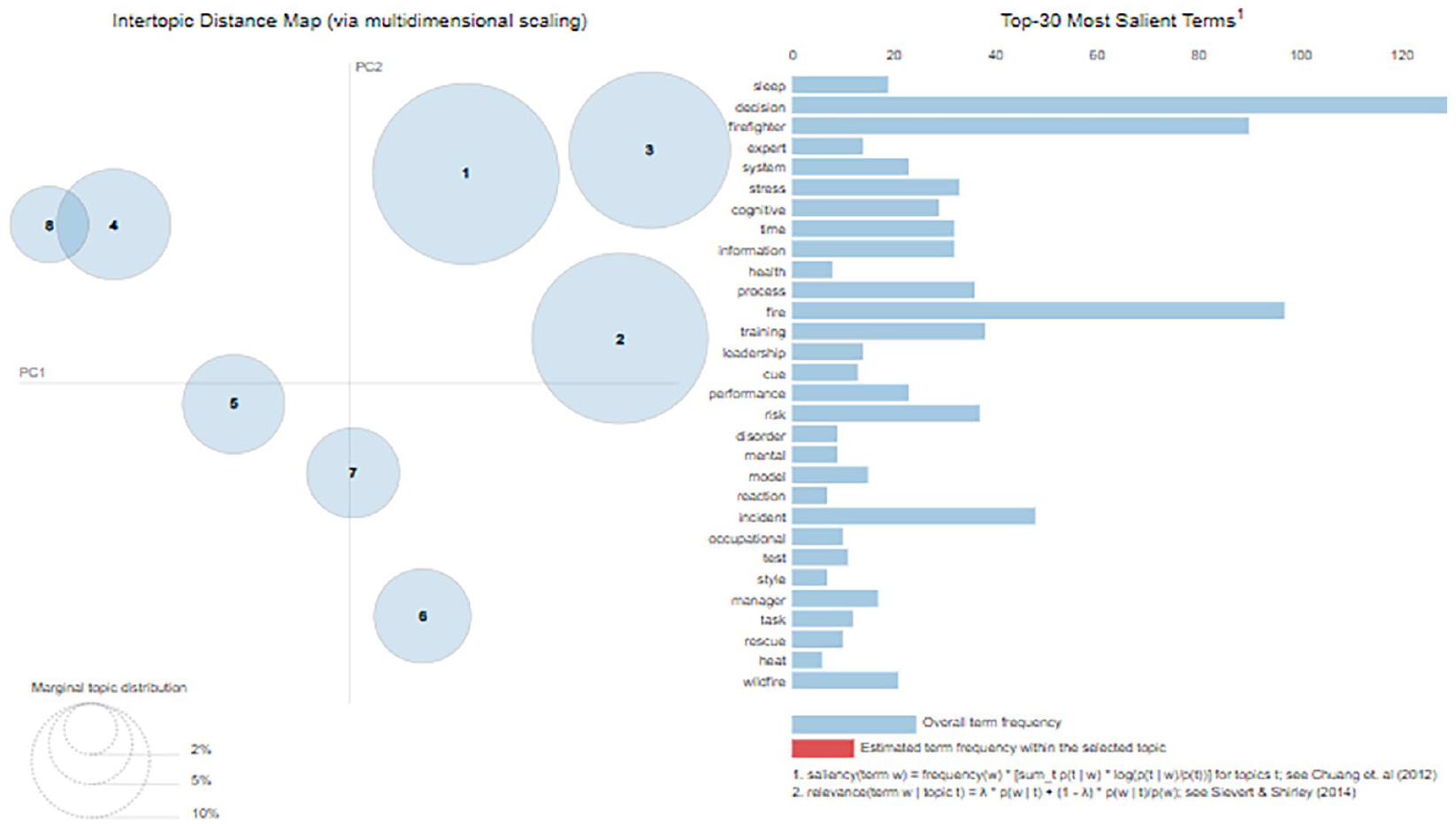
Inter-topic distance map.
Top 10 Words and Description of Each Topic.
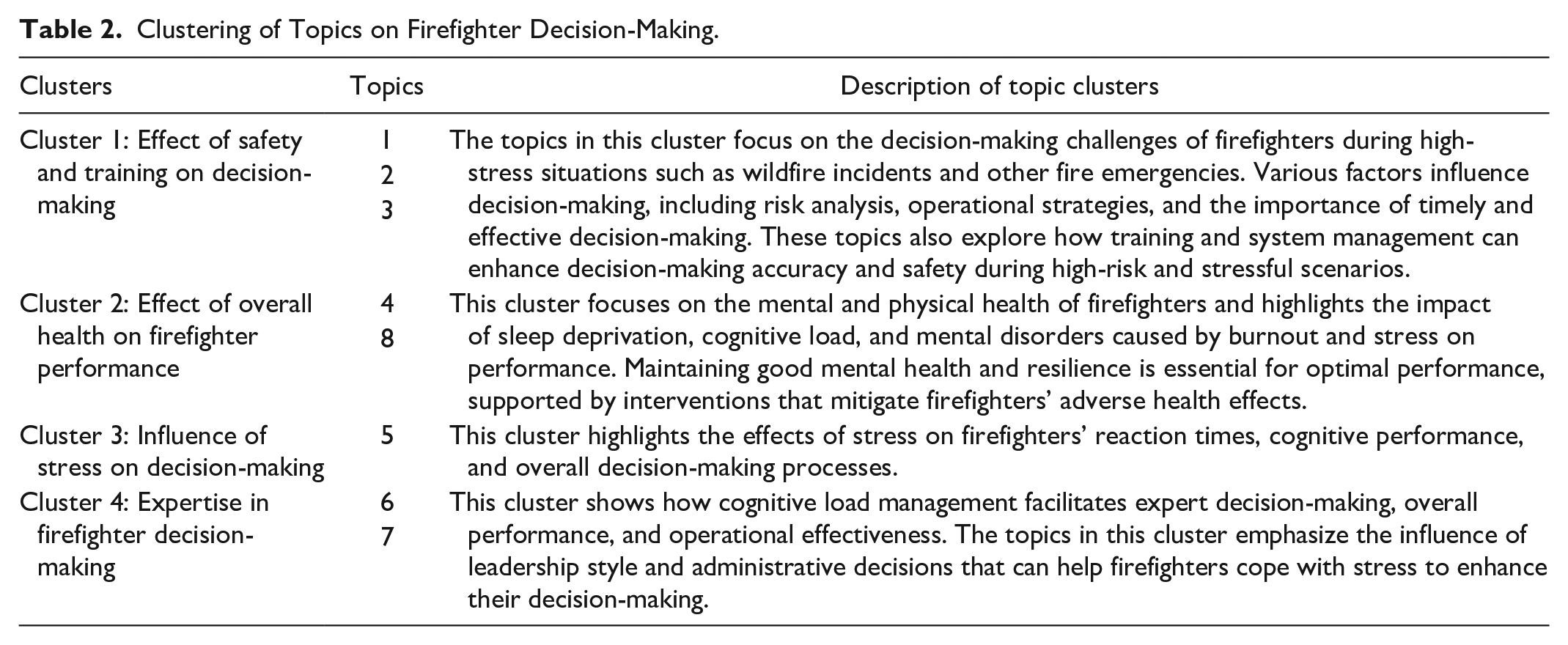
The eight extracted topics were then clustered into four groups based on the proximity of topic circles in the map (e.g., topics 4 and 8), by grouping semantically related topics into broader thematic categories (see Table 2).
Clustering of Topics on Firefighter Decision-Making.
Cluster 1: Effect of Safety and Training on Decision-Making
This cluster groups three topics, “safety measures in fire incidents,” “wildfire decision-making and risk management,” and “training and system management,” highlighting the importance of operational safety and training on firefighter decision-making in high-stakes scenarios. The dominant words within the topics are “safety,” “firefighter,” “incident,” “decision,” “training,” “risk,” and “management.” The topics within this cluster explore how structured training programs (Cohen-Hatton & Honey, 2015; Dorrer et al., 2018) and effective system management (Bearman et al., 2023) influence decision accuracy and safety during wildfire emergencies (Castellnou et al., 2019; Vitolo et al., 2019). Notably, the topic of wildfire decision-making and risk management emphasizes time-sensitive judgments under complex environmental conditions (Dorrer et al., 2018). These studies suggested that ongoing training and institutional support would enable firefighters to respond more effectively in high-risk environments. Furthermore, several articles identified how risk perception and incident command strategies influence individual and team-level decisions (Bird et al., 2019; Butler et al., 2023; Dos Santos & Son, 2024). Cluster 1 reinforces the need for the integration of risk management and safety systems in firefighter training.
Cluster 2: Effect of Overall Health on Firefighter Performance
This cluster highlights the role of physical and mental health and resilience in the decision-making and overall well-being of firefighters. Common words to appear in both topics are “firefighter,” “health,” “mental,” “sleep,” “resilience,” “cognitive,” and “performance.” Articles in this cluster focus on the cognitive effects of sleep deprivation (Frost et al., 2021; Wolkow et al., 2019), and psychological conditions, such as anxiety (Smith et al., 2023) and burnout (Wolkow et al., 2019). Several studies have emphasized the role of resilience in battling stress, burnout, and mental exhaustion. Firefighters with higher resilience showed better responses and task focus during challenging operations (Arbona and Schwartz, 2016; Heydari et al., 2022). The integration of cognitive health monitoring and resilience into firefighting systems also acts as a proactive measure (Curral et al., 2023; Heydari et al., 2022).
Cluster 3: Influence of Stress on Decision-Making
This cluster includes a single topic, “stress and cognitive responses,” and addresses the impact of stress on cognitive functioning and decision-making in firefighting. Studies reported that stress affects cognitive ability by slowing reaction time and quick response (Li et al., 2014; Williams-Bell et al., 2017). Firefighters working under high stress are more prone to performance lapses and post-traumatic stress disorder (PTSD) during time-sensitive crisis (Arbona & Schwartz, 2016; Brugghemans & Marynissen, 2013).
Cluster 4: Expertise in Firefighter Decision-Making
This cluster includes topics “Expertise in Firefighters Decision-making” and “Decision-making and Cognitive Performance.” Common words that emerged in both topics are “fire,” “decision,” “expert,” “cognitive,” “leadership,” “performance,” and “firefighter.” This cluster includes articles that discuss how experience, expertise, and leadership influence decision-making during emergency response. Studies show that experienced firefighters rely on intuitive cue recognition and situation awareness to make quick and accurate decisions (Cohen-Hatton & Honey, 2015; Okoli et al., 2022). Expertise enables firefighters to filter critical information and manage cognitive load more effectively (Dos Santos & Son, 2024). Moreover, several studies have associated leadership with accurate and coordinated decision-making in high-risk scenarios (Curral et al., 2023).
Discussion
This study applied topic modeling to study recurring themes in firefighter decision-making literature. The eight identified topics were grouped into four clusters. Topics like structured training or intuitive judgment developed through experience play a foundational role in firefighter decision-making, as reflected in Clusters 1 and 4. Moreover, Clusters 2 and 3 emphasize the importance of mental and physical well-being of the firefighters and the adverse effects of stress, burnout, and sleep deprivation on cognitive performance.
Analysis of the top 10 words within each topic revealed certain words appearing under multiple topics, including “firefighter,” “decision,” “fire,” “risk,” “cognitive,” “performance,” and “stress.” “Cognitive” and “performance” were common in topics relating to stress, resilience, and leadership, revealing how cognitive functioning is influenced by individual (e.g., sleep behavior, fatigue, stress) and occupational (e.g., time pressure, leadership style) factors. These findings align with Arbona and Schwartz (2016) and Price et al. (2022), showing cognitive decline under stressful working conditions. The frequent appearance of “risk” in both Safety Measures in Fire Incidents and Wildfire Decision-Making and Risk Management highlights the association between decision-making and risk assessment, consistent with earlier findings from Hagemann et al. (2022). “Stress” recurred in three topics: Wildfire Decision-Making, Training and System Management, and Stress and Cognitive Responses, suggesting its importance in existing research.
Incorporating these findings and recommendations into standard practices can enhance operational effectiveness and safety. For example, cognition, resilience, and physical well-being are clustered together, indicating a possibility of exploring the interaction between these topics in future research. Similarly, the term “risk” was observed under three different topics, showcasing the importance of risk management in different areas of firefighting. The findings also encourage future research on thorough investigations into underexplored areas, such as the interplay between the identified factors and team decision-making under high-risk scenarios. For instance, Heydari et al. (2022) identified key indicators of firefighter resilience, but this study complements their work by grouping cognitive performance and health with resilience in one cluster. Furthermore, our study extends the findings from the systematic review of Igboanugo et al. (2021) by showing how stress recurs across multiple thematic clusters (e.g., clusters 1 and 4) to influence the cognitive performance and decision-making of firefighters.
One limitation of the study is that interpreting themes from literature can be subjective and may not fully reflect real-world implementation. Therefore, expanding the scope of analysis to include operational data from real-world fire incidents could further validate the identified themes. Moreover, these research methods and findings can be extended to other high-risk professions, such as emergency medical services, disaster management, and aviation, where decision-making is equally critical.
Conclusion
Using topic modeling, this study aimed to uncover the recurring themes in existing literature on firefighter decision-making. The major findings of the study include eight topics in firefighter decision-making research grouped into four thematic clusters. These findings highlight the effectiveness of topic modeling as a practical approach to identifying recurring research themes in this domain. Future studies can focus on the identified topics and clustered themes for designing training programs to improve decision-making and the safety of firefighters.
Footnotes
Declaration of Conflicting Interests
The author(s) declared no potential conflicts of interest with respect to the research, authorship, and/or publication of this article.
Funding
The author(s) received no financial support for the research, authorship, and/or publication of this article.
