







Abstract
This study examines how personal protective equipment (PPE) influences measurement accuracy and perceived ergonomics in ladder-based tasks. Twenty-four participants performed tasks under four PPE configurations using anti-slip gloves and sole grips while assessing ceiling-mounted shapes from a ladder. Measurement accuracy was evaluated against predefined ground truth values, and participants rated their confidence, task difficulty, and risk perception. Results showed a mean absolute error of 0.121 cm and a root mean square error of 0.248 cm. Higher confidence during ladder ascent was strongly correlated with greater accuracy (r = −0.75), while increased perceptions of difficulty and risk were associated with larger measurement deviations (r = 0.52 and 0.34, respectively). These findings suggest that both physical and cognitive factors play a significant role in task performance. No overconfidence effects were observed, indicating that accurate self-assessment contributes positively to task precision.
Introduction
Ladder work is a fundamental task in many industrial and construction settings, requiring workers to maintain stability, execute precise movements, and manage physical exertion at elevated positions (Cudlip et al., 2021; Hsiao, 2014). These tasks pose a risk of musculoskeletal disorders (MSDs) and accidents, particularly when cognitive load, balance, and measurement precision are affected by environmental or ergonomic factors. Personal protective equipment (PPE) is commonly used to improve stability and reduce physical strain, yet its impact on task accuracy and perceived effort needs further exploration. This study aims to address this gap by analyzing the relationship between PPE use, measurement accuracy, and self-perceived task difficulty in ladder-based tasks. Unlike traditional ergonomic assessments that rely on observational methods or subjective self-reports, this study quantifies measurement accuracy using objective comparisons against a predefined ground truth. The results indicate that while overall measurement deviations were relatively low, self-perceived ability played a significant role in accuracy, particularly in ascent tasks where confidence strongly correlated with lower errors. Higher perceptions of risk and task difficulty were associated with increased measurement deviations, suggesting that cognitive and physical strain negatively impact precision. These findings highlight the importance of integrating both physical and perceptual factors into ergonomic risk assessments. By examining the relationship between PPE use, task performance, and subjective experience, this study contributes to a more data-driven understanding of ladder work ergonomics.
Background
Ladder-related injuries remain a significant occupational hazard, with falls and ergonomic strain among the leading causes of workplace accidents (Pliner, 2020). Accurate measurement and stability are critical in ladder-based tasks, yet factors such as ergonomic discomfort, cognitive load, and perceived risk can influence performance. Gloves are commonly used to improve grip and reduce hand fatigue, while anti-slip sole grips improve traction and stability (Cudlip et al., 2021; Iyer et al., 2024). Existing research suggests that PPE may redistribute physical strain and improve stability, potentially reducing cognitive demands associated with balance and precision tasks (Darabont et al., 2024). However, the current study highlights that perceived task difficulty and risk perception can negatively impact accuracy, emphasizing the need for ergonomic interventions that address both physical and cognitive factors. By analyzing the relationship between self-reported confidence, risk perception, and actual measurement performance, this study provides a data-driven perspective on how PPE influences ladder-based tasks, offering insights for improving safety and efficiency. Cognitive PPE—like feedback tools—may further support perception-based risk mitigation.
Approach
In the experiment, Figure 1 shows the ladder tasks performed by participants while wearing PPE, including anti-slip gloves (e.g., Impacto BG408, AV408) and anti-slip foot protection (e.g., Impacto SLKGRP). The ladder used for the tasks, an A-frame step ladder, complies with OSHA and ANSI certifications. Figure 2 shows the PPE worn by the participants.
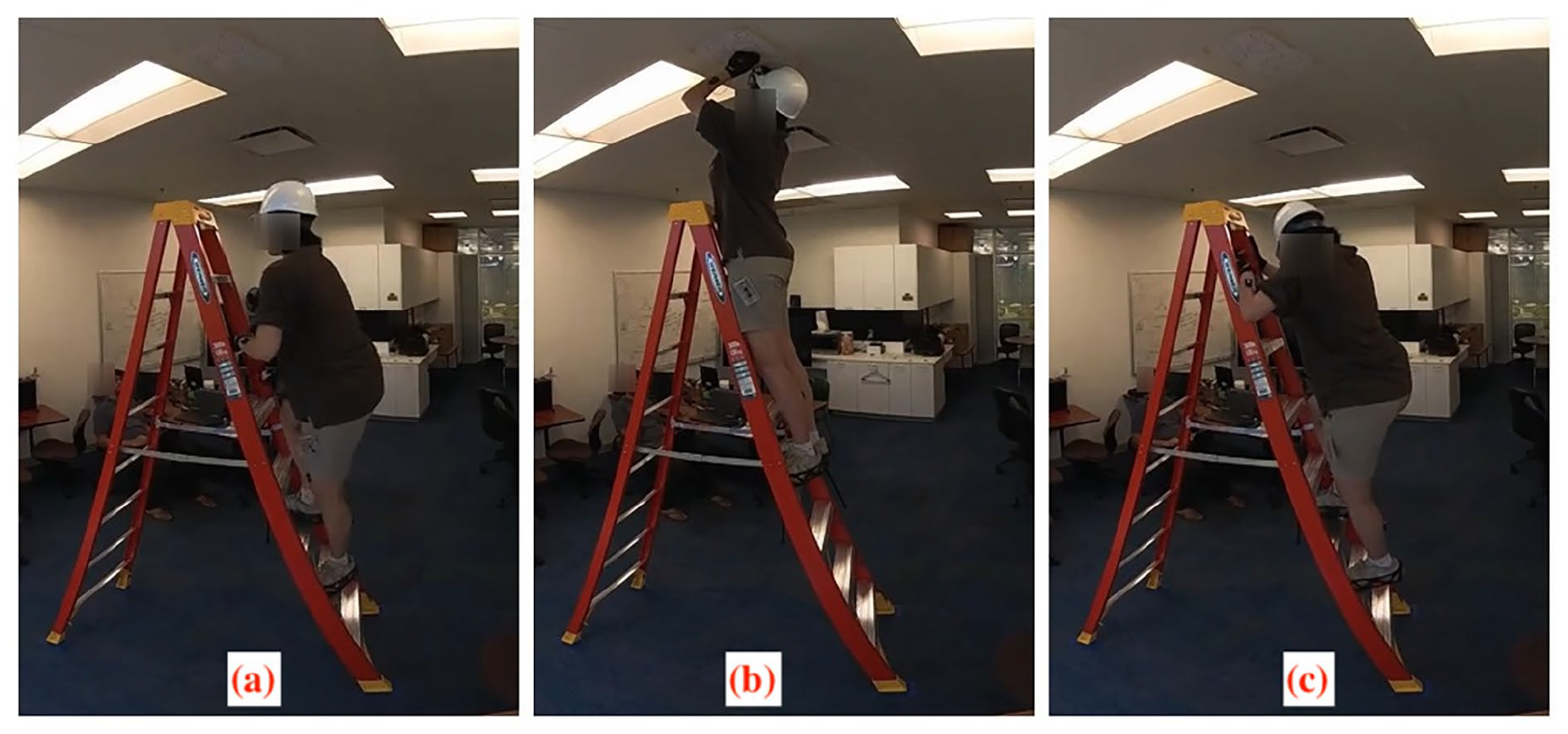
Ladder tasks with full PPE worn: (a) Participant ascending the ladder to perform the task. (b) Dimension measuring task, performed after ladder ascent. (c) Participant descending the ladder after performing task.
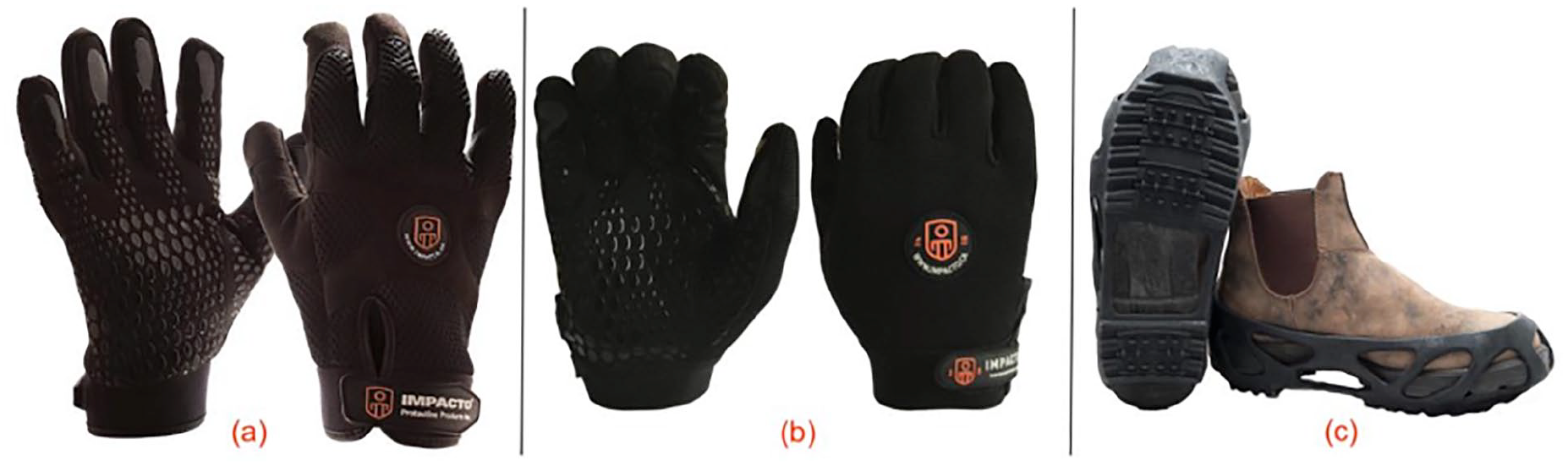
(a) Impacto BG408 glove, (b) Impacto AV408 glove, (c) Impacto SLKGRP foot protection.
This study used an experimental design with 24 participants (12 male, 12 female) performing ladder-based tasks under four PPE conditions: (1) gloves and sole-grips, (2) gloves without sole-grips, (3) sole-grips without gloves, and (4) no PPE. The sequence of these conditions followed a factorial sequence. Participants ascended and descended a ladder while using a tape measure to assess predefined shapes on the ceiling, requiring both stability and precision. Measurement accuracy was evaluated by comparing participants reported values against a predefined ground truth, allowing for an assessment of deviations. To examine the relationship between perceived and actual accuracy, participants completed a post-task perception survey, rating their confidence, task difficulty, and risk perception. Statistical analysis included error calculations (mean absolute error and root mean square error) to quantify measurement deviations, along with Pearson correlation analysis to examine the relationship between self-perception and accuracy (Benesty et al., 2009). The results shows how confidence, perceived risk, and task difficulty influenced precision, highlighting the role of cognitive and physical factors in ergonomic assessments. Bayesian models were applied to estimate the likelihood of performance variations based on PPE configurations, contributing to a deeper understanding of measurement reliability in workplace safety contexts.
Outcome
The analysis revealed significant variations in measurement accuracy among participants when compared to the ground truth values. The mean absolute error was 0.121 cm, while the root mean square error was 0.248 cm, indicating a relatively low but notable level of measurement deviation. Scatter plots showed that while some participants closely approximated the ground truth, others exhibited systematic measurement errors. The distribution of absolute errors highlighted that some dimensions had larger deviations, suggesting that these may have been more difficult to measure consistently. Perception ratings provided further understanding into participants’ self-assessment of accuracy and task difficulty. A strong negative correlation (−0.75) was observed between perceived ability to assess ladder step placement during ascent and actual measurement errors, indicating that those who felt more confident in their assessments tended to measure more accurately. Conversely, perception of task difficulty and risk exhibited moderate positive correlations (0.52 and 0.34, respectively) with measurement errors, suggesting that participants who found the task more challenging or risky generally had higher deviations from the ground truth. Perception of step placement during descent had a weaker relationship with accuracy (−0.23), possibly due to the reduced visual reference and added complexity of the task. Interestingly, no evidence of overconfidence effects was found—participants with high confidence also tended to perform well. However, further investigation with larger samples is needed to explore this effect more rigorously.
Conclusion
This study evaluated the accuracy of participant measurements in a ladder-based task and their relationship with self-perceived assessment abilities. The results indicate that while overall measurement accuracy was reasonably close to the ground truth, certain dimensions exhibited larger errors, highlighting challenges in consistency. Self-perception of assessment ability during ascent showed a strong correlation with accuracy, suggesting that participants who felt more confident in their judgments generally performed better. Higher perceptions of risk and task difficulty were associated with greater measurement errors, indicating that discomfort and cognitive load negatively impacted accuracy. These findings emphasize the importance of task conditions and individual perception in ergonomic assessments. Future research should explore strategies to mitigate perception-driven inaccuracies, such as training interventions or augmented feedback systems, to improve measurement reliability in occupational safety applications. These insights suggest that perception-aware interventions—such as confidence-based safety training or feedback systems—could help reduce errors in ladder tasks. Aligning perceived and actual ability may prevent missteps that lead to injury, especially during ascent, where both overconfidence and underconfidence can compromise stability.
Footnotes
Acknowledgements
The authors gratefully acknowledge Ms. Debra Bradley from Impacto Protective Products Inc. for their generous donation of personal protective equipment used in this research project. Their support significantly contributed to the successful execution of the study.
Declaration of Conflicting Interests
The author(s) declared no potential conflicts of interest with respect to the research, authorship, and/or publication of this article.
Funding
The author(s) disclosed receipt of the following financial support for the research, authorship, and/or publication of this article: This publication is supported by the Pilot Project Research Training Program of the Southern California NIOSH Education and Research Center (SCERC), Grant Agreement Number T42 OH004812 from the Centers of Disease Control and Prevention (CDC).
