







Abstract
The present study investigates how experienced ageism mediates the relationship between perceived ageism from GenAI and age anxiety outcomes with a secondary data analysis from the Older Adult Annotator Demographic and Attitudinal Survey (N = 1,483). Measures consist of older adult (age range: 50–90) responses to the previously validated Aging Anxiety Scale (AAS) and the unvalidated Age Experience Survey (AES). An exploratory factor analysis followed by a confirmatory factor analysis establishes latent variables from both surveys. A structural mediation model was used to assess whether Experienced Ageism (AES) mediated the relationship between attitudes towards algorithmic ageism (AES) and age anxiety outcomes (AAS). Experienced ageism mediated the relationship between attitudes toward algorithmic ageism and implicit age anxieties (ps < .05) but not explicit age anxieties. Future work should explore how perceived ageism in GenAI influences age anxiety and adoption of GenAI technology among older adults.
Generative Artificial Intelligence (GenAI) generated content is projected to occupy 10% of the publicly accessible internet by the end of 2025 (Gartner, 2024). GenAI is also being integrated into adult care technologies to facilitate healthy aging experiences for older adults over time (Chan et al., 2024). In this form, GenAI content is integrated into companion robots (cobots), applications for medical treatment technologies, and GenAI for verbal and nonverbal communication facilitation (Chan et al., 2024). The models used in these technologies are derived from legacy generative models such as GPT-4o (used in ChatGPT).
Despite the widespread availability and promising utility of GenAI-generated content and technologies, age biases introduced into GenAI algorithms via data annotation and model training are of concern. Age bias in GenAI algorithms (algorithmic bias) raises concerns about the representation and inclusivity of GenAI-generated content, particularly regarding age bias or ageism (Nielsen & Woemmel, 2024; Rosales & Fernández-Ardèvol, 2019). Iversen et al. (2009) define ageism as “. . .negative or positive stereotypes, prejudice and/or discrimination against. . .aging people because of their chronological age” (p. 4).
While a person can experience ageism regardless of chronological age (Iversen et al., 2009), research has found that person-to-person ageism negatively impacts the mental and physical health of the older adult (Chang et al., 2020; Lyons et al., 2018). As of present, little work has been done to understand how technology-to-person ageism impacts older adults.
If we expect older adults to accept GenAI technologies designed for their aging experience readily, it is critical to understand how GenAI algorithmic age biases impact older adult users. To study this, Díaz (2020b). developed the Older Adult Annotator Demographic and Attitudinal Survey (OAADA), collecting responses from a nationally representative sample and making the data publicly available on Harvard Dataverse. However, items on the OAADA that focused on experienced ageism and perceived ageism in technology remain unvalidated. Further, the relationship between attitudes towards algorithmic ageism, experienced ageism, and age anxiety outcomes remains under explored. To address this gap, our study conducted a secondary analysis of OAADA responses to examine whether explicit perceptions of algorithmic age bias influence implicit age perceptions in older adults.
Background
GenAI technologies increasingly rely on legacy large language models (LLMs) of the generative transformer class, such as GPT-4o (used in OpenAI’s ChatGPT). Age bias in these models, typically stemming from the data annotation and model training stages, is a growing concern (Díaz et al., 2018; Nielsen and Woemmel, 2024). Before an LLM can generate predictions, a ground truth dataset must first be curated, which provides a “true” label for the LLM’s ideal accurate output (What Is Ground Truth in Machine Learning, 2024). For supervised fine tuning (a form of LLM training), the LLM output is compared to the ideal output to generate a measure of accuracy. LLMs are trained to respond accurately to the ideal response pattern found in the ground truth dataset. LLM ground truth datasets rely on human annotators whose biases, including ageism, can influence model outcomes (Díaz et al., 2018) by influencing the pattern of responses toward the established but biased “ideal.” Age bias in algorithms may occur through processes the exclusion of older adults in these design processes, or through data annotation that overgeneralizes across older adult cohorts (Chu et al., 2023). In a scoping review, Chu et al. (2023) older adults were commonly misrepresented or not represented in AI training data due to lack of data availability by age demographic. Further, Chu et al. (2023) found that for facial recognition AI, studies that categorized faces by age exhibited higher errors for older adult faces, likely stemming from initial data representation issues. Data misrepresentation and measurement error are only a few ways in which algorithm bias persists and stands to impact the older adult user (Chu et al., 2023). Further, since the current form of generative GenAI is a nascent form of technology, the extent to which older adults perceive algorithmic ageism and how this influences their perceptions of aging has received little study.
In an effort to examine older adults’ perceptions of algorithmic ageism, Díaz (2020b) developed the Age Experience Survey (AES) within the OAADA. The AES assessed experienced ageism and perceptions of ageism in technology. Participants also completed the Age Anxiety Survey (AAS; Lasher & Faulkender, 1993), which measures age anxiety across four dimensions: (1) Fear of Old People, (2) Psychological Concern, (3) Physical Appearance, and (4) Fear of Losses.
It is important to note that (1) the factor structure of the AES has not yet been validated, and (2) the relationship between the dimensions of the AES and AAS has not been examined. Thus, it is essential to validate these measures, as they are critical tools in evaluating how algorithmic ageism may lead to outputs that underrepresent and misrepresent older adults. When age-biased information is integrated into consumer products, it can lead to age discrimination, reinforce societal ageism perceptions, and hinder older adults’ technology adoption (Berridge & Grigorovich, 2022). The combined responses on the AES and AAS from the OAADA provide an opportunity to assess the impacts of algorithmic age bias on the older adult end user.
This study aimed to evaluate the following research questions: (1) What is the dimensionality of the AES? Our first hypothesis was that the AES would retain a two-factor structure according to its original specification by Díaz (2020b) (H1). (2) Is there an indirect relationship between attitudes towards algorithmic ageism (Att-Alg) and the dimensions of age anxiety (Lasher and Faulkender, 1993) mediated through experienced ageism (EA)? Our second hypothesis was that experienced ageism would significantly mediate the relationship between attitudes towards algorithmic ageism and each subdimension of the AAS (H2a–H2d). Refer to Figure 1 to see our hypothesized model.
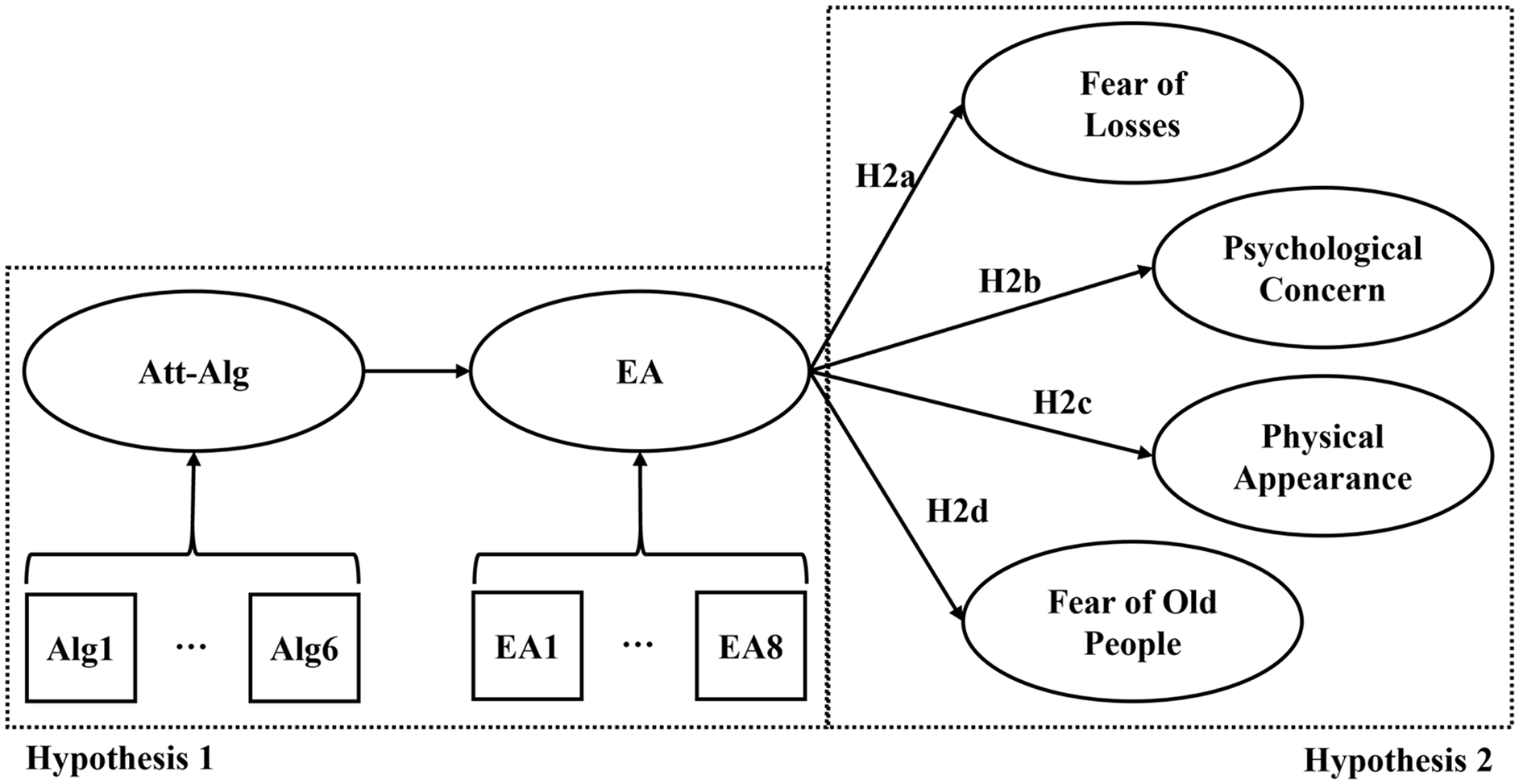
Hypothesized mediation model.
Methods
Data was sourced from the Harvard Dataverse as an open-source raw data product (Díaz 2020a). Our sample included 1,483 responses from older adults (Age range = 50–90+) who completed both the AES (Díaz 2020a) and AAS (Lasher and Faulkender, 1993. The dataset included within-subjects responses to items from the AES (Díaz, 2020b) and AAS (Lasher and Faulkender, 1993).
A confirmatory factor analysis (CFA) was used to validate the factor structure (H1) of the AES and to confirm the four-factor structure of the AAS (Lasher and Faulkender, 1993). A structural regression model was fit to explore the hypothesized mediation relationship between the variables of (1) attitudes towards algorithmic ageism (Att-Alg), (2) experienced ageism (EA: mediator), (3) and each age anxiety subdimension, see Figure 1 (H2a–H2d).
Our analytical approach followed the two-step modeling approach (Anderson & Gerbing, 1988). Maximum likelihood estimation methods were used. We evaluated the CFAs and structural mediation model fit using established fit criteria: RMSEA, CFI, and SRMR. Analyses were conducted using the R statistical language (version 4.4.1) with package lavaan.
Results
All AES items were normalized into z-scores to account for differences in Likert scaling between item sets. The combined alpha coefficient for the AES was .69, while the AAS had a coefficient alpha of .62. Both the combined items and the AAS had a reasonable internal consistency.
The dimensions of the AES and AAS were explored through a principal axis exploratory factor analysis (EFA) with varimax rotation. Parallel analyses and the Kaiser criteria were applied to both AES and AAS. A five-factor solution fits the data best for the AES, explaining 65% of the variance. A four-factor solution fits the data best for the AAS, which explains 78% of the variance. All retained items for both measures had significant item loadings, exceeding the ≥ | .40| recommended cutoff (Hinkin, 1998).
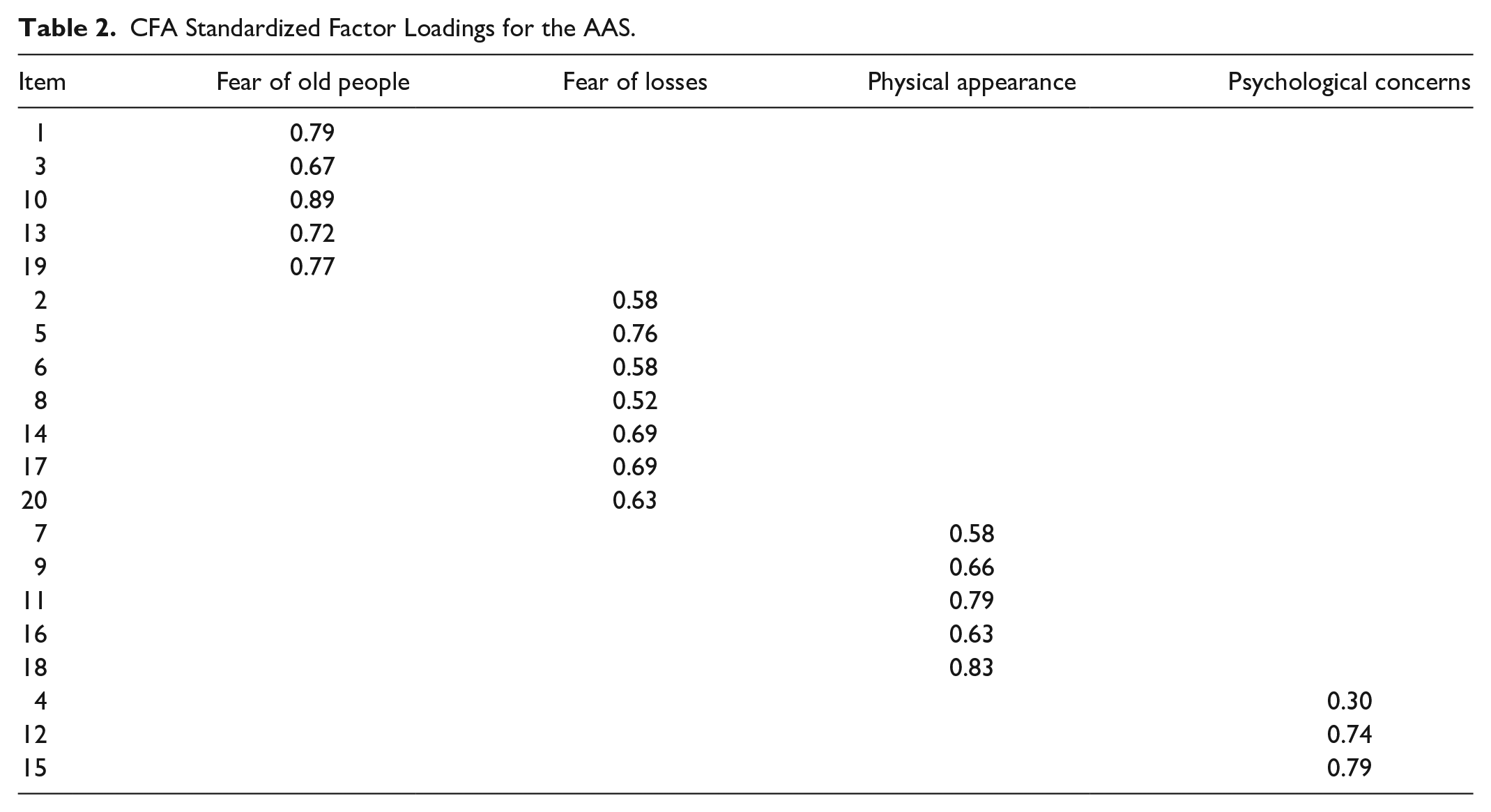
A principal factor CFA was conducted to evaluate the AES’s five-factor structure (see Table 1). Item loadings were sufficiently large and significant (λ ≥ .30, p < .05), and fit indices indicated an acceptable model fit (RMSEA = .066, SRMR = .054, CFI = 0.912) (Browne and Cudeck, 1993; Hu and Bentler, 1999). Results did not support a two-dimensional structure, confirming that the AES retained five factors: three in the EA domain and two in the Att-Alg domain. Similarly, a principal factor, CFA, assessed the four-factor structure of the AAS (see Table 2). Item loadings met significance thresholds (λ ≥ .30, p < .05), and fit indices supported a close fit, supporting the four-factor structure of the AAS (RMSEA = .070, SRMR = .058, CFI = 0.903) (Browne and Cudeck, 1993; Hu and Bentler, 1999).
CFA Standardized Factor Loadings for the AES.
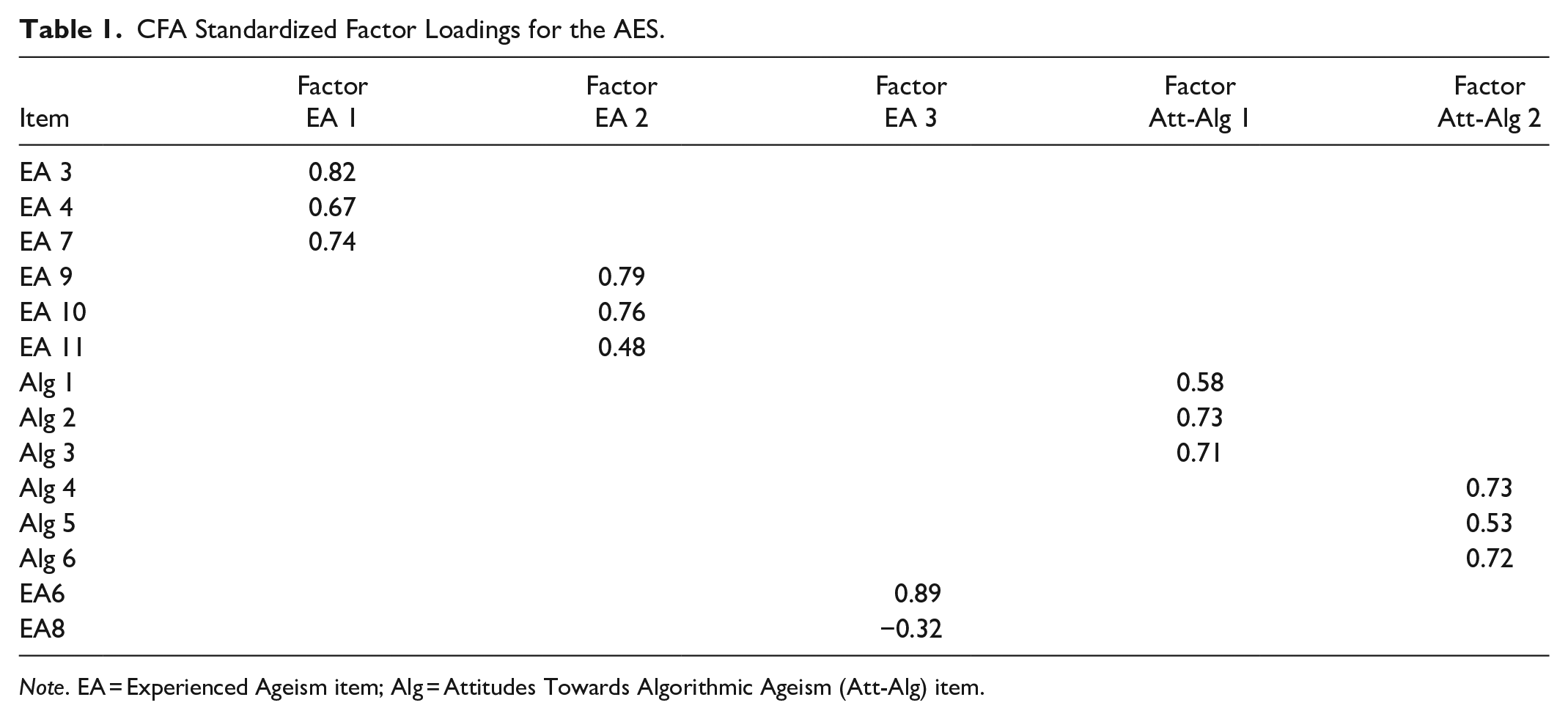
Note. EA = Experienced Ageism item; Alg = Attitudes Towards Algorithmic Ageism (Att-Alg) item.
CFA Standardized Factor Loadings for the AAS.
We tested our mediation hypotheses using a structural regression model (Figure 2). Given the AES’s factor structure, EA1, EA2, and EA3 were combined into a single composite Experienced Ageism variable (EAc), while Att-Alg1 and Att-Alg2 remained separate. The model fit was evaluated using CFA criteria and indicated an acceptable fit.
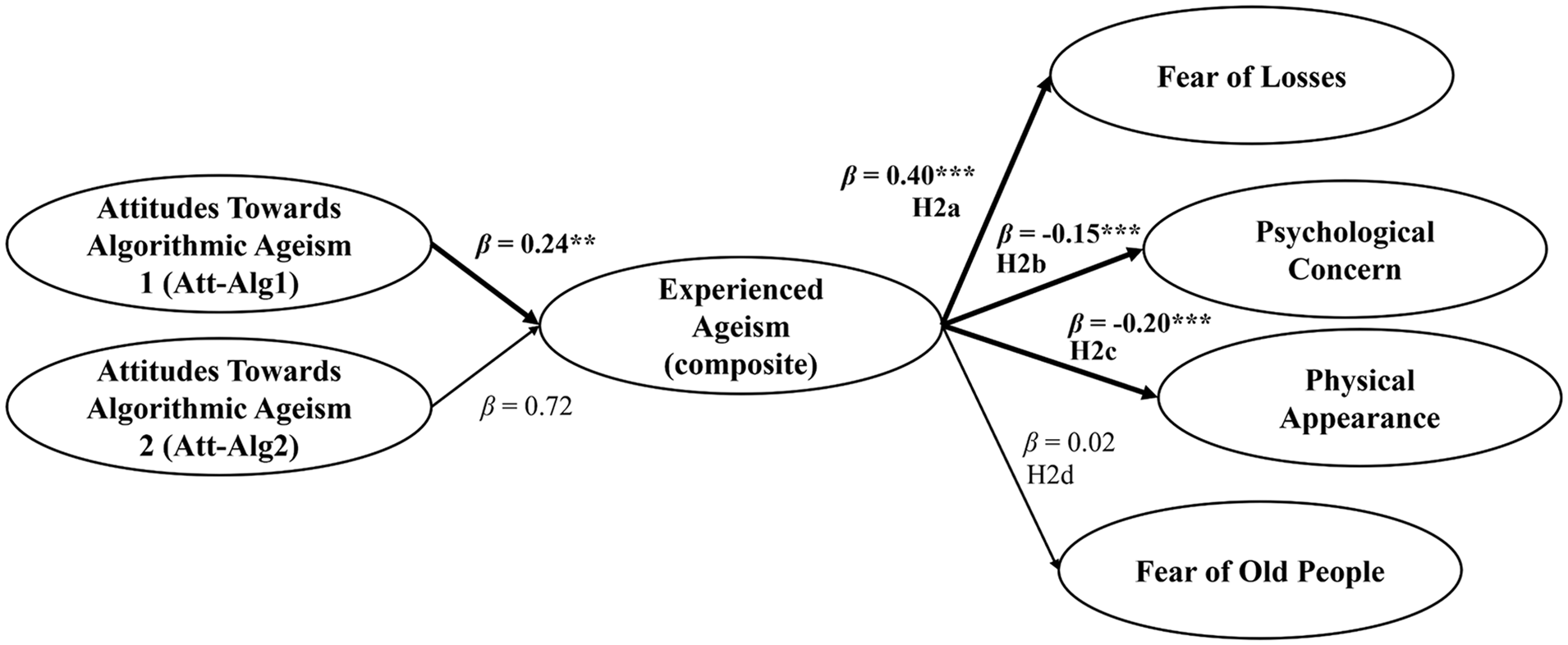
Structural mediation model with standardized parameter estimates.
Mediation analyses revealed that EAc significantly mediated the relationship between Att-Alg1 and Fear of Losses (b1 = 0.14, p1 < .05) but not Att-Alg2 (b2 = −0.05, p2 = .625), partially supporting H2a. Similarly, EAc significantly mediated the relationship between Att-Alg1 and Psychological concern (b1 = −0.04, p1 < .05), but not Att-Alg2 (b2 = 0.02, p2 = .653), partially supporting H2b. Also, EAc significantly mediated the relationship between Att-Alg1 and Physical Appearance (b1 = −0.03, p1 < .05), but not Att-Alg2 (b2 = 0.01, p2 = .653), partially supporting H2c. However, EAc did not significantly mediate the relationship between either subdimension of Att-Alg and Fear of Old People (b1 = 0.01, p1 = .473, b2 = 0, p2 = .717); thus, H2d was not supported.
Discussion
Our findings validate the AES scale (Díaz, 2020b) and confirm the AAS’s four-factor structure (Lasher and Faulkender, 1993). Results suggest that older adults recognize age bias in emerging technologies and experience age-related anxiety when their technological needs are overlooked. Specifically, perceptions of algorithmic ageism impact age anxiety outcomes at the dimensions of Fear of Losses, Psychological Concern, and Physical Appearance, but not Fear of Old People. This suggests that through experienced ageism, perceiving algorithmic ageism may influence implicit age anxieties regarding self-image and future aging rather than attitudes toward other older adults.
Ageism has been found to increase age anxiety and has negative impacts on older adults’ interaction with GenAI (Berridge & Grigorovich, 2022). Moreover, perceived value and confidence in one’s learning ability strongly predict technology adoption in older adults (Berkowsky et al., 2017). Thus, future research should examine how perceived value in GenAI and confidence in learning ability interact with perceptions of algorithmic ageism and age-related anxiety. Possibly, older adults who perceive technology as less valuable and lack confidence in their ability to learn may be more vulnerable to the adverse effects of algorithmic ageism, leading to increased anxiety and reduced engagement with GenAI technology. Most importantly, evaluating and addressing ageism within the early technological development stage is essential to promote inclusivity and accessibility in GenAI technologies.
Limitations
While our findings offer new exciting insights, the limitations of conducting a secondary analysis highlight opportunities for future work. First, the reliance on self-reported measures introduces the possibility of response biases, such as social desirability or subjective interpretation of survey items. Future work should aim to test the variables and hypothesized relationships presented here experimentally, using an older adult sample to investigate the causality of any claimed relationships.
Further, our analysis draws on a dataset collected in 2020, which may limit the applicability of our findings to current GenAI systems. Participants’ perceptions of algorithmic ageism were likely informed by earlier forms of GenAI decision-making (e.g., customer service GenAI agents) rather than the more interactive generative pre-trained transformer GenAI systems currently used today. Still, these findings offer an important historical baseline and highlight foundational concerns that may persist or intensify with current GenAI technology.
As this is a secondary data analysis, we note that the original data owners did not explore the mediation model presented here. Our contribution builds upon their dataset and existing work to investigate a novel and timely research question concerning the psychological impact of perceived algorithmic ageism on older adults. Future studies should examine these relationships using either an updated sample or longitudinal approaches that specifically reflect older adults’ interactions with current and future generative GenAI technologies. Future studies should explore how interactions with present-day GenAI technologies shape age anxiety, trust, and technology adoption among older populations.
Key Takeaways
The present study provides supporting evidence that experienced ageism mediates the relationship between perceived algorithmic ageism and implicit age-related anxieties among older adults.
Findings indicate that the psychological impact of GenAI systems may persist beyond the instance of direct human-system interaction.
This work highlights the critical need for system design best practices that are equitable and responsive to age-related concerns.
Footnotes
Declaration of Conflicting Interests
The author(s) declared no potential conflicts of interest with respect to the research, authorship, and/or publication of this article.
Funding
The author(s) received no financial support for the research, authorship, and/or publication of this article.
