







Abstract
Artificial Intelligence is changing the way people work and live. However, there is a good deal of fear and uncertainty with respect to this technology. This study investigated a learning and familiarization program regarding generative AI, specifically ChatGPT. Employees at a consultancy completed a program designed to familiarize the employees with ChatGPT and walk them through a variety of use cases. A pre- and post-training survey was used to collect data on employees’ perceptions and experiences. This study revealed that the training was effective in improving the employees’ confidence in using generative AI, their feelings of familiarity with the tool, their usage frequency, the complexity of usage, and their feelings of having been trained on the tool. In addition, the training shifted attitudes from general concerns and fears to greater understanding and more practical expectations regarding ChatGPT.
Introduction
Artificial Intelligence (AI), defined as “systems that seek to provide the intellectual processes characteristic of people” (National Academies of Sciences, Engineering, and Medicine, 2021, p. 127), is a disruptive technology, radically changing our lives. Even people who do not deliberately choose to use AI technology are affected, as internet search engines use AI to provide responses, recommender engines on Amazon or Netflix, and advertisements on social media are all based on AI. Individuals and organizations have a wide variety of interest and willingness to engage and explore the opportunities afforded by AI. However, given the ever-increasing capabilities, many are motivated to learn by a fear of falling behind their colleagues and competitors.
This paper discusses the implementation and evaluation of a training and familiarization program at a consultancy. The employees experienced a month-long, self-directed program that included guided experiences interacting with Generative AI (GenAI), specifically ChatGPT. The effectiveness of this training in terms of employees’ attitudes and usage of GenAI was evaluated by a short survey, delivered before and after the training program. This paper discusses the training program and the impact of the training on the consultants’ attitudes and usage of GenAI following the training.
Research indicates that people and companies have both strongly positive and negative attitudes toward AI. As with new technology in general, a lack of understanding is common and can lead to both negative attitudes as well as excessive optimism (Castagno & Khalifa, 2020; Vogel et al., 2023). Fear of job displacement or expected changes in jobs cause concern and rejection of the technology (Morikawa, 2017). Concerns about ethical issues are another potential barrier (Gîngută et al., 2023; Na et al., 2022). At a company level, concerns about intellectual property are front and center. Some companies have mandated that AI will not be used for any work purposes, given the fear of losing IP and competitive advantage. Other companies are experimenting with AI and investigating ways to effectively implement the technology.
For those companies that want to encourage the use of AI, a variety of tools exist. These include providing a safe instantiation of AI, where employees can use the tool without fear of their data being sent out to the internet. Training is another option: companies indicate clear support for using AI when they train employees to work with the tools. In addition, clear communications, explicit regulations regarding AI usage (Castagno & Khalifa, 2020; Greenwald, 2017), organizational and leadership support (Castagno & Khalifa, 2020; Suseno et al., 2022), and explicit use cases for AI can all drive adoption. The explicit use case is an important factor, as it shows employees how AI can fit into their workflow and how it can be used to solve particular problems.
One particularly relevant study (Adams et al., 2024) investigated college students and their usage and perceptions regarding ChatGPT. This study found that students were interested in using ChatGPT for academic work, but they expressed concerns regarding the lack of clear guidance on how to use the tools. Students saw an opportunity to use the AI to “nurture self-regulated learning” (Adams et al., 2024, p. 13630). Students expressed concerns about relying too heavily on AI and diminishing their critical and creative thinking abilities.
The research question addressed in this work is as follows: Does a GenAI training and familiarization program affect trainee perceptions (e.g., confidence, familiarity) and use of the technology?
Approach
The approach in this work was to administer a survey prior to the GenAI training experience, provide the training experience, and administer the survey a second time upon completion of the experience. The training was offered over a four-week period. Personnel consented (opt-in) to have their data included in this analysis. Approval for this study was granted through the UNCo Institutional Review Board.
Training and Familiarization Program
The training program was implemented in a tool called Adoptify that provides a gamified learning experience with a set of exercises and reflections. For the GenAI training experience, the tasks required participants to engage with the content for approximately 30 minutes per week. Details of the program are provided in Table 1. General information about AI, potential uses, intellectual property concerns, and other material was provided via an eLearning module. Upon completion of that background information, trainees began the series of interactions with ChatGPT. The tasks were crafted to demonstrate specific use cases that employees might use in daily life (e.g., meal planning, trip planning) and in work (e.g., brainstorming and refining ideas, summarizing meeting transcripts, analyzing data in a spreadsheet). Gamification elements of Adoptify include a leaderboard where players are awarded points for completing exercises in a timely manner and receiving peer nominations.
Overview of the GenAI Training Program.
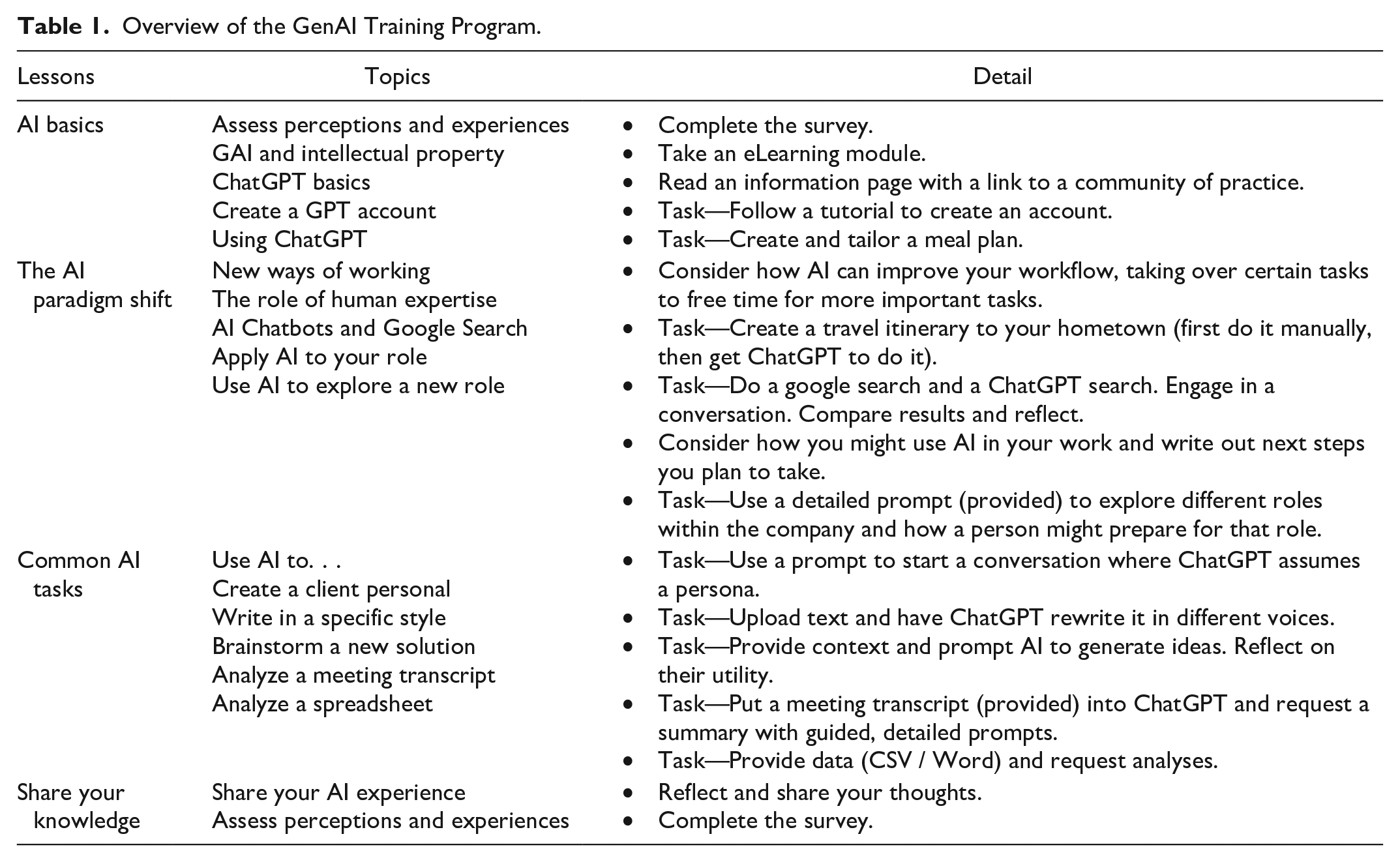
The lessons were developed to adhere to a key principle of adult learning: namely, that adults need to see how the course material is relevant to their daily lives and work (Merriam & Bierema, 2013). Further, the training included reflection points after each task, where participants were specifically asked to consider how the learnings could be incorporated into their lives and work (Chuang, 2021; Merriam & Bierema, 2013; Powell & Bodur, 2019). In addition, a Community of Practice was established around the use of generative AI, and training participants were encouraged to join (Lave & Wenger, 1991).
Interactions with AI were completed in a company instantiation of ChatGPT, so participants did not need to worry about security concerns. The program was designed so trainees began interactions with more simple tasks that they could easily complete while seeing tangible benefits. Scaffolding was provided through detailed instructions and initial simple tasks that gradually increased in complexity. The meal planning example was simple and effective in showing how ChatGPT could provide useful recommendations and how it could refine these recommendations based on subsequent user inputs. As trainees progressed through the learning experience, tasks became more complex and involved. One of the final tasks was uploading a spreadsheet and performing statistical analyses.
One key lesson included in the experience was that interactions with ChatGPT were not “one and done,” but they involved iteration and conversation to get more refined results. The exercises gave people experience with the tool, they learned nuances of interacting, and they learned a set of practical use cases. Trainees saw specific examples of how ChatGPT can be valuable in daily life and in work contexts.
Survey
Prior to beginning the Adoptify experience, participants completed a short survey, asking about their experiences and perceptions using AI. Participants were given the same survey at the end of the experience. Results were analyzed to identify changes in experiences and perceptions following the training. The survey was delivered as part of the training experience. It was offered in Microsoft Forms and included an option to participate in a study for the University of Northern Colorado (UNCo). Nearly 95% of the learning experience participants agreed to allow their data to be included in the UNCo study.
The survey included eight questions asking about experiences and familiarity with AI and six demographic questions. Among the AI questions, five were multiple choice Likert-scale type questions and three were open-ended text questions. Multiple choice questions are listed below:
How
How
How
To what extent have you
One open-ended question asked how participants had used AI. Two open-ended questions asked about perceived concerns and benefits of AI.
Outcomes
Quantitative Findings
The program participation was high, with approximately 80% of the employees at the consultancy at least starting the learning experience. Approximately 45% of employees completed the entire experience, including the final survey. Of the employees who agreed to have their data included in the UNCo study, 239 had completed the pre-training survey and 119 completed the post-training survey. A multivariate analysis of variance (MANOVA) was conducted to assess overall differences between pre-training survey and post-training survey groups across four outcome variables: confidence, familiarity, frequency of AI use, and AI skill level.
Responses were quantified for the rating scales. Results revealed a statistically significant multivariate effect of Test Time (Pre vs. Post) on the combined dependent variables,
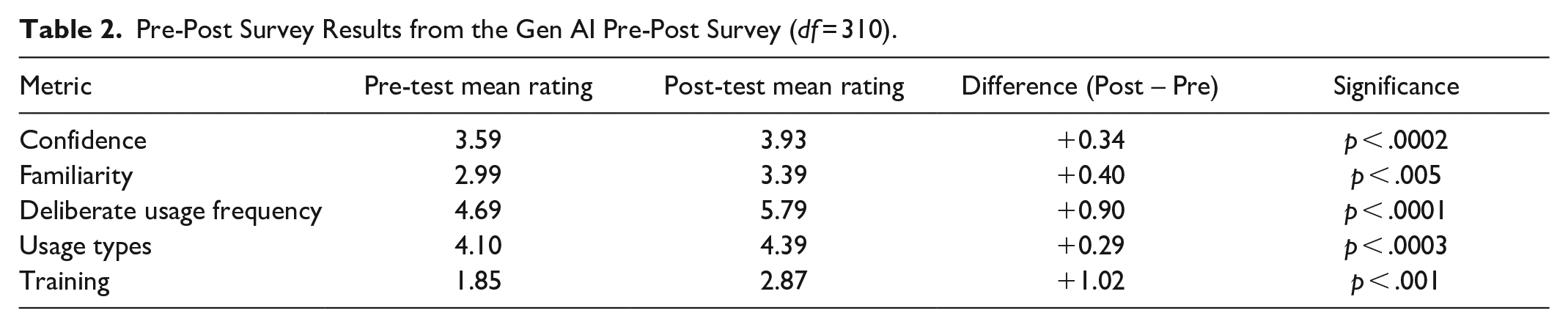
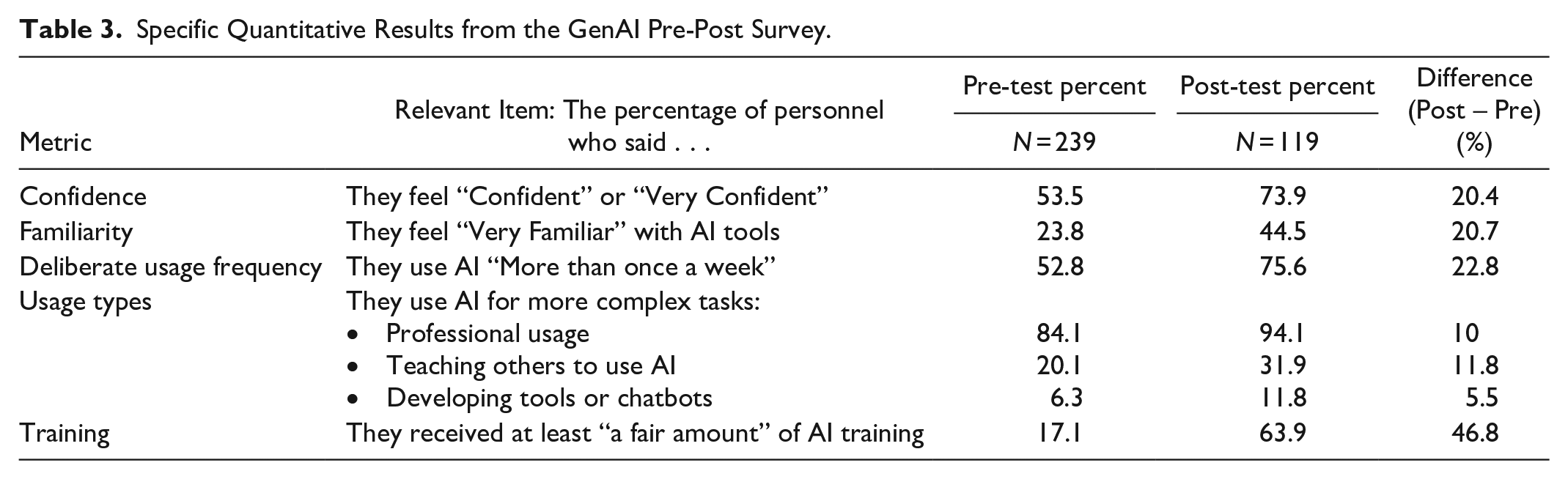
A one-way ANOVA, with pre- and post-training session as the dependent variable, was performed on the data using SPSS. Table 2 identifies the key quantitative findings from the study. It shows the overall averages on these performance metrics. Participants reported greater confidence and familiarity with AI following the training. They reported using AI more frequently and they reported using AI for more sophisticated types of tasks (e.g., developing tools and chatbots or teaching, versus personal use). These results indicate that the personnel feel more confident and familiar with AI and they engage in more frequent and complex usage of AI. They feel they have received training. Table 3 gives specific examples of the types of quantitative changes that were reported in the pre- and post-training surveys, listing specific types of questions that revealed differences.
Pre-Post Survey Results from the Gen AI Pre-Post Survey (df = 310).
Specific Quantitative Results from the GenAI Pre-Post Survey.
Qualitative Findings
The survey asked participants to identify (1) the ways in which they deliberately use AI, (2) their top concerns with respect to AI and, (3) the key benefits they envision. Thematic analysis of the results were conducted and chi-squared analyses performed to determine differences. Results are shown in Figures 1 to 3.
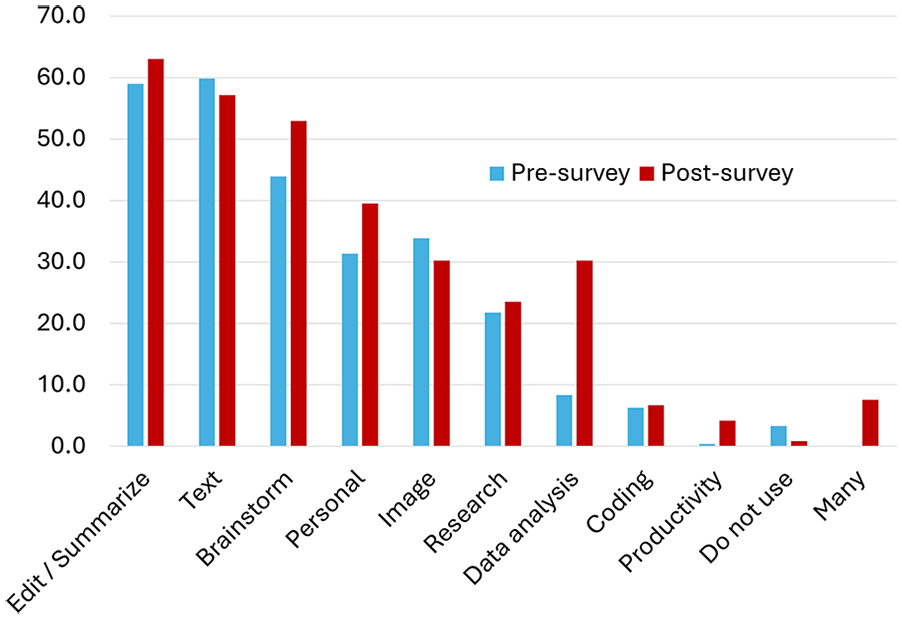
Percentage of respondents answers to the question “How do you use AI?” in the pre- and post-training survey.
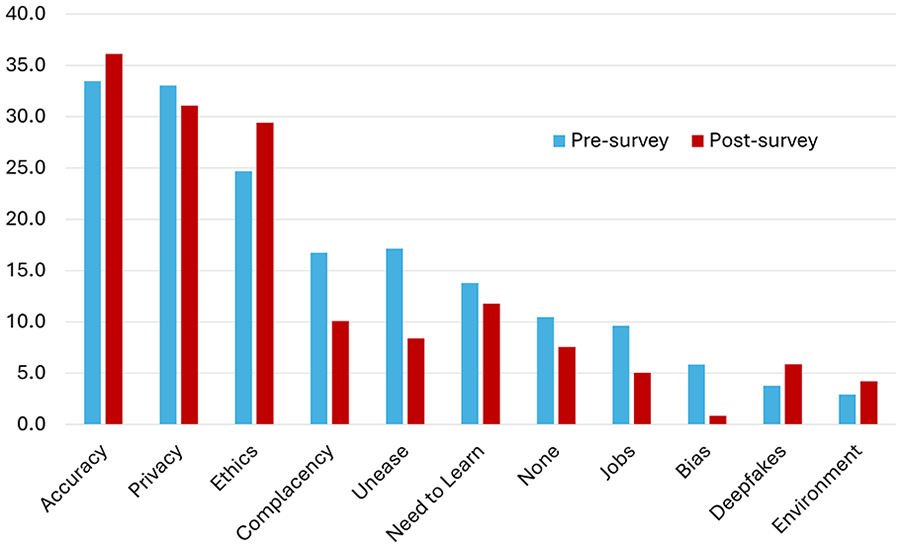
Percentage of respondents answers to the question “What concerns do you have about AI?”
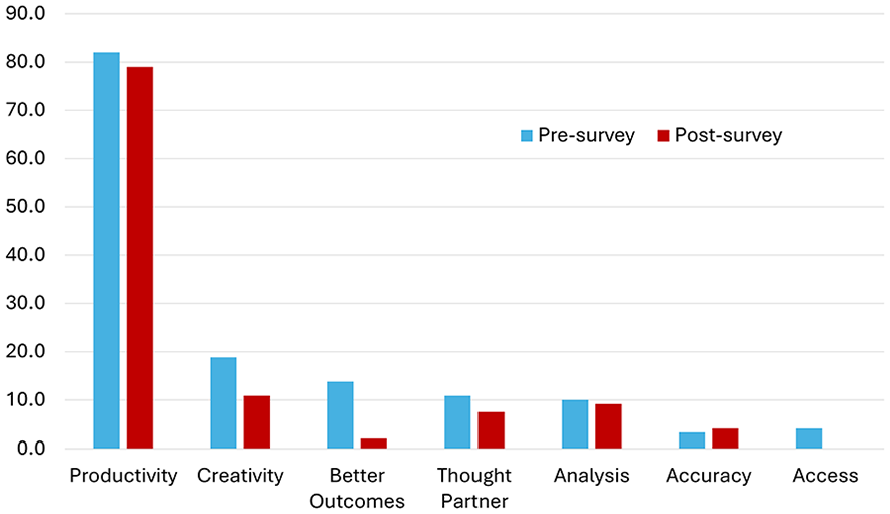
Percentage of respondents answers to the question “What benefits do you see with respect to AI?”
In the post-training survey, participants were more likely to indicate using AI for data analysis or to say many uses. A chi-squared analysis revealed differences between the pre- and post-training responses regarding uses: χ2(10) = 46.9, p < .005.
Results indicate that the participant concerns focused on accuracy of results, data privacy and security, and ethical issues. A chi-squared analysis revealed no differences between the pre- and post-training responses regarding concerns: χ2(10) = 15.2, p > .10.
With respect to benefits, the participants in the pre- and post-test indicated that productivity (e.g., time savings and increased efficiency) was the most commonly reported benefit, followed by supporting creativity through idea generation. A chi-squared analysis revealed differences between the pre- and post-training responses regarding benefits: χ2(6) = 21.7, p < .005. In the pre-test, participants indicated that better outcomes (e.g., advances in healthcare, science, and innovation) were a potential benefit. In the post-test, participants identified more personal uses for AI. These results suggest a deeper understanding of GenAI capabilities and limitations based on experiences in the training and familiarization program.
Interestingly, despite productivity being the most commonly cited benefit by the vast majority of participants (approximately 80%), few of the participants claimed to use ChatGPT specifically for productivity (see Figure 1, where approximately 5% of participants in the post-test claimed to use AI for productivity). While this might initially appear to be a disconnect, the concept of “productivity” was captured or implied in the other uses provided by participants (e.g., edit/summarize, text, brainstorm, research, data analysis).
Potential Limitations
While the findings are encouraging, a few limitations should be noted. Not all participants completed both the pre- and post-tests, introducing potential bias. Future studies should focus on improving participant retention and exploring whether completers and non-completers differ in important ways. The survey and training were offered at a single consultancy, so results might not apply across different companies and industries. Further, the survey was not framed as an evaluation of the training (e.g., no questions asked, “How effective did you find this training?”). It was developed to assess perceptions, beliefs, and interactions. However, the shift in these factors reveal findings of interest to those who want to develop or deliver training on Generative AI technology.
Conclusion
These findings consistently indicate the positive impact of the training experience. They emphasize the importance of providing employees with an opportunity to use ChatGPT and walking them through relevant use cases. The value of use cases is that they show people, specifically, how they can use an AI tool to support them in everyday tasks. The step-by-step guidance on these tasks also enabled the participants to complete the exercises, experiencing success. One interesting point to note is that participants in this study did not echo the concerns that the students identified in Adams et al. (2024). Participants in this current study did not express a fear that AI would limit their critical thinking or creativity. This might have been due, in part, to the specific use cases in the training program, none of which directly “threatened” these higher mental processes but left the human in control.
Another critical aspect is providing a culture of innovation, where people are encouraged to experiment, are given the tools needed to do that work, and are given the grace to fail. If that last component is not in place, if failure is punished, a culture of innovation cannot be said to exist. The success of AI implementation relies on seeing clearly how AI can be integrated into workflows. These use cases supported that recognition. Further, a work culture that promotes innovation and delivers consistent messaging from leadership is another key element in successful implementation of AI in the workplace.
Footnotes
Declaration of Conflicting Interests
The author(s) declared the following potential conflicts of interest with respect to the research, authorship, and/or publication of this article: This work was performed as part of a course at the University of Northern Colorado and no funding was provided. The lead author is a consultant at the company that participated in the research.
Funding
The author(s) received no financial support for the research, authorship, and/or publication of this article.