







Abstract
Collaborative learning (students helping each other learn by working in small groups) has become increasingly popular in instructional settings and offers many benefits, including improved learning outcomes and interpersonal skill development. Despite its many benefits, the characterization of learning teams that engage in effective collaborative learning remains unclear. In this study, quantitative and data-driven methodologies (content analysis and factor analysis) were used to identify the underlying dimensions of teamness in the education context. While previous work has studied classroom learning structures, this work integrates academic and non-academic sources to present a set of dimensions applicable to learning teams. Our analysis uncovered six distinct dimensions, including both general team dimensions (synergy, homogeneity) and an education-specific dimension (skill development). These findings provide a framework for educators and researchers to better characterize collaborative learning teams. Future research will extend this work and further explore the relationship between the team dimensions with learning outcomes.
Keywords
Introduction
Collaborative learning (the practice where students help each other learn by working in small groups) has become increasingly popular in instructional settings ranging from elementary school (Slavin, 2015) to medical school (Lerner et al., 2009). Effective collaborative learning offers many academic benefits, including active involvement in learning, heightened critical thinking skills, and improved learning outcomes (Laal & Ghodsi, 2012). Interestingly, effective collaborative learning also improves the development of interpersonal skills like perspective sharing and conflict management (Fredrick, 2008). In the modern business world, where workplace collaboration is becoming increasingly common, developing these interpersonal skills at every education level is extremely important.
Despite its many benefits, the characterization of learning teams that engage in effective collaborative learning remains unclear. In 2024, Cooke et al. (2024) presented a multidimensional construct called “teamness” for the general characterization and comparison of different teams “by qualifying the differences and similarities between and within instances of teaming.” To make this construct of teamness more directly applicable in the educational system, it needs to be evidence-based, concrete, and specialized for the educational context. A clearly identified set of team dimensions could provide teachers, administrators, and researchers with the tools to characterize and improve different learning teams. The practice of making measurements along pre-defined dimensions is a cornerstone of empirical research, and in this study, we aim to present a set of dimensions to further enable empirical research on learning teams and team training.
While the construct of teamness could improve the field of research surrounding collaborative learning, the education-specific dimensions remain opaque. For teamness to be tangible and useful, there must be a defined set of dimensions along which learning teams can be measured, and these dimensions need to be based on a variety of sources (including academic and non-academic sources). Furthermore, to enhance the validity of these dimensions, they must be extracted via empirical evidence and quantitative analysis. The objective of this study is to use empirical data and quantitative methods to identify the underlying dimensions of teamness in learning teams by analyzing academic and non-academic text sources using both content analysis and factor analysis.
Background
Salas et al. (1992) presented a generic definition of teams in 1992, in which they defined teams as being groups of interdependent people who interact dynamically and adaptively to pursue common goals. This was an important step forward in teaming research, but this definition did not provide specific dimensions with which teams can be characterized. In 1990, Sundstrom et al. (1990) proposed nine dimensions along which teams could be classified based on an interpretive literature review. In 2012, Hollenbeck et al. (2012) conducted similar work and proposed three dimensions along which teams could be characterized based on their review of the teaming literature. Neither work provides an empirical basis for choosing nine (in the case of Sundstrom) or three (in the case of Hollenbeck) dimensions, and in both works, the suggested dimensions are solely based on the authors’ interpretation of the literature. Moreover, neither study included non-academic source materials in their literature review, thereby overlooking the potentially unique perspectives and insights offered by the non-academic domain. It is also unclear whether these prior works are directly applicable to learning teams because the educational context is distinct, and the dimensions that adequately define a team in a general setting may fall short in this more specific context.
There has been some qualitative research, based on literature review, with the aim of defining the dimensions of classroom learning structures (Sharan, 1980), but much like the works of Sundstrom and Hollenbeck, the proposed dimensions are based solely on the author’s interpretation of the academic literature. Furthermore, the focus of these dimensions is limited to the classroom context, specifically aimed at characterizing methods of cooperative learning in classrooms. The proposed dimensions are more classroom process-focused than team-focused, and while they may be effective at characterizing cooperative learning methods, they fall short in their ability to characterize learning teams.
In 2024, when Cooke and colleagues presented the multidimensional construct of teamness, they accompanied it with five “potential dimensions” based on their review of literature and research questions raised in a seminar class. In their follow-up article, they commented on their prior findings: “The concept of teamness needs further refinement to address the needs of team researchers; for instance, there are likely many teamness dimensions beyond those currently identified by Cooke et al. (2024)” (Cohen et al., 2024). This points to a need for rigorous and data-driven analysis to identify the underlying dimensions. Furthermore, in the original article where teamness was first presented, the authors clarified their findings, stating that the “dimensions of teamness vary within and between contexts” (Cooke et al., 2024). This clarification makes it clear that a general set of teamness dimensions may not be suitable to characterize teams in the specific learning context. We endeavor to advance this line of research by conducting a data-driven analysis of education texts (both academic and non-academic) to identify a set of teamness dimensions that are relevant to the education context. By building on this work, we aim to equip educators with the tools to further improve learning outcomes and hope to further the research field by enabling a more rigorous characterization and comparison of learning teams.
Approach
In this study, we employed the data-driven and statistical methodologies of content analysis and factor analysis to investigate the underlying dimensions of teamness in the education context. Content analysis (Drisko & Maschi, 2016) was used to analyze text sources, while factor analysis (Kline, 2014) was used to extract a small number of unobservable factors (dimensions) that underlie a large number of observable variables. To serve as the basis for our content analysis, we collected many academic and non-academic text sources referencing teams in the education setting. A variety of search terms was used to gather these sources, including but not limited to “learning teams,” “group work in education,” and “group projects.” The distinction between academic and non-academic texts was based on the features and origin of the text source. The collected academic texts were limited to peer-reviewed articles published within the last 40 years (collected via the Google Scholar search engine), and the non-academic texts were limited to blogs and videos published in the last 15 years (collected via the Google search engine). All sources in video format were converted to transcript format prior to content analysis.
There is an exceedingly large corpus of blogs and videos that does not have standardized indexing nor dedicated databases, making a standardized search neither practical nor appropriate. Instead, we adopted a theoretical saturation approach (Saunders et al., 2018) where the search for new text sources ceased when the inclusion of new texts no longer introduced new concepts or applications to the existing set of sources. This methodology was also implemented for the identification and inclusion of academic articles to ensure consistency. To achieve broad coverage of the source material, we included texts discussing learning teams at all education levels, ranging from medical school to elementary school, to ensure broad relevance to the learning team context. The data in this study presents a Western cultural perspective as all texts were from North American or European sources.
For content analysis, all the sources were entered into the content analysis software MAXQDA (VERBI Software, 2024). We then ran a frequency analysis on all the sources collected, and it output a list of the most common words/phrases in the text sources. Frequency analysis was used because it is the most popular method of content analysis, and it is a transparent and efficient way to identify the underlying themes of text sources. This methodology is supported by the Lexical Hypothesis (Saucier & Goldberg, 2001), which states that the number of words used to describe traits reflects their importance, and that the most commonly used terms/phrases reflect the most important themes. Following the standard procedure of content analysis, this list was filtered by a researcher to eliminate all words/phrases that were unequivocally nonsensical, redundant, or irrelevant to teams in the education setting but could not be detected by the software. Redundancy was defined as words that have the same root and imply the same things (e.g., “cooperate,” “cooperative,” and “cooperating” all imply that the team members cooperate), and only the most evidently nonsensical terms were removed (e.g., “way,” “go,” and “only”).
The keyword-in-context feature, coupled with these words/phrases, was used to generate the specific items for factor analysis. The keyword-in-context functionality was used to contextualize the common words/phrases gathered from frequency analysis, and the items were generated based on an archetypal phrase from the text. For example, the words “encourage,” “help,” and “interdependence” linked to the sentences “Team members must interact in ways that ‘help, support, and encourage each other,’” “When things are not going well, everyone makes an effort to help each other,” and “One of the results of positive interdependence is face-to-face promotive interaction” in the source material. The first sentence (linked to “encourage”) seemed to be the most representative of the idea that team members help/support/encourage each other for the betterment of the team, and it inspired the following item: “Team members are committed to helping each other.” All of the items were rooted in the text material and written to be precise and universally understandable. Other examples of items include “Team members openly share their perspective,” “Team members effortfully engage with the team,” and “Team members disagree often.”
Following the collection of items, they were arranged into a relationship matrix for similarity analysis. Three researchers individually and independently rated the similarity of each item pair from very dissimilar (−1) to very similar (+1). The only qualification required to rate item similarity was to be fluent in English and to have experience being on a team. Experience being a part of (or observing) teams sufficiently qualified a person to judge the similarity between two team-related items because we aimed to characterize human teams, and it requires no specialized judgment to rate the similarity of two items related to a lived experience. For example, most humans with some level of team experience would rate “Team members communicate with each other” and “Team members discuss different ways of approaching a task” as being very similar, while rating “Team members are individually accountable for their work” and “Team members share responsibility for task successes and failures” as being very dissimilar. The clarity of instruction was ensured by having the raters complete a practice set of items.
After the ratings were completed, the three relationship matrices were averaged to produce a similarity matrix, which served as the input for factor analysis. The factor analysis was run in R using a minimum residual factoring method and varimax orthogonal rotation. A combination of Kaiser’s (1960) rule, Cattell’s (1966) scree test, and a cumulative variance explained threshold of 60% was used to determine how many factors to retain. The conceptual names and descriptions of the factors were determined based on the factor loading scores of the various items. Factor analysis was used for this investigation because it offers a statistical methodology by which the observable relationship between many variables is explained in terms of unobservable and underlying factors (dimensions).
Outcome
Through our search for text sources, we found 19 relevant academic articles, 11 relevant blogs, and 13 relevant videos (a sample of the text sources is cited in the references). Our content analysis yielded 47 distinct items, and three researchers independently rated the similarity between each pair of items. These ratings had an intra-class correlation coefficient of .611. The compiled similarity matrix was used as the basis for factor analysis, which resulted in 14 potential factors with eigenvalues > 1. Following both Cattell’s method of visually inspecting the generated scree plot (Figure 1) and finding the point where cumulative variance explained is above a target threshold (60%), six factors were retained.
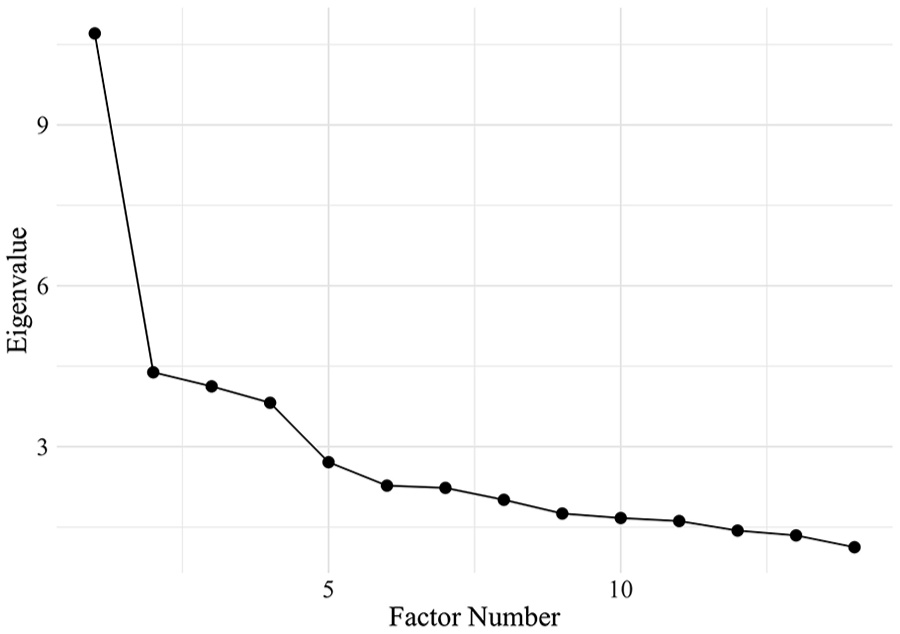
Scree plot of identified eigenvalues. A scree plot of the 14 identified eigenvalues greater than 1. Based on a visual and numeric inspection of this scree plot, six factors were retained.
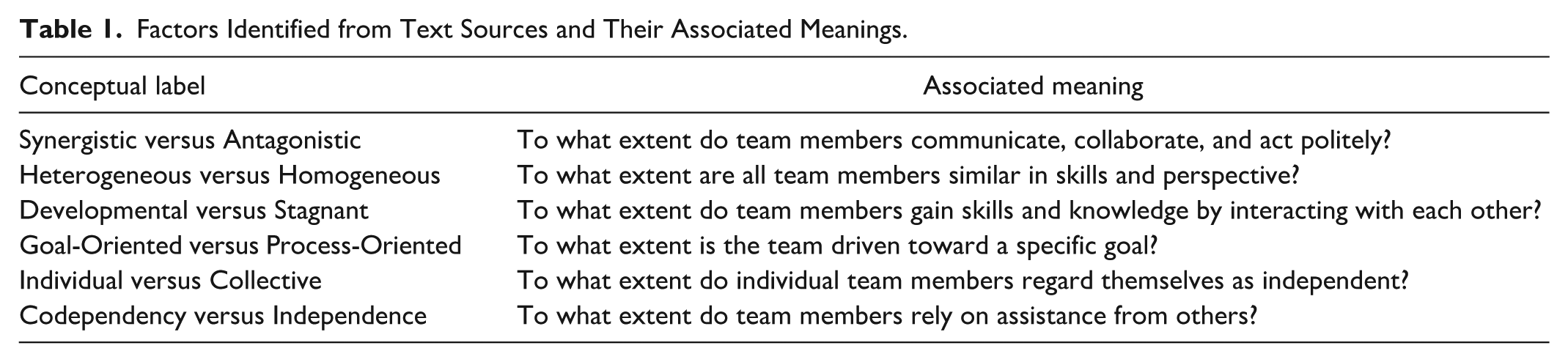
We determined the factor meanings based on the factor loading scores. A summary of these retained factors and their conceptual definitions is included in Table 1, and the six factors are listed as follows. (1) Synergistic versus Antagonistic: The extent to which team members communicate, collaborate, and act politely. This factor accounted for the largest amount of variance and was highly correlated (|λ| > .3) with more than 15 of the 46 items identified for factor analysis, including “Team members feel comfortable working with each other,” “Team members trust each other,” and “Team members have positive social relationships.” This factor captures a wide variety of positive interpersonal interaction elements, including trust, collaboration, communication, and conflict management, making it a very broadly defined dimension. (2) Heterogeneous versus Homogeneous: The extent to which all team members are similar in skill and perspective. This factor is highly correlated with fewer than 10 items despite accounting for the second-highest amount of variance. This factor is correlated with items like “Team members work independently on tasks” and “Team members have assigned roles.”
Factors Identified from Text Sources and Their Associated Meanings.
This factor encompasses many elements related to team structure, leadership, and member traits, which are defining components of team homogeneity/heterogeny. This factor also captures more obscure elements like individuality, where individual identity is more likely to arise in a team where specialized skills are identified and appreciated. (3) Developmental versus Stagnant: The extent to which team members gain skills and knowledge by interacting with each other. This factor is positively correlated with items like “Working in teams enables skill development in team members,” “Team members learn from each other,” and “Team members learn social competencies from teamwork.” This factor appears to capture the many elements (intellectual, social, and skill acquisitional) of personal development as a result of team participation. (4) Goal-Oriented versus Process-Oriented: The extent to which the team is driven by a specific goal. This factor was positively correlated with items such as “The team works toward specific goals” and “Team members work together to achieve their shared goals.” This factor captures the elements of both goal pursuit and goal achievement, both of which set apart goal-oriented teams from teams that tend to be more concerned with the process (e.g., innovation teams). (5) Individual versus Collective: The extent to which individual team members regard themselves as independent. This factor is positively correlated with items like “Working in teams enhances the skills of individual team members,” while being negatively correlated with items like “Team members have a sense of community within their teams.” This factor seems to capture the elements of individual development, community development, and the perceptions of such. Not to be confused with Synergistic versus Antagonistic and Heterogeneous versus Homogeneous, this factor is specific to how people regard themselves as being individuals or members of a collective, while Synergistic versus Antagonistic captures the extent to which individuals form a collective, and Heterogeneous versus Homogeneous captures the extent to which individual strengths are valued. (6) Codependency versus Independence: The extent to which members rely on the assistance of others. This factor was positively correlated with items like “Team members depend on each other,” “Team members are committed to helping each other,” and “Team members encourage each other and provide verbal support.” This factor appears to capture elements of dependence, specifically teammates helping each other complete tasks and offering support. This is similar to the Synergistic versus Antagonistic factor, but the Synergistic versus Antagonistic factor is concerned with how well teammates support each other, and Codependency versus Independence is more concerned with whether help is needed/relied on. This dimension is also similar to the Individual versus Collective dimension, but Codependency versus Independence is concerned with dependence, while Individual versus Collective is specifically concerned with how team members regard themselves.
Conclusion
In this study, we leveraged the quantitative and data-driven approaches of content analysis and factor analysis to extract the underlying dimensions of teamness in an education context. We successfully identified six underlying dimensions by which learning teams should be characterized. The dimensions identified based on empirical data in this study have some key similarities with dimensions proposed in prior literature, which were instead based on the authors’ interpretation. Sundstrom et al. (1990) proposed nine dimensions along which teams can be characterized based on their interpretation of the literature (as summarized by Hollenbeck et al., 2012): industry, organizational hierarchy, team member education level, scope of activities, member autonomy, routinization of activities, frequency with which members work together, skill differentiation, and difficulty of performance evaluation. Many of these dimensions are related to the empirically-based dimensions we presented in this study: the frequency with which members work together is related to both Codependency versus Independence and Individual versus Collective, difficulty of performance evaluation is related to Goal-Oriented versus Process-Oriented, and skill differentiation is related to Heterogeneous versus Homogeneous. The dimensions presented in our study should also be compared to the work of Hollenbeck et al. (2012), who proposed three dimensions along which teams can be characterized: skill differentiation, authority differentiation, and temporal stability. Only one of these dimensions is represented by the six factors we found: skill differentiation is similar to Heterogeneous versus Homogeneous. Most interestingly, Synergistic versus Antagonistic, the factor that accounted for the greatest amount of variance in our study, was not accounted for by Sundstrom or Hollenbeck. This could be a result of methodological differences, where Hollenbeck and Sundstrom overlooked interpersonal factors like the Synergistic versus Antagonistic dimension, or it could indicate the specificity of education-specific items we identified. The other dimension the prior literature did not account for was Developmental versus Stagnant. This is even more evidence for the specificity of our dimensions because the Developmental versus Stagnant dimension is associated with elements about knowledge sharing and skill development, both of which are cornerstones of the collaborative learning philosophy.
We may also be able to garner insights from the dimensions proposed in prior literature that are not covered by our presented dimensions. None of the dimensions presented in this study can account for Sundstrom’s dimensions of industry or organizational hierarchy. This is likely because all education teams function within the same industry, and most academic organizations have similar hierarchies. Other unaccounted-for dimensions have similar explanations: Hollenbeck’s authority differentiation and Sundstrom’s member autonomy were not addressed by our dimensions because few educational teams have leaders with any managerial power; Hollenbeck’s temporal stability was not addressed because most educational teams are rapidly changing with changing class composition; and Sundstrom’s dimension of education level was not addressed because members of education teams would all have similar grade-appropriate education levels. This further suggests that the dimensions presented in this article are uniquely relevant to education teams.
We can also compare our findings with the dimensions suggested by Sharan (1980) aimed at characterizing classroom learning structures. Most of Sharan’s dimensions are more organizationally significant, like “Information is transmitted by the teacher or a text,” “Peer communication is for rehearsal of teacher-taught materials,” and “Learning sources are limited to cards, a worksheet, or a lecture.” However, many of the factors we present are related to Sharan’s dimensions (especially those that are relevant to interpersonal relations), including “Peer communication in teams is primarily unilateral or bilateral,” which is related to Synergistic versus Antagonistic, and “Evaluation is primarily individual,” which is related to Individual versus Collective. Furthermore, the Developmental versus Stagnant dimension, which appeared to be specific to the education context, was represented by Sharan’s dimensions “Peer communication is for rehearsal of teacher-taught materials” and “Tasks emphasize information and/or skill acquisition.” This further emphasizes that the dimensions we present here in this study are specific to the education context. While some dimensions we presented here apply to both general teams and education-specific teams, we did present a single factor that is clearly unique to the educational context: Developmental versus Stagnant. A set of dimensions that is domain-specific for learning teams in education can be made up of both education-exclusive dimensions and dimensions that apply readily to more general teams.
This quantitative and empirical study is a first step in defining a set of dimensions to characterize education teams. A well-defined set of education teamness dimensions would enable better research in the collaborative learning space and improve the creation and development of effective collaborative learning teams. Furthermore, after the relationship between these dimensions and learning outcomes is identified, interventions can be implemented to address factor scores associated with negative student outcomes.
The interrater reliability, as measured by the intra-class correlation coefficient (ICC = .611), indicates a moderate level of reliability between the individual raters. While this score does suggest some variability, the level of interrater reliability is at a level acceptable for this exploratory research. Future research will work to explore a more diverse mixed-methods methodology to deepen our understanding and enhance the validity of the identified dimensions. We aim to incorporate other qualitative and quantitative methodologies, like thematic analysis or code mapping, in future studies.
Moreover, we seek to study these dimensions in a variety of education settings to evaluate collaborative learning teams and uncover the relationships between these teamness dimensions and learning outcomes. In this study, we use the term “teamness” because it is an established construct in the human factors literature (Cooke et al., 2024). The social psychology literature presents a similar construct of “entitativity” (Lickel et al., 2000), and future works will consider the merits of presenting a more consistent terminology.
Footnotes
Declaration of Conflicting Interests
The authors declared no potential conflicts of interest with respect to the research, authorship, and/or publication of this article.
Funding
The authors received no financial support for the research, authorship, and/or publication of this article.
