







Abstract
Home healthcare is one of the fastest-growing industries, expected to increase for decades. Healthcare workers experience a range of work-related musculoskeletal disorders during work tasks. The objective of this study was to observe and quantify the ergonomic hazards experienced by home healthcare workers in Puerto Rico. Eighteen study participants were observed in Puerto Rico while visiting patient homes. Direct observation confirmed perceived ergonomic exposures for home care workers in Puerto Rico. Trunk bent over 25°, and extended overreach were the most prevalent ergonomic stressors experienced by home care workers. Repositioning patients in bed was the most commonly conducted patient handling task by home care workers.
Keywords
Introduction
Home care is one of the fastest-growing industries, with home health and personal care aides holding about 4.0 million jobs in the United States in 2023 (Bureau of Labor Statistics, 2025). Furthermore, the number of personal care aides, those aiding with activities of daily living such as cooking, cleaning, dressing, or bathing within the patient’s home, is expected to increase 39% by 2026 to over 2.7 million jobs (Bureau of Labor Statistics, 2025). Employment of home health and personal care aides is expected to grow 21% from 2023 to 2033, much faster than the average for all occupations (Bureau of Labor Statistics, 2025). Howard and Adams (2010) reported an average claims rate of 1,375 claims/10,000 full-time equivalents (FTEs) for home healthcare workers between 1998 and 2007, which was higher than all other industries (Howard et al., 2010). Healthcare workers are exposed to various tasks during patient handling, such as carrying, lifting, moving heavy equipment, repositioning of patients, awkward and static as well as repetitive movements that can result in musculoskeletal injuries (Caponecchia et al., 2020).
Healthcare workers are exposed to a variety of tasks during patient handling, such as carrying, lifting, and moving heavy equipment, repositioning patients, and awkward and static as well as repetitive movements that can result in musculoskeletal injuries (Caponecchia et al., 2020). The objective of this study was to observe and quantify the ergonomic hazards experienced by home care workers in Puerto Rico.
Methods
Study Design
This cross-sectional study design involved a direct observation of home care workers during a home care visit in the patient’s home care environment. The research team completed the observations and data collection by utilizing the Homecare Worker Observation Tool (HHCWO; Bien, Davis, Reutman, et al., 2021). Workers’ and patients’ consents were completed prior to the commencement of data collection. The home care client was provided with a detailed description of the study being conducted, invited to join the study, and provided with an opportunity to accept or refuse to participate and ask any questions for clarification. Observations began once the consent process was completed. A keen consideration was taken by observers not to interact with the study participants during the visit, but rather to observe and document the findings on the respective observation tool.
Study Setting
This study was conducted in Puerto Rico, which is a non-incorporated territory of the United States (U.S.). The research team followed and observed home care workers in the regions of Arecibo, Trujilo Alto, Caguas, and Ponce. Participants were recruited through a local healthcare agency’s WhatsApp platform and in-person staff meetings. Recruitment strategies included presenting the project information through in-person staff meetings and utilizing the WhatsApp platform.
Study Participants
Eighteen study participants were observed. The inclusion criteria for study participants included home care workers who were 18 years and above, employed by the respective partnering agency, and able to speak English or Spanish. The research team met the home care worker at the patient care location.
Observation Tool
The research team member utilized the Home Health Care Worker Observation tool (HHCWO) to identify ergonomic exposures for the workers in patients’ homes, including ergonomic risk factors such as extended or overreach, trunk bent, pull or push, kneeling, and awkward postures when conducting patient handling tasks such as repositioning patients in bed, transfer of bed from bed to chair, cooking, laundry, etc. (Bien, Davis, Reutman, et al., 2021).
Analysis
For this study, statistics were limited to a descriptive nature. The frequencies and percentages of the outcome variables were computed, as there were no specific comparisons between groups, but rather a description of the hazards for Puerto Rican care workers.
Results
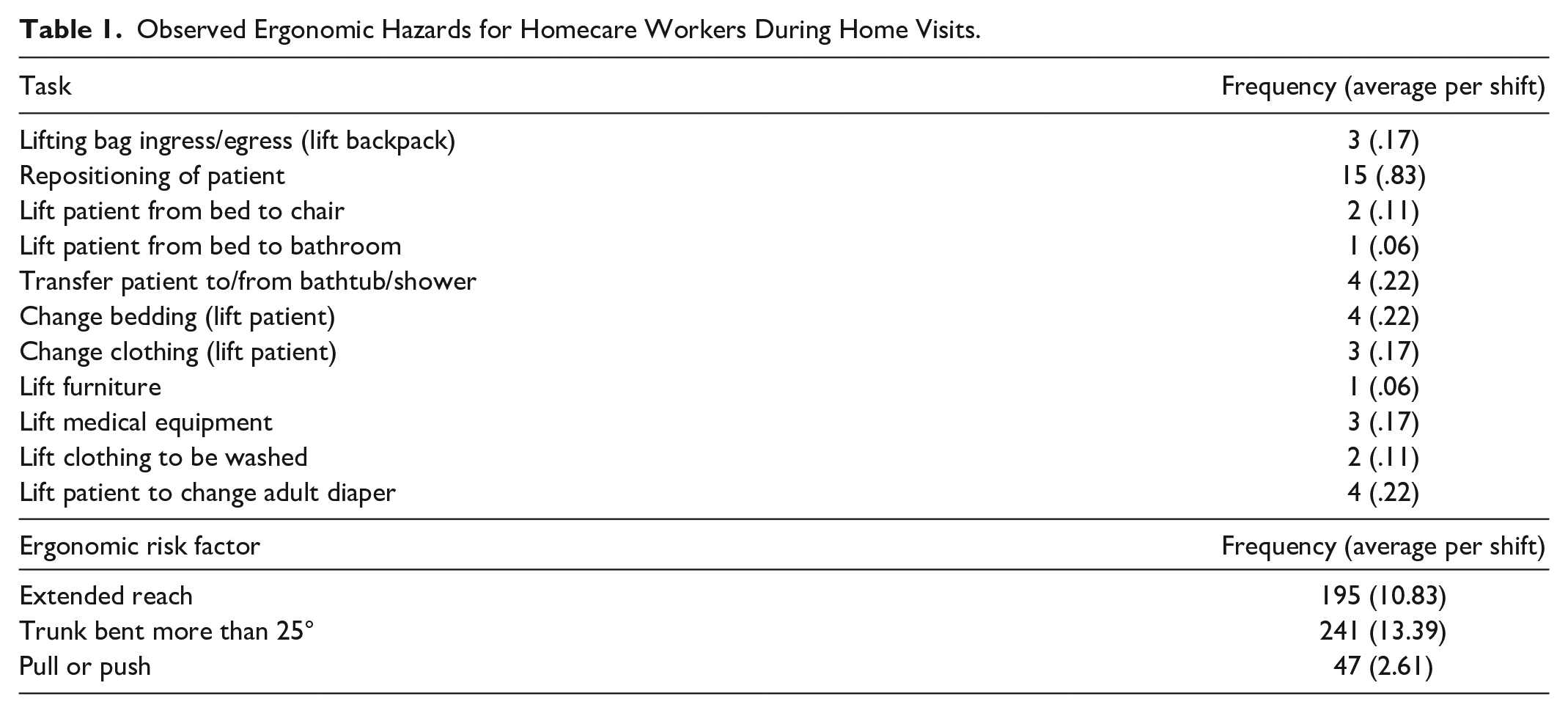
Table 1 summarizes the ergonomic hazards that home healthcare workers experienced when in their patients’ homes. Repositioning the patient occurred almost every time they went into the home (.83 per visit). Many of the other ergonomic tasks were patient-dependent, as some care workers completed them while many did not (average less than .25). Actual risk factors such as extended reach and bending of the torso were routinely performed (more than 10 times per shift).
Observed Ergonomic Hazards for Homecare Workers During Home Visits.
Conclusion
Direct observation confirmed perceived ergonomic exposures for home care workers in Puerto Rico. Trunk bent over 25°, and extended overreach were the most prevalent ergonomic stressors experienced by home care workers. Repositioning patients in bed was the most commonly conducted patient handling task by home care workers. These findings have been shown to be higher in many levels when compared to similar studies conducted in the United Kingdom by Dondi et al. (2024) and studies conducted in the United States by Bien, Davis, Small, et al. (2021), Hittle et al. (2016), and Suarez et al. (2017).
Footnotes
Declaration of Conflicting Interests
The author(s) declared no potential conflicts of interest with respect to the research, authorship, and/or publication of this article.
Funding
The author(s) disclosed receipt of the following financial support for the research, authorship, and/or publication of this article: Funding was provided by the National Institute for Occupational Safety and Health, University of Cincinnati Education and Research Center Grant (#T42OH008432).