







Abstract
Tactile symbols which are meaningful to people with visual impairments (PVI) are easier to remember. However, how PVI retrieve information from memory to decode structure and function of a tactile symbol has not been studied in-depth. Therefore, this study investigated how sketches of architectural features drawn by PVI can offer insights about underlying mental images. Thirty students from a school for PVI sketched from memory five architectural features—staircase, ramp, elevator, door, and toilet. Retrospective protocol analysis was used to learn from participants about why a sketch represented a feature. Findings indicate that architectural features were primarily represented in a specific reference plane by one or two dominant geometric shapes raising possibilities for a common underlying mental image. Preliminary findings suggest that sketches by PVI relate to both structure and function. Insights about underlying mental images can offer new perspectives on developing tactile symbols for and with PVI.
Keywords
Introduction
Tactile maps with raised symbols can convey spatial information to people with visual impairments (PVI). These maps are frequently used by PVI to construct a cognitive map of a new area or route (Brock et al., 2013; McCallum et al., 2006), which enables them to explore and learn about an unknown area before actually traveling through it (Gual et al., 2015; Rowell & Ungar, 2005). Four types of morphological elements used in a tactile map are points, lines, areal and volumetric elements (Edman, 1992; Nolan & Morris, 1971; Wong, 1993). To read a tactile symbol on a map effectively, PVI has to evaluate legibility or structure of the symbol first, and then associate the shape with a particular meaning or function (Lambert & Lederman, 1989). A tactile symbol, which is meaningful to the user, is easier to remember and use. However, tactile symbols have not always been ascribed meanings that are obvious (Lee, 2019). Except for a few symbols that have iconic status, the nature of symbol representation is arbitrary (Rowell & Ungar, 2003). Little research has attempted to distinguish tactile symbols based on meaningfulness for PVI.
Background
The conventional design of tactile symbols involves creation of raised shapes perceived by touch which are tested by PVI to verify usability of the shapes for tactile maps (Gardiner & Perkins, 2002). The choice and tactual representation of cartographic features constitutes a significant challenge in designing a tactile map (Edman, 1992). Since design of tactile symbols is usually created by sighted individuals and only then tested by the PVI, confusion can result from the arbitrary assignment of tactile symbols to cartographic features. PVI may find it difficult to decode the meaning of the symbol and may require additional time to refer to a legend (Lambert & Lederman, 1989). While symbology of tactile maps has been widely studied, how the PVI retrieve information from memory to decode legibility and meaning of a tactile symbol has not been studied in depth.
Studies in design cognition suggest that mental images visualized through sketches can offer insights on how people perceive and remember spatial environments (Kavakli & Gero, 2001). Mental imagery and perception share many of the same neural mechanisms (Farah, 1988; Finke, 1989); characterizations of mental imagery have a strong resemblance to perception (Kosslyn & Osherson, 1995). Imagery can be used to retrieve information from memory and identify properties of imaged objects including their function and structure (Finke & Shepherd, 1989). However, some authors argue that there is no direct connection between the function and structure of an object (De Kleer & Brown, 1984). Rather, people construct connections between function, behavior and structure through experience and interactions with the objects and spaces; function is ascribed to behavior and behavior is causally connected to structure (Gero & Kannengiesser, 2014).
Since prior research on design of tactile symbols for the built environment neither focused on how PVI perceive and visualise architectural elements, nor was there an attempt to use function-behavior-structure (FBS) framework—the objective of this pilot study was to investigate how sketches of architectural elements drawn by the PVI can offer insights about the underlying mental imagery. Findings may inform the co-design of intuitive tactile symbols with and for people with visual impairments.
Methods
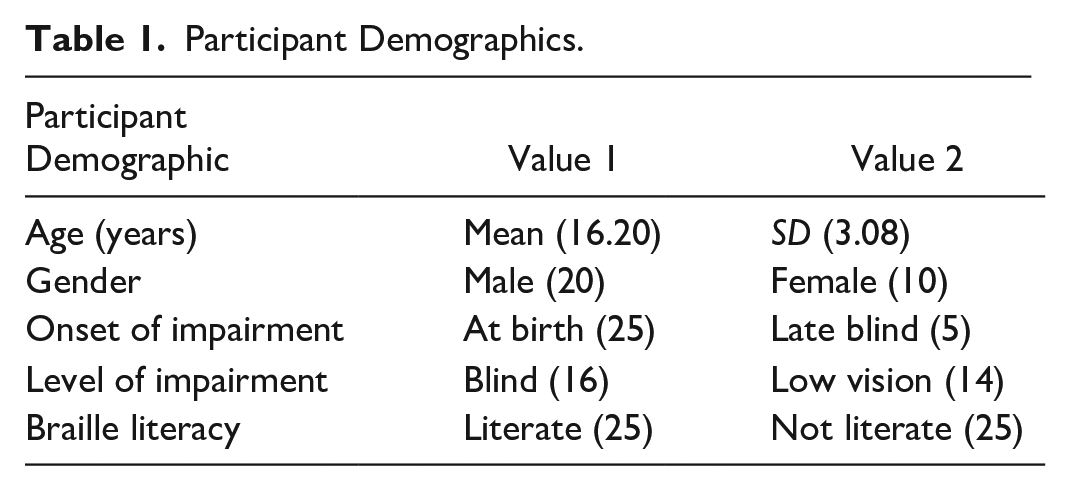
Thirty students from two schools for PVI in New Delhi, India, participated in the study. Participants were aged between 11 and 21 years and included students who were blind (n = 16) and those with low vision (n = 14). Most participants were blind at birth while a few were late blind (Table 1).
Participant Demographics.
At the start of the experiment, each participant was seated at a chair with a desk, informed consent was obtained from them verbally, and experimental protocol was explained to them by a researcher. Next, participants were verbally asked demographic questions about their age, gender, degree of blindness, and prior experience with tactile maps. Following this, participants were provided with an A4-sized sheet of paper, a tactile drawing board and a drawing tool. They were asked to sketch from memory five architectural elements—a staircase, a ramp, an elevator, a door and a toilet—one element at a time. Each element was drawn on a separate sheet of paper. Participants could perceive indentations they had made on paper by the drawing tool. After each element was sketched, a retrospective verbal protocol analysis was used to learn from participants about why and how their sketch represented the architectural element (Suwa & Tversky, 1997; Perkins & Gardiner, 2003). The complete experiment took about 25 to 30 min for each participant and was video recorded (Figures 1 and 2).
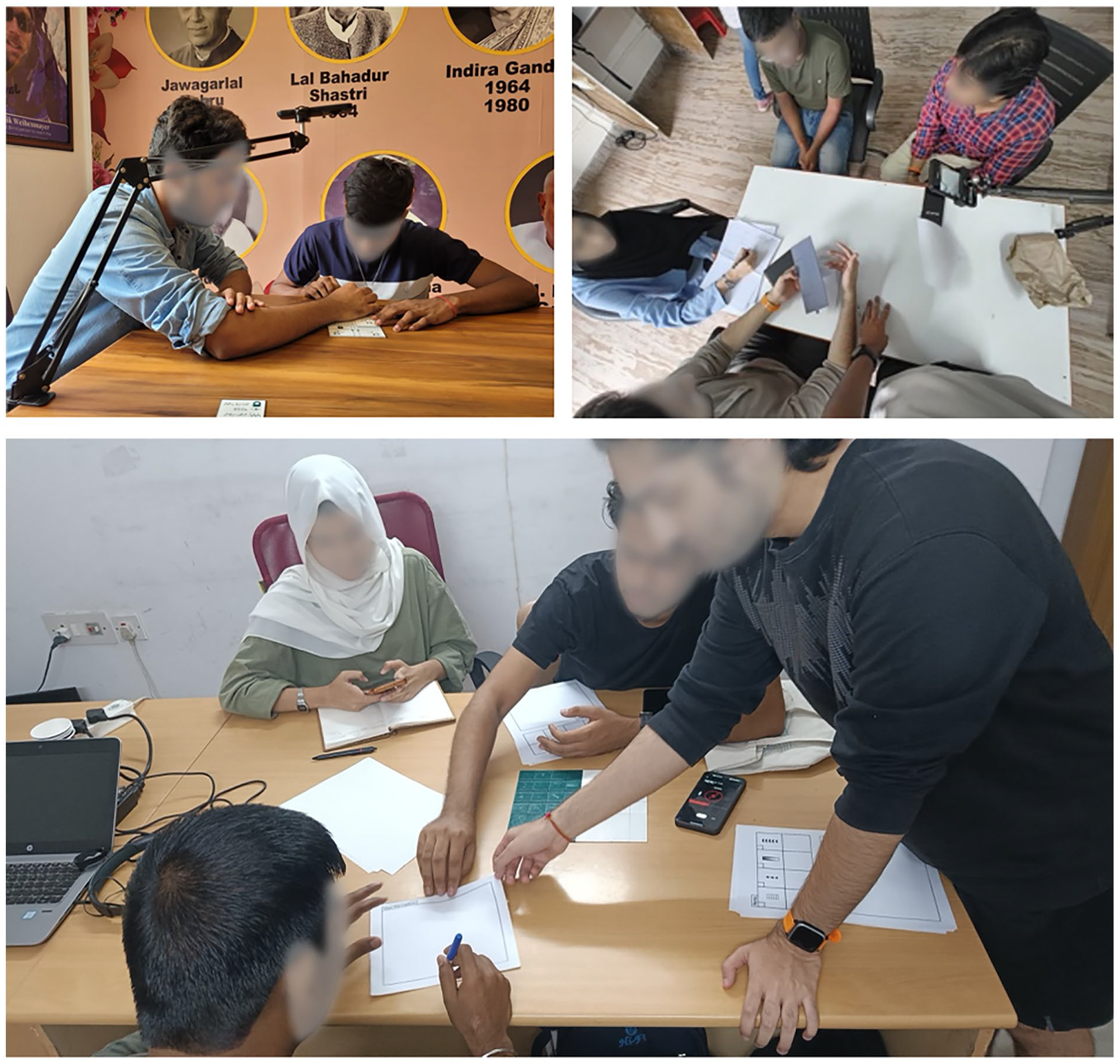
Participants verbally describing their sketches to the experimenters during the retrospective verbal protocol.
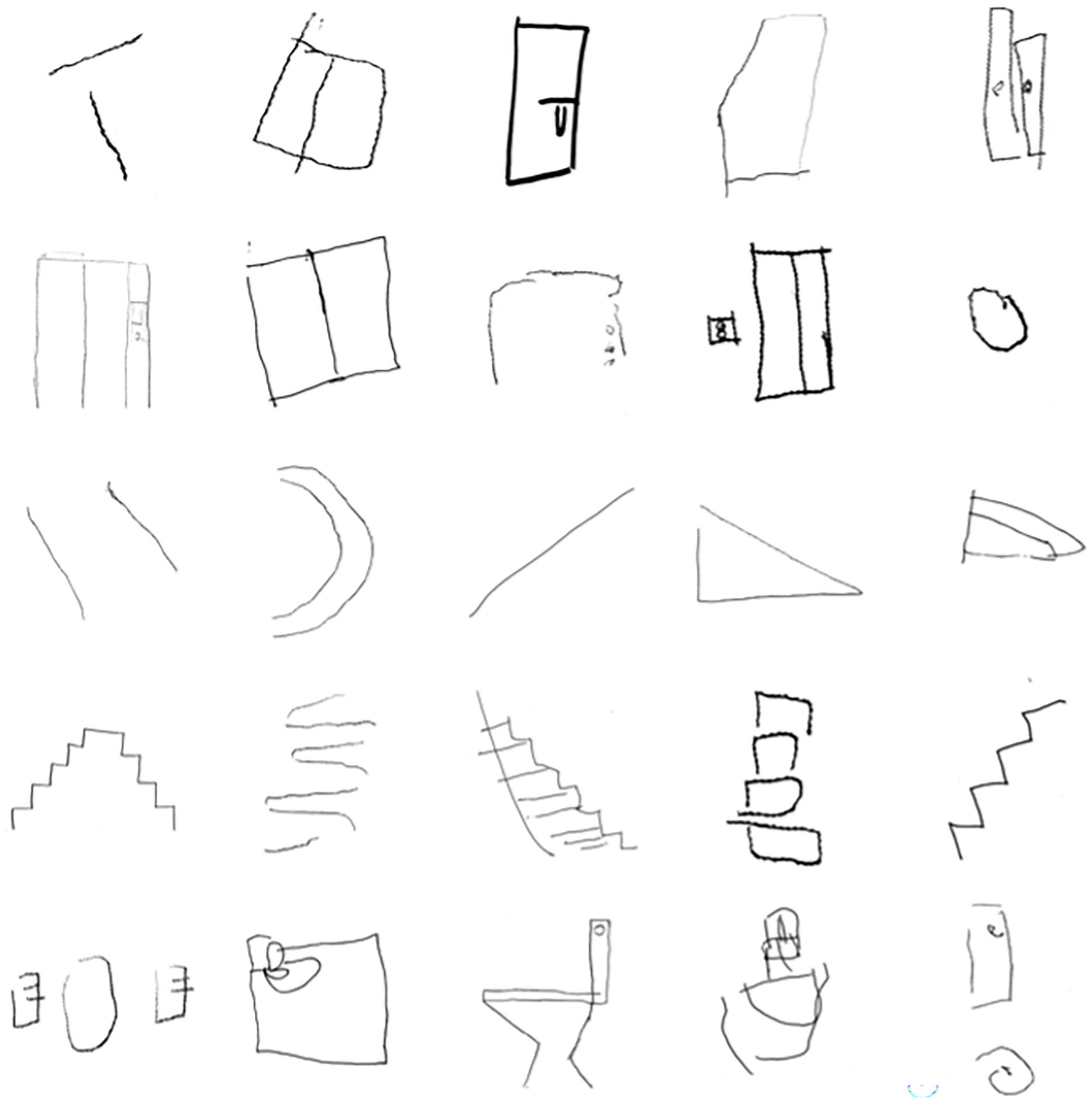
Examples of sketches made by participants for the five architectural elements—door, elevator, ramp, staircase, and toilet.
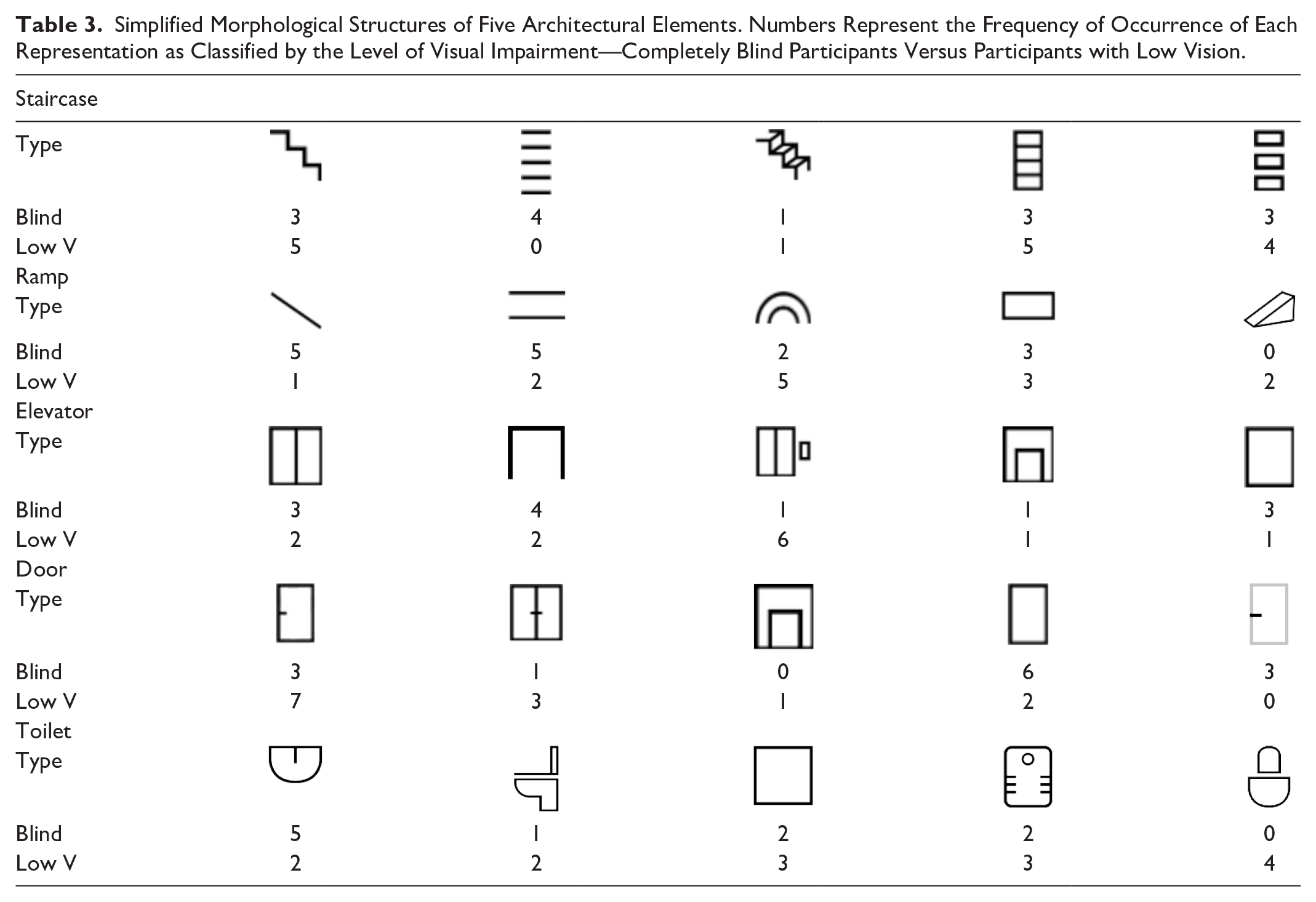
Sketches made by the participants were reviewed in conjunction with playback of the associated video files to—(a) decode the reference plane (top, front, side, etc.) in which the sketch was made (Table 2), (b) extract the morphological structure of the sketch and (c) identify differences in visualizations based on the level of visual impairment that is, participants who were completely blind vs. participants with low-vision (Table 3). Sketches made by the participants were independently coded by two researchers; in case there were differences in the coded outcomes, a third researcher was consulted to arrive at a consensus.
Reference Planes for Sketches Made by the Participants.
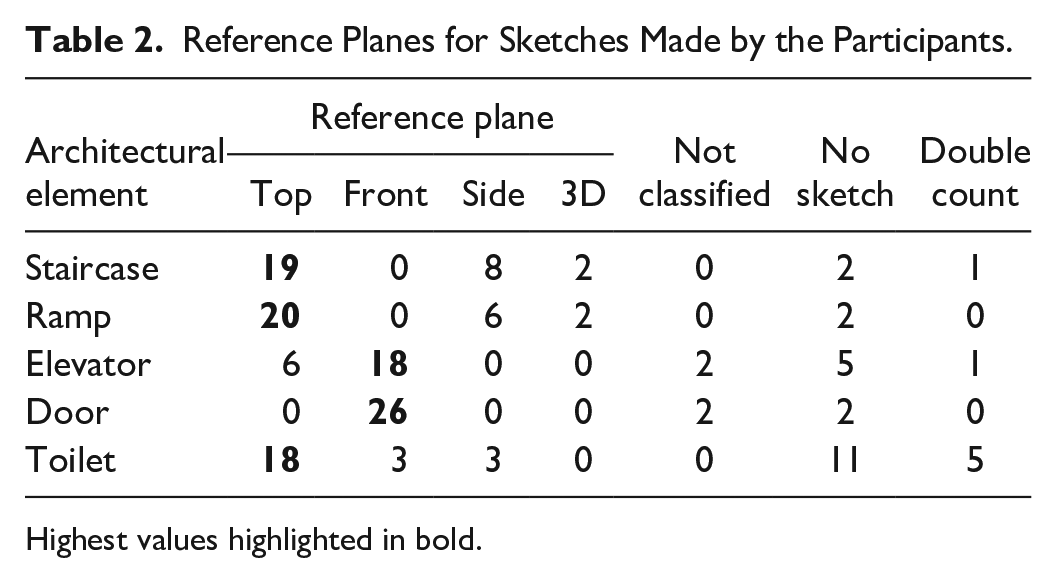
Highest values highlighted in bold.
Simplified Morphological Structures of Five Architectural Elements. Numbers Represent the Frequency of Occurrence of Each Representation as Classified by the Level of Visual Impairment—Completely Blind Participants Versus Participants with Low Vision.
Findings
Reference Planes
Staircase
The staircase was represented in the top-view (n = 19), in the side-view (n = 8), and in 3D-view (n = 2); two participants could not sketch the staircase from memory.
Ramp
The ramp was represented in the top-view (n = 20), in the side-view (n = 6) and in 3D-view (n = 2); two participants could not sketch the ramp from memory.
Elevator
The elevator was represented in the top view (n = 6) and in the front view (n = 18); five of the participants could not sketch the elevator from memory and two sketches in the elevator cohort could not be classified.
Door
The door was represented in the front view (n = 26); two of the participants could not sketch the door from memory while two sketches were unclassified.
Toilet
The toilet was represented in the top-view (n = 18), in the front-view (n = 3) and in the side-view (n = 3); eleven participants could not sketch the toilet from memory while five participants had sketched multiple elements to represent the toilet.
Morphological Structure
Staircase
The staircase was represented by zigzag lines (n = 8), multiple rectangles spaced apart (n = 7), a ladder (n = 8), a series of parallel lines (n = 4), and isometric views (n = 2).
Ramp
The ramp was represented by a pair of parallel lines (n = 7), a diagonal line (n = 6), concentric arcs (n = 7), a rectangle (n = 6), and isometric views (n = 2).
Elevator
The elevator was represented by a small rectangle sharing its base with a larger rectangle (n = 2), rectangles placed side-by-side (n = 5), rectangles placed side-by-side with a smaller rectangle adjacent to one side (n = 7), a rectangular box (n = 4) and a rectangle with one side open (n = 6).
Door
The door was represented by a rectangle with a handle (n = 10), two rectangles with handles (n = 4), a rectangle without any handles or details (n = 8), a handle drawn alone (n = 3), and a small rectangle sharing its base with a larger rectangle (n = 1).
Toilet
The toilet was represented by a semi-circular shape (n = 7), a rectangle with elements of the toilet (n = 5), visual representations of a western-style water closet from the side-view (n = 3) and front view (n = 4), and an Indian-style toilet pan (n = 5).
Representations—Blind Versus Low Vision
For the participants from the completely blind group, the most frequent representations employed linear, often two-dimensional and minimalist geometric elements. Stairs were mostly represented using basic stacked line segments (n = 4), and ramp symbols showed preferences for elementary diagonal lines (n = 5). Similarly, elevator representations favored minimal rectangular symbols (n = 4); door representations were consistently observed to contain simple rectangular enclosures (n = 6). Toilets were frequently sketched using basic geometric shapes, such as semicircles, rectangles etc., maintaining the pattern of simplification observed across the other architectural elements.
In contrast to the sketches made by the blind cohort, the low-vision cohort exhibited a different representational preference—showcasing a higher degree of visual detail and spatial complexity. For example, sketches of the staircase, deviated from the previous pattern of simplicity and more frequently showcased rectangular forms with multiple internal divisions. The representations for ramps also showed variations, with participants frequently using curved, concentric geometric elements (n = 5) and even 3D representations (n = 2), suggesting a mental model with an understanding of three-dimensional space. Elevator representations featured bisected rectangular shapes accompanied by call button indicators (n = 6), which contrasted with the simplified geometric forms sketched by the completely blind participants. Door representations often showcased details of doorframe with interactional features such as door handles also included. The pattern of increased complexity can also be observed from the representation of toilets, with low-vision participants indicating details of washbasins, taps, and water closets.
Discussion
Reference Planes
The participants choice of the reference plane provides an insight into how the PVI perceive and represent architectural elements. Each element was drawn in the plane in which the PVI interacted with the elements. For example, since the PVI interacted with the door in the vertical plane, all participants depicted the door in the front view. The elevator was also depicted in a similar manner—18 of the participants sketched the elevator in the front view. Only the participants who had described the elevator as a “space” or “room” drew the feature in top view.
Staircases and ramps exhibited the same pattern of representation with most of the sketches being made in the top view, followed by sketches in the side view. The toilet as a prompt provided multiple options and resulted in a wide variety of sketches. However, the top view remained the dominant reference plane for depicting the architectural elements representing the toilet. A few participants, primarily those with low vision, chose to depict the toilet from the front (n = 3) or side views (n = 3).
Representations—Blind Versus Low-Vision
The difference in representational strategies observed between the blind and low-vision cohorts may be attributed to fundamental differences in perceptual information processing and cognitive mapping. The representations from blind group that featured linear, simplified forms may reflect patterns shaped by their experience in navigation, using clear boundaries and transition points. These symbols often contained only essential information, that could be informed by the participants’ interactions with architectural elements. The deeper complexity of the representations produced by the low-vision cohort may be attributed to the ability to integrate visual information with tactile inputs, allowing for a more comprehensive understanding of the spatial interactions. Retention of some visual processing capacity combined with prior experiences may allow participants with low vision to create more detailed representations of architectural elements.
Conclusion
In conclusion, the choice of a dominant reference plane to represent an architectural feature suggests that the mental image sketched by PVI may plausibly be informed by prior experience or interaction with the feature. For instance, the staircase and the ramp were primarily visualized in the top view. This seems to suggest that the experience of walking up/down a staircase and/or ramp may have informed PVI of the choice of the reference plane. Similarly, both the door and elevator were primarily visualized in the front view which seems to suggest that these sketches may have been informed by prior experience of interacting with a door or an elevator in the vertical plane.
The five architectural elements were represented primarily by one or two dominant geometric shapes. For instance, staircase was visualized by many PVI as a series of rectangles stacked vertically or as a ladder, while the door was visualized by a majority of the PVI as a rectangle with or without handles. Morphological similarity across the sketches of an architectural feature drawn suggest the possibility of there being one or two common underlying mental images for that architectural feature.
If these preliminary findings from the choice of reference planes is combined with initial insights on the dominant geometrical shapes for the architectural features—we can infer that sketches by the PVI relate to both the structure (through geometric shapes) and the function (through choice of reference plane) and offer insights about the behavior which connects the structure to the function. While the data is limited and this is only a pilot study, preliminary insights could offer new perspectives on developing tactile graphics for and with the PVI by using the function-behavior-structure framework.
The strengths of the study are—first, the use of sketches by PVI to decipher the underlying mental images of architectural elements; second, use of a retrospective verbal protocol to collect data on what the sketches meant to the PVI; third; use of visual analysis to discover and classify the morphological structures; fourth, the striation of the morphological structures based on the level of visual impairment.
The limitations of the study include—first, not all the participants were accustomed to sketching, some had to be verbally encouraged to sketch; second, the toilet as a prompt offered an array of sketches representing features such as a washbasin, a tap, a water closet etc., therefore, it was not an effective prompt; third, the participant sample was limited in number (n = 30) and restricted to a relatively young cohort (aged 11–21 years) and finally, sketches by PVI could not be classified on the basis of onset of impairment as the participant sample was skewed in favor of PVI who were impaired at birth.
In future we plan to increase the sample size of participants, expand the list of architectural elements, and include a greater diversity of participants across both the onset and the level of visual impairment. Findings from this pilot study suggest that sketches of architectural elements made by PVI can not only offer insights about underlying mental images but also relate to the function-behavior-structure framework.
Footnotes
Acknowledgements
This work was supported by the National Centre for Assistive Health Technologies (NCAHT), Indian Institute of Technology Delhi—an initiative of the Indian Council of Medical Research (ICMR). The authors thank the National Association for the Blind (NAB), Delhi and Saksham, New Delhi for enabling access to students with visual impairments.
Declaration of Conflicting Interests
The author(s) declared no potential conflicts of interest with respect to the research, authorship, and/or publication of this article.
Funding
The author(s) received no financial support for the research, authorship, and/or publication of this article.
