







Abstract
Autonomous vehicles are becoming increasingly popular in society. Removing manual drivers from the vehicle-pedestrian interaction presents new challenges on how to explicitly communicate information to other road users. Many external human-machine interface (eHMI) designs have been proposed including text, icon, and light bar arrangements mounted on various locations of the vehicle. This scoping review examines the effects of different eHMI designs, locations, contexts, and other characteristics and how they affect pedestrian crossing decisions to improve safety. Results indicate that text-based visual eHMI displays offer the best pedestrian understanding while light bar displays have the quickest perception and reaction time.
Background
Over the past decade, autonomous vehicle (AV) technologies have become increasingly popular with systems like Tesla Autopilot gaining widespread appeal. Unfortunately, car crashes involving pedestrians remain a leading cause of pedestrian injury and death. Manually driven vehicles communicate with other road users (pedestrians, cyclists, and other vehicles) through driver-centric explicit communication, such as eye contact, hand gestures, and vocalizations (Dey et al., 2021). Pedestrians also derive vehicle information based on implicit factors such as speed and deceleration, but these are not always clear. With the onset of Level 3+ autonomous vehicles, continuous driver attention is no longer required, and drivers can engage in non-driving related tasks and not be available for direct communication with other road users. Higher-level autonomous vehicles (Level 4 and above), like driverless taxis, lack a driver altogether, eliminating the possibility entirely of explicit communication with pedestrians.
Introduction
As adoption of AVs becomes more widespread in urban areas, pedestrians will need explicit cues to make informed crossing decisions. To address the communication gap between pedestrians and autonomous vehicles, recent research has focused on the effects of equipping AVs with external human-machine interfaces (eHMI) (Ackermans et al., 2020). These eHMI display information about the vehicle’s yielding intentions, speed, and other factors critical for pedestrian safety. Various eHMI designs, including both visual and auditory signaling methods, have been proposed and explored. Despite the large volume of research, there is no consensus as to which displays are most effective at increasing the safety of pedestrian crossings (Faas et al., 2020; Tran et al., 2024). Understanding which eHMI is most effective in mediating pedestrian interactions is important for optimizing the designs of future autonomous vehicles. This structured literature review will examine how factors such as eHMI design, modality, timing, context, and information type impact pedestrian crossing behaviors or perceived safety.
Method
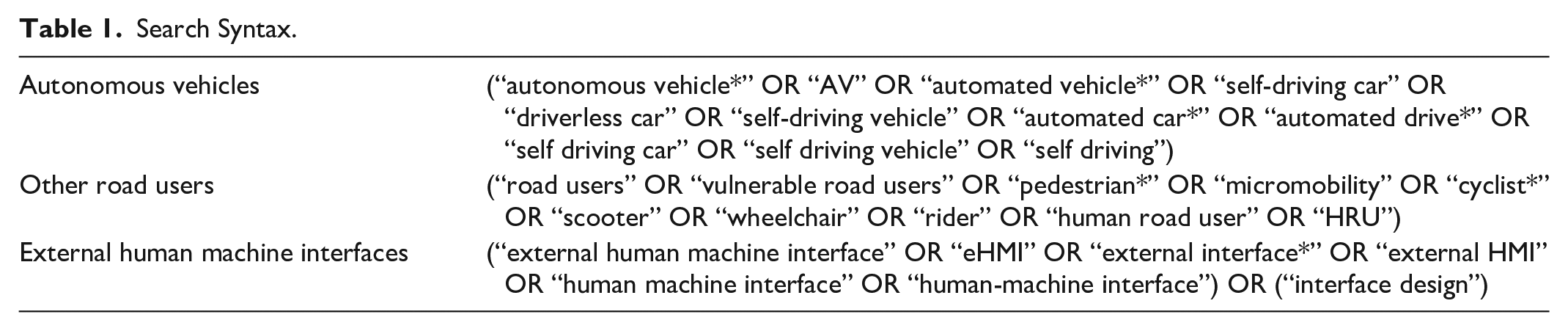
This scoping review follows the Preferred Reporting Items for Systematic Reviews and Meta-Analyses (PRISMA) guidelines to identify the most relevant research on autonomous vehicle external human-machine interfaces for pedestrian safety (Figure 1). In November 2024, a search was conducted across five databases: Engineering Village, Web of Science, SCOPUS, psychINFO, and TRID. The search was conducted using combined keywords for external human-machine interfaces, pedestrians, and automated vehicles (Table 1). There were 1167 initial results and after removing duplicates, 767 articles remained. Only peer-reviewed academic journals and conference proceedings published in English within the last 5 years (January 2019 to November 2024) were included. The title and abstract review excluded 686 articles. After a more complete evaluation of 81 articles additional exclusion criteria were developed. This involved excluding any online video-based studies and eHMI studies on non-passenger vehicles. Inclusion was also limited to articles which used either virtual reality, immersive indoor environments like CAVE and HIKER, or field studies. For final analysis and thematic coding, 27 articles were selected.
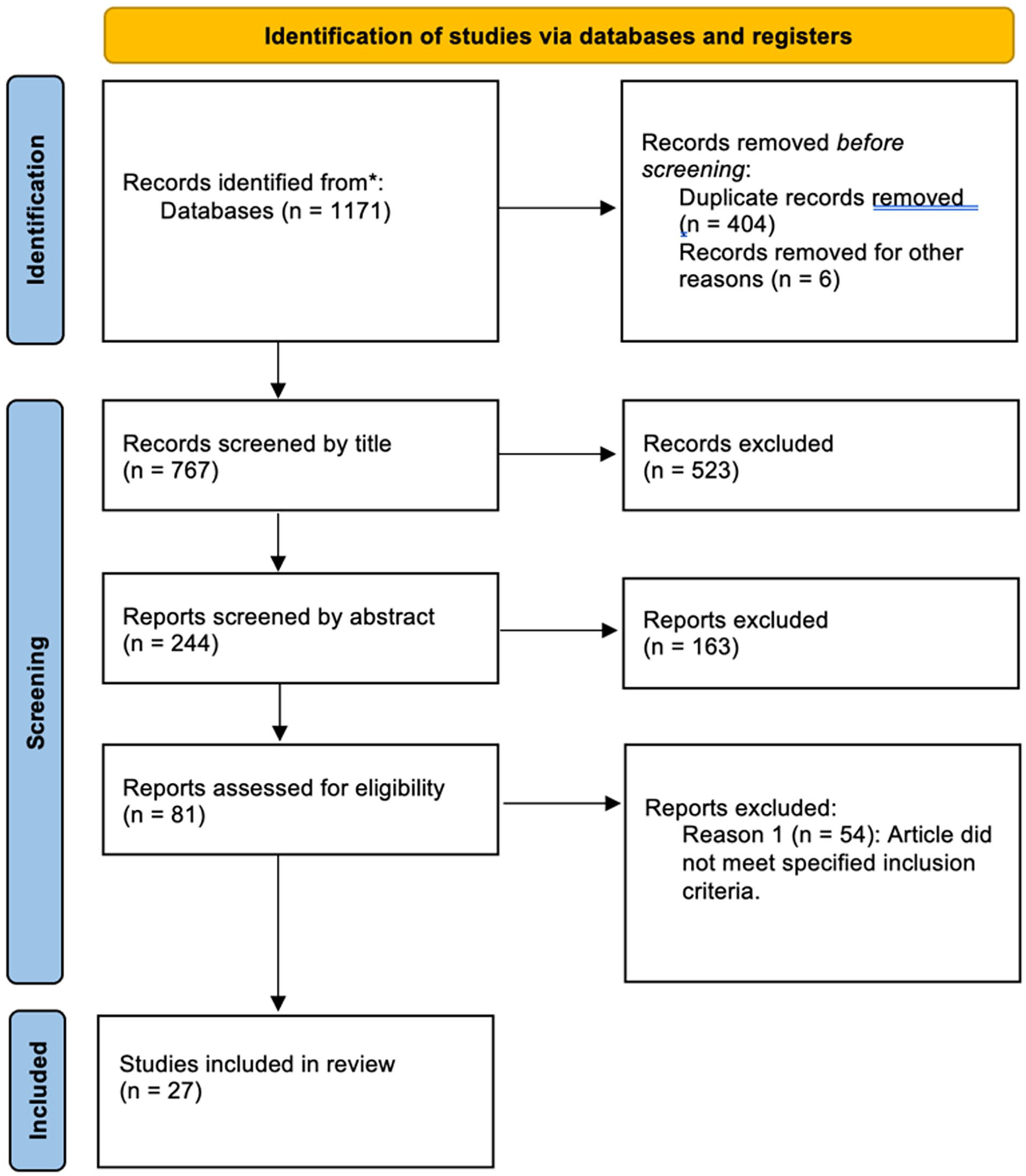
Prisma search.
Search Syntax.
Results
Among the 81 full text articles selected reviewed, 27 were selected for the final review. Among the articles, three primary themes emerged including eHMI Design and Modality, eHMI Context, and Static vs Dynamic eHMI.
eHMI Design and Modality
Much of the recent literature on eHMI and pedestrians have focused on the effect of different designs with light bars, text displays, various icon displays, and road projection systems. Studies have shown that the presence of any eHMI leads to faster pedestrian crossing decisions compared to no eHMI, but there are differences in pedestrian understanding based on which design is used (Ackermans et al., 2020; Song et al., 2023; Wang et al., 2021; Wang et al., 2020). Many visual eHMI designs (text, lightbar, icon) use cyan coloring because it is not associated with specific meanings like green or red (Faas & Baumann, 2020). Studies have shown that pedestrian understanding changes depending on if a flashing/pulsing or sweeping pattern is used (Faas & Baumann, 2020). For example, Faas and Baumann (2020) investigated the effects of using a steady, flashing, or sweeping light bar on pedestrian crossing behavior. Participants were asked to cross the street in a controlled environment using a wizard of oz vehicle setup. Participants started crossing sooner with the flashing signal compared to sweeping or steady, and reported the sweeping signal as ambiguous, with some interpreting it as a message to cross and others the opposite. The researchers also examined participants’ learnability, likeability, and safety ratings when viewing flashing and sweeping light bars (Fass & Baumann, 2020; Bindschädel et al., 2021). Results showed that flashing light bars are rated as easier to learn and more well liked than sweeping designs (Bindschädel et al., 2021). Researchers have also compared text displays with frontal brake lights (FBL). Participants were asked if the eHMI enhanced their ability to predict the behavior of the vehicle. The text displays received the lowest difficulty ratings followed by FBL (Kooijman et al., 2019). Additional investigations by Lee and colleagues (2019) focused on comparing a novel slow pulsing light bar (SPLB) to a familiar flashing headlight (FH) eHMI. Participants reported the flashing headlights were easier to perceive from farther away compared to SPLB. The flashing headlights had shorter crossing initiation times by an average of 1 second compared to light bar, indicating that one’s familiarity with a design can moderate its effectiveness. The optimal eHMI design is dependent on the primary function. If clarity and understanding of message are paramount, a text display is best; if reaction time is more important a flashing light bar is best (Faas & Baumann, 2020). Other studies present mixed results. Joisten and colleagues (2020) compared an icon eHMI to no eHMI and found there was no significant difference in perceived safety ratings. Lee and colleagues (2024) investigated the flashing headlight and slow pulsing light bar across two situations, one where the AV was yielding for the pedestrian and another where the AV was yielding to a traffic light 34 meters past the pedestrian, causing ambiguity of the meaning of the message. The flashing headlights caused significantly more collisions when the AV yielded for the traffic light, potentially due to the increased familiarity and over reliance on the eHMI. There has also been increased research interest into audio accompaniment to existing eHMI designs and manipulating the eHMI onset to further change pedestrians’ behavior towards more safe crossing patterns (Bindschädel et al., 2023; Kaleefathullah et al., 2022; Lee et al., 2019). While visual eHMI concepts have numerous demonstrated benefits to pedestrian crossing and safety, one drawback is that the user must be looking at the interface to derive its meaning. Visual eHMI designs also have no way to communicate with blind or vision-impaired populations, posing potential risks in urban environments. A study by Bindschädel and colleagues (2023) examined adding acoustic signals to visual eHMI concepts and found that adding an acoustic signal had a positive effect on crossing initiation time, leading to more efficient crossings (Bindschädel et al., 2023). Although the crossing initiation times were reduced auditory signals present their own unique set of challenges. One being that in heavy traffic scenarios, the numerous auditory signals may become confusing and overwhelming for pedestrians. It is also unclear what vehicle behaviors pedestrians associate audio cues with. A rating study by Lee and colleagues (2019) found that a combination of visual and auditory signals for conveying yielding intention received high association ratings. but pure auditory signals were low rated. Manipulating timing characteristics of the eHMI can also influence pedestrian crossing decisions (Kaleefathullah et al., 2022). One study examined trust development and eHMI onset time by presenting the eHMI either early (before braking), on time (at the onset of braking), or late (after the onset of braking). The results indicated that pedestrians rated early eHMI onset times with a higher perceived safety score compared to on-time and late scenario.
eHMI Context
Other aspects such as the environmental factors, vehicle size, mounting location, and interconnected vehicles may influence the eHMI effectiveness in signaling important information to pedestrians. The location where an eHMI is placed may influence pedestrians’ perception of the interface and affect crossing decisions (Zheng et al., 2024). There are conflicting findings on the effect of eHMI mounting location on pedestrian. Zheng and colleagues (2024) placed different eHMI on the grill, windshield, and roof of a vehicle, but found no significant difference on pedestrian’s crossing decision time. Other eHMI context such as vehicle size has also been investigated (de Clercq et al., 2019; Zheng et al., 2024). One study that leveraged virtual reality in their experimental design found that as vehicle size increases, participants report feeling less safe and are less willing to cross in front of it, across all eHMI tested (de Clercq et al., 2019). Another aspect of eHMI context that modulates their effectiveness is the environment where they are presented. One study explored the effect of the presence of a zebra crossing on pedestrian crossing intention compared to an ambiguous scenario. Results showed that the presence of a zebra crossing further increased participants intention to cross when presented with an eHMI (Madigan et al., 2023). Investigations by Tran and colleagues (2024) investigated how pedestrians respond to multiple yielding vehicles equipped with interconnected eHMI. In conditions where the eHMI were connected, signal misinterpretation was lower among participants but still resulted in the highest number of collisions (Tran et al., 2024). While interconnected eHMI designs are promising, more research is necessary to understand how they might be used effectively. Environmental context can also influence eHMI effectiveness. Tan and colleagues (2024) manipulated environmental factors in conjunction with eHMI. They tested three designs, light bar, road projection, and infrastructure eHMI. The light bar was sweeping green to indicate yielding intention, the road projection projected a green zebra crossing to indicate safe crossing. The third design had the curbstones light up greed or red for safe or unsafe crossing while the vehicle had no eHMI. Participants found the curbstone display confusing indicating it may be more detrimental than beneficial. These findings show that consideration should be made to the location, vehicle size, and supporting infrastructure to increase the efficiency and experience of eHMI designs.
Static and Dynamic eHMI
One factor which has been explored extensively in the literature is the difference in effectiveness between static and dynamic eHMI signaling. Static and dynamic eHMI present the same message but with different levels of information richness. Static eHMI are described in the literature as only displaying the vehicle automation state (manual or autonomous) without displaying more complex information. Dynamic eHMI can present additional information such as the vehicle yielding intentions or pedestrian perception. The current body of research supports dynamic eHMI solutions as the best method of communication (Almeida et al., 2024; Chang et al., 2024; Faas et al., 2020; Faas & Baumann, 2020; Lau et al., 2024). Presenting additional information to the pedestrian such as yielding intent allows them to have a greater understanding of the situation and make a more informed decision of whether to cross the street or not. In one study, Wilbrink and colleagues (2021) compared the effect of dynamic and static eHMI signals on pedestrian crossing time. Participants had significantly earlier crossing times when interacting with dynamic eHMI designs which indicated yielding intent (Wilbrink et al., 2021). Earlier crossing times can lead to a more efficient traffic flow and fewer dangerous pedestrian interactions where the gap between person and vehicle is not adequately judged. Dynamic eHMI messages can also increase safety by helping pedestrians understand when not to cross. In one study, researchers collected qualitative responses from participants comparing dynamic eHMI indicating either perception of pedestrian or yielding intent. Participants reported that the perception display was not necessary because it was inherent that the AV would have an awareness of its surroundings. This display also led to longer crossing duration which is counterproductive to safety. Participants also reported that the yielding indicator made them feel safer and more detected by the vehicle (Faas et al., 2020). Loew and colleagues (2022) also tested a light band design communicating either yielding intention or pedestrian perception. Results showed that both intention and perception based eHMI reduced CIT compared to no eHMI conditions. It was also noted though interviews that the intention-based design was rated as more comprehensible compared to the perception eHMI. These findings align with the existing literature on dynamic and static eHMI. Additional research by Song et al. (2024) found that adding an acceleration indicator (activating whenever the vehicle is accelerating near pedestrians) can reduce risky road crossing behaviors. Showing additional information, such as yielding intent allows pedestrians to cross more safely and have a more accurate understanding of the vehicles kinematic behavior to reduce accidents. Other research has focused on factors which may moderate the effectiveness of yielding intent messages. Izquierdo and colleagues (2023) combined eHMI yielding intent messages with different braking behaviors, aggressive and gentle. The combination of gentle braking and eHMI displaying yielding intent increased pedestrians trust in AV. With aggressive braking, the eHMI increased pedestrians’ confidence in the AV to brake, but did not reduce pedestrians crossing initiation times (Izquierdo et al., 2023).
Conclusion and Discussion
This scoping review examined factors influencing the effectiveness of various external human-machine interface (eHMI) display configurations on autonomous vehicles (AVs) to enhance pedestrian safety. The findings highlight the potential of eHMI to enhance the safety of interactions between AVs and pedestrians. However, the findings also highlight the need for further research to determine the most effective designs and address remaining complexities. While the presence of almost any eHMI generally leads to quicker pedestrian crossing decisions compared to no eHMI, the optimal design depends on the specific communication goal. Text-based displays offer the highest clarity and pedestrian understanding, whereas slow pulsing light bars and flashing headlights result in faster perception and reaction time. Dynamic eHMI, which convey information like the vehicle’s yielding intent, are broadly supported by the literature as superior to static displays that only indicate automation state. Dynamic displays showing yielding intent lead to earlier crossing times, increased perceived safety, and better pedestrian understanding of the vehicle’s behavior compared to displays showing only pedestrian perception. Combining yielding intent messages with gentle braking further enhances pedestrian trust. Despite these findings, a clear consensus on the single best visual design for the broadest audience is still lacking. Factors such as the specific light pattern (flashing vs. sweeping), color, onset timing, and the potential inclusion of auditory signals require further investigation, especially considering challenges like potential confusion in heavy traffic and accessibility for vision-impaired individuals.
Limitations
One limitation of the current research is that many studies only focus on simple traffic scenarios with one pedestrian and one vehicle. To increase the realism of scenarios future studies should consider adding more vehicles to better understand pedestrian crossing in mixed traffic.
Footnotes
Declaration of Conflicting Interests
The author declared no potential conflicts of interest with respect to the research, authorship, and/or publication of this article.
Funding
The author received no financial support for the research, authorship, and/or publication of this article.