







Abstract
Interior design practitioners continue to adopt social media technologies as part of the early stages of the inspiration design process. This prominence of social media is also interwoven in the practices of design students. However, the way interior design students perceive and use social media such as Pinterest® as a part of their design process has been underexplored. Drawing on interviews with 25 interior design students in a Council for Interior Design Accredited program, the findings from this study illustrate how students are developing their own norms and guidelines for their search strategies, evaluation of sources, and navigation of attribution on Pinterest. An understanding of interior design students’ perceptions of Pinterest is situated through a connected design learning and information literacy approach, which places values on student-driven interests, media knowledge, and technologies as opportunities to amplify design learning experiences across digital–physical environments. Although Pinterest has social networking features, the interviews revealed that interior design students do not view Pinterest as a social media platform and instead think of Pinterest as a digital tool used alongside other design software. From a connected design learning approach, this finding suggests an opportunity for educators to guide students on how to leverage some of the social features to expand their own professional design networks. With an ever-changing media ecology that provides opportunities for sharing creative work and requires adeptness at managing visibility and flows of information, insights for building more intentional learning environments around how students use Pinterest in interior design are provided.
Keywords
Introduction
Pinterest® describes itself as a “visual discovery engine for finding ideas” to “spark inspiration” (Pinterest, 2023, para. 1 & 2). With an estimated 445 million monthly active users worldwide (Statistica, 2022), the image-based, social media platform continues to be a place of convergence for everyday users and design professionals (Linder et al., 2014; Scolere & Humphreys, 2016). Among other visual, social media platforms, Pinterest is unique in how users create boards comprised of saved images (pins), and these inspiration boards are public by default (Figure 1). Interior designers continue to adopt social media technologies such as Pinterest during the initial stages of inspiration and to collaborate with clients (Scolere, 2021a), while other design professionals leverage a broader social media ecology for portfolio-building. This prominence of social media is interwoven in the practices of design students who are using platforms such as Pinterest in their design processes. More specifically, design students have reported using Pinterest for design inspiration (Webb & Aulgur, 2022) as well as for searching ideas and sharing images among a team (Cho & Cho, 2020). While prior work has examined how design students have used a range of social media technologies in the design process (Bakir & Alsaadani, 2022; Cho & Cho, 2014, 2020; Güler, 2015; Webb & Aulgur, 2022), the role of informal learning outside of the classroom (Gray & Howard, 2014) and the ongoing use of Pinterest as a visual resource for ideation (Wright, 2020), the way interior design students perceive and use Pinterest and how this self-initiated use is contextualized has been underexplored.
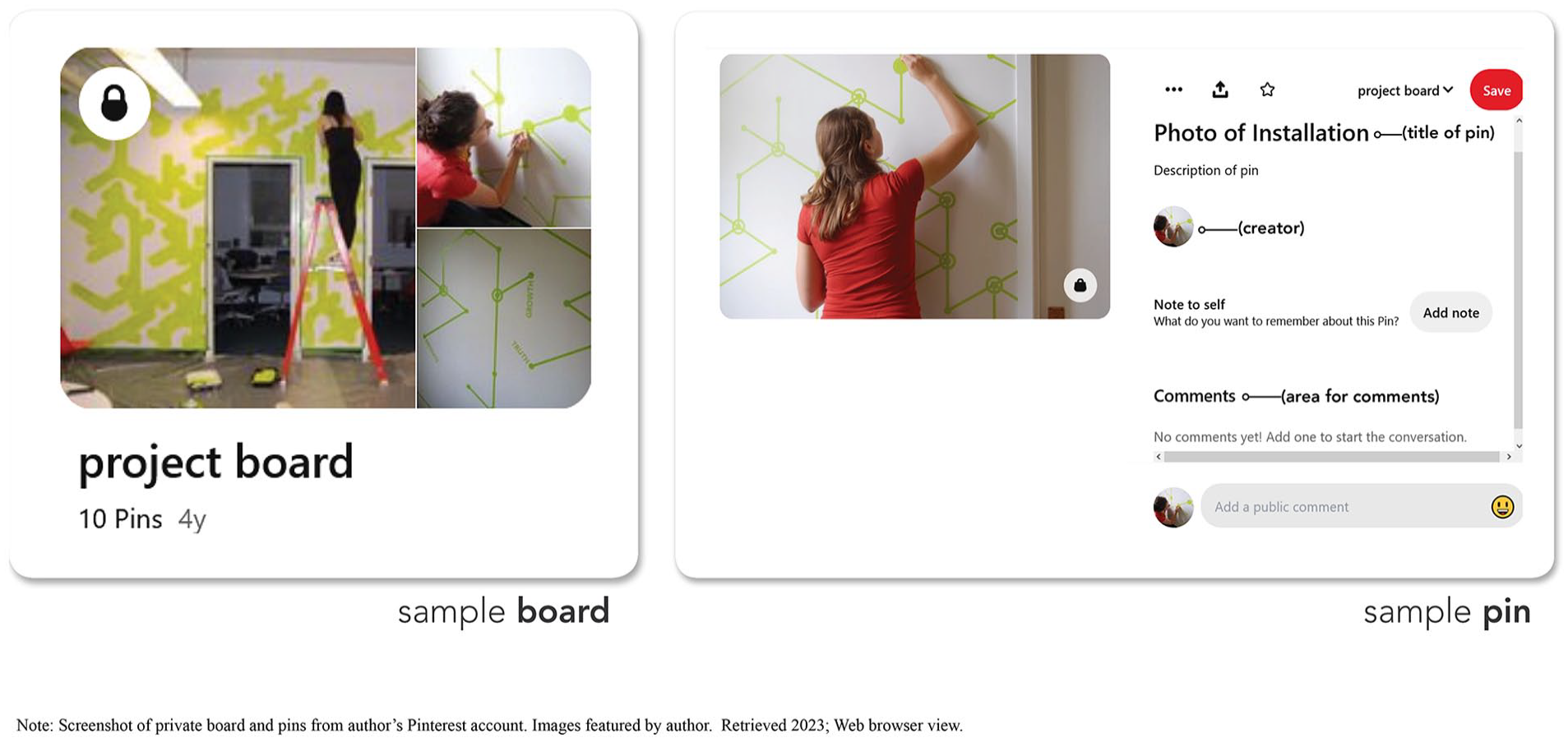
Author’s example Pinterest board and pin with annotations.
This use of social media by interior design students plugs into the accelerating growth in an ever-changing media ecology for young people, which includes connective technologies, digital tools, big data, and open-educational resources (Ito et al., 2020). This growing digital and networked landscape of technology creates “new opportunities for interest-driven learning and creative expression,” but also illuminates emerging concerns such as “challenges to the credibility of information, threats to privacy, changing literacy needs, and new demands for managing attention and connection” (Ito et al., 2020, p. 4). Drawing on what Ito et al. termed a connected learning approach can help us examine how technologies such as Pinterest mediate opportunities for learning and teaching in design education and information literacy.
As Pinterest has become a common tool in the design process for finding and curating sources of inspiration by professional designers (Scolere, 2019, 2021a; Scolere & Humphreys, 2016), there is an opportunity to examine interior design students’ (i.e., future practitioners) interest and use of Pinterest to inform educators’ approaches. Webb and Aulgur (2022) found that while design students reported actively using Pinterest, there was a shared perception between students and faculty that bringing social media into the design education conversation was “taboo.” This finding suggests that there may be misconceptions about the technology of Pinterest as a tool in studio education. Prior pedagogical research emphasizes the role of educator knowledge for technology integration in teaching and proposes the importance of “understanding how teaching and learning can change when particular technologies are used in particular ways” (Koehler & Mishra, 2009, p. 65). Understanding the “pedagogical affordances” of technologies can impact how technologies can be leveraged as tools toward disciplinary goals (Koehler & Mishra, 2009, p. 65). Pinterest’s use in higher education has been studied across a variety of disciplinary contexts including the role of Pinterest in expanding informal learning (Pearce & Learmonth, 2013) and the guidance necessary for students’ use of Pinterest toward professional contexts (Baker & Hitchcock, 2017). Examining students’ perceptions of Pinterest could foster a shared understanding between students and educators about the future possibilities and best practices of Pinterest in design education.
I propose that a connected learning lens (Ito et al., 2020) combined with information literacy frames (Framework, 2015) situates students’ interests and perceptions of the affordances of Pinterest in the context of learning and teaching opportunities. Guided by these propositions, I sought to answer the following questions related to aspiring designers and Pinterest:
RQ1: How are aspiring interior designers—interior design students—using Pinterest as a part of the design process?
RQ2: What are interior design students’ perceptions about the affordances of Pinterest?
RQ3: What can we learn about interior design students’ social media literacy through a connected learning lens related to their Pinterest use?
Literature Review
Social Media and Design
Social media platforms belong to the broader category of connective technologies and media tools and are defined by a common set of attributes. Carr and Hayes (2015) defined social media as the following: “Social media are Internet-based channels that allow users to opportunistically interact and selectively self-present, either in real-time or asynchronously, with both broad and narrow audiences who derive value from user-generated content and the perception of interaction with others” (p. 49). Within this category, social networking sites Instagram, Linkedin, and Pinterest allow users to create a profile, display a list of connections (following/followers), and view others’ lists of connections (boyd & Ellison, 2007). Users can share content and connect with others through the actions of following, liking, and posting.
There has been large growth in creator communities (Cunningham & Craig, 2021) with creative professionals using social media to share their work digitally. Professional designers have used a wide range of social media sites as a part of their career path development including portfolio-building, design inspiration processes, and reputation-building. Often the technology affordances of these channels inform how creatives use specific platforms to achieve certain communication goals (Nagy & Neff, 2015; Scolere et al., 2018). Many designers view image-sharing applications such as Behance and Instagram as a key component of portfolio-building and distributing in-progress or completed design projects (Scolere, 2019). A number of these platforms such as Behance, Instagram, and Pinterest are part of a reciprocal inspiration economy that runs on designers sharing their work and other designers consuming this work as part of preliminary stages of a project (Scolere, 2021b).
Designers often refer to browsing, searching, and curating visual imagery as a type of design research that inspires and serves as a form of “idea generation” for the design process (Herring et al., 2009, p. 5) or provides a benchmark of what has been done previously (Eckert & Stacey, 2000). Platforms like Pinterest plug into professional designers’ search practices for collecting design inspiration in the form of digital images during the initial design process stages. Pinterest boards are used by designers to gather imagery for projects, and in other cases, they are shared with clients to understand tastes, preferences, and point of view to inform the project direction (Scolere & Humphreys, 2016). While web-based search processes have been studied related to creative output (Biskjaer et al., 2020) and Pinterest has been studied across related art and design disciplines (Castro, 2012; Lapolla, 2014), the way interior design students perceive visual social media platforms like Pinterest and understand their self-initiated Pinterest-use has been underexplored.
Social Media and Interior Design Education
Interior design education has historically explored the integration of emerging technologies in studio education (Huber, 2021) including design software such as AutoCAD and digital-sketching tools (McLain-Kark & Rawls, 1988; Meneely, 2007), collaborative video-conferencing technologies (Asojo, 2007), web-based technologies and new media (D’souza, 2016; Matthews & Weigand, 2001; Schrock, 1994), and explorations across contexts with virtual and augmented reality (D’souza & Nanda, 2023; Kim et al., 2023; Scolere & Malinin, 2023; Vahdat, 2023). While there has been a continual uptick in design students using social media (Bakir & Alsaadani, 2022; Cho & Cho, 2014; Güler, 2015), there is a noticeable opportunity in design scholarship to examine the evolving use of these technologies in interior design education. One important contribution is the case study by Cho and Cho (2020) who surveyed 27 junior interior design students across 12 teams in studio about their social media use throughout a collaborative project. The results of the questionnaire indicated that across the teams, 11 social media technologies were used for different aspects of design collaboration with Pinterest being the most popular (Cho & Cho, 2020, p. 907). These findings are an indicator of Pinterest’s popularity among interior design students and suggest that understanding more about students’ perceptions of Pinterest could help inform interior design education.
Filgo and Martinsen (2017) sought to use the Association of College and Research Libraries’ (ACRL) (Framework, 2015) Framework for Information Literacy for Higher Education to help interior design students re-conceptualize how to use Pinterest as a research tool in design education by creating an assignment to build literacy principles into their processes. 1 Emphasizing sources of information, Filgo and Martinsen required students to add descriptions and citations to their pins. Furthermore, they had students use Pinterest for storing content rather than searching for content. The multi-year iterative approach included a class of 18 and then 35 interior design students with refinement of the frames to help students experiment with Pinterest. Their method illustrates the importance of avoiding the trap of labeling a technology as entirely problematic by examining how technological knowledge can inform use. In a study focused on technology use, Meneely (2007) deployed a digital sketching intervention across four undergraduate studios where 63 interior design students gave feedback on the benefits and challenges to digital technology. The findings emphasized the importance of empowering students to situate technology-use related to goals and constraints.
Framework: Connected Learning and Information Literacy
The uniqueness of this investigation is the combination of a connected learning approach with information literacy frames to propose a connected design learning framework for understanding students’ social media literacy within the context of Pinterest and design education. Interdisciplinary scholars and practitioners developed the connected learning framework to contextualize learning in a new media context (Ito et al., 2013, 2020). 2 The “connected learning” lens considers how connective technologies and new media are mediators in learning and acknowledges the role of social networks, information exchange, and affordances of these technologies in education (Peppler et al., 2022, p. 265). Furthermore, connected learning is an educational model that emphasizes the importance of connecting a student’s interests, experiences/opportunities, and relationships to their learning process (Ito et al., 2020) (Figure 2). 3 This framework suggests that learning should be interest driven, socially connected, and academically relevant. It also recognizes the importance of learning as extending beyond the formal educational environment to multiple pathways including both the physical and digital that offer learners opportunities to become part of online and networked communities of practice (Ito et al., 2018, 2020). These networked communities include social media where students may be experimenting with publishing design work and developing a creative identity.
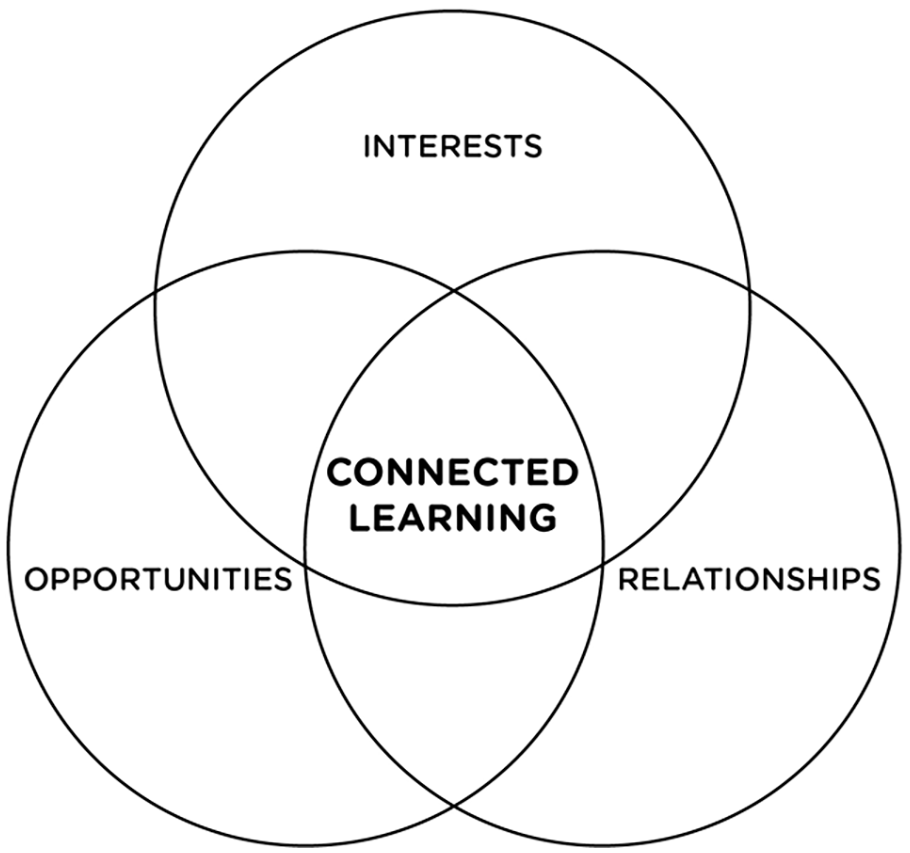
Connected learning framework.
In response to this rapidly changing “information ecosystem” and higher education learning environments, the Association of College and Research Libraries developed a Framework for Information Literacy for Higher Education (Framework, 2015) which identifies six conceptual frames along with knowledge practices and dispositions that are core to information literacy. The philosophy of this Framework (2015) is the goal of building increased “critical self-reflection” to allow students to better navigate a complex media landscape of information. Furthermore, this Framework (2015) re-imagines information literacy as “an overarching set of abilities in which students are consumers and creators of information who can participate successfully in collaborative spaces” (p. 8). From six conceptual frames, three are particularly helpful for critically thinking about Pinterest and interior design education: authority is constructed and contextual, information has value, and searching as strategic exploration (Framework, 2015). Authority is constructed focuses on building awareness around evaluating sources in context while recognizing the “social nature of the information ecosystem where authorities actively connect with one another” (p. 5). The frame of information has value emphasizes developing understanding of information as multi-dimensional and guiding critical thinking around how to make “informed choices regarding their online actions” with awareness of tensions between sharing, privacy, and commodification of personal information in a networked context (pp. 16–17). The frame of searching as strategic exploration prioritizes thinking about searching for information as an iterative process that requires evaluation of sources (pp. 22–23). Each of these three frames were layered onto the existing connected learning framework (Ito et al., 2020) and guided question topic areas and analysis related to the following: search process (search strategies), source (authority), and content (information).
Building on the scholarship of prior approaches, I propose a connected design learning framework which overlays the connected learning framework (interests, relationships, opportunities) with information literacy frames (searching, authority, information) to examine the role of the social media platform Pinterest in design education from the perspective of interior design students. 4 This connected design learning framework guided the interview questions 5 and the analysis to expand how we contextualize the social media practices of design students and how these practices provide insight about their information literacy and perceptions of Pinterest (Figure 3).
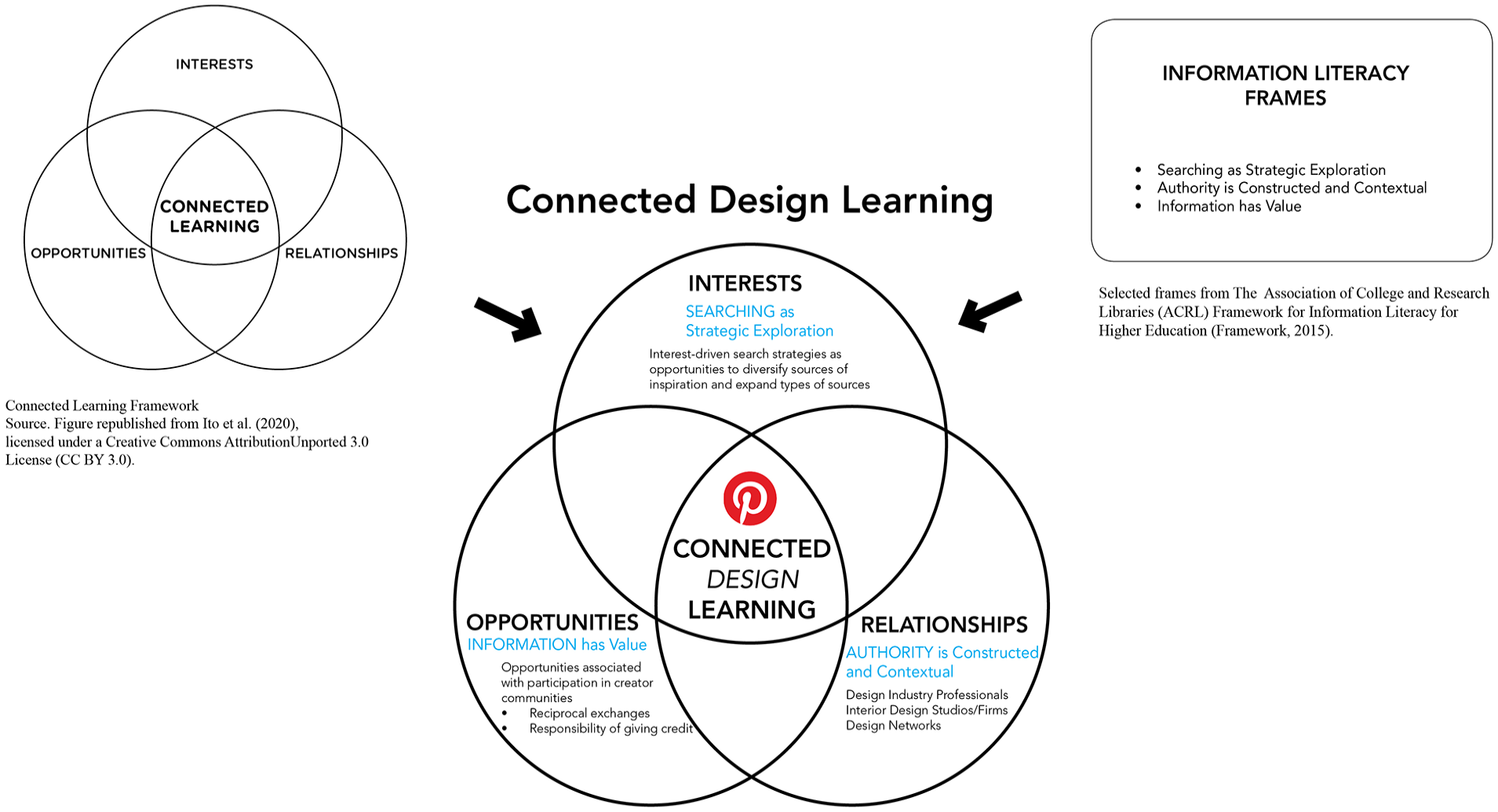
Proposed conceptual framework. Connected design learning: Overlay of information literacy frames on connected learning framework as applied to Pinterest use.
Method
Sampling and Recruitment
To investigate interior design students’ perceptions of Pinterest, this project draws on data from 25 in-depth interviews from upper-level, interior design students in a Council for Interior Design Accredited program. Due to the prevalence of Pinterest in professional interior design communities and within interior design education, Pinterest 6 use was the sampling frame for this study. Participants were recruited through fliers and interior design program email-listserves soliciting interviewees for study on Pinterest use. From these initial contacts, I employed snowball sampling to recruit additional eligible participants. The participants included third-year (n = 9) and fourth-year students (n = 16) who had active Pinterest accounts that were related to design coursework. Mapping onto the demographics of the interior design program, the sample was predominantly comprised of women (23 out of 25 identified as women). Participants had an average of 6.5 years of Pinterest usage, with many participants reporting having accounts since middle school or high school.
Data Collection and Analysis
Semi-structured, in-depth interviews, which ranged from 30 to 60 min, were conducted either in-person or via Zoom, and at the completion of the interview, participants received an eGift card. If the participant elected for an in-person interview, the interviews took place in an on-campus location based on participant preference (office or informal space). The interviews were audio-recorded and transcribed by a professional transcription service to ensure accuracy. This study was granted Institutional Review Board permission by the author’s university. Interview questions were open-ended (Charmaz, 2006) to encourage participants to reflect on their own usage of Pinterest. The interviews, 7 which were guided by the connected learning framework and the literacy frames, focused on a range of areas including Pinterest platform use and motivations, Pinterest features (affordances) and the creative design process, the role of inspiration and Pinterest in the design process, platform perceptions, and anticipated future career use (Table 1).
Sample Interview Questions.
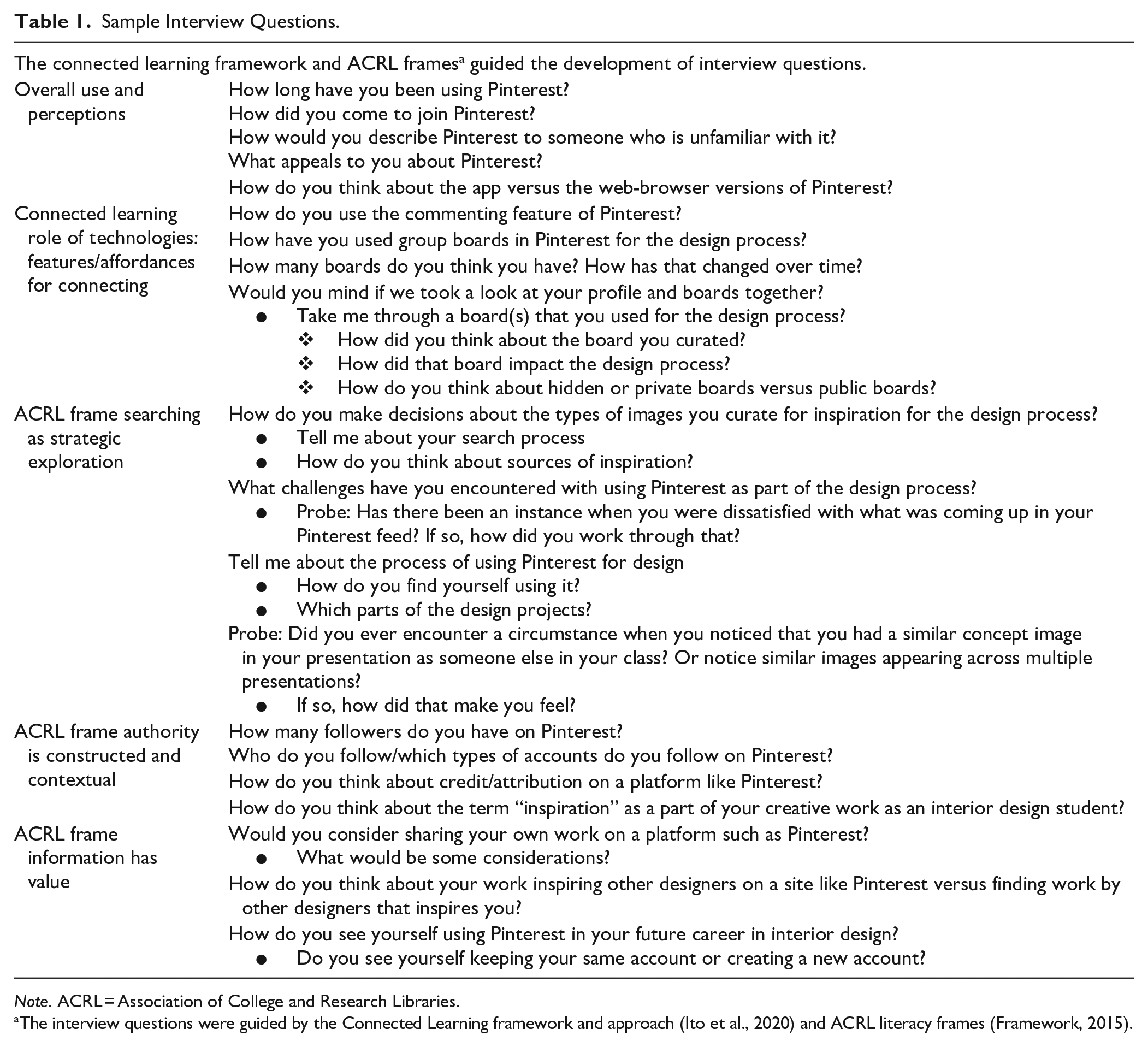
Note. ACRL = Association of College and Research Libraries.
The interview questions were guided by the Connected Learning framework and approach (Ito et al., 2020) and ACRL literacy frames (Framework, 2015).
Drawing on grounded theory (Glaser & Strauss, 1967), I used an inductive approach to data collection and analysis to move iteratively between collecting data, coding, and developing categories. During the first phase of coding, I developed initial coding categories including social media, inspiration, use-types, creative process, search strategies, and use in coursework. I refined this coding to create analytic second-level codes (Tracy, 2013, p. 194) based on emergent themes related to connected learning and information literacy including search strategies, attribution and credit practices, authority, technology affordances, and types of use. Names of the participants interviewed for this article are pseudonyms to protect their identity.
Findings
Overall, the interviews revealed that Pinterest was the primary site used most frequently as a part of the search process in the early stages of design. Students reported three key motivations for using Pinterest: (a) getting inspired to create, (b) exploring one’s taste and style preferences, and (c) collecting sources of inspiration for current and future design projects. These findings were organized into two key categories including emerging platform perceptions (i.e., how participants view and ascribe meaning to Pinterest) and practices of interior design students using Pinterest in design studios and courses.
Platform Perceptions
Personally Oriented Platform
While Pinterest is commonly categorized as a social media platform due to its social features (Pew Research Center, 2021), the interior design students interviewed described Pinterest as decidedly not social media. Instead, participants viewed Pinterest as a personally oriented platform because they did not frequently use the social features that enabled following of users or boards. Frequently browsing the main feed for pins, Alyssa asserted that she personally “wouldn’t consider it [Pinterest] a social media platform,” describing how she “never really felt the need to go follow anything specific” and “never paid attention to the following [feature].” Echoing these sentiments, Taylor emphasized how she used it differently than other social media apps: “I use it more of like a researching-type reference tool. I don’t really care about followers or pay attention, I don’t even know how many followers I have.”
Several interviewees pointed to Pinterest features that prioritized the image pins (visual content) over the pinners (user profiles) as a reason they did not view Pinterest as a social media platform. For example, Miri explained, “Pinterest is more of, you go in there and you see an image and you don’t instantly attach it to a person or who posted it.” More specifically, Macey described how the small size of the person’s Pinterest profile that traveled with the pin made it difficult to immediately associate a pin with the person who added the content. She stated, “I definitely think it’s harder to recognize who you’re following [on Pinterest], because on the app, it’s like a tiny little picture in the corner to see who actually pinned something.” Instead of perceiving an audience or a community of users when using Pinterest, students described Pinterest as a personally oriented, individualistic platform for design use.
Integral Digital Design Tool
The interviews revealed that students viewed Pinterest as a key digital “tool” for the design process. Although many varied communities outside of design use Pinterest, for students, Pinterest was experienced as a creative platform for designers. Taylor described Pinterest as “creative and artist geared” due to the content that she frequently encountered while using the app. In addition, participants often discussed their use of Pinterest alongside other design-centric software such as Revit, AutoCAD, and SketchUp. Third-year student Lena emphasized how she thought of Pinterest as a tool for design work. She explained, “I purely see it as a tool, like AutoCAD, SketchUp. I don’t really see it as a place that I go to for entertainment, or social media. It’s a tool, definitely.”
While students described using the Pinterest mobile-app, many also used the web-browser version of Pinterest while actively working on studio projects. Jamie described how Pinterest was used side-by-side with other digital platforms during her design process for her senior Capstone project:
Pinterest is probably one of the tabs that’s always open on my computer. Especially with working on capstone right now, I am back and forth between what I’m doing in Pinterest all the time. Looking at other layouts and getting their shapes and colors and ratios and things like that. So, I always have it open.
Unlike other design software, participant Celia thought of Pinterest as a “fun” way of working. As such, students reported enjoying the feeling of being productive while taking a “break” from some of the more technical aspects of design software.
Pinterest Practices
Using the connected design learning framework, three emerging practices 8 by the interior design students in this study were identified: search strategies (interests), evaluation of sources (relationships), and navigating credit and attribution (opportunities). Each of these practices map onto the information literacy frames used in the connected design learning framework (searching, authority, and information). The students’ experimentation with Pinterest yielded a range of different degrees of information and social media literacy as outlined below:
Search Strategies: Between explorative and generative (searching as strategic exploration)
Evaluating Sources: Between everyday pins and professor-reviewed pins (authority is constructed)
Navigating Credit and Attribution: Between consumer and contributor (information has value)
Search Strategies: Between Explorative and Generative (Searching as Strategic Exploration)
Overall, participants discussed multiple approaches to searching for sources on Pinterest. While students engaged in a continuous process of searching for design inspiration that extended beyond projects (Gonçalves, 2016; Mougenot et al., 2008), they also discussed goal-oriented searching for specific parts of the design process as well as passive searching (Herring et al., 2009). At times, this passive searching was conceptualized as a way to relax while still feeling productive.
In the design process, inspiration imagery is often included within an interior design presentation to convey the conceptual design direction. Participants discussed how they often observed similar inspiration images ending up in several students’ presentations. One student recalled this happening in a studio presentation with students exclaiming, “Oh wow. Three of us used that same image in our presentation.” Kellie described the feeling when another student included the exact same image in their concept presentation as she had, “I’ll see that image in someone else’s. And it’s almost a moment of like, Did I not go deep enough in my research?” For some, this result of drawing on the same imagery from Pinterest was viewed as a lack of effort in the search strategy. As a result, students developed a range of search strategies between explorative to generative to ensure unique imagery that guided their conceptual direction. Generative search strategies included intentionally manipulating the images they would receive algorithmically through their feed using new search terms or categories.
To avoid drawing on the same Pinterest images, students refined their search strategies such as “trying different variations” or using “specific terms” instead of more generic terms that they felt other peers might use. Alyssa felt the time investment she put into the search resulted in more unique imagery that went beyond the images that were on the “top of pile” on Pinterest:
I think just taking more time to search through other than just keeping it in the top of the pile, because they are always going to be the same ones [images] that come up a lot. So, I think just spending more time digging deeper and trying different variations of searches can help.
Although participants lauded the algorithm-generated “more like this” pins, they also equated their time investment in searching with a likelihood of more unique inspiration imagery as the outcome.
Another emerging strategy that students reported was drawing on multiple sources of inspiration rather than heavily using a singular source. Alyssa used a continuous browsing strategy to “get an overload of information and an overload of different styles.” Nadia was adamant about using multiple sources of inspiration to avoid “just regurgitating something” that already exists. Nadia described the primary “rule” that she used when searching for inspiration on Pinterest: “I’d say the rule is mainly that in looking at pieces of inspiration that I can’t just take the one thing, the one picture, one piece of art, whatever it is and make everything exactly like that.”
Some participants described how they tried to avoid using interior environments as sources of inspiration for interior projects. Students described their goals of browsing and collecting “conceptual” or “abstract” images including “elements of nature,” “texture,” and “materials and furniture.” This idea of avoiding interiors as inspiration appeared to be a guideline that students had received at different points in their courses. Recalling how she had heard this guidance “over and over again through the [interior design] Program,” Brynn noted that she does not “typically pin a lot of interior images unless there’s something really specific.” While this stated goal of avoiding images of interiors was common among students interviewed, this was unevenly applied in practice with most participants having boards with images of interiors.
More social media savvy students who were aware of the algorithm’s role on impacting their feed view on Pinterest invested time in intentionally browsing content areas outside of design to help diversify the image content that would populate their Pinterest feeds. In searching interior design content on Pinterest, Abbie expressed her frustration with “seeing the exact same pin over and over and over again.” She intentionally experimented with searching content outside of design:
The other day, I was looking up different Mustang models for cars and that threw in a whole bunch of these really cool color schemes and stuff into my Pinterest, which was interesting [. . .]. When I think of something random, I’m going to try and search it and then see how that kind of incorporates into my feed that it creates for me.
Although this level of understanding was rare in this sample of students, intentional, generative strategies by Abbie represent users’ knowledge and understanding of the algorithm underpinning the content that is served up to Pinterest users. Among students interviewed, it was less common for them to explicitly acknowledge seeking out digital sources of inspiration beyond Pinterest to help diversify their inspiration sources. One exception to this was Lena who discussed digital platforms beyond Pinterest, “I actually really want to branch out of it [Pinterest], because it’s so used. You can only dig so much. It’s just such a popular format that if I want to stand out, I’m going to try and find other programs that people might not know about [. . .] and use those more.”
Evaluating Sources: Between Everyday Pins and Professor-Reviewed Pins (Authority is Constructed)
Despite 15 out of 25 students interviewed asserting that they did not follow many people or boards on Pinterest, these interviewees described one key exception where they had valued the experience of following a professor’s boards which had been introduced as part of a studio course. Students described how the professor’s Pinterest boards were a helpful way to observe a wide variety of approaches for a certain type of design communication such as “model making, conceptual models, architectural models, and parti diagrams” and several noted that this was a great starting point for understanding expectations for an assignment as well as a source for seeing curated examples. Sandra recalled how referring to the professor’s Pinterest boards was “really helpful to get a better idea of professors’ expectations for what they’re looking for.” In addition to expectation setting, Allison liked how the professor’s boards indicated “the styles that they would maybe go for.” This meant that having access to the professor’s boards was perceived as being able to gain more insight about them personally beyond the more formalized classroom self-presentation. In addition to the relational benefits of the boards, the professors’ boards served as a learning tool. For example, one senior student reflected on learning about parti diagrams for the first time and how the professor’s pins categorized on a board called “parti diagrams” helped her feel more confident that the pin she was looking at was indeed an example “because it’s on the parti board.” Nadia explained:
And so especially learning about design, I think it’s really important that it’s almost like peer-reviewed pins, like the professor has their stamp of approval on the pin. So, you know, Oh, this parti diagram, not that it’s been done correctly but that it’s a good example of it.
In addition to Nadia, several stated that a “pin by the professor” became a way to evaluate a source amidst an overwhelming amount of visual content on Pinterest “where not everything is from a reputable source.”
Navigating Credit and Attribution: Between Consumer and Contributor (Information has Value)
The interviews revealed that students were unsure about guidelines for giving and receiving credit within Pinterest. For many, the sources of the creative work they were pinning were unclear. In her use of Pinterest, Jamie expressed how she does not typically; “go out of the way to figure out what project or designer” was responsible for an image. She elaborated,
On Pinterest, since it is just images and links [. . .], you don’t know who the originator of that content is. So, it’s kind of hard to give them credit, especially with all the interiors on there.
While a few students tried to navigate credit and sources on Pinterest, many expressed frustration with figuring out the source of content. Some like Abbie perceived “little to no crediting through Pinterest.” Meanwhile, Brynn was challenged with how to determine who to credit with a particular image: “I think it’s great to give credit, but with Pinterest it can be re-pinned so many times or someone can pull it from somewhere else. You could be crediting the wrong person.”
Students expressed their interest in posting their work to inspire others during their future professional careers, yet the challenges they observed with credit and attribution on Pinterest made them reflect. One student cited her lack of “technology knowledge” as the root of her concerns for sharing her work in the future, while Emily pointed to concerns about the lack of control for how content circulates on Pinterest. The perceived ambiguity around credit and attribution made others hesitant about how they might manage pinning their professional work in the future and ensuring that their work was attributed to them. This idea of receiving credit for their creative work became particularly salient when thinking about how credit/attribution might work related to sharing their own designs on a platform like Pinterest. Nadia described her concerns:
I mean designers and architects do that all the time and those are pins on Pinterest, but I don’t know how that works. I don’t know whether that’s a good thing or a bad thing because there’s always the chance that someone could copy what you’ve done and that’s a little scary.
Those who did not currently pin their own work described several factors for this practice including (a) Pinterest platform norms, (b) creative confidence, and (c) issues related to attribution and credit. Recalling platform norms, Jamie explained that she “mostly pins other things that people have posted” since this is the way that she “first starting using Pinterest.” Several others pointed to their developing creative confidence at this point in their career as a reason for feeling uncomfortable pinning their own work or creating their own pin to share. Kellie asserted, “I don’t know if I have the confidence and the creativity yet [. . .] to see it [my creative work] on Pinterest, on other people’s boards as a source of inspiration for other people.” In addition to confidence, Kellie confided that she also worried about her ability to translate inspiration into a new design and explained her hesitancy about “leaning pretty heavily on Pinterest for inspiration” in her earlier years: “I sometimes wonder in a project, if I find a piece of inspiration from an image and I use that inspiration pretty strongly in my project, I worry that it would almost come across as plagiarism.” This concern speaks to the practice where often art and design students learn through emulating what they see as a form of practicing their creative skills (Castro, 2012; Schenk & Parker, 2019), taking missteps around the distance between inspiration and the new creative product. The difference in the contemporary era is that digital platforms have made it possible for practice work, originally intended to be in the confines of a safe learning environment, to circulate widely intersecting more explicitly with issues of credit in a public setting and professional context.
Only three interviewees expressed their awareness of the reciprocal nature to consuming and producing design content as a part of digital platforms such as Pinterest and used terms such as “giving back to communities.” For example, Jared did “try and give back and post on Pinterest,” and explained his intention:
I mean, if nobody’s posting on Pinterest then none of us could use Pinterest.[. . .] So, I feel like I should do it [post/pin]. And sometimes if I do it [post/pin] once for every hundred things I take [from Pinterest], I feel that’s justified.
Jared’s point of view was the exception in this sample with the majority of students not expressing any awareness around their potential role in being “contributors to the information marketplace” (Framework, 2015, p. 17; see also Filgo & Martinsen, 2017). Describing herself as one of the many users “who just uses it [Pinterest] and they don’t contribute to it,” Lena suggested that if more people added creative content, then Pinterest “would become much more diverse [with a] wider selection.”
Discussion
Unlike designers in the profession who have been adapting to the influx of social media platforms such as Pinterest in their design processes, these current interior design students are native social media users, many of whom reported setting up Pinterest accounts as early as middle school. As such, their long-standing, everyday use of Pinterest and their perspective on how they are using Pinterest as part of their studio experience provides valuable insights for interior design education. Their self-initiated use of Pinterest can be understood through the connected learning approach that accounts for the role of mediated technologies and tools and prioritizes interests, network-building, and connection to career opportunities (Ito et al., 2020; Peppler et al., 2022).
Although Pinterest is classified as social media due to its social networking features and can be categorized as an “advertising platform” (Srnicek, 2017), the interviews with the students revealed that they do not view Pinterest this way. A key aspect of the connected learning framework is the role of online platforms in affording opportunities for young people to “connect to a wider range of specialized communities of interest” (Ito et al., 2020, p. 4). By not leveraging the social features of Pinterest, interior design students are missing potential opportunities to expand their networks and develop understanding of creative communities with whom they may identify. As such, this finding has significant implications for interior design educators to encourage students to strategically use Pinterest’s social features to follow industry professionals and design firms to expand their professional relationships.
This group of aspiring designers was actively but unevenly developing their own norms and guidelines for three key practices that illustrate different degrees of information literacy: searching strategies, evaluation of sources, and navigation of attribution and credit. By adopting a connected design learning framework, interior design students’ use of Pinterest and social media literacy in the context of interests, relationships, and opportunities (Ito et al., 2020) were explored to suggest strategies for building more intentional learning across digital–physical environments. This framework allows insights about searching strategies on Pinterest related to interests (interests × searching), evaluation of authority related to relationships (relationships × authority), and actively navigating the value of information in the context of opportunities in creative communities (opportunities × information).
Interests × Searching
This group of interior design students’ search strategies of digital sources of inspiration on Pinterest ranged between exploration and generative. Many of the interviewees’ practices aligned with learners who are developing literacy related to the ACRL frame Searching as Strategic Exploration (Framework, 2015) in how they understood that to find novel images required going past first search attempts while continuing to invest time in searching as well as varying their key search language on Pinterest. Their emerging search strategies on Pinterest included the following: (a) experimenting with the specificity of their search terms, (b) intentionally searching for items and terms outside of interior design to influence their Pinterest feed, and (c) avoiding images of interiors.
While a number of these tactics mimic those reported by professional designers (Scolere, 2021b), very few students engaged in the broader strategy of diversifying their sources of inspiration beyond the Pinterest platform. This finding suggests that helping students expand their sources of inspiration to include other digital sources as well as those that move beyond images to include blogs, podcasts, and materiality could be beneficial to their current projects and process and their future professional practices.
Explorative search strategies were typical among this sample, yet it was less common that participants were engaging in generative search strategies—intentionally selecting diverse keywords and topics so Pinterest would populate their feeds with these new interests, leading to new content. Klawitter and Hargittai (2018) pointed to the importance of creatives’ knowledge of “algorithmic skills” or “understanding how algorithms influence” (p. 3949) content visibility on platforms such as Pinterest as a key part of building their businesses and brands. As creative professionals are actively navigating the algorithmic literacy (Klawitter & Hargittai, 2018) of social media to share their work and curate inspiration (Scolere, 2021b), there is an opportunity to empower students about their own agency in shaping the content that populates their feeds through their interest-driven searches and through a curated professional network, building their algorithmic literacy.
Relationships × Authority
The ACRL frame of Authority is Constructed and Contextual (Framework, 2015) emphasizes literacy for recognizing and assessing distinct types of expertise. On Pinterest, students’ evaluation of sources varied between the everyday pins they encountered and the pins shared by their professors. The interviews revealed that participants did not typically think about or assess the sources of the pins when browsing and pinning images. However, the one exception was “professor-reviewed pins” or those pins that were shared by their professors. Peppler et al. (2022) applied a “connected arts learning lens” to understand ways to amplify opportunities for arts education including the role of “multiple influences on learners” (p. 277) identities as they are shaped and connected across settings, including home, community, school, and online contexts. Similarly, applying connected design learning to interior design education suggests that online platforms such as Pinterest can provide opportunities for developing what Peppler et al. termed “affinity-based networks” to help aspiring designers find their communities. 9 This strategy might help students consider the sources of pins within Pinterest, which may include other design industry professionals, educators, and firms. For example, guiding students to go beyond just pinning content and intentionally following specific designers to understand the type of pins they share about work and inspiration could help students begin to curate sources of expertise in their networks, recognizing expertise and leveraging that to build their networks. In addition to integrating activities like Filgo and Martinsen (2017) used to help students evaluate sources (i.e., adding descriptions and citations to pins), interior design educators may consider creating studio boards to demonstrate the types of expertise that are linked to design content on Pinterest.
Opportunities × Information
The ACRL frame of Information has Value (Framework, 2015) informs how learners develop an understanding of being an engaged participant in communities including both the role of consuming and contributing to “communities of practice” (Wenger, 1999). Part of this active participation is the responsibility of giving credit to the ideas of others and making informed decisions about where to publish information or creative content. The interview data from this study illustrate that students were much more attuned to consuming visual content, had not fully considered what it would mean to be more active contributors, and were grappling with understanding credit and attribution practices within Pinterest. This was in part due to the perceived and technology affordances (Nagy & Neff, 2015) of Pinterest. While governed by the same social media logic (Van Dijck & Poell, 2013) as other social media platforms, Pinterest has successfully tried to distance itself from being seen as social media by adjusting features such as removing the like button (Wagner, 2017). This has served to de-emphasize the source of the pin in favor of the visual content. A frequent practice by pinners, including this sample of aspiring designers, was to save pins directly from browsing without clicking through to the content of the pin. When pins are viewed from this approach, the name and profile image of the pin’s source are positioned discreetly below the image, rendering the source almost invisible (Figure 4). This may have contributed to a lack of awareness of pinned sources and suggests the potential to have students think more intentionally about their role as contributors to inspiration exchange on Pinterest and other image sharing platforms.
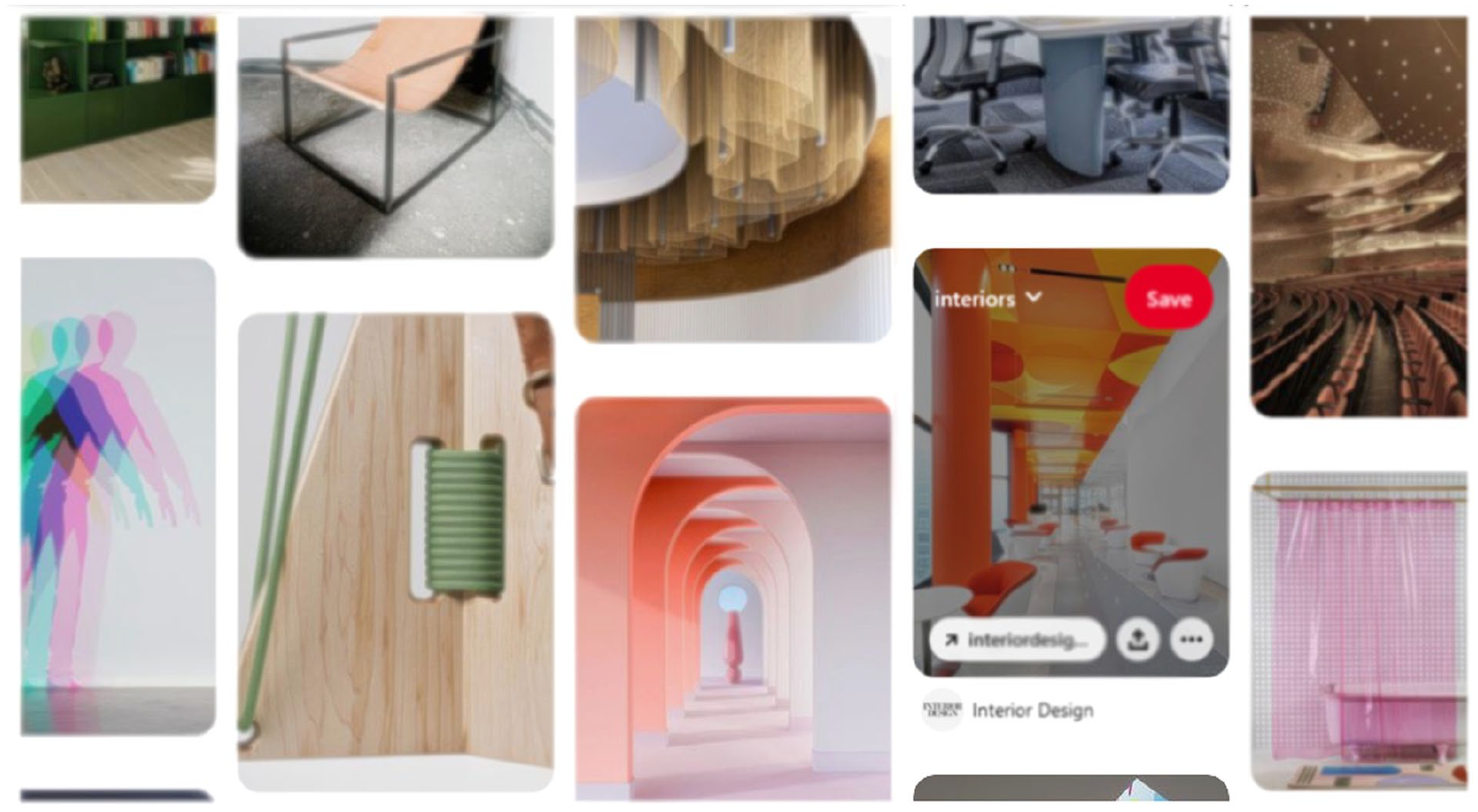
Feed view of sample pins on Pinterest: How pin sources are communicated when a user hovers over the pin.
Thinking about the larger “digital inspirational economy” of reciprocal interaction that professional designers are navigating (Scolere, 2021b) could guide discussions about how students set up their profiles on Pinterest as a part of their professional reputation-building. This might inform smaller actions on Pinterest such as being more intentional with settings for their boards and the decision to create a public or private board (Figure 5). Students’ candor about their concerns about how they integrate sources of digital inspiration into their projects and how their work is circulating across online networks suggests that future assignments could help students experiment in low-stakes ways with sharing their design point of view or projects in progress through networked platforms to build knowledge about participating in creator communities.
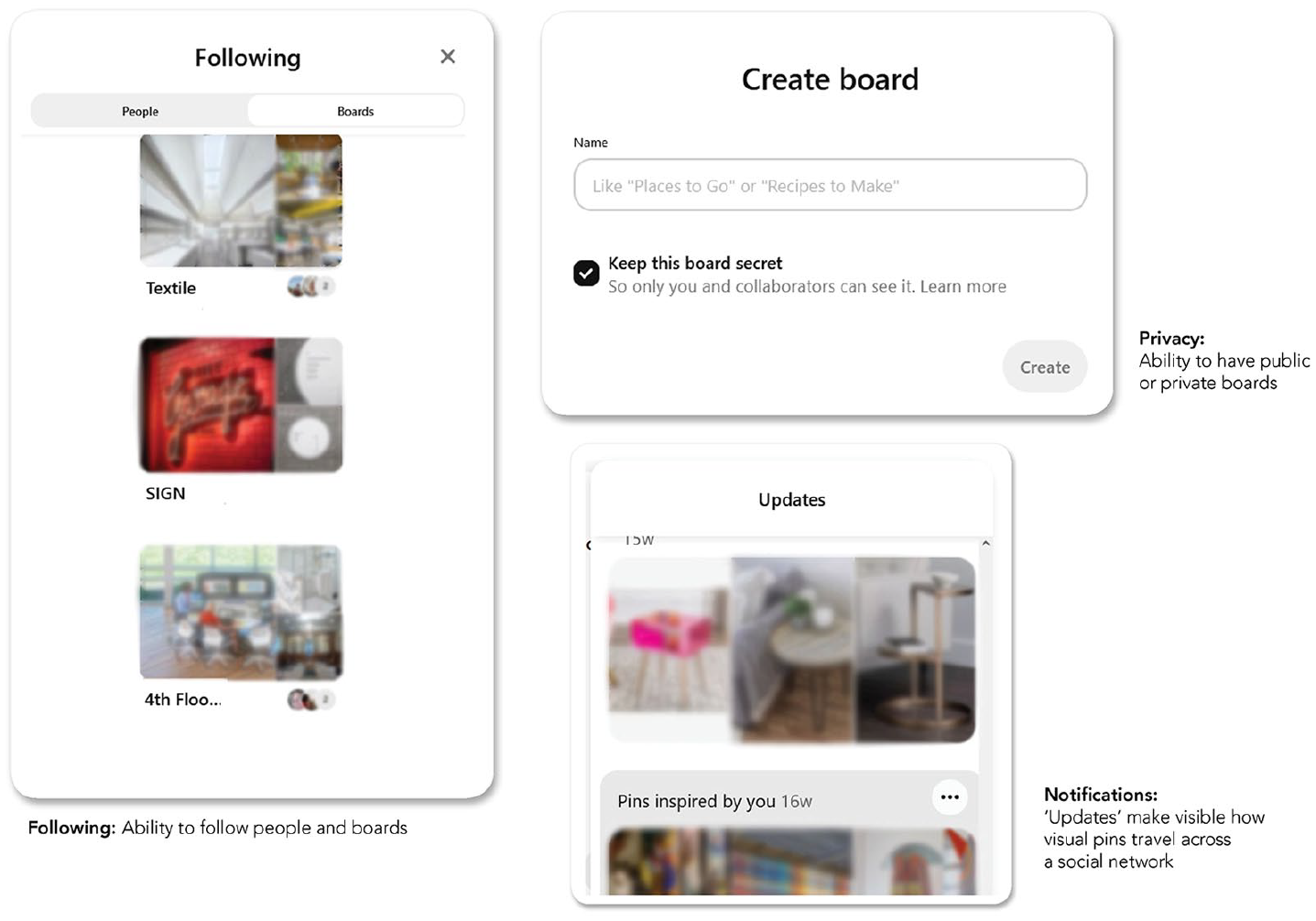
Pinterest features from author’s account.
Conclusion
Heeding the call by Cho and Cho (2020) for more empirical research focused on how interior design students use social media, I identify and contextualize specific practices surrounding Pinterest in relation to digital and information literacy concepts. By bringing together connected learning (Ito et al., 2020) and information literacy frames (Framework, 2015), a key contribution of this study is a framework that guides pedagogical strategies for integrating social media platforms in design education. This approach contextualizes Pinterest in the broader context of learning and forming connections across digital–physical contexts. Students’ use of Pinterest can be considered within this connected design learning framework as an opportunity to engage with educational experiences related to creative expression, evaluation of expertise, awareness about attribution, and participation in networked creator communities.
Students’ self-initiated use of Pinterest alongside their perception of Pinterest as a digital tool for the design process suggests a teaching opportunity for interior design educators to enhance the pedagogical affordances of Pinterest toward professional practice. The findings from this study are limited based on a small, convenience sample and the focus on only student practices and perceptions of Pinterest reducing transferability of the results. Further research is necessary to understand interior design educators’ perceptions and use of Pinterest to continue to develop knowledge about the potential of Pinterest in studio education. However, the findings from this study and the framework are a starting point for addressing tensions identified by Webb and Aulgur (2022) between students and faculty about the role of social media in design education. Rather than not acknowledging the use of social media by students in the design process, the proposed framework can facilitate discussion between faculty and students about social media in design education toward disciplinary goals. Instead of restricting a technology such as Pinterest in design education, scaffolding the use of the platform in relation to information and sources can be more effective and prepare students for future use in their professional careers (Filgo & Martinsen, 2017; Gray & Howard, 2014). With an ever-changing media ecology that provides opportunities for sharing creative work and requires adeptness at managing flows of information and digital content, helping aspiring designers to think critically about issues related to social media literacy 10 and digital platforms 11 will serve them in navigating their future careers.
Footnotes
Declaration of Conflicting Interests
The author declared no potential conflicts of interest with respect to the research, authorship, and/or publication of this article.
Funding
The author received no financial support for the research, authorship, and/or publication of this article.
