







Abstract
The designers of the Arts and Crafts movement attempted to articulate the democratic power of the domestic interior. The legacies of these ideas are shaped by house museums such as Kelmscott Manor (home of William Morris) and 7 Hammersmith Terrace (Emery Walker’s House, publicized as “The Arts and Crafts Home”). Lived in and maintained by female descendants, May Morris and Dorothy Walker, and their female companions, these house museums invite a reassessment of the role of the Arts and Crafts movement in feminist and queer histories of interior design. In this article, I demonstrate some of the ways in which house museums and the Arts and Crafts movement can offer opportunities to expose some of the disciplinary structures that hinder an inclusive history of interior design. Situating its case studies in the context of the history of heritage preservation, and engaging with feminist scholarship, I argue that one strategy for exposing and challenging hidden biases in the field is to recognize homemaking, preservation, and curating as forms of creative labor that have made crucial contributions to the history of interior design. Focusing primarily on gender but also paying attention to questions of class, race, and sexuality, I consider the potential and the limits of the Arts and Crafts house museum’s capacity to contribute to intersectional histories of interior design.
Keywords
Introduction
Despite its associations with democracy and radical politics, the English Arts and Crafts movement does not readily yield a diverse list of interior designers. The best-known, and most influential, Arts and Crafts interiors are invariably attributed to white men of a privileged class. The disciplinary structures underlying this situation are partly institutional; for example, the Art Workers’ Guild, to which many Arts and Crafts designers belonged, was barred to women. 1 As Linda Nochlin notes in her pathbreaking 1971 essay, “Why Have There Been No Great Women Artists?,” such systemic biases demand not a search for unrecognized historical female practitioners but rather a critique of the assumptions embedded in the question, particularly “the myth of the Great Artist.” 2 Similarly, to uncover the structures that disadvantage those from marginalized groups in the history of interior design, it is productive to begin by rethinking what counts as “interior design” and what constitutes authorship. While it may not be possible to unearth a more diverse list of people who neatly fit the identity of Arts and Crafts “interior designer,” it is possible to adjust how we attribute agency in the production of Arts and Crafts interiors. I argue that one strategy for exposing and challenging hidden biases in the field is to reconsider homemaking, preservation, and curating as forms of creative labor that have made crucial contributions to the history of interior design. 3
I make this argument through a critical analysis of two Arts and Crafts interiors that are now house museums: Kelmscott Manor, the home of William Morris; and Emery Walker’s House at 7 Hammersmith Terrace in West London. I propose that these interiors should be understood, in an important sense, as the productions of May Morris and Dorothy Walker, and that these two women, therefore, belong in the history of interior design (Figures 1 and 2). In the process, I hope to demonstrate some of the ways in which house museums and the Arts and Crafts movement can offer opportunities to expose some of the disciplinary structures that hinder an inclusive history of interior design.
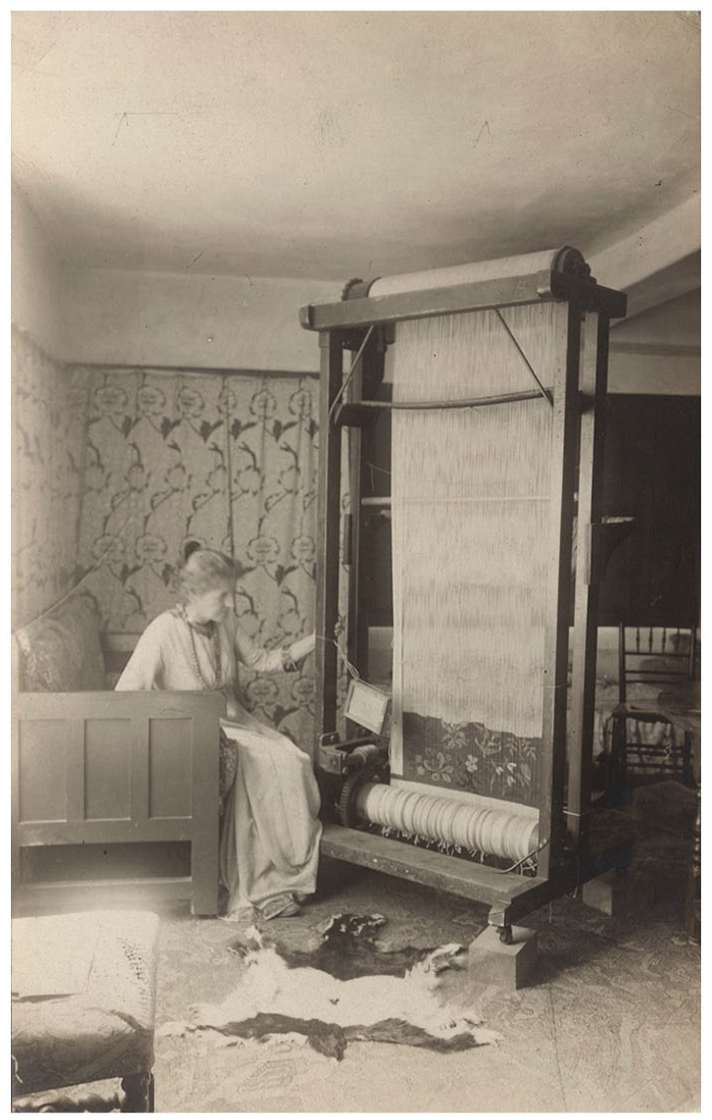
May Morris in the Green Room at Kelmscott Manor, pre-1921. Photographer unknown. © National Portrait Gallery, London.
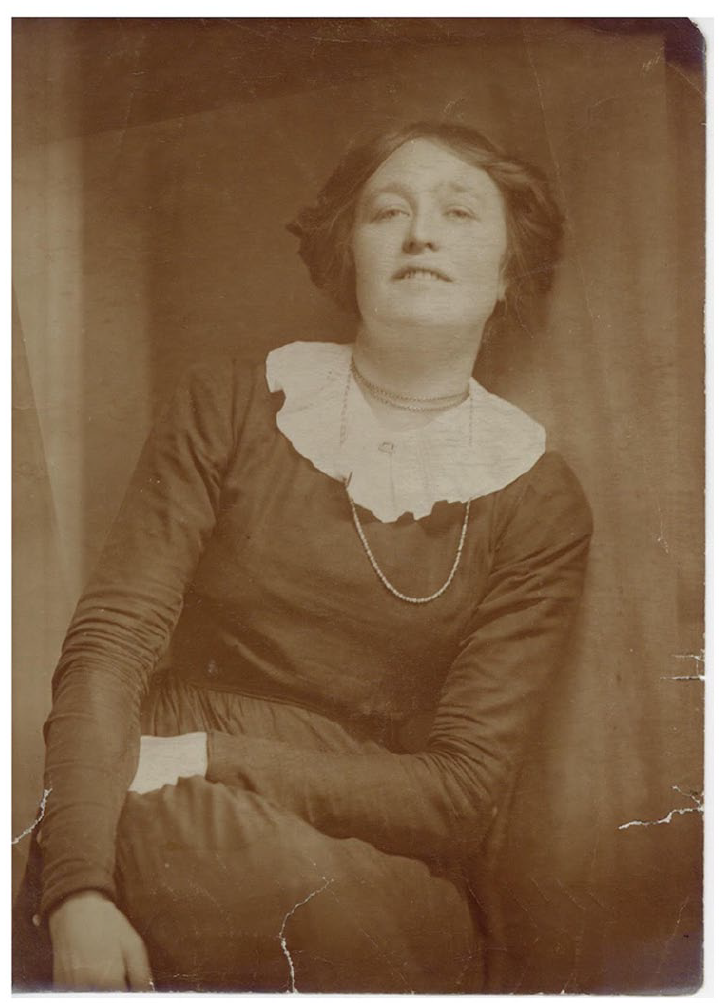
Dorothy Walker c. 1910. Photographer unknown. © The Emery Walker Trust.
These structures include a hierarchy of skills and qualifications. To include May Morris and Dorothy Walker in the history of interior design involves reimagining the kinds of practices that are encompassed within the broad category of interior design. Since paths to professionalization have been unequally accessible to different groups in society, efforts to diversify the history of the field require us to place less emphasis on the professional role of interior designer and recognize the many other people who have been responsible for historic interiors. Such an approach may appear to risk diminishing the status of interior design by associating it with amateur practices. Indeed, the emphasis on individual, named, professional interior designers has probably been motivated partly by the desire to elevate the status of interior design vis-à-vis architecture and fine art. However, interior design’s conceptual flexibility can be considered as an advantage. The capacity of interior design to embrace a wide range of practices suggests that this field may lend itself to a more inclusive history than other related, more narrowly defined, and more exclusively professionalized disciplines such as architecture or painting. When viewed from this perspective, interior design’s position in the margins of architectural history and art history becomes one of its strengths. In this article, I explore how the interdisciplinary and porous nature of the interior can be exploited to develop new histories of interior design that center people from marginalized groups.
The Arts and Crafts Movement in the History of Interior Design
Although Emery Walker’s House is publicized as “The Arts and Crafts Home,” the burden of representing this amorphous movement is a heavy one for a single house to bear. The Arts and Crafts movement has been defined in many different—and often conflicting—ways. 4 For this article, I will briefly summarize what I understand the movement to be. Beginning in the mid-nineteenth century, a number of British artists criticized both the dehumanizing effects of industrialization and the exclusive policies of fine art institutions such as the Royal Academy. These artists argued that art should be understood as fundamental to all forms of human labor and that the products of that labor should be valued, as art, as much as (or more than) paintings and sculptures. They wrote about their aims to bring art out of museums and into people’s lives. While this could mean public, civic, and religious spaces, it also meant rethinking the domestic interior as a site for art. Certainly, this was how Nikolaus Pevsner assessed its contribution. In his much-criticized but widely influential book Pioneers of Modern Design, Pevsner declared of William Morris that “we owe it to him that an ordinary man’s dwelling-house has once more become a worthy object of the architect’s thought, and a chair, a wallpaper, or a vase a worthy object of the artist’s imagination.” 5
Red House, which Philip Webb built for William Morris in 1859–60, is widely considered “the first Arts and Crafts building.” 6 It was adorned with textiles, stained glass, and painted furniture made by the Morris family and their circle. Morris continued to be a leading figure in the development of Arts and Crafts interiors, co-founding the decorating firm Morris, Marshall, Faulkner & Co. (later reconstituted as Morris & Co.), which not only sold textiles, furniture, metalwork, glass, and ceramics designed by its members and others but also undertook comprehensive interior decoration commissions for rural and urban residences including Great Tangley Manor in Surrey and 1 Holland Park in London. Other Arts and Crafts interiors were designed as an integral part of new buildings by architects such as M. H. Baillie Scott, whose Blackwell (1898–9) in the Lake District is now marketed as “The Arts and Crafts house,” echoing the 7 Hammersmith Terrace tagline, which tellingly replaces “house” with “home.”
Writing about 7 Hammersmith Terrace in 2005, architectural historian Gavin Stamp described “the Arts and Crafts as a way of living.” 7 It is important to keep this interpretation of the Arts and Crafts movement in mind when we think about the movement’s significance in the history of interior design. It is a definition that implies that agency should be attributed to the inhabitant, as well as the designer, in bringing the Arts and Crafts interior into being.
Today, the legacies of these ideas that the home is the site of art, and that art is a way of life, are shaped by house museums. While Arts and Crafts objects survive in many museum collections and are frequently displayed in temporary exhibitions, the house museum is the place where visitors today can experience the so-called “Arts and Crafts way of living” in a domestic interior. The house museum appears to enshrine the Arts and Crafts ideal of art as everyday life by maintaining the aura of a home in which art is not so much in the objects as in the routines and experiences they collectively enable. 8 To explore the implications of this further, I will analyze and compare Kelmscott Manor and 7 Hammersmith Terrace. While there are numerous Arts and Crafts houses that can be visited today, these are the two surviving houses occupied by major figures in the Arts and Crafts movement which display the collections of their former owners more or less in situ. They are also distinctive in that they were actively preserved as historic interiors while being lived in by female descendants of the people they commemorate. The history of interior design faces a scarcity of evidence, since interiors by nature change over time, but in some cases, interiors have been preserved or reconstructed in the form of house museums. Such institutions play an important role in shaping present-day understandings of the interiors of the past. Through an analysis of two specific case studies, I aim to demonstrate that a critical examination of house museums is necessary to uncover and challenge interior design’s disciplinary structures.
Kelmscott Manor and 7 Hammersmith Terrace
In 1871, Kelmscott Manor became the country home of designer, writer, and socialist William Morris; his wife, Jane; and their two young daughters, Jenny and May. 9 Jane and William each played a part in redecorating Kelmscott with wallpapers, ceramics, textiles, and furniture (Figure 1), although they retained several features of the existing decoration, including seventeenth-century tapestries depicting the Biblical story of Samson. 10 For the first three years, they shared the lease jointly with the Pre-Raphaelite painter Dante Gabriel Rossetti, who left many of his belongings behind. 11 Morris recorded his affection for the house in private correspondence and in a number of publications, including his utopian romance News From Nowhere, and its garden and environs inspired many of his designs. 12 Jane, Jenny, and May continued to use the house after William died in 1896, and Jane purchased it before her death. Furnishings from their house in Hammersmith, London, which Morris renamed Kelmscott House in honor of his country home, were relocated to Kelmscott Manor. 13 Kelmscott was May Morris’s home for 67 years, and for the last 20 years of her life, she shared the home with Mary Lobb, a Women’s Land Army farm worker whom May initially employed as a gardener. May and Mary lived and traveled together for two decades (Figure 3). This article follows Thomas Cooper’s example by considering May and Mary as a “queer couple.” 14 Mary Lobb was perceived as queer by contemporaries, who observed, and often unkindly mocked, her gender nonconformism. 15 On her death in 1938, May Morris bequeathed the house and most of its contents to the University of Oxford, although all her personal belongings were left to Lobb, who died shortly afterward in 1939. 16 May’s intention was that Kelmscott would be “a house of rest for artists, men of letters, scholars and men of science” affiliated with the University but her vision proved unsustainable. 17 Kelmscott Manor passed to May’s residuary legatee, the Society of Antiquaries of London, whose property it remains. 18 Now a popular tourist attraction, Kelmscott has undergone numerous renovations and reinstallations.
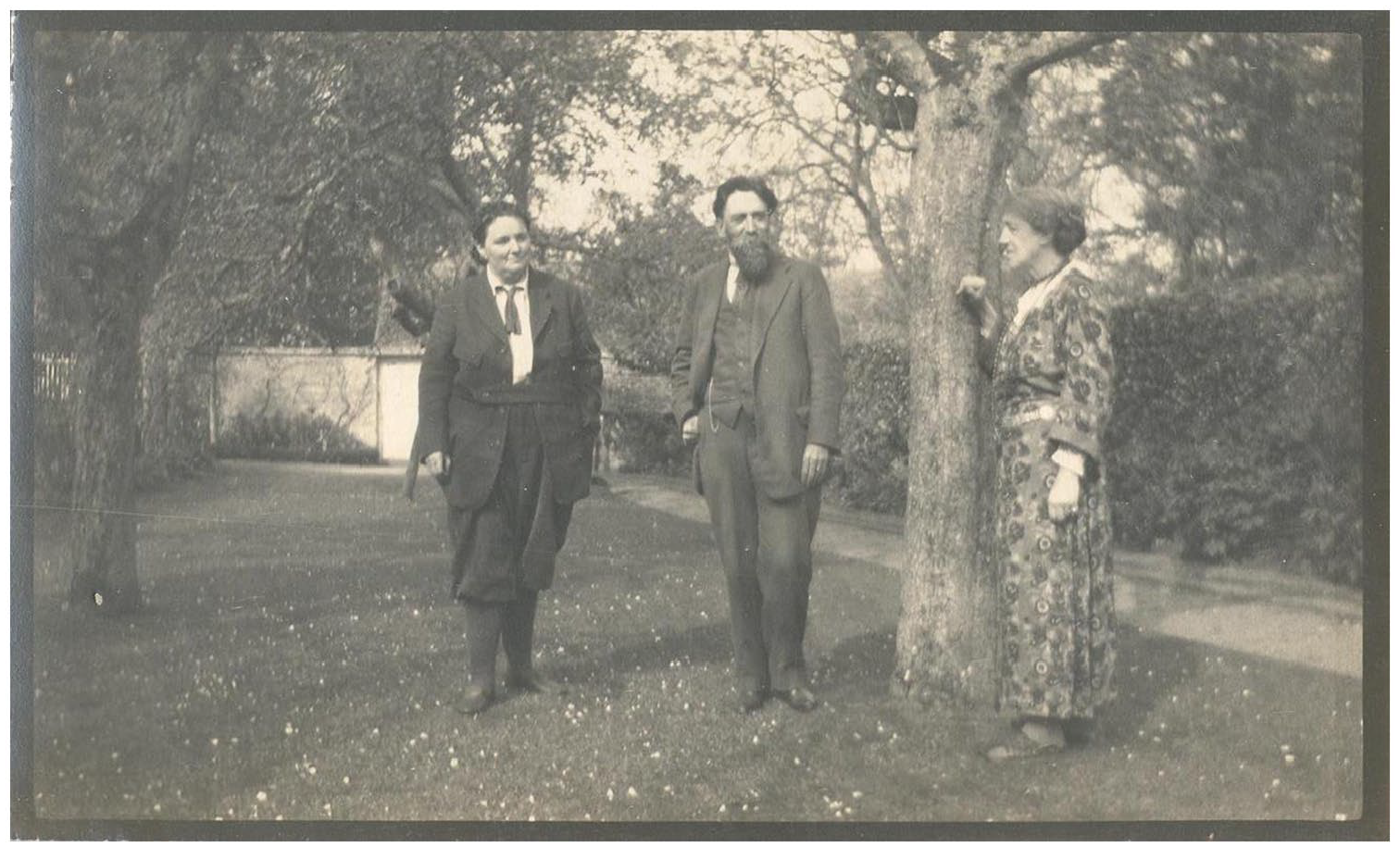
May Morris, Mary Lobb and unknown man at Kelmscott Manor, May 1, 1923. Photographer unknown. William Morris Gallery, London Borough of Waltham Forest.
Emery Walker is much less famous than William Morris but he was an influential printer and an active member of Arts and Crafts organizations. 19 Dorothy Walker, born in 1878, was the only child of Emery and Mary Walker. In 1903, the Walker family moved to 7 Hammersmith Terrace, which would be Dorothy’s home for sixty years, until she died in 1963 (Figure 4). The family were close friends with key Arts and Crafts figures including William Morris; May Morris, who lived next door at 8 Hammersmith Terrace; and the architect Philip Webb. Objects belonging to all three were passed on to the Walkers and many remain at 7 Hammersmith Terrace, including wooden furniture, woven textiles, embroideries, and table glass, as well as a lock of William’s hair and several pairs of his spectacles (Figure 5). 20 By 1933, both of Dorothy’s parents had died and she had inherited the house. In 1948, after Dorothy advertised for a companion, Elizabeth de Haas, a Dutchwoman, came to live with her, accompanied her on travels abroad, and helped her to look after the house. 21 Dorothy left the house and its contents to Elizabeth, who continued to live there until her death in 1999. 22 Now run by the Emery Walker Trust, 7 Hammersmith Terrace is open to the public.
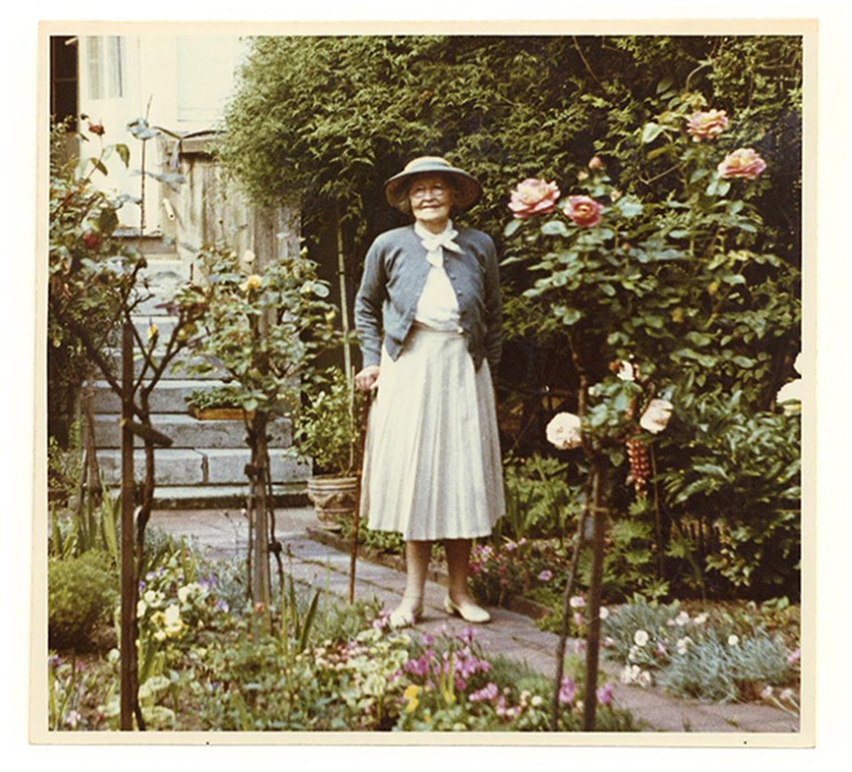
Dorothy Walker in the garden at 7 Hammersmith Terrace, c. 1960. Photographer unknown. © The Emery Walker Trust.
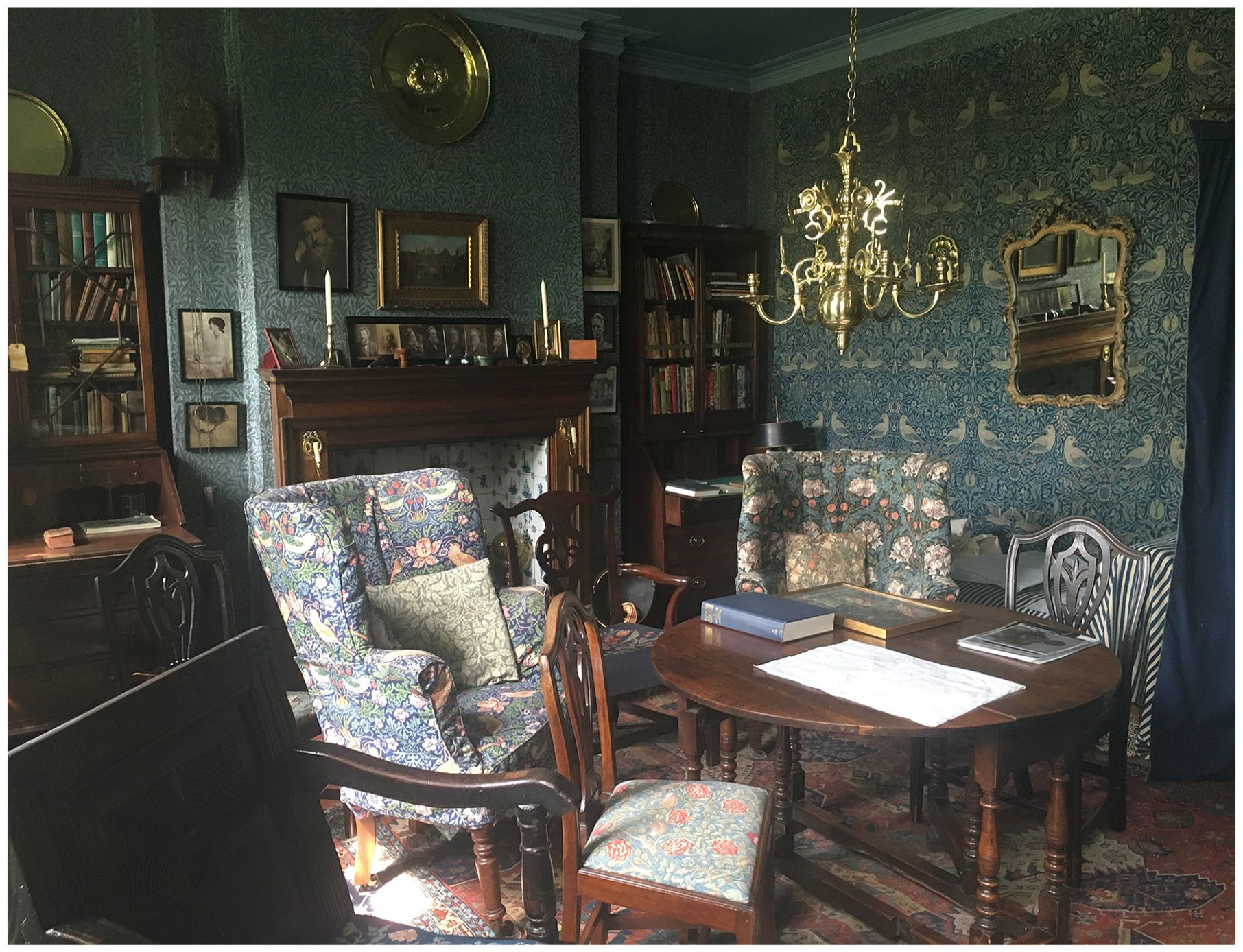
View of the dining room, Emery Walker’s House, 2019. Photo: author. © The Emery Walker Trust.
Preserved by female descendants and their female companions, these two houses provide an opportunity to consider the potential contributions of the house museum, and indeed the Arts and Crafts movement, to feminist and queer histories of interior design. The interiors would not exist today without May Morris and Dorothy Walker, who took steps to ensure that the houses and their contents would be saved for posterity. Repeated claims that the interiors were unchanged since the time of William Morris or Emery Walker have tended to undermine the labor of caretaking, organizing, recording, and selecting that took place after their deaths.
Acknowledging the work that has gone into producing these houses for more than a century allows us to examine critically any claim that they preserve an authentic past. In Writers’ Houses and the Making of Memory, Harald Hendrix notes, “It is the more general idea of authenticity. . . that turns out to be the greatest attraction of the visit to places like writers’ houses, and their curators wisely have taken this into account when rearranging their museum’s display.” 23 This sentence acknowledges the fiction that is authenticity: to satisfy the desire for authenticity, authenticity must be constructed by curating the house in a particular way. In the case of Arts and Crafts house museums, the collections are carefully arranged to support narratives about William Morris and the Arts and Crafts movement, but they also have the potential to tell other stories. To unlock this potential, we need to be critical of the disciplinary structures that perpetuate limited notions of authorship and creativity. Understanding these spaces as sites of discourse and labor, rather than as supposedly “authentic” survivals, enables us to explore questions that have important implications for the investigation of hidden biases in interior design history.
While visitors to Kelmscott Manor and Emery Walker’s House are made aware of May Morris’s and Dorothy Walker’s important roles in preserving the houses, both sites, in their publicity and conservation plans, are nevertheless considered primarily significant because of their association with the men who lived there—William Morris and Emery Walker, respectively. As Linda Young notes, “heritage agencies tend to. . . follow fairly old-fashioned ideas about history” focused on “great men and great events.” 24 My aim in this article is to reconsider how May’s and Dorothy’s contributions are understood and valued, especially in the context of interior design history. This involves a shift of perspective. By focusing on the thought and labor that went into the tasks of preservation, veneration, and presentation, it becomes possible to see that May and Dorothy were working with a particular notion of the historical significance of the interior. 25 It is due to May and Dorothy that Kelmscott Manor and Emery Walker’s House have been incorporated into interior design history, and it was their attitudes, decisions, and actions that influenced the terms on which the houses were accepted into that discourse.
Neither May nor Dorothy undertook the task of preservation entirely alone. Each of them benefited from the assistance of a domestic companion with whom they shared the labors of care and maintenance. May and Dorothy may also have discussed the future of their homes with one another. May notes in a letter of 1915 her wish to “leave something to Dorothy Walker, who will most likely be poorly off.” 26 May consulted two friends in particular about her will and the future of Kelmscott Manor: Sydney Cockerell and Emery Walker. Indeed, it appears to have been Emery Walker’s idea to leave the house to the University of Oxford. 27 The earliest surviving set of photographs of the 7 Hammersmith Terrace interiors dates from 1939, the year after May Morris’s death. 28 Elizabeth de Haas recalls that Dorothy “went to the [estate] sale at Kelmscott Manor in July 1939, and was much distressed to see the dispersal of so many Morris treasures.” 29 Dorothy would have been aware of May’s sense of responsibility as the proprietor of Kelmscott Manor and it may have influenced her approach to her own home.
The Labors of Home Making, Preservation, and Curation
Kelmscott Manor and 7 Hammersmith Terrace were approached in strikingly similar ways by May and Dorothy. They were both self-consciously maintained monuments. Each daughter attempted to keep the house as much as possible as it had been when her father lived there. In a letter discussing her bequest to the University of Oxford, May noted that “the furniture, etc., is arranged and the house remains almost exactly as it was in my Father’s time.” 30 In her will, May explained her “desire” that “no modern innovations improvements or installations be put in or made to the House in view of its age and its historic interest as the Home of the late William Morris as it is in the same condition as when he left it.” 31 As Julia Dudkiewicz has shown, archival documents recently acquired by the William Morris Gallery demonstrate May’s deliberations about the future of Kelmscott. 32 May repeatedly emphasizes her desire to prevent change: “My wish to keep Kelmscott as it is”; “keep things more or less as they are”; “keep Kelmscott as far as possible as it was—I mean even with the main furniture there.” 33 Similar ambitions were expressed for 7 Hammersmith Terrace. Dorothy Walker’s intention to preserve the interiors her father had known is inferred from a range of sources, including the careful labels she attached to objects, the surviving photographs, and the recollections of those who knew her, several of which appear in a privately printed book among the Emery Walker Papers at the Archive of Art and Design, In Memory of Dorothy Walker 2 April 1878–20 September 1963. 34 According to John Brandon-Jones, the architect who converted the ground floor telephone room into a kitchen in the 1960s, “Everything remained in its essentials as it had been when Emery Walker himself had entertained his friends in the house.” 35 Similarly, Vivian Meynell, whom Dorothy employed to dust Emery’s library, observes, “The interior during the thirty years following her father’s death remained essentially the same.” This, Meynell emphasizes, was intentional on Dorothy’s part: “I feel it right to add that it was Dolly’s fervent and abiding wish that the house and books and other contents she knew how to preserve so well should remain intact as of national interest, and provide posterity a legacy as interesting and enthralling as it had been for her.” 36 Both May and Dorothy cultivated narratives of preciousness and authenticity around the interior and its contents.
Photographs taken in 1896, the year of William Morris’s death, can be compared with photographs published in Country Life in 1921 to demonstrate that while many objects were moved over the course of these decades, some objects remained in situ, such as William Morris’s bed (Figure 6). 37 The particular layout—which inevitably changed over time, particularly after new objects were acquired from the family’s London home—may have been less important to May than maintaining the integrity of the collection. She noted in 1919, “I shouldn’t like all family treasures in my present care to be scattered” and suggested trying to find someone to “undertake to keep certain relics together to show real admirers.” 38 As the latter comment suggests, another similarity between Kelmscott Manor and 7 Hammersmith Terrace is that they were both valued as reliquaries and pilgrimage sites. John Betjeman visited 7 Hammersmith Terrace in 1964 and wrote “nor was there ever a Morris interior to retain so many relics of the Morris movement.” 39 Brandon-Jones recalled how, at their first meeting, Dorothy “introduced herself and invited me to visit her home, saying modestly that she had a few relics of [architect W.R.] Lethaby and of his friend Philip Webb that she thought might interest me.” 40 In a letter to Emery Walker of 1911, May lists a number of recent visitors to Kelmscott Manor, adding that she “Treated all these good pilgrims as the master of the house would have liked them to be treated.” 41 Later, in 1925, 150 visitors were given “a short talk on Tapestry and my father, and Miss Lobb + I [sic] took them all round the Manor in parties of twenty.” 42 In 1926, the University of Oxford undertook to ensure that, when Kelmscott Manor came into their possession, “the rooms now shown to the public should be open to visitors at reasonable times.” 43
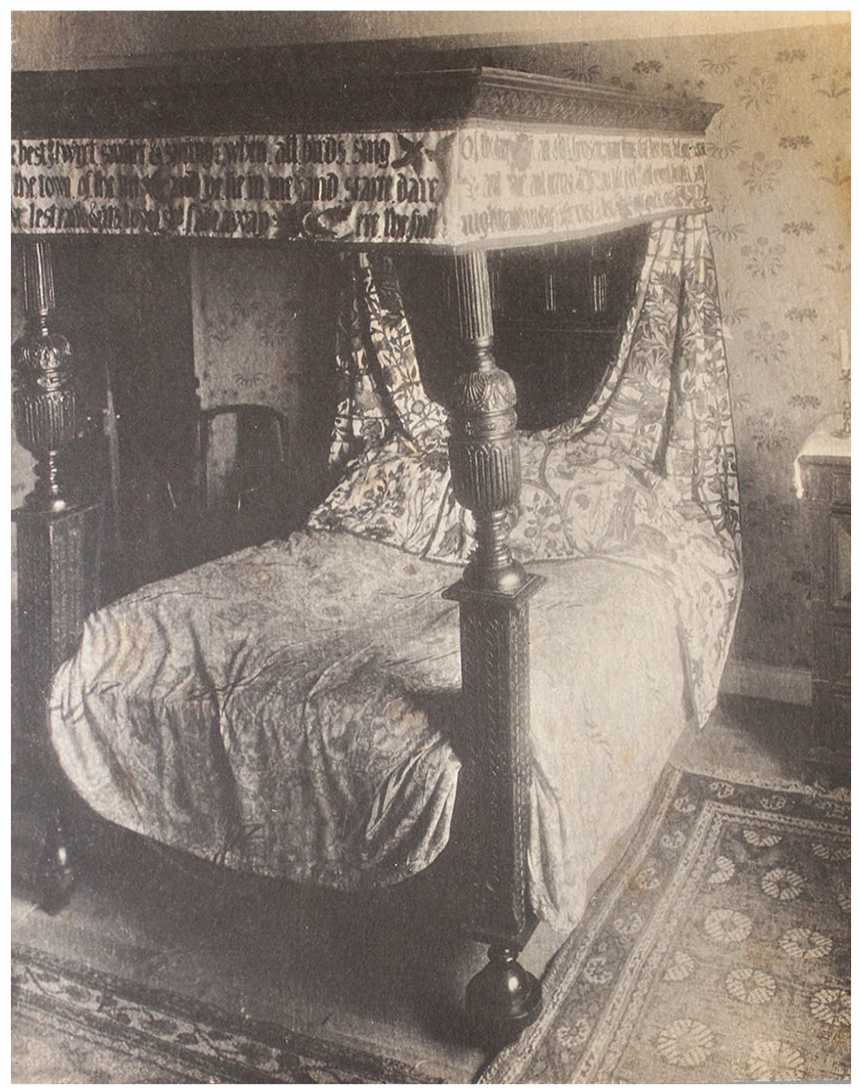
William Morris’s bedroom, Kelmscott Manor, 1896. Photographed by Frederick Evans. William Morris Gallery, London Borough of Waltham Forest.
Under these circumstances, it is clear that both houses were to some extent already museums while being lived in. We can think of May and Dorothy as curators. Indeed, Kathy Haslam has called May Kelmscott’s “first ‘curator.’” 44 May prepared a detailed inventory that defined the biographical and historical significance of many objects. 45 Among these items were “Ebony and ivory cabinet from William Morris’s study at Hammersmith,” “Fourpost bed of Mrs. Morris mere, in which William Morris was born,” “Very worn Turkey carpet from Red House,” and “Large wooden sofa—Queen Square, fitted with Wandle chintz cushions and mattresses”; the sofa is visible in the photograph of May in the Green Room (see Figure 1). 46 These biographical descriptions contrast strongly with the more dispassionate entries in the official inventory of August 1939, after May’s death, which was more concerned with condition than provenance. Referring to the cabinet and bed May described in such personal terms in the quotations cited above, the 1939 inventory listed “Inlaid two-tier Cabinet with the fitted top interior of 16 drawers each inlaid in Ivory enclosed by writing flap, Cupboards with 2 paneled doors. Faded and spotted exterior. Flap ring marked. Various pieces of inlay missing and one handle gone” and “Georgian 4-post Canopy bedstead with carved foot pillars with lined Chintz Hangings, Pelmet, and Valances. Wood faded and chipped. Hangings faded and stained.” 47 Side by side, these different approaches to recording the contents of the house highlight May’s role as interpreter and historian. Meanwhile, at 7 Hammersmith Terrace, Dorothy labeled objects, fixing their meaning in a similar way. On a label attached to one object, Dorothy wrote, “Tea pot which belonged to the poet Rossetti from Kelmscott Manor” (Figure 7). 48
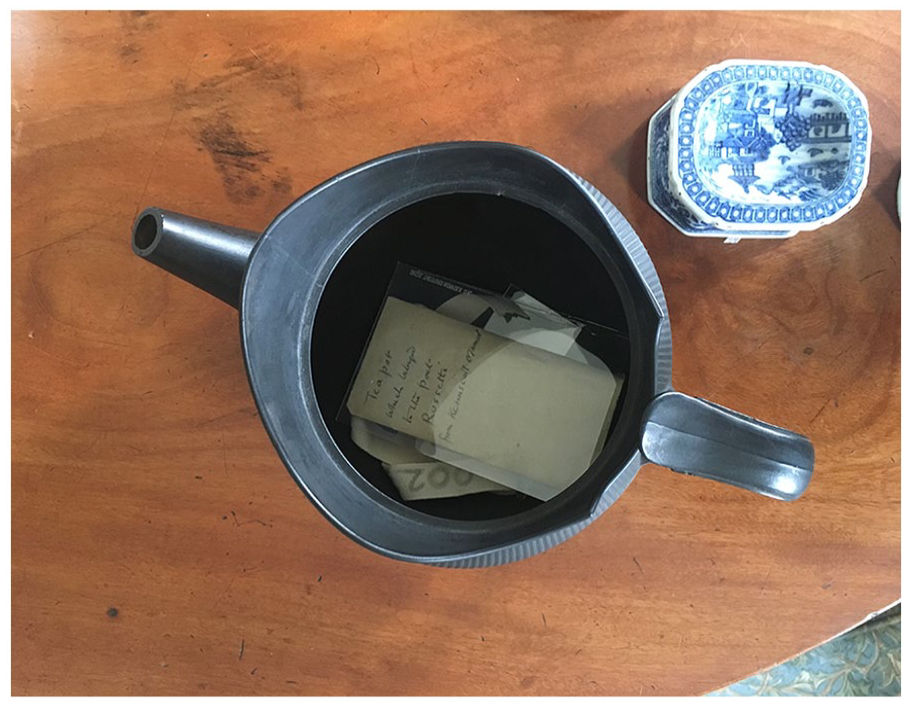
Dante Gabriel Rossetti’s teapot on display at Emery Walker’s House, 2019. Label written by Dorothy Walker reads: “Tea pot which belonged to the poet Rossetti from Kelmscott Manor.” Photo: Author. © The Emery Walker Trust.
Focusing on the labor of May and Dorothy invites us not only to think about the relationship between creation and preservation but also to consider how dwelling fits into the histories of interior design. Martin Heidegger understands both building and preservation to be fundamental elements of dwelling. 49 As feminist scholars have shown, these practices are gendered. 50 Building is a male-dominated domain, while preservation typically falls to women. Building has a higher status than preservation—in Heidegger’s theory, in society, and in design history. The Arts and Crafts house museum offers an opportunity to recognize homemaking and maintenance as forms of artistic agency. Such a view is supported by William Morris’s definition of art as the expression of “joy in labor,” a definition that can encompass the labor of maintaining the home—selecting, cleaning, arranging, organizing, and recording. 51 As we have seen, Kelmscott Manor and 7 Hammersmith Terrace became monuments not through a passive process of “survival,” but through the active imagination and labor of May Morris and Dorothy Walker.
Building on the work of other feminist thinkers, philosopher Iris Marion Young has argued that although ideologies of domesticity have contributed to the oppression of women, people of color, and working-class people, homemaking has the potential to be both valuable and powerful. 52 One of the values of homemaking, for Young, is the curation of personal, collective, and often intergenerational history and memory. Young calls for “revaluation of the private and public work of the preservation of meaningful things, and degendering these activities.” 53 May and Dorothy’s homemaking and preservation work at Kelmscott Manor and 7 Hammersmith Terrace needs to be revalued. In these cases, homemaking and preservation cannot be separated from one another. The processes of making these houses their homes over the decades following their fathers’ deaths involved imagining the historical value their homes could have in the future and preserving the traces of the past with those future audiences in mind. Dwelling and curating occurred simultaneously.
This blurring complicates what Hendrix describes as “a transformation of the house from a flexible instrument into a stable object, . . . a passage from the private to the public,” in which “the house changes from being a medium of expression to becoming one of remembrance.” 54 Both houses were mediums of remembrance throughout their histories, as I will further demonstrate later. And they remain “flexible” despite attempts to stabilize them. As Young argues, “the narratives of the history of what brought us here are not fixed, and part of the creative and moral task of preservation is to reconstruct the connection of the past to the present in light of new events, relationships, and political understandings.” 55 By recognizing the close relationships between homemaking and curating, and between creating and preserving, we can become more aware of the mobility of these spaces, and their potential to yield new insights and reward new interpretative methods. According to Young, “Homemaking consists in the activities of endowing things with living meaning, arranging them in space in order to facilitate the life activities of those to whom they belong, and preserving them, along with their meaning.” 56 It is significant that Young blends the aims of facilitating life activities and preserving meaning in the task of homemaking. Preserving meaning is something we might associate more with history, curation, and the museum space; facilitating life activities seems closer to what we think of as dwelling, being concerned with the present. Yet in Young’s phrase, and in the Arts and Crafts movement, use and meaning are so interdependent that if we are to grasp the meaning of the object or interior, we also need to understand how it facilitates life activities.
For May, the house’s authenticity lay in its direct connection to her father, and the maintenance of the house “as it was in my Father’s time” was what gave the house value. There is a tension between this investment in preservation and May’s unrealized hope that the house should continue to be lived in “as a house of rest for artists, men of letters, scholars, and men of science” after the University of Oxford inherited it on her death. One thing suggested by this tension is that it was a way of life facilitated by the place that May wanted to preserve and that this required it to remain a dwelling. Perhaps most revealing is a letter of 1919 in which May writes to Cockerell of her aim to “keep the ‘atmosphere’ of his [William Morris’s] life here going for many & many years.” 57 The value and meaning of the interior lay partly in its capacity to sustain particular activities. The paradox of the house museum is unwittingly summed up by John Betjeman, who said of Kelmscott Manor in 1952, “there’s no other place which is kept as it is and yet so clearly is not a museum but a house.” 58 Twelve years later, Betjeman used almost the same phrase about 7 Hammersmith Terrace: “Of course, its appeal is as a private house, not a museum.” 59 Here we come back to the idea of Arts and Crafts as a “way of living,” and the question of how the house museum might be a space in which we can encounter that definition of art.
When visitors enter Kelmscott Manor and 7 Hammersmith Terrace today, the living human beings who inhabited the houses have gone and the rituals of daily domestic life are no longer performed. In these ways, life is absent. Yet, the objects remain and there is a sense that they not only bear witness to life in the past but also embody an invitation to live in particular ways, as May hoped would be possible when she designated Kelmscott “a house of rest.” Both houses conjure absent bodies. Alongside objects made by the Morris and Walker families, they display composite collections assembled partly from the collections of others. For instance, Kelmscott has Rossetti’s collections (recorded as “D. G. R’s things” in May’s inventory), as well as objects from the Morris family’s previous homes, including the famous Red House and their London home, Kelmscott House, which was just a short walk along the Thames from 7 Hammersmith Terrace. Emery Walker’s House has Philip Webb’s collections, objects from Kelmscott House such as the William Morris-designed Bird woven hangings, and, as we have seen, some of Rossetti’s objects from Kelmscott Manor. They were the homes of multiple people and brought numerous collections together. After these objects had such an itinerant life, passing between people and places, it is striking that there was such a strong effort to halt that process, to keep them as they were. In May and Dorothy’s minds, they became monuments to be preserved. It was through this conceptual shift that the houses accrued the historical value of representing the Arts and Crafts interior for posterity. And yet, ironically, as monuments, Kelmscott Manor and 7 Hammersmith Terrace could no longer fulfill the Arts and Crafts ideal of blending art and daily life.
The paradoxes of the Arts and Crafts house museum, which attempts to preserve an authentic home while in the process removing the element that makes it a home, arise from a distinctive attitude toward architectural heritage that developed in tandem with the Arts and Crafts movement. Both Kelmscott Manor and 7 Hammersmith Terrace are connected to the Society for the Protection of Ancient Buildings (SPAB), founded by William Morris in 1877. 60 Emery Walker and May Morris were active members of the SPAB. 61 Dorothy first met Brandon-Jones at a meeting of the SPAB, when she invited him to visit 7 Hammersmith Terrace. 62 May and Dorothy’s treatment of their homes demonstrates a particular approach to preservation that is specific to their time and to this organization. The histories of the houses strongly echo the Manifesto of the SPAB. For example, the Manifesto proposes to “stave off decay by daily care,” while Dorothy Walker “faithfully guarded,” “carefully preserved,” and employed Meynell to dust Walker’s library methodically. 63 Similarly, the Manifesto urges readers “to resist all tampering with either the fabric or the ornament of the building as it stands,” and both May and Dorothy insisted on keeping the house and its contents unchanged. 64 For its supporters, the SPAB represented one of the most important methods for participating in architectural history: not only creating new structures but preserving existing ones. In this context, preservation is an active contribution to the history of interior design. We can understand May and Dorothy as applying the principles of SPAB—usually directed at pre-Victorian buildings—to their own homes, which involved foreseeing and indeed creating the importance that the Arts and Crafts movement would have for future generations, and the capacity of the interior to carry that meaning.
The SPAB was part of a broader nineteenth-century tendency toward preservation. 65 In Britain, such efforts developed in response to changes in local government systems which left historic buildings and the natural landscape in greater need of protection. 66 Linda Young sees the SPAB as the beginning of a drive toward “the philanthropy of saving heritage places” that has “surged ever since.” 67 The National Trust for Places of Historic Interest and Natural Beauty was founded in 1893–5 with close links to the SPAB. 68 The practice of memorializing historical figures through house museums also became established in the nineteenth century. Young identifies as the first house museum in Britain Sir John Soane’s house, whose layout and contents were preserved upon his death in 1837; Shakespeare’s Birthplace in Stratford-upon-Avon, which opened in 1847, is another early example. 69 Dorothy and May would have seen many house museums open in their lifetimes. 70 While they may not necessarily have intended their homes to become house museums along the lines of Sir John Soane’s museum or the Dickens Museum (opened in 1925), the prevalence of such institutions is likely to have made May and Dorothy all the more conscious of the potential historical value of their homes.
Gender Roles and Questions of Intersectionality
While I aim to challenge the dominance of heroic male designers in the history of interior design by attributing shared authorship to May Morris and Dorothy Walker as caretakers and curators, the forms of creativity that constitute Kelmscott Manor and 7 Hammersmith Terrace are not strictly gendered as masculine production on the one hand and feminine maintenance on the other. A more complex situation emerges when we look closely at the interiors. Both houses contain objects made by women and men and objects collected by women and men that fed back into their own artistic production so that the designer was made by the space as much as the space by the designer. May and Dorothy were artists. There are myriad examples of May’s work, especially embroideries, in both houses. May took over the embroidery section of Morris and Company at the age of 23. When she was at Kelmscott Manor, it was her studio home. In Figure 1, she is seated in her workroom, the Green Room, next to a tapestry loom. She made watercolors of the interiors of Kelmscott Manor, which are now in the collection of the William Morris Gallery in London. Similarly, Rossetti made paintings of the Kelmscott Manor interiors and the objects in his collections. 71 As for Dorothy, there are examples of her embroidery at 7 Hammersmith Terrace, and at the turn of the twentieth century, she was a student at the Slade School of Fine Art. 72 May and Dorothy belonged to a generation of women who had access to artistic training and careers. Their work at Kelmscott Manor and 7 Hammersmith Terrace needs to be understood in tandem with these other manifestations of their artistic creativity. Informed by the tenets of the SPAB, they may have viewed the preservation of their interiors as a significant contribution to the history of art and design.
Although this article has been primarily concerned with questions of gender, it is important to consider how this analysis of May Morris’s and Dorothy Walker’s work has implications for intersectional histories of interior design. Their class and race privilege and their refusal of heteronormative domesticity allowed Morris and Walker to step into the roles of preserver and curator. Devoting themselves to the legacies of their fathers rather than the present needs of husbands and children, and with the support of same-sex companions who began as their employees and later became their heirs, Morris and Walker were able to create interiors that facilitated unconventional forms of domesticity. Unlike Morris and Lobb, it does not appear to be the case that Walker and de Haas were ever perceived as a queer couple. Without suggesting that both relationships were necessarily romantic, I believe both houses should be understood as queer spaces in the most expansive sense since they accommodated loving relationships between women that developed through cohabitation. Despite conforming to the social expectation of homemaking as a woman’s task, Morris’s and Walker’s interiors were cultivated not to raise future citizens but rather with the joint aims of securing independence and fixing memory. As we think critically about who has contributed to the history of interior design, it is significant that two of the most important surviving English Arts and Crafts interiors were produced by women whose lives, although very different in many ways, share a number of important parallels: they were daughters of famous men, enjoyed class privilege, lived with same-sex companions, and dedicated the last years of their lives to ensuring that their homes would be maintained as repositories of memory. The conditions necessary for these house museums to exist include the freedoms Morris and Walker enjoyed: the freedoms of financial independence, family connection, social status, and different forms of queer domesticity. When we study interiors, one way of uncovering hidden biases is to look for these kinds of parallels in their histories.
The approach demonstrated in this article has the potential to attribute agency to an expanded range of contributors to the history of interior design. However, it is also important to recognize the limits of a method that reassesses sites that already belong in the canon, such as the two Arts and Crafts houses discussed here. A reexamination of Kelmscott Manor and Emery Walker’s House can center the work of wealthy women and queer forms of domesticity and, to some extent, recognize the contributions of women of less privileged classes. Nevertheless, as elite, white interiors these case studies can only play a partial role in addressing the biases of the discipline. Revealing the conditions on which these house museums rely draws attention to the limitations of the evidence we work with as interior design historians. Hidden social and economic structures determine which sites survive and become canonized. A critical analysis of well-known interiors can, then, be an essential first step in exposing the inequities of the field.
Conclusion
In this article, I begin to demonstrate how Arts and Crafts house museums can construct, reinforce, and potentially undermine exclusive disciplinary structures. One of the challenges facing attempts to uncover hidden biases is that the concept of interior design is closely bound up with the figure of the interior designer. If we accept Iris Marion Young’s argument that home has political potential as a space for constructing identity, facilitating daily actions, making connections with the past, and imagining new futures, we can value all of these processes as contributions to interior design. 73 As I have shown, Arts and Crafts house museums can be analyzed as interiors that suggest all of these functions of home, but these possibilities can be obscured by the official or repeated narratives that become attached to the sites and by the expectations of a discipline that privileges certain kinds of practices. To try to avoid this, I have experimented with the strategy of examining these houses as a pair, looking across from one interior to the other to see what they have in common as sites of discourse, labor, and curation. If we resist the dominant rhetoric that surrounds them, these objects and arrangements and spaces have the potential to make visible histories of domestic labor, defy patriarchal and heteronormative domesticities, and inspire new histories of interior design.
Footnotes
Acknowledgements
I am grateful to everyone who facilitated this research, including Kathy Haslam at Kelmscott Manor and Mallory Horrill at Emery Walker’s House; Rachel Boyd Hall, James Hall, and Aileen Reid; and staff at the Archive of Art and Design, Society of Antiquaries of London, and William Morris Gallery. I would like to thank the undergraduate research apprentices who worked on this project at UC Berkeley: Larissa Cope, Karissa Hernandez, Mai Yang Vang, Constance Villalvazo, and Chesa Wang. I presented parts of this research at the Interdisciplinary Nineteenth Century Studies Annual Conference; CAA’s Annual Conference; Yale University’s Material Culture Lunch series; the University of Edinburgh’s “Private Life” conference; the Open University and University of York’s “Dwelling on the Everyday” conference; and the Tate Britain, Paul Mellon Centre, and the University of York’s “Rossettis: In Relation” conference. I extend my thanks to the event organizers and fellow participants. I would also like to thank Thomas Cooper and the anonymous peer reviewers for their constructive feedback on earlier drafts.
Declaration of Conflicting Interests
The author declared no potential conflicts of interest with respect to the research, authorship, and/or publication of this article.
Funding
The author received no financial support for the research, authorship, and/or publication of this article.
