







Abstract
Interiors theory is an evolving area of inquiry that examines how designed environments shape and are shaped by human experience. Despite a growing body of scholarship, interiors remains theoretically diffuse, often existing in the margins of other disciplines. This article argues for the recognition of interiors as a distinct field of scholarship by mapping its theoretical terrain through three interrelated paradigms: Generative, Interpretive, and Empirical. The Generative Paradigm explores how spatial composition, material experimentation, and sensory engagement inform interior design processes. The Interpretive Paradigm situates interiors within broader socio-political, cultural, and ideological frameworks, interrogating power, identity, and historical narratives in spatial practice. The Empirical Paradigm grounds interiors in evidence-based research, examining the psychological, physiological, and behavioral impacts of interior environments. By examining these approaches, this article demonstrates how interiors theory bridges conceptual inquiry, design methodologies, and social engagement. It identifies key areas of scholarship—including experience, materiality, and lifestyle—while underscoring the role of marginalized perspectives in expanding interiors discourse, ensuring its responsiveness to contemporary issues such as climate change, digital transformation, and spatial justice. By mapping the intellectual currents shaping interiors theory, this article argues for interiors as a critical, human-centered spatial discipline that extends beyond traditional notions of enclosure.
Keywords
Introduction: The Necessity of Interiors Theory
Defining Interiors Theory and Its Contemporary Relevance
Interiors theory is an evolving area of scholarship that considers the ways in which designed environments shape, and are shaped by, human experience. This field of inquiry centers on understanding the lived, sensory, and adaptive aspects of the built environment. It examines both the arrangement of physical environments and how these places influence perception, behavior, and identity.
In contemporary discourse, the study of interiors is increasingly significant due to the growing complexity of spatial experience in a rapidly shifting world. Interiors are no longer confined to enclosed architectural spaces, or conventional program typologies; they extend into virtual, temporary, and public domains. As digital interfaces, environmental crises, and increased mobility reshape human interaction with space, interiors theory provides a framework for understanding and addressing these transformations. While academic journals and key anthologies have helped establish a growing body of scholarship, theoretical work in interiors remains distributed across a range of discourses and methodologies, with no single paradigm or shared lexicon anchoring the field.
The Need for a Theoretical Framework
Despite significant scholarship, interiors theory does not yet fully articulate its distinct disciplinary contributions, nor does it cohesively integrate its diverse approaches. Many existing publications focus on design processes, spatial critique, or empirical research, yet few attempt to bring these perspectives into a coherent theoretical discourse. This article suggests that identifying and mapping the methodological and intellectual strands of interiors theory can support more integrative thinking in the field, and is an important step in advancing the discipline. By clarifying how interiors theory operates in relation to architecture and other spatial disciplines, this article seeks to articulate its relevance and demonstrate why it should be recognized as a distinct field of inquiry.
A key aspect of this argument is recognition of the fundamental role that interiors play in human life. Studies estimate that people spend upwards of 90% of their lives indoors, 1 meaning that interior environments have an outsized influence on well-being, identity, and social interactions. Despite this profound impact, interiors remain under-theorized compared to architecture, reinforcing the need for an approach that acknowledges the significance of interior spaces in shaping human experience.
Core Arguments of the Article
This article advances five key arguments about the need for and significance of interiors theory:
Interiors theory is necessary to articulate the discipline’s distinct contributions within and beyond architecture, decoration, or environmental psychology.
Previous contributions have shaped the field but have not provided a cohesive theoretical discourse.
By identifying major paradigmatic approaches, this article offers a conceptual framework that characterizes the intellectual diversity of interiors theory.
Interiors center people and experience in ways that architecture often does not, focusing on sensory, social, and psychological dimensions of space.
Interiors are transformative, interdisciplinary, and porous, engaging with media, materiality, and social issues in ways that make them highly relevant to contemporary spatial discourse.
Preview of the Article’s Structure
To support these claims, this article begins by establishing the need for a more explicitly articulated interiors theory, highlighting the growing body of interiors scholarship and acknowledging the diffuse nature of its theoretical development. It then loosely maps interiors theory through an exploration of three paradigms—generative, interpretive, and empirical—which serve as distinct yet interrelated approaches to understanding interiors as a creative, critical, and research-driven field. These paradigms illuminate the methodological and intellectual currents shaping interiors discourse, demonstrating how they each contribute to an understanding of spatial experience. This article discusses how the integration of these paradigms can provide for a richer and more comprehensive theory of interiors.
Following this, the discussion expands to consider how these paradigms intersect with key themes such as materiality, media, and social dimensions, positioning interiors within contemporary debates in design, architecture, and cultural studies. The paper then turns to the implications of these paradigms for research, practice, and pedagogy, exploring how a more clearly articulated interiors discourse can inform scholarly inquiry, professional design methodologies, and education in the field. Finally, the conclusion reaffirms the significance of interiors theory as an evolving field of study, emphasizing its role in shaping spatial experience, identity, and well-being. With integrated theoretical development, interiors can remain dynamic, interdisciplinary, and responsive to contemporary spatial challenges.
Establishing the Need for Interiors Theory
A Growing Body of Scholarship
While interiors theory has yet to fully emerge as a distinct and widely recognized theoretical domain, a growing body of scholarship is laying the groundwork for its development. Across multiple disciplines, scholars and practitioners have explored interiors through diverse lenses, including materiality, atmosphere, spatial experience, environmental psychology, and social engagement. Several anthologies have assembled critical writings that reflect the interdisciplinary and evolving nature of interiors. A range of theory readers and historical surveys have helped define the discourse of interiors, from foundational volumes like Intimus 2 and Toward a New Interior, 3 which center materiality, performativity, and spatial narrative, to anthologies like The People, Place, and Space Reader, 4 which foreground socio-spatial analysis and identity. Complementing these are historical surveys, such as Pile’s A History of Interior Design 5 and Massey’s Interior Design Since 1900, 6 that trace interiors through cultural, technological, and ideological shifts. Brooker’s Key Interiors Since 1900 is one of several compilations that help establish a body of precedent references. 7 These publications have been instrumental in bringing together interiors as a subject of inquiry, yet they primarily curate and compile scholarship rather than establishing a cohesive theoretical foundation.
Empirical research has also contributed to interiors theory, particularly through environmental psychology and evidence-based design. Studies examining how interior environments impact cognition, well-being, and social interaction have deepened the understanding of the relationship between space and human behavior. Research in healthcare, workplace, and educational design has demonstrated the measurable effects of spatial configurations, material choices, and sensory conditions on human outcomes. Various scholars have compiled insights from psychology, neuroscience, and material science, linking design strategies to human-centered outcomes. 8 However, while these contributions provide empirical and practical understanding of interiors, they are not consistently integrated into broader conceptual or methodological discussions about interiors.
The challenge, then, is not a lack of scholarship but a lack of cohesion. Existing contributions have shaped how interiors are studied, yet they remain scattered across different methodological and disciplinary frameworks. This article builds on these foundations and proposes a conceptual methodology that brings diverse contributions into conversation—supporting an integrated theoretical discourse in interiors. By doing so, interiors can move beyond its current under-theorized position, often viewed as secondary to architectural scholarship, and instead be recognized as a leading spatial discipline that actively engages contemporary social, material, and experiential challenges.
The Limitations of Architectural Theory for Interiors
The historical subordination of interiors to architecture has significantly hindered the theoretical understanding of interiors. While architecture and interiors share historical and disciplinary connections, the application of architectural theory to interiors is often insufficient, as it tends to prioritize concerns that do not fully address the nuances of interior space. Architectural discourse frequently emphasizes formal and structural considerations, such as massing, material innovation, and tectonics, which focus on the external and compositional aspects of design rather than the sensory and experiential dimensions that define interiors. 9 Similarly, architectural theory is often oriented toward urban and environmental contexts, engaging with city-scale interactions, infrastructure, and macro-level spatial planning, whereas interiors are inherently human-scale, intimate, and immediate. Additionally, architecture often operates within spatial abstraction, relying on conceptual and theoretical constructs that may not fully account for the lived, embodied experience of space. Interiors, by contrast, engage directly with how people perceive, inhabit, and interact with their surroundings, making it necessary to embrace theoretical approaches that prioritize the experiential, material, and adaptable qualities of interior environments.
Interiors operate within dynamic, evolving conditions where temporality, sensory perception, and affect play a defining role. Unlike architectural structures, which may remain unchanged for decades, interior spaces are routinely adapted, reconfigured, and reimagined to meet changing needs. Materiality, atmosphere, and spatial agency are central to interiors theory in ways that architectural theory does not fully capture. While architectural theory offers important insights, it is not sufficient on its own to account for the temporality, sensory engagement, and everyday adaptability that define interiors. The development of an interiors-specific theoretical discourse is necessary to bridge this gap, allowing interiors to be understood on their own terms.
Interiors as a Terrain of Transformation
One of the defining characteristics of interiors is their capacity for transformation. Unlike architecture, which is primarily concerned with permanence, structural integrity, and formal composition, interiors are fundamentally adaptive—shaped by processes of reuse, renovation, and continual modification. 10 Rather than prioritizing the creation of new structures, interiors engage with existing environments, responding to shifting cultural, economic, and environmental conditions in ways that make them inherently flexible and dynamic. 11 This adaptability distinguishes interiors as a field that is not just about space-making but about reconfiguring, repurposing, and responding to human needs over time. By working within and against existing constraints, interiors introduce new narratives, uses, and possibilities into established spaces.
Interiors also operate through material and spatial interventions, shaping experience through surfaces, textures, lighting, furnishings, and atmospheric conditions. These elements mediate perception and emotion, making interiors unique in their ability to shape sensory, psychological, and affective experiences. Unlike architecture, which often privileges form and volume, interiors theory must account for how material choices, spatial configurations, and ephemeral qualities shape human interactions, comfort, and memory.
Further, interiors possess temporal and ephemeral qualities that challenge conventional understandings of spatial permanence. Unlike buildings, which may stand for centuries with minimal change, interiors evolve through seasonal modifications, temporary installations, pop-up environments, and flexible workplace designs. This adaptability positions interiors within a discourse of spatial agility, where impermanence and transformation are embraced rather than resisted.
Interiors are also deeply embedded in social and cultural dynamics, reflecting and shaping societal values, identity formation, and communal belonging. Interior spaces can reinforce or challenge power structures, shaping accessibility, inclusivity, and exclusion. Theories of gendered space, domesticity, public/private boundaries, and spatial politics demonstrate that interiors mediate lived experience in ways that extend beyond aesthetic or functional concerns. This fluid responsiveness to contemporary social challenges positions interiors as a human-centered practice that engages with cultural shifts, behavioral patterns, and collective memory.
The transformative nature of interiors challenges traditional notions of fixity and stability in both the built environment and social realms. This paper suggests that a more cohesive interiors theory can emerge by recognizing adaptation and lived experience as core characteristics of interior space. By positioning interiors as a terrain of continuous transformation, this article argues that theory must recognize and support the ever-evolving nature of interior spaces, allowing the discipline to remain responsive, innovative, and attuned to human needs.
A Methodological Framework for Interiors Theory
Despite the breadth of existing literature, what is still lacking is a clearly articulated conceptual methodology to organize and advance theoretical inquiry in interiors. However, stepping back reveals that much of the existing literature falls into one of three distinct paradigms: (1) Generative approaches, which focus on design processes, spatial composition, and material experimentation; (2) Interpretive approaches, which analyze interiors through cultural, semiotic, and critical theory lenses; and (3) Empirical approaches, which examine the measurable effects of interior environments on human psychology, behavior, and well-being.
While these paradigms utilize different methodological approaches, they offer complementary—not competing—perspectives. They represent overlapping areas of inquiry and reveal a complex field where design intuition, cultural meaning, and scientific inquiry intersect. This article proposes a framework that braids together these three paradigms, highlighting their potential interdependence and advocating for cross-disciplinary engagement. Recognizing and interweaving these perspectives can strengthen interiors theory, reinforcing its relevance across research, practice, and pedagogy.
Three Paradigms of Interiors Theory
Theoretical discussions of interiors have emerged from diverse disciplines, resulting in a rich but dispersed body of knowledge. This paper proposes a conceptual framework to help cohere and advance this discourse through three interrelated paradigms: Generative, Interpretive, and Empirical. Each represents a distinct mode of engagement—emphasizing respectively, making and perception, meaning and power, behavior, and measurable outcomes (Figure 1).

Diagram of interiors theory paradigms.
These paradigms do not stand alone; rather, they overlap and inform one another, offering complementary approaches to theorizing interiors as both a creative and research-driven field. Together, they help clarify the intellectual complexity of interiors theory and support more integrated approaches to design and scholarship. Mapping these paradigms is both a descriptive gesture and a critical method for articulating the field’s scope, deepening its theoretical foundations, and guiding its future development (Figure 2).
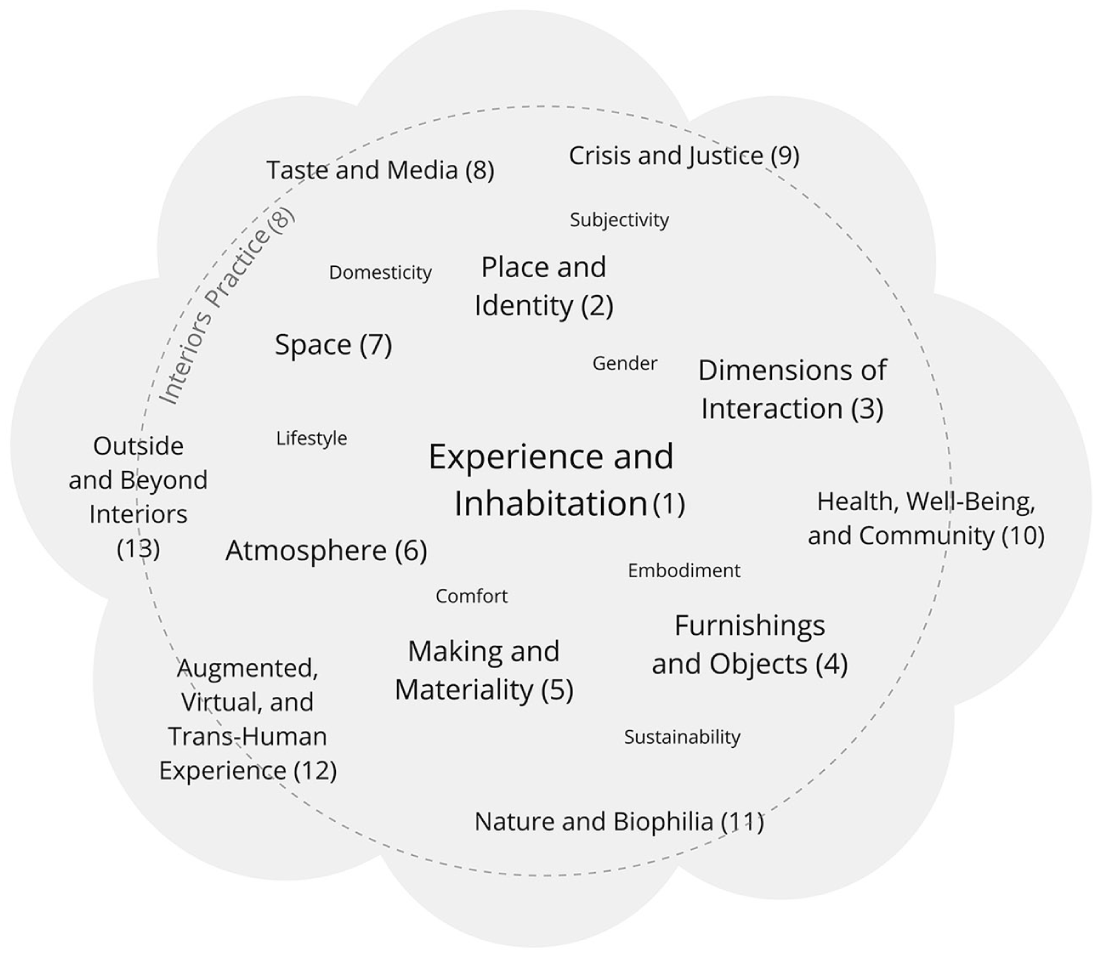
Diagram of interiors theory mapping (from The Interiors Theory Primer).
Generative Paradigm
The generative paradigm positions interiors as a site of creative production and conceptual speculation, foregrounding design processes, spatial composition, materiality, atmosphere, and narrative. Closely aligned with artistic and speculative design work, this approach emphasizes processes of making, spatial phenomena, and sensory engagement. Generative theory suggests ways of thinking and working—active approaches to shaping perception, emotion, and interaction. Drawing on phenomenology and materialist discourse, generative theory conceives the built environment as continuously evolving with the experiences of its inhabitants.
What makes this paradigm vital to interiors theory is its insistence that design is not only a reflection of culture but a way of producing new spatial, material, and affective conditions. It privileges iteration, performance, and atmosphere as theoretical tools—framing the physical environment as a dynamic field of transformation. This generative logic reorients theory away from post-facto interpretation and toward design as a form of thought: spatial thinking through material acts.
Andrea Zittel’s A–Z West 12 exemplifies this paradigm by treating interiors as experiments in inhabitation. Her mobile units and modular systems explore how space shapes behavior and daily routine. Zittel creates constraints that prompt new spatial habits, blurring boundaries between art, life, and design. Her work shows how generative practice can reconfigure norms and position interiors as tools for ethical and existential inquiry.
Alex Schweder’s performance-based installations similarly embody the generative paradigm. Projects such as ReActor 13 and The Hotel Rehearsal require user interaction to remain functional, emphasizing interiors as enacted and time-based. Schweder’s work uses movement, interdependence, and affect to choreograph relationships and unsettle spatial norms. His practice demonstrates how generative design reframes space as an active and socially contingent process.
Zittel and Schweder highlight this paradigm as a mode of inquiry rather than mere aesthetic experimentation. Working at the edges of art, performance, and design, they show how interiors theory can be methodologically and ethically generative—producing knowledge through spatial practice. Their work responds to contemporary conditions by staging questions of identity, adaptation, and relation within the built environment. These examples reinforce the generative paradigm as a critical framework for experimental, situated, and responsive design thinking.
Generative theory is inherently interdisciplinary, borrowing from architecture, art, and performance to explore new ways of shaping spatial experience. Designers and scholars such as Schneiderman 14 and Lavin 15 offer perspectives that place interiors within a broader creative discourse, where spatial experimentation becomes a method of inquiry as much as a design outcome.
This paradigm is further evident in work that constructs meaning through spatial choreography and sensorial immersion. Zumthor’s 16 writing explores the emotional and tactile qualities of space, emphasizing how materials, light, and temperature shape memory and perception. Pallasmaa 17 similarly argues that interiors are fully embodied atmospheres rather than visual compositions—spaces that engage all the senses. Weinthal’s 3 Toward a New Interior curates practices and texts that center performativity, material transformation, and sensory affect, reinforcing the generative nature of interior practice.
Generative theory has also gained traction through process-driven design research. Designers such as Iwamoto, 18 Davis, 19 and Sabin 20 integrate computational methods, adaptive materials, and environmental responsiveness, producing interiors that evolve in relation to both users and conditions. These practices are not only technical innovations—they expand what counts as interior, merging aesthetics, behavior, and ecology in new ways. Beyond material experimentation, the generative paradigm also provides a framework for engaging mobile interiors, installation art, and immersive environments. Projects by Eliasson, 21 Diller Scofidio, and Renfro 22 are examples where spatial experiences are shaped through sensorial, participatory, and temporal design strategies. Generative theory helps position these works as extensions of interior practice that challenge traditional notions of enclosure and permanence.
Drawing upon phenomenology, materialist discourse, and process-driven methodologies, generative theory frames interiors as active, experimental, and immersive, emphasizing design’s role in shaping perception, emotion, and interaction. However, this paradigm also has limitations. By focusing on material and sensorial qualities, it can risk aestheticism—foregrounding surface, sensation, or novelty at the expense of social or political context. Without critical grounding, generative work may overlook how design practices reproduce normative values or structural exclusions. But alongside other paradigms, the generative lens offers essential insight into how interiors are shaped not only by intention but by experimentation, atmosphere, and the performance of space itself.
In sum, this paradigm offers a language for understanding interiors as a practice that theorizes space through design. It shows how space, material, and perception co-produce meaning, and it offers an experimental ethos for thinking through design. In dialogue with the interpretive and empirical approaches, the generative paradigm helps us consider how sensation meets critique and speculation meets lived experience.
Interpretive Paradigm
The interpretive paradigm frames interiors as a site of critical inquiry, engaging with the cultural, social, and political dimensions of spatial practice. This paradigm emphasizes an analytical mode that considers lived experience, identity formation, and the production of meaning within interior spaces. It draws from semiotics, feminist and queer theory, de-colonial perspectives, and post-human discourse to interrogate how interiors shape and are shaped by systems of power, social structures, and collective memory.
The essays collected in Intimus: Interior Design Theory Reader 2 are an example of this paradigm, highlighting how interiors are sites of negotiation between personal identity, cultural context, and social structures. What distinguishes this paradigm is its emphasis on interior space as a socially constructed and symbolically charged medium—one through which power, identity, and cultural values are enacted. Rather than treating interiors as neutral containers, interpretive theory examines how spatial norms are reinforced or contested through design. Sparke 23 critiques the gendered construction of modern interiors, showing how domestic space became a site of social control through the aesthetics of comfort and consumption. Colomina 24 similarly reveals how media and surveillance are embedded in the spatial codes of modern domesticity. These examples illustrate how interiors participate in broader systems of representation and regulation, often naturalizing social hierarchies through material and spatial form.
Interpretive theory examines interiors as spaces where norms are reinforced or disrupted, where gender, race, and class are negotiated, and where historical narratives are materialized. Drawing on feminist, queer, and de-colonial perspectives, scholars like Rendell 25 explore interiors as spaces of political agency and transgression—where spatial practices unsettle normative assumptions about gender, sexuality, and domesticity. Through case studies of domestic interiors, commercial spaces, and institutional environments, the interpretive paradigm reveals how spatial arrangements contribute to inclusion or exclusion, comfort or control, agency or subjugation. For example, Lupton and Miller 26 explore how hygiene-based narratives in modern interiors shaped ideals of health, efficiency, and bodily regulation.
Other examples show how the interpretive paradigm reads interiors as spatial texts—objects and arrangements that reflect and reproduce cultural narratives. Rather than treating design as neutral, scholars in this tradition show how everyday spaces encode ideology, structure power, and mediate identity. By analyzing symbolic content, historical context, and cultural function, interpretive theory reveals interiors as complex expressions of meaning, open to both critique and reimagination.
McAtee 27 examines the Womb Chair as a material response to Cold-War-era cultural anxiety, reading its enveloping form and domestic placement as an aesthetic and psychological response to geopolitical instability. She situates the chair within a postwar desire for comfort, containment, and security, suggesting that its form enacts a gendered ideology of protection and retreat. Through this lens, McAtee highlights how design objects serve as affective and ideological instruments in shaping emotional life and national identity.
Braham 28 analyzes the “wall of books” as a spatial trope that naturalizes masculine authority and intellectual legitimacy. Books, he argues, are often positioned as “natural” cultural artifacts, contrasted with “artificial” or feminized décor. This binary reinforces aesthetic hierarchies and cultural assumptions about knowledge and value. Yet Braham also demonstrates how designers can manipulate these associations, using spatial arrangement to question what is considered intellectual, decorative, or legitimate within interiors discourse.
By linking spatial experience to ideology, representation, and memory, the interpretive paradigm reveals interiors as active agents in shaping subjectivity and social relations. It draws on theorists such as Lefebvre, Foucault, and Butler to expose how everyday environments participate in the construction of the self, often in ways that are unconscious or habituated. Design, in this view, becomes a cultural text—one that encodes histories of exclusion, but also offers opportunities for reimagining social life. Interpretive theory positions interior design not just as reflective of culture but as capable of articulating alternative ways of being and belonging.
However, this paradigm also has limitations. By emphasizing symbolic meaning and critical interpretation, it can underplay the lived sensory and experiential dimensions of interior space, or treat them primarily as signs to be decoded. But in concert with other paradigms, it provides essential insight into how spaces encode ideology and enact power—clarifying that theories of interiors must be attentive not only to what is built, but to what is represented, remembered, and resisted. In dialogue with generative and empirical paradigms, the interpretive paradigm provides a critical understanding of spatial narratives, and highlights the symbolic, historical, and political dimensions of interior design.
Empirical Paradigm
The Empirical Paradigm establishes interiors as an evidence-based discipline, drawing from environmental psychology, behavioral studies, neuroscience, and material science. It examines how interior environments directly impact cognitive function, sensory perception, emotional health, and physiological responses. Rather than prioritizing formal or interpretive concerns, it is human-centric, considering how design decisions shape occupant experiences, behaviors, and well-being. This approach underscores the ethical and practical responsibilities of designers, advocating for human-centered, data-informed methodologies that enhance comfort, equity, and sustainability.
The paradigm offers a framework for evaluating how spatial environments affect bodies, minds, and behaviors. It lends credibility and accountability to design by insisting that spatial decisions have real consequences—particularly for health, well-being, and access. Research from the social sciences has demonstrated that the built environment influences psychological and physiological outcomes. A foundational example of this approach is the work of Ulrich, which continues to inform biophilic design and healthcare environments.
Ulrich’s 1984 study remains one of the most cited in evidence-based design. 29 He found that post-surgical patients with a window view of trees recovered more quickly, used less pain medication, and had fewer complications than those with a view of a blank wall. This empirical finding provided measurable proof that visual access to nature directly impacts healing, catalyzing a broader shift toward biophilic design strategies. Ulrich’s research exemplifies how empirical data can substantiate the psychological and physiological value of interior elements—demonstrating that design choices have quantifiable impacts on human outcomes. Evidence-based design practices likewise extend these findings, translating environmental data into design strategies that respond to diverse human needs. 30 By systematically linking research to practice, evidence-based design builds a feedback loop between occupant outcomes and design decisions—allowing interiors to be tested, refined, and optimized based on empirical insight.
Inclusive design and disability studies are central to this paradigm. Scholars such as Boys 31 and Imrie 32 have examined how built environments shape—and sometimes constrain—autonomy, mobility, and access. Research in universal design and neurodiversity demonstrates how tailored spatial conditions can enhance focus, reduce anxiety, and support navigation for neuro-divergent individuals. These approaches foreground the body in design, expanding the paradigm beyond normative averages and toward adaptive, inclusive practice.
The paradigm also addresses the emotional and cultural dimensions of spatial experience, drawing on concepts such as place attachment and place identity. Tuan 33 and Marcus 34 have explored how people form psychological bonds with environments—connections that shape belonging, memory, and well-being. Hayden 35 uses empirical research to critique how gender, race, and class shape the cultural memory of built environments, emphasizing how domestic and community spaces become sites of erasure or resistance. These perspectives underscore the personal and political dimensions of interiors and their role in shaping individual and collective experiences.
Recent scholarship expands empirical inquiry through Indigenous and decolonial perspectives, which challenge dominant assumptions about evidence and knowledge. Scholars such as Tunstall 36 and Smith 37 call for relational, multisensory, and land-based ways of knowing that resist Western scientific framings. These interventions broaden the paradigm, insisting that data must include ecological, ancestral, and collective experience. In this way, empirical research becomes not only a mode of validation but a site of epistemological contestation.
Spatial justice efforts further challenge the historical biases of mainstream interiors, calling for environments that respond to diverse sensory, cognitive, and physical needs. Critical theory from Marxism, feminist geography, disability studies, and decolonial urbanism reinforces that interior spaces are not neutral—they reflect and perpetuate social values, access, and exclusion. By incorporating these perspectives, the Empirical Paradigm ensures interior design is ethically engaged, socially responsive, and reflective of diverse human experiences.
Interdisciplinary scholarship, such as The People, Place, and Space Reader, 4 has helped solidify empirical research as foundational to interior design. As climate change, urbanization, and digital transformation reshape the built environment, empirical approaches ensure design remains responsive to contemporary conditions. From the sensory impact of materials to the psychological effects of spatial arrangements, this paradigm provides a rigorous, evidence-based foundation for interior design practice.
However, empirical approaches also have limitations. By privileging measurable data, they can obscure subjective, symbolic, or sensory forms of experience. Metrics alone may not capture the affective or atmospheric dimensions of space. But when placed in dialogue with generative and interpretive paradigms, the empirical offers essential grounding. It reminds us that good design must not only express meaning or provoke sensation—it must also work for people.
Together, these three paradigms provide a conceptual structure through which the richness and complexity of interiors theory can be more clearly understood and more deliberately developed. The Generative Paradigm foregrounds interiors as a site of material and spatial experimentation, advancing design methodologies that shape sensory, emotional, and embodied experience. The Interpretive Paradigm situates interiors within broader cultural and political discourses, interrogating how spaces construct and are constructed by systems of power, identity, and memory. The Empirical Paradigm grounds interiors in evidence-based methodologies, ensuring that design decisions are informed by research in environmental psychology, material science, and human behavior.
These approaches represent distinct but overlapping strands of inquiry, each contributing to an evolving understanding of interiors as both a conceptual and applied field. Mapping these paradigms clarifies the scope of interiors theory and positions it as an essential and interdisciplinary area of study—one that engages with creative making, critical reflection, and empirical validation. Rather than privileging a single mode of inquiry, this article proposes a braided framework that embraces the hybrid nature of the field. By drawing together generative, interpretive, and empirical perspectives, this approach invites more integrated, situated, and reflexive forms of theorizing. It encourages continued dialogue across paradigms and opens space for new conceptual and methodological insights. The following section explores several key themes through which these paradigms intersect, demonstrating how theoretical convergence can support a more expansive understanding of interiors in research, education, and practice.
Key Themes in Interiors Theory
Interiors theory offers a dynamic and transformative lens through which to consider the experiential, material, and socio-cultural dimensions of 21st-century life. Because interiors operate within existing conditions, focusing on modification, adaptation, and renewal, they are inherently responsive, flexible, and sustainable. This characterization is important for understanding interiors as a dynamic and evolving field, where spaces are continuously reinterpreted to respond to changes in social, economic, and cultural conditions. Interior spaces and experiences are fluid, responding to the immediate needs of their occupants as well as shifting cultural, technological, and environmental forces. The Interiors Theory Primer addresses a number of key themes that emerge when looking at interior spaces and experiences in this dynamic context. 38
Centering on People and Experience
At the core of interiors theory is an emphasis on human experience. Unlike architectural theory, which often prioritizes form, structure, and urban context, interiors theory foregrounds human perception, emotion, and behavior. Interiors are not static enclosures but lived environments that engage the body in multisensory ways. This aligns with phenomenology, environmental psychology, and user-centered design, which emphasize the sensorial and embodied dimensions of space. Scholars have explored how memory, touch, light, and sound contribute to the intimate experience of interiors, shaping how spaces are understood and felt. This emphasis on spatial intimacy and material engagement spans the generative and empirical paradigms—foregrounding both perception and evidence as tools for design. It underscores the need for a theory that prioritizes the body, recognizing interiors as more than static containers, but as actively shaping human well-being.
Materiality, Atmosphere, and Sensory Engagement
Interiors theory also engages with materiality, atmosphere, and sensory perception, considering the qualitative and affective dimensions of space, and examining how materials, textures, lighting, and acoustics shape human experience. Atmosphere, as theorized in contemporary design discourse, emerges from the interaction between material, phenomena, and human perception, influencing mood, comfort, and emotional response. Hospitality design, therapeutic environments, and domestic spaces provide compelling examples of how design decisions impact psychological and physical well-being. In these contexts, interiors operate as mediators between material conditions and human experience, a logic rooted in both generative and empirical approaches. This reinforces the need for a theory that accounts for sensory engagement and material presence.
Taste, Media, and Lifestyle
Beyond the tangible aspects of interiors, media and digital culture play a growing role in shaping spatial perception and design discourse. Interiors are increasingly shaped by ephemeral, aestheticized, and participatory digital cultures. Platforms like Instagram, Pinterest, and design blogs have transformed how interiors are produced, curated, and consumed, emphasizing visual presentation, branding, and lifestyle narratives. This emphasis on representation and cultural production aligns closely with the interpretive paradigm, which interrogates how identity and power are mediated through space and visual culture. This suggests a distinction between architecture and interiors: while architecture is often mediated through professional discourse, interiors exist in a more accessible and trend-focused realm, where amateur and expert perspectives converge. This consumerization and democratization of interiors raises important theoretical questions about representation, taste, authenticity, and the role of digital media in shaping contemporary spatial practices.
Social and Ethical Dimensions of Interiors
One evolving aspect of interiors is the responsibility to address social and ethical dimensions of spatial experience, engaging with issues of inclusion, equity, and identity. Interiors mediate subjectivities and agency in ways that are deeply embedded in everyday life. Questions of gender, disability, race, and decolonial perspectives are particularly relevant in interiors, as spatial organization and design choices often reinforce or disrupt power dynamics. Gender-neutral restrooms, inclusive workplace design, community-driven housing projects, and accessible environments demonstrate how interiors can act as sites of political and cultural intervention. This theme crosses the interpretive and empirical paradigms, addressing both user needs and social meanings. By examining interiors through a socially engaged lens, theory can contribute to more ethical and equitable design practices, ensuring that interiors remain not just aesthetically compelling but also socially responsible and inclusive.
Together, these themes—adaptability, experience, materiality, media, and social engagement—demonstrate how the three paradigms interlace and diverge, showcasing the scope of interiors theory and positioning it as an essential discipline within spatial studies. Interiors are inherently porous and interdisciplinary, drawing from design, psychology, cultural studies, and emerging digital technologies. Understanding these key themes ensures that interiors theory remains relevant, adaptable, and capable of addressing the evolving conditions of contemporary spatial practice.
Implications for Research, Practice, and Pedagogy
The continued development of interiors theory has significant implications for research, practice, and pedagogy, providing greater clarity to the field while reinforcing its relevance within broader design and spatial disciplines. Rather than functioning solely as an academic discourse, interiors theory serves as a critical tool for interdisciplinary engagement, professional application, and addressing contemporary challenges—especially when organized through coherent theoretical paradigms.
Clarifying Disciplinary Boundaries
A more clearly articulated interiors theory helps solidify its relationship to adjacent disciplines while establishing its distinct intellectual contributions. Interiors theory exists in dialogue with architecture, industrial design, urbanism, and environmental psychology, yet it remains unique in its emphasis on human experience, materiality, and adaptive spatial practices. While architecture often prioritizes form, structure, and permanence, interiors tend to focus on transformation, atmosphere, and sensory engagement. Unlike industrial design, which centers on objects and products, interiors address the interactions between space, objects, and inhabitation. In contrast to urbanism, which extends outward toward cities and infrastructures, interiors turn inward, considering the intimate, lived dimensions of spatial experience. The theoretical paradigms discussed above provide a framework through which the contributions of interiors become more legible, and underscore its capacity to move between conceptual abstraction and everyday material realities.
Supporting Interdisciplinary Collaboration
At the same time, interiors theory is inherently interdisciplinary, engaging with fields such as psychology, media studies, environmental science, and material research. These connections ensure that interiors remain responsive to emerging scholarship and societal needs. Research in environmental psychology and cognitive science has provided crucial insights into how interior environments impact well-being, stress, and cognitive performance, reinforcing evidence-based design approaches. Media studies highlight how digital representations of interiors—through social media, virtual reality, and cinematic set design—reshape how interiors are conceptualized and experienced. Environmental science informs discussions on sustainability, biophilic design, and climate-responsive interiors, positioning interiors as key to addressing ecological concerns. Meanwhile, advances in material research continue to shape interiors discourse by exploring how surfaces, acoustics, and sensory properties affect spatial perception, comfort, and atmosphere. These interdisciplinary engagements cross all three paradigms: the Empirical Paradigm brings evidence-based rigor to questions of inhabitation; the Interpretive Paradigm connects interior conditions to cultural meaning; and the Generative Paradigm opens space for speculative and experimental approaches to design.
Integrating Marginalized Perspectives into Theoretical Development
As interiors theory continues to develop, marginalized perspectives play a crucial role in expanding its scope, methodologies, and ethical considerations. Historically, dominant narratives in design theory have prioritized Western, Eurocentric, and heteronormative frameworks, often neglecting the contributions of Indigenous, Black, feminist, queer, disabled, and other historically excluded voices. However, emerging scholarship challenges these omissions by foregrounding alternative epistemologies, embodied knowledge, and decolonial spatial practices. Scholars have examined how race, gender, and colonial histories are embedded in interior environments, revealing how spatial arrangements reinforce or resist systems of oppression. Similarly, critical disability studies and neurodiversity research have expanded interiors discourse by advocating for inclusive, multisensory, and accessibility-driven approaches to spatial design. Such perspectives resonate especially within the Interpretive and Empirical Paradigms, challenging who gets to create and inhabit space, and on what terms. By integrating these perspectives, interiors theory can become not only more comprehensive but also more socially and politically responsive, ensuring that its frameworks account for the full diversity of human experience. Recognizing marginalized perspectives is not just an ethical imperative, but also a theoretical necessity, as it reveals how interiors actively participate in the construction of power, agency, and belonging.
Interiors as an Area of Expertise
By mapping the generative, interpretive, and empirical paradigms, this paper highlights how interiors theory emerges through interdisciplinary intersections, allowing for a more robust intellectual discourse while encouraging new avenues of inquiry that acknowledge the complexity and breadth of interiors as a field. Rather than positioning interiors as a subdiscipline of architecture, a more clearly defined theoretical discourse affirms its significance as an area of expertise in its own right, influencing scholarship and professional practice by reinforcing the sensory, material, and human-centered dimensions of spatial design. Understanding the depth and breadth of the theoretical paradigms affirms interiors as a comprehensive site of disciplinary knowledge.
A well-developed theoretical discourse bridges conceptual thought with design methodologies, ensuring that interiors are not only functionally and aesthetically designed but also socially and intellectually engaged. Beyond academic and professional applications, interiors theory also shapes the future of pedagogy, guiding how interiors are taught and conceptualized. By advancing interiors theory as an independent area of study, curricula can better reflect the unique disciplinary contributions of interiors, integrating phenomenological, material, social, and scientific perspectives. This also encourages students to move beyond conventional typologies, preparing them to engage with emerging spatial conditions, including digital, mobile, and hybrid environments in an era in which spatial boundaries are increasingly fluid. In this way, the three paradigms offer a pedagogical roadmap: enabling educators to frame coursework around making and material exploration (Generative), critical reflection and social engagement (Interpretive), and evidence-based spatial research (Empirical).
Addressing Contemporary Concerns
Perhaps most importantly, interiors theory must engage with the pressing global challenges of the 21st century, including climate change, digital transformation, and social justice. As climate change accelerates, interiors play a crucial role in sustainable design strategies, adaptive reuse, and energy-efficient environments. The rise of digital technology requires new ways of conceptualizing virtual and hybrid spaces, acknowledging how digital environments shape human interaction and interior experiences. Additionally, the ethical imperatives of accessibility, equity, and inclusion require that interiors theory critically examine how spaces serve—or fail to serve—diverse populations, ensuring that interiors foster belonging rather than reinforcing exclusivity or privilege. Using the paradigms proposed here as a methodology for analysis, synthesis, and speculation, interior designers, educators, and researchers can respond to these challenges with clarity and purpose.
By positioning interiors theory as a dynamic, responsive, and interdisciplinary field, this article argues for its relevance in addressing contemporary spatial challenges. In doing so, it moves beyond the historical perception of interiors as secondary to architecture, asserting interiors theory as a critical area of study that bridges conceptual inquiry, material practice, and human experience. Mapping the key themes and paradigms of interiors theory clarifies its intellectual foundations while ensuring its continued evolution as a socially and environmentally engaged area of study.
Conclusion: The Future of Interiors Theory
Through understanding intellectual currents and discussing contemporary challenges, this paper suggests ways interiors theory can continue to develop. The discipline has long drawn from adjacent fields—architecture, social sciences, psychology, and material studies—without fully asserting its own intellectual autonomy. By articulating three interrelated paradigms—Generative, Interpretive, and Empirical—this paper offers a conceptual framework through which interiors theory can cohere as a distinct and interdisciplinary field. These paradigms show how interiors theory integrates design experimentation, cultural critique, and empirical research, ensuring that interiors are not only designed and experienced but also theorized and analyzed with clarity and depth.
Previous readers and anthologies have illuminated interiors as a conceptual, spatial, and social practice, yet the field remains fragmented across disciplinary and methodological divides. The proposed paradigms help bridge these divides, demonstrating how design processes, social identities, and evidence-based research can inform one another. Mapping these paradigms allows for a more cohesive and expansive discourse, where design processes, social identities, and empirical research are not treated in isolation but as interconnected facets of interiors theory. In this way, interiors theory asserts itself as a distinct, interdisciplinary, and evolving field, drawing from existing knowledge while developing a clearer epistemological foundation.
At the same time, the openness of interiors theory is one of its greatest strengths, allowing it to remain porous, adaptive, and engaged with contemporary issues. Approaching interiors through feminist, decolonial, and marginalized perspectives reveals that interiors have always operated at the edges of power, between disciplines, and in spaces that are often overlooked. This positioning is not a weakness but a strength, enabling interiors theory to remain responsive to shifting political, social, and environmental concerns. The proposed framework does not constrain this openness; instead, it scaffolds it—supporting theoretical integration while allowing space for situated, relational, and emergent approaches.
The future of interiors theory, then, lies in further developing this integrative capacity: embracing the experimental spirit of the Generative Paradigm, the critical insight of the Interpretive Paradigm, and the methodological rigor of the Empirical Paradigm. Interiors theory embodies a politics of space that is fluid, inclusive, and responsive, resisting static classifications in favor of relational and situated knowledge. In advancing these paradigms, the field strengthens its capacity to engage with design pedagogy, spatial justice, technological change, and human experience—affirming interiors as a vital site of both creative practice and intellectual inquiry.
Footnotes
Declaration of Conflicting Interests
The author declared no potential conflicts of interest with respect to the research, authorship, and/or publication of this article.
Funding
The author received no financial support for the research, authorship, and/or publication of this article.
