






Abstract
This article presents a historical account of how two pioneering figures—Widagdo and Rita Widagdo—shaped the early formation of interior design education in Indonesia through their German Modernist training. Drawing on archival sources and oral histories, the study traces the educational lineage from Bauhaus pedagogy, transmitted through Herbert Hirche at the Staatliche Akademie der Bildenden Künste Stuttgart, to the Bandung Institute of Technology (ITB) in Indonesia’s independence. Rather than offering a stylistic comparison between European and Indonesian design philosophies, this research reconstructs the chronology and influence of individual educators who translated Bauhaus principles into a new academic culture. It argues that interior design education in Indonesia emerged not as an imitation of Bauhaus Modernism but as an institutional legacy shaped by transnational experiences. Their teaching methods and studio practices established the foundation for a professional discipline that continues to inform Indonesian design pedagogy today.
Introduction
The emergence of interior design education in Indonesia reflects the nation’s broader transformation from colonial modernization to post-independence nation-building. According to the National Accreditation Board for Higher Education, 1 thirty-eight accredited interior design programs now operate across Indonesia, concentrated mainly in Java’s major cities and Bali. Yet this national network of programs has its roots in a much earlier period when design education was still entangled with colonial structures and the search for cultural identity. Most programs operate at the undergraduate level, culminating in a four-year Sarjana Desain (S.Ds.), equivalent to a Bachelor of Design degree, with only one program offered at the master’s level.
Although the institutional landscape of interior design education in Indonesia appears firmly modern today, its formation is inseparable from the long evolution of learning systems that preceded it. To understand how contemporary design pedagogy took shape, it is necessary to revisit the cultural and intellectual frameworks that once governed artistic training in the archipelago.
Before the introduction of Western-style schooling under Dutch colonial rule, knowledge in the arts and design was transmitted through pesantren (Islamic boarding schools), kraton (palace) workshops, and artisanal guilds that specialized in woodcarving, weaving, and rattan crafts. 2 These systems represented sophisticated modes of learning grounded in spirituality, craftsmanship, and symbolic order—foundations that would later intersect, and often conflict, with colonial and Modernist pedagogies.
The arrival of Dutch modern education in the early twentieth century introduced rationalized, bureaucratic models of knowledge that marginalized these indigenous systems. 3 Colonial schooling privileged technical and administrative skills while diminishing the value of cultural and symbolic expression. Yet long before this imposition of Western modernity, local societies had cultivated highly developed spatial and visual cultures. The Javanese rumah joglo expressed social hierarchy and cosmology through its pendopo–dalem axis 4 ; the Minangkabau rumah gadang in West Sumatra embodied matrilineal kinship through elongated halls and curving rooflines 5 ; and the Balinese bale reflected the triadic principle of Tri Angga, linking body, cosmos, and dwelling. 6 Monumental sites such as Borobudur Temple revealed mastery of spatial symbolism through mandala-like organization, while traditional crafts—from batik and ikat textiles to bamboo weaving and woodcarving—functioned not merely as decoration but as carriers of philosophy, identity, and spirituality. 7 Similarly, performative arts such as wayang kulit and gamelan reinforced cosmological order and collective harmony, demonstrating that precolonial Indonesia already possessed a deep integration of art, space, and belief (Figure 1).
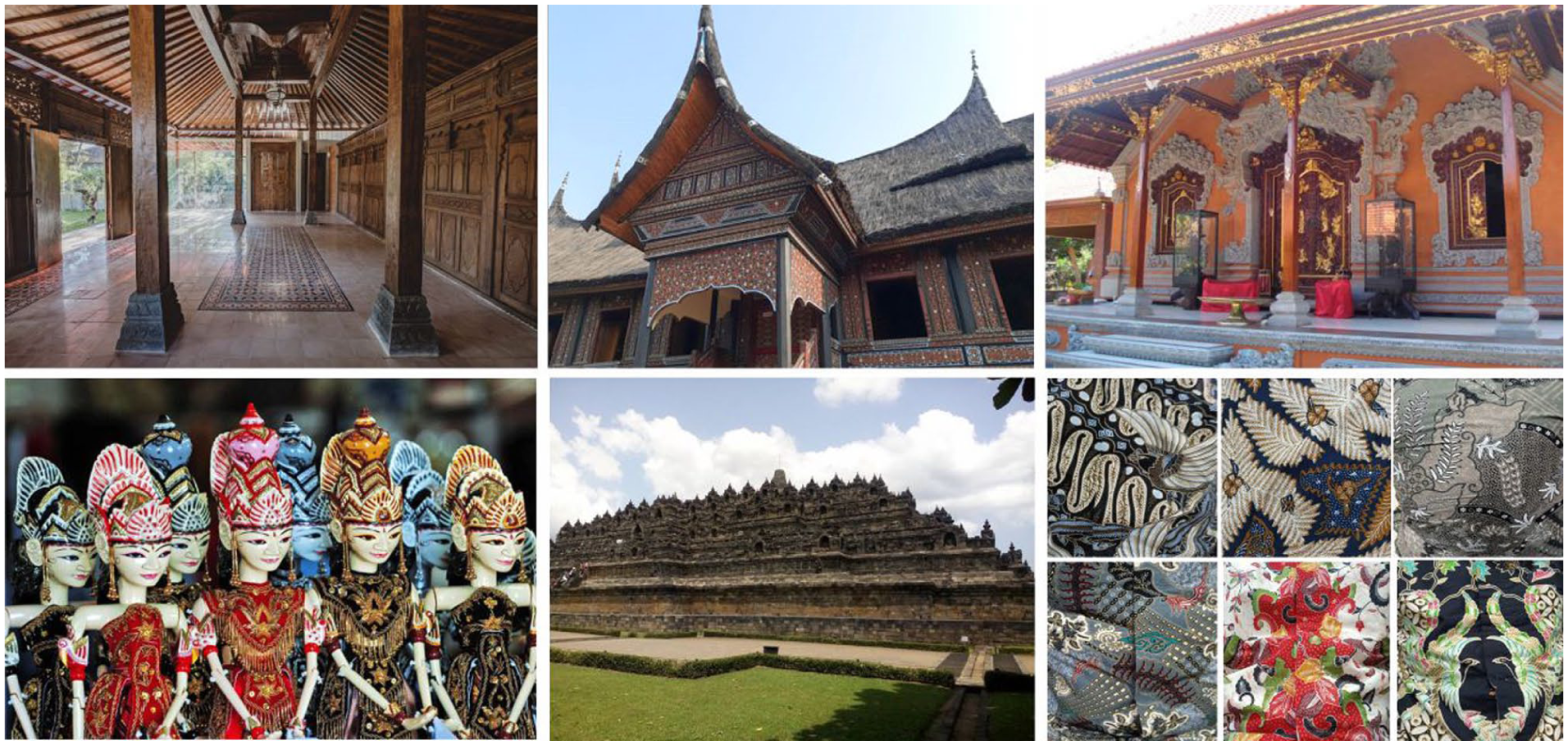
Examples of Indonesian cultural expressions. Top row (left to right): Javanese rumah joglo, Minangkabau rumah gadang, Balinese bale. Bottom row (left to right): wayang golek puppets, Borobudur Temple, and batik textiles.
This article situates the development of interior design education within a broader historical continuum—from traditional craft-based apprenticeship to postcolonial academic formation. It argues that the emergence of design education in Indonesia was less a direct importation of European philosophy than a gradual adaptation of Modernist pedagogical models into a local context shaped by social change, nationalism, and cultural negotiation.
The narrative centers on Widagdo and Rita Widagdo, two pioneering figures educated in post-war Germany under Bauhaus-trained designer Herbert Hirche. Their education at the Staatliche Akademie der Bildenden Künste Stuttgart provided the conceptual and methodological basis for establishing Indonesia’s first formal interior design curriculum at the Bandung Institute of Technology (ITB). Through their teaching, Bauhaus principles—discipline in form, honesty in material, and learning through making—were localized and reinterpreted within Indonesia’s early post-independence design education.
Rather than emphasizing stylistic comparison between European and Indonesian traditions, this study examines how design thinking evolved through personal, institutional, and pedagogical transformation. It highlights the agency of the Widagdos as educators who bridged global Modernism and local sensibilities, forming a hybrid identity that redefined Indonesia’s interior design discipline.
Using a historiographic approach, the study combines documentary research with oral testimony derived from informal interviews and academic discussions conducted in Bandung between 1998 and 2010. These accounts provide rare first-hand perspectives on the founding of Indonesia’s interior design program and the adaptation of Bauhaus-based studio culture in a postcolonial setting. Triangulated with secondary literature, these oral histories allow reconstruction of the intellectual and institutional formation of interior design education in Indonesia.
By tracing this trajectory, the article contributes to the global historiography of design education by revealing how Modernist pedagogies were translated into a non-Western context. It clarifies that Indonesia’s interior design education evolved not as a philosophical synthesis of East and West, but as a localized process of knowledge transfer shaped by people, institutions, and historical circumstances.
The First Fine Art and Design School
Formal art and design education in Indonesia emerged during the late Dutch colonial period, when European vocational models were introduced primarily for administrative and technical purposes. However, the decisive turning point came after independence, when returning Indonesian educators sought to redefine art and design as tools for nation-building rather than colonial utility.
Dutch artists Simon Admiraal and Ries Mulder played a transitional role in the 1940s by founding Indonesia’s first structured art education program in Bandung. Their efforts, later expanded by local educators such as Syafei Sumardja and Ahmad Sadali, marked the beginning of an indigenous approach to art and design instruction that combined technical discipline with cultural sensibility. 8
This formative period represented Indonesia’s first experiment in intellectual self-determination within art education—a bridge between colonial pedagogy and the emergence of modern design thinking led by internationally trained Indonesian figures. Among these, Widagdo and Rita Widagdo would later transform inherited colonial frameworks into a modern academic discipline grounded in both global Modernism and local identity.
The Dutch Ethical Policy (1901 onward) expanded access to education through technical schools, but these were intended to serve colonial administration. 9 Although such programs introduced drafting and applied-arts instruction, they largely ignored local visual culture and symbolism. Consequently, early art education remained utilitarian rather than culturally expressive.
…early art education remained utilitarian rather than culturally expressive.
The seeds of Modern design education were planted through Bandung’s Technische Hoogeschool te Bandoeng, established in 1920, which modeled itself after Delft’s engineering curriculum. Its focus on rational design, technological expertise, and environmental adaptation created an intellectual environment where architecture and interior design were first conceived as unified spatial disciplines. Architect C. P. W. Schoemaker’s Villa Isola (1933) exemplified this synthesis between structure and interior space, foreshadowing later modernist approaches within Indonesian design education (Figure 2). 10
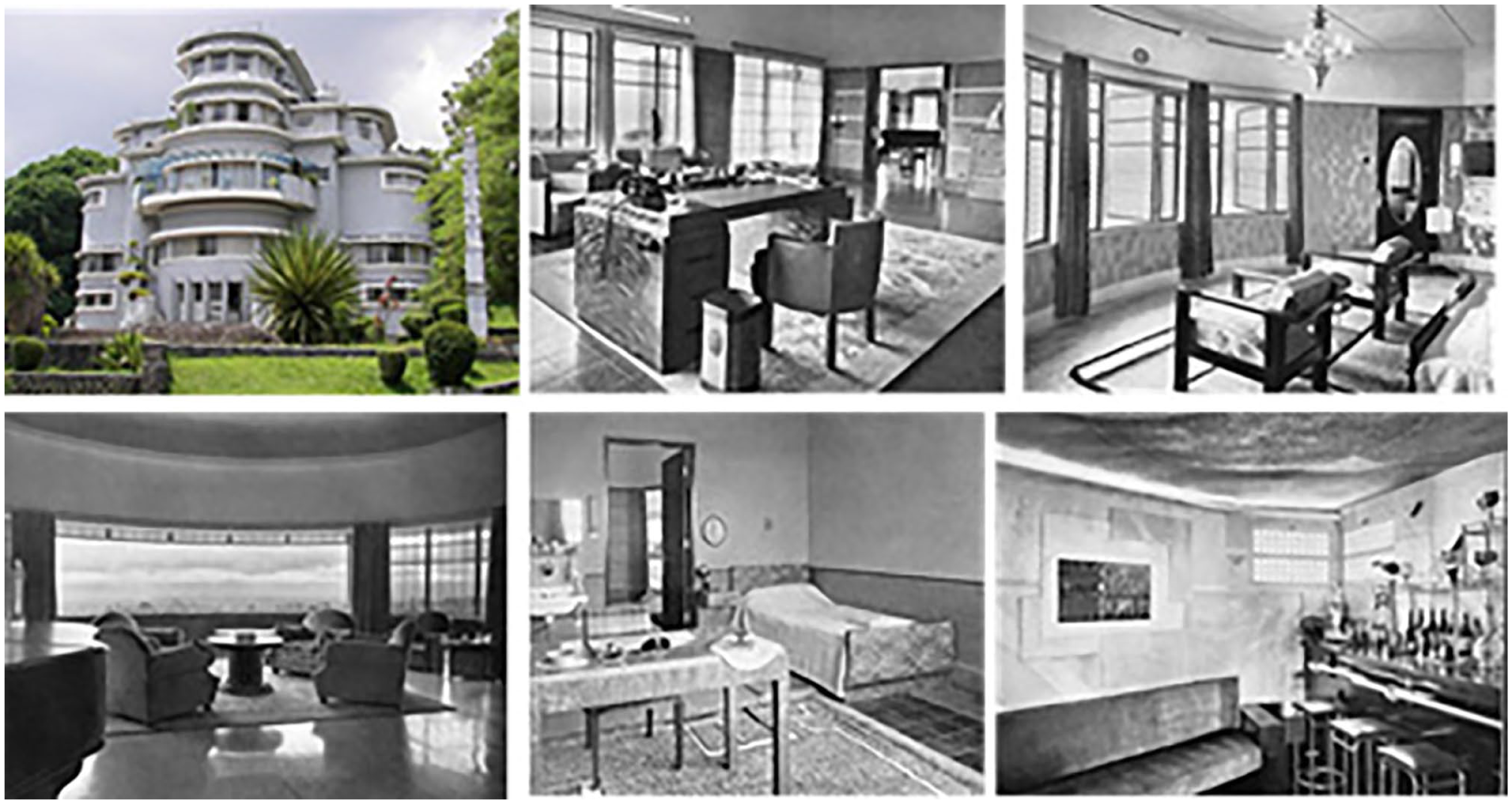
Exterior and interior views of Villa Isola, Bandung, designed by C. P. W. Schoemaker, showing the façade, main lounge, office, bedroom, and bar area, c. 1932–1934.
Following the upheavals of Japanese occupation and Indonesia’s independence, Admiraal and Mulder—together with astronomer E. A. Kreiken and art educator J. M. Hopman—established the Universitaire Leergang voor de Opleiding van Tekenleraren (University Course for the Training of Drawing Teachers) in 1947. Located in Bandung under the Faculty of Engineering, University of Indonesia, this initiative formally institutionalized art instruction in the country. Its curriculum combined European art pedagogy with elements of applied design (gebonden kunst), which would later evolve into Indonesia’s design education model (Figure 3).
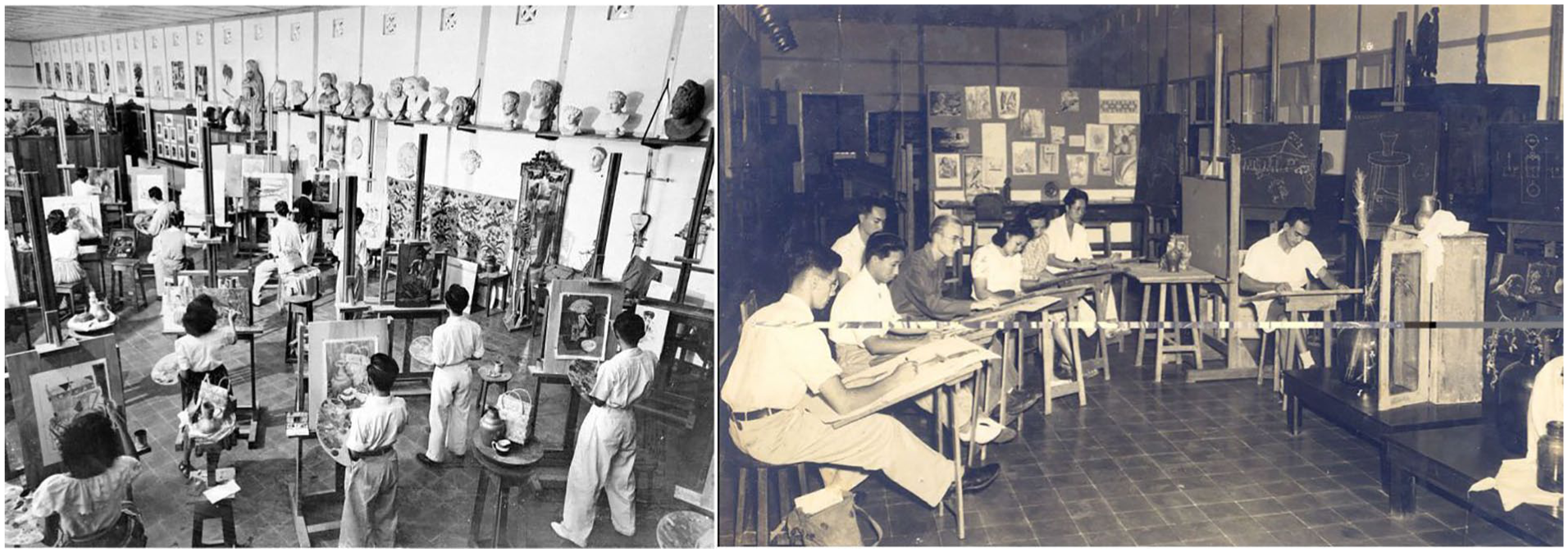
Drawing studio of the University Course for the Training of Drawing Teachers, Faculty of Engineering Sciences, University of Indonesia, Bandung, c. 1947–1950.
Although Dutch sovereignty officially ended in 1949, many Dutch lecturers remained in Indonesia. Some stayed due to ongoing work contracts, and by 1953, only a few—such as Ries Mulder and Hans Frans—were still teaching. In 1950, Syafei Sumardja, a native of Bandung who had completed art teacher training in the Netherlands and Belgium, returned to Indonesia and became the first Indonesian lecturer at the school. However, worsening diplomatic tensions—especially over the status of Irian Barat (West New Guinea, now Papua)—eventually led to the withdrawal of the remaining Dutch teaching staff in 1954. Mulder himself returned to the Netherlands in 1959. This transitional period marked the beginning of the institution’s indigenization.
With the departure of Dutch faculty, Syafei Sumardja initiated the recruitment of a new generation of Indonesian educators, including Ahmad Sadali, Sudjoko, Muhtar Apin, Eddie Kartasubarna, and Angkama Setjadipradja (Figure 4). This shift not only changed the language of instruction from Dutch to Indonesian but also signaled a broader pedagogical reorientation—toward national identity, cultural autonomy, and the cultivation of a distinctly local approach to design education.
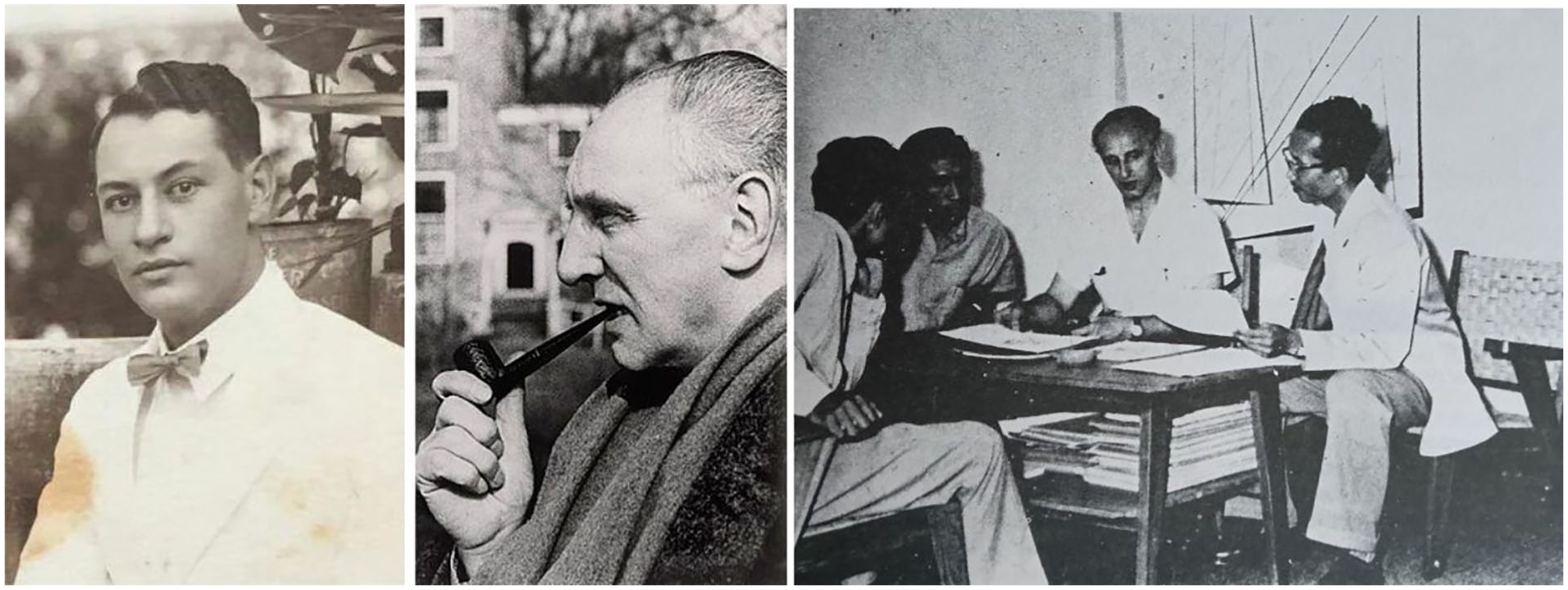
Simon Admiraal (left), Ries Mulder (center), and Indonesian lecturers in the drawing studio with Ries Mulder, circa 1950s. From left to right: Angkama Setjadipradja, Achmad Sadali, Ries Mulder, and Edie Kartasubarna.
To support national development through higher education, in 1959, the Faculty of Engineering at the University of Indonesia (Bandung Campus) officially became a separate campus under the name ITB. This new campus was challenged to open various engineering departments and transform the University’s Drawing Teacher Training School into the Department of Fine Arts, laying the groundwork for future design disciplines in the Department of Fine Arts.
From Bauhaus to Innenhausbau: Tracing the Roots of Interior Design Education in Germany
The pedagogical roots of interior design can be traced to early twentieth-century Germany, where the concept of Innenhausbau (interior construction) emphasized the integration of architecture, furniture, and interior space into a unified aesthetic and functional vision. 11 This idea reflected a broader cultural shift in which domestic space became a testing ground for modern design principles, linking craftsmanship, material honesty, and spatial harmony.
The Bauhaus, founded by Walter Gropius in 1919, transformed these ideas into an educational system rather than a mere stylistic movement. Its Vorkurs (preliminary course), developed by Johannes Itten and later refined by Josef Albers, introduced “learning by doing” as the foundation of design pedagogy—training students through material exploration, spatial composition, and visual experimentation before specialization. 12
What is significant for this study is not the history of the Bauhaus as an institution, but the transmission of its pedagogical principles—particularly the Vorkurs—through post-war educators such as Herbert Hirche. 13 A former Bauhaus student under Ludwig Mies van der Rohe, Hirche carried forward the school’s humanist and functional ideals into his teaching at the Staatliche Akademie der Bildenden Künste Stuttgart. It was here that Widagdo, the future founder of Indonesia’s interior design program, absorbed the Bauhaus ethos of disciplined experimentation and synthesis between art, craft, and technology.
By framing the Bauhaus as an educational model rather than a stylistic canon, this article emphasizes pedagogy as the primary conduit of modernist transfer. The essence of Bauhaus learning—its emphasis on process, structure, and moral clarity in design—provided the conceptual vocabulary that would later underpin the formation of Indonesia’s academic approach to interior design. Thus, rather than retelling Bauhaus history, this section establishes its relevance as a pedagogical lineage—one that moved from Gropius to Hirche, from Stuttgart to Bandung, and from universal modernism to the local realities of Indonesian education.
Herbert Hirche: From Bauhaus to Stuttgart
Herbert Hirche (1910–2002) represented the last generation of students to be trained at the Bauhaus before its closure. Born in Görlitz, near the present-day German–Polish border, Hirche began his career as a carpenter before enrolling at the Bauhaus, where from 1930 to 1933 he studied under Wassily Kandinsky, Lilly Reich, and Ludwig Mies van der Rohe. 14 When the school was forced to close by the Nazi regime in 1933, Hirche continued to work with Mies in his Berlin architectural office, where he absorbed the Bauhaus synthesis of structure, space, and detail as interdependent elements of design. 15
This early education shaped Hirche’s lifelong commitment to functional integrity and spatial unity—principles that would later define his academic leadership. In 1948, he was appointed Professor of Applied Arts at the newly established Kunsthochschule Berlin-Weißensee, located in the Soviet sector of Berlin. Four years later, he joined the Stuttgart State Academy of Fine Arts (Staatliche Akademie der Bildenden Künste Stuttgart) as Professor of Interior Design and Furniture Making, a position he held until 1975.
At Stuttgart, Hirche became one of post-war Germany’s leading design educators, advancing a studio culture grounded in the Bauhaus ethos of “learning by doing.” His pedagogy emphasized material honesty, geometric order, and visual restraint—qualities that came to define what critics later described as “visual silence.” In contrast to the monumentalism of pre-war modernism, Hirche’s approach cultivated sensitivity to proportion, texture, and spatial rhythm, aligning interior design with both ethical and aesthetic discipline. 16
Hirche’s influence extended beyond academia. He collaborated with Braun in shaping its Modernist corporate identity through rational and user-centered products such as the HM 5–7 music cabinet (1957) and the HF1 television set (1958). 17 His works were exhibited at the 1957 Milan Triennale, the Interbau Exhibition in Berlin, and the 1958 Brussels World’s Fair. These achievements consolidated his reputation not only as a designer but as a theorist of modern living—bridging architecture, product design, and interior space.
For Indonesian design history, Hirche’s significance lies less in his furniture than in his role as mentor to Widagdo, who studied under him at Stuttgart in the 1950s. Through Hirche, Widagdo encountered a living continuation of Bauhaus pedagogy—refined through post-war humanism and functional rationality—which he would later reinterpret for Indonesia’s cultural and educational landscape. Thus, Hirche stands as the intellectual intermediary through whom Bauhaus ideals were translated from Germany’s reconstruction era to Indonesia’s early post-independence academic formation (Figure 5).
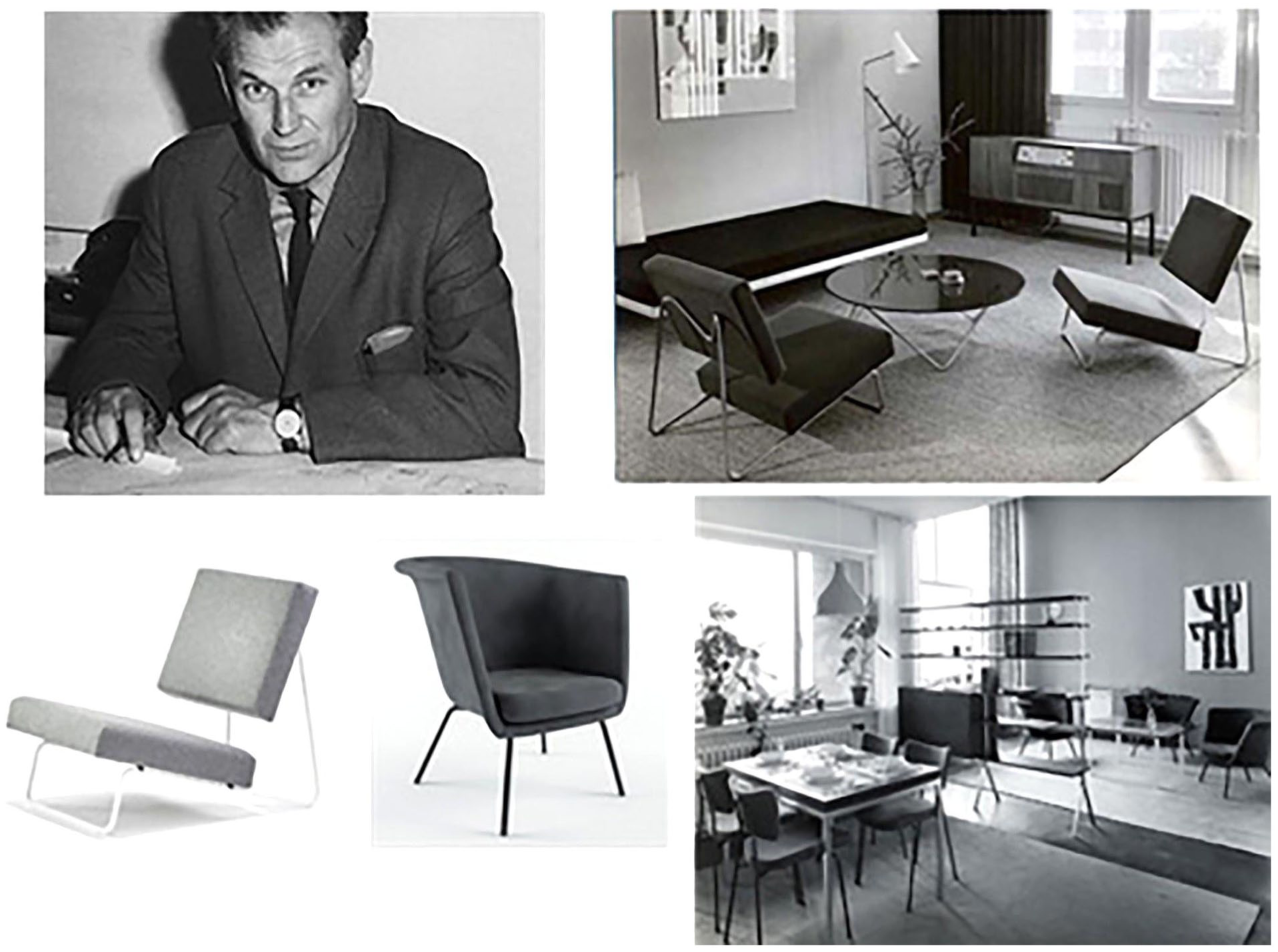
Herbert Hirche (1910–2002) and selected examples of his interior and furniture design, including contributions to the Interbau Exhibition in Berlin, 1957.
Translating Bauhaus Pedagogy: Widagdo’s Education and the Formation of Indonesian Interior Design
One of Herbert Hirche’s most distinguished students at the Stuttgart State Academy of Fine Arts was Widagdo, an Indonesian designer who would later pioneer the establishment of interior design education in his home country. Born in Surakarta, Central Java, in 1934, Widagdo began his studies in Stuttgart in 1956 under a scholarship from the Indonesian Ministry of Education. He enrolled in the Innenarchitektur und Möbelbau (Interior Architecture and Furniture Design) department, which reflected Germany’s academic framework for interior design as a synthesis of space, structure, and material. He completed his studies in 1964, becoming the first Indonesian to earn a professional qualification in interior design—a milestone that positioned him as Indonesia’s first academically trained interior designer.
During his foundational training, Widagdo studied under Professor Hannes Neuner, a former assistant to László Moholy-Nagy and Wassily Kandinsky, whose Vorkurs-based pedagogy emphasized experimentation with material, proportion, and form. 18 In the core interior architecture program, Professor Herbert Hirche provided Widagdo with a direct continuation of the Bauhaus ethos: discipline in process, functional clarity, and the moral dimension of form-making.
Hirche’s studio was characterized by rigorous problem-solving exercises and a “learning by doing” approach that integrated aesthetics with ethical responsibility. Under this guidance, Widagdo learned to view design as an intellectual process rather than mere decoration. His practical assignments—including assisting Hirche in small renovation projects at the academy—became laboratories for understanding spatial logic and material honesty. 19
When Widagdo returned to Indonesia in 1964, he carried not only technical competence but also a pedagogical philosophy shaped by German Modernism. He was determined to build an academic foundation for interior design education modeled on the Bauhaus-Stuttgart lineage but reinterpreted for Indonesia’s cultural and social context. His teaching in Bandung emphasized the moral integrity of form, spatial unity, and process-driven creativity—principles that contrasted sharply with the prevailing perception of interior design as ornamental craft.
In 1965, Widagdo’s German training gained national attention when architect Soejoedi Wirjoatmodjo—also educated in Germany—invited him to collaborate on the interior design of the Conference of the New Emerging Forces (CONEFO) building in Jakarta, now the Parliament complex. 20 This commission represented the first state-level recognition of interior design as a distinct profession in Indonesia, signaling the beginning of its institutional legitimacy. Through this collaboration, the Modernist vocabulary that Widagdo had acquired abroad found its first material expression in the new nation’s architectural identity.
By the 1970s, as interior design began emerging as an autonomous profession, Widagdo played a key role in advising the founders of the Indonesian Interior Designers Association (HDII). Jakarta-based designers Hoemar Tjokrodiatmo, Fred Haradiran, and Maya Soeharnoko sought his expertise to ensure that professional recognition would be grounded in academic legitimacy. As the only formally trained interior designer in Indonesia, Widagdo provided both intellectual authority and pedagogical guidance, helping institutionalize design education at the ITB.
The enduring influence of his German education became evident in his teaching philosophy, which fused rational method with cultural sensitivity. His students were taught to balance material discipline with symbolic expression, adapting Bauhaus principles to Indonesia’s diverse material and spatial traditions. This synthesis laid the groundwork for a distinctly Indonesian modernism—one that valued order and precision without severing ties to local identity.
This synthesis laid the groundwork for a distinctly Indonesian modernism…
Herbert Hirche’s later visits to Bandung in the 1980s reaffirmed this enduring intellectual bond. In their exchanges, Hirche and Widagdo reflected on the Bauhaus principle that design must reconcile utility with aesthetic meaning. For Widagdo, this was not merely an aesthetic statement but a moral one—underscoring design as a disciplined, ethical practice that bridges modern knowledge and cultural consciousness.
Rita Widagdo: Infusing the Bauhaus Spirit into Indonesian Design Education
While studying in Stuttgart, Widagdo met Rita Weizmann, a German student in the Sculpture Department at the Staatliche Akademie der Bildenden Künste Stuttgart. Their shared academic environment and creative ideals led to a lifelong partnership, both personally and professionally. Born in Rottweil, West Germany, in 1938, Rita studied sculpture from 1957 to 1964, earning the title of Meisterschülerin—a distinction conferred upon students under close mentorship. One of her principal instructors was Hannes Neuner, a Bauhaus alumnus and one of the few who continued the Grundlehre (foundation course) after the school’s closure. Neuner’s emphasis on rhythm, material exploration, and visual abstraction profoundly influenced Rita’s pedagogical and artistic philosophy. 21
After relocating to Indonesia in 1966, Rita joined the Department of Fine Art at the ITB as a lecturer in the Sculpture Studio. Although she initially held German citizenship—officially becoming Indonesian fourteen years later—her commitment to developing Indonesia’s design education was immediate and profound. Within the department, Rita played a pivotal role in transforming art instruction from studio craft to structured design pedagogy.
Drawing from her Bauhaus training, she introduced a foundation course modeled after the Vorkurs, which in Indonesia became known as Nirmana. This course—now fundamental to all art and design schools in Indonesia—embodied the Bauhaus spirit of perceptual sensitivity, material exploration, and freedom from representational convention. 22 Nirmana guided students through the study of point, line, plane, color, and composition while encouraging direct engagement with materials.
Rita taught Nirmana across both the Fine Art and Architecture departments at ITB, fostering an interdisciplinary design culture that bridged art and spatial thinking. Her studio practice emphasized tactile experimentation with materials such as clay, wire, corrugated metal, straw, and cardboard—a process through which students learned to perceive the expressive and structural qualities of matter. This pedagogy cultivated not only visual literacy but also ethical awareness of material use—a distinctly Bauhaus approach reinterpreted for Indonesia’s local context (Figure 6).
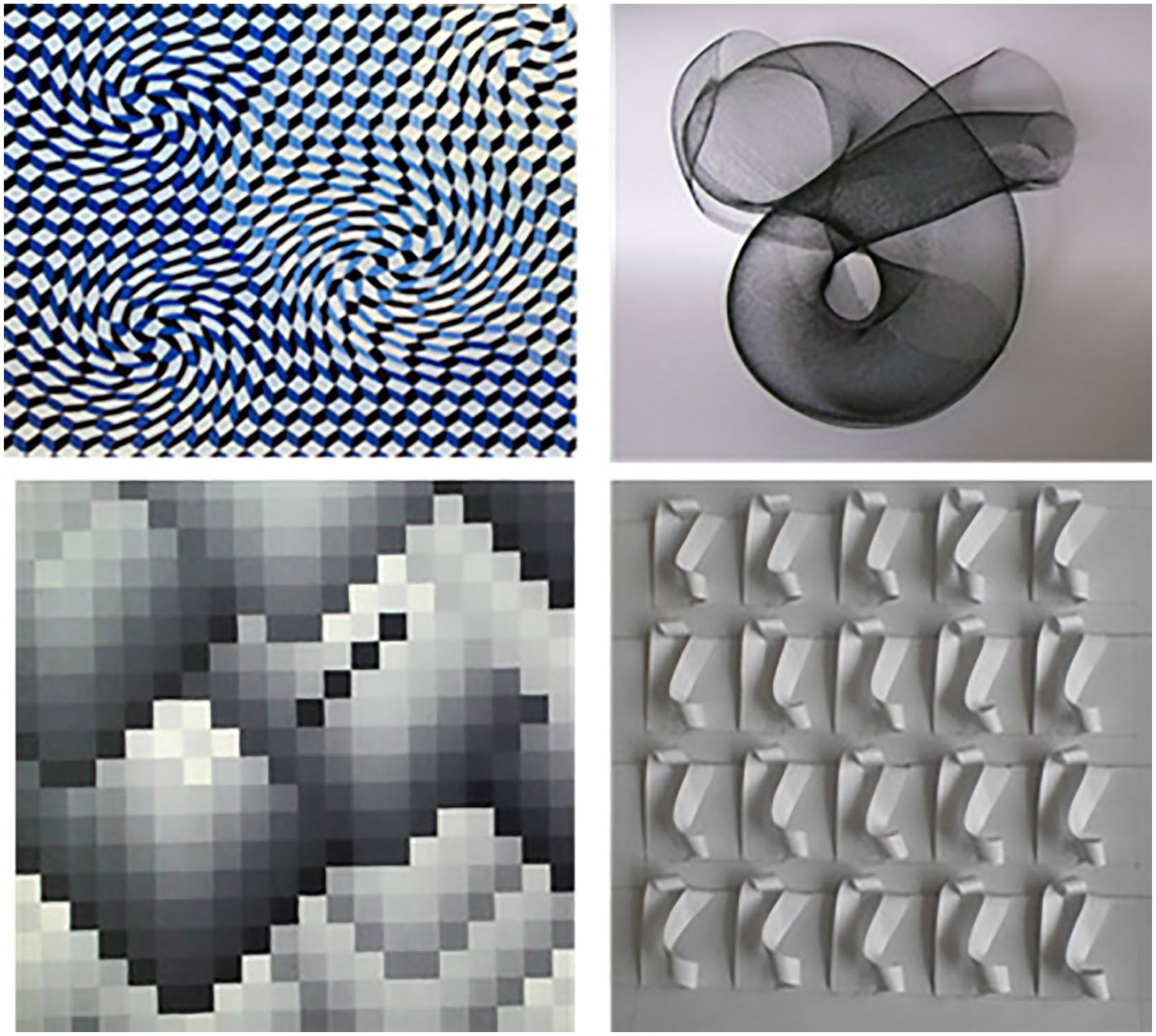
Examples of Nirmana in two-dimensional (left) and three-dimensional (right) compositions.
Beyond her academic contributions, Rita became a nationally recognized sculptor known for her stainless-steel works that embody geometric clarity and formal balance. Her public sculptures in cities such as Jakarta, Palembang, and Balikpapan reflect the same principles of structure, rhythm, and proportion that she instilled in her students. Through both her artistic and pedagogical practice, Rita Widagdo became a crucial transmitter of Bauhaus values in postcolonial Indonesia—demonstrating how Modernist discipline could coexist with cultural particularity. Her legacy lies not only in the visual order of her sculptures or the curriculum she helped build, but in the generation of Indonesian designers who learned to see design as a disciplined act of thought, material, and spirit.
Transformation of Interior Design Education in Indonesia
In 1965, after completing his studies in Stuttgart, Widagdo returned to Indonesia and visited the ITB, where he was introduced to Ahmad Sadali. Sadali—who had established the Interior Arts program in 1959—invited him to contribute to its further development. The following year, in 1966, Widagdo officially renamed the program from Interior Arts to Interior Architecture, reflecting the German academic model and signaling a shift from decorative practice to spatial design pedagogy.
This renaming was more than administrative; it marked a conceptual transformation from “arts of the interior” to “architecture of the interior.” While adapting to ITB’s institutional structure, Widagdo was granted significant autonomy to reform the curriculum according to the Bauhaus-derived principles he had absorbed in Stuttgart.
Widagdo was supported by a team of young lecturers—Sukria Fihamatmadja, Ma'mun Mulia, and Achadiat Yudawinata—all alumni of the Interior Arts program. Together, they translated Bauhaus pedagogy into the Indonesian classroom, introducing studio-based learning, hands-on experimentation, and iterative critique. Although archival documentation from the 1960s–1980s is scarce, vivid alumni recollections describe a studio culture that embodied discipline and collaboration. Housed in a Dutch colonial building near ITB’s East Hall, the studio’s spatial layout—high ceilings, gray cement tiles, teak drawing tables, and custom-built “drawing machines”—created an environment that echoed the rigor of European ateliers while remaining rooted in local materiality.
Evidence of the curriculum’s structure can be found in the academic transcript of Miya Rumiyana (class of 1964), which reveals that the first four semesters were dedicated to foundational courses such as Nirmana (basic design) before advancing to specialized studios in interior architecture. This sequence—foundation to specialization—mirrored the Bauhaus educational model but was recontextualized for Indonesia’s institutional and cultural conditions (Figure 7).
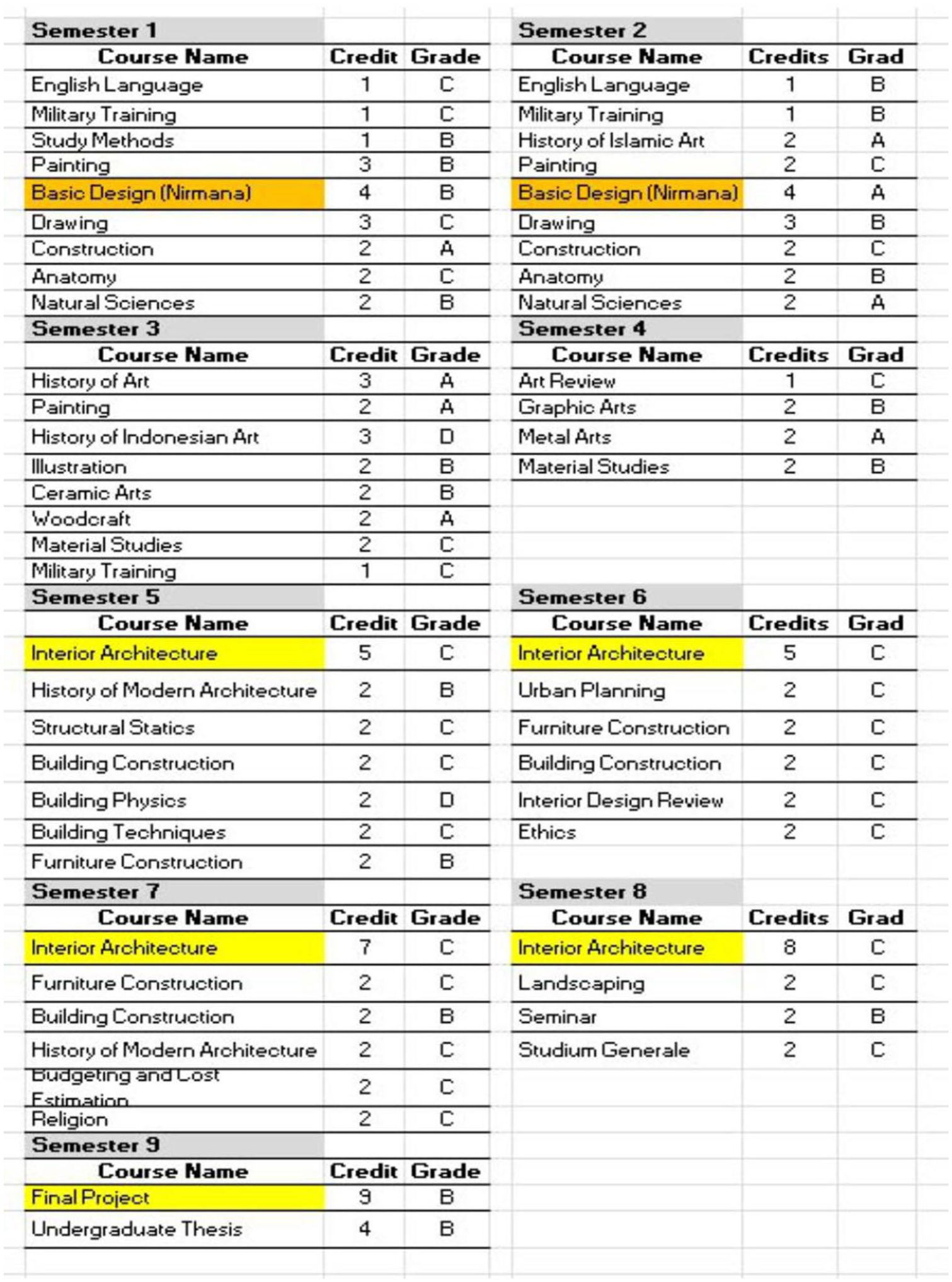
Distribution of interior design courses in the 1960s–1970s curriculum, based on archival transcript data (Miya Rumiyana).
The program’s studios focused on three main categories: residential, commercial, and institutional interiors. As students advanced, project complexity increased—from small domestic spaces to hotels, museums, and government offices. Pedagogically, the emphasis shifted from aesthetic arrangement to spatial reasoning—how interior environments shape human experience and support function. The academic journey culminated in the Final Project, preceded by an internship in professional practice—a requirement introduced by Widagdo to bridge academic learning and the realities of Indonesia’s growing design industry.
The pedagogical outcomes of this system can be seen in the student works of the 1970s, such as Pribadi Widodo (class of 1977). His eighth-semester project—a hand-rendered hotel interior perspective (Figure 8, left)—and his Final Project maquette (Figure 8, right) demonstrate mastery of spatial composition, color harmony, and modular planning. These works exemplify the integration of Bauhaus functionalism into the Indonesian context: rational layouts adapted to tropical materiality and social function.
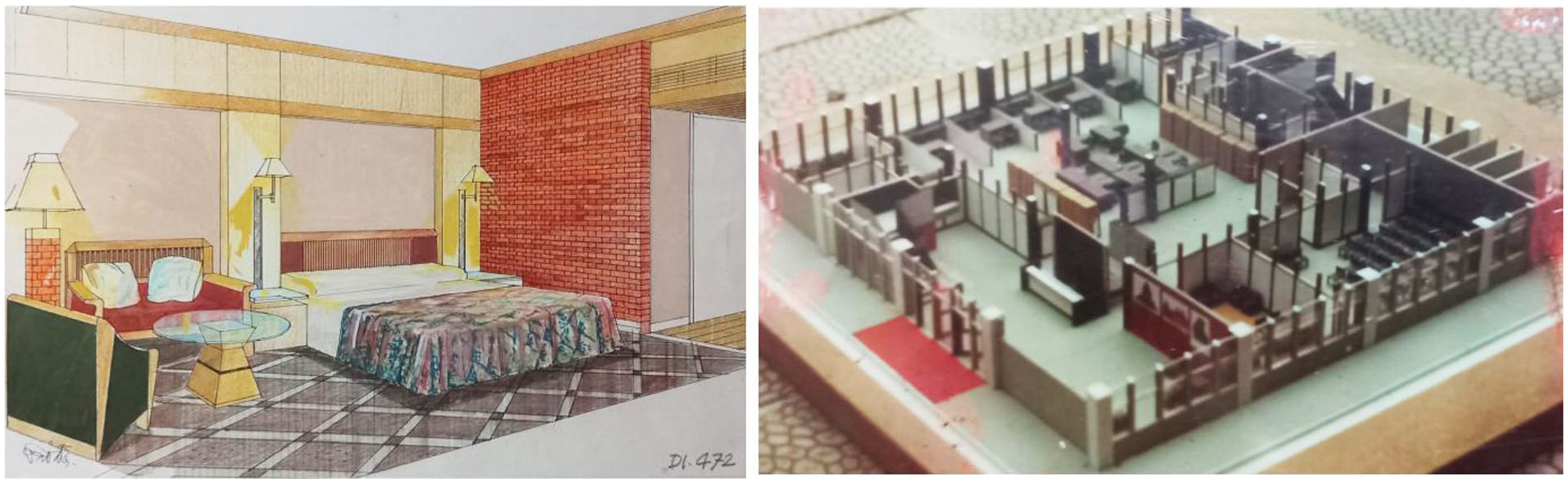
A hand-rendered perspective of a hotel bedroom by Pribadi Widodo (left). Maquette for final project of office interior design (right).
Complementing spatial design, the curriculum incorporated a progressive series of furniture design courses—beginning with basic seating, advancing to modular systems, and culminating in full-scale prototyping. While European schools emphasized in-house fabrication, ITB collaborated with local craftsmen and furniture industries, forging an early model of academic–industry partnership. This practice localized Bauhaus’s “learning by doing” principle, aligning it with Indonesia’s craft traditions and limited workshop infrastructure.
Through these curricular and methodological transformations, Widagdo effectively indigenized Bauhaus education—translating its universal design ethos into a pedagogy attuned to Indonesian material culture, institutional capacity, and social context.
Widagdo effectively indigenized Bauhaus education…
Bridging Bauhaus and Tradition: Interior Design Education in Postcolonial Indonesia
Although Widagdo was trained in Modernist design under Herbert Hirche in Stuttgart, he did not simply transplant those ideas into Indonesia. In a personal interview, he recalled 23 that his first step upon returning was to “take distance” from the Bauhaus ideals he had internalized. This distancing was not rejection but reinterpretation—a conscious adaptation of Modernism to Indonesia’s postcolonial realities. He recognized that local traditions—communal values, symbolic meaning, and vernacular spatial forms—were essential for constructing a modern national identity.
This adaptive approach reflected the hybrid intellectual and institutional landscape of the 1960s. Rather than replicating Bauhaus pedagogy, Widagdo localized it through critical engagement with indigenous design knowledge and educational conditions. As Gunawan observes, 24 his teaching philosophy avoided stylistic imitation, promoting analytical understanding of traditional logic and proportion. For Widagdo, the true continuity between tradition and Modernism lay in uncovering shared design principles—structure, rhythm, balance—rather than in visual replication.
Accordingly, the curriculum he developed integrated Modernist design foundations with Indonesia’s own architectural and artistic heritage. Students studied vernacular typologies such as the joglo, balé, and gadang, as well as monumental structures like Borobudur. These were not presented as nostalgic icons, but as living systems of proportion and meaning. Through comparative analysis, students learned to reinterpret traditional space in modern terms—connecting local cosmology with functional design thinking. Historical figures such as Raden Saleh were introduced as early models of hybridity: European-trained yet grounded in local sensibility, fusing Romantic technique with Javanese imagination. 25 This method provided continuity between craft, art, and design—an educational genealogy that positioned Indonesian Modernism within its own historical roots.
The influence of Widagdo’s pedagogy was visible in the work of his students, including Pribadi Widodo, who continued assisting him in studio courses while practicing as a designer. In 1988, Widodo’s hotel interior project in Bali (Figure 9) exemplified this synthesis: Modernist spatial clarity organized through tropical materiality and cultural symbolism. The wooden roof structure, ornamental carving, and open-plan layout reflected both Bauhaus rationality and Balinese spatial harmony. This demonstrated how Widagdo’s educational model extended into professional practice—fostering a generation capable of translating cultural meaning into Modern design form (Figure 9).
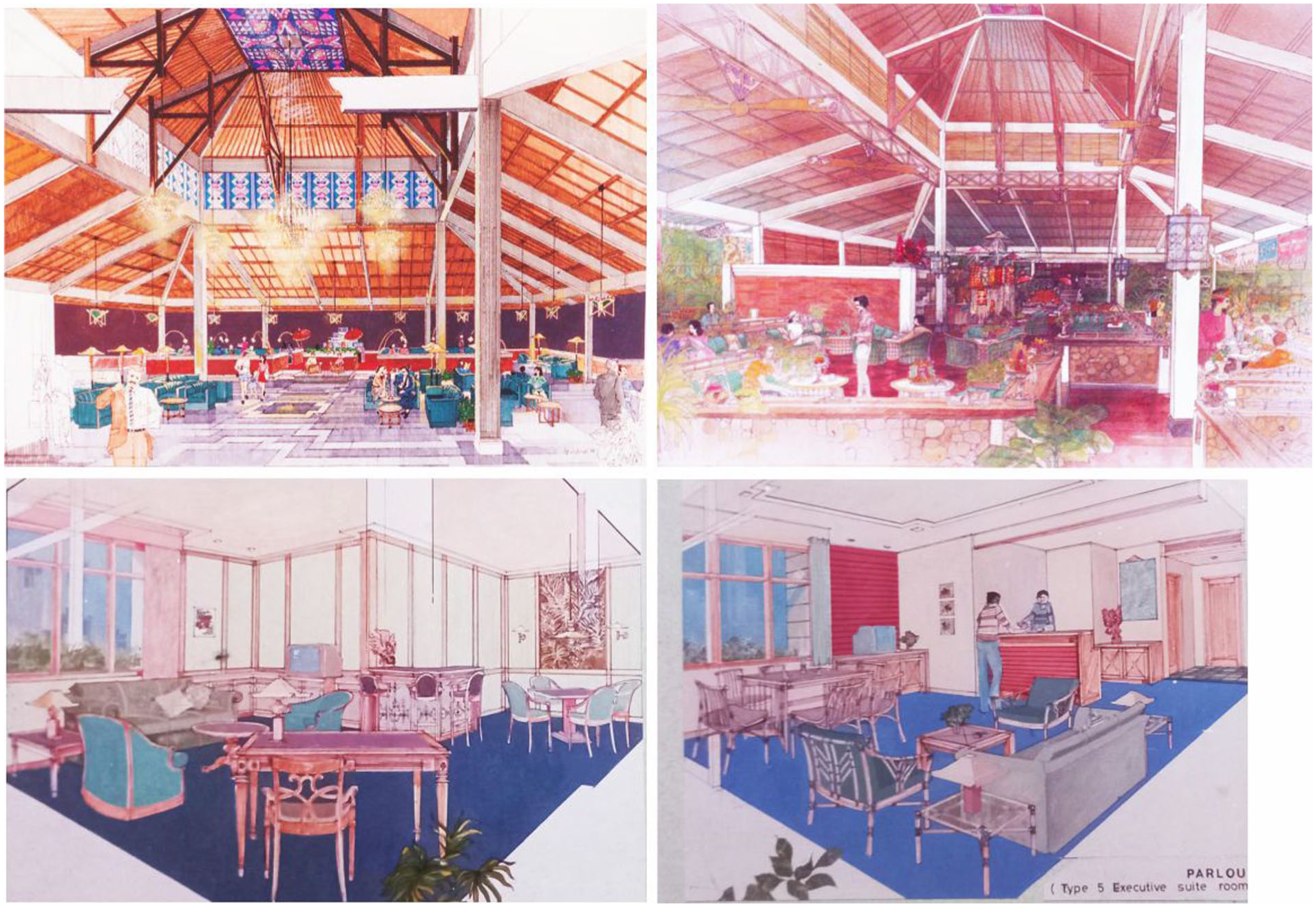
Perspective rendering of a hotel lobby in Bali, designed by Pribadi Widodo, alumnus of the ITB Interior Design program. The project combines tropical vernacular architecture with Modern planning principles, reflecting Widagdo’s influence.
Beyond Bandung, Widagdo’s students became key agents in establishing interior design departments throughout Indonesia, embedding his pedagogy into national education. This diffusion aligned with the vision articulated by Boyer and Mitgang, 26 who called for design education that is culturally responsive and socially grounded.
Throughout his career, Widagdo continued to stress that Bauhaus principles required reinterpretation rather than imitation. In another personal interview, he argued 27 that uncritical Western adoption was “unsuitable for a nation still defining itself.” Instead, he selectively integrated Bauhaus methods—such as material discipline, process-based learning, and the ethics of function—into a curriculum informed by Indonesia’s own visual and craft traditions.
He regarded Indonesia’s ethnic diversity as an untapped resource for Modern design identity. Each region offered unique spatial logics and symbolic languages that could inform contemporary practice. His teaching thus balanced analytic precision with intuitive cultural understanding, framing design as both an intellectual and moral act. For Widagdo, interior design was an applied art, where aesthetics serve social and spiritual functions.
While Western Modernism often pursued rupture from history, Widagdo positioned Modernism in Indonesia as a bridge—linking past and future, locality and universality. His perspective resonates with Sachari, 28 who identified Indonesia’s Modern design education as a synthesis of traditional craft, symbolic vocabulary, and Modernist pedagogy.
Ultimately, Widagdo’s enduring contribution lies in this synthesis: a pedagogy that united rational Modernism with cultural meaning. Through his teaching, mentorship, and leadership, he transformed Bauhaus ideals into a living framework for Indonesian design education—modern, yet unmistakably rooted in place.
Visual Discipline: Crafting Character Through Studio Culture
Widagdo’s reinterpretation of Bauhaus pedagogy emphasized studio-based learning, process-oriented exploration, and material honesty. His teaching demonstrated that Bauhaus ideals could not simply be transplanted; they had to be translated into Indonesia’s social and material context. In this adaptation, the Bauhaus became less a European legacy and more a pedagogical method for cultivating discipline, creativity, and ethical awareness in a postcolonial environment.
The interior design courses he introduced at ITB integrated structured studio projects, material experimentation, and spatial analysis—creating a framework that combined Modernist rigor with Indonesian cultural sensibility. This hybrid approach laid the foundation for a distinct model of interior design education that was both globally informed and locally grounded.
Studio culture was central to this process of formation. It shaped not only students’ technical competence but also their professional ethos. Oral testimonies from alumni describe a studio environment defined by rigor, repetition, and collaboration—where critique and camaraderie coexisted. These nightly sessions of model-making and iterative refinement mirrored the Bauhaus workshop tradition while evolving its own local character—equal parts discipline and humor. As McCoy, Guerin, and Martin argue, 29 design studios act as cultural microcosms; in Bandung, they became spaces where European method, local material culture, and postcolonial aspiration converged.
At the heart of Widagdo’s pedagogy was moral precision. He viewed drawing and making as ethical acts—requiring sincerity, patience, and respect for material. Students recalled his insistence that craftsmanship reflected character; a poorly executed line was, to him, a failure of thought. Assignments demanded iterative drawings on duplex board—a surface that tolerated no error—and the exclusive use of professional instruments such as Rotring or Staedtler pens. These tools symbolized discipline, not luxury, embodying the seriousness of the designer’s vocation.
At the heart of Widagdo’s pedagogy was moral precision.
His critiques were legendary. Sharp yet laced with dry humor, they became part of studio folklore. When reviewing a project with a curved table edge, he famously asked, “Why does that table look like a train?”—a moment both mortifying and formative. Such comments, though playful, underscored his belief that wit and precision were equally vital to the design process. Through these rituals of critique, students internalized the values of clarity, proportion, and intellectual rigor.
For Widagdo, the studio was a site of moral education as much as technical training. Students learned that the act of drawing was a commitment to truth in representation, and the act of making was a negotiation between idea and material constraint. In this way, his teaching embodied the Bauhaus spirit—learning through making—but rooted it in Indonesian virtues of diligence (ketekunan) and communal collaboration (gotong royong).
This pedagogical philosophy culminated in the renaming of the department in 1980 from Interior Architecture to Interior Design, aligning it with international nomenclature while maintaining its German pedagogical roots in Innenarchitektur. The change signaled a maturation of the discipline in Indonesia—from colonial craft education to an autonomous, research-based academic field.
In recognition of his lifelong contribution, former students organized a celebration of Widagdo’s eighty-first birthday in Bandung in 2015—a testament to a teacher whose influence extended beyond classrooms into professional identity formation (Figure 10).
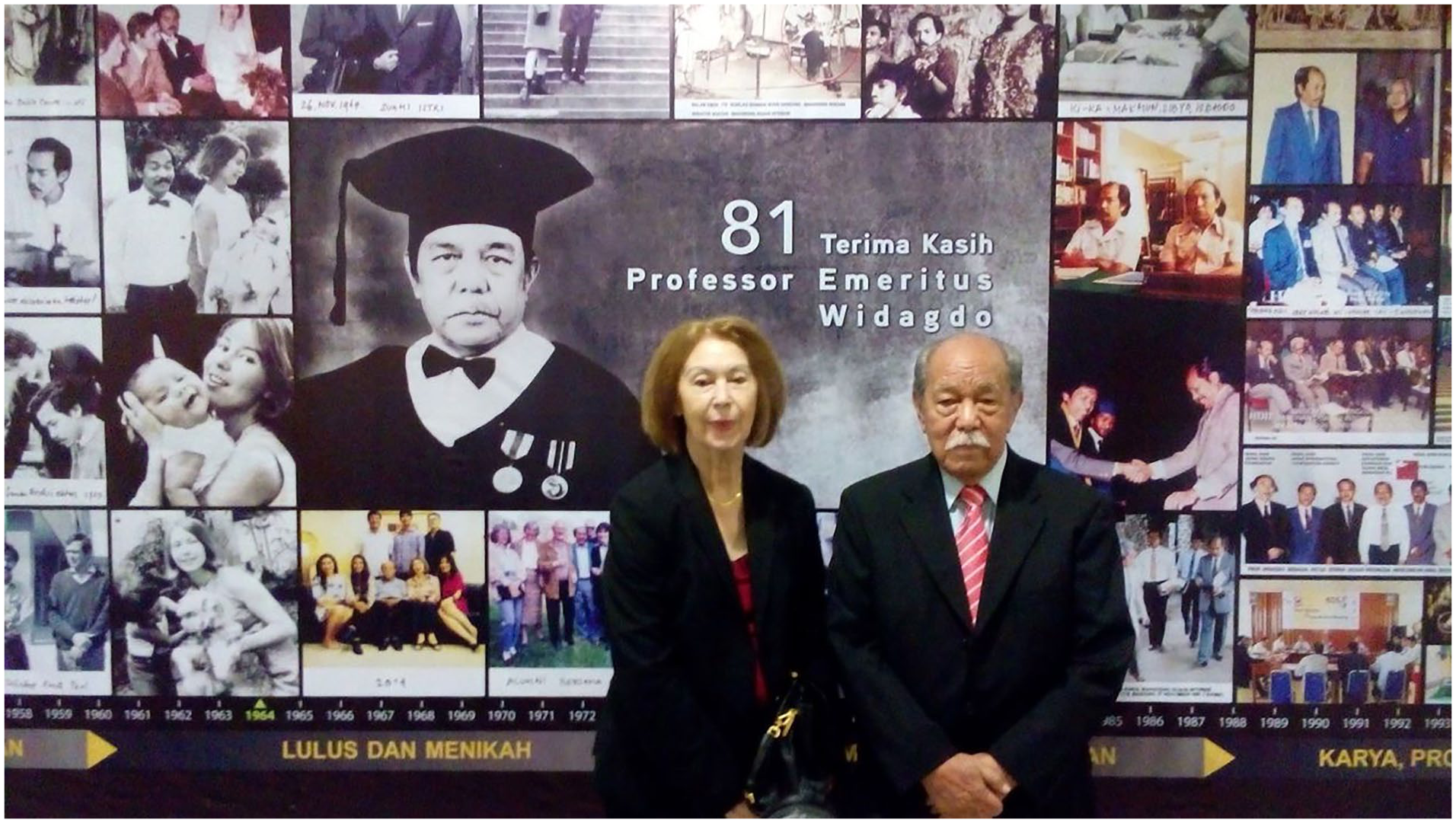
Professor Emeritus Widagdo and Rita Widagdo, photographed during his eighty-first birthday celebration in Bandung, 2015—an event organized by his former students as a tribute to his legacy.
Global Influences on Indonesian Design Education: From Bauhaus to Scandinavia and the United States
While the German Bauhaus provided the intellectual foundation for Indonesia’s early interior design education, other global Modernist movements also played formative roles—particularly the Scandinavian and American schools of thought. Together, these influences introduced new conceptions of functionality, humanism, and materiality that expanded the scope of design pedagogy beyond European Modernism.
At the ITB, international study became a strategic pathway to build disciplinary expertise. In the 1950s and 1960s, the institution sent young lecturers abroad to cultivate new areas of specialization. This academic migration reflected a postcolonial aspiration to align Indonesia’s design education with global standards while developing its own national identity.
Sudjoko became the first fine arts lecturer to study overseas, earning a master’s degree in Art History from the University of Chicago (1959) and a doctorate in Art Education from Ohio State University (1971). His exposure to American liberal arts pedagogy introduced analytical and contextual approaches to art education, which later shaped ITB’s design curriculum. At ITB, Sudjoko taught Art History and Asian Culture, grounding design in a broader humanistic and cultural framework.
In the early 1970s, several lecturers pursued overseas study to develop emerging disciplines. A. D. Pirous and Yusuf Affendi both studied at the Rochester Institute of Technology, New York—specializing in Graphic Design and Textile Design, respectively. Upon returning, they established new studios within the Department of Fine Arts, formalizing Graphic and Textile Design as academic fields. Their presence diversified ITB’s curriculum and encouraged interdisciplinary collaboration across design disciplines.
At the same time, international exposure to design centers in Europe and America broadened the educational landscape. Imam Buchori Zainuddin studied Product Design at Kunstakademiets Arkitektskole in Copenhagen, where he encountered Scandinavian functionalism—a design philosophy rooted in simplicity, craftsmanship, and the ethical use of natural materials. Dibyo Hartono attended the Rhode Island School of Design, where the humanistic Modernism of Frank Lloyd Wright and Charles Eames emphasized organic unity between structure, interior, and landscape.
Upon returning, both lecturers contributed to the establishment of the Product Design Studio at ITB, continuing the pedagogical lineage initiated by Widagdo. Their combined influence introduced user-centered and ecological perspectives into design thinking—bridging the Bauhaus ethos of rational form with Scandinavian and American ideals of humanism and environmental harmony.
Although these educators did not teach directly in the Interior Design Studio, their academic experiences abroad significantly shaped ITB’s broader pedagogical ecosystem. The cross-pollination among graphic, textile, product, and interior design studios fostered an interdisciplinary culture where visual communication, material exploration, and spatial composition were treated as interconnected fields.
Global Modernist ideas also reached Indonesia indirectly—through books, design journals, traveling exhibitions, and visiting scholars. These mediated channels created a layered process of cultural transmission, where global ideas were selectively absorbed, localized, and integrated into existing frameworks. By the late 1970s, Indonesian design education had evolved into a pluralistic system—rooted in Bauhaus discipline, enriched by Scandinavian craftsmanship, and expanded by American humanism.
This convergence of multiple Modernisms did not dilute Indonesia’s design identity; it diversified it. Through adaptation and reinterpretation, Indonesian educators forged a pedagogical model that was globally conversant yet deeply grounded in local cultural and material realities.
Conclusion
These findings indicate that the emergence of interior design education in Indonesia was not a passive transmission of European Modernist pedagogy but an active process of reinterpretation and localization. Drawing on Bauhaus-derived methods, Widagdo redefined design teaching as a dialogue between global Modernism and Indonesian cultural identity. His pedagogy—shaped by material experimentation, spatial discipline, and ethical precision—translated Modernist ideals into a postcolonial framework where education became a vehicle for both resistance and reconstruction.
Rather than perpetuating a universalist paradigm, Widagdo’s teaching reframed global design methods through local cultural logic. His adaptation of Bauhaus principles to Indonesian materials, vernacular forms, and symbolic systems legitimized indigenous design thinking within an international discourse. In this sense, interior design education in Indonesia functioned not merely as technical training but as a site of cultural negotiation and identity formation in the early post-independence period.
The Indonesian case illustrates how Modern design pedagogy can simultaneously embody global ideals and articulate local aspirations. It shows that design education in postcolonial societies does not imitate Western models but appropriates and transforms them to express national consciousness. In doing so, it expands the historiography of design education beyond Euro-American narratives, positioning Indonesia as a key reference for understanding how modernism is indigenized and reimagined in the Global South.
More broadly, this study underscores the need to engage with local pedagogical histories as a means of diversifying and decolonizing design education. The Indonesian experience highlights that Modern design cannot be detached from its social, cultural, and political contexts. It is through such contextual adaptation—balancing imported ideals with indigenous values—that design education achieves cultural relevance and intellectual depth.
As global design institutions today call for inclusivity and pluralism, Indonesia’s model offers a vital precedent: a design pedagogy that is modern yet rooted in tradition, disciplined yet humanistic, and globally connected yet unmistakably local. In this way, the legacy of the Widagdos continues to shape not only Indonesian design education but also the global understanding of how modernism adapts and endures through cultural translation.
Footnotes
Declaration of Conflicting Interests
The authors declared no potential conflicts of interest with respect to the research, authorship, and/or publication of this article.
Funding
The authors received no financial support for the research, authorship, and/or publication of this article.
