






Abstract
The National Institute of Mental Health Research Domain Criteria initiative (Insel et al., 2010) calls for a focus on biologically meaningful dimensional constructs in the study of clinical problems. Examples are needed of how Research Domain Criteria constructs can be linked to clinical problems. We examined how two such constructs, threat sensitivity (THT+) and weak inhibitory control (INH−), operationalized using scale measures of fear/fearlessness and inhibition/disinhibition dimensions from established structural models, predicted symptoms of multiple Diagnostic and Statistical Manual of Mental Disorders (4th edition) clinical disorders in 471 community adults. Robust relationships with internalizing disorder symptoms were evident for both trait variables, with THT+ more predictive of fear disorder symptoms and INH− more predictive of distress disorder symptoms. For substance-related problems, prediction was evident only for INH−. Additionally, interactive effects of THT+ and INH− were found for distress disorders, and to a lesser extent, fear disorders. Given their well-established physiological correlates, these dispositional variables represent prime targets for combined psychometric–neurophysiological assessment of broad liabilities to multiple forms of psychopathology.
Calls have intensified for mental health researchers to incorporate neurobiological variables into conceptions of psychological disorders and methods for assessing them (Hyman, 2007), so as to permit knowledge of neural systems to inform and guide prevention and treatment efforts (Insel & Scolnick, 2006). Psychiatric disorders as currently defined pose challenges to neurobiological analysis, as they are complex phenotypically (i.e., manifest in diverse ways across affected individuals), routinely co-occur (i.e., show high levels of comorbidity), and are operationalized nonbiologically (i.e., mainly through interview-based ratings), constraining their ability to correlate with physiological variables (Campbell & Fiske, 1959; Patrick et al., 2013b). One approach that may help bring diagnostic and biological conceptions (and their operationalizations) into closer proximity entails focusing on neurobehavioral trait constructs—that is, individual difference constructs with direct referents in neurobiology as well as behavior (Patrick et al., 2013b).
The National Institute of Mental Health’s Research Domain Criteria (RDoC; Cuthbert & Insel, 2013; Insel et al., 2010) initiative in particular emphasizes the study of biologically meaningful dimensional constructs. Yet empirical examples are needed of how biobehavioral constructs specified in the RDoC framework can be effectively linked to clinical problems. The current study evaluated contributions of two dispositional variables corresponding to RDoC constructs of response inhibition and acute threat—inhibition/disinhibition and fear/fearlessness—to prediction of various internalizing (mood and anxiety) and externalizing (substance use) problems. By demonstrating the transdiagnostic relevance of these RDoC-related trait dispositions (Nolen-Hoeksema & Watkins, 2011), which have counterparts in neural systems and correlate reliably with physiological indicators, our study highlights the potential role that such constructs can play in bridging diagnostic and neurophysiological domains.
Two biobehavioral dispositions with ostensible relevance to many common forms of psychopathology are fear/fearlessness, corresponding to “acute threat” in the “Negative Valence Systems” domain of the RDoC framework, and inhibitory control (inhibition/disinhibition), corresponding to response inhibition in the “Cognitive Systems” domain. Dispositional fear (or threat sensitivity [THT+]), reflecting heightened negative emotional reactivity to threatening situations and stimuli, appears most relevant to focal fear disorders such as specific phobia, social phobia, and panic disorder. Weak inhibitory control (or deficient response inhibition [INH−]), reflecting impaired capacity for behavioral restraint, is most clearly relevant to externalizing conditions such as alcohol and drug dependence and antisocial behavior problems. Both dispositions may be relevant to distress (or “anxious misery”; Krueger, 1999; Watson, 2005) conditions such as major depression, dysthymia, and generalized anxiety disorder—which are marked by pervasive, dysregulated negative affect.
Notably, quantitative measurement models exist for these two dispositional constructs with established links to neurobiology. Kramer, Patrick, Krueger, and Gasperi (2012) modeled the structure of various existing scale measures of situational fear- and fearless-dominant tendencies in a large adult twin sample and identified a bipolar factor that accounted for substantial variance in all scales. Scores on this fear/fearlessness factor were appreciably heritable and—extending prior work demonstrating relations of individual scale indicators with physiological threat reactivity (Vaidyanathan, Patrick, & Bernat, 2009a; Vaidyanathan, Patrick, & Cuthbert, 2009b)—associated with variations in aversive startle potentiation, a reflex-based index of brain defensive activation (Lang, Davis, & Ohman, 2000). A brief scale measure exists for operationalizing THT+ in terms of scores on this general fear/fearlessness factor (Patrick, Durbin, & Moser, 2012; Vizueta, Patrick, Jiang, Thomas, & He, 2012). A counterpart model of inhibition/disinhibition exists in the form of the Externalizing Spectrum Inventory (ESI)—a comprehensive index of disinhibitory behaviors and traits (Krueger, Markon, Patrick, Benning, & Kramer, 2007). The 23 content scales of the ESI load together on a common factor, also appreciably heritable (Yancey, Venables, Hicks, & Patrick, 2013), that demonstrates reliable associations with brain response indicators of disinhibitory tendencies including P300 and error-related negativity (Hall, Bernat, & Patrick, 2007; Nelson, Patrick, & Bernat, 2011). As with the fear/fearlessness factor, a brief scale measure exists for operationalizing INH− in terms of this general disinhibition factor (Patrick, Kramer, Krueger, & Markon, 2013a).
Operationalized in these ways, THT+ and INH− can be linked to self-report frameworks for personality such as the five-factor model (Costa & McCrae, 1992) and Multidimensional Personality Questionnaire framework (Tellegen & Waller, 2008). Given their bases in structural models focusing on scale measures with common neurophysiological correlates, these dispositions do not map neatly onto basic traits or broad dimensions of report-based personality frameworks. However, recent work indicates that THT+ and INH− can be indexed effectively using items from differing trait scales of inventories that capture these models (Brislin, Drislane, Smith, Edens, & Patrick, 2015; Poy, Segarra, Esteller, Lopez, & Molto, 2014). As such, and given their conceptual bases in neural systems and empirical relations with physiological indicators, these dispositional constructs—whether operationalized as dispositional fear/fearlessness and general disinhibition or as composites of items from standard personality inventories—have unique potential to serve as effective bridges between clinical and neurobiological domains. In focusing on neurobehavioral dispositions, the current approach is also consistent with broader calls to incorporate dimensional trait constructs into major diagnostic nosologies (see Widiger, 2011), exemplified most recently in the comprehensive maladaptive personality model included in the 5th edition of the Diagnostic and Statistical Manual of Mental Disorders (DSM-5; American Psychiatric Association, 2013).
To further establish their utility, a systematic evaluation of associations for THT+ and INH- with clinical conditions is needed. The current study examined relations of these dispositions with symptoms of common disorders as defined in DSM-IV using data from a large adult community sample. Specifically, relationships were examined with sets of DSM-IV Axis I clinical disorders that have been shown to covary systematically in factor analytic studies (e.g., Kendler, Prescott, Myers, & Neale, 2003; Patrick et al., 2006; Vizueta et al., 2012): fear disorders (phobias, panic disorder, agoraphobia, obsessive–compulsive disorder), distress disorders (major depression, dysthymia, generalized anxiety, posttraumatic stress disorder [PTSD]), and substance-related externalizing disorders (alcohol abuse/dependence, drug/abuse dependence).
Given the differing psychometric and physiological correlates of THT+ and INH− (Patrick et al., 2012), and the distinct neural systems thought to contribute to externalizing and fear disorders (e.g., Hall et al., 2007; Vaidyanathan, Nelson, & Patrick, 2012), we hypothesized that:
Our expectation that THT+ would correlate with fear disorders more than distress disorders was founded on evidence indicating that phasic, cue-elicited fear and tonic, nonspecific anxiety are relatively distinct, both psychometrically and neurobiologically (for reviews, see Sylvers, Lilienfeld, & LaPrairie, 2011; Vaidyanathan et al., 2012; Vaidyanathan et al., 2009b; White & Depue, 1999). We also tested for possible interactive effects of these two dispositional variables in predicting disorders of each type.
Method
Participants
The study sample consisted of 508 same-sex adult twins (257 female) recruited from the Minneapolis-Saint Paul metro area, of whom half were preselected for levels of THT+ (see below). Written informed consent was obtained prior to testing, which included a diagnostic interview, a lab-task physiology assessment, and administration of questionnaires, for which participants were paid $100. Diagnostic data were unavailable for two participants and 35 were missing questionnaire data. Excluding these participants yielded a final sample of 471 (52% male; 96.4% Caucasian; M age = 29.5 years, SD = 4.8).
Questionnaire and Interview Measures
THT+: Trait Fear Inventory
The 55-item Trait Fear inventory (TF-55; Kramer et al., 2012; Patrick et al., 2012; Vaidyanathan et al., 2009a; Vizueta et al., 2012) was developed to index the general factor found to underlie various scale measures of fear/fearlessness (Kramer et al., 2012)—which accounts for relations of these differing scales with aversive startle potentiation (Kramer et al., 2012; Vaidyanathan et al., 2009a). The TF-55 contains subsets of items from 10 scales: the Fear Survey Schedule-III (Arrindell, Emmelkamp, & van der Ende, 1984), the Fearfulness subscale of the Emotionality, Activity, Sociability Temperament Survey (Buss & Plomin, 1984), the four facet scales of Harm Avoidance from Cloninger’s (1987) Temperament and Personality Questionnaire, the Thrill/Adventure Seeking subscale of the Sensation Seeking Scale (Zuckerman, 1979), and the three subscales that demarcate the fearless dominance factor of the Psychopathic Personality Inventory (Lilienfeld & Andrews, 1996). Items from all 10 of these scales are included in the TF-55 because all of them loaded appreciably (i.e., ~.5 to .8; see Kramer et al., 2012) on the general factor of the fear/fearlessness model. The inventory contains items of two types: (a) trait-oriented items pertaining to general presence/absence of fear experience, discomfort with versus tolerance for unfamiliarity/risk, and low versus high social assurance/assertiveness and (b) items pertaining to fear of specific objects or situations and enjoyment of specific risky but adventurous activities or occupations. Scores on the TF-55, computed as an average score across constituent items (each coded 0 to 3, in the direction of higher fear), correlate very highly (r > .9) with scores on the general fear/fearlessness factor from the model of these differing scale measures (Patrick et al., 2012).
Participants were recruited from a larger sample prescreened using the TF-55 (N = 2,511; Kramer et al., 2012). Half of the sample (one member of each twin pair) was preselected based on TF-55 scores to ensure an adequate spread across levels of THT+, with the other half comprising unselected co-twins. In particular, approximately one third of the selected portion of the sample were chosen to be high in THT+ (i.e., highest 18% of screening sample), one-third to be low (lowest 18%), and the remaining third to represent the intermediate range (19th to 82nd percentile of scorers). The TF-55 measure was readministered at time of testing and scores from this administration were utilized in all analyses. On average, women scored higher than men on this index of THT+: item-score Ms (SDs) = 1.33 (0.44) and 0.94 (0.41), respectively; t(469) = −10.05, p < .001 (where p values in this report reflect significance from a mixed-model analysis that adjusts for the twin composition of the sample; Carlin, Gurrin, Sterne, Morley, & Dwyer, 2005; Visscher, Benyamin, & White, 2004).
INH–: Externalizing Spectrum Inventory (ESI)
Participants completed a 100-item version of the ESI, an inventory of behavioral and dispositional tendencies associated with externalizing psychopathology (Krueger et al., 2007). The ESI’s 23 subscales index differing expressions of externalizing proneness, including aggression, irresponsibility, boredom proneness, impulsivity, theft, fraud, rebelliousness, alienation, blame externalization, and drug and alcohol problems. Higher ESI scores indicate greater disinhibitory tendencies, or INH−. In line with recent prior work (Yancey et al., 2013), INH− was operationalized for purposes of analyses as the mean score across 30 items (each coded 0 to 3, in the direction of higher disinhibition) from subscales as follows that load selectively on the ESI’s general disinhibition factor: irresponsibility, dependability, problematic impulsivity, impatient urgency, planful control, alienation, and theft. Notably, this set of 30 items does not include any pertaining to substance use/abuse or mood or anxiety disorder symptoms akin to those assessed via clinical interview (see below). Men scored higher on average than women on this index of INH−: item-score Ms (SDs) = 0.47 (0.37) and 0.36 (0.31), respectively; t(442.60) = 3.45, p = .004.
Current Dysphoria: Inventory of Depression and Anxiety Symptoms (IDAS)
The IDAS (Watson et al., 2007) assesses for current symptoms of major depression and anxiety disorders that commonly co-occur with depression. Items are self-rated over a recent timeframe (i.e., past 2 weeks), using a 5-point scale (coded 1-5). The IDAS includes a dysphoria scale that indexes general depressed mood and distress, along with narrower scales indexing specific clinical symptoms (i.e., lassitude, insomnia, appetite gain, appetite loss, suicidality, traumatic intrusions, ill temper, panic, social anxiousness). The dysphoria scale was included in supplemental analyses directed at evaluating incremental prediction of clinical problems from dispositional variables of interest (THT+ and INH−) over and above current dysphoria/distress. Men and women did not differ in levels of current dysphoria as indexed by this scale: item-score Ms (SDs) = 1.65 (0.62) and 1.61 (0.59), respectively; t(469) = 0.78, p = .47.
Structured Clinical Interview for DSM-IV-TR Disorders (SCID-I)
The SCID-I (nonpatient edition; First, Spitzer, Gibbon, & Williams, 2002) is a structured clinical interview designed to assess the full range of Axis I psychiatric disorders, including anxiety and mood disorders, eating disorders, substance use disorders, and psychotic disorders. Interviews were conducted by advanced clinical psychology graduate students trained in interview-based diagnostic assessment using the SCID-I protocol. Interviewers had no knowledge of other assessment data collected from interviewees. Arbitrary skip-out rules were relaxed to achieve comprehensive dimensional symptom scores for each disorder. For example, all questions pertaining to substance abuse and dependence symptoms were posed for each substance endorsed as being used in the past. Participants who endorsed PTSD criterion A (witnessed/experienced a fearful traumatic event) were asked all remaining PTSD criteria. All panic disorder criteria A and B questions were asked even if participants had experienced only one panic attack.
Symptom ratings were assigned through a consensus process entailing meetings attended by the interviewers (cf. Iacono, Carlson, Taylor, Elkins, & McGue, 1999), along with the project principal investigator (Patrick) and a licensed PhD-level clinical psychologist with extensive experience using the SCID-I in clinical and research contexts (Arbisi). Interviewers recorded participant responses verbatim, and interviews were video recorded so that potentially ambiguous responses could be reviewed and resolved.
Derivation of DSM-IV-TR Clinical Symptom Variables
A symptom count variable was computed for each of the following clinical conditions, within categories delineated by comorbidity modeling studies (e.g., Cox, Clara, & Enns, 2002; Krueger, 1999; Slade & Watson, 2006; Vaidyanathan, Patrick, & Iacono, 2011; Vollebergh et al., 2001): fear disorders—specific phobia, social phobia, panic disorder, agoraphobia, obsessive−compulsive disorder; distress disorders—major depression, dysthymia, generalized anxiety disorder, PTSD; substance use disorders—alcohol abuse, alcohol dependence, cannabis abuse, cannabis dependence, other drug (stimulant, cocaine, opioid, hallucinogen) abuse, other drug dependence. Symptom counts in each case corresponded to the maximum number of DSM-IV-TR criteria met for the condition at any time in the individual’s life. Criteria reflecting disorder symptoms and severity (i.e., distress or impairment criteria) were included in the count for each condition. Symptoms deemed to be due to the direct effects of a substance, general medical condition, or (in the case of depression) bereavement were excluded.
In addition to symptom scores for individual disorders, composite symptom scores were computed for each disorder category (fear, distress, substance) representing the mean symptom rating across the disorders within each category. Gender comparisons for these symptom composites revealed higher levels of fear disorder symptomatology for women than men: Ms (SDs) = 0.10 (0.13) and 0.06 (0.09), respectively; t(435.08) = −4.33, p < .001. By contrast, men showed higher levels of substance disorder symptomatology than women: Ms (SDs) = 0.04 (0.06) and 0.02 (0.04); t(394.74) = 3.48, p = 001. Men and women did not differ in levels of distress disorder symptomatology: Ms (SDs) = 0.09 (0.16) and 0.10 (0.16); t(469) = −0.71, p = .478.
Statistical Analysis
For ease of interpretation, we report rs, multiple Rs, and beta weights from standard correlational and regression analyses, noting effects significant at or beyond .01. Significance values correspond to effects from mixed-model analyses that adjusted for effects of correlated observations present due to the twin composition of the sample (cf. Patrick et al., 2006). 1
Results
As shown in Table 1 (left side), the two dispositional variables (THT+, INH−) showed contrasting patterns of relations with clinical problems of differing types, and consistent with our hypothesis, were largely uncorrelated (r =.10). THT+ and INH− each showed some degree of positive association with most individual fear and distress disorders, but THT+ generally showed higher rs with fear disorder symptoms than INH−, whereas the reverse was true for distress disorder symptoms. This divergence was especially evident in the symptom composites, where THT+ and INH− showed rs of .47 and .23, respectively, with fear symptoms as a whole (t[468] for comparison of rs = 4.36, p < .001; Steiger, 1980), and rs of .27 and .40 with distress symptoms as a whole (t[468] = −2.31, p = .021). The pattern of relations for the two dispositional variables was different again for substance use disorders: INH− showed robust positive associations (rs = .33 to .53) with all disorders of this type, whereas correlations for THT+ were slightly negative or near zero (−.11 to .03); p < .001 for all comparisons of INH− versus THT+ correlations with substance use measures. 2
Prediction of DSM-IV Clinical Symptoms From THT+ and INH−.

Note. DSM-IV = Diagnostic and Statistical Manual of Mental Disorders (4th edition); PTSD = posttraumatic stress disorder; THT+ = threat sensitivity, operationalized by scores on the Trait Fear Inventory (TF-55; Kramer et al., 2012; Patrick et al., 2012; Vaidyanathan et al., 2009a; Vizueta et al., 2012) scores; INH− = deficient response inhibition, operationalized by scores on the Disinhibition factor of the Externalization Spectrum Inventory (Krueger et al., 2007). r and β values greater than or equal to .20 are bolded to highlight salient patterns of associations.
p < .01 (where, p = significance value adjusted for twin composition of the sample using a mixed-model procedure).
Table 1 (right side) also presents results from regression analyses incorporating scores on INH− and THT+ as joint predictors of clinical symptom variables, providing for direct evaluation of their relative contributions. Consistent with findings at the bivariate level, INH− and THT+ each contributed distinctively to prediction of fear and distress disorder symptoms, with THT+ generally contributing more than INH− to prediction of fear symptomatology (βs for fear composite = .45 and .18, respectively), and INH− generally contributing more than THT+ to prediction of distress symptomatology (βs for distress composite = .37 and .23, respectively, ps < .001). For substance use disorders of differing types, the predictive contribution of INH− was strongly positive in all cases, whereas the contribution of THT+ was either negligible or modestly negative (βs for substance disorder composite = .59 and −.11, respectively, ps < .001 and .007).
An additional series of analyses was carried out to evaluate the predictive relations of the two neurobehavioral trait variables (THT+ and INH−) controlling for current/state distress (measured by IDAS dysphoria). The dysphoria scale of the IDAS was used because it indexes feelings of general demoralization and anxiousness without referring to symptoms of particular internalizing disorders. Although its contribution to the internalizing disorders was of primary interest (given that these comprise the majority of common DSM-IV Axis I disorders, and thus most of the diagnostic variables in the current data set; see Krueger, 1999), it was also valuable to examine the relative predictive contribution of dysphoria versus THT+ and INH− toward substance use disorders given the documented role of negative affectivity in externalizing problems (Krueger, Caspi, Moffitt, Silva, & McGee, 1996; Sher & Trull, 1994) and the known positive relationship between internalizing and externalizing psychopathology (Achenbach & Edelbrock, 1978; Krueger, 1999). These analyses consisted of two-step hierarchical regression models in which IDAS dysphoria was included as a predictor at Step 1 followed by the two dispositional variables at Step 2.
As shown in Table 2, current dysphoria contributed positively to prediction of all symptom variables at Step 1, but for fear and substance-related conditions of all types, this contribution was rendered nonsignificant when THT+ and INH− were added as predictors at Step 2. In all but one of these cases, significant contributions of THT+ and/or INH− were evident at Step 2—with contributions of THT+ most salient for specific and social phobic symptoms (βs = .34 and .41) and fear disorder symptoms as a whole (β = .43), and contributions of INH− salient for all substance-related conditions (βs = .32 to .53) and substance disorder symptoms as a whole (β = .59). Only in the case of the distress disorders (i.e., all but PTSD) did the predictive contribution of current dysphoria at Step 1 remain significant with the addition of the two dispositional variables at Step 2. For major depression and distress disorders as a whole, significant predictive contributions were also evident at Step 2 for INH− and to some extent THT+ (βs = .13 and .23), and for dysthymia and PTSD a significant contribution for INH− only was evident at Step 2.
Prediction of DSM-IV Clinical Symptoms From THT+ and INH− Over and Above Current Dysphoria.

Note. DSM-IV = Diagnostic and Statistical Manual of Mental Disorders (4th edition); THT+ = threat sensitivity; INH− = deficient response inhibition. Since Model 1 includes only one independent variable, standardized beta weights (β) and r values for this model are equivalent and thus are collapsed to avoid redundancy. r and β values ≥.20 and numeric model change (ΔR2) values ≥ .10 are bolded to highlight salient patterns of associations.
p < .01 (where, p = significance value adjusted for the twin composition of the sample using a mixed-model procedure).
A final set of exploratory analyses tested for interactive effects of the two dispositional variables in predicting clinical problems within the three broad categories represented. An interaction term consisting of the product of mean-centered scores for THT+ and INH− was entered together with scores on the two individual variables in separate prediction models for fear, distress, and substance use symptom composites. A small but significant predictive contribution for the THT+ × INH− interaction term over and above main effects was found for fear disorder symptoms, β = .12, p = .002 (change in R2 relative to prediction model including main effects only = .01), and for distress disorder symptoms even more so, β = .19, p < .001 (R2 change = .04), but not substance disorder symptoms, β = −.04, p = .46 (R2 change = .002).
Figure 1 depicts these interaction effects graphically. Formal statistical tests of effects for INH−, probing at high and low levels of THT+ (Preacher, Curran, & Bauer, 2007), confirmed the patterns depicted. For fear disorders, low INH− was predictive of increased symptomatology only among participants scoring high in THT+ (β = .56, p < .001; for low THT+ participants, β = .07, p = .244). By contrast, for distress disorders, INH− was predictive of symptomatology across levels of THT+, with the relationship markedly amplified for high THT+ participants (β = .88, p < .001) compared with low THT+ participants (β = .21, p < .001).
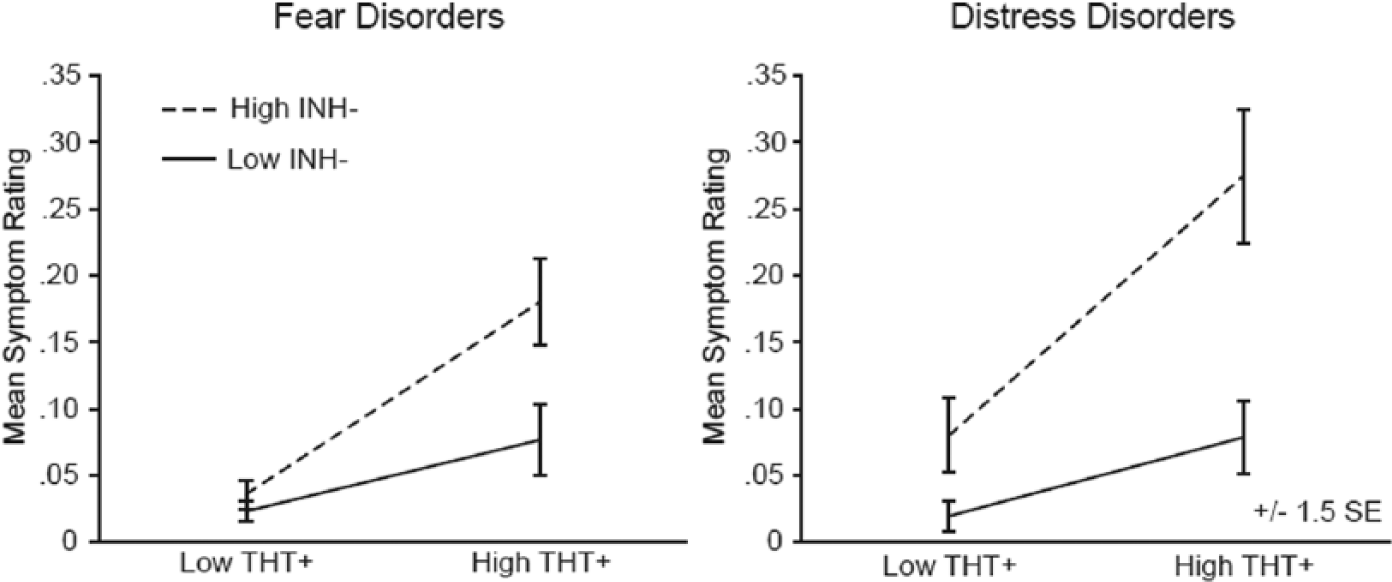
Response inhibition (INH−) × threat sensitivity (THT+) interactions for fear disorder (left) and distress disorder (right) symptom composites.
Discussion
Findings from the current work demonstrate that neurobehavioral dispositions corresponding to constructs of acute threat and response inhibition from the RDoC framework contribute individually, and in some cases interactively, to prediction of common clinical problems involving excessive fear, pervasive distress/dysphoria, and abuse of alcohol and other substances. Importantly, THT+ and INH− showed predictive associations with clinical symptoms over and above current dysphoria/distress; indeed, scores on these dispositional variables accounted for relations between current dysphoria and symptomatology in the case of fear and substance-related conditions. In line with the RDoC initiative’s call for investigation of core biobehavioral constructs with relevance to multiple clinical problems across differing levels of analysis, the current study provides evidence for INH− and THT+—indexed using efficient scale measures of anchor dimensions from quantitative models of the fear/fearlessness and inhibition/disinhibition domains—as transdiagnostic trait constructs that can serve as effective targets for neurobiological research.
Specificity in relationships for the two dispositional variables with clinical symptoms was evident in particular for fear and substance-related conditions. Relations for THT+ were most salient for symptoms of fear-related conditions, in particular specific and social phobia, considered the most cue-driven forms of fear pathology (Cook, Melamed, Cuthbert, McNeil, & Lang, 1988; Lang & McTeague, 2009). Relations for INH− were most robust and selective for substance-related conditions, which as a whole showed modest negative as opposed to positive relations with THT+ (Hicks, Iacono, & McGue, 2014). Differential patterns of association were also evident for the two dispositions in relation to distress versus fear symptomatology: INH− was associated more strongly with symptoms of distress disorders as a whole than THT+, whereas THT+ was associated more strongly with the occurrence of fear disorder symptoms.
That THT+ showed relatively preferential relations with fear (vs. distress) disorders is not surprising in light of prior psychometric and neuroscientific work showing that fear and anxiety are relatively distinct emotional states with differing neurobiological correlates (for reviews, see Sylvers et al., 2011; Vaidyanathan et al., 2012; White & Depue, 1999). Furthermore, as depicted in Figure 1, elevated INH− (i.e., lower levels of inhibitory control) was associated with increased fear symptomatology, but only among individuals with higher, but not lower, levels of THT+. Similarly, the increased risk for distress disorder symptoms associated with high INH− was most pronounced among individuals who were also high in THT+. These interactive effects are consistent with the notion that reduced inhibitory control may exacerbate existing vulnerabilities (such as high-trait fear) by influencing an individual’s ability to modulate temperamental inclinations to approach appetitive stimuli or avoid aversive stimuli (Depue & Collins, 1999).
The current findings are important in light of prior research documenting the heritability of THT+ and INH− when operationalized as fear/fearlessness and disinhibition (Kramer et al., 2012; Yancey et al., 2013), and work establishing reliable neurophysiological indicators of these dispositions. Scores on the dimension of fear/fearlessness relate systematically to variations in aversive startle potentiation, a physiological index of brain defensive activation (Vaidyanathan et al., 2009a). In parallel with this, other work has demonstrated increased startle potentiation during aversive cuing in individuals meeting criteria for fear disorders—specific and social phobia in particular (Lang & McTeague, 2009; Vaidyanathan et al., 2009b), which showed the most robust associations with dispositional fear in the current study. Disinhibition as indexed by the ESI inventory, on the other hand, is associated with impairments in brain reactivity within performance contexts, including diminished amplitude of P300 to salient task stimuli and reduced amplitude of error-related negativity following incorrect behavioral responses (Nelson et al., 2011). Similar brain response impairments have been shown in relation to substance-related problems (found to be associated most strongly with INH− in the current study), and DSM-defined externalizing disorders more broadly (Iacono, Carlson, Malone, & McGue, 2002)—and recent work indicates that these overlapping brain response correlates reflect genetic variance in common between ESI disinhibition and externalizing psychopathology (Yancey et al., 2013). As such, measures of these dispositions represent potential endophenotypes (Gould & Gottesman, 2006) for psychopathology.
THT+ and INH− dispositions can also serve as referents for connecting traits from established personality frameworks such as the five-factor model and Tellegen’s multidimensional personality model to key constructs in the RDoC framework (i.e., acute threat, response inhibition), and to biological systems of relevance to these constructs. As noted at the outset, scale measures of these dispositions do not map neatly onto basic traits or broad factors of standard personality frameworks (i.e., because they derive from structural analyses targeted at scale measures exhibiting shared neurophysiological correlates). However, these dispositional variables can be operationalized effectively using items from differing trait scales of established personality inventories—for example, as blends of lower-order traits from inventories such as the Multidimensional Personality Questionnaire (Brislin et al., 2015) and NEO Personality Inventory–Revised (Poy et al., 2014)—providing a mechanism whereby research on the clinical, biological, and behavioral correlates of these dispositions can be conducted using existing multimeasure data sets that include omnibus personality inventories. Work of this kind using data from longitudinal or twin studies (or combined longitudinal-twin studies; e.g., Iacono et al., 1999; Lichtenstein, Tuvblad, Larsson, & Carlstrom, 2007) could be extremely valuable for advancing understanding of the etiologic bases and developmental trajectories of these dispositions and their relations with clinical problems.
Furthermore, our finding that these trait dispositions accounted for appreciable portions of variance in multiple DSM disorders points to important clinical assessment implications. Assessments focusing on neurobiologically based dispositions that play a role in various disorders can simplify clinical case conceptualizations for clients who appear complex from a traditional diagnostic perspective (e.g., individuals with multiple comorbid diagnoses, several subthreshhold diagnoses, or “not otherwise specified” diagnoses). Specifically, regardless of their particular diagnostic presentation, clients with high-levels of both THT+ and INH− are likely to exhibit common biobehavioral tendencies that contribute to problems, and that serve as transdiagnostic maintaining factors. For example, clients high in THT+ are likely to exhibit tendencies toward behavioral avoidance, which has been shown to maintain fear and, in some cases, distress conditions (Mineka & Zinbarg, 2006). In such cases, assessing for levels of THT+ may provide information beyond DSM-5 diagnoses that is useful for conceptualizing cases and selecting or developing optimal treatments.
Some key limitations of the present study should be borne in mind when considering implications of the findings. First, dispositional variables were indexed via self-report—in contrast with clinical symptom variables, which were assessed through structured interview. While magnitudes of relations for the two dispositions with symptom variables were appreciable (i.e., most multiple Rs were in the .3 to .6 range) considering that differences in assessment mode operate to attenuate prediction (Campbell & Fiske, 1959), it will be important in future research to operationalize THT+ and INH− in other ways—including clinician ratings, behavioral responses (Young et al., 2009), and physiological measures (Nelson et al., 2011; Patrick et al., 2012). In addition, given the number of statistical tests performed on this data set, it will be important to replicate findings from the current study in new samples.
A further limitation is that the current work was cross-sectional rather than longitudinal, such that predictive relationships were assessed concurrently rather than prospectively. To establish THT+ and INH− as dispositional liabilities, follow-up work demonstrating increased incidence of clinical problems at later ages for individuals identified as high versus low in these dispositions at earlier ages will be needed. Counterparts to these dispositional constructs exist in the child-developmental literature, and have been shown to predict later emergence of problem behaviors (Kochanska & Knaack, 2003; Moser, Durbin, Patrick, & Schmidt, 2015). However, systematic research is needed to connect behaviorally based measures of these dispositions in childhood with counterpart operationalizations in adolescence and adulthood. As noted, computation of scores on these dispositional variables using personality items available in existing longitudinal data sets can provide one major avenue for work of this kind.
Notwithstanding these limitations, the current findings have important implications for research on psychopathology. They suggest that variations in threat sensitivity and inhibitory control play an important role in multiple problems of clinical concern and help account for observed comorbidity among common DSM-defined mental disorders (Krueger, 1999). The novel finding of interaction effects for distress disorders, and to some extent fear disorders, points to a synergistic contribution of the two dispositions to problems of these types. The fact that no such interaction was evident for substance-related problems, despite their marked association with INH−, could indicate a distinct pathophysiological process associated with the co-occurrence of these dispositions—perhaps entailing broad affective dysregulation associated with inability to compartmentalize threat reactions (Rosen & Schulkin, 1998). It will be important to explore this possibility in future research. Research is also needed to identify additional neurophysiological indicators of THT+ and INH− and to establish the utility of aggregating indicators of this type with psychometric indicators (i.e., “neurometric” scales; Nelson et al., 2011; Patrick et al., 2012) in the prediction of clinical problems—prospectively as well as concurrently. Systematic efforts along these lines can move the field toward a more integrated conception of psychological disorders anchored around cross-domain assessments of core biobehavioral constructs.
Footnotes
Declaration of Conflicting Interests
The author(s) declared no potential conflicts of interest with respect to the research, authorship, and/or publication of this article.
Funding
The author(s) disclosed receipt of the following financial support for the research, authorship, and/or publication of this article: This work was supported by grants R21 MH65137, P50 MH072850, and RC1 MH089727 from the National Institute of Mental Health and grant W911NF-14-1-0027 from the U.S. Army. The content of this paper is solely the responsibility of the authors and does not necessarily represent the official views of the U.S. Government, Department of Defense, Department of the Army, Department of Veterans Affairs, or U.S. Recruiting Command.