







Abstract
The Comprehensive Assessment of Psychopathic Personality (CAPP) is an emerging integrative model that makes use of 33 symptoms to characterize psychopathic personality disorder, but operationalizations of this model have not endured extensive validation to date. The current study sought to validate the recently published CAPP-Self-Report (CAPP-SR). Participants derived from two Lithuanian offender (n = 231) and nonoffender (n = 312) samples. They were administered the CAPP-SR, Triarchic Psychopathy Measure, Buss–Perry Aggression Questionnaire, and a subsample of offenders also had Offender Assessment System risk assessment scores available. The results showed that CAPP-SR total, domain, and symptom scores were associated with TriPM and Aggression Questionnaire scores in a manner consistent with conceptual expectations. CAPP-SR symptoms specifically reflective of aggression, anger, and antagonism were most strongly associated with Offender Assessment System risk scores. The findings provide support for construct validity of CAPP-SR scores as well as have implications for the CAPP model more broadly, which are discussed.
Keywords
Psychopathic personality disorder (PPD) has been the topic of conceptual and scientific scrutiny for the past two centuries (e.g., Pinel, 1806). Several theoretical perspectives have been proposed (e.g., Cleckley, 1941; Hare, 2003; Karpman, 1941; Lykken, 1995; Lynam & Miller, 2015; McCord & McCord, 1964; Newman & Wallace, 1993; Patrick et al., 2009; Robins, 1966) from which various operationalizations have been developed. Multiple theoretical accounts usually make for good science as theories are evaluated against one another and research accumulates, which has seemingly both been a blessing and a curse in the psychopathy field. Indeed, while the overall literature is voluminous, there is little consensus in the field of what truly constitutes psychopathy; there are expert scholarly (e.g., Miller et al., 2001) and clinical (e.g., Kreis et al., 2012; Verschuere & te Kaat, 2019) opinions about what constitutes the most important traits of psychopathy (e.g., callousness, lack of empathy, remorse, shallow affect, manipulativeness, egocentricity, grandiose self-assurance), but other characteristics such as boldness/fearless dominance (e.g., Lilienfeld et al., 2012; Miller & Lynam, 2012), criminal behavior (Hare & Neumann, 2010; Skeem & Cooke, 2010), and even impulsivity (Poythress & Hall, 2011) seem to be disputed with respect to degree of relevance. Partially in response to these concerns, Cooke et al. (2004, 2012; see also Cooke & Logan, 2018) proposed the Comprehensive Assessment of Psychopathic Personality (CAPP) as a concept map to further guide both psychopathy research and clinical assessment.
Cooke et al. (2012) took the perspective that a concept needs to be articulated before it can be operationalized (Cook & Campbell, 1979). In developing the CAPP, a bottom-up approach to construct explication (Blashfield & Livesley, 1991) was implemented. They considered a range of potential symptoms of PPD for inclusion in the model through a careful review of the relevant scientific, clinical and professional literatures, and also, by interviewing clinical subject matter experts, specifically, mental health professionals working within different conceptual frameworks, about PPD symptoms they had observed in their patients. The overall body of information was translated into trait-descriptive adjectives rooted in the lexical hypothesis, which proposes that the frequent use of adjectives indicate that they represent salient psychological phenomena (Allport & Odbert, 1936; Saucier & Goldberg, 2001), and so, symptoms were specified in the natural language of trait-descriptive adjectives. This process resulted in 33 symptoms of PPD described either as a single trait-descriptive adjective or a short adjectival phrase. For example, the symptom unempathic was defined as uncompassionate, cruel, and callous. Using three trait-descriptive adjectives helps triangulate the meaning of the symptom (see Cooke & Logan, 2018). The 33 symptoms were rationally organized into six broad domains: attachment, behavioral, cognitive, dominance, emotional, and self, to provide an additional thematic interpretive framework of the meaning of the symptoms and further reducing the potential for ambiguity in their meaning. 1
Most research studies to date have examined content validity of the CAPP concept map across multiple languages (e.g., Flórez et al., 2015; Hoff et al., 2012; Kreis & Cooke, 2011; Kreis et al., 2012; Sea, 2018; Sörman et al., 2014), with experts and lay people rating each of the CAPP symptoms with respect to prototypicality of PPD, and in particular, in comparison with a set of symptoms unrelated to PPD. Across this research, symptoms in the attachment, dominance, and self domains are typically rated as more prototypical of psychopathy than are symptoms in the other domains, which is consistent with other expert judgments (e.g., Miller et al., 2001; Verschuere & te Kaat, 2019).
One study to date has examined the internal structure of CAPP symptoms. Sellbom et al. (2015) tested a variety of alternative factor structures of self-ratings of the 33 CAPP symptoms via the CAPP Lexical Rating Scale (CAPP-LRS) using a large international sample. They found support for a general psychopathy factor they opined validated the CAPP as a concept map, but also interpreted three residual group factors as resembling the triarchic model of psychopathy. Other studies have revealed evidence that the CAPP model overlaps with the Hare Psychopathy Checklist–Revised (PCL-R; Hare, 2003) and Screening Version (Flórez et al., 2017; Hart et al., 1995; Pedersen et al., 2010; Sandvik et al., 2012), and that the CAPP equaled the latter in the prediction of violence and general reoffending (Pedersen et al., 2010), and related more strongly than the PCL-R to heart rate variability parameters (Flórez et al., 2017).
The most recent development in the CAPP literature is the CAPP Self-Report (CAPP-SR; Sellbom & Cooke, 2020; see also Sellbom et al., 2019) inventory, which was designed to overcome the laborious nature of the CAPP Institutional Rating Form (Cooke et al., 2004) and the shortcomings of the CAPP-LRS. The 99-item CAPP-SR was developed through various latent modeling methods (item response theory, confirmatory factor analysis) and classical test theory principles using a large community sample demographically representative of the U.S. population. Sellbom et al. (2019) validated the CAPP-SR against the CAPP-LRS and several other psychopathy measures reflective of multiple theoretical perspectives across two university and community samples drawn from the United States and New Zealand. Overall, the CAPP-SR symptom scale scores were associated with promising criterion and convergent validity (with a few exceptions) as well as overall incremental validity over the CAPP-LRS in predicting scores on other psychopathy measures. Sellbom et al. (2019) noted that one of their limitations was the unavailability of an offender sample for validation purposes—a gap which the current study aimed to fill.
The current investigation was designed to replicate and expand upon Sellbom et al.’s (2019) research through a validity examination in multiple samples and using novel (to CAPP-SR research) criterion measures. Specifically, we tested the reliability and validity of a Lithuanian translation of the CAPP-SR in two separate samples of male prison inmates and mixed-gender university students. In both samples, we examined the associations between the CAPP-SR and a measure of Patrick et al.’s (2009) triarchic psychopathy model, the Triarchic Psychopathy Measure (TriPM; Patrick, 2010), in an effort to replicate the results of Sellbom et al. (2019). Furthermore, we also tested the associations between CAPP-SR scale scores and the well-established Buss–Perry Aggression Questionnaire (AQ). Finally, to elaborate on the CAPP-SR potential for risk assessment, we examined the concurrent associations between its scales and the Offender Assessment System (OASys) risk assessment instrument in a subsample of the offender participants.
We articulated a series of hypotheses for convergent validity. The details are shown in Table 1 and are based on both conceptual and empirical knowledge of the triarchic psychopathy model (see e.g., Sellbom, 2018, for a recent review), the symptoms underlying the CAPP model (e.g., Cooke et al., 2012; Cooke & Logan, 2018), and the findings of Sellbom et al. (2019) across two community and university samples. For instance, we expected Boldness should be associated with Domineering, Garrulous, Lacks Anxiety, Self-Aggrandizing, Sense of Uniqueness, and Sense of Invulnerability, as reflected in this triarchic construct’s emphasis on interpersonal dominance, social poise, self-assurance/grandiosity, fearlessness, and stress immunity (Patrick et al., 2009; Sellbom, 2018; Sellbom et al., 2018). We hypothesized that Meanness should be related to most symptoms in the Attachment, Dominance, and Self domains, as well as specific symptoms from other domains, such as Aggressive, Intolerant, Lacks Emotional Depth, and Lacks Remorse, to capture the interpersonal antagonism, deficiencies in affective experience, exploitativeness, and egocentricity associated with this triarchic domain (Patrick et al., 2009; Sellbom, 2018; Sellbom et al., 2018). Disinhibition was expected to be related primarily to traits from the Behavioral and Cognitive domains as well as specific symptoms such as Lacks Emotional Stability, Self-Justifying, and Unstable Self-Concept, as indicated in the impulsive, irresponsible, nonplanful, and blame externalizing aspects of PPD (Patrick et al., 2009; Sellbom, 2018; Sellbom et al., 2018). Furthermore, the AQ subscales of Physical Aggression, Verbal Aggression, Anger, and Hostility would be primarily related to the Aggressive CAPP-SR symptom scale, but also more broadly to various symptom scales of the Behavioral domain as well as the specific symptoms Intolerant, Antagonistic, and Lacks Emotional Stability as they all reflect components of interpersonal hostility and poor anger control. Finally, although we did not have sufficient basis for a clear set of hypotheses with the OASys risk assessment measure, we did expect, per previous psychopathy literature (e.g., Camp et al., 2013; Olver & Wong, 2015; Sellbom et al., 2018), that symptoms from the Behavioral domain would be most strongly associated with those variables.
Hypotheses for Relationships Between CAPP-SR and TriPM.
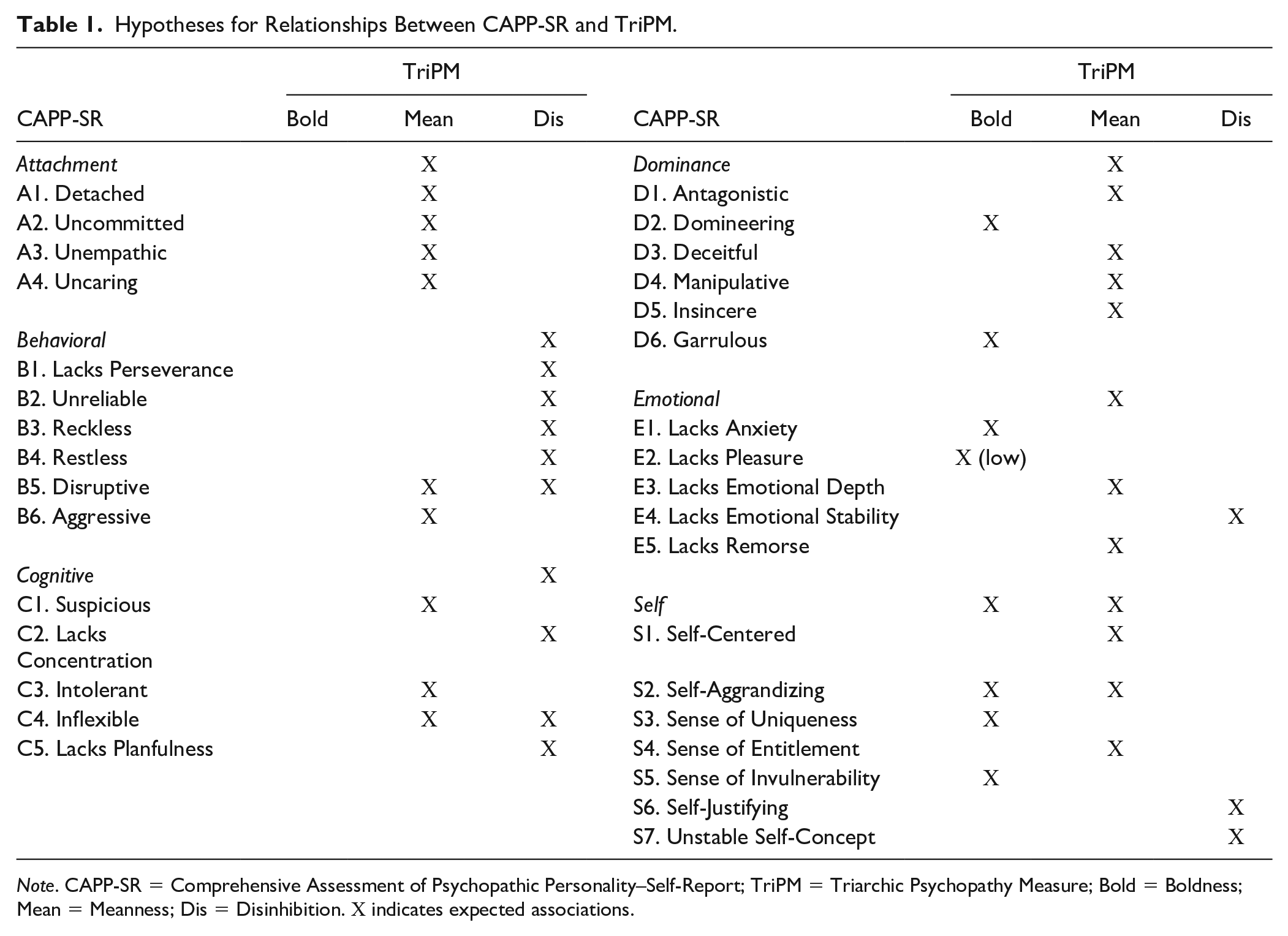
Note. CAPP-SR = Comprehensive Assessment of Psychopathic Personality–Self-Report; TriPM = Triarchic Psychopathy Measure; Bold = Boldness; Mean = Meanness; Dis = Disinhibition. Χ indicates expected associations.
Method
Participants
Offender Sample
The offender sample consisted of 268 male prison inmates from three medium to large size Lithuanian custodial institutions, which constituted 4.62% of incarcerated offenders in Lithuania at the time of data collection. Because 37 participants were removed due to failing attention checks (e.g., “If you are reading this statement, please respond mostly true) while completing the survey, the final sample consisted of 231 men, with an average age of 37.71 years (SD = 10.17) ranging from 19 to 78 years. The participants had on average 10.96 years (SD = 2.1) of education. The average number of convictions was 6.06 (SD = 3.67) including an average of 1.83 convictions of violent crimes (SD = 1.55). Most inmates (60.2%) served their current sentence for conviction of a violent crime (e.g., murder, health impairment [assault causing bodily harm], rape, robbery, etc.), 53.7% had their first contact with the police before the age of 18 years, and 38.4% had their first conviction before the age of 18 years.
Excluded offenders did not significantly differ from included ones on age (Mex = 34.65, SD = 8.2 vs. Min = 37.71, SD = 10.17, t(266) = −1.74, p = .08); years of education (Mex = 10.65, SD = 2.12 vs. Min = 10.96, SD = 2.1, t(232) = −.79, p = .43); number of convictions (Mex = 5.97, SD = 3.35 vs. Min = 6.06, SD = 3.67, t(237) = −.14, p = .89); or number of convictions of violent crimes (Mex = 1.61, SD = 1.3 vs. Min = 1.83, SD = 1.55, t(237) = −.77, p = .44).
University Sample
This sample consisted of 312 students (18-35 years, M = 21.04, SD = 2.26) from two Lithuanian universities. All participants passed the attention checks; therefore, none of them was excluded. Females (n = 255) and males (n = 57) did not vary in age, t(310) = −.01, p = .99. The majority of students, 84.9% (n = 264), was single. No formal data on race/ethnicity were collected, but Lithuania is a relatively homogeneous population on such demographics, with White ethnic Lithuanians accounting for the great majority of the population.
Measures
Descriptive statistics and internal consistency reliability information are available in Tables S1 and S2 in supplemental materials (available online).
Comprehensive Assessment of Psychopathic Personality–Self-Report (CAPP-SR)
The CAPP-SR (Sellbom & Cooke, 2020) is a 99-item self-report inventory. Participants rated the items on a 4-point scale (false, mostly false, mostly true, and true). The 33 CAPP symptom scales consist of the mean aggregate of their three items, with scores ranging from 1 to 4 for each. The six CAPP domains were scored through mean aggregates of their symptom scores; thus, also ranging from 1 to 4. All CAPP scales are listed in Table 1.
Triarchic Psychopathy Measure (TriPM)
The TriPM (Patrick, 2010) operationalizes the triarchic psychopathy model (Patrick et al., 2009) and consists of 58 items that aggregate onto three distinct psychopathy domain scales of Boldness, Meanness, and Disinhibition. The Participants rate each item on a 4-point scale (true, mostly true, false, mostly false). The TriPM scale scores have amassed extensive validity support, including as accounting for variance in other psychopathy scales in a manner consistent with triarchic psychopathy theory (see Sellbom, 2018, and Sellbom, Lilienfeld, et al., 2018, for reviews). The Lithuanian translation was executed in accordance with standard procedures and has been validated in previous research with offender samples (Sellbom, Laurinavičius, et al., 2018).
Aggression Questionnaire
The AQ (Buss & Perry, 1992) is 29-item self-report measure of aggression. Each item is evaluated on a 5-point Likert-type scale from 1 (extremely uncharacteristic of me) to 5 (extremely characteristic of me). The AQ has four subscales: Physical Aggression (PA, 9 items), Verbal Aggression (VA, 5 items), Anger (A, 7 items), and Hostility (H, 8 items). The validity of the AQ has been supported in various samples, including criminal offenders (Gallagher & Ashford, 2016). The Lithuanian version of the AQ was prepared by Ustinavičiūtė et al. (2012; also see Sellbom, Laurinavičius, et al., 2018, for validity evidence).
Offender Assessment System
The OASys (Home Office, 2002) was developed by the Prison and Probation services of the United Kingdom to serve as a risk assessment instrument. The formal short version (OASys1) was used in the current study and only in the offender sample. The OASys risk assessment section has 11 parts in which separate items are assessed on a 3-point scale from 0 (no problems) to 2 (significant problems). The sections are the following: (a) offending information; (b) accommodation; (c) education, training, and employability; (d) financial management and income; (e) relationships; (f) lifestyle and associates; (g) drug misuse; (h) alcohol misuse; (i) emotional well-being; (j) thinking and behavior; and (k) attitudes. The OASys assessment is based on information derived from official criminal records, interviews with offenders, and collateral information. A validation study of the Lithuanian version of the OASys confirmed the utility for the evaluation of risk of reconviction in a 12-month period in a Lithuanian sample of incarcerated men (area under the curve = .67; Ustinavičiūtė et al., 2012). Further Lithuanian research has shown that OASys risk of reconviction score positively correlates with both antisocial behavior scales of the Minnesota Multiphasic Personality Inventory–2–Restructured Form (Laurinaitytė et al., 2017) and psychopathic personality traits (Sellbom, Laurinavičius, et al., 2018) in a conceptually expected manner.
Procedures
The Lithuanian version of the CAPP for present research was prepared by I. Laurinaitytė, P. Dainiūtė, and A. Laurinavičius. A bilingual person (with nonexpertise in psychopathy) back-translated the Lithuanian version into English. The back-translation was reviewed by M. Sellbom (the first author of the CAPP-SR). Items that were deemed to not adequately capture the original content were retranslated and the same process applied again until M. Sellbom had formally approved all back-translated items.
The research was conducted in accordance with the Law of the Republic of Lithuania on Legal Protection of Personal Data, Lithuanian research ethics standards, and regulatory requirements of Vilnius University related to the conduct of research. The research protocol was approved by the Prison Department under the Ministry of Justice of the Republic of Lithuania. The data were collected between February and June 2018. There were no specific inclusion or exclusion criteria beyond willingness to participate. Informed written consent was obtained from all research participants. The study was introduced and data collection was completed by psychologists working in correctional institutions. The survey was administered individually in a private assessment room. Demographic data were taken from the interviews with offenders and/or OASys evaluation forms that were derived from institutional databases. The OASys is routinely used in Lithuanian correctional system, with the evaluations being conducted by prison staff.
For the university sample, the participants were recruited from their psychology classes as well as through their Students’ Representatives Councils at two large universities in Lithuania. No inclusion or exclusion criteria were applied. They had the option of a paper-based survey and using an online platform to complete the questionnaires. Most students (59.6%) completed the questionnaires in electronic format.
Results
First, we examined zero-order correlations between the CAPP-SR total, domain, and symptom scores with TriPM, AQ, and OASys. We considered correlations between self-reported measures as meaningful only if their strength of relationship was at least of a medium effect size (r > |.30|). The correlations are presented in Table 2. The CAPP-SR total score correlation with the TriPM total scores was large (r = .77, in offender sample, and r = .75, in university sample), with AQ total scores was large (r = .77, in offender sample, and r = .64, in university sample), and with OASys total score in offender sample was medium (r = .32). All CAPP-SR domains, except for the Self domain, were associated at large effect size (i.e., r > |.50|) with theoretically corresponding TriPM domains across both samples. At the symptom level, the CAPP-SR scale correlations with TriPM domains, with few exceptions, were consistent with hypotheses (see Table 1), and their magnitudes, in most cases, were of at least medium effect size. A main exception to this pattern was CAPP-SR Garrulous with TriPM Boldness in both samples (r = .23, in offender sample, and r = .10, in student sample). Correlations between TriPM Meanness and CAPP-SR Detached (r = .29), Insincere (r = .21) in university sample and CAPP-SR Self-Aggrandizing in both samples (r = -.01 in offender sample and r = .26 in university sample) also failed to reach our a priori threshold for meaningfulness. All the expected relationships between CAPP-SR symptoms and Disinhibition were observed in the offender sample, whereas only two correlations involving CAPP-SR Inflexible (r = .20) and Unstable Self-Concept (r = .26) failed to meet threshold for meaningfulness in the university sample.
Correlations Between CAPP-SR Scales and TriPM, AQ, and OASys Scores in Correctional and University Samples.
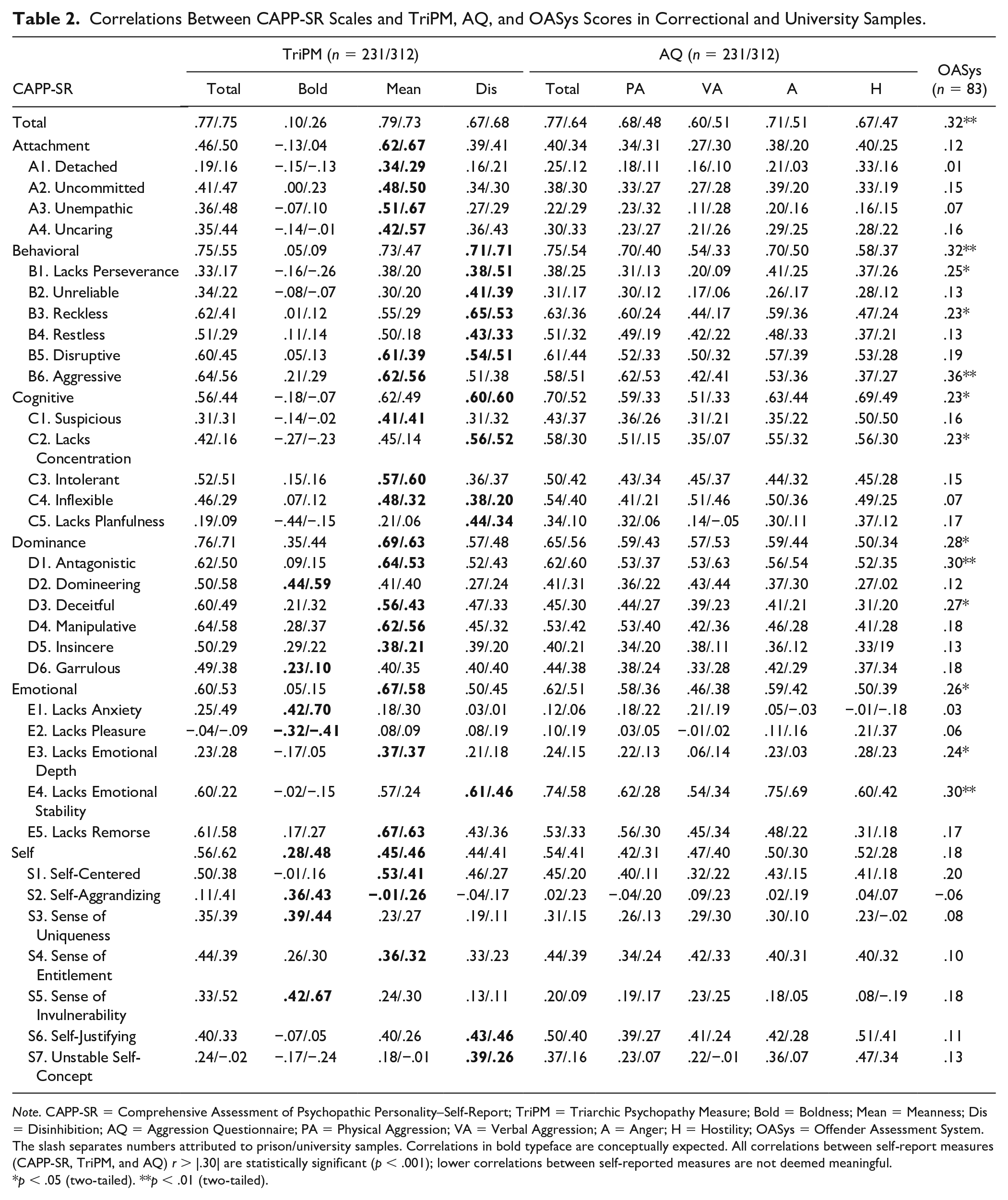
Note. CAPP-SR = Comprehensive Assessment of Psychopathic Personality–Self-Report; TriPM = Triarchic Psychopathy Measure; Bold = Boldness; Mean = Meanness; Dis = Disinhibition; AQ = Aggression Questionnaire; PA = Physical Aggression; VA = Verbal Aggression; A = Anger; H = Hostility; OASys = Offender Assessment System. The slash separates numbers attributed to prison/university samples. Correlations in bold typeface are conceptually expected. All correlations between self-report measures (CAPP-SR, TriPM, and AQ) r > |.30| are statistically significant (p < .001); lower correlations between self-reported measures are not deemed meaningful.
p < .05 (two-tailed). **p < .01 (two-tailed).
The AQ total score, Physical Aggression, Verbal Aggression, Anger, and Hostility scales correlated with proposed CAPP-SR symptom scales Aggressive, Intolerant, Antagonistic, and Lacks Emotional Stability in an expected manner. The correlations ranged from medium to large. A few correlations in university sample did not reach the medium effect size magnitude, but were close (the weakest magnitude, r = .27, was between CAPP-SR Aggressive and AQ Hostility). At the domain level, all the correlations between CAPP-SR domains and AQ total scores were at least of medium effect size (.34 < r < .75) indicating that the CAPP psychopathy model captures interpersonal aggression to a meaningful degree. The lowest AQ total correlation was with CAPP Attachment domain (r = .40, in offender, and r = .34, in student sample), the highest with Behavioral (r = .75, in offender, and r = .54, in student sample) domain.
Specific hypotheses about relationships between the risk assessment tool OASys and the CAPP-SR scale scores were not formulated given limited research on which to base such hypotheses; however, we expected positive associations with CAPP-SR total score and more specifically with the Behavioral domain and OASys scores. Indeed, medium effect size correlations between OASys and CAPP-SR total scores (r = .32) and Behavioral domain scores (r = .32) were observed. At the symptom level, the largest OASys correlations were observed for CAPP-SR Aggressive (r = .36), Antagonistic (r = .30), and Lacks Emotional Stability (r = .30). It is noteworthy that as the correlations were based on data from two different assessment modalities (self-report vs. prison staff ratings), so despite relatively smaller effect sizes, these correlations point at importance of CAPP psychopathy-related variables for risk assessment.
For the next stage of the analyses, we tested the amount of variance of TriPM and AQ that could be accounted for by CAPP-SR symptom scales, and in doing so, which CAPP-SR symptom scores were uniquely associated with these criterion measures. We regressed TriPM and AQ scores onto selected CAPP-SR symptoms (rather than all) to decrease the possibility of arbitrary suppressor effects associated with limited statistical power. As we were interested in most robust psychopathy and aggression predictors, for the regression analysis, we selected only the CAPP-SR symptoms with zero-order correlations with the TriPM and the AQ of at least of medium effect size (r > |.30|). Moreover, as we were interested in most universal predictors of psychopathy and aggression, we limited the selection to only those CAPP-SR symptoms scales which satisfied the selected magnitude threshold across both samples. In the regression equations with the TriPM as a criterion, the number of selected CAPP-SR symptoms as predictors was 19 for total score, 6 for Boldness, 17 for Meanness, and 19 for Disinhibition. In predicting AQ scores, the number of predictors was 19 for total score, 6 for Physical Aggression, 11 for Verbal Aggression, 11 for Anger, and 8 for Hostility. The results of the regression analyses are presented in Table 3. As evident from this table, the selected symptoms explained the substantial amount of variance of the TriPM total and domains scores (R2 = .45-.77) across both samples. The CAPP-SR symptoms Domineering, Lacks Anxiety, Lacks Pleasure (negative), and Sense of Invulnerability remained significant predictors for TriPM Boldness across both samples. TriPM Meanness was uniquely predicted by Unempathic, Uncaring, Aggressive, Intolerant, Manipulative, and Lacks Remorse. The significant unique predictors of TriPM Disinhibition were CAPP-SR Reckless, Lacks Concentration, and Lacks Emotional Stability across both samples.
Multiple Regression Analyses Predicting TriPM and AQ Scores with CAPP-SR Scales.
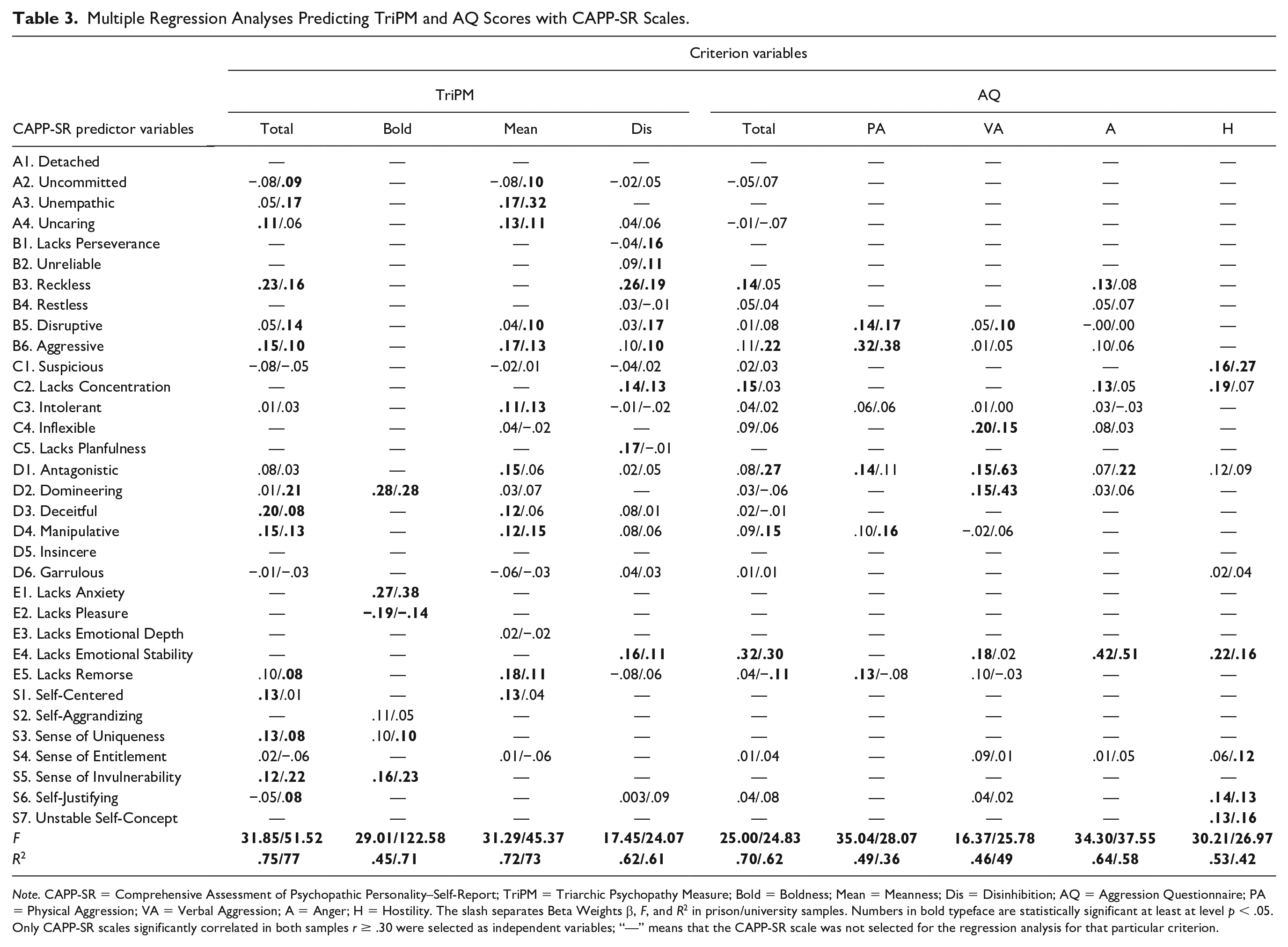
Note. CAPP-SR = Comprehensive Assessment of Psychopathic Personality–Self-Report; TriPM = Triarchic Psychopathy Measure; Bold = Boldness; Mean = Meanness; Dis = Disinhibition; AQ = Aggression Questionnaire; PA = Physical Aggression; VA = Verbal Aggression; A = Anger; H = Hostility. The slash separates Beta Weights β, F, and R2 in prison/university samples. Numbers in bold typeface are statistically significant at least at level p < .05. Only CAPP-SR scales significantly correlated in both samples r ≥ .30 were selected as independent variables; “—” means that the CAPP-SR scale was not selected for the regression analysis for that particular criterion.
The amount of AQ variance explained by CAPP-SR symptoms across both samples was R2 =.36-.70. The CAPP-SR symptoms significantly predicting AQ total and/or subscale scores across both samples were Disruptive, Aggressive, Suspicious, Inflexible, Antagonistic, Domineering, Lacks emotional stability, Self-Justifying, and Unstable Self-Concept. As evident from the table, symptoms from every CAPP-SR domain, except the Attachment domain, remained significant in at least one regression. The results indicate that CAPP-SR captures behavioral, cognitive, interpersonal (dominance), emotional, and intrapersonal (self) aspects of aggression. The results of both regression sets show that selected CAPP-SR symptoms contain a substantial amount of information which is related to the variance of TriPM psychopathy and AQ aggressiveness scores across the samples.
As aggression is one of the most robust psychopathy-related correlates, we compared the two psychopathy measures (CAPP-SR and TriPM) in their relative utility in accounting for variance in AQ scores. In particular, we were interested in whether the CAPP-SR model would confer incremental validity above and beyond the already well-established TriPM, though we tested the reverse as well. In our final analysis, we used CAPP-SR and TriPM domains scores. We estimated two series of hierarchical regression analyses in which the AQ scores were treated as dependent variables. In the first set of models, we entered the TriPM domain scales in the first step, and the CAPP-SR domain scales in the second step. We calculated the amount of additional variance accounted for by CAPP-SR scales. In the second series, we reversed the order of entry and thus examined the amount of incremental variance accounted for in each AQ scale by TriPM scores, above and beyond CAPP-SR scores. The results are presented in Table 4. As evident from this table, psychopathy measures in first step of both sets of regression models accounted for a similar amount of variance in AQ scales. The TriPM scales explained from 30% to 59%, and the CAPP-SR domain scales explained from 25% to 66% of variance in AQ scores. The results of the first step show that the TriPM scales explained the highest amount of variance in the Physical Aggression scale (R2 = .55, in prison sample and R2 = .36, in university sample). Boldness was a significant predictor of Verbal Aggression and Hostility (negative), Meanness and Disinhibition were significant predictors of AQ total score and all other AQ scales across both samples.
Results of Two Hierarchical Regression Analyses Predicting AQ Scores with TriPM and CAPP-SR Scales.
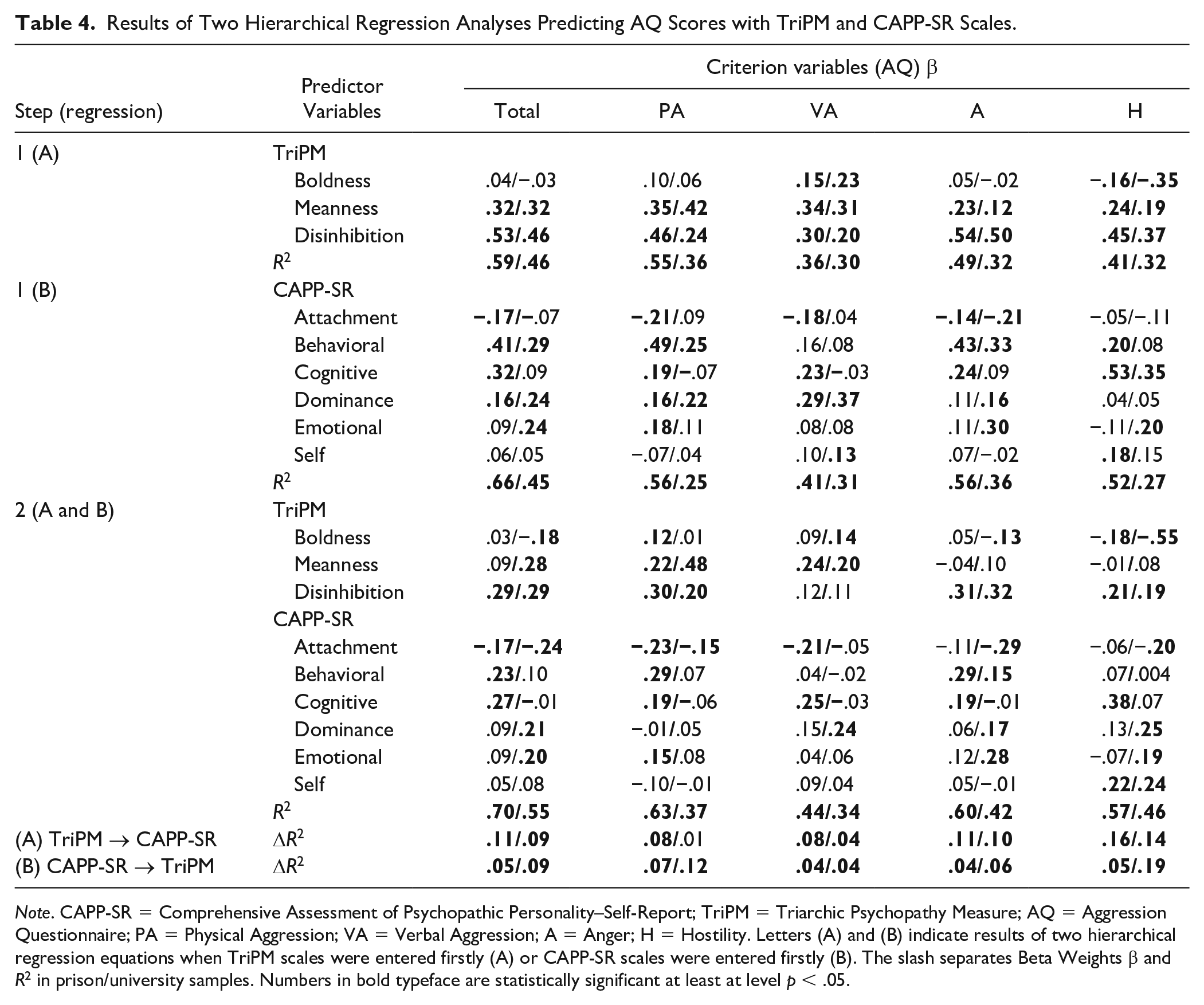
Note. CAPP-SR = Comprehensive Assessment of Psychopathic Personality–Self-Report; TriPM = Triarchic Psychopathy Measure; AQ = Aggression Questionnaire; PA = Physical Aggression; VA = Verbal Aggression; A = Anger; H = Hostility. Letters (A) and (B) indicate results of two hierarchical regression equations when TriPM scales were entered firstly (A) or CAPP-SR scales were entered firstly (B). The slash separates Beta Weights β and R2 in prison/university samples. Numbers in bold typeface are statistically significant at least at level p < .05.
The CAPP-SR scales were most successful in prediction of Anger (R2 = .56, in prison sample, and R2 = .36, in university sample) and Physical Aggression (R2 = .56, in prison sample and R2 = .25, in university sample). The Behavioral and Cognitive domains were the most important predictors of AQ total and other AQ subscale scores, especially in prison sample. It is worth noting that after controlling for all the CAPP-SR domains, the relationships between Attachment domain and AQ scales turned from positive to negative. This finding was likely the product of statistical suppression. As it is evident from Table 2, the correlation between the AQ scales and the CAPP-SR Attachment domain was the weakest one in comparison with other CAPP-SR domain scales, but nevertheless positive. In terms of incremental validity, both instruments added statistically significant amounts of variance to each other in predictions of AQ total scores and subscale scores. The only exception was the Physical Aggression scale in university sample, when CAPP-SR domain scales failed to add significant amount of variance explained to the TriPM scores. The CAPP-SR scores added up to 16% of variance explained to the TriPM scores (ΔR2 = .01-.16), the TriPM scores added up to 19% of variance explained to the CAPP-SR scores (ΔR2 = .04-.19) in predicting AQ scores. If the results from first step indicated that the CAPP-SR and the TriPM can explain substantial and comparable amount of variance in AQ scores, the results from second step show that the instruments are capturing slightly different aspects of aggressiveness. It is evident from the Table 4 that the TriPM scales contain rich information related to Physical Aggression. In predicting Physical Aggression scores, the TriPM scales added substantial amount of variance (ΔR2 = .07 in the prison sample and ΔR2 = .12 in the university sample) to the CAPP-SR scores. The CAPP-SR scales accounted for slightly less variance above and beyond TriPM scales scores (ΔR2 = .08 in the prison sample, and ΔR2 = .01ns in the university sample). On the other hand, the CAPP-SR outperformed the TriPM in prediction of AQ Anger scale scores (ΔR2 = .11 in the prison sample and ΔR2 = .10 in the university sample vs. ΔR2 = .04 in the prison sample and ΔR2 = .06 in the placeuniversity sample). Overall, it can be assumed that aggressiveness is considered to be an important correlate of psychopathy in both theoretical perspectives (the TriPM and the CAPP) with no clear advantage of one over the other; however, the models emphasis on slightly different elements of aggressiveness.
Discussion
The current project sought to translate and validate the Lithuanian version of the CAPP-SR as well as building on the CAPP-SR literature more generally through examining associations with both aggression and risk for reoffending scores. No previous CAPP-SR study has used an offender sample, which was deemed a particular strength of the current project. Overall, the results of the current study were quite supportive of the construct validity associated with CAPP-SR scale scores. CAPP-SR symptom scores by and large aligned quite well with TriPM and AQ scale scores as conceptually expected, and the pattern of associations was robust across both settings. The CAPP-SR also conferred incremental validity above and beyond the TriPM in associations with various forms of aggression.
The CAPP-SR scale scores were associated with very good convergent validity. Almost all hypothesized associations with the TriPM emerged as expected. These findings were also remarkably consistent with the CAPP-SR and TriPM findings in Sellbom et al. (2019), who examined those in large community (United States) and university (New Zealand) samples. In other words, the CAPP-SR show good convergent validity with the TriPM across multiple countries and contexts. Moreover, convergent validity with the Buss-Perry Aggression Questionnaire was also supported in that CAPP-SR Aggressive, Intolerant, Antagonistic, and Lacks Emotional Stability were all associated with a range of aggressive behaviors as expected, particularly in the offender sample; and not surprisingly, the Behavioral domain was the strongest domain-level predictor of these various forms of aggression. A few CAPP-SR symptom scales clearly did increment these traits in the prediction of specific forms of aggression. Across both samples, Domineering, Antagonistic, and Inflexible predicted AQ Verbal Aggression, which is not surprising as such symptoms would be related to an assertive, an argumentative, and rigid interpersonal style, respectively. Suspicious, Self-Justifying, and Unstable Self-Concept were all related to AQ Hostility, which also makes intuitive sense, as traits reflective of mistrust and blame externalizing have been linked to interpersonal hostility (e.g., Jeon et al., 2013).
There were two CAPP-SR symptoms that did not converge with theoretical expectations across both samples. CAPP-SR Garrulous was not meaningfully associated with TriPM Boldness despite their putative conceptual overlap. Similar to Sellbom et al. (2019), this CAPP-SR symptom scale was more strongly aligned with TriPM Meanness and Disinhibition, though it did not emerge as a unique predictor of either in the regression models. Regardless, it is clear from these findings across four different samples that the glib superficial verbose style that encompasses Garrulous is measuring something different from the theoretically expected assertive/domineering interpersonal style associated with Boldness and is more likely aligned with an antagonistic/manipulative interpersonal style shared by TriPM Meanness and Disinhibition. Furthermore, CAPP-SR Self-Aggrandizing was associated with TriPM Boldness as expected, but not TriPM Meanness, which is also consistent with Sellbom et al. (2019). Therefore, it seems clear that this CAPP-SR symptom scale reflects grandiose self-assurance more so that the malignant grandiosity that subsumes the meanness construct.
The CAPP-SR scales also showed promise in their concurrent associations with an established risk for reoffending measure. The CAPP-SR total score and the Behavioral domain were associated with the largest effect sizes, with Aggressive, Antagonistic, and Lacks Emotional Stability being the best symptom-level predictors. This latter finding also parallels the results for the aggression results. Disinhibition markers, such as Reckless, Lacks Perseverance, and Lacks Concentration, as well as more “affective-interpersonal” symptoms including Deceitful, Lacks Emotional Stability, and Lacks Emotional Depth were also associated with significant correlations with the risk measure. Although no a priori hypotheses were tested, these findings are generally intuitive in terms of general scientific knowledge about dynamic risk factors for reoffending (e.g., Douglas et al., 2014; Douglas & Skeem, 2005). Of course, it is important to note that these associations were cross-sectional and by no means indicate prediction of actual future reoffending, but the results do build on the nomological networks associated with CAPP-SR scale scores.
It is also noteworthy that some findings potentially speak to questionable discriminant validity, in that while CAPP-SR scale scores were substantially correlated with a conceptually expected TriPM or AQ scale, they were also substantially correlated with other psychopathy or aggression scales. This issue was particularly relevant to differentiating TriPM Meanness and Disinhibition, in that many CAPP-SR scales hypothesized to be associated with the former were also meaningfully correlated with the latter, and vice versa. However, TriPM Meanness and Disinhibition were substantially correlated in these samples (rs = .60 [offender] and .54 [nonoffender]), which could at least partly explain these patterns. Moreover, the regression analyses also provided for a clearer picture. Nevertheless, future studies should provide for a more detailed examination of discriminant validity.
Overall, these findings build upon the initial work of Sellbom et al. (2019) and extends them to both offender samples as well as the culturally different population of an understudied European country from the Baltic region. Associations with TriPM scores clearly replicate across four distinct samples across three countries (United States, New Zealand, and Lithuania) as well as across both incarcerated and nonincarcerated samples. Furthermore, in Sellbom et al. (2019), several symptoms were highlighted as being more peripheral to psychopathy than others. Among these, one symptom in particular continues to show its likely irrelevance to psychopathy: Lacks Pleasure. This CAPP symptom is negatively associated with the boldness construct, which is consistent with triarchic theory, but inconsistent with the CAPP. It failed to correlate at all with the meanness and disinhibition constructs and was generally unrelated to important relevant criteria in this current study. There is also no strong theoretical postulate for its inclusion in a psychopathy model (if anything, hedonic capacity makes more theoretical sense) and it is rated among the least prototypical symptoms by forensic mental health experts (e.g., Kreis et al., 2012). The current study findings further support the exclusion of Lacks Pleasure from the CAPP model.
Despite the important strengths just articulated, the current findings must be considered in light of some limitations. First, there were important gender disparities in the two samples; the offender sample was entirely composed of male inmates, whereas the university sample consisted primarily of female students. These disparities potentially affect generalizability, and in particular, to female offenders. However, we think this issue is potentially mitigated as we emphasized results that replicated across samples. Second, the sample size associated with OASys scores was very small (n = 83), which limited statistical power in particular to conduct multivariate analyses to determine unique associations for CAPP-SR scale scores. Unfortunately, we were constrained by data availability for those who volunteered to participate in the research study; only a subset had OASys data which could be derived from their files with the requisite written permission. Finally, the majority of our criterion measures were self-report inventories; as such, shared method variance likely inflated some correlations to an unknown degree. We attempted to control for such effects through using a conservative effect size estimate for meaningful interpretation.
These limitations and the scarcity of research on the CAPP-SR offers avenues for future research. The findings reported here and in Sellbom et al. (2019) need to be replicated across other samples, including female offender samples. One of the advantages associated with the lexical approach to the CAPP concept map is easy translation across languages as already determined in a host of previous studies. Additional translations of the CAPP-SR, particularly in cultures in which psychopathy is understudied will be important. Furthermore, it will be important to examine the role of the CAPP-SR in actual prediction of general and violent reoffending given that the CAPP model is viewed as a constellation of dynamic traits (Cooke et al., 2012).
Supplemental Material
supplementary_material – Supplemental material for Further Validation of the Comprehensive Assessment of Psychopathic Personality-Self-Report (CAPP-SR) in Lithuanian Offender and Nonoffender Samples
Supplemental material, supplementary_material for Further Validation of the Comprehensive Assessment of Psychopathic Personality-Self-Report (CAPP-SR) in Lithuanian Offender and Nonoffender Samples by Martin Sellbom, Ilona Laurinaitytė and Alfredas Laurinavičius in Assessment
Footnotes
Acknowledgements
The authors thank Kristina Žalytė, Paulina Dainiūtė, and Vilmantė Gintaraitė for their helpful assistance with this project.
Declaration of Conflicting Interests
The author(s) declared no potential conflicts of interest with respect to the research, authorship, and/or publication of this article.
Funding
The author(s) received no financial support for the research, authorship, and/or publication of this article.

Supplemental Material
Supplemental material for this article is available online.
Notes
References
Supplementary Material
Please find the following supplemental material available below.
For Open Access articles published under a Creative Commons License, all supplemental material carries the same license as the article it is associated with.
For non-Open Access articles published, all supplemental material carries a non-exclusive license, and permission requests for re-use of supplemental material or any part of supplemental material shall be sent directly to the copyright owner as specified in the copyright notice associated with the article.
