







Abstract
Throughout our evolutionary history, our cognitive systems have been altered by the advent of technological inventions such as primitive tools, spoken language, writing, and arithmetic systems. Thirty years ago, the Internet surfaced as the latest technological invention poised to deeply reshape human cognition. With its multifaceted affordances, the Internet environment has profoundly transformed our thoughts and behaviors. Growing up with Internet technologies, “Digital Natives” gravitate toward “shallow” information processing behaviors characterized by rapid attention shifting and reduced deliberations. They engage in increased multitasking behaviors that are linked to increased distractibility and poor executive control abilities. Digital natives also exhibit higher prevalence of Internet-related addictive behaviors that reflect altered reward-processing and self-control mechanisms. Recent neuroimaging investigations have suggested associations between these Internet-related cognitive impacts and structural changes in the brain. Against mounting apprehension over the Internet’s consequences on our cognitive systems, several researchers have lamented that these concerns were often exaggerated beyond existing scientific evidence. In the present review, we aim to provide an objective overview of the Internet’s impacts on our cognitive systems. We critically discuss current empirical evidence about how the Internet environment has altered the cognitive behaviors and structures involved in information processing, executive control, and reward-processing.
Keywords
A hallmark of our species, Homo sapiens, is the remarkable ability to adapt and flourish across a wide range of living conditions. Central to our successful adaptations is a highly specialized set of mental operations, collectively known as cognition, which allows us to efficiently process environmental information and produce adaptive behaviors. Importantly, these cognitive processes and their underlying anatomical structures are both highly plastic to behavioral and environmental changes throughout our lives (Pascual-Leone and others 2005). As “wise men,” we further expand our cognitive capacities via technological inventions, which include any tool, method, or skill designed to facilitate our daily functions. With enduring alterations to our behaviors and environments, technological inventions can profoundly affect our highly plastic cognitive systems. Indeed, throughout our evolutionary history, our cognitive systems have been reshaped by the advent of tool making and usage (Stout and others 2008), language (Aboitiz and García 1997), and writing and arithmetic systems (Dehaene 2005). Providing insights to this reshaping process, Dehaene and Cohen (2007) suggested that the acquisition of a new tool, thought, or behavioral system would specifically encroach into and over time reshape preexisting brain systems performing similar functions. This was evident in the acquisition of reading and arithmetic abilities, which both gave rise to specialized brain regions for orthographic processing (visual word form area; Cohen and Dehaene 2004) and arithmetic functions (intraparietal sulcus; Dehaene 2005). These specialized regions were part of primitive brain circuitries involved in visual recognition and numerical functions, respectively. As such, Dehaene and Cohen (2007) argued that both literacy and arithmetic led to the “neuronal recycling” of preexisting brain systems for novel functions.
Just barely 30 years ago, the Internet surfaced as the latest technological invention poised to deeply reshape human cognition. Developed by Tim Berners-Lee, the Internet first served as an information exchange network between scientists and academics situated all over the world. On April 30, 1993, the Internet was officially released for public use and has since phenomenally evolved to become an integral part of our lives. Today, once plugged into this high-speed, hyperconnected global information network, we can easily accomplish our everyday tasks and more. Highly efficient online search engines provide immediate access to any information we require. Online social networking and communication platforms enable the exchange of knowledge with individuals from all over the world. For entertainment, we can “stream” and enjoy, on demand, a wide range of online media such as music, videos, and games. The advent of portable and multifunctional “smart” devices further allows us to stay connected at all times and enjoy several of such Internet-afforded conveniences simultaneously or effortlessly switch between them. This unprecedented Internet environment, with its multifaceted affordances, has profoundly transformed our thoughts and behaviors. Popularly referred to as the “Digital Natives,” generations that grow up with Internet technologies display starkly different cognitive profiles from “Digital Immigrants,” who adopt them later in life (Prensky 2001). Digital Natives gravitate toward a “shallow” mode of information processing characterized by rapid attention shifting and reduced deliberations (Carr 2011). Relative to older generations, they engage in increased multitasking behaviors (Carrier and others 2009) that are linked to increased distractibility and poor executive control abilities (Ophir and others 2009). Digital natives also exhibit higher prevalence of Internet-related addictive behaviors that reflect altered reward-processing and self-control mechanisms (Brand and others 2014; Greenfield 2011). Recent neuroimaging investigations have suggested links between these Internet-related cognitive impacts and structural changes in the brain (Brand and others 2014; Loh and Kanai 2014; Small and Vorgan 2008). Against mounting apprehension over the Internet’s consequences on our cognitive systems (Carr 2011; Greenfield 2014), several researchers have lamented that these concerns were often exaggerated beyond existing scientific evidence (Bavelier and others 2010; Choudhury and McKinney 2013; Mills 2014). In the present review, we aim to provide an objective overview of the Internet’s impacts on our cognitive systems. We critically discuss current empirical evidence about how the Internet environment has altered the cognitive behaviors and structures involved in information processing, executive control, and reward-processing.
A Shallower Mode of Information Processing?
Carr (2011) argued that the Internet, with efficient information distribution, has cultivated a shallow mode of information processing characterized by rapid and nonlinear attention shifts, reduced contemplation, and decreased information retention. In agreement, studies examining online reading and information-seeking behaviors have revealed trends toward increased browsing and scanning behaviors, keyword spotting, nonlinear and selective reading, and decreased sustained attention (Liu 2005; Nicholas and others 2009, 2011). Carr’s (2011) reasoning was in line with Craik and Lockhart’s (1972) account that lower processing depths, with reduced attention allocation and elaborative thinking, would result in worse information learning. Carr (2011) also highlighted aspects of the Internet environment that contributed to this mode of information processing: First, information is typically presented as hypertexts in which users can quickly access, via embedded hyperlinks, desired portions within the same document or between documents. With higher processing demands, hypertext environments reduce the cognitive resources available for deeper processing. Second, the Internet offers a vast store of knowledge that users can effortlessly access via efficient online search engines. Since information is readily available, there is a reduced need for elaborative processing to commit them to memory.
Cognitive Effects of Hypertext Environments
According to DeStefano and LevFevre (2007), hyperlinks can increase cognitive loads in several ways: First, designed to stand out from normal text, hyperlinks can impose increased visual processing demands. They also incur additional decision costs, as users need to decide whether or not to follow them. Extra effort is also required to integrate contents from the original text and hyperlinked destinations. Indeed, studies have found that increasing the number of hyperlinks (Zhu 1999) or using visual icons as annotations (compared with using words or no annotations; Plass and others 2003) led to worse information learning. This provided evidence for Carr’s (2011) account that hypertext environments, with increased processing demands, could reduce the cognitive resources available for deeper processing and memory consolidation. However, researchers also highlighted the role of the learner characteristics in mediating the effects of cognitive load in hypertexts (Niederhauser and others 2000; Shapiro and Niederhauser 2004). Factors including having prior knowledge about the subject (Dillon and Gabbard 1998; Gall and Hannafin 1994), a global cognitive style (Dünser and Jirasko 2005), increased motivation and interest (Moos and Marroquin 2010), and better meta-cognitive abilities (Verezub and Wang 2008) contribute to better learning from hypertexts. Including elements that supported navigation can also reduce the cognitive load effects in hypertext environments (Antonenko and Niederhauser 2010; Brusilovsky 2004; Van Oostendorp and Juvina 2007). As such, the detrimental effects of hypertext environments on information processing are not inevitable and can be mitigated by fostering adaptive learning and reading behaviors and providing navigational support.
Cognitive Effects of Online Information Access
Sparrow and others (2011) provided the first empirical investigation of the cognitive effects associated with online information access. Based on a series of experiments, they found that people were becoming quick to rely on the Internet for knowledge retrieval (Experiment 1) and better at recalling where to retrieve information rather than the information itself (Experiments 2, 3, and 4). In a related study, Henkel (2014) found that photographing objects, compared with just observing them, led to poorer recall of their properties. Knowing that they could easily access photographed objects later, participants put less effort into processing and remembering them. Fisher and others (2015) noted that after searching for information online, people were highly prone to mistake information they accessed as part of their own memory. In line with these findings, Sparrow and others suggested that the Internet, with its vast and accessible information, was serving as an efficient form of external transactive memory. The idea of a transactive memory was first proposed by Wegner and others (1985) to describe the integrated memory systems that emerged as people communicated and shared information with each other. In transactive memory, information is distributed within a social group (e.g., couples or families) such that each member is responsible for specific areas of knowledge. As such, instead of remembering all the information, individuals can just approach the person holding the desired information. According to Ward (2013), the Internet facilitates a one-sided transactive memory network in which all the information is held by the Internet and the user has little responsibility to remember any information. In this situation, individuals only have to focus on remembering where and how to access information rather than the information itself. This is congruent with Sparrow and colleagues’ and Henkel’s findings. Overall, the reviewed literature provided support for Carr’s (2011) view that the Internet, as an efficient source of information, is reducing the need for effortful processing and remembering of information. However, this increased reliance on external memory sources might not necessarily be maladaptive. As noted by Storm and others (2015), humans have been relying on external tools such as calendars, shopping lists, notes to record ideas and memories for a long time and this external “off-sourcing” of memory can have cognitive enhancing effects. In Storm and colleagues’ study, participants first studied a list of words on an initial PDF file. Subsequently, they were instructed to either save that file onto the computer or to just close it before studying a second file. Storm and colleagues found that saving the first file led to poorer recall of its contents but improved recall of words from the second file. As such, the strategic off-loading of information to the computer has resulted in better learning of new information. Storm and colleagues’ finding is in line with the idea that human cognition can be extended via external resources (Chalmers and Clark 1998; Maeda 2012; Wilson 2004).
Impacts of Shallow Information Processing on the Brain
According to Wolf and Barzillai (2009), the shift toward shallow information processing can disrupt the development of deep reading skills (e.g., inferential reasoning, critical analysis, reflection, etc.). These skills are not innate but are progressively acquired during the human lifespan (Wolf 2008). The acquisition of deep reading parallels neural changes in an extensive network of brain regions including the early visual processing system, the ventral-visual pathway, and phonological coding system (Dehaene and others 2015; Keller and others 2001; Sandak and others 2004). As such, in disrupting deep reading, this Internet-induced shallow information processing can affect the development of these brain circuitries.
Only two studies (Small and Vorgan 2008; Small and others 2009) have directly investigated the neural correlates of online information processing. Small and others (2009) compared brain activations between elderly participants with and without Internet searching experience as they engaged in a simulated Internet search task versus a reading task. Experienced participants reflected increased extents of brain activations especially in prefrontal regions in the Internet search task versus the reading task, whereas nonexperienced participants showed little difference in brain activations between the two tasks (see Fig. 1). After 5 days of Internet practice, the same nonexperienced participants also showed additional prefrontal activations during the Internet search task (Small and Vorgan 2008). These findings suggested that Internet searching experience could alter the neural processes involved in information processing. However, the functional significance of the increased prefrontal activations remains controversial. Small and others (2009) suggested that these activations reflected increased novelty and stimulation as Internet experienced users engaged the simulated Internet search task but they could also indicate increased processing effort due to the additional need to choose between search options or the presentation of information in a web-browser format. Also, since these findings were based on an elderly sample, it is unclear whether they were generalizable to younger individuals. As such, these studies only provide limited support for Wolf and Barzillai’s (2009) view by showing that Internet experience can result in differences in neural activations during information processing. More research is needed to characterize the neural correlates of online information processing.
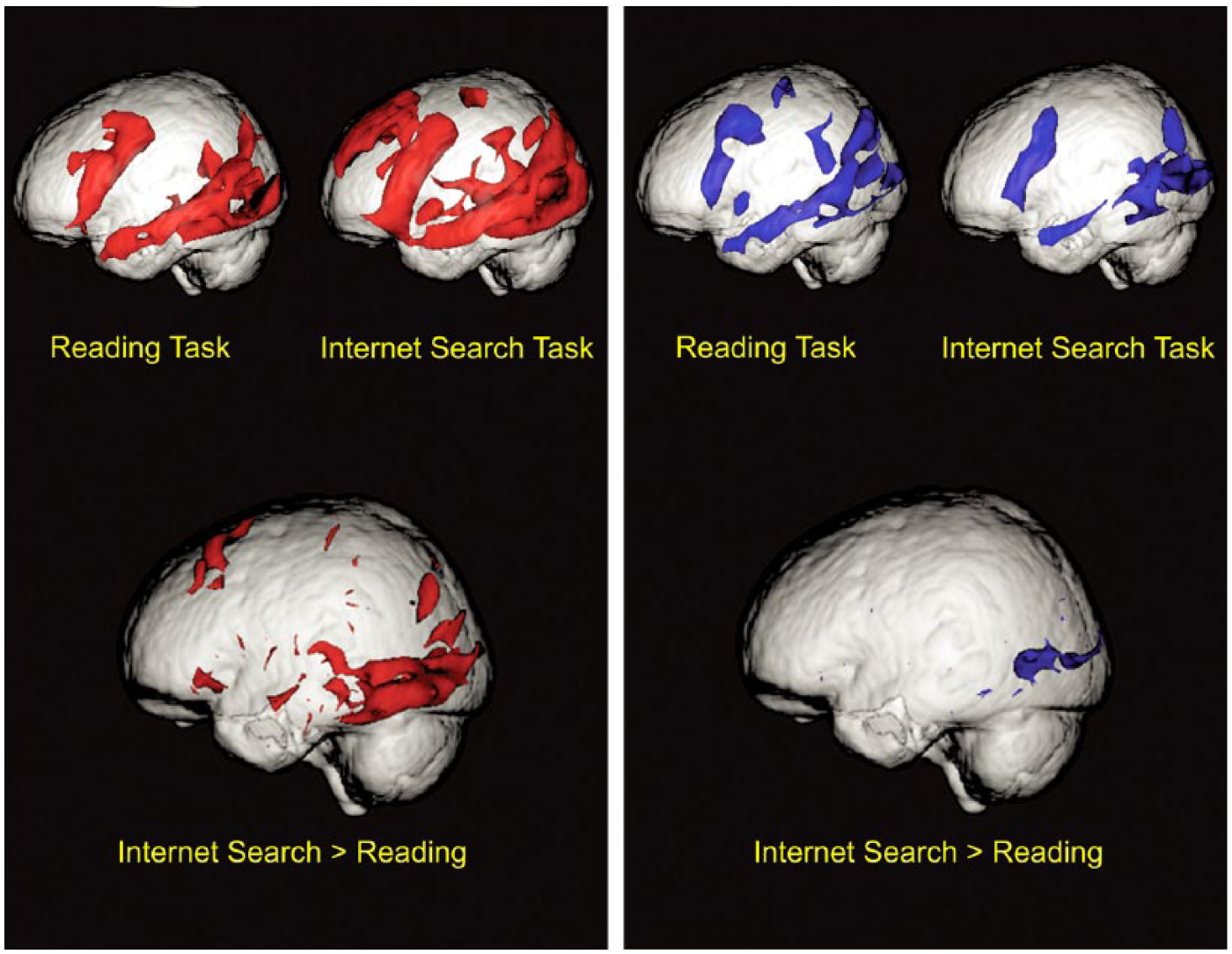
Differences in brain activations between participants with (Red) and without (Blue) Internet searching experience during Internet searching and reading (Small and others 2009). Reading evoked similar brain regions in both groups that were typically involved in reading (i.e., inferior and middle frontal gyri, medial temporal gyrus, angular gyrus, hippocampus, posterior cingulate, visual cortex). During Internet search, nonexperienced participants showed similar activation patterns as reading, whereas Internet-experienced participants showed additional activations in frontal pole, right anterior temporal cortex, cingulate cortex, and hippocampus. Comparisons between Internet search and Reading conditions revealed increased extents of activation in Internet-experienced participants in frontal and occipital regions. Small and Vorgan (2008) further reported that nonexperienced participants, after 5 days of exposure to Internet searching, also showed the same pattern of increased activations in the Internet search task. These findings suggested that Internet searching could alter brain mechanisms involved in information processing. More work is needed to characterize the nature of these neural changes. Figures were adapted and modified from Small and others (2009).
Increased Multitasking Behaviors, Increased Distractibility, and Reduced Executive Control?
The proliferation of Internet technologies has also mirrored a dramatic increase in Internet-related multitasking behaviors especially among younger generations (Carrier and others 2009; Rideout and others 2010). Here, we broadly use the term Internet-related multitasking to refer to any form of multitasking with Internet technologies, for example, smartphones, computers, and so on. Internet-related multitasking behaviors have been consistently linked with increased distractibility, poorer classroom learning, and poorer academic performance (reviewed in Carrier and others 2015). Recent findings have associated these multitasking behaviors with negative impacts on executive control abilities (Ophir and others 2009).
Internet-Related Multitasking and Increased Distractibility during Classroom Learning
Armed with portable and multifunctional smart devices, modern students can do much more than learning from their teachers in class. Research has shown that majority of students reported texting (Tindell and Bohlander 2012), web-browsing (Hembrooke and Gay 2003), or using other electronic media (Jacobsen and Forste 2011) during class. Wood and others (2012) investigated the impacts of multitasking with various digital technologies (Facebook, online messaging, emailing, or phone texting) as students attended a real-time 20-minute lecture. They found that multitasking with technologies as compared with pen-and-pencil note taking led to poorer recall of the taught material. Further comparisons revealed that students who had not used any digital technology during the lecture performed better than those who did on the postlecture quiz. Three other studies (Ellis and others 2010; Kuznekoff and Titsworth 2013; Rosen and others 2011) also found worse learning performance in students instructed to engage in text messaging during a live lecture. Similarly, Sana and others (2013) had participants perform secondary online tasks while taking notes during a live lecture. Compared with participants who performed only the primary task, multitasking participants performed worse in the recall task. The aforementioned studies consistently showed a negative association between multitasking behaviors and class learning performance. Since participants in these studies were explicitly instructed to multitask, it was unclear whether the learning impairments were a result of “distraction” by the technologies or just a product of competing task demands. Addressing this gap, other researchers directly examined the relationship between naturalistic (noninstructed) multitasking behaviors, distractibility, and primary task performance. Brasel and Gip (2011) exposed participants to a naturalistic multitasking environment consisting of a television set and a computer for 30 minutes. Without explicit instructions to multitask, participants extensively switched between the TV and computer at an average rate of 4 switches per minute and an average of 120 switches throughout the experiment. Rosen and others (2013) observed participants as they engaged in 15 minutes of studying in a familiar environment. They found that participants switched to a secondary task every 5 to 6 minutes and spent only 10 minutes on average on their primary task. Furthermore, the amount of switching was predicted by the amount of technology available and led to worse task performance. Adler and Benbunan-Fich (2013) allowed participants to freely switch between a primary Sudoku task and a few other tasks. They also found that increased switching behaviors predicted poorer performance on the primary task. Finally, in the study by Sana and colleagues, participants who were instructed to engage in the primary task only showed poorer recall performance when they were seated within view of participants who were multitasking with their laptops. Together, these findings highlighted that Internet-related multitasking behaviors are related to both increased distractibility (by Internet technologies) and also poorer performance on the primary task. However, researchers also noted the factors that could moderate these multitasking behaviors and its detrimental effects on learning (reviewed in Carrier and others 2015). These include having specific goals and motivation (Judd and Kennedy 2011), positive affect while engaging in the primary task (Adler and Benbunan-Fich 2013), and reduced time constraints (Bowman and others 2010; Judd and Kennedy 2011). In particular, researchers also highlighted the importance of meta-cognitive abilities (self-awareness of learning and cognitive styles, mindfulness, etc.) in moderating multitasking behaviors (Carrier and others 2015; Ie and others 2012; Rosen and others 2011).
Media-Multitasking Activity and Executive Control Abilities
A landmark study by Ophir and others (2009) provided first insights into the links between media-multitasking activity and executive control abilities. Through a series of laboratory-based cognitive control tasks, they revealed that heavy media multitaskers (who reported consuming a higher number of media concurrently; HMM) were worse at inhibiting the processing of irrelevant stimuli, memory representations, and task-sets than light multitaskers (LMM). Lin (2009) further proposed that HMMs, being used to switching between media types, were habituated toward a breadth-biased style of attention control that compromised attention focus on the primary task for the parallel processing of multiple information sources. Cain and Mitroff (2011) engaged HMMs and LMMs in a singleton detection task where they searched for a target stimulus that was different in shape from the rest. Additionally, as a distraction, one stimulus (target or nontarget) could appear in a different color from the rest. Participants were validly informed whether the target could (“sometimes” condition) or could not (“never” condition) be in a different color from the rest. Unlike LMMs who performed better in “never” versus “sometimes” conditions, HMMs showed no improvements regardless of whether they knew that the target could be of a different color. Cain and Mitroff suggested that HMMs persisted in their wider attention allocation (and processed irrelevant color information) even when instructed otherwise. Lui and Wong (2012) provided additional evidence of a broader attention scope by showing that HMMs were better at processing irrelevant stimuli that led to improved performance on a multisensory integration task. Yap and Lim (2013) found that HMMs were better at splitting their visual focal attention. HMMs also performed worse in a dual-task paradigm where they had to concurrently solve math problems and remember letters (Sanbonmatsu and others 2013). These studies suggested that HMMs were adopting a wider attention focus that was associated with poorer inhibition (or better processing) of goal-irrelevant perceptual stimulus, memory representations, and task-sets. Two recent studies revealed contradictory findings to the above-mentioned views (Alzahabi and Becker 2013; Minear and others 2013). Minear and colleagues investigated the abilities of HMMs in attention control (Fan and others 2002), inhibition of past memory representations (recent probes recognition task), and task-switching. They found that HMMs did not perform worse in any of the three tasks. The ANT task was designed to measure performance on three different attention processes (alerting, orienting, and executive). According to Fan and colleagues, alerting involved the ability to maintain a state of alertness, orienting involved the ability to direct attention (either covertly or overtly), and executive involved the ability to resolve conflicts between competing stimulus and responses. As shown in the studies by Ophir, Lui, and Cain, HMMs were not impaired in alerting and covert orienting processes since they were efficiently attending to visual stimulus (including distractors). As such Minear and colleagues’ finding that HMMs were not worse in orienting and alerting were not incongruent with Ophir, Lui and Cain’s findings. However, Minear and colleagues’ finding that HMMs were not worse in executive attention was incompatible with Ophir, Lui and Cain’s findings. With regard to their finding that HMMs were not worse in inhibiting past memory representations, Minear and colleagues suggested the possibility that their task was not equivalent in terms of cognitive load. They highlighted that Ophir and colleagues had observed memory interference effects only at higher cognitive loadings. Last, Minear and colleagues did not find an impaired task-switching ability in heavy multitaskers despite a direct replication of Ophir and colleagues’ task. Minear and colleagues also highlighted that their HMMs (who were more impulsive and had lower fluid intelligence) might be adopting different attentional strategies than the HMMs in the study by Ophir and colleagues (who were students from a renowned institution). Alzahabi and Becker (2013) had similarly reported that HMMs were not worse at dual-task performance and in fact better in task-switching on Ophir and colleagues’ task. They concluded that people might be becoming more proficient at media-multitasking. They further highlighted that, contrary to the study by Ophir and colleagues, their sample was dominantly female and could be part of a generation that was more experienced with media-multitasking.
As such, findings were generally consistent that HMMs were worse at inhibiting distracting perceptual information. They also tend to split their attention focus and were better at integrating multisensory information. This suggested that HMMs were adopting a breadth-biased form of attention control. Deployment of this mode of attention control seemed to be involuntary since HMMs were found to persist in processing distracting information even when instructed otherwise. However, findings were inconsistent about whether HMMs performed worse in inhibiting memory representations, task-switching, and dual-tasking. One possibility is that HMMs automatically adopt a breadth-biased mode of attention control only for tasks involving less top-down control such as target discrimination and detection tasks. On the other hand, when faced with tasks involving a higher degree of top-down control, that is, the inhibition of memory representations and task-sets, HMMs were more varied in their adoption of breadth-biased attention control. The discussed studies had all adopted an individual differences approach to study the impacts of media-multitasking. This approach does not warrant conclusions about the directionality of the relationship between media-multitasking and cognitive impacts. It is possible that higher media multitasking activity led to observed executive control problems, and equally likely that executive control deficits predisposed individuals toward higher media multitasking. Interestingly, a series of studies conducted by Daphne Bavalier (Bavelier and others 2012; Dye and others 2011; Green and Bavelier 2003) revealed that increased exposure to multitasking via action video games was associated with better attention control performance. Frequent video gamers were better at inhibiting irrelevant information (Bavelier and others 2012; Mishra and others 2011) and dividing attention (Green and Bavelier 2006). These findings, running opposite to the behavioral correlates of media-multitasking, were suggestive that exposure to different forms of multitasking could have different impacts on cognitive control abilities.
Impacts of Internet-Related Multitasking on the Brain
Two studies investigated the neural correlates of engaging in a conversation while driving (Just and others 2008; Schweizer and others 2012). These studies provide useful insights into the neural consequences of media distractions. Just and colleagues investigated functional brain activity when participants engaged in a simulated driving task with or without an additional language comprehension task. Findings revealed that dual tasking led to a 37% decrease in parietal brain activations compared with driving undisturbed. This decrement in brain activation was also related to poorer driving performance. Schweiser and colleagues found that distraction by an auditory task resulted in decreased activations in posterior brain regions involved in visual attention and vigilance while driving. This reflected that engagement in a secondary task would reduce the brain activations involved in the primary task. By the same vein, as students engage in media use during classroom learning, the brain activity necessary for efficient learning can be compromised.
Loh and Kanai (2014) examined the association between trait media-multitasking and brain structure. It was revealed via voxel-based morphometry (VBM) analysis that higher levels of media-multitasking reflected decreased gray matter densities in the anterior cingulate cortex (ACC; Fig. 2). This region also showed significant connectivity with cognitive control brain regions. In particular, higher media-multitasking activity also predicted connectivity between the ACC and precuneus (Fig. 2). As such, these findings provided a possible neural correlate for the cognitive control deficits observed in HMMs. However, since cognitive control abilities were not directly measured in the study and with recent findings that revealed null and positive associations between media-multitasking and cognitive control (Alzahabi and Becker 2013; Minear and others 2013), the link between decreased ACC volumes and decreased cognitive control abilities needs to be further explored. Importantly, the study was also correlational in nature and thus it was unknown if increased media-multitasking had caused decreased ACC volumes or vice versa.
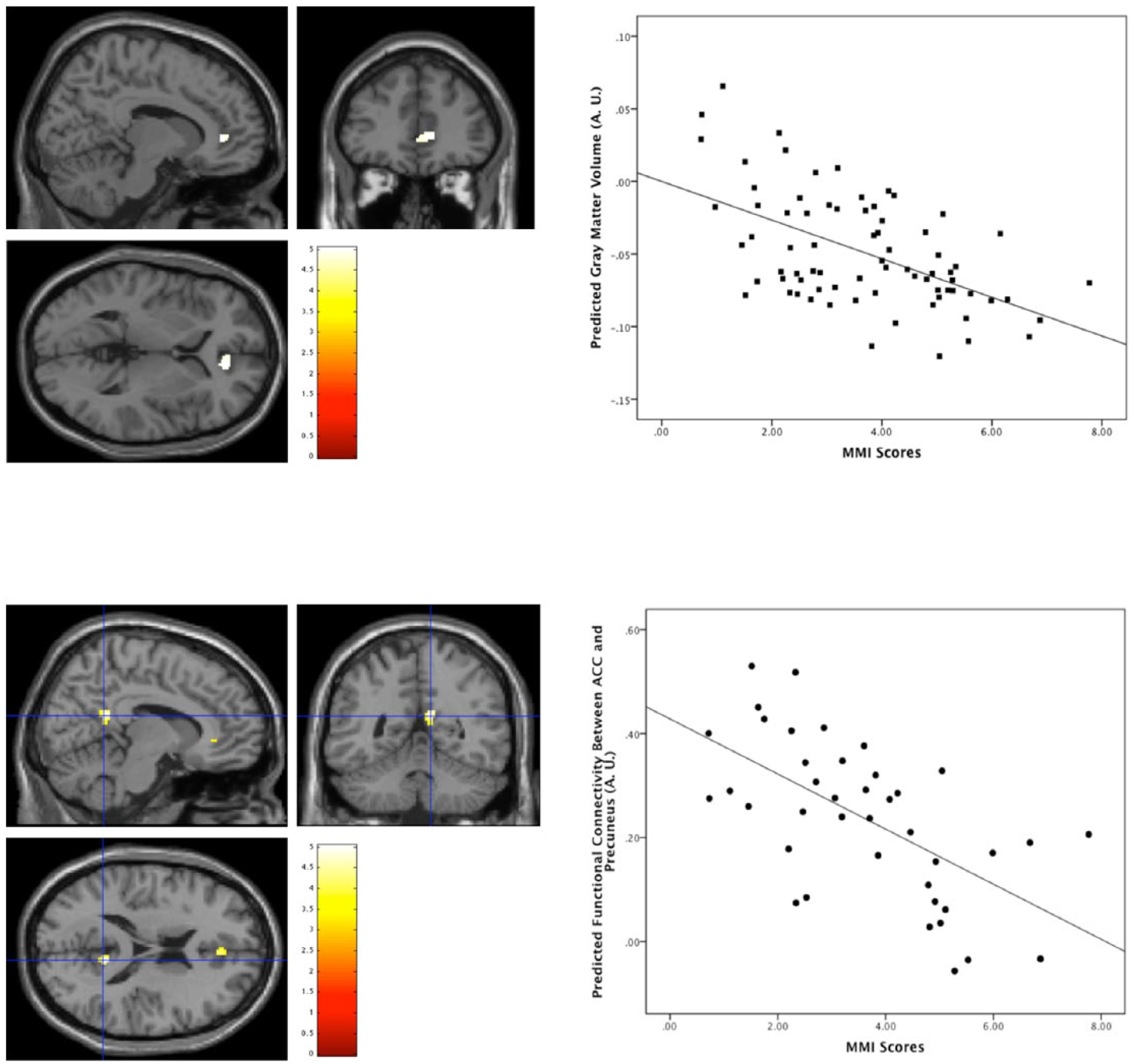
Increased media-multitasking activity predicted larger gray matter densities (GMD) in the anterior cingulate cortex (ACC) and functional connectivity between the ACC and precuneus (Loh and Kanai 2014). (Top left) Individuals with higher media-multitasking index (MMI) scores showed decreased GMD in the rostral ACC. (Top right) ACC gray matter densities was significantly correlated with MMI scores. (Bottom left and right) MMI scores also predicted the functional connectivity between the ACC region-of-interest and precuneus (intersection of blue lines).
In the case of video-game multitasking, Bavelier and others (2012) found that frequent gamers, compared with nongamers, showed reduced activation of visual and frontal-parietal regions with increasing attention demands, without performance decrements. This suggested that frequent gamers were more efficiently utilizing their cognitive resources when dealing with attention demands. This was in line with other studies that revealed decreased frontoparietal activations in individuals who were better at multitasking (Dux and others 2009; Jaeggi and others 2007). Although it was not apparent from the cross-Wsectional design, Bavelier and others (2012) argued that this increased neural efficiency was a product of increased video-gaming based on previous experiments that revealed attention enhancements via video-game training (Green and Bavelier 2003). Tanaka and others (2013) also revealed that expert gamers showed larger gray matter volumes in the posterior parietal cortex that correlated with better visual working memory performance. Overall, neuroimaging investigations consistently show that exposure to multitasking via action video games led to structural and functional changes in the frontal-parietal network that were associated with better attention performance.
Altered Reward-Processing and Self-Control Mechanisms?
The Internet environment can offer users a highly stimulating and rewarding experience. Greenfield (2011) highlighted the main properties of the Internet’s appeal: First, the typical content found on the Internet, including music and videos, social information, and games, are inherently pleasurable in nature. Furthermore, popular Internet activities, such as gaming, shopping, and sexual interactions, are extremely gratifying and associated with overuse in the real world (Young 1998). Leveraging on the Internet’s infrastructure, these desirable content and activities can be more frequently and conveniently accessed. The diminished presence of physical and temporal barriers to Internet-afforded gratifications further enhances the Internet experience. The Internet environment also metes out rewards on a variable ratio schedule (Skinner 1969). Users receive pleasurable returns at both unpredictable frequencies (e.g., the occurrences of Facebook “likes,” YouTube “views,” etc.) and magnitudes (e.g., the quality of Google search matches, blog reviews or comments, etc.). This rewarding structure is known to strongly reinforce reward-pursuing behaviors and commonly implicated in compulsive behaviors (Knapp 1976). One critical consequence of the highly rewarding Internet environment is the increased prevalence of Internet-related addictive behaviors (Kuss and others 2014). Although the exact definition and description of these behaviors are still highly controversial, there is a general consensus that they typically involve the excessive usage of the Internet (or its supported functions) and the inability to control this usage (Brand and others 2014; Kuss and others 2014). Accumulating work had associated Internet-related addictive behaviors with altered reward processing (e.g., Lin and others 2015; Yao and others 2015) and self-control (reviewed in Brand and others 2014) mechanisms.
Altered Reward-Processing in Internet-Related Addictions
Relative to controls, individuals with Internet-related addictions (IA) show differences in the way they process rewards during decision-making tasks. The Iowa gambling task (Bechara and others 1994) is a probabilistic decision-making task that involves the ability to forego larger immediate rewards that led to net losses, for smaller rewards that led to net gains. IA individuals less frequently selected advantageous decks (smaller immediate rewards but leading to net gains) and were slower in learning the optimal strategy than normal control (Sun and others 2009; Xu 2012). In reaction to a big gain (which indicated that they were on disadvantageous decks), normal controls would switch decks to avoid potential larger losses that follow. Conversely, IA participants persisted on the same deck after large gains cards (Xu 2012). This suggested they were highly biased toward larger immediate rewards even when they could lead to net losses. Lin and others (2015), via a probability-discounting task, found that, compared with controls, IA participants could tolerate a larger amount of probability for larger rewards. Pawlikowski and Brand (2011) further revealed that even when IA participants were aware of the choices’ reward probabilities, they still preferred lower probability choices that were linked with high rewards. Yao and others (2015) compared the risk-taking behaviors of IA individuals in the gain and loss domains via the cups task. Participants chose between a safe option (100% probability of either winning or losing a fixed smaller sum) and a risky option (25%, 33%, or 50% chance of winning or losing a larger variable sum). Overall, IA individuals chose risky options more often than controls. They also made more disadvantageous risky choices in the loss domain (when selecting between a sure small loss or probable big loss). Further analyses suggested that IA participants were less likely to account for probability and outcome magnitude in these decisions. Taken together, IA individuals were strongly driven by immediate rewards in their decisions, even in the face of potential losses and reduced reward probabilities. This account could explain why IA individuals continue to engage in excessive amounts of Internet use despite being aware of the associated detriments.
Impaired Self-Control Mechanisms in Internet-Related Addictions
IA individuals also show poorer abilities in controlling or inhibiting their responses. A common experimental paradigm that was used to assess response inhibition was the Stroop task (Stroop 1935) in which better performance was indicated by decreased error rates and decreased reaction time (RT) between congruent and incongruent trials. IA participants tend to commit more errors than controls on incongruent trials (Dong and others 2011b; van Holst and others 2012; Wang and others 2015; Xing and others 2014; Yuan and others 2013). With respect to RT, findings were inconsistent as to whether IA participants were faster (Wang and others 2015), slower (Dong and others 2011b; Li and others 2015; Xing and others 2014), or not different (van Holst and others 2012; Yuan and others 2013) from control in incongruent trials. Interpretation of RT differences was ambiguous as faster RTs could mean either increased impulsivity (reflecting poorer self-control) or reduced time to inhibit responses (reflecting better self-control). Some studies revealed no difference in Stroop performance in both RTs and error rates between IA and normal participants (Dong and others 2012; Dong and others 2013b; Dong and others 2014). However, these null findings could be associated with a lack of statistical power as these studies reported relatively smaller sample sizes (n = 24, 30, 31) than the earlier mentioned studies (n between 34 and 92). The Go/No-Go task was also adopted to measure response inhibition performance. In this task, participants had to respond quickly to “Go” stimuli and inhibit responses to “No-Go” stimuli. Littel and others (2012) found that IA participants, relative to controls, reacted faster and had similar error rates in “go” trials but had more errors in “no-go” trials. Similarly, Li and others (2014) noted a decreased percentage of successful no-go trials in IA participants. However, multiple studies had found better (Sun and others 2009) or no difference (Ding and others 2014; Dong and others 2010) in go/no-go task performance in IA versus controls. Researchers had also used Internet or gaming-related cues for the go/no-go tasks (Decker and Gay 2011; van Holst and others 2012; Zhou and others 2012). These studies consistently found that IA individuals had faster RT and accuracy when the “go” stimulus was an Internet or gaming related cue and poorer inhibition performance when the “no-go” stimulus was an Internet or gaming cue. Overall, individuals with Internet-related addictions showed poorer response inhibition and this was further aggravated in the presence of Internet-related cues.
Based on the above discussion, research had consistently revealed that IA individuals are highly driven by instant rewards in their decisions even in the face of losses and low winning probabilities. They are also worse at cognitively inhibiting their responses especially in response to Internet-related cues. These findings provide an important link between excessive Internet use and impaired reward-processing and self-control abilities. However, given that these results were largely derived from cross-sectional studies, the directionality of the relationship between Internet usage and the cognitive impairments remains ambiguous. Another important limitation was that studies were dominantly conducted on Asian male Internet gaming populations. This greatly restricted the generalizability of the observed cognitive impacts to other populations and forms of Internet use.
Neural Correlates of Internet Addictive Behaviors
The neural mechanisms underlying IA behaviors had been extensively studied over the past decade (reviewed in Brand and others 2014; Kuss and Griffiths 2012). Figure 3 provides a summary of the typical brain regions associated with Internet addiction. Studies have consistently found that IA individuals show enhanced neural activations toward Internet-related cues (Ko and others 2009; Sun and others 2012). Suggesting a causal link between Internet gaming exposure and enhanced neural sensitivity to Internet-related cues, Han and others (2011) found that after being exposed to a novel Internet game, healthy subjects showed increased activation in response to game-related cues versus normal visual stimuli. Kühn and others (2011) compared regional gray matter density (GMD) differences between frequent and infrequent Internet gamers. They found that frequent gamers had higher GMD in the left ventral striatal region. The authors suggested that increased striatal volumes were indicative of enhanced dopaminergic release as a result of frequent gaming. In line with this interpretation, neurobiological studies have also revealed decreased dopamine transporter expression (Hou and others 2012) and reduced D2 receptors (Kim and others 2011) in the striatums of IA individuals, which were both associated with decreased dopamine regulation. Kühn and others (2011) further found increased activation in the same striatal region (indicating increased dopamine release) when IA individuals experienced losses. This could underlie IA individuals’ tendencies to persist in addictive behaviors even when confronted with negative consequences. When confronted with continuous wins, IA individuals compared with controls, showed higher activations in the superior frontal gyrus (SFG; Dong and others 2013a) and orbital frontal cortex (OFC; Dong and others 2011a). These regions had been found to preferentially activate in response to choices associated with immediate versus delayed rewards (McClure and others 2004). Interestingly, IA individuals also showed higher SFG activations in the face of continuous losses (Dong and others 2013a). This suggested that IA participants, compared with controls, showed increased reward anticipation in both gains and losses conditions. In the face of losses, IA individuals showed decreased anterior (ACC) and posterior cingulate cortical (PCC) activation than controls (Dong and others 2011a; Dong and others 2013a). The ACC and PCC had been implicated in aversive processing (Petrovic and others 2008) and adaptive behavioral changes (Pearson and others 2011). This reflected reduced loss sensitivity in IA individuals.
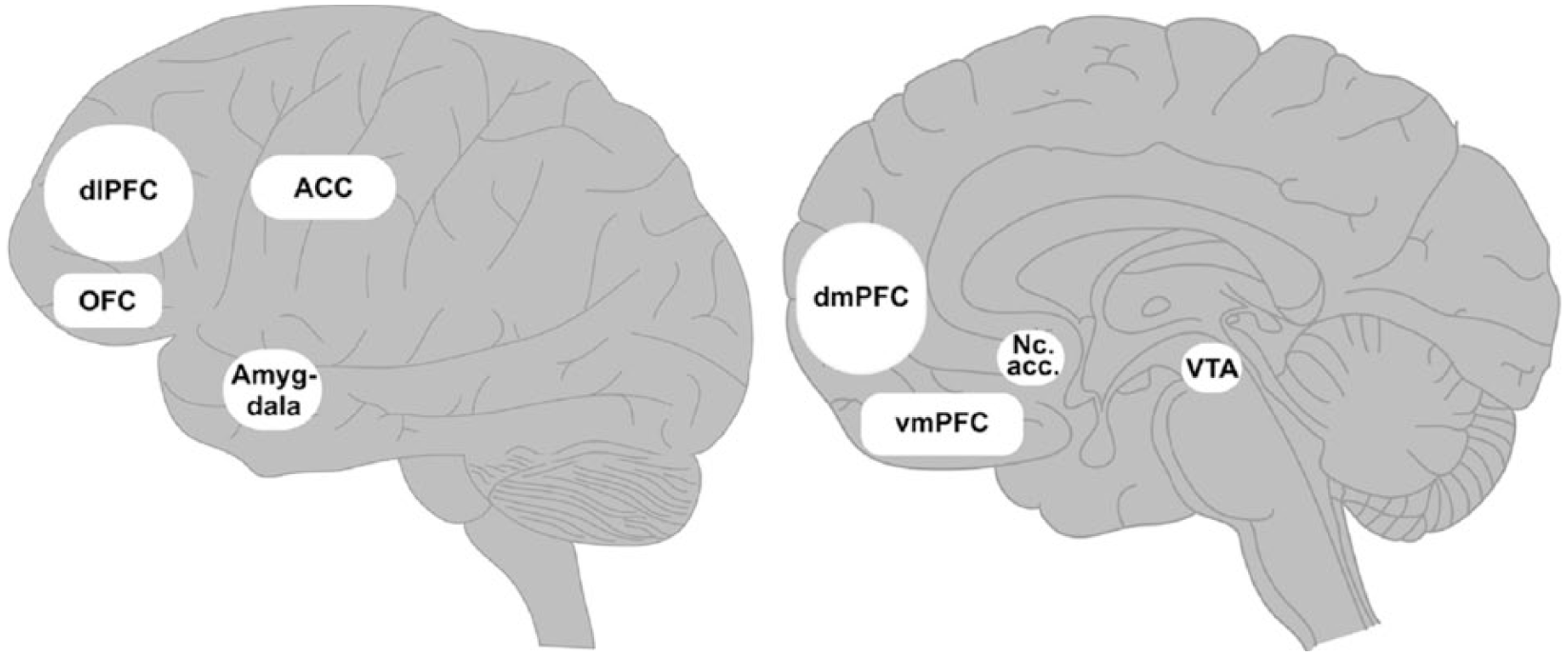
Locations of typical brain regions associated with altered self-control and reward-processing in Internet addiction (IA; Brand and others 2014). This figure depicts the lateral (left) and medial (right) brain regions that commonly reflect structural and functional differences in IA individuals. The dorsolateral prefrontal cortex (dlPFC) and anterior cingulate cortex (ACC) are typically involved in top-down response inhibition, error monitoring, and goal maintenance. The orbitofrontal cortex (OFC), dorsomedial prefrontal cortex (dmPFC), ventromedial prefrontal cortex (vmPFC) are implicated in the processing of rewards during decision making. Limbic structures such as the amygdala, nucleus accumbens (Nc. acc.), and ventral tegmental area (VTA) are important in motivating and driving reward-pursuing behaviors. Figure adapted and modified from Brand and others (2014).
IA individuals also show alterations in self-control neural mechanisms. Multiple studies have revealed that IA individuals, relative to controls, had decreased GMD in frontal-parietal structures that were typically involved in cognitive control (Hong and others 2013; Weng and others 2013; Zhou and others 2011). Wang and others (2015) revealed, via VBM, reduced GM volumes in the ACC, precuneus, supplementary motor area (SMA), superior parietal cortex, dorsolateral prefrontal cortex (DLPFC) in IA individuals. Importantly, the decrease in ACC volumes was correlated with poorer Stroop task performance. Yuan and others (2013) found decreased OFC cortical thickness that was correlated with poorer Stroop performance in IA subjects. Yuan and others (2011) showed that IA individuals had smaller volumes in the DLPFC, OFC, SMA, and ACC that correlated with the reported duration of the disorder. Li and others (2015) found that increased tendencies toward Internet addiction predicted increased GM volumes in the DLPFC (which reflected reduced inhibitory function; see discussion by Li and others 2015) and decreased anticorrelations between the DLPFC and ACC. These neural differences were also associated with poorer Stroop task performance. Functional imaging and event-related potential studies have also found altered neural activations in prefrontal regions as IA individuals engaged in response inhibition tasks (Dong and others 2010; Dong and others 2011b; Dong and others 2012). Overall, IA behaviors were associated with alterations in both structural and functional differences in brain regions involved in response inhibition.
One important caveat here is that the aforementioned findings do not inform if the rewarding Internet environment has caused these brain changes. It was equally likely that impairments in reward-processing and self-control led IA individuals toward IA behaviors. Future work should directly investigate the impacts of the rewarding Internet environment on healthy nonaddicted populations.
Summary and Conclusions
Over the past two decades, a substantial body of work has unraveled important impacts of the Internet environment on our cognitive behaviors and structures. In terms of information processing, we are shifting toward a shallow mode of learning characterized by quick scanning, reduced contemplation, and memory consolidation. This can be attributed to the increased presence of hypertext environments that reduces the cognitive resources required for deep processing. However, this cognitive loading effect can be mediated by fostering adaptive learning habits or by improving the navigability in hypertext environments. Another factor contributing to the shift toward shallow learning is the ease of online information retrieval that reduces the need for deep processing to commit information to memory. Relying on technology as an external memory source can result in reduced learning efforts as information can be easily retrieved later. This is not entirely maladaptive as we can strategically free up additional cognitive resources for other prioritized operations. In interrupting the development of deep reading skills, this shift toward shallow information processing may affect brain circuitry necessary for these skills. There is evidence that Internet searching experience can result in neural changes but more research is required to reveal the exact mechanisms that are affected by online information processing.
The Internet environment also greatly facilitates multitasking behaviors. These behaviors, induced by the presence of Internet technologies, have been linked with increased distractibility and reduced learning in the classroom. Researchers have noted the importance of meta-cognitive abilities, motivation, and positive affect in moderating the distractibility by the Internet technology. Increased media-multitasking was associated with a breadth-biased form of attention control that generally resulted in better integration of multiple sources of information but poorer inhibition of distractors. However, findings about the impacts of media-multitasking on multitasking and task-switching performance were inconsistent. More research is also required to determine the causal relationship between media-multitasking and executive control as most of the existing findings have been based on cross-sectional studies. Currently, there are limited neuroimaging studies about the impacts on Internet-related multitasking and distractibility. A related line of research has found that when attending to media distractions, drivers show a reduction of brain activity required for the performance of their primary task (driving). A recent VBM study has also linked increased media-multitasking with smaller ACC volumes. However, given its correlational nature, longitudinal or experimental approaches are required to determine causality between media-multitasking and brain structure differences. Interestingly, multitasking with action video games can produce improvements in attention abilities. These improvements have also been reflected as structural and functional changes in the frontoparietal attention network. This suggested that exposure to different forms of multitasking can lead to different cognitive effects.
Finally, the rewarding Internet environment also has resulted in the increased prevalence of Internet-related addictive behaviors. IA individuals were worse at inhibiting their responses especially in the face of Internet-related cues and were also highly driven by immediate rewards even in the face of potential losses and uncertainty. These cognitive deficits were further associated with alterations in brain networks involved in self-control and reward-processing. Extending these findings, future work should examine the impacts of the rewarding Internet environment on self-control and reward-processing mechanisms in healthy, nonaddicted populations.
Footnotes
Declaration of Conflicting Interests
The author(s) declared no potential conflicts of interest with respect to the research, authorship, and/or publication of this article.
Funding
The author(s) disclosed receipt of the following financial support for the research, authorship, and/or publication of this article: Funding for this project came from a PRESTO grant from the Japan Science and Technology Agency. The funders had no role in study design, data collection and analysis, decision to publish, or preparation of the manuscript.