







Abstract
Students with emotional and behavioral disorders (EBD) often have deficient reading skills that require intensive intervention. Effective intervention is comprehensive in nature, addressing individual student needs. This article provides an overview and recommendations for one potential component of individualized support: the use of repeated reading interventions to improve the reading fluency of secondary grade students with EBD. Recommendations include practices teachers can use to plan, deliver, and improve the effectiveness of repeated reading interventions.
Improving Reading Fluency Scores for Secondary Students With Emotional and Behavioral Disorders
Students with emotional and behavioral disorders (EBD) often struggle with a range of reading skills, including reading fluently, understanding vocabulary, and comprehending text (Hilsmier, Wehby, & Falk, 2016). Students with EBD are also likely to spend less time reading (Vaughn, Levy, Coleman, & Bos, 2002). Although it is important to individualize and provide comprehensive reading intervention programs for students with EBD, we focus this discussion article on developing reading fluency for secondary students. We target reading fluency for the following four reasons.
Rationale for Developing Reading Fluency Skills
First, reading difficulties are important to address, as they contribute to problematic school and postschool difficulties (Ciullo, Ortiz, Al Otaiba, & Lane, 2016). For example, reading proficiency is necessary for success in curricula based on college and career readiness standards (Alberti, 2013) and reading deficiencies are associated with school dropout and unemployment (Jolivette, Stichter, Nelson, Scott, & Liaupsin, 2000). Thus, it is essential that teachers provide beneficial opportunities to all students to improve their reading skills. This mandate is particularly salient for teachers of students with EBD because these students have challenging behaviors and may be significantly below grade level in reading (McKenna & Ciullo, 2016).
Second, the need exists to provide effective instruction to students with EBD because there is reason to believe that it is not commonly occurring in schools. Observational research studies continue to demonstrate a lack of effective instructional practice in school-based contexts for students with EBD. More than 15 years ago, Vaughn et al. (2002) published a synthesis of reading observation studies and concluded that students with EBD received instruction characterized by minimal instructional time and infrequent opportunities for individualized instruction. Students overall spent little time engaged in text reading and comprehension was infrequently the focus of instruction.
More recently, McKenna and Ciullo (2016) investigated the reading instruction provided to students with EBD at a day and residential treatment center. Students were in Grades 1 through 6. In this study, a substantial amount of reading instructional time was spent managing student behavior and class transitions. Overall, students had few opportunities to engage in text reading and no opportunities for fluency practice. When students encountered narrative text, teachers tended to read the story aloud rather than requiring students to read. When students did participate in text reading, teachers often used a round robin format to engage students and were not observed engaging students in repeated reading. Although these strategies can potentially be used to make reading instruction easier for teachers to manage, they limit the frequency and quality of student opportunities to develop reading fluency and comprehension skills.
Third, although it is one of a host of skills that need to work together to promote reading comprehension for secondary students, fluency is still an important skill. Fluent readers are able to automatically recognize words, reading texts quickly and accurately (Stahl & Kuhn, 2002). For younger students, fluency improves comprehension because automaticity in word-reading skills allows readers to devote more working memory to constructing an understanding of what they read (Wolf & Katzir-Cohen, 2001). Acknowledging the importance of reading fluency, the Common Core State Standards (CCSS; National Governors Association Center for Best Practices & Council of Chief State School Officers, 2010) considers it a foundational skill. Yet struggling readers, such as students with EBD, may avoid reading tasks (Burke, Boon, Hatton, & Bowman-Perrott, 2015), limiting their ability to develop fluency skills (Chard, Vaughn, & Tyler, 2002). Weak fluency and insufficient engagement in reading, in turn, limits the development of stronger vocabulary knowledge and comprehension skills, as these reading competencies often develop through engaging in frequent reading (Kuhn & Stahl, 2003). Reading fluently and engaging in text reading is thus essential to reading performance.
Finally, there is a small body of research indicating that repeated reading interventions can improve the fluency skills of secondary students with EBD. Students who struggle in reading, including those with EBD, require high-quality opportunities to read connected text, including engaging narrative and expository texts (e.g., nonfiction or informational texts) within their instructional reading level (Swanson & Wexler, 2017). Repeated text reading is one instructional practice that teachers can use to engage students in text reading to improve fluency. Repeatedly reading text passages has a strong research base supporting its use to improve the reading fluency of students with learning disabilities (LD) in the elementary grades (Stevens, Walker, & Vaughn, 2017). Recent research involving secondary grade students with EBD has also demonstrated the promise of repeated reading for this student population (Escarpio & Barbetta, 2016; Hilsmier et al., 2016).
Escarpio and Barbetta (2016) investigated the effects of a repeated reading intervention with four sixth grade students with EBD and LD who attended a substantially separate day school. The researchers compared students’ comprehension and fluency across three intervention conditions. Students repeatedly read connected text passages of 100-150 words that were at their independent reading level. Texts at a student’s independent reading level were those that they could read with minimal adult support and with at least 92% accuracy (O’Connor, Swanson, & Geraghty, 2010). When a student made a reading error, the researcher told the student the word he or she had missed. The student then repeated the word and reread the entire sentence that contained the missed word. Upon completing the passage, the student reread each word that had been mistakenly read. Then the student reread the passage twice without researcher error correction. When students’ repeatedly read the same text and were provided teacher feedback, they read a greater number of words correctly per minute, made fewer reading errors, and performed better on a comprehension assessment (Escarpio & Barbetta, 2016).
Hilsmier et al. (2016) investigated the effects of a supplemental repeated reading intervention that included a teacher provided model of fluent reading. Four students in Grades 6 through 8 who received instruction in a classroom for students with learning and behavioral difficulties participated. All students had a history of externalizing problem behaviors, such as aggression, oppositional behaviors, and peer conflicts. Students were provided individualized instruction during each 20-min session. Students first silently read a passage and then followed along as a researcher read the passage aloud to model fluent reading. Students then read the passage aloud 3 times. Finally, students completed a timed reading of the passage with the researcher. The intervention was effective at improving fluency scores for all students and reading comprehension for three of the four students (Hilsmier et al., 2016).
Repeated Reading Interventions
As we have indicated, students with or at risk for EBD with deficient reading skills require intensive intervention that is designed to meet their individual needs. Reading intervention should take a comprehensive approach to develop skills that are necessary for comprehension, which is the primary outcome of reading. The purpose of this discussion article is to provide information on research-based strategies for developing one of these aspects, reading fluency for secondary grade students with or at risk for EBD. We describe repeated reading interventions, which can be included as one part of a comprehensive approach to address reading difficulties. Repeated reading interventions can be used to engage students in text reading and address reading fluency difficulties. We provide specific suggestions for teachers to use with students before, during, and after repeated reading activities.
Repeated reading typically requires students to read the same passage several times within a single instructional session, endeavoring to improve the number of words read correctly on each subsequent reading. There are specific practices that teachers can employ to effectively engage students with or at risk for EBD in repeated reading, including (a) carefully selecting texts, (b) setting goals, (c) providing an authentic purpose for reading, (d) providing a model, (e) providing feedback and reinforcement, and (f) graphing reading performance. Figure 1 provides a summary of these recommendations that practitioners can use when planning and implementing repeated reading interventions.
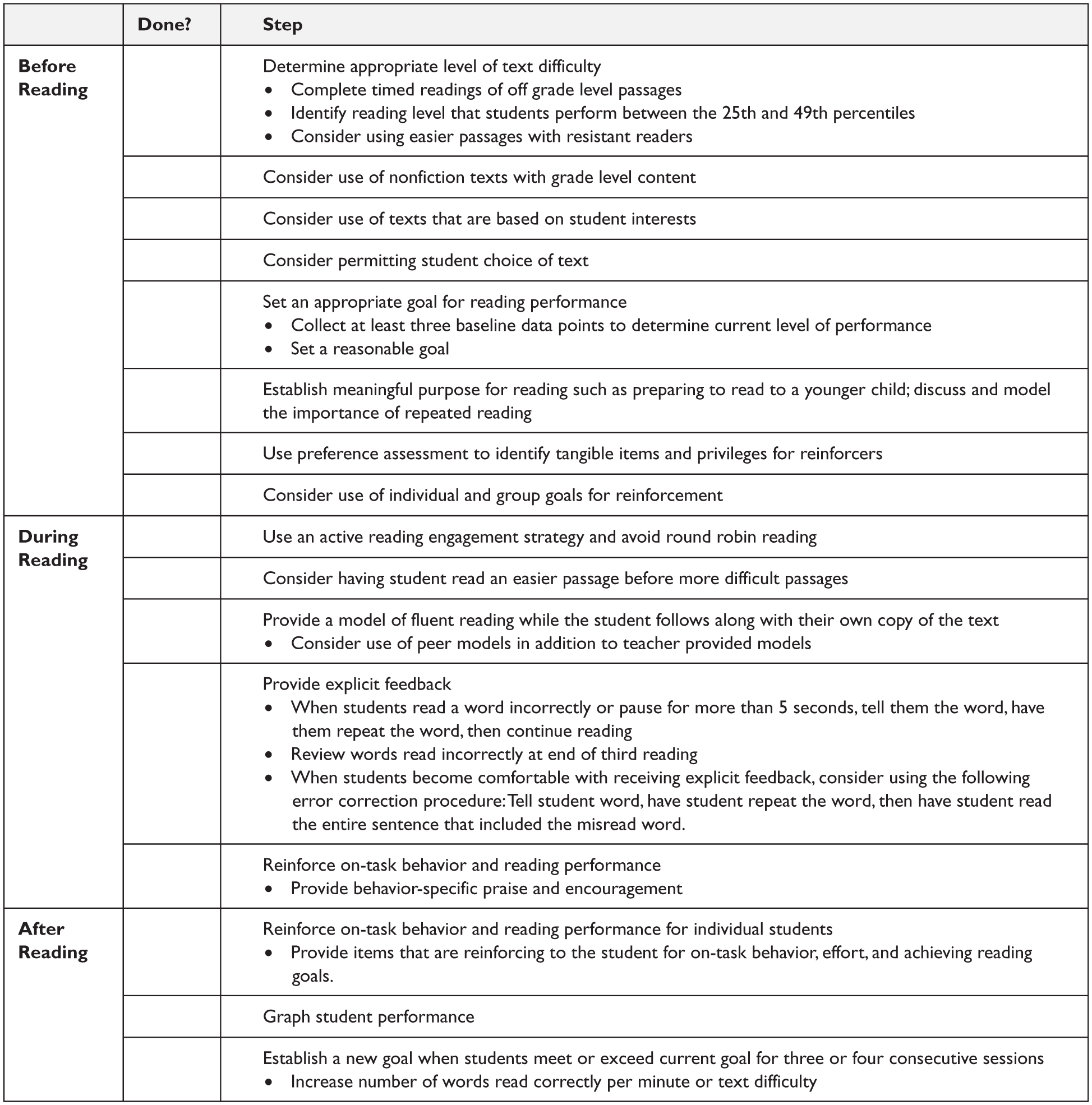
Fidelity checklist: Considerations for repeated reading interventions.
Selecting Texts
When selecting texts, it is essential to carefully match text difficulty to student reading level, promote on-task behavior, and decrease the likelihood that students will engage in problem behaviors to escape a challenging task (Sanford & Horner, 2013). To determine the appropriate level of text difficulty, teachers can have students complete timed readings with off-grade level passages. The easyCBM website (https://www.easycbm.com) provides teachers free access to grade-leveled passages, as well as guidelines for interpreting scores. Teachers can then select text at the level in which the student scores between the 10th and 50th percentile (Alonzo & Tindal, 2010). Considering that students with or at risk for EBD likely have comorbid learning and behavioral problems (Burke et al., 2015) and may find reading aversive, it may be beneficial to initially select texts in which students are able to score in the middle of this percentile range (e.g., between the 25th and 35th percentile). When students are able to correctly read a number of words that is consistent with performance at the 50th percentile, teachers can increase the text difficulty level (Alonzo & Tindal, 2010). As reading performance may vary across texts and testing days, teachers may want to have students achieve this level of performance for three or four consecutive probes before increasing task difficulty.
In addition, teachers can select expository or informational texts with grade-level content that is at the student’s independent reading level (Ciullo et al., 2016). This provides students an opportunity to improve reading skills while developing content-area knowledge. For example, students could read a science text about concepts that will be covered in a future science class, thus providing an opportunity to develop background knowledge prior to science instruction, while also developing reading fluency skills. Conversely, students could read content-area text on subject matter that has already been taught, which provides students an opportunity to clarify and refine their understanding of previously learned concepts, while also developing reading fluency. Selecting texts that address academic content areas also has an advantage for teachers who are delivering instruction across content areas, as it provides an opportunity to streamline planning and instruction.
Selecting texts based on student interests, or permitting students to select texts from options at their reading level, can potentially promote task engagement and student interest in reading. Providing students opportunities to make choices from among appropriately leveled texts is a promising practice for promoting academic engagement and decreasing problem behaviors (Jolivette, Stichter, & McCormick, 2002; Royer, Lane, Cantwell, & Messenger, 2017). Teachers can identify student interests by having students complete reading interest surveys and by having discussions with their students regarding their interests inside and outside of school. Resources for selecting texts can be found at https://easycbm.com and https://dibels.uoregon.edu. (Those interested in accessing texts at either site will need to create a username and password to advance in the system.)
Setting Goals
Goal setting is an effective practice for improving the reading fluency of students with disabilities (Morgan, Sideridis, & Hua, 2012). Goal setting helps students to develop a growth mind-set, focusing their attention on improving fluency and other skills rather than on avoiding errors (Dweck, Walton, & Cohen, 2014). Fluency goals can focus on the number of words per minute that students correctly read on instructional level text. The idea is to establish a goal, monitor student progress toward its attainment, and adjust instructional practices if students are not achieving them (Haas, Stickney, & Ysseldyke, 2016).
A teacher can first collect data for at least three baseline data points so that there is an objective starting point to be able to evaluate the effectiveness of an intervention. Then, a teacher can have a conversation with a student about the student’s fluency goals. Setting the magnitude of the goal is challenging, as there are two imperatives to keep in mind. First, it is important to set reasonable goals for student performance. Reasonable goals are targets that are achievable within a fairly short period of time (e.g., 2 to 4 weeks, depending on the frequency of intervention and previous student performance). Second, it is also important to set goals that are sufficiently ambitious to help students who are far behind in reading close the gap with their peers. However, teachers might use caution when considering grade-level expectations for reading goals as this requires students to make substantial progress (Haas et al., 2016).
Researchers have made various recommendations for expected reading fluency growth, such as between .3 and 3 new words read correctly per minute each week (Fuchs, Fuchs, Hamlett, Walz, & Germann, 1993). Jenkins and Terjeson (2011) considered 1.5 additional words read correctly per minute as an “ambitious” weekly goal and one additional word per week a “moderate” (p. 28) goal. Hilsmier et al. (2016) set daily goals of 115 to 120 words per minute on passages for which students were initially reading between 65 and 100 words per minute. In Hilsmier et al. (2016), a student was provided a new goal when the student exceeded or met his or her current goal on 3 consecutive days. However, participants infrequently met their fluency goals and expressed frustration with this difficulty, suggesting this goal may have been too ambitious. These findings highlight the challenge associated with setting appropriate goals for students with or at risk for EBD. It also suggests a need to reinforce student effort and on-task behavior in addition to reading performance. Collaborating with students to identify an appropriate reading goal may be beneficial, as it may promote student engagement and investment in reading (Hagaman, 2012; Swain, 2005).
Weekly data collection for 6 weeks may be the minimum length of time to establish a reliable trend in fluency performance for oral reading fluency probes (Thornblad & Christ, 2014). If students are not on track to meet their goal, teachers can make instructional adjustments such as increasing the amount of time spent reading text, selecting texts based on student interests, allocating reading instructional time to different types of instructional activities, decreasing group size, providing one to one instruction, or seeking out coaching with performance feedback to improve fidelity of instruction (Jenkins & Terjeson, 2011; McKenna & Parenti, 2017).
When students meet their goals for three or four consecutive sessions, new goals can be set by either increasing the number of expected words per minute or increasing passage difficulty. Again, teachers can increase the text difficulty level when students perform at the 50th percentile or higher (Alonzo & Tindal, 2010). However, teachers may want students to read an easier passage immediately prior to reading more difficult texts to make it less aversive for struggling readers (Landrum & Sweigart, 2014). Additional guidelines and resources for goal setting can be found at https://dibels.uoregon.edu.
Providing Authentic Reading Purposes
Reading activities can provide a meaningful, motivating purpose for repeated reading. For example, asking a student to regularly read to a younger child can provide a meaningful reason for an older student to repeatedly read a text at the student’s Lexile level, in preparation for reading it fluently to the younger child. Lexile level refers to a system that can be used to determine a student’s reading level and the difficulty of a text, as indicated by the text’s sentence difficulty and word frequency (Lennon & Burdick, 2004). The idea is to select texts that are not too difficult to read and a good fit for the student (go to https://lexile.com for more information on use of Lexile levels to select texts). Teachers can also set the expectation that most texts will be read repeatedly, by modeling this during whole-class reading activities. For instance, teachers can model that we read the first time for vocabulary, the second time to identify the main idea, and the third time to identify relevant supporting details. Teachers can also model how good readers selectively reread when discussing texts to identify evidence to support claims and locate information to answer questions. Teachers can also model how good readers purposively reread sections of text they find confusing.
Providing Models
Providing students with a model of fluent reading may make repeated reading more effective (Chard et al., 2002). Models provide students opportunities to listen to text read fluently while they follow along visually. This allows students to mentally rehearse fluent reading, and extant research indicates it can improve the likelihood that students benefit from repeated reading opportunities (Stevens et al., 2017). Hilsmier et al. (2016) incorporated an adult model into the reading intervention of four students with EBD and found that all students improved their fluency rates and three increased reading comprehension performance.
Special educators, paraprofessionals, or peers with stronger reading skills can provide reading models (Chard et al., 2002; Fuchs, Fuchs, & Kazdan, 1999). Persons providing a model need to read the assigned text accurately and with appropriate pace in a 1:1 instructional setting, while the target student follows along silently. The target student can then read the same text independently, while the model follows along, providing feedback and reinforcement. Peers can also chorally read the text to promote the active engagement of all students. When establishing peers as models, it is important to directly teach the expected behaviors for both roles. That means stating the importance of performing each role, modeling the behaviors, providing corrective feedback when appropriate, reinforcing correct performance of the behaviors, and reteach role behaviors as necessary (Wang, Bettini, & Cheyney, 2014).
Providing Feedback and Reinforcement
Feedback is an essential component of explicit instruction (Archer & Hughes, 2011). Explicit feedback is immediate and specific, providing details about what students did well and what they can improve (Doabler, Nelson, & Clarke, 2016). When a student incorrectly reads a word or pauses for more than 5 s, the student should be told the word and then required to read it accurately before continuing to read. Feedback can also include reviewing words that were read incorrectly at the end of a third reading.
Being on task is a useful prerequisite to growth. Students with or at risk for EBD may struggle to maintain on-task behavior. Therefore, in addition to providing explicit feedback on reading, it may be advantageous to reward students for on-task behavior during repeated reading interventions to help make the act of reading less aversive. For example, Hilsmier et al. (2016) completed preference assessments to identify items that students were motivated to earn during repeated reading practice. In this study, students received reinforcement for achieving their daily reading goal for words correct per minute. Researchers first created a list of tangible items that students preferred and that were acceptable to school administration. Next, students’ rank ordered each item on the list based on their personal preference. Finally, students selected an item to earn at the conclusion of the reading lesson. Figure 2 provides an example of a preference assessment. In this example, teachers can list items and privileges that they believe students are motivated to earn. Teachers can also leave blank lines so that students can write down their ideas. Each student, then, rates each item according to the student’s personal preferences.
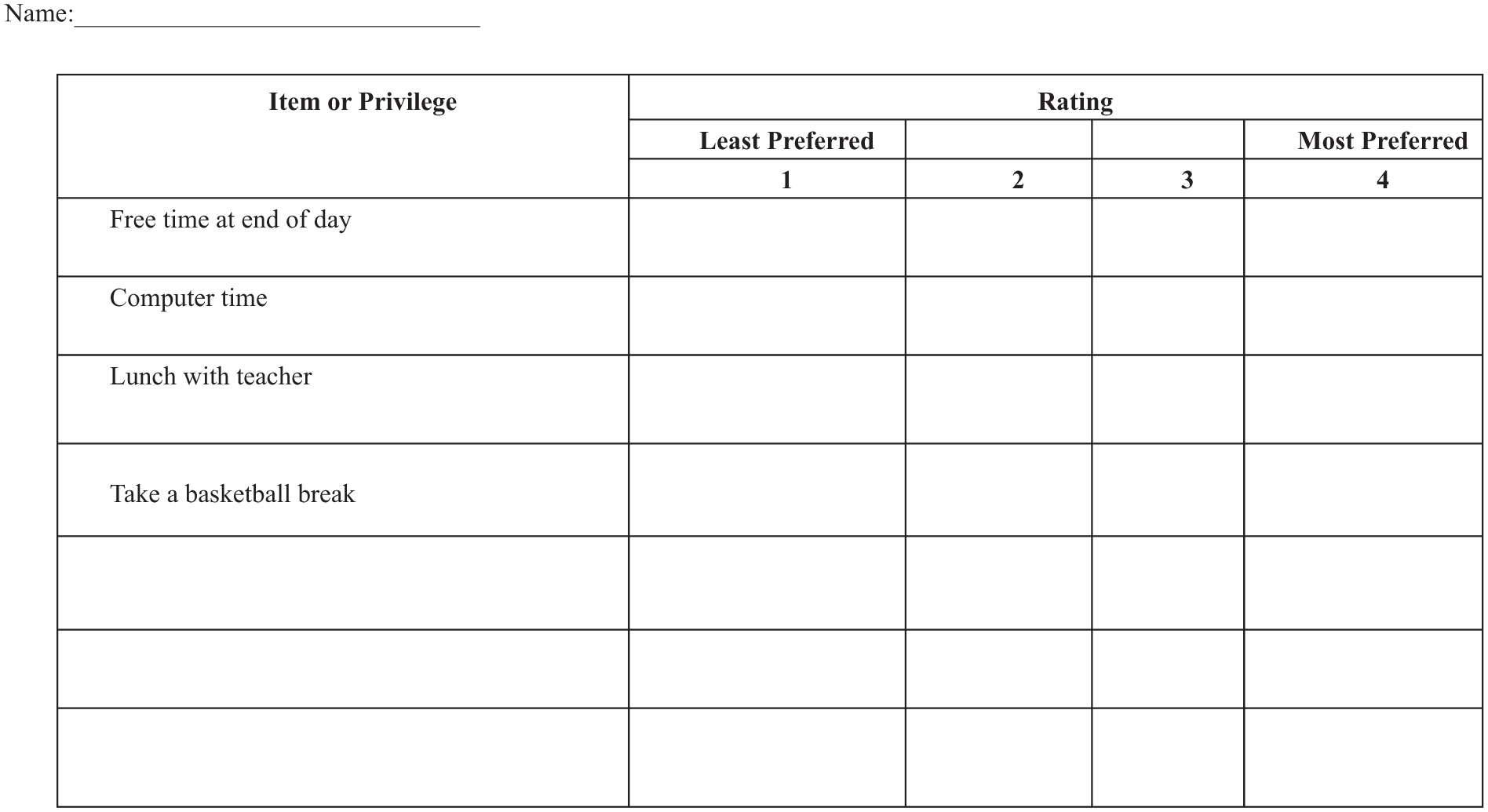
Preference assessment example.
Reinforcement can be systematically provided for both fluency and on-task behavioral improvement. Providing reinforcement for on-task behavior and reading growth can help students be more receptive to reading instruction and to receiving explicit feedback on their reading. For example, a teacher could choose to provide a student with a sticker or a point if the student was on task during reading and with a prize from a prize box if the student increases his or her words read correctly per minute. Students could earn a sticker or point each time they complete a task during intervention, thus increasing the rate of reinforcement. Students could also be provided a reward upon earning a predetermined number of stickers or points for on-task behavior. As with all incentives, these systems will be most effective if teachers (a) present the reinforcers positively; (b) choose reinforcers students want and do not otherwise have easy access to; (c) use an array of reinforcement options from which students can choose; and (d) remind students that they can earn a sticker, points, or a prize (Simonsen et al., 2015). In addition, teachers may choose to reward groups of students for achieving collective goals related to reading performance and on-task behavior (Chow & Gilmour, 2016). For example, Hale, Skinner, Winn, Oliver, and Allin (2005) provided a reward to four students with EBD between 12 and 14 years of age for achieving a cumulative group goal for correct answers on multiple choice comprehension questions.
Graphing Reading Performance
Self-graphing reading performance can have a positive effect on student engagement and motivation (Menzies, Lane, & Lee, 2009). With teacher support, students can graph the number of words read correctly, as well as the number of errors made during a 1 min timed reading. Teachers and students can then use the graph to discuss current performance in relation to past performance, performance in regards to goals, and possible modifications to goals and instructional methods. For example, in Hilsmier et al.’s (2016) study, students graphed their reading performance at the end of each session and visually analyzed the graph to determine how they were progressing toward their respective goals.
Teachers need be aware that students may not know how to independently create and interpret the graph initially and use principles of explicit instruction (Archer & Hughes, 2011) in teaching students how to graph. Teachers can first format the graph and then explicitly model the process of entering data in the graph. Instruction could use an explicit talk aloud, explaining and showing students how to enter data in a graph. In subsequent reading sessions, students can enter this information with teacher guidance and feedback. Finally, as students take full responsibility for entering the data, teachers should remember to check the graph to ensure certain data are entered correctly and provide explicit feedback and reteaching as necessary (Hirsch, Ennis, & McDaniel, 2013).
Additional Suggestions for Intervention
We believe that a few other suggestions can help you plan and implement effective repeated reading interventions for students with or at risk for EBD. The first suggestion is to avoid practices wherein students take turns reading paragraphs aloud to groups of students—known as round robin reading—and randomly calling on individual students to read aloud to groups—popcorn reading—because both practices have been found to be ineffective at improving reading (Ash, Kuhn, & Walpole, 2008). Round robin reading only requires one student to be actively engaged in the task. Reading aloud in front of peers can provoke anxiety among students who struggle with reading.
Another practice to avoid is sustained silent reading, which has been shown to be ineffective at developing reading fluency (Stevens et al., 2017). Instead, teachers can engage students in partner reading, choral reading, or echo reading, as these strategies actively engage all students in the reading task throughout the activity. In partner reading, partners take turns reading with the guidance and support of their peer (Katz & Bohman, 2007). Scripts for facilitating partner reading can be found at this webpage (https://buildingrti.utexas.org/lessons/fluency-partner-reading-comprehension-check).
During choral reading, the teacher and students read the text aloud together at the same time, with the teacher providing a model of fluent reading and providing error correction on such things as difficult words and phrases as necessary (Paige, 2011). Echo reading involves the teacher reading a complete sentence and then having students read the sentence. The teacher and students then work through the text, sentence by sentence (Doake, 1985).
Final Thoughts
It is essential that schools address the academic needs of students with EBD. This article highlights the importance of high-quality reading instruction that addresses individual student needs. Repeated reading interventions are an effective method for developing the reading fluency of students in the secondary grades. It is insufficient and inappropriate to focus exclusively on a student’s behavioral needs, particularly when considering students with comorbid academic difficulties, such as students with EBD. We provide suggestions for practices that research indicates are effective in promoting stronger fluency. Teachers can incorporate one or more of these practices while considering each student’s individualized pattern of strengths, areas for development, and interests.
Footnotes
Declaration of Conflicting Interests
The author(s) declared no potential conflicts of interest with respect to the research, authorship, and/or publication of this article.
Funding
The author(s) received no financial support for the research, authorship, and/or publication of this article.